Late Triassic Mass Extinction post is all written. Pix included. Need to just do a bit of addition for the sources, but that will come later tonight. I am happy with it. I wish I had more time, but think I'm getting a bit burned on this post. It'll be ready for Saturday's Boneyard.
Thursday, August 30, 2007



Wednesday, August 29, 2007
Global Warming Round Up
I have a few links on climate change. Rather than do a self-spamming of the blog...

As the climate models have been predicting, the tropical rainfall, as a whole, has been increasing. Overall it has increased in the tropical areas 5%, but in Africa as a whole its decreased. (red above is the highest point of the spectrum and purple is the lowest). The tropics are not the only places getting dumped on. Ireland is reporting an increase in rainfall related to global warming. Should I be considering importing redwoods there? I think I'll stick to doing that in Greenland though.
Changing our time frames, a group of British researchers think that we are postponing the end of this interglacial. If we burn 1000 gigatons of carbon based fuels (specifically fossil fuels), then they think we'll skip the next glacial cycle. Furthermore, they say, we'll skip the next five if we burn 3000 gigatons. Interestingly, one of the juicy bits from Under a Green Sky that I hinted at is that Ward thinks we're headed to the Eocene[1] and right out of the glacial cycles altogether. Truthfully, I am somewhat inclined to agree, but that's due to a gut feeling rather than hard data. The paleoclimate guys seem to think that breaking out of the glacial cycle is a done deal if I am not misunderstanding what I've read.
Additionally, over on Real Climate, they have some projections of the near future for the regional climate changes that are expected. Africa is just in for a world of hurt, no matter who you talk to. :(
1. Sorry, no Neo-Oligocene, James, but fret not, the paleo climate guys in general think the Pliocene prior to the Ice Age is more likely than the Eocene. As noted before and will be in the future, I quoth Pielou: climate doesn't repeat; it's unique every single time.
As the climate models have been predicting, the tropical rainfall, as a whole, has been increasing. Overall it has increased in the tropical areas 5%, but in Africa as a whole its decreased. (red above is the highest point of the spectrum and purple is the lowest). The tropics are not the only places getting dumped on. Ireland is reporting an increase in rainfall related to global warming. Should I be considering importing redwoods there? I think I'll stick to doing that in Greenland though.
Changing our time frames, a group of British researchers think that we are postponing the end of this interglacial. If we burn 1000 gigatons of carbon based fuels (specifically fossil fuels), then they think we'll skip the next glacial cycle. Furthermore, they say, we'll skip the next five if we burn 3000 gigatons. Interestingly, one of the juicy bits from Under a Green Sky that I hinted at is that Ward thinks we're headed to the Eocene[1] and right out of the glacial cycles altogether. Truthfully, I am somewhat inclined to agree, but that's due to a gut feeling rather than hard data. The paleoclimate guys seem to think that breaking out of the glacial cycle is a done deal if I am not misunderstanding what I've read.
Additionally, over on Real Climate, they have some projections of the near future for the regional climate changes that are expected. Africa is just in for a world of hurt, no matter who you talk to. :(
1. Sorry, no Neo-Oligocene, James, but fret not, the paleo climate guys in general think the Pliocene prior to the Ice Age is more likely than the Eocene. As noted before and will be in the future, I quoth Pielou: climate doesn't repeat; it's unique every single time.
Some bits on the Eocene Ocean & PETM Extinction

I finished reading Under a Green Sky by Dr Peter D Ward. It's an interesting book, but not as deep as his other latest one that I read, Out of Thin Air. This has more travelogue and discussion of the see-sawing on the Permian Extinction's announcements - Becker et al vs most everyone else on the Permian Extinction root cause and mechanism, frex - and other bits of paleo historia. However, it does have a lot of good bits that are well worth reading.
One of those good bits is the chapter on the Eocene called "The Overlooked Extinction." More specifically it's really about the PETM and the associated extinctions. He goes on to link a flood basalt eruption to the PETM kick off: the Brito-Arctic Province I believe is the one he's fingering. He paints a picture of the chain of events that are a lot like the Permian Mass Extinction but on a much smaller scale. I find the evidence as presented as interesting and possibly compelling, but as with other extinction events, I think it's premature to say that there's a Grand Unified Mass Extinction Theory[1].
However, there is an interesting bit that seems to have come out of the research on the PETM and more specifically the Eocene Oceans. Doug Muir once commented that the water column for the Eocene Ocean was warm, damn warm from top to bottom (Doug, was this on HDTD, SHWI, or here somewhere? I can't seem to find it!). It wasn't quite as warm as the ocean surface temperatures in the Permian, but the Permian had uber stratified oceans, so the depths were colder. This contrasts with the PETM oceans. They were warm and not stratified, at least vertically. The mixing - from top to bottom - still happened, but in a way that seems wrong to those of us that grew up with our oceans and their circulation.
It seems that there were cold provinces - if I may use that word here - in the Arctic and Antarctic. However, they were more like cool provinces since they were ice free as far as we can tell (-1.5 C is the average temperature recorded for the Arctic waters at this point). Whereas the tropical surface temperatures were approximately 8 C. To a lay person, this would seem to say that the oceans would have a normal circulation albeit a sluggish one due to the smaller differential. However, the reality is that it had a completely opposite direction than our own.
Our oceans have the warm waters sweep to the north and then get cold and sink. The water then flows along the ocean basins and upwells in the tropics where it is once again heated and sent back to the north and south. This keeps the waters oxygenated and the bottoms of the oceans from becoming anoxic. Mostly. However, during the PETM it seems that the oceans had the opposite pattern. The upwelling was in the higher latitudes and the sinking was in the tropics. The reason being is that the water evaporation of the very warm tropical waters would produce very salty water which would sink and displace the cooler waters of the south and north along the top to the tropics by upwelling at the mid-latitudes or Arctic depending on the model used. If the warm bottom waters upwelled in the mid-latitudes that means that Arctic and Antarctic Seas might have been isolated in terms of water circulation...which is interesting. In my mind, it almost gives the ocean current circulation a model that looks like how the atmospheric circulation looks today.
That's interesting, very interesting, and has a lot of implications. I haven't thought them through as yet: the PETM and it's associated extinction are so far down pipeline that it might not ever see the light of day. However, if you guys have some thoughts be sure to post (*cough*doug*cough*carlos*cough*Zach*cough*Brian*cough*) Since I finished Ward's book and found it worthwhile I thought I'd share it. I've done so before and I'll do it again. There are some other juicy bits in there as well, but this one came up first. Now I have to get the Late Triassic Extinction rewrite done (Open Office core dumped yesterday's work) and clear up some bits with work. Woo.
1. I am going to have to do a post on why I find GUMETs annoying at some point. While we are making progress in that direction, I'm unconvinced we've arrived there whatsoever.
One of those good bits is the chapter on the Eocene called "The Overlooked Extinction." More specifically it's really about the PETM and the associated extinctions. He goes on to link a flood basalt eruption to the PETM kick off: the Brito-Arctic Province I believe is the one he's fingering. He paints a picture of the chain of events that are a lot like the Permian Mass Extinction but on a much smaller scale. I find the evidence as presented as interesting and possibly compelling, but as with other extinction events, I think it's premature to say that there's a Grand Unified Mass Extinction Theory[1].
However, there is an interesting bit that seems to have come out of the research on the PETM and more specifically the Eocene Oceans. Doug Muir once commented that the water column for the Eocene Ocean was warm, damn warm from top to bottom (Doug, was this on HDTD, SHWI, or here somewhere? I can't seem to find it!). It wasn't quite as warm as the ocean surface temperatures in the Permian, but the Permian had uber stratified oceans, so the depths were colder. This contrasts with the PETM oceans. They were warm and not stratified, at least vertically. The mixing - from top to bottom - still happened, but in a way that seems wrong to those of us that grew up with our oceans and their circulation.
It seems that there were cold provinces - if I may use that word here - in the Arctic and Antarctic. However, they were more like cool provinces since they were ice free as far as we can tell (-1.5 C is the average temperature recorded for the Arctic waters at this point). Whereas the tropical surface temperatures were approximately 8 C. To a lay person, this would seem to say that the oceans would have a normal circulation albeit a sluggish one due to the smaller differential. However, the reality is that it had a completely opposite direction than our own.
Our oceans have the warm waters sweep to the north and then get cold and sink. The water then flows along the ocean basins and upwells in the tropics where it is once again heated and sent back to the north and south. This keeps the waters oxygenated and the bottoms of the oceans from becoming anoxic. Mostly. However, during the PETM it seems that the oceans had the opposite pattern. The upwelling was in the higher latitudes and the sinking was in the tropics. The reason being is that the water evaporation of the very warm tropical waters would produce very salty water which would sink and displace the cooler waters of the south and north along the top to the tropics by upwelling at the mid-latitudes or Arctic depending on the model used. If the warm bottom waters upwelled in the mid-latitudes that means that Arctic and Antarctic Seas might have been isolated in terms of water circulation...which is interesting. In my mind, it almost gives the ocean current circulation a model that looks like how the atmospheric circulation looks today.
That's interesting, very interesting, and has a lot of implications. I haven't thought them through as yet: the PETM and it's associated extinction are so far down pipeline that it might not ever see the light of day. However, if you guys have some thoughts be sure to post (*cough*doug*cough*carlos*cough*Zach*cough*Brian*cough*) Since I finished Ward's book and found it worthwhile I thought I'd share it. I've done so before and I'll do it again. There are some other juicy bits in there as well, but this one came up first. Now I have to get the Late Triassic Extinction rewrite done (Open Office core dumped yesterday's work) and clear up some bits with work. Woo.
1. I am going to have to do a post on why I find GUMETs annoying at some point. While we are making progress in that direction, I'm unconvinced we've arrived there whatsoever.
I Think The Defense Backfired
It appears that chemical warfare has been around a lot longer than poison arrows, mustard gas or nerve weapons – about 100 million years, give or take a little.
A new study by researchers at Oregon State University has identified a soldier beetle, preserved almost perfectly in amber, which was in the process of using chemical repellants to fight off an attacker when an oozing flow of sap preserved the struggle for eternity.
The discovery is the earliest fossil record of a chemical defense response, scientists say, and indicates that this type of protective mechanism – now common in the insect world and among other animal species – has been around for more than 100 million years. It’s a sophisticated form of defense that clearly was in good working order while dinosaurs still roamed the Earth.
The findings were just published in the Journal of Chemical Ecology.
“The chance of these circumstances all coming together at the exact right second was pretty slim,” said George Poinar, Jr., a courtesy professor of zoology at OSU and one of the world’s leading experts on distant life forms preserved in amber. “You have a prehistoric insect being attacked, using its defenses to ward off the predator and the whole event becoming captured in action as sap flowed down a tree. It’s quite remarkable.”
The beetle was a small insect, about one-quarter inch long, which may have been in the process of becoming lunch for a giant roach or some other larger insect that apparently was 2-3 inches long, judging by the length of an antenna from the other insect also found in the specimen. The other insect either escaped the sap or was preserved in a different piece of amber, in these samples of Burmese amber that came from the Hukawng Valley in Myanmar.
“This particular insect is now extinct, but the broader family of soldier beetles still exists, and they still use this same type of chemical defense mechanism,” Poinar said. “That this type of defense has been preserved through 100 million years of evolution is evidence that it works pretty well.”
At the time of this event in the Early Cretaceous Period, huge animals such as dinosaurs still dominated the Earth, but scurrying beneath them were early mammals and large numbers of terrestrial invertebrates, such as these insects. Soldier beetles, then as now, were omnivores that lived on things like aphids, other tiny insects or plant pollen. Among other things, this finding pushes back the known existence of this type of beetle by about 60 million years. And at that distant time, they had already evolved ways to defend themselves.
“This beetle was able to exude a sticky chemical substance that was irritating to potential predators, and caused them to go away or leave it alone,” Poinar said. “It could even conserve its excretions and control the direction of the defense; in other words, produce the substance only on its left rear side if that was where the attack was coming from.”
Major kewlness factor there.
Stumbled Upon
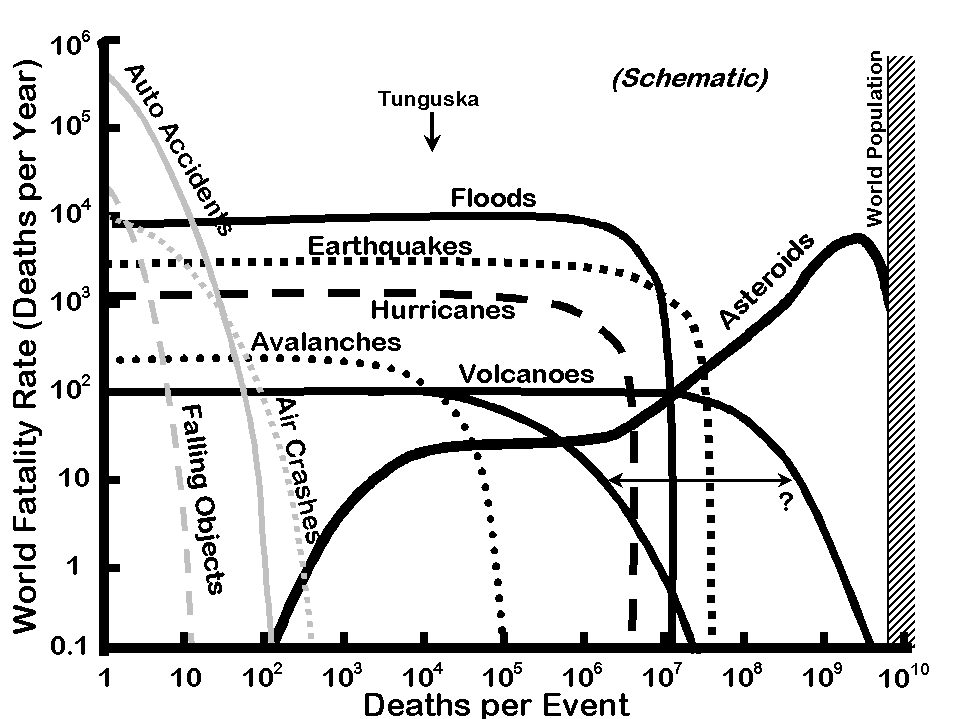
I was out looking for a graph on Raup's Kill Curve for asteroid impacts and found this instead.
Amateurs!

We did far more impressive things to people in Los Alamos when I was a teenager.
*look of digust*
;)
*look of digust*
;)
Tuesday, August 28, 2007

Monday, August 27, 2007
How Immigration Effects US Cities
In the past 25 years immigration has re-emerged as a driving force in the size and composition of U.S. cities. This paper describes the effects of immigration on overall population growth and the skill composition of cities, focusing on the connection between immigrant inflows and the relative number of less-skilled workers in the local population. The labor market impacts of immigrant arrivals can be offset by outflows of natives and earlier generations of immigrants. Empirically, however, these offsetting flows are small, so most cities with higher rates of immigration have experienced overall population growth and a rising share of the less-skilled. These supply shifts are associated with a modest widening of the wage gap between more- and less-skilled natives, coupled with a positive effect on average native wages. Beyond the labor market, immigrant arrivals also affect rents and housing prices, government revenues and expenses, and the composition of neighborhoods and schools. The effect on rents is the same magnitude as the effect on average wages, implying that the average “rent burden” (the ratio of rents to incomes) is roughly constant. The local fiscal effects of increased immigration also appear to be relatively small. The neighborhood and school externalities posed by the presence of low-income and minority families may be larger, and may be a key factor in understanding native reactions to immigration.
Found via The Economist's View.
Major problem for Ukraine now is to preserve territorial integrity
“Today, the question is not on the agenda whether Ukraine can become a part of any other state. Today, the question is whether the Ukrainian territorial integrity will be maintained. In this case, independence and threat acquire a kind of another meaning. For instance, many people believe that involvement of Ukraine into NATO is a threat to Ukraine’s independence. Others, on the contrary, think that if Ukraine remains outside NATO, it will fall under Russia’s influence again. There are many different notions,” the analyst concluded.
Oy. Thinking about what he just said makes my brain hurt.
First off, joining NATO doesn't make you not independent from anyone. For Chrissakes! If someone were to tell the French that they were an American sock puppet, first they'd be insulted rather badly and then mocked to the extreme! To take it even further, which I have heard from Ukrainians multiple times, joining NATO doesn't make you a colony of the United States either.
Unfortunately, there is a lingering xenophobic world view in Ukraine. They feel that The West, especially the United States and NATO, are out to kill them - not kidding here - or make them into a colony on the order of what the Europeans did in Africa or we did in the Philippines. The fact of the matter is that we don't want that. That we never wanted anything even remotely like that for Ukraine. However, a large number of their leaders and their managers have been beating that drum rather effectively. Blend that liberally with the automatic fear of things of the West that underlies a lot of their culture already because of the undispellable - understandably so - ghost of the Soviet Union and the Cold War. After all, they fell from an okay standard of living to a bit of crushing poverty...and this was the work of the West. Or so Western triumphantalists, Ukrainian wishers for the return of the Soviet Union say and Russian nationalists say. Its a vicious bit of work and would seem that its self feeding with little hope of escape. Yet there are a few signs that this hard shell is beginning to crack.
One of the more amusing bits that is driving this break is that there have been some Western companies that have been taking over local businesses. Banks are a good example. Another was the sale of that large steel company to the Dutch conglomerate. It turns out that some relatives of mine - by marriage - work there. For years, their managers had been telling them that the workers had better be glad that their company had Ukrainian owners because Westerners would fire all the workers and sell all the equipment to make a profit - something that a lot of privateers essentially did during the attempt to move from the state controlled economy to capitalism after the Fall of the Soviet Union - and so the workers better work twice as hard and twice as long with minuscule, irregular pay because there was no light at the end of the rainbow. On the contrary, it was a crocodile beneath their feet!!! Then came Yushenko...
As part of the Orange Revolution, they ripped the company from the Ukrainian owners because the deal smacked of cronyism and corruption. They put it back up for bid and sold it to the Dutch. The Ukrainians I knew expected that the world would end for the workers. On the contrary, according to the inside source here, they love the changes! The pay is higher and comes on time as promised. The crazy hours are done. The management is no longer acting as though they are Darth Vader's little Slavic understudies.
His one comment as he related it to my mother-in-law was: Why the hell didn't they do it sooner??? And when are they going to resell all the other big businesses?!?
Cracks are definitely showing.
Yet Another Memetic Virus
I blame Brian and Zach for this one...
Three things in my fridge that define life right now:
1. My wife and daughter's lunch. Every night or morning, if I am unlucky and too preoccupied the night before, I make lunch for my daughter, wife, and myself. My wife is banging her head against the wall of ESLdom and weird profs at her college and my daughter - being 2 and a 1/2 - is still to young to really help out, so I am left doing the food prep. That extends to breakfast and dinner, btw.
2. JUICE! We consume juice like we use it instead of air. We often go to Trader Joe's and pick up a good 7 gallons at a time and this covers us for about two weeks...if we're lucky. Keep in mind, based on what our Doctor told us, we are watering down the juice for Avrora: it's only 25% juice and the rest is old fashioned water. She still sucks down 1/3 a gallon of juice per day. Which means she is drinking 1 1/3 gallons of juice/water mix and a cup of milk each day.
3. Cilantro: It's a good symptom of my life. WHAT?! Let me explain, but just hold still this won't hurt. It's something that I have been long curious about - not the herb itself - but experimental cooking. Some of my NMican friends are probably still wincing in remembered pain when I tried stir frying back about 7 years ago: you just have to mumble "ginger" to them to retrigger their Post Traumatic Stress Syndrome that was only recently cured after what was probably a long road through expensive therapy. OTOH, occasionally I hit some real home runs. Chicken a la Will, as Jason calls it was one. My spaghetti was another. My salsas are yet another. However, like any good Mad Scientist there are lots of casualties dumped out the laboratory and let loose on the unsuspecting mankind.
Three recent acquisitions:
1. Books. They are political (immigration mostly), deep time, and history related.
2. A Microscope. For my wife on her birthday. Being an up and coming bio type, it seemed like a good idea. Besides, she wanted it.
3. tickets to hawaii. We'll be there over Turkey Day.
Three classics I reach for every day:
1. Books. I read every down moment I have which isn't much. This includes walking to and from the parking garage, the few moments after putting my daughter in bed, or when I am cooking and the pot needs stirring, but I can't get away. I even read when I am at the gym: either in a treadmill or exercise bike or between sets on weights.
2. The Tivo remote. I do stomach crunches every day. I actually do between five hundred and two thousand depending on the amount of time I have. I'm a classic Gen Xer so I need constant mental stimulation. Doing exercise is, frankly, BORING with a blink tag. Stomach crunches are accompanied by a movie, show, or some such. It's close to the only TV I get these days.
3. My family. Hugs and kisses and tickles and general affection keeps my mood up even when I am frustrated and lances any festering anger or unhappiness if I am frustrated with something...which happens alot.
My kids right now, in three words or less:
Brilliant, Beautiful Weed.
My sweetie right now, in three words or less:
Beautiful, Aggressive, Crafty.
What's on my to-do list:
Too much. White & academic papers to read and comment on. A uber long blog post to finish for the Boneyard. A design document to finish. A project at work to reinvigorate.
What I'm listening to right now:
nada. I need to remember to bring an ipod to work. My puter has issues for playing music at the moment.
What I'm worried about right now:
Family. Not my immediate family, but my wife's and my own extended one.
Which news stories I'm following right now:
Immigration related. Global Warming Related. International Relations Related (esp wrt to Ukraine and Russia since it effects family). Presidential Election Related.
What I'm reading right now:
The Nemesis Affair: A Story of the Death of Dinosaurs and the Ways of Science.
What I'm looking forward to right now:
A Date with My Wife. I have a coworker that is offering to babysit Avrora since I stayed late when I was not supposed to to help her with a problem at work that I had some idea on how to fix: being one of the GPFS people here and she was getting whacked by confused fs mgr by didn't realize it. So, Lyuda and I are planning to go out to dinner and either catch something of the fine arts - opera, ballet, or symphony - or go to a movie depending on the time we have.
A thought I keep returning to right now:
I need more hours in a day.
One small thing that's making me happy right now:
Seeing my daughter run up to me, demand to sit on my lap, wrap her arms around me and tell me: "Papa, I love you."
Three things in my fridge that define life right now:
1. My wife and daughter's lunch. Every night or morning, if I am unlucky and too preoccupied the night before, I make lunch for my daughter, wife, and myself. My wife is banging her head against the wall of ESLdom and weird profs at her college and my daughter - being 2 and a 1/2 - is still to young to really help out, so I am left doing the food prep. That extends to breakfast and dinner, btw.
2. JUICE! We consume juice like we use it instead of air. We often go to Trader Joe's and pick up a good 7 gallons at a time and this covers us for about two weeks...if we're lucky. Keep in mind, based on what our Doctor told us, we are watering down the juice for Avrora: it's only 25% juice and the rest is old fashioned water. She still sucks down 1/3 a gallon of juice per day. Which means she is drinking 1 1/3 gallons of juice/water mix and a cup of milk each day.
3. Cilantro: It's a good symptom of my life. WHAT?! Let me explain, but just hold still this won't hurt. It's something that I have been long curious about - not the herb itself - but experimental cooking. Some of my NMican friends are probably still wincing in remembered pain when I tried stir frying back about 7 years ago: you just have to mumble "ginger" to them to retrigger their Post Traumatic Stress Syndrome that was only recently cured after what was probably a long road through expensive therapy. OTOH, occasionally I hit some real home runs. Chicken a la Will, as Jason calls it was one. My spaghetti was another. My salsas are yet another. However, like any good Mad Scientist there are lots of casualties dumped out the laboratory and let loose on the unsuspecting mankind.
Three recent acquisitions:
1. Books. They are political (immigration mostly), deep time, and history related.
2. A Microscope. For my wife on her birthday. Being an up and coming bio type, it seemed like a good idea. Besides, she wanted it.
3. tickets to hawaii. We'll be there over Turkey Day.
Three classics I reach for every day:
1. Books. I read every down moment I have which isn't much. This includes walking to and from the parking garage, the few moments after putting my daughter in bed, or when I am cooking and the pot needs stirring, but I can't get away. I even read when I am at the gym: either in a treadmill or exercise bike or between sets on weights.
2. The Tivo remote. I do stomach crunches every day. I actually do between five hundred and two thousand depending on the amount of time I have. I'm a classic Gen Xer so I need constant mental stimulation. Doing exercise is, frankly, BORING with a blink tag. Stomach crunches are accompanied by a movie, show, or some such. It's close to the only TV I get these days.
3. My family. Hugs and kisses and tickles and general affection keeps my mood up even when I am frustrated and lances any festering anger or unhappiness if I am frustrated with something...which happens alot.
My kids right now, in three words or less:
Brilliant, Beautiful Weed.
My sweetie right now, in three words or less:
Beautiful, Aggressive, Crafty.
What's on my to-do list:
Too much. White & academic papers to read and comment on. A uber long blog post to finish for the Boneyard. A design document to finish. A project at work to reinvigorate.
What I'm listening to right now:
nada. I need to remember to bring an ipod to work. My puter has issues for playing music at the moment.
What I'm worried about right now:
Family. Not my immediate family, but my wife's and my own extended one.
Which news stories I'm following right now:
Immigration related. Global Warming Related. International Relations Related (esp wrt to Ukraine and Russia since it effects family). Presidential Election Related.
What I'm reading right now:
The Nemesis Affair: A Story of the Death of Dinosaurs and the Ways of Science.
What I'm looking forward to right now:
A Date with My Wife. I have a coworker that is offering to babysit Avrora since I stayed late when I was not supposed to to help her with a problem at work that I had some idea on how to fix: being one of the GPFS people here and she was getting whacked by confused fs mgr by didn't realize it. So, Lyuda and I are planning to go out to dinner and either catch something of the fine arts - opera, ballet, or symphony - or go to a movie depending on the time we have.
A thought I keep returning to right now:
I need more hours in a day.
One small thing that's making me happy right now:
Seeing my daughter run up to me, demand to sit on my lap, wrap her arms around me and tell me: "Papa, I love you."
Sunday, August 26, 2007
What Book Am I?

You're Jurassic Park!
by Michael Crichton
You combine all the elements of a mad scientist, a brash philosopher, a humble researcher, and a money-hungry attracter of tourists. With all these features, you could build something monumental or get chased around by your own demons. Probably both, in fact. A movie based on your life would make millions, and spawn at least two sequels that wouldn't be very good. Be very careful around islands.
Take the Book Quiz
at the Blue Pyramid.
I blame James. Making me into a bad, bad book! bah!
Friday, August 24, 2007
Weekly Updated Arctic Sea Ice Information

The link aboveis going to be updating weekly on the sea ice extent. Worth looking at.

Thursday, August 23, 2007
Timing is Everything
The text of my Late Triassic Extinction Post is done. I just needed to put in the references and footnotes. I have a pile of books in my office at work about the extinction that I could read and reference to double check everything as I wrote. With the exception of the Fraser work, one of the Hallam works, and one of the Ward's, most of my references are about ten years old. Mass extinction work is a very fast moving field. The issue is that there are only so many popular works to go through on the subject that are not KT related.
Part of the problem is that I don't have access to all the journals and I am already hurting for time: I have been reading the white papers about the Claytronics Project at CMU and trying to formulate some good questions and comments, writing up a design paper for the Usenet successor, trying to get this albatross of a project wrt work off the ground, keep this blog up, write my book, and still have a family life. Oy.
Sometimes something fortuituous happens. Sometimes it might be that, but still fscking annoying. I have been reading Ward's latest, Under A Green Sky by Peter Ward. There's a wonderful section on the Late Triassic Extinction. It will force me to rewrite chunks of my post. This is good that I read first and didn't publish here before it was done. OTOH, damnit, I'm going to have to revise my nine page in MS Word post. argh.
Better accurate than not, I s'pose since this is meant to be a Boneyard submission.
Part of the problem is that I don't have access to all the journals and I am already hurting for time: I have been reading the white papers about the Claytronics Project at CMU and trying to formulate some good questions and comments, writing up a design paper for the Usenet successor, trying to get this albatross of a project wrt work off the ground, keep this blog up, write my book, and still have a family life. Oy.
Sometimes something fortuituous happens. Sometimes it might be that, but still fscking annoying. I have been reading Ward's latest, Under A Green Sky by Peter Ward. There's a wonderful section on the Late Triassic Extinction. It will force me to rewrite chunks of my post. This is good that I read first and didn't publish here before it was done. OTOH, damnit, I'm going to have to revise my nine page in MS Word post. argh.
Better accurate than not, I s'pose since this is meant to be a Boneyard submission.
China to Lose Farmland to Global Warming too
Global warming is set to cut China's annual grain harvest by up to 10 percent by 2030, placing extra burden on its shrinking farmland, state press reported Thursday.
Zheng Guoguang, head of the State Meteorological Administration, said the impact of global warming means that China will likely need an extra 10 million hectares (247 million acres) of farmland by 2030.
The year 2030 is a key date because that is when the nation's population is expected to peak at 1.5 billion people, up from just over 1.3 billion today, requiring an extra 100 million tons of food to feed them.
"Global warming may cause the grain harvest to fall by five to 10 percent, that is by 30-50 million tons, by 2030," the China Daily quoted Zheng as saying.
[...]
Chinese authorities have issued a series of reports and studies in recent months outlining the grim impact global warming will have on the country.
Last month environmental authorities said climate change was shrinking wetlands at the source of China's two greatest rivers -- the Yangtze and the Yellow -- which had reduced water flows.
Other studies found that massive glaciers in northwestern China's Xinjiang region and in the Himalayas had been shrinking rapidly.
This would have dire consequences for much of Asia as many of the region's rivers begin in those regions.
Note, my bet is that China will have something worse based on the fact that there is a lot of evidence that makes it seem as though the climate is changing much faster than we thought it would. If China loses even more farm land, what do you want to bet the farmers in the US will definitely no longer need subsidies? Especially if we make the possibly foolish switchover to biofuels.
Deutchland Uber Mond
The latest plans for the Lunar Explorations Orbiter (LEO), a German lunar mission due for launch in 2012, will be presented on Wednesday 22nd August at the European Planetary Science Congress, Potsdam
Professor Ralf Jaumann, from the German aerospace centre DLR, said "The Lunar Explorations Orbiter will be a unique mission. It will consist of two spacecraft flying in formation and taking simultaneous measurements, which will give us the first three-dimensional view of the Moon's magnetic and gravitation field. It will also give us the first opportunity to study these fields on the far site of the Moon. In addition LEO will give us a very detailed picture of the lunar surface and also the structure of the lunar regolith, layers of crushed rocks that extend about 100 metres beneath the lunar surface, and the boundary with the bed-rock beneath."
Brits have attempted to go to Mars (well, they got there, but...) The Euros together went with the Americans to Saturn and went to Venus and the moon on their own. Now the Germans are going to the Moon! Kewl!
Say Hi to Russia's Skat


Aviation Week has a number of posts on their tour of the mockup of the new Russian Mikoyan UCAV, the Skat (skate, as in fish). Best picts are here. Note: it is not a flying prototype. It's at the same point as the Kliper was and is. I think this will move along further than the Kliper though. This is a military project, not a company's wishful thinking. OTOH, Russia's got serious quality control issues and there has been speculation in the press that soon Russia will need to start buying weapons from the West because its own military industrial complex is in terrible shape.
Ed: Just realized that this, as pronounced sounds identical to this. Perhaps not the best choice of names then.
Wednesday, August 22, 2007
Read this: LOT OF POKEMON CARDS THAT MY KIDS TRIED TO SNEAK BY ME
BWAHAHAHAHAHA!
James, you're a bad man for bringing this to my attention.
:D
James, you're a bad man for bringing this to my attention.
:D

Tuesday, August 21, 2007
Dinosaur Speeding Ticket Rescinded
T. rex may have struggled to chase down speeding vehicles as the movie Jurassic Park would have us believe but the world’s most fearsome carnivore was certainly no slouch, research out today suggests.
The University of Manchester study used a powerful supercomputer to calculate the running speeds of five meat-eating dinosaurs that varied in size from a 3kg Compsognathus to a six-tonne Tyrannosaurus.
The study – believed to be the most accurate ever produced – puts the T. rex at speeds of up to 18mph, fractionally quicker than a sportsman such as a professional footballer.
The bipedal Compsognathus, by comparison, could reach speeds of almost 40mph – that’s 5mph faster than the computer’s estimate for the fastest living animal on two legs, the ostrich.
The team – headed by biomechanics expert Bill Sellers and palaeontologist Phil Manning – say the accuracy of their results is due to the computer’s ability to use data relating directly to each dinosaur.
Woo! T Rex could book after all! What were the other 4 theropods?
Ares on the Su-35

And...it's just an evolved Su-27. *gasp* *surprise* Soooo...this is their 5th Generation Fighter?
Hydrogen On the Cheap(er)
A new class of catalysts created at the U.S. Department of Energy's Argonne National Laboratory may help scientists and engineers overcome some of the hurdles that have inhibited the production of hydrogen for use in fuel cells.
Argonne chemist Michael Krumpelt and his colleagues in Argonne's Chemical Engineering Division used "single-site" catalysts based on ceria or lanthanum chromite doped with either platinum or ruthenium to boost hydrogen production at lower temperatures during reforming. "We've made significant progress in bringing the rate of reaction to where applications require it to be," Krumpelt said.
Most hydrogen produced industrially is created through steam reforming. In this process, a nickel-based catalyst is used to react natural gas with steam to produce pure hydrogen and carbon dioxide.
These nickel catalysts typically consist of metal grains tens of thousands of atoms in diameter that speckle the surface of metal oxide substrates. Conversely, the new catalysts that Krumpelt developed consist of single atomic sites imbedded in an oxide matrix. The difference is akin to that between a yard strewn with several large snowballs and one covered by a dusting of flakes. Because some reforming processes tend to clog much of the larger catalysts with carbon or sulfur byproducts, smaller catalysts process the fuel much more efficiently and can produce more hydrogen at lower temperatures.
[...]
Krumpelt will present an invited keynote talk describing these results during the 234th national meeting of the American Chemical Society in Boston from August 18 to 23.
Anyone in Boston care to do a live blogging of the talk?
oy - No FIddling While the FIle System is Burning
I had planned to post some comments on the papers about the Claytronics project today. it's going to be a wash. I am stuck in an emergency maintenance wrt our global file system and I am going to be point man since I have the most experience with the storage subsystems.
This Doth Sucketh.
But its what I am paid for, so IDK if I'll get to blog much today.
This Doth Sucketh.
But its what I am paid for, so IDK if I'll get to blog much today.
Monday, August 20, 2007
Russia Rearms...alas.
The message to the West is clear: The days of dismissing Russia as a spent force are over. Bolstered by the cash from sales of oil and gas and President Putin's steely determination to re-establish the country on the world stage, the Russian military machine is back in business.
Various theories have been offered for the dramatic military expansion, not least the need to appeal to nationalists in the run-up to forthcoming parliamentary and presidential elections. The real reason, however, appears to be that Russia has taken offense at what it regards as the West's insulting indifference to its very existence.
Intelligence sources say Washington and London have been taken aback by just how seriously Russia has viewed the perceived slight and concede that in concentrating so heavily on Iraq and al Qaeda, they took their eye off the ball.
This sounds like a case of the Great Russian run amok. However, it might not be at all. AS I have said before, Putin studies and believes in Ju Jitsu. Stop and think about that for a moment. Then consider that he might have just been waiting for this moment to rearm. It's really too bad that the Russians are taking this route to try to confront the West again. I've already blogged my disappointment with Russia. Right now, with all that oil revenue coming in, Putin ought to be out digging out the corruption, building infrastructure, and making people's lives better; after all Moscow is the worldest most expensive city to live in. He has no current or near term threats. Why not do what the US did during the 19th century and invest the helloutta everything?
*sighs*
IPCC Report for Arctic Sea Ice Off by 40 Years?
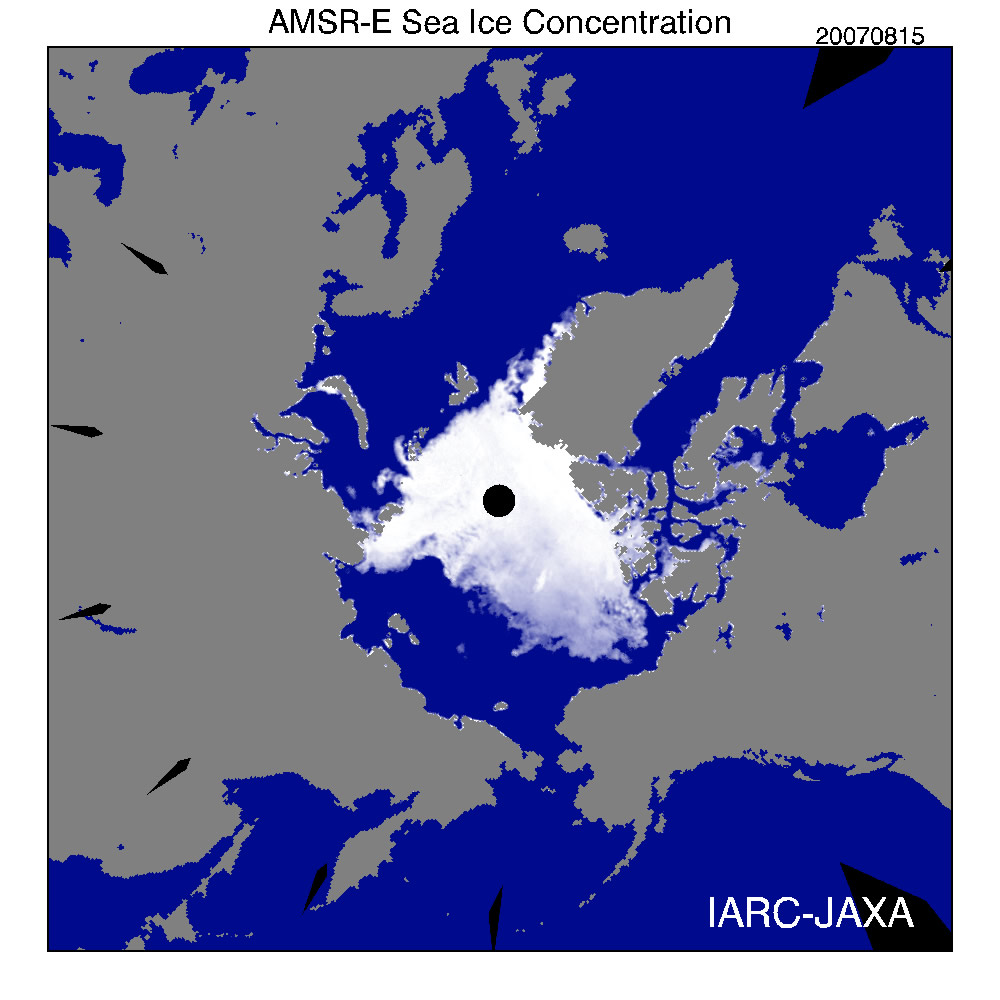
The Japan Agency for Marine-Earth Science and Technology (JAMSTEC, led by President Yasuhiro Kato) and the Japan Aerospace Exploration Agency (JAXA, led by President Keiji Tachikawa) cooperatively analyzed oceanic and atmospheric observation data and sea ice data acquired by satellites, and found that the sea ice area in the Arctic Ocean has been decreasing at a much faster pace than expected compared to the previous worst record in the summer of 2005. After satellite observations started in 1978, the observed area shrunk to its lowest level on August 15, 2007. Ice melting normally continues until mid September, thus further shrinkage of the sea ice area is expected. The observed phenomenon significantly exceeded the forecasted model submitted in the Intergovernmental Panel on Climate Change (IPCC) fourth Assessment Report, and the big difference tells us that the model may not precisely reflect the actual situation in the Arctic Ocean.
Boiled down, this implies that the Arctic is warming up faster than anyone has been anticipating. Decades faster! They had been talking about an ice free summers - ie loss of the permanent pack ice - in the Arctic by possibly the 2050s and they were surprised about that prospect. Now, if the Japanese are correct, the Arctic, if the current trends continue, could be ice free far, far sooner. That would be sooner, as in 2010s sooner. The Japanese have one really, really good comment: our models are completely inaccurate for the Arctic and it seems we don't understand what is going on there.
Friday, August 17, 2007
Seeding Atmosphere w/ Sulfur Not A Good Idea
A controversial theory proposes mimicking volcanoes to fight global warming. But throwing sulfur particles into the sky may do more harm than good, a new study says.I can't help but think that sulfur would cause other issues as well, but it is pretty high up in the atmosphere.
The temporary solution would pump particles of sulfur high into the atmosphere—simulating the effect of a massive volcano by blocking out some of the sun's rays. This intervention, advocates argue, would buy a little time to reduce greenhouse gas emissions.
But as well as cooling the planet, the sulfur particles would reduce rainfall and cause serious global drought, a new study says.
"It is a Band-Aid fix that does not work," said study co-author Kevin Trenberth of the National Center for Atmospheric Research (NCAR) in Boulder, Colorado.
It's just one of several drastic measures proposed to combat global warming, now that most scientists are in agreement that carbon dioxide, primarily from burning fossil fuels, is changing Earth's climate.
Thursday, August 16, 2007
Wednesday, August 15, 2007
Open Science Grid Council Meeting
Open Science Grid Council Meeting
National Energy Research Scientific Computing Center (NERSC)
415 Thomas L. Berkley Way
Oakland, California
August 17, 2007
http://opensciencegrid.org/
The Open Science Grid is a distributed computing infrastructure for large-scale scientific research. The OSG Consortium's unique alliance of universities, national laboratories, scientific collaborations and software developers brings petascale computing and storage resources into a uniform shared cyberinfrastructure. Members of the OSG Consortium contribute effort and resources to the OSG infrastructure and reap the benefits of a shared infrastructure that integrates computing and storage resources from more than 50 sites in the United States, Asia and South America. OSG also has partners, including campus, regional, national and international grids.The OSG is supported by the National Science Foundation and the U.S. Department of Energy's Office of Science.
The OSG Council is the governing body of the Consortium and provides the scientific coordination and oversight of OSG activities. The meeting on August 17, 2007 is to review the accomplishments of the first year of the OSG Project and signoff on the deliverables and schedule for the second year.
Going to be an exciting day.
Why Global Warming Is Inevitable Part Two
The global-warming debate's great unmentionable is this: We lack the technology to get from here to there. Just because Arnold Schwarzenegger wants to cut emissions 80 percent below 1990 levels by 2050 doesn't mean it can happen. At best, we might curb the growth of emissions.
Consider a 2006 study from the International Energy Agency. Using present policies, it projected that emissions of carbon dioxide (a main greenhouse gas) would more than double by 2050; developing countries would account for almost 70 percent of the increase. The IEA then simulated an aggressive, global program to cut emissions that is based on the best available technologies: more solar, wind and biomass energy; more-efficient cars, appliances and buildings; more nuclear energy. Under this admitted fantasy, global emissions in 2050 would still slightly exceed 2003 levels.
Even the fantasy would be a stretch. In the United States, it would take massive regulations, higher energy taxes or both. Democracies don't easily adopt painful measures in the present to avert possible future problems. Examples abound. Since the 1973 Arab oil embargo, we've been on notice to limit dependence on insecure foreign oil. We've done little. In 1973, imports were 35 percent of U.S. oil use; in 2006, they were 60 percent. For decades we've known of the huge retirement costs of baby boomers. Little has been done.
An OpEd from the Washington Post. That last paragraph I quoted is key. :)
I'm looking forward to our tropical Canada future!
'Lunar Ark' Proposed in Case of Deadly Impact on Earth
The moon should be developed as a sanctuary for civilization in case of a cataclysmic cosmic impact, according to an international team of experts.
NASA already has blueprints to create a permanent lunar outpost by the 2020s. (Read: "Moon Base Announced by NASA" [December 4, 2006].)
But that plan should be expanded to include a way to preserve humanity's learning, culture, and technology if Earth is hit by a doomsday asteroid or comet, said Jim Burke, a scientist at NASA's Jet Propulsion Laboratory in California.
Burke, a project manager on some of the earliest American lunar landings, now heads an International Space University study on surviving a collision with a near-Earth object.
An impact of the size that wiped out the dinosaurs hasn't happened since long before the rise of humans, he pointed out.
Yet scientists' expanding knowledge of asteroids and craters left throughout the solar system has created a consensus that Earth remains vulnerable to a civilization-crushing collision.
This calls for the creation of a space age Noah's ark, Burke said.
Oh! Just imagine!
The world rebuilt by an 'ark' with a snapshot of 21st century America's take on the world. I believe the appropriate sound bite would be "And much hilarity ensued!"
Tuesday, August 14, 2007
A Gooie, Chewie Chinese Post: Whither China?
There are a plethora of Chinese posts and articles out there that ought to be pointed out for some of my readers. There's a bunch that is just plain fascinating and disturbing at the same time. I don't have time right now to think this through and let things gel, but the info can be used to paint an odd picture for China's future.
First up from the BBC and it's article titled "Perils of a new Pacific arms race":
The article goes on to discuss how, basically, the Chinese Military is being crafted to try to negate the American Military. In some ways it sounds like the way that the Soviets were working to counter the US military. In other ways though, it definitely does not. Keep in mind, the Chinese have stated that they were aiming for the 2050s as the time to do the big time build up anything other than the economy aspect. Has that changed? Or are they still just biding their time?
Next up is Asia Times Online's "Eurasian bloc seeks world without West":
A World with the West sounds an awful lot like the old Second World bit from the Cold War. Is it that the Americans are the Cold Warriors or, perhaps, the Russians are far more so than the Americans. or perhaps...the media keeps interpreting something new through old eyes.
Shifting into China's internal issues, Demography Matters has a fascinating, and a bit scary about "Asian Economies on a Demographic Cliff?":
The idea is that the Chinese - and other Asian nations - are going to hit a demographic wall and possibly have their economies choke as the workers dry up. That might play havoc with the 2050 time frame that the Chinese were thinking of throwing themselves around. If they are still planning for that time frame.
Next up is the NY Times' Orwellian "China Enacting a High-Tech Plan to Track People":
hrm. Frightening, yes, but is it a sign of things coming unglued a bit? The more you clamp down and all that jazz?
Then there's the debtable LA Times' "China's new revolutionaries: U.S. consumers":
I'm unsure if I buy the idea, but I've not had time to assimilate the whole thing.
Finally, the Danger Room - Wired's militaria blog - makes the comment that maybe China (!!) might be joining the fray for the north pole resources even as the University of Chicago's Law School Blog questions the legality of claims up there under international law.
May you live in interesting times, the Alien Marshmellow cursed me with[1]: I just wish I had time to think through what was going on around me for what it means.
1. Allen, if I see you any time within the next 50 years in person, you're getting a nice big kick in the fundament for that curse!
First up from the BBC and it's article titled "Perils of a new Pacific arms race":
This year China is celebrating the 80th anniversary of the Peoples' Liberation Army.
But its traditional strategic thinking is undergoing a huge shift, prompting fears in the United States that China might pose a threat to American diplomatic and military power with a naval arms race in the Pacific.
The capitulation of Sadam Hussein's army in the face of a hi-tech American onslaught in Desert Storm, with land, air and sea forces enabling a rapid US advance across large areas of land, gave a fresh impetus to military modernisation, according to Christian Lemiere, China expert at Jane's Country Risk.
"China had always relied upon the idea that if attacked it had large areas of land. It could fall back with these areas but if one power is able to take that and very quickly, it rapidly negates any advantage.
China has been looking to match US military technology and launched an anti-satellite missile as part of this process.
Joseph Lin, a military affairs analyst with the Jamestown Foundation in Washington said this development has unnerved the Pentagon.
"The United States is heavily dependent upon satellites for all matters of communications, especially the military, which would be crippled and completely ineffectual without any sort of satellite coverage either for imaging, navigation or for communications."
At the same time, China's naval build-up has alerted American military officials to the previously unthinkable possibility that they might face competition in the Pacific Ocean, where the US has enjoyed naval dominance since the World War Two.
The article goes on to discuss how, basically, the Chinese Military is being crafted to try to negate the American Military. In some ways it sounds like the way that the Soviets were working to counter the US military. In other ways though, it definitely does not. Keep in mind, the Chinese have stated that they were aiming for the 2050s as the time to do the big time build up anything other than the economy aspect. Has that changed? Or are they still just biding their time?
Next up is Asia Times Online's "Eurasian bloc seeks world without West":
What is the significance of "Peace Mission 2007" - the Shanghai Cooperation Organization (SCO) exercise now under way at the Chebarkulsk training ground in Chelyabinsk, Russia - and the summit that will follow in Bishkek?
Is the SCO, which consists of China, Russia, Kazakhstan, Kyrgyzstan, Tajikistan and Uzbekistan, on the verge of being transformed into a new Warsaw Pact, a Eurasian counterbalance to the US-led North Atlantic Treaty Organization (NATO)? Simon Tidsall of The Guardian newspaper quoted Pavel Felgenhauer, a Russian defense analyst, who observed: "As Moscow's relations with the West deteriorate, the Kremlin is doing its best to seek allies and is building up the SCO to counterbalance NATO. In propaganda terms, Peace Mission 2007 will be used to the full."
Meanwhile, the Russian newspaper Kommersant, in an article tellingly titled "Maneuvers to go around the United States", sees the exercises and the summit that will follow in Bishkek as part of a renewed Russian effort to push back against the US "on all fronts", from opposing plans to deploy missile-defense components in central-eastern Europe to "expelling" the US from Central Asia altogether. Kommersant also highlights the role played by former defense minister and current Deputy Prime Minister (and presidential contender) Sergei Ivanov in acting as the godfather of this mission, beginning with his visit to Beijing last year.
Statements coming from China, however, support the thesis advanced by political scientists Naazneen Barma, Ely Ratner and Steven Weber that emerging powers are seeking neither to integrate with nor balance against the US, but to create an alternative international order that "routes around" Washington. Chen Hu, executive chief editor of China's state-owned World Military Affairs magazine, made a point of stressing that "Peace Mission 2007 targets no country, nor does it mean a military alliance", and argued that the Shanghai grouping is not trying to create a counterbalancing bloc against Washington. He described it as a "new type" of regional security organization that has made obsolete the "traditional security outlook" of seeking a balance of power.
Yes, Chen had a not-so-subtle dig at Washington - noting that countries felt the need to work more closely together in the Shanghai framework since "different countries have different anti-terror combat criteria and a few of them push forward hegemony under the cloak of war on terror". But as Tidsall commented, "No one in the SCO, least of all China with next year's Beijing Olympics and its trade and development goals potentially in the firing line, seriously wanted confrontation with the West."
One of the theses of Weber, Ratner and Barma is that countries in the "World without the West" remain in play, and India's reaction to the exercises is a case in point. The Hindu newspaper reported: "While favoring cooperation with the SCO on trade and economic issues, official sources told The Hindu that India would like to steer clear of aligning with this six-nation grouping in military, strategic and political terms."
A World with the West sounds an awful lot like the old Second World bit from the Cold War. Is it that the Americans are the Cold Warriors or, perhaps, the Russians are far more so than the Americans. or perhaps...the media keeps interpreting something new through old eyes.
Shifting into China's internal issues, Demography Matters has a fascinating, and a bit scary about "Asian Economies on a Demographic Cliff?":
The International Labour Organisation has a new report out today, entitled "Visions for Asia’s Decent Work Decade: Sustainable Growth and Jobs to 2015". You can download the report in pdf here).
The report uses comparatively strong langauge, warning that - due to comparatively rapid `population ageing - the “demographic dividend” process is likely be limited in many parts of Asia, with the proportion of children aged 0 to 15 and youth aged 15 to 24 set to decline rapidly across the whole of the region. In fact they point out that the more developed parts of Asia - such as Singapore, South Korea and parts of China - are likely to hit the “demographic cliff” much earlier than the rest.
As they point out, more than a quarter of the population in several of the more “developed economies” are expected to be older than 65 by 2015, and in China, largely as a result of short sighted family planning policies, there has beem an “accelerated" demographic transition process. As a result, China is “ageing faster than any other nation in history”.
The idea is that the Chinese - and other Asian nations - are going to hit a demographic wall and possibly have their economies choke as the workers dry up. That might play havoc with the 2050 time frame that the Chinese were thinking of throwing themselves around. If they are still planning for that time frame.
Next up is the NY Times' Orwellian "China Enacting a High-Tech Plan to Track People":
At least 20,000 police surveillance cameras are being installed along streets here in southern China and will soon be guided by sophisticated computer software from an American-financed company to recognize automatically the faces of police suspects and detect unusual activity.
Starting this month in a port neighborhood and then spreading across Shenzhen, a city of 12.4 million people, residency cards fitted with powerful computer chips programmed by the same company will be issued to most citizens.
Data on the chip will include not just the citizen’s name and address but also work history, educational background, religion, ethnicity, police record, medical insurance status and landlord’s phone number. Even personal reproductive history will be included, for enforcement of China’s controversial “one child” policy. Plans are being studied to add credit histories, subway travel payments and small purchases charged to the card.
Security experts describe China’s plans as the world’s largest effort to meld cutting-edge computer technology with police work to track the activities of a population and fight crime. But they say the technology can be used to violate civil rights.
The Chinese government has ordered all large cities to apply technology to police work and to issue high-tech residency cards to 150 million people who have moved to a city but not yet acquired permanent residency.
Both steps are officially aimed at fighting crime and developing better controls on an increasingly mobile population, including the nearly 10 million peasants who move to big cities each year. But they could also help the Communist Party retain power by maintaining tight controls on an increasingly prosperous population at a time when street protests are becoming more common.
“If they do not get the permanent card, they cannot live here, they cannot get government benefits, and that is a way for the government to control the population in the future,” said Michael Lin, the vice president for investor relations at China Public Security Technology, the company providing the technology.
hrm. Frightening, yes, but is it a sign of things coming unglued a bit? The more you clamp down and all that jazz?
Then there's the debtable LA Times' "China's new revolutionaries: U.S. consumers":
Who would have thought that tainted pet food and toys would threaten to unravel the authoritarian export model of Chinese growth that the brutal Tiananmen Square crackdown in 1989 was partly meant to secure? China's then "paramount leader" Deng Xiaoping, who had been purged during the Cultural Revolution, could well imagine how political upheaval would derail China's stable path to prosperity. But it surely never entered his mind, nor that of his descendant comrades, that the fickle American consumer would one day become, as the students in the square wanted to be, the agent of revolutionary change in China.
In the name of sovereignty, China's leaders for a long time have gotten away with suppressing their own citizens while ignoring the get-gloriously-rich-quick corruption that has thrived in the absence of the rule of law. But, thanks to globalization, China's export reliance on the U.S. market has imported the political demands of the U.S. consumer into the equation. Americans won't hesitate to cut the import lifeline and shift away from Chinese products that might poison their children or kill their pets.
Unlike organized labor or human rights groups, consumers don't have to mobilize to effect change; they only have to stop spending. And their bargaining agents -- Wal-Mart, Target, Toys R Us -- have immensely more clout than the AFL-CIO and Amnesty International in fostering change in China.
Ironically, the United States' "most favored nation" trade treatment for China (and its later entry into the World Trade Organization), which labor and human rights groups so virulently opposed in the past, has become a Trojan horse. China's future is now so linked to the American consumer that Beijing will be forced to curb corruption and strengthen regulation through the rule of law or face the certain doom of its export-led growth.
I'm unsure if I buy the idea, but I've not had time to assimilate the whole thing.
Finally, the Danger Room - Wired's militaria blog - makes the comment that maybe China (!!) might be joining the fray for the north pole resources even as the University of Chicago's Law School Blog questions the legality of claims up there under international law.
May you live in interesting times, the Alien Marshmellow cursed me with[1]: I just wish I had time to think through what was going on around me for what it means.
1. Allen, if I see you any time within the next 50 years in person, you're getting a nice big kick in the fundament for that curse!
Yet Another Bill for Puerto Rico's Status
A bill filed this month by U.S. Sen. Mel Martinez takes a step toward resolving Puerto Rico's ambiguous political status by mandating a referendum in which one of the choices would be a little-known form of independence called "free association."
Under the free-association form of government, Puerto Rico would be an independent nation that would relinquish some sovereign powers to the U.S. in exchange for benefits. The specifics of that arrangement would be bilaterally negotiated.
Voters also could choose the current commonwealth status, statehood or complete independence.
[...]
Critics of Martinez's bill point out that it doesn't compel Congress to act on the outcome of the referendum, which could render it little more than an opinion survey.
But through spokeswoman Jessica Garcia, Martinez, R-Fla., said Congress would act regardless.
"Congress will be morally and politically bound to act on a Puerto Rican status choice if Congress authorized the choice," Garcia said after consulting staff. "[Martinez] will fight to implement the choice of the Puerto Rican people."
The senator said he will seek a public hearing on the bill early next year.
The proposed legislation is being hailed as a victory by the island's autonomist-movement leaders, who have long said it is possible for Puerto Rico to be a sovereign nation without divorcing the U.S.
"We have been working for years to achieve recognition of the free-association formula as viable for all of the parties involved," said Nestor Duprey, spokesman for the Social Democratic Autonomist Movement. "It gives Puerto Rico the political powers it needs to solve its problems, and it helps the U.S. in the sense that Puerto Rico would stop being a financial burden for its treasury.
"At the same time, it preserves the political and economic relationship between the two countries."
Free association is the type of relationship that the Federated States of Micronesia, the Republic of the Marshall Islands and the Republic of Palau have with the United States. Each nation negotiated the terms of that association but yielded some of their sovereign powers to the U.S. in areas such as national defense and security. In exchange, the U.S. treats these nations uniquely by allowing access to domestic programs, including disaster response under the Federal Emergency Management Agency.
So, now we have the possibility of Statehood, Commonwealth, Free Association, or Independence. You all know what I support. I am unsure whether or not the Free Association Option is such a hot one, really. It is interesting that this is a way to get around the constitutional issues that have been raised already. The question becomes though whether or not the Pacific Islands had a similar status in constitutionally as PR does now.
Doug? Care to way in? You probably know more than I do. For that matter Carlos and Noel do too.
A Belarus Blog
It's interesting and mostly a page of links to things Belarusian and seems to be updated once every 3 to 4 days in a magazine-esque format. It's worth a look.
Nitrogen Cycle As Important as Carbon Cycle in Global Warming
Not only is this glut of nitrogen disrupting ecosystems, polluting waters and harming human health, but its a silent partner, along with carbon dioxide, in changing the Earths climate.
Despite the countless initiatives under way to reduce CO2 levels to slow global warming, scientists warn that those efforts will prove moot unless nitrogen releases also are lowered.
One nitrogen compound is especially worrisome, as it lingers in the atmosphere for a century and is 300 times as potent a heat-trapping gas as carbon dioxide.
"We won't solve global warming without addressing nitrogen," said Elizabeth Holland, a senior scientist with the National Center for Atmospheric Research in Boulder, Colo.
"The changes to the nitrogen cycle are larger in magnitude and more profound than the changes to the carbon cycle," Holland continued. "But the nitrogen cycle is being neglected."
And that's a grave oversight, said Margaret Torn, the head of Climate Change and Carbon Management program at Lawrence Berkeley National Laboratory.
"Nitrogen should be on the radar," she said. "Unless we control that problem, we won't solve climate change."
hrm. Interesting. I think this will have to go on the stack of lit searches. Unfortunately, that stack is pretty deep right now.
Hmm Science: Birds with Genetic Memory?
A researcher at the University of Sheffield has discovered that the reason birds learn to fly so easily is because latent memories may have been left behind by their ancestors.
It is widely known that birds learn to fly through practice, gradually refining their innate ability into a finely tuned skill. However, according to Dr Jim Stone from the University of Sheffield’s Department of Psychology, these skills may be easy to refine because of a genetically specified latent memory for flying.
Dr Stone used simple models of brains called artificial neural networks and computer simulations to test his theory. He discovered that learning in previous generations indirectly induces the formation of a latent memory in the current generation and therefore decreases the amount of learning required. These effects are especially pronounced if there is a large biological 'fitness cost' to learning, where biological fitness is measured in terms of the number of offspring each individual has.
I don't know enough to say anything intelligent here. It's interesting, but I am skeptical. Any bird science or neuro-types out there care to comment?
Monday, August 13, 2007


Atlanta Blog Post
I originally wrote this up on Saturday. I have just been a little too busy to post it and it was on my wife's computer...when I had issues connecting to SFOs hotspot.
***
We’re back from Atlanta. I have to say that it was not a joyous trip. We did have some fun. We had some disturbing moments. All in all it was a good experience, but I have to say it was rather weird in certain ways and that we’re glad we’re back. You already read out about Lyuda and Avrora’s not so great adventure in US Airways Frakked up land. Now let’s discuss some of the other fun adventures: we’re not flying separately ever again, btw. I mean that literally and otherwise.
First off, the rental car place which work arranged, btw, actually rocked. They had us in and out PDQ, especially this morning. The hotel was eh ok. I guess the W isn’t all that despite several reviews to the contrary. That’s ok. It appears – and I may be uncertain about this – that the W is building two more hotels in the region, so more up to date facilities will be there for whoever happens to stay with them in the future. I doubt we’ll be back in Atlanta any time soon, so I’m not so worried about it.
I already mentioned the restaurant that we went to on our 3rd Anniversary, but we also went to another good one last night. This was the Imperial Fez. It is a Moroccan themed and cusined joint. It was quite good and the belly dancer was amusing and comely, especially when she was flinging around some flaming batons during her ‘Fire Dance.’ My wife and daughter loved it and I mostly ignored it to avoid setting off my wife’s jealousy twitches: Ukrainian women, jealousy, oy. Nuff said. Anyways, the fare was good. The service was excellent. Our camera’s battery died, but the people at the next table offered to send us pix they’d taken of us. Some of those were Lyuda and Avrora dancing with the belly dancer. Over my objections. Once again, I get to show how neandertalish I am. *sighs*
We also went to a HORRIBLE restaurant. Or at least we didn’t like it at all. Lyuda and I have confessed to each other that maybe it might just be the cuisine that just doesn’t match our tastes. We went to Fire of Brazil. Which is, you guessed it! – a Brazil BBQ place. The meat was just a touch too salty and way too dry. Sadly, despite being an internal cuisine lover, we just haven’t been impressed with this one. We had two out of three restaurants turn out bad for us, so we’ll probably be skipping this kind in the future.
My wife went to CNN as I said. She and Avrora also went to the Georgia Aquarium which they both found to be very, very underwhelming after having been to the Monterey Aquarium. They loved the Beluga’s, the sea snakes, kinda liked the whale sharks, and not much else. Avrora liked the penguins, but she likes them everywhere and we have a colony at the SF Zoo, Steinhart Aquarium, and the Monterey Aquarium. My wife’s comment was that if you’ve been to the MA, all you need is 20 minutes to wander through the GA. My wife and daughter also went to Lanier Lake resorts to play in the waterpark. They had a good time. Avrora loved seeing all the carp in the water.
We also went to Georgia Underground. A very un-unique mall, frankly, but we did pick up some glass work from there. Not much else to say other than my wife kept getting hit on rather blatantly when she went to the restroom and came back out again. Sheesh. I know she’s hot guys, but show some class when she’s got a ring on her finger. *shakes head*
Then came the most bizarre thing we did. My wife and I had an argument over it, actually. We went to Stone Mountain, Georgia to the state park. Frankly, the whole thing made me want to vomit from the get go. Well, it was worse than that. We went. We saw. We realized that they Disney-fied the whole kit and caboodle. It was frankly a bizarro world entered we. Praises for the antebellum South. Various God Loving Songs. Puppet shows. A talking and spitting fountain. Various shops too. And it was mostly run by African Americans. In fact, about a quarter of the visitors were African American. Frankly, IDK what to think about it.
The worst thing we encountered otherwise was that driving. I honestly thought California drivers were horrible. The overly aggressive tactics, the obnoxiousness to each other, etc, I thought were worse in Cali than in New Mexico. Well, Georgia takes the cake for bad drivers so far. I cannot come up with words to describe how I felt about this. The English language does not have the necessary invective. Traffic was worse than in the Bay Area. Um? huh? There were two very good reasons.
The first is that exits are not just exits for is on the sign. More than once we found that on exiting the off ramp would sprout multiple routes and that they were not always as clearing marked as we’d expected: I compared notes from another Californian from my classes and he was having a frakked up time of it too by accidentally missing the right ramp (sometimes out of 4 or more). The Oakland Maze is less scary! So, people are dodging all over to get into the right exit. My instructor stated that Atlantans were not so upset with Sherman for burning the place, but were hopping mad for leaving the road system intact.
The second reason is that Atlantans simply cannot merge. It is beyond them. What is orderly, in comparison for Bay Area residents to do on the freeway, these guys simply are incapable. There were times when two lanes would become one and the drivers would continue double file in a single lane for over a thousand feet. Another ‘amusing’ variant of the unable to merge gene expressing itself was that if someone could not get into the lane they wanted, they STOP DEAD COLD IN THE INTERSTATE AND WAIT TO GET IN. Cars would and would backup into a gridlock situation because some dipshibbit would just refuse to budge until he, by golly and gum, got into the lane he wanted. Gottimhimmel, these people are frakkin insane with blink tag! What would normally take me 20 minutes on the freeway with no traffic could turn into 2 ½ hours there (and did! It really did!). Just because people cannot merge. There’s gotta be a genetic reason for it, I swear. We can cure it. This won’t hurt but a bit, I promise.
A tangential comment my wife said was as we were driving back to hotel one night was that she noticed that a lot of the cars were bumped, dinged, or whatnot. Almost all of them were in the side 9but not to bad) like someone was trying to merge and couldn’t quite make it. Instead they’d bump the car they were trying to get ahead of.
Another darkly amusing bit was that Atlantans must have some serious issues with car maintenance. All I can think of is that maintenance must be that it is beyond them or they are getting fleeced by their mechanics or something. We always saw at least one car, truck, or semi broken down every two miles on the highways. One day, Thursday, it was worse: one per mile. It didn’t matter what time of day or night it was either.
If you all didn’t hear, it was hot there too. Multiple days of over 100 F (37 C). Wow. Fun. Especially with the humidity.
We did find a Trader Joe’s. WOOOOOOO! Actually this seemed symptomatic of something else I noticed. Of the people I interacted with, which was limited truth be told, about half of them lacked the Southern Accent. The other half had varying degrees of Southron on their tongue, but mostly it was damned light. Carlos bitches about the Southernization of America, but, frankly, I think our Yankee’s Burden is paying off (note, glyph of satire there).
All in all, we had an interesting time. Lyuda thinks it looks nice. I made it plain I wasn’t going to work there, so she could forget even getting a minor inkling of living there. I think, even though Atlanta was in better shape in general the San Francisco, I’d much rather take a bowl of Fruits, Nuts, and Flakes than grits anytime. Even if it is an over priced bowl and the fruits, nuts, and flakes are politically woohoo. ;)
***
We’re back from Atlanta. I have to say that it was not a joyous trip. We did have some fun. We had some disturbing moments. All in all it was a good experience, but I have to say it was rather weird in certain ways and that we’re glad we’re back. You already read out about Lyuda and Avrora’s not so great adventure in US Airways Frakked up land. Now let’s discuss some of the other fun adventures: we’re not flying separately ever again, btw. I mean that literally and otherwise.
First off, the rental car place which work arranged, btw, actually rocked. They had us in and out PDQ, especially this morning. The hotel was eh ok. I guess the W isn’t all that despite several reviews to the contrary. That’s ok. It appears – and I may be uncertain about this – that the W is building two more hotels in the region, so more up to date facilities will be there for whoever happens to stay with them in the future. I doubt we’ll be back in Atlanta any time soon, so I’m not so worried about it.
I already mentioned the restaurant that we went to on our 3rd Anniversary, but we also went to another good one last night. This was the Imperial Fez. It is a Moroccan themed and cusined joint. It was quite good and the belly dancer was amusing and comely, especially when she was flinging around some flaming batons during her ‘Fire Dance.’ My wife and daughter loved it and I mostly ignored it to avoid setting off my wife’s jealousy twitches: Ukrainian women, jealousy, oy. Nuff said. Anyways, the fare was good. The service was excellent. Our camera’s battery died, but the people at the next table offered to send us pix they’d taken of us. Some of those were Lyuda and Avrora dancing with the belly dancer. Over my objections. Once again, I get to show how neandertalish I am. *sighs*
We also went to a HORRIBLE restaurant. Or at least we didn’t like it at all. Lyuda and I have confessed to each other that maybe it might just be the cuisine that just doesn’t match our tastes. We went to Fire of Brazil. Which is, you guessed it! – a Brazil BBQ place. The meat was just a touch too salty and way too dry. Sadly, despite being an internal cuisine lover, we just haven’t been impressed with this one. We had two out of three restaurants turn out bad for us, so we’ll probably be skipping this kind in the future.
My wife went to CNN as I said. She and Avrora also went to the Georgia Aquarium which they both found to be very, very underwhelming after having been to the Monterey Aquarium. They loved the Beluga’s, the sea snakes, kinda liked the whale sharks, and not much else. Avrora liked the penguins, but she likes them everywhere and we have a colony at the SF Zoo, Steinhart Aquarium, and the Monterey Aquarium. My wife’s comment was that if you’ve been to the MA, all you need is 20 minutes to wander through the GA. My wife and daughter also went to Lanier Lake resorts to play in the waterpark. They had a good time. Avrora loved seeing all the carp in the water.
We also went to Georgia Underground. A very un-unique mall, frankly, but we did pick up some glass work from there. Not much else to say other than my wife kept getting hit on rather blatantly when she went to the restroom and came back out again. Sheesh. I know she’s hot guys, but show some class when she’s got a ring on her finger. *shakes head*
Then came the most bizarre thing we did. My wife and I had an argument over it, actually. We went to Stone Mountain, Georgia to the state park. Frankly, the whole thing made me want to vomit from the get go. Well, it was worse than that. We went. We saw. We realized that they Disney-fied the whole kit and caboodle. It was frankly a bizarro world entered we. Praises for the antebellum South. Various God Loving Songs. Puppet shows. A talking and spitting fountain. Various shops too. And it was mostly run by African Americans. In fact, about a quarter of the visitors were African American. Frankly, IDK what to think about it.
The worst thing we encountered otherwise was that driving. I honestly thought California drivers were horrible. The overly aggressive tactics, the obnoxiousness to each other, etc, I thought were worse in Cali than in New Mexico. Well, Georgia takes the cake for bad drivers so far. I cannot come up with words to describe how I felt about this. The English language does not have the necessary invective. Traffic was worse than in the Bay Area. Um? huh? There were two very good reasons.
The first is that exits are not just exits for is on the sign. More than once we found that on exiting the off ramp would sprout multiple routes and that they were not always as clearing marked as we’d expected: I compared notes from another Californian from my classes and he was having a frakked up time of it too by accidentally missing the right ramp (sometimes out of 4 or more). The Oakland Maze is less scary! So, people are dodging all over to get into the right exit. My instructor stated that Atlantans were not so upset with Sherman for burning the place, but were hopping mad for leaving the road system intact.
The second reason is that Atlantans simply cannot merge. It is beyond them. What is orderly, in comparison for Bay Area residents to do on the freeway, these guys simply are incapable. There were times when two lanes would become one and the drivers would continue double file in a single lane for over a thousand feet. Another ‘amusing’ variant of the unable to merge gene expressing itself was that if someone could not get into the lane they wanted, they STOP DEAD COLD IN THE INTERSTATE AND WAIT TO GET IN. Cars would and would backup into a gridlock situation because some dipshibbit would just refuse to budge until he, by golly and gum, got into the lane he wanted. Gottimhimmel, these people are frakkin insane with blink tag! What would normally take me 20 minutes on the freeway with no traffic could turn into 2 ½ hours there (and did! It really did!). Just because people cannot merge. There’s gotta be a genetic reason for it, I swear. We can cure it. This won’t hurt but a bit, I promise.
A tangential comment my wife said was as we were driving back to hotel one night was that she noticed that a lot of the cars were bumped, dinged, or whatnot. Almost all of them were in the side 9but not to bad) like someone was trying to merge and couldn’t quite make it. Instead they’d bump the car they were trying to get ahead of.
Another darkly amusing bit was that Atlantans must have some serious issues with car maintenance. All I can think of is that maintenance must be that it is beyond them or they are getting fleeced by their mechanics or something. We always saw at least one car, truck, or semi broken down every two miles on the highways. One day, Thursday, it was worse: one per mile. It didn’t matter what time of day or night it was either.
If you all didn’t hear, it was hot there too. Multiple days of over 100 F (37 C). Wow. Fun. Especially with the humidity.
We did find a Trader Joe’s. WOOOOOOO! Actually this seemed symptomatic of something else I noticed. Of the people I interacted with, which was limited truth be told, about half of them lacked the Southern Accent. The other half had varying degrees of Southron on their tongue, but mostly it was damned light. Carlos bitches about the Southernization of America, but, frankly, I think our Yankee’s Burden is paying off (note, glyph of satire there).
All in all, we had an interesting time. Lyuda thinks it looks nice. I made it plain I wasn’t going to work there, so she could forget even getting a minor inkling of living there. I think, even though Atlanta was in better shape in general the San Francisco, I’d much rather take a bowl of Fruits, Nuts, and Flakes than grits anytime. Even if it is an over priced bowl and the fruits, nuts, and flakes are politically woohoo. ;)
American Geophysical Union (AGU) 2007 Meeting
10–14 December 2007, Monday–Friday
Moscone West, 800 Howard Street
Moscone South, Howard Street (between 3rd and 4th streets)
San Francisco, CA, USA
There are already two emails I've recieved wrt this. One is asking for papers about climate forcing and the other is about the Pliocene Warm Period as a model for future climate trends. A search for the Paleoclimate papers, etc. is here. I am definitely going to see if I can wing going to this one. It's frakkin local.
Yet Another Grand Unified Mass Extinction Theory

Researchers may have uncovered the reason why Earth's biodiversity mysteriously plummets periodically. They have found that a rollercoaster-like wobble in the sun's orbit around the center of the Milky Way galaxy regularly moves Earth closer to a source of dangerous intergalactic cosmic rays.Over the last 500 million years or so, the number of species on Earth has tended to dip regularly about every 62 million years. The last time this happened, about 55 million years ago--or about 10 million years after the great K-T extinction event that wiped out the dinosaurs--biodiversity sank by about 10%; around 115 million years ago, it dropped by a similar amount. So far, evolutionary biologists have only been able to establish that the phenomenon seems cyclical, but they haven't isolated a cause.
oy.
Periodicity raises its head again.
And so does Yet Another Grand Unified Mass Extinction Theory. (YAGUMET!)
Periodicity raises its head again.
And so does Yet Another Grand Unified Mass Extinction Theory. (YAGUMET!)
High End Computing File Systems and I/O Workshop 2007
HECIWG Executive Summary
The HECIWG is chartered by the The National Science and Technology Council's Subcommittee on Networking and Information Technology Research and Development (NITRD). The purpose of the IWG is to coordinate high-end computing (HEC) programs, budgets and policy recommendations. This includes identifying and integrating requirements, conducting joint program planning and devloping joint strategies for the HEC programs conducted by agencies that participate in the NITRD Program. A complete description of the HEC IWG can be found at NITRD's website.
HEC File Systems and I/O (HEC FSIO) Background
The need for immense and rapidly increasing scale in scientific computation drives the need for rapidly increasing scale in storage for scientific processing. Individual storage devices are rapidly getting denser while their bandwidth is not growing at the same pace. In the past several years, initial research into highly scalable file systems, high level Input/Output (I/O) libraries, and I/O middleware was done to provide some solutions to the problems that arise from massively parallel storage. To help plan for the research needs in the area of File Systems and I/O, the inter-government-agency document titled "HPC File Systems and Scalable I/O: Suggested Research and Development Topics for the Fiscal 2005-2009 Time Frame" was published which led the HECIWG to designate this area (FSIO) as a national focus area starting in FY06.
HEC FSIO Purpose
The HEC FSIO was created to advise the HECIWG in coordination of government R&D funding in HEC File Systems and I/O area so that the government's investment in this area of HEC is well spent, reduce gaps and overlaps. We are attempting to enable more and better R&D, and pass along the knowledge to the next generation.
Take a look. There's some good and interesting chewsy bits in there.
How Bacteria Nearly Destroyed All Life
About two and one-half billion years ago, life on Earth was still in its infancy. Complex organisms such as plants and animals had not yet appeared, but the planet was teeming with microscopic bacteria which thrived in the temperate and nutrient-rich environment. Greenhouse methane lingered in the atmosphere and trapped the sun's warmth, creating a climate very accommodating to the stew of microbes life that made their home on primitive Earth.
But a billion years of bacterial evolutionary progress was soon stunted by a catastrophic global event. Geologists find no signs of a great meteor impact nor a volcanic eruption, but they have uncovered the unmistakable geologic scars of rapid worldwide climate change. Average temperatures, which were previously comparable to our present climate, plummeted to minus 50 degrees Celsius and brought the planet into its first major ice age. This environmental shift triggered a massive die-off which threatened to extinguish all life on Earth, and paleoclimatologists have good reason to believe that this world-changing event was unwittingly caused by some of the planet's own humble residents: bacteria.
An older post, to be sure, but fascinating all the same. You all know how much I find amss extinctions interesting...
Are Latinos Becoming White?
A new study on Latino immigrants finds that, in contrast to past generations of European immigrants, a significant share of second-and-third-generation Latino-Americans identify with a Latino racial category. The paper – “Are Latinos Becoming White" Determinants of Latinos’ Racial Self-Identification in the U.S.” – was presented Aug. 12 at the 102nd annual meeting of the American Sociological Association in New York, and was co-written by Joseph Michael, a UC doctoral student in the Department of Sociology and a researcher at the National Opinion Research Center at the University of Chicago, and Jeffrey Timberlake, UC assistant professor of sociology.
Michael and Timberlake are examining how the immigration of Latinos to the United States compares to the earlier immigration waves of white ethnic groups such as the Italian, Irish and European Jewish immigrants who were once considered non-white. The researchers explain that in most surveys and the U.S. Census, Latino respondents are first asked to identify themselves as Latino or Hispanic, and then they are asked to select a racial identity. “Thus, American social scientists have defined Latinos not as a racial group, but rather as an ethnicity (or set of ethnicities) based largely on the relatively common cultural heritage of Latin America and the Spanish Caribbean,” write the authors.
This is rather interesting. I have held the point of view that someday everyone in the US will be Latino, but that would be just like the fact that most people who are white have German ancestry in the US...and there was a time when Ben Franklin was very nervous about the German immigrants, fwiw, just as we are now about all the Lantinos.
What's interesting to note though is that Latinos, and other immigrants, are intermarrying quite a bit. Latino and Asian immigrants and their descendants integrate via marriage much more than blacks or whites. There was a statistic out there about the 3rd and 4th generation Latino and language that indicated that they were essentially generic American (ie cursed) wrt the English language being their sole language including at home by the third or forth generation. IDK where to find it right now...
Friday, August 10, 2007
Arctic Sea Ice Already Surpasses Record Minimum
First for perspective:
 And then the Ouchie...
And then the Ouchie...It's going to get worse since the melt season isn't over; that stops sometime in September. It's a feedback mechanism. This year's ice melts down further. The melt season ends later and starts earlier. That makes the amount of ice created less and less each year. It gets faster and faster for the melt rate. They have been saying 2040 for the permanent ice pack being gone. Whatcha wanna bet it's a lot sooner.
It also puts into perspective the race for the north by Russia, Denmark, Canada, and the USA.
It also puts into perspective the race for the north by Russia, Denmark, Canada, and the USA.
Denmark Places Arctic Claim
Danish scientists head for the Arctic ice pack on Sunday seeking evidence to position Denmark in a race to claim the potentially vast oil and other resources of the North Pole region.
Russia sent two small submarines to plant a tiny national flag under the North Pole last week. Canada, the United States and Norway also have competing claims in the vast Arctic region, where a U.S. study suggests as much as 25 percent of the world's undiscovered oil and gas could be hidden.
The monthlong Danish expedition will seek evidence that the Lomonosov Ridge, a 1,240-mile underwater mountain range, is attached to the Danish territory of Greenland, making it a geological extension of the Arctic island.
That might allow the Nordic nation to stake a claim under a U.N. treaty that could stretch all the way the North Pole, although Canada and Russia also claim the ridge.
oy. Okay. So, I am going to go hang my head in shame. Gosh.
ALL OF THE NORTHERN NATIONS ARE GETTING IN ON THIS.
Good grief. I will now stop mocking the Russians for this. gah.
Sunspot Abundance Linked to Heavy Rains in East Africa
A new study reveals correlations between plentiful sunspots and periods of heavy rain in East Africa. Intense rainfall in the region often leads to flooding and disease outbreaks.Fascinating!
The analysis by a team of U.S. and British researchers shows that unusually heavy rainfalls in East Africa over the past century preceded peak sunspot activity by about one year. Because periods of peak sunspot activity, known as solar maxima, are predictable, so too are the associated heavy rains that precede them, the researchers propose.
"With the help of these findings, we can now say when especially rainy seasons are likely to occur, several years in advance," says paleoclimatologist and study leader Curt Stager of Paul Smith's College in Paul Smiths, New York. Forewarned by such predictions, public health officials could ramp up prevention measures against insect-borne diseases long before epidemics begin, he adds.
The sunspot-rainfall analysis is scheduled to appear on 7 August in the Journal of Geophysical Research - Atmospheres, a publication of the American Geophysical Union.
Increasing sunspot numbers indicate a rise in the sun's energy output. Sunspot abundance peaks on an 11-year cycle. The next solar maximum is expected in 2011-2012. If the newfound pattern holds, rainfall would also peak the year before.
It'd be interesting to see if anything like this has been done or is planned to be done for other parts of the world. If you could predict the weather patterns for the Mississippi? Or Amazon?
Thursday, August 09, 2007
The American Demographic Shift

 (credit: Latino Pundit)
I wonder what happens when we start moving the borders? O:)
PS As in GROWING the country, James and Randy, damnit.
Live Science: What Causes Mass Extinctions?
They are known ominously as the Big Five—the five greatest mass extinctions over the past 500 million years, each of which is thought to have annihilated anywhere from 50 to 95 percent of all species on the planet.
Many unsolved mysteries remain regarding these disasters, perhaps the greatest of which is what caused each of them. But research is uncovering how these extinction events dictated the fate of life on this planet—for instance, determining which animals first crawled onto land and which ruled the oceans.
The main suspects behind these catastrophes seem to come either from above, in the form of deadly asteroids or comets, or from below, in the form of extraordinarily massive volcanism. Occasionally, however, unexpected culprits arise—for instance, otherwise innocuous forests.
My Late Triassic Extinction post is progressing slowly, but surely during class breaks. This class is actually showing more promise. Anyways, the LTE post is getting long and needs to have some more information taken from some books at home and the citations need to be done. Mostly its there. Just not polished (it also needs the purty pix).
Maneuvers to Outflank US?
The Shanghai Cooperation Organization (SCO) launches military exercises in Russia’s Chelyabinsk Region and China’s Xinjiang Uyghur Autonomous Region on Thursday. The maneuvers are designed to counter an uprising reminiscent of bloodshed in Uzbekistan in 2005 and aimed to show that Eurasia’s east has a powerful military and political alliance whose members are ready to close ranks in any situation. SCO leaders including Russian President Vladimir Putin are to visit a training range in Chebarkul for the final stage of the drills.
Sounds ominous. Now is it real - the "alliance whose members are ready to close ranks" bit - or is it yet another case of the infamous bluster?
Wednesday, August 08, 2007
EU Needs to Take a Stand with Russia
Two Sukhoi fighter-bombers with Russian Air Force markings, flying together from the direction of North Ossetia, intruded by some 80 kilometers into Georgia’s air space on August 6. At 18:20 local time, one of these planes dived from 3,000 meters altitude and dropped a missile near the town of Gori, some 50-60 kilometers from Tbilisi, on a village within the so-called “Georgian-South Ossetian conflict zone.”
The powerful missile with 78 kilograms of TNT landed in a field, failed to explode, and was defused by Georgian military sappers. Georgian Defense Ministry radars and those of Georgia’s civil aviation authority recorded the flight itinerary from and back to Russia’s North Ossetia. The village, Tsitelubani, is within sight of Russian and South Ossetian “peacekeeping” troops’ posts.
This incident follows in the footsteps of the Russian air raid on the Georgian-controlled Kodori Gorge in upper Abkhazia on March 11 (see EDM, March 19, 20). The United Nations led the investigation into that incident, dragged its feet as long as it could, and published the results in July, whitewashing Russia, despite the clear evidence of Russian culpability. The fresh whitewash almost certainly emboldened the Russian military into recidivism, further probing and testing Georgian and Western reactions.
If the Europeans don't stand up and state, "here, but no further" wrt the Georgian-Russian conflict (with teeth) this will end up making Russia bolder and bolder. If Belarus' government is undermined by the Russian gas conflict, do you really think that they're going to let it have an Orange REvolution on the off chance it might be successful and be steered into the EU? *snork* And then whither Ukraine? And then? Russia needs to be told, by Europe, that they need to knock it off and Europe needs to hold that line. Otherwise, for the next twenty years, Russia is going to be a serious PITA for Europeans: consider they're coveting the Med too. At least navally.
Tuesday, August 07, 2007
DARPA's Programmable Matter
What if you had a material that could form itself into a hammer or a wrench on demand? That's the goal of DARPA's Programmable Matter project, described here by program manager Mitchell Zakin.
The idea is what Zakin calls "infochemistry", building structures out of smart, versatile mesoparticles that can nond themselves together on demand, perehaps using techniques like tribocharging - static cling, in ultrasimple terms - or jamming, the technical term for the process that turns sand and water into concrete.
The result, he says, could be materials that assemble themselves and include different mesoparticles to carry out different functions - sensing and computing.
All manufacturing, says Zakin, could be reduced to producing the mesoparticles and assembling them. The results could include airplane wings that instantly change shape, or apparel that automatically adjusts body temperature.
From Ares
Or from Carnegie Mellon's Synethtic Reality website:
The goal of the claytronics project is to understand and develop the hardware and software neccesary to create a material which can be programmed to form dynamic three dimensional shapes which can interact in the physical world and visually take on an arbitrary appearance. Claytronics refers to an ensemble of individual components, called catoms—for claytronic atoms—that can move in three dimensions (in relation to other catoms), adhere to other catoms to maintain a 3D shape, and compute state information (with possible assistance from other catoms in the ensemble). Each catom contains a CPU, an energy store, a network device, a video output device, one or more sensors, a means of locomotion, and a mechanism for adhering to other catoms.
The power and flexibility that will arise from being able to "program" the world around us should influence every aspect of the human experience. In our project we focus in on one particular aspect of the human experience, how we communicate and interact with each other. Claytronics is a technology which can serve as the means of implementing a new communication medium, which we call pario. The idea behind pario is to reproduce moving, physical 3D objects. Similar to audio and video, we are neither transporting the original phenomena nor recreating an exact replica: instead, the idea is to create a physical artifact that can do a good enough job of reproducing the shape, appearance, motion, etc., of the original object that our senses will accept it as being close enough.
I wonder how they will power this...and what the power requirements are.
Subscribe to:
Posts (Atom)