Showing posts sorted by date for query xenopermian. Sort by relevance Show all posts

Thursday, August 27, 2015

Xenopermian Biota of the Ural Sea: Brontopator chapsia, a hippodont dicynodont


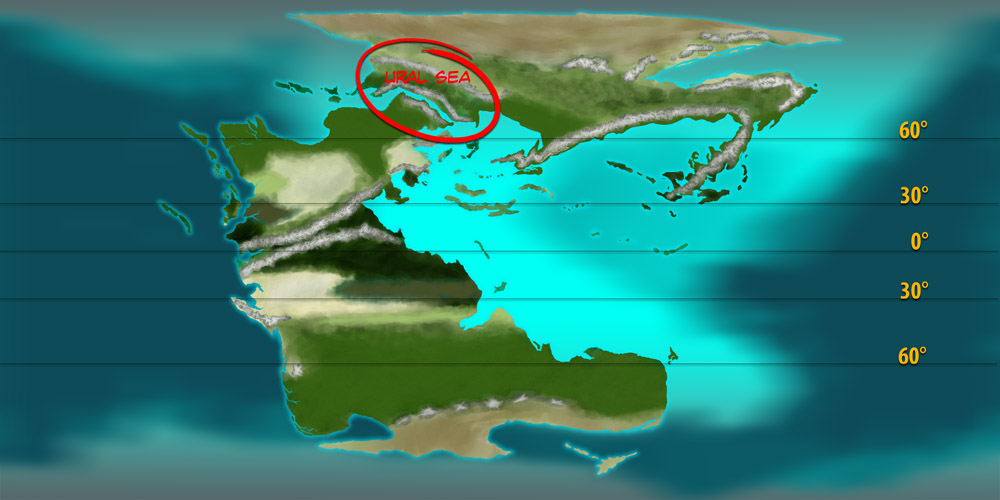
The Xenopermian is a collaborative effort between Scott, Raven, Zach and myself to outline a very different, speculative world. In some ways this is not all that different than the exercises of Dougal Dixon, After Man and The New Dinosaurs. Rather than speculating on what the dinosaurs would be like if they had not gone extinct, much like his New Dinosaurs or the Spec World Project, or project into the future with After Man or The Future is Wild, our team asked the question of ‘what if the Permian Extinction did not happen?

This is the next post about the fauna of the Xenopermian in the Ural Sea region. We have talked about a ‘fossil’ and a faux controversy associated it with. We have talked about the geological staging differences in the XenoPermian timeline, and have even talked about the differences in the world in general under such a different period. We have generalized about the fauna, but now we want to get into specifics. In our first post, we talked about the first faunal member of the Xenopermian, Graviloricanasus roma, a pseudochelonid and very derived pareiasaur. Then we talked about Elyardia hensonii, a very derived anomodont. Then we talked about the alternate pterosaur, Maralae whittoni.  Another time we talked about the trematosaurine temnospondyl Chronoperifronius thassalicus.  Post before last, we looked at the walrodont, Psittacops makradens.   The last post we looked at the desmodont dicynodont, Palonatator beccus.


Today we are sticking with the dicynodonts.  It will be the last dicynodont post for some time.  However, we are looking today at another branch that has been nicknamed the 'hippodonts' since they have developed in parallel in form (somewhat) and function (more so) to the hippopotamuses of our timeline.  The parallel evolutionary example we will work with today is Brontopator chapsia.

Brontopator chapsia is an example of another fictional and derived member of the clade Thassalothere which are a clade of the dicynodonts, an important group within the anomodonts.  These are in turn therapsids like the gorgons, therocephalians and cynodonts.  That last is inclusive of the mammals like you, you darned dirty ape, you!


During the great Evolutionary Churn of the XenoPermian, when the Siberian Traps did a 10 million year long sustained eruption instead of the bursty nastiness causing the Permian Triassic mass Extinction, the dicynodonts branched out into different clades.  The dicynodonts were already very successful herbivores and as the innovation took place within the clade, the dicynodonts started to exploit new resources.  One of these was the waterways.  The dicynodonts took to the water, despite not really being semi aquatic in OTL, and found a very unexploited set of niches with the lack of aquatic herbivores at the time.  The basal most thassalothere took to the swampy regions.  From there, they branched out into what would be informally called the hippodonts (river dwellers), walrodonts (sea residents) and desmodonts (swamp dwellers).

The hippodonts look like the strange cousins of Placerias.   They are big and portly and spend most of their time in the water.  They munch on the aquatic plants and come on land to graze at night.  While there is no grass in the XenoPermian, there are plenty of low herbaceous conifers and fast growing ferns.  They live in small herds and birth live young.
  
Brontopator chapsia is pretty generic for a hippodont.  They have a semi sprawled front leg stance and can and do charge predators.  Their thick skulls and semi forward facing tusks make them a serious hazard for predators.  They do protect their young and do not have large litters, rather one or two at a time.  Their young are more developed than the desmodont and walrodonts'.  However, they are still birthed on land.
One species of hippodont, not B. chapsia, actually seems to do some minor intentional environmental engineering and digs side pools to the rivers which they live.  In there, they raise their young, defended from even the reptilomorph and temnospondyls lurking in the rivers. This cousin does have a problem with reptilomorphs though.  The communally nesting variety can and will take over unoccupied hippodont ponds.  The repitlomorphs are not a match one on one, but when they have taken over a pond, they will enmass defend it.    That many reptilomorphs get rather hungry when they are sitting in the defense for so long.  They'll eschew eating the eats, but they can take down baby hippodonts in the area.
Brontopator chapsia is common in the short rivers running into the Ural Sea.  Cousins of their's are present in most rivers draining into the Tethys and in some draining into the Panthalassa.  Two species even migrate from the Transpangaea Mountains down into the Megavongo.

Their biggest predators are the gorgonopsids.  They are large enough to take down an adult B. chapsia.  However, the gorgons prefer munching on the young or sick.  The second most deadly are the venomous felid-like therocephalians that will ambush a herd, take a bite and run, letting its poison kill whatever it bit.  The large adult B. chapsia will pull through.  However, the young or old will not.  Temnospondyls are a problem as well when the herd takes to the water: they can wait crocodile like in the water to attack and pull young under the water for a kill.  This is rather risky given the strength of a stab by the hippodont tusks.

The hippodonts will last to the XenoPermian Jurassic Mass Extinction.  However, an Elvis Taxon would arise in the Cretaceous from a NeoDicynodont clade.  This mimicing lineage would die out in the Cretaceous-Eocene Extinction at the Mesozoic/Allozoic boundary.  Examples of competing parallel evolution would take place during the Allozoic, with dicynodonts, therocephalians and mammals duking it out up until the Pleistocene for the ecological niche.  However, the true hippodonts were gone 200 million years earlier.

Tuesday, August 25, 2015

Xenopermian Biota of the Ural Sea: Palonatator beccus, a desmodont dicynodont


The Xenopermian is a collaborative effort between Scott, Raven, Zach and myself to outline a very different, speculative world. In some ways this is not all that different than the exercises of Dougal Dixon, After Man and The New Dinosaurs. Rather than speculating on what the dinosaurs would be like if they had not gone extinct, much like his New Dinosaurs or the Spec World Project, or project into the future with After Man or The Future is Wild, our team asked the question of ‘what if the Permian Extinction did not happen?

This is the next post about the fauna of the Xenopermian in the Ural Sea region. We have talked about a ‘fossil’ and a faux controversy associated it with. We have talked about the geological staging differences in the XenoPermian timeline, and have even talked about the differences in the world in general under such a different period. We have generalized about the fauna, but now we want to get into specifics. In our first post, we talked about the first faunal member of the Xenopermian, Graviloricanasus roma, a pseudochelonid and very derived pareiasaur. Then we talked about Elyardia hensonii, a very derived anomodont. Then we talked about the alternate pterosaur, Maralae whittoni.  Last time we talked about the trematosaurine temnospondyl Chronoperifronius thassalicus.  Last week, we looked at the walrodont, Psittacops makradens.   

This week we are going continue with the anomodont therapsids with a some of the close relatives of the walrodonts, the desmodonts.  Specifically, we are going to be taking a look at Palonatator beccus.


Palonatator beccus is an example of another fictional and derived member of the clade Thassalothere which are a clade of the dicynodonts, an important group within the anomodonts.  These are in turn therapsids like the gorgons, therocephalians and cynodonts.  That last is inclusive of the mammals like you, you hairless ape, you!

During the great Churn of the XenoPermian, the dicynodonts branched out into different clades.  The dicynodonts were already very successful herbivores and as the innovation took place within the clade, the dicynodonts started to exploit new resources.  One of these was the waterways.  It had long been thought dicynodonts were semiaquatic, but it turns out they were not by and large in our time line.  Approximately 250 million years ago, when the Siberian Traps started erupting, the basal most thassalothere took to the swampy regions.  From there, they branched out into what would be informally called the hippodonts (river dwellers), walrodonts (sea residents) and desmodonts (swamp dwellers).

The desmodonts are in some ways more derived than their cousins.  They developed a parasagittal stance convergent with the neodicynodonts.  They also were rather more gracile than most of the other thassalotheres.  They picked up a number of traits in their adaptation to the water that reminded of the desmostylians.  Hence where they got their informal nickname.  However, they were very much dicynodonts and retained the beak and grinding mill.  One of the most striking differences is that they have lost the canine which the dicynodonts are most famous for.

However, they are nowhere as nearly derived as the walrodonts, of course.


Palonatator beccus is a pretty generic member of the clade.  They, like their relatives, inhabit swampy ground where they can eat both aquatic and waterside flora.  They are relatively quick and can out run many larger predators and those they cannot, they run into deeper water where the predators fear to tread.

They do have problems with the temnospondyls and reptilomorphs inhabiting the waterways of the swamps.  Their young are the most vulnerable.  However, on land the giant derived gorgons are dangerous even tot he adult P. beccus.  However, moving in herds does help with the predator problems.

The desmodonts are confined to the Ural Sea and along the Tethys Sea.  They are not, largely due to being unable to spread along the coastline, resident in the deltas of the Panthalassa.  Speculation is the waters are simply too cold.

The desmodonts will exist for approximately 25 million years.  They originated 10 million years before the current snapshot of the XenoPermian.  They will last until the X-J Extinction which is coming up rather soon, in 15 million years from the time of the snapshot we have here of the XenoPermian.  The Mesozoic will have different animals fill the roles the desmodonts fill.

Saturday, August 22, 2015

Xenopermian Biota of the Ural Sea: Psittacops makradens, a walrodont dicynodont


The Xenopermian is a collaborative effort between Scott, Raven, Zach and myself to outline a very different, speculative world. In some ways this is not all that different than the exercises of Dougal Dixon, After Man and The New Dinosaurs. Rather than speculating on what the dinosaurs would be like if they had not gone extinct, much like his New Dinosaurs or the Spec World Project, or project into the future with After Man or The Future is Wild, our team asked the question of ‘what if the Permian Extinction did not happen?

This is the next post about the fauna of the Xenopermian in the Ural Sea region. We have talked about a ‘fossil’ and a faux controversy associated it with. We have talked about the geological staging differences in the XenoPermian timeline, and have even talked about the differences in the world in general under such a different period. We have generalized about the fauna, but now we want to get into specifics. In our first post, we talked about the first faunal member of the Xenopermian, Graviloricanasus roma, a pseudochelonid and very derived pareiasaur. Then we talked about Elyardia hensonii, a very derived anomodont. Then we talked about the alternate pterosaur, Maralae whittoni.  Last time we talked about the trematosaurine temnospondyl Chronoperifronius thassalicus.

Today we return to the therapsids.  Specifically, we are returning to the anomodonts and one rather peculiar branch of the most famous of anomodonts (dicynodonts) called we, their creators, have been affectionately calling the 'walrodont:' Psittacops makradens.

Psittacops makradens: Parrot face Walruses, erm, long teeth of the Ural Sea


Psittacops makradens is an example of a derived anomodont. Anomodonts are one of the major clades of therapsids, very derived synapsids that superceded the pelycasaurs like Dimetrodon. Other famous derviced clades are the gorgonopsids, therocephalians and cynodonts (of which mammals – and you! – are a part of).


During the Great Churn, when the Siberian Traps long erupted long and slow at the start of the XenoPermian, rather the short and quick according to our timeline, some of the dicynodonts actually adapted to being semiaquatic.  The irony is that the dicynodonts have been called semiaquatic for a long, long time, but generally were not.

This branch of dicynodonts became what the cross time paleontologists would call the Thassalotheres.  These in turn would develop clades which were more derived and specialized as forms that would be labeled based on their general form as Hippodonts, desmodonts and walrodonts.  These were not their scientific names, but work well enough for our purposes.  The hippodonts became the dominant forms in lakes and rivers.  The more gracile desmodonts became dwellers of the swampy lands.  Finally, the walrodonts would take to the open oceans.


P. makradens is modestly sexually dimorphic species having a lot of parallels with our own pinnipeds and walruses.  They come onto the beach to sun and bare their young.  They bare live young, which they take care of, but are relatively developed.  They could give birth at sea, but the sea is a dangerous place, in some ways more than land.  However, even so land is still dangerous and the the walrodonts will form colonies to protect each other and the young. 

On land, they must protect against raids by the giant gorgonopsids, gracile canid and venomous felid-like therocephalians, Xenosuchus and temnospondyls.  The latter are often a problem as the walrodonts transition from land to water or vice versa.  However, none of these are nearly as dangerous as the hovasaurs.  These newt-ish basal diapsids have developed into mosasaur-like predators in the sea where they are a real danger to the young.  They didn't develop the fish-like tail though.


The walrodonts are herbivores.  They dive to eat the kelp-like algae forests.  P makradens eats the ones growing throughout the Ural Sea, even becoming something of a deep diver since the Ural Sea is so well mixed.  They will occasionally take a shelly bivalve for the mineral supplement.  They have coevolved with the local marine forest algae where the algae grows rather fast and sometimes had been called sea kudzu.  A colony of walrodonts might mow their way through the algae forest only for it to be largely regrown in a matter of weeks.  

Psittacops makradens is not the only species of walrodont.  There are four others.  Two others are of the same genera and live in Tethys.  Psittacops erythros is common in the western Tethys on the shores of the mainland and Psittacops corvus resides in the islands and archipelagoes of the eastern Tethys.  In the Panthalassa, on the northern mainland of Pangaea coast resides Ododenodon millerensis, a very robust and heavily tusked species (pictured above).  A cogeneric species, O. amos is on the southern coast of Pangaea.  


The walrodonts would survive through the XenoPermian-Jurassic Extinction.  However, they would not make it past the Jurassic-Cretaceous transition, save for a single species.  It would die out though by the time of Middle Cretaceous during the anoxic events.  Their form would not be replicated by Juxtarodentia in the Allozoic, the surviving lineage of dicynodonts would not return to the sea.  Therocephalians would have a chubby descendant that would like vaguely like a walrus, but without the tusks in the Allozoic glaciations though.

Friday, August 07, 2015

The Final Shift


The above image has always been very poignant for me. That's Avrora and Orest in the Dominican Republic with their mom.  This was in June 2011.  Orest was nearly 2.  Avrora was 6.  I didn't take the picture (I was in the US working); however, I always felt the picture was from my POV.  My daughter ready to walk out into the light.  My son looking out but turned somewhat, wondering if he ought to go back.  Are they moving on, walking away, growing up?  Or am I slipping away into the dark with my daughter accepting and my son not so sure?  Or is this the future,my children are that bright future and my mortality and the present is the dark, narrow tunnel?  Or is the darkness the fear of change and the bright that future?  Or....?  There are a million different thoughts which go with the future.

 The future is now though.  Whatever the meaning of the above, I am facing the future today.  Today is my last working day at NERSC, the supercomputing center I have been at since June 2001.  After 14 years, I am shifting from HPC geek to rocket scientist full time.  I am trading in the Singularity (Rapture of the Nerds!) for the Space Enthusiast (If Only We Had the Will Power!). 

Or perhaps I am just trying to escape Skynet. IN SPACE!

This shift signals the end of my career in supercomputing.  I first logged into a Cray YMP in fall 1990.  Out of the past 25 years, I have had an account on a supercomputer somewhere within DOE with a short stretch from 1998 to 2001 as the exception.  I have worked as a user or admin on Cray XMPs, YMPs, C90s, J90s, T3Es, XT4s, XT5s, XC30s and XE6s.  I have worked on IBM SP3s, SP5s and a mongo iDataPlex.  I have also worked on Thinking Machines CM200 and CM5s.  Even the odd largish SGI Altix, white box linux clusters and even a Linux Networx cluster.  I have managed file systems which both span multiple supercomputers and even one which spanned multiple states.  I've assembled a data transfer system which can packet cannon a sustained 2.5 terabits per second for bandwidth.

I've done a lot.  I've seen a lot.  I've also made it to the point where everything I saw in the beginning of my HPC career is being revisited.  Its not just a silly saying when everything old is new again.  In all the architecture meetings and data handling meetings, this has been almost the uniform theme.  And its uninteresting.  When that happens, its time to go...

Fortunately, for me, I'd laid down the plans pretty thoroughly to move on.

And now I am.

From now on, I am a full time rocket scientist.  Its more than a little scary.

Its a major life change.  I have been working 17 hour days for the past year.  Now I'll shift down to 12 hour days, still long, but it will allow me to be better engaged in many things.  Especially my kids.  For that, I am grateful if nothing else.  However, this is a new business and I AM THE BOSS.  HOLY SHBT.

One of the life changes is that I am going to forgo doing much with the blog.  The rapid updates recently were as much to see if I could get the old backlog of articles I'd saved done before I wound this down.  However, I will not completely abandon the blog.  However, for the most part,  The blog will update with original content only.  It will probably only be weekly rather than daily.

However, I threw up the ads on here (for those of you not using a blocker).  If there are enough clicks for a cup of coffee at a coffee shop per week, I'll guarantee a new article.   In fact, let's turn this around.  I'll write an article on space, HPC, the robopocalypse, Ukraine or a paleo post every time I get a cup o joe paid for.

Actually, let's nuance this a bit.  A cup of coffee is worth a Ukraine update or Robopocalypse report or equivalent.  Cup of coffee and a munchie is worth a xenopermian or equivalent.  A serious research article will require a full meal folks.  :P

Appropriate end music.  


Sunday, January 11, 2015

10 Years of Blog

I have been running this blog for ten years now.  Its been rather busy and interesting.  I've had some serious UPs in life and major CRASHES.  Some I've talked about here.  Some I have not.  I wrote some popular essays on paleo topics when the paleoblogosphere was far more healthy.  I've shared crazy thoughts as well.  The original content fell as I became busy and yet my traffic grew immensely.

After ten years, its time for a change. 

Between now and June 1, I am going to be winding down the regular postings and transitioning to only posts of original content.  This will end up reducing my traffic significantly: discontinuing the late night posting dropped my traffic from around 1600 hits per day to 1000.  However, there will be more posts of the XenoPermian, my family, crazy thoughts, paleo essays etc.  

And it will be a lot less work.

First up to clip is the 5:30 pm posts (and later) and 6 am post.  I'll be folding the 5:30 pm/6 pm into the 5 PM slot.  The precambrian posts will be in the paleoenvironment slot at 2 pm.  The 3:30 and 4:30 PM posts are no longer going to continue at this point.  Militaria will be restricted to the 3 & 4 PM slots.

February 6th and March 6th will have a couple original content posts each.  February 6th will have the "What to do About the Robopocalypse?" Crazy Thought post and another XenoPermian post.  March is undecided at this point.

The next 'downshift' for posting will be March 26th.

Wednesday, January 07, 2015

Xenopermian Biota of the Ural Sea: Chronoperifronius thassalicus, a trematosaurine temnospondyl


The Xenopermian is a collaborative effort between Scott, Raven, Zach and myself to outline a very different, speculative world. In some ways this is not all that different than the exercises of Dougal Dixon, After Man and The New Dinosaurs. Rather than speculating on what the dinosaurs would be like if they had not gone extinct, much like his New Dinosaurs or the Spec World Project, or project into the future with After Man or The Future is Wild, our team asked the question of ‘what if the Permian Extinction did not happen?

This is the next post about the fauna of the Xenopermian in the Ural Sea region. We have talked about a ‘fossil’ and a faux controversy associated it with. We have talked about the geological staging differences in the XenoPermian timeline, and have even talked about the differences in the world in general under such a different period. We have generalized about the fauna, but now we want to get into specifics. In our first post, we talked about the first faunal member of the Xenopermian, Graviloricanasus roma, a pseudochelonid and very derived pareiasaur. Then we talked about Elyardia hensonii, a very derived anomodont. Then we talked about the alternate pterosaur, Maralae whittoni.

Today we leap from the amniotes to the nonamniotes.  Generally, the amniotes dominate the terrestrial ecology of the Xenopermian, but there are a number of interesting and important nonamniotes which participate.  Because there was no mass extinction, but rather a great evolutionary churn from the extended and muted Siberian Traps eruption.

Our first foray into nonamniote territory is Chronoperifronius thassalicus, a Xenopermian temnospondyl trematosaur.  What is a trematosaur?

Trematosaurs: the Marine Temnospondyls of the Permian, Triassic & Jurassic

The trematosaurs were a clade of temnospondyli.  Temnospondyls were one of the clades of what could be loosely called amphibians.  The two other are lissamphibians and lepospondyls.  The exact relationship between them is very contentious. 

Trematosaurs were a clade which originated in the Permian.  They were one of two clades of temnospondyls to survive the Permian Triassic Extinction in our time line.  They would diversify and even do something which is quite remarkable: they invaded the marine environment.  That's something not very common for tetrapods prior to reptiles.  Trematosaurs would become increasingly adapted to their new environment and would be excellent examples of parallel evolution relative to the crocodilians. 

It was thought the trematosaurs declined over the course of the Triassic and to be wiped out finally in the Triassic Jurassic extinction.  However, it was proven incorrect.  It seems the extinction failed to do the deed: postcranial skeletal fossils from a trematosaur were found in China from the late Jurassic.  If anything, its quite possible they may have survived longer still: the chigutisaurs (Koolasuchus) made it to the Aptian Cretaceous.

Trematosaurs of the XenoPermian

The XenoPermian didn't have the PT Extinction and this would cause no small ripple effects when it came to biota.  The increased numbers of temnospondyls is one of them.  In our case, in the Ural Sea Biota, Chronoperifronius thassalicus.

Chronoperifronius thassalicus - time despiser of the sea - is a marine, or rather beach dwelling, trematosaur.  The trematosaurs of our time line were piscovores.  C. thassalicus has started to return to the land or at least raiding the beach and the near shore, becoming a true carnivore.  With the increase of beach dwelling critters, such as the marululateans and the walrodonts, the edibles have increased from merely the washed ashore or whatnot.

C thassalicus takes two different approaches.  When it encounters a colony of beach dwelling therapsids, like those mentioned above, it attempt to lie in wait just past the wave break, not unlike how crocodiles would in freshwater of our time line.  When the colony would take to the sea, one or more would act in ambush to take a warm blooded therapsid.  However, during breeding seasons, when the therpasids have either pupped or laid eggs, C thassalicus will often charge the beach, hoping to scatter much of the colony to grab a pup or eggs.  

C thassalicus is starting to have competition though.  The archosaur, Xenosuchus prognathus, has moved east from what would be Russia and has successfully crossed to both sides of the Ural Sea.  Not as amphibious, but perfectly capable of swimming, has also taken to primarily predating the therapsid beach colonies.  This increases the pressure on the trematosaurs.  It will not, however, cause them to become extinct.  They largely go under during the X-J Extinction with some relic populations in the Arctic and Antarctic.  There they will survive until the K-T or rather K-Pg Extinction at 55.8 Million Years.

In the mean time, C thassalicus and her relatives will dispute the water ways with the crododilians.  The archosaurs and their relatives will be held at bay until the XJ Extinction, largely excluded from the waterways, but not totally.  One great casualty of the temnospondyl strength will be the 'fact' phytosaurs will never grade the waterways of the allohistorical Earth we describe.

One of the reasons is that C thassalicus and her marine relatives produced an interesting reproductive strategy: they birthed live young, fully formed, not unlike what frogs do with undersized juveniles, the "froglets." This allows the trematosaurs to no longer require returning to freshwater to breed.  Other trematosaurs would become thoroughly adapted to marine life, becoming limbless and become obligatory aquatic.    Producing greater sea monsters for a time, but eventually the purely aquatic forms losing out to hovasaurs and others with better respiratory systems at the XJ Extinction.

In the end, they will have made their mark and have given a good run, from the Mid XenoPermian until the end of the Mesozoic even if they do despise the passage of time.

Thursday, October 17, 2013

Xenopermian Teaser: Niictodon gobelinus


This is a sketch  to make sure we're on the same page for this guest in another critter's scene.

So, guesses as to the phylogenetic placement of our friend here?

Raven Amos is the artist.

Monday, September 02, 2013

XenoPermian Biota of the Ural Sea: Maralae whittoni, a pterosaur

THE XENOPERMIAN OF THE URAL SEA

The Xenopermian is a collaborative effort between Scott, Raven, Zach and myself to outline a very different, speculative world. In some ways this is not all that different than the exercises of Dougal Dixon, After Man and The New Dinosaurs. Rather than speculating on what the dinosaurs would be like if they had not gone extinct, much like his New Dinosaurs or the Spec World Project, or project into the future with After Man or The Future is Wild, our team asked the question of ‘what if the Permian Extinction did not happen?

This is the first post about the fauna of the Xenopermian in the Ural Sea region. We have talked about a ‘fossil’ and a faux controversy associated it with. We have talked about the geological staging differences in the XenoPermian timeline, and have even talked about the differences in the world in general under such a different period. We have generalized about the fauna, but now we want to get into specifics. In our first post, we talked about the first faunal member of the Xenopermian, G roma, a pseudochelonid and very derived pareiasaur. Then we talked about Elyardia hensonii, a very derived anomodont. 

Today we leap from the very odd therapsids and the derived parareptiles to another of the three major clades of amniotes which grace the XenoPermian. Diapsids in the Permian, both the real life one and the Permian up to and including the Guadelupian were pretty unimportant. Some small forms which graced the here and there, which a handful of larger animals as well. However, they were relatively unimportant to the overall ecology and lived in edge niches. This began to change with evolutionary churn which began with the guadelupian into the extended Xenopermian eruptions of the Siberian Traps.

Opportunistically, the diapsids began to fill different niches. Ironically, except in a few island cases, few became what we would think of as squamates: they would be outcompeted by the millerettids until the XJ extinction. Most would follow other familiar patterns, hovasaurs would break out into the marine environment to compete with the trematosaurs. Archosaurs and their kin with their moderately successful and novel breathing would take to the water…and to the air. And, yes, Virginia, there would be dinosaurs. They were minor participants in the grand ecology of the allohistorical ecology, but they were present. On islands and in thin aired mountains, the dinosaurs and endothermic archosaurs would truly make their mark. And from those heights would spread in a niche only partially filled, the second vertebrate fliers of the XenoPermian: the pterosaurs.

(yes, that's a trematosaur, we'll get to them...erm...soon)

Beginning with something not unlike a very gracile, very small, gliding animal looking somewhat like a crocodile, the pterosaurs would first take to the mountain airs above the Transpangean Mountains, leaping between upland trees and then taking to flight. First they were bug and arboreal hunters, feeding off of smaller animals in the trees. Then snatching fish and temnospodyl and lepospondyl spawn in the cold pools high in the mountains, safe from other animals in the warmer climes below. As their flight capabilities increased, they spread down and out from the mountains. Their spread was at first stymied by the first vertebrate fliers, the rib flapping flutterzards. However, the pterosaurs were simply better fliers and slowly the flutterzards were displaced. If not for the rise of the suminopterans, the pterosaurs would have solely ruled the skies like in our time until the Cretaceous.

The pterosaurs would spread into the Ural Sea region in time. The first lineages were the orophilic, living in the Ural and AntiUral Mountains. Later, though not more than a million years, the piscovorous lineages would spread along the Ural Sea itself. A characteristic species of the latter is Maralae whittoni.

M. whittoni has a curious lifestyle. For this reason, there are no flutterzards left in the Ural Sea forests. M. whittoni practices chronological niche partitioning. There are three populations and the details vary between them due to behavioural differences. The western population is so named because the breeding grounds are in the foothills of the AntiUrals to the west. The eastern population migrates inland to the Urals. The southern population actually lives on craggy, but marshy isles that reside at the mouth of the Ural Sea to the Tethys. They do fish in the Tethys, but for whatever reason the majority migrate back up into the Ural Sea each year.

As with most Xenopermian pterosaurs, the young can fly within a week. M whittoni then escorts the hatchlings to the coastal forests of the Ural Sea. There the young are abandoned. There, they become aerial pursuit predators, chasing down insects on the wing by and large. They do indulge in nest raiding opportunistically. They live colonially in trees for protection. Their noise is cacophonous.

Once they are around three years of age, adolescent M whittoni move to different colonies and begin to exploit the rivers and ponds and lakes for food, even taking small vertebrates by swooping and snatching. The attrition of the newborn to three year olds is pretty significant and only around 10% of the bug eaters making it to the terrestrial and freshwater forager stage.


Finally, at age five, “teenage” and full adult M whittoni have migrated out to the sea and become reproductively active. Here they exploit the seas directly, becoming divers after fish and exploit the carrion bounty of the seashore. At this stage, M whittoni is often solitary, though some pairs or incidental flocks have been noted.

By doing niche partitioning in this manner, M whittoni decreases cross-generational competition. It also can exploit more resources, as a species, than many others. The flutterzards, being weaker fliers, are unable to compete with the insectivorous stage M whittoni and have become extinct in the Ural Sea region.

The southern population differs from the other two. The southern isles, formally called the Angliski, are swampy and have limited forests. The terrestrial forager stage flit between isles in flocks, hunting through the fern and mangrove-esque swamps. The bug biter stage stay local to each island they are hatched on. Selection as a result is very powerful and it seems likely M whittoni’s southern population will diverge from the other two populations in the relatively near future.

Given M whittoni’s lifestyle, it would be correctly assumed their species was not a physically large one.  The largest of them would have a wing span of two meters and that was an exceptional example.  Due to their size and their rhamphorhynoid grade planiform, M whittoni is largely airborne, roosting in trees or in cliffs.

 
-->

This does bring it into conflict with arboreal species.  The manisuminids, including Elyardia, and the foliosensians are two of the largest problems for M whittoni, including being the largest single source of casualties to other animals in the region.  A pterosaur could seriously wound, if not kill, a lone Elyardia.  However, the pterosaur itself would be wounded and Elyardia is gregarious.  And ganged together would kill a M whittoni easily.  Adult M whittoni can easily dispact any of the arboreal foliosensian cynodonts, but ‘rat packs’ which some times raid the fledgling colonies are a serious source of adolescent mortality.

 
-->
When confronted by a manisuminid or foliosensian, a three year old or older M whittoni will first display.  This is accomplished by brandishing its teeth and hiss loudly.  If this fails, it will make false lunges at the offending Xenopermian critter.  If this is still not enough, it will flee and defecate.  When it does it, the excreta will have an extra foul smelling substance.  This often drives off an offender, but M whittoni does not linger to find out.  A rat pack raid can be smelled from the juvnile M whittoni colony long before it can be seen or heard. 


M whittoni
would survive up until the XJ Boundary while M whittoni’s lineage and descendents would have a good run of it. They would survive the XJ Extinction and even reach the end of the Jurassic. While the pterosaurs as a whole would survive the Bristol Impact at the end of the Cretaceous 55 million years ago, none of the rhamphorhynchine grade pterosaurs, and thus none would be of M whittoni’s line would make it into the Allozoic. While they would be missed, with birds, bats, suminopterans and pterodactyl grade pterosaurs, the Allozoic skies are far from dull.

Friday, April 19, 2013

A Liberated XenoPermian Pic


This one was featured in the Elyardia post, but had not been seen separately.  Just liberating it.

Monday, March 25, 2013

XenoPermian Biota of the Ural Sea: Elyadia hensonii, a manisuminid


THE XENOPERMIAN OF THE URAL SEA

The Xenopermian is a collaborative effort between Scott, Raven, Zach and myself to outline a very different, speculative world. In some ways this is not all that different than the exercises of Dougal Dixon, After Man and The New Dinosaurs. Rather than speculating on what the dinosaurs would be like if they had not gone extinct, much like his New Dinosaurs or the Spec World project , or project into the future with After Man or The Future is Wild, our team asked the question of ‘what if the Permian Extinction did not happen?

This is the first post about the fauna of the Xenopermian in the Ural Sea region. We have talked about a ‘fossil’ and a faux controversy associated it with. We have talked about the geological staging differences in the XenoPermian timeline, and have even talked about the differences in the world in general under such a different period. We have generalized about the fauna, but now we want to get into specifics. In our last post, we talked about the first faunal member of the Xenopermian, G roma, a pseudochelonid and very derived pareiasaur. Now we are shifting to the trees to talk about our first therapsid, Elyardia hensonii.

Welcome Elyardia: Anomalous Teeth, Beaks and Bites

Elyardia hensonii is an example of a derived anomodont. Anomodonts are one of the major clades of therapsids, very derived synapsids that superceded the pelycasaurs like Dimetrodon. Other famous derviced clades are the gorgonopsids, therocephalians and cynodonts (of which mammals – and you! – are a part of).

The anomodonts had three main clades, as far as we can tell. The two lesser known ones were the venjukoviamorpha (small Laurasian herbivores and possibly omnivores) and the anomocephalians (which were Gondawanan in origin, but large herbivores). The most famous of the anomodonts and most successful in real life were the dicynodonts, of which the relatively famous Lystrosaurus was one. In real life, the other two clades of anomodonts seem to have gone extinct around the Guadalupean. The dicynodonts would be very successful through the Triassic and even survive into the Early Cretaceous of Australia. Again, in real life. All of the anomodonts seem to have had a peculiar front to back chewing mechanism that was developed to the most extreme in the dicynodonts.

XenoPermian Anomodont Phylogeny

All three of the major clades of anomodonts have become important in the Xenopermian. The dicynodonts are the dominant clade, to be sure, filling niches between that of marine herbivore to large herbivore to rodent analog, but the other two are major members of the fauna. The anomocephalans have given rise to the Tiarajudensines. These are derived from Tiarajudens, the earliest known tusked or sabre toothed herbivore. They are split into two clades based on their derived dental arrangement: foreward facing tusks (hastadensids) or sabre teeth (gladiotaurines). They are very large sized herbivores, though rarely gregarious ones. The venjukoviamorpha developed into a cluster of small bodied herbivores and omnivores. They dominate the arboreal and mountain realms. They contest the rodent like niches with juxtarodentia (dicynodonts) in the Arctic and Antarctic regions of Pangaea. They even contest the skies with the two flying diapsid clades. The most common venjukoviamorph in the Ural Sea region is Elyardia hensonii.

Elyardia hensonii is derived from Suminia, a real life fascinating taxon. In the Xenopermian, Suminia was a founder of a fascinating and very important lineage.  E hensonii is a descendent of Suminia as a member of that clade.  Specifically, Elyardia is an example of a nonspecialized, arboreal manisuminid, (handed suminid or suminid with hands). This is a branch of the suminid lineage, those that are derived from Suminia in our fictitious XenoPermian. The other is the Suminopterans, one of the XenoPermian’s three clades of vertebrate fliers.

Something Other This Way Comes: the "Paleo"biology of Elyardia

The manisuminids are mostly, but not exclusively, arboreal. They fill roles similar to squirrels and primates. E hensonii is a relatively basal member of the clade that mostly eats gingko nuts, but supplements its diet by raiding nests for eggs, periodically munching on insects and eating foliage either in tough times or for roughage.  It would be tempting to call the manisuminds the primates of the Xenopermian. There are parallels between the two fictitiously related clades, but there are massive differences as well.

Primates are placental mammals. This allows them to bare live, very developed young. Elyardia and the rest of the manisuminids are definitely not mammals, even if they are fuzzy. They independently developed the ability to bare live young and even suckle their young in a manner similar to monotreme mammals. The live young they bare though are very underdeveloped and must be cared for extensively. However, the time cycle for taking care of their progeny blurs the K/r selection line to some extent. They have fewer pups at a time, but they generally reproduce quite frequently.

One of the great drivers of primate evolution was the presence of fruit. Tropical fruit had a profound impact. Flowering plants do not exist in the XenoPermian. They will arrive, but later, during the alternate Mesozoic and somewhat earlier than their great flowering in the Cretaceous. The presence of the manisuminids and their cousins, the fissonucines, would drive a great deal more innovation in the gingko tree evolution, producing many variants that never existed in OTL. The same held true for changes to coniferous cones as well.


The threats and competitors that the manisuminids would face were radically different than anything the primates did. There are hardly any pterosaurs in the Cenozoic. Nor were there flying primates, which would be the closest parallel with the suminopterans. Pterosaurs are actually one of the biggest problems for manisuminids. While far from large, pterosaurs could and would dive in to raid for young. An adult Elyardia was a serious danger for pterosaurs: their bites are sufficient to lame a pterosaur that they do not outright kill.


Other threats in the trees include, the foliosensids – arboreal insectivorous cynodonts – that take pups and can kill adults if driven to; niictodons (an arboreal parareptilian scavenger with immense bite forces necessary to crush bone) can be a menace if Elyardia is unlucky; and in other habitats, Suminopterans are not above raiding manisuminid nests. Of course, other manisuminids are a problem.

When traversing the ground between copses of gingkoes and other trees, Acerdens (a cynodont that has parallels with badgers), the unnamed ‘sprintocrocs’ and the paratheropods are also problematic. Larger predators rarely notice Elyardia and their kind: they are too much effort for the amount of meat acquired.

The threats from predators have produced some interesting behaviors. Manisuminids are nesters. Depending on the species, how they nest is vastly different. Elyardia nests by finding a large branch and building a large nest from sticks, leaves and other materials. Their hands allow for the innovation that this represents. The nests themselves are often adorned with sticks that have been chewed into a sharpened state and the points are placed outwards.

Elyardia is very gregarious and a colony can occupy a huge tree at very branching point. Every year, the majority of the young leave the colony to either join another or start their own. Most do not succeed, becoming lunch or a snack for some other entity of the XenoPermian.

Likewise, mating season is quite loud and horribly smelly with males jockeying for position in the social structure and females selecting with whom they mate based on the nest construction and displays. Older males, those that have built up their nests over time almost always come out well during the season.

Cha-Cha-Cha-Changes!  Skeletal Changes from Suminia to manisuminids.


Suminia top, Elyardia bottom

The changes to E hensonii from Suminia have been largely constrained to four areas: respiratory, locomotive and cranial. They are driven by the niche and lifestyle of the manisuminids.  Relatively speaking, Elyardia is fairly conservative in its changes, morphologically speaking.

E hensonii and most of the therapsids that made it through the great evolutionary churn that was initiated by the stretched out Siberian Traps of the XenoPermian developed an improved set of lungs. E hensonii came out with an improved tidal breathing apparatus, one that mirrors the method of how the lungs work in modern mammals. Likewise, E hensonii is also endothermic and bounces around the treetops of the Ural Sea region with a great deal of energy.

The changes to the skull are pretty profound on E hensonii compared to Suminia. There are three areas that are of interest. The first is driven by the continued necessities of being a arboreal animal. The suminid line developed binocular vision. Binocular vision developed early on in the suminid line and both the suminopterans and manisuminids retained the trait. The second trait that has developed to an extreme in the manisuminids is heterodontia. The teeth have become more and more specialized. Elyardia has heavy, peglike “incisors” and very molar-like back teeth. This has been driven by the diet related to the gingko nut and its various relatives.


 The chewing action has changed from the basal mill process that anomodonts had, but still processes the food far more than any other therapsids save the cynodonts, other anomodonts and a singular clade of therocephalians. One advantage that the manisuminids have over cynodonts is that they replace their teeth throughout their lives. Although, they are relatively short lives most of the time.

The final collection of traits that has significantly changed from the ancestral sumina is that of locomotion. To speed up, the limbs have become parasaggital. Likewise, the hands have developed into true hands with opposable thumbs. This has allowed the manisuminids to become even more adept climbers and dominate the canopies throughout the XenoPermian world. Their tails have become fully prehensile as well. It is not uncommon to see Elyardia to be dangling by the tail eating or reaching for food.  They are often also used during displays: individuals hanging from their tails and calling and squawking. 

Past the Future

Elyardia's lineage will exist for a long time.  Manisuminids make it past the XenoPermian-Jurassic Extinction and continue to thrive.  They will even make it past the K-E Extinction at the end of the Mesozoic.  They were always a very important member of the fauna, but in the Allozoic (the alternate of the Cenozoic) is when the manisuminids come into their own, being one of the most dominant clades present.  They will outlast the gorgons and parieasaurs.  They will outlast the megafaunal dicynodonts, or at least those not derived from juxtarodentia.  Their response to the greatly increased competition that arose during the late Allozoic glaciations will be fascinating.  However, that is beyond the scope of the XenoPermian, being 213 million years hence.

Notes:

Yeah!  Next Xenopermian done.  The it only took a year and change.  Oy.  There will be two smaller posts in the near future.  The first one will be about our friend the pterosaur.  Given that they are relatively well known from our own timeline I will just touch on them (and risk looking a bit foolish, though I will consult some of the netizens known for their pterosaur knowledge). The next post will not be a year away.

Personally, I loved the touch that Scott put into the first altercation pic: the pseudochelonids of that last post are featured in the beach.  It helps tie, at least visually, the narrative together.

Any questions or comments or corrections, please post.

Tuesday, March 12, 2013

Post 4000: Updating Pournelle's CoDominium

Pondering Post 4000

This is not the original post that I intended for post 4000.

Originally, I wanted the next Xenopermain post to take that slot.  However, a few things have dissuaded me.  First off, the post is still too rough around the edges.  It needs a lot more work before its ready.  I've decided to shift bits here and there and make chagnes as well as clean it up.  So, Xenopermian is out.

I went back and saw that my 2000th entry was an argument for the annexation of Mexico.  So, it struck me as something off the wall was needed.  I am too busy to write something with a serious political bent; though, I did consider it.  Then, I thought, why not write about something that is easier and fun.  Something I've kicked around with friends a few times.  Something that could be thought provoking as well as twitting just the right folks.  Like last time.  When I reviewed Through Struggle, The Stars, I referenced the Pournelleverse, in passing.  Then it occured to me.  A whackadilly post that could be fun and fill the 4000 requirement.

So!

Let's look at the Jerry Pournelle CoDominium and see if we might update it and address some of the things that now look a bit...dated.  To put it politely.

A Bit of Background:

The idea of the Codominium seems to have hit print, or at least become most commonly known, through Pournelle and Niven's The Mote in God's Eye, but there were a couple short stories set in the timeline released earlier.  The basic idea was that the United States and the Soviet Union formed an alliance and dominate the world together rather than competing with the other states that were going through convergence with the USA and USSR (at that point largely recovering from the effects of WWII).  Other bits that were included in the basic background were that the world had developed space travel to a significant degree, developed faster than light travel (alderson drive) and that technological research was quashed for the purposes of maintaining the status quo. 

A lot of this is dated.  Badly.  What has to be shelved, dumped and redone?

The Changes to the Geopolitics Leading to the CoDo

The obvious off the top is the extinction of the Soviet Union.  Its a little hard to build the CoDo with a nation no longer in existence.  The primary successor, Russia, to the Soviet Union is not one of the two top nations in the world no matter how you cut it.  It is also not projected to rise above the top of the pack in the next 40+ years.  That means we need to find at least one replacement for the duo to put the Co in CoDo.

The is an obvious answer to that: China.  China is now the second ranked country in terms of, well, virtually everything.  Its slated to become the #1 country some time between 2030 and 2050 (on the outside).  It may even happen sooner.  There's one of the two partners.  The question is whether or not we believe that the US is likely to be the other.

Most likely, the answer is, yes, the United States would be one of the two partners in a CoDo circa 2030 to 2050, at least.  However, there is another possibility that is fun and interesting.  What-if the US is surpassed as the second power.  Or What-if, the US so alienates an up and coming power that they might ally with the Chinese (this is far fetched to the point of unrealistic, but the whole Codo scenario is one that is just that anyways...)

India.  Yep.

Why would they form a CoDo?  The same reason that Pournelle  suggested.  This would mean that other parts of the world were converging with the power of India and China.  If you did this right, it might mean a 'reconvergence' of the US, Japan and EU with their power and economic clout: possibly Nigeria and Brazil or even Russia.  This could be the rise (finally) of technologies that decouple population size with productivity.  Automated factories, frex.

What would an Sino-Indian CoDo look like? Some obvious things is that there's no St Ekaterina.  Another likewise is that Sparta s not the capitol of any Empire follow-on.  The mythology that would follow would be rather different.  When and if they were to encounter the Moties, it'd be under a rather different paradigm than a resurrected 19th century empire.

Warfare of the Sino-Indian CoDo.

Like in the original Pournellean Soviet-American CoDo, neither side would trust the other to have the military.  The question now becomes who do we model the CoDo marines after?  The originals were based on the French Foreign Legion.  That's possible, still, but seems moderately unlikely.  Things have changed since the 1970s and Europe has come into its own as the Holy Roman Empire resurrected.  Neither would probably want the United States as the basis of the military (though my nationalist vanity does want to make that leap here).  Its not likely to be European whatsoever and Japan is 100% certainly out.  If its not the EU and its not the US, who could China and India settle on that would work at least moderately well?  If you are projecting into 2030 to 2050 for the creation of the CoDo?

If you had to pick a nation to base the CoDo military forces on, that pick would have to be based on the fact that the warfare of our updated CoDo is not what the CoDo of original Pournelleverse was like.  He posited ground warfare closer to that of pre-WWI for all but the most major engagements.  That is not what we'd have if we had our jumping off point between 2030 to 2050.  Rather we're likely to see war based on drones and special forces.  Not mass armies, although those may still exist and be of use.  That would leave one of two nations, if the EU and US are excluded: either Russia or Israel.

Russia has a proud tradition with the Spetnaz.  If they could catch up sufficiently technology wise - they are very far behind now - then they are not a bad choice: China and India could work with them.  Lermontov might still be an important name in the updated CoDo-verse.

On the other hand, Israel has a special forces tradition and the tech for dealing with drones and more.  They are a force that would be of use in a significant way.  Neither side would have concerns about Israel leading a military coup against the other.  You're looking at several orders of magnitude difference in people and the Defense Forces have quite the ability.  They also have ties with both militaries.

An Israeli based CoDo military would be...interesting.

As noted, SpecOps, CyberOps and drones will dominate.  Remotely operated machines, powered armor, and...yes, given the setting the CoDo space navy, aka The Fleet.

Space Development, Exploration and the Fleet in the Sino-Indian CoDo

In the original Pournellean timeline, Caltech developed the Alderson drive between 2004 and 2008.   In 2008, the first exploratory ships leave the solar system.  The ships use a fusion drive.  Obviously, this is not happening now.  We have hardly sent manned spacecraft outside the solar system nor have we developed an FTL drive.

So, obviously, this needs to be updated.

There's no issue with Caltech developing the drive still, but its as likely to be John Hopkins or MIT or Stanford or Berkeley or even someone at CERN discovering it rather than the JP/N bias to SoCal.  It might even be one of the Chinese, Japanese or Indian universities.  The Chinese have been working on entanglement and you could even handwave an update to the Alderson Drive that matches this.  Spooky action at a distance being the key to the existence of the Alderson Drive...or whatever Chinese name would be attached.  For geopolitical reasons, it'd be better if it was either the US or EU that developed it...and that might be part of the reason that the Sino-Indian CoDo developed.  We could keep the name Alderson for that reason.

Given that the Alderson Drive is really, really unfriendly to computers, people are going to necessary.  That would mean a massive expansion past the ISS.  I can say in 40 years, its possible to have the presence in space to support the idea of the Fleet and whatnot, but it will be tough.  We've learned just how hard it is to get off world and only some sort of ideological reason will do, rather than economic.  Two rising powers overtaking the former leader would probably do and then they attempt to outdo one another would be best.

The second problem with the Fleet is that we STILL do not have anything like a fusion drive that is used in the CoDo universe.  The NIF has failed to produce inertial confinement fusion and probably lacks the power to do so.  This means that we would need to have a breakthrough here in a big way.  Even if we do, we're likely to see accelerations and whatnot that fit more with those shown in Through Struggle, The Stars, than those shown off in the Pournelleverse for a SinoIndian CoDo.  However, the use of antimatter would be questionable, to me at least.

The third bit that is radically different from the original CoDo setting is that we are discovering exoplanets at a rate that is amazing, even has someone that has dabbled in that 20 years ago.  We're highly likely to have the habitable worlds IDed prior to the formation of the SinoIndian CoDo.  The largest that the CoDo was supposed to be was ~200 light years across.  By 2050, we're likely to have found all the planets within that sphere and very likely we will have found all the habitable worlds. 

There are 15,000 worlds within 100 ly.  If there is even 1% with habitable worlds, the SinoIndian CoDo is likely to have 150 worlds that it could settle.  Assuming that they are all reachable.

Demise of the SinoIndian CoDo

The CoDo in the Pournelleverse tore itself apart.  The Soviets and the Americans, even though they had become so much like each other, hated one another.  The extremism we have in Congress with nuclear weapons.  That could happen here, too.

Personally, it feels more likely that the other powers would revolt.  At some point, the burden of India and China running the world and known space absolutely would become too much.  The Americans, Brazillians, Europeans and Japanese (perhaps Nigerians and Indonesians) are going to chafe at the limitations.  Even one of them throwing in shoes to the gears of everything could set off a conflagration. 

If we give this new CoDo a 100 year lifespan like the original, then we're seeing everything go up in flames around 2150 +/-.  Earth gets bombarded into oblivion, nuclear and otherwise, and the Fleet has an exodus.

Where the fleet settles...IDK.  An Indian constitutional monarchical world?    Attempting to fit into the original theme here.  Half going to New Beijing?  Or some such.

Far Flung into the Future

Assuming that you attempted to keep even remotely to the timeline, even if changed for the future, there's one more thing.  Supersoldiers that the Saurons produced as their ideal made sense at the time that Pournelle and Niven wrote their book: it was 30 years after WWII and the super race nonsense that the Nazis espoused.  That resonated with the readership.  This.  Was.  Evil.  These days, as noted in Through Struggle, The Stars, everyone is likely to get gene upgrades in the future, just like we get dental work done.  Superhuman?  Perhaps, but not by the comparison between their peers.  What sort of nemesis could be something that would bring down the Empire?

I would suggest naming the world of the nemesis 'Blight,' 'Vinge,' 'Kurzweil,' or 'Stross,' to be honest. That traitorous villain ought to be blatant and apparent.  And amusing.  One starship escapes the empire crashing war to...a system with a habitable Moon?

And the folks that the Moties meet...well...they are not named Roderick or Sally, let's just say and I'd be more worried about the Moties than Humanity.

Wrapping Up and Summing Up.

There ought to more to go in and play with to update.  However, I'm out of time.  We have a SinoIndian CoDominium with a starship fleet with a CoDo Marine Corps derived from the Israelis.  All because the Soviet Union fell and the US didn't find an FTL before losing its hyperpowerhood.  Tsk.

I hope you enjoyed post 4k and I at least got this bug out of my head.  Back to regular blogging.  And the XenoPermian.