Showing posts with label naval aircraft. Show all posts
Showing posts with label naval aircraft. Show all posts
Sunday, January 12, 2020


Sunday, August 05, 2018
INS Vikrant Aircraft Carrier to Start Sea Trials by Early 2020
Sea trials of the indigenously built aircraft carrier, Vikrant, are expected to commence by early 2020, a Defence spokesperson said on Thursday. The Indigenous Aircraft Carrier (IAC) Project was reviewed by defence secretary Sanjay Mitra at Cochin Shipyard Limited (CSL) in Kochi, he said.
link.
Saturday, July 21, 2018
Stealth Saga #76
Sixth Generation Fighter:
France and Germany are planning their nextgen (sixth gen?) fighter.
Since Britain has been excluded from the Franco-German next gen fighter, they are planning what to do for their next gen.
The British government has given BAe a 12 month contract for their FCAS.
The Brits have started talks with the Swedes on the next gen fighter.
The Brits have come out to call their next gen fighter concept, called the Tempest. At this point, the aircraft shown is only a concept, not necessarily what it will end up being. The Italians are involved with the new fighter (Leonardo) making the avionics and EW suite. Why BAe wants to do away with the traditional cockpit in the Tempest concept. Interestingly, no American companies or Japanese: Boeing is interested in helping though. Nor does it include the Germans or French. The program does hinge on international cooperation though. The announcement has been met with more than a little skepticism. And here's a USAF POV. Dassault was a bit snarky over the Tempest.
Airbus has since come out to say that there isn't room in Europe for two sixth gen fighters and has started discussions with the Brits to include them in the project at a later date. Some are not sure either way. Airbus wants a collaborative approach to the FCAS project. How will this new set of projects, the Franco-German and British, for the next gen fighter play out?
Eurofighter expects to demo a lot of the technologies for the next gen european fighter(s). Eurofighter is also predicting one of the two programs will be discarded.
Is the Chinese Dark Sword Fighter UCAV the world's first sixth gen fighter?
GE received a contract for the 6th gen fighter engine prototype for the US. This engine type will support lasers and other new weapons through increased electrical output (amongst other ways).
What's going on with the USAF and USN sixth gen fighters?
The Russians are claiming the are developing a dual LIDAR/RADAR sensor to find stealth aircraft for their 6th gen fighter.
The Russians are claiming they are testing 6th gen fighter systems on the Su-57. They stated their baseline sixth gen fighter will be unmanned, but can be flown by a pilot.
J-15 Replacement:
China has stated they are developing a replacement for the J-15. The FC-31/J-31 has been suggested, but not likely as the start of the next gen aircraft.
Chinese VSTOL Fighter:
Could China build a VSTOL fighter like the F-35B?
HUNTER-B:

The Russians claim to have a new "stealthy" flying wing UCAV with a gross takeoff weight of 25klbs. Flight tests are supposed to start in 2019. Or this year...
5th Gen Aerial Target:
Sierra Nevada completed the CDR for a 5th gen aerial target using carbon fibre and two afterburning jet engines. It is intended to simulate a J-20, Su-57 or some other stealthy aircraft for target practice by fighters or surface to air weaponry.
KFX:
South Korea wants the CDR for the KFX to be completed by September 2019.
South Korea wants a "Taurus" missile for its KFX.
South Korea released updated images for their KFX design.
Indonesia is wondering whether to continue with the KFX program.
TF-X:
The Anglo-Turkish deal to work on the TF-X fighter project appears to be in trouble.
Turkey is considering which engine to put in the TFX.
F-3:
Northrop Grumman wants a big part of the Japanese F-3 5th generation fighter.
The Lockheed F-22/F-35 hybrid is being offered to Japan at $177M per plane. This is more than the $133M/plane they want for the F-3 program.
FGFA:
What killed the Russo-Indian FGFA?
And there are rumors it might be brought back from the dead.
Su-57:
Russia has still not signed the contract for the Su-57. It would be a challenge, to say the least, to deliver all 12 Su-57s by the end of 2019 at this point.
Now, supposedly, they have inked the contract. It should be noted, the Russians have stated the new engine will not be installed until 2023 at the earliest.
Russia is claiming the Su-57 is going to be far cheaper than the F-35. The F-35 is now at the same price (for the A model) as F/A-18s, Rafales and Eurofighters. The price will continue to drop through the initiation of full rate production.
The Russians have stated they developed a new G suit for the Su-57.
The Su-57 project isn't dead, yet, but its not healthy either.
There is also a report running around that the Su-57 is going to never be mass produced.
KC-Z:
The Air Force Research Lab is talking about a stealthy tanker.
PAK-DA:
The Russians are stating the PAK-DA will have multiple roles beyond bomber including recon and command center.
The PAK-DA will be stealthy. If it ever gets built.
H-20:
China's H-20 might be the world's first manned aircraft using the cranked kite bauplan.
B-21:
The B-21 program could complete its Critical Design Review by the end of the year.
As the B-21's come online, the B-1s will be retired.
100 B-21s may not be enough.
B-2:
The B-2 has undergone B61-12 nuclear bomb qualifications.
The USAF is not yet willing to publicly discuss how it will retire the B-2 bomber when the B-21 comes online.
The B-2 is getting a battle management software upgrade.
There are some cool shots of the B-2.
F-22:
The EA-18G Growler has been used as the aggressor for the F-22A for training.
The GAO is recommending changes to the F-22 organization for better availability and utilization.
F-35:
France and Germany are planning their nextgen (sixth gen?) fighter.
Since Britain has been excluded from the Franco-German next gen fighter, they are planning what to do for their next gen.
The British government has given BAe a 12 month contract for their FCAS.
The Brits have started talks with the Swedes on the next gen fighter.
The Brits have come out to call their next gen fighter concept, called the Tempest. At this point, the aircraft shown is only a concept, not necessarily what it will end up being. The Italians are involved with the new fighter (Leonardo) making the avionics and EW suite. Why BAe wants to do away with the traditional cockpit in the Tempest concept. Interestingly, no American companies or Japanese: Boeing is interested in helping though. Nor does it include the Germans or French. The program does hinge on international cooperation though. The announcement has been met with more than a little skepticism. And here's a USAF POV. Dassault was a bit snarky over the Tempest.
Airbus has since come out to say that there isn't room in Europe for two sixth gen fighters and has started discussions with the Brits to include them in the project at a later date. Some are not sure either way. Airbus wants a collaborative approach to the FCAS project. How will this new set of projects, the Franco-German and British, for the next gen fighter play out?
Eurofighter expects to demo a lot of the technologies for the next gen european fighter(s). Eurofighter is also predicting one of the two programs will be discarded.
Is the Chinese Dark Sword Fighter UCAV the world's first sixth gen fighter?
GE received a contract for the 6th gen fighter engine prototype for the US. This engine type will support lasers and other new weapons through increased electrical output (amongst other ways).
What's going on with the USAF and USN sixth gen fighters?
The Russians are claiming the are developing a dual LIDAR/RADAR sensor to find stealth aircraft for their 6th gen fighter.
The Russians are claiming they are testing 6th gen fighter systems on the Su-57. They stated their baseline sixth gen fighter will be unmanned, but can be flown by a pilot.
J-15 Replacement:
China has stated they are developing a replacement for the J-15. The FC-31/J-31 has been suggested, but not likely as the start of the next gen aircraft.
Chinese VSTOL Fighter:
Could China build a VSTOL fighter like the F-35B?
A Rolls Royce engineer has been busted for trying to sell F-35 secrets to the Chinese.
HUNTER-B:

The Russians claim to have a new "stealthy" flying wing UCAV with a gross takeoff weight of 25klbs. Flight tests are supposed to start in 2019. Or this year...
5th Gen Aerial Target:
Sierra Nevada completed the CDR for a 5th gen aerial target using carbon fibre and two afterburning jet engines. It is intended to simulate a J-20, Su-57 or some other stealthy aircraft for target practice by fighters or surface to air weaponry.
KFX:
South Korea wants the CDR for the KFX to be completed by September 2019.
South Korea wants a "Taurus" missile for its KFX.
South Korea released updated images for their KFX design.
Indonesia is wondering whether to continue with the KFX program.
TF-X:
The Anglo-Turkish deal to work on the TF-X fighter project appears to be in trouble.
Turkey is considering which engine to put in the TFX.
F-3:
Northrop Grumman wants a big part of the Japanese F-3 5th generation fighter.
The Lockheed F-22/F-35 hybrid is being offered to Japan at $177M per plane. This is more than the $133M/plane they want for the F-3 program.
FGFA:
What killed the Russo-Indian FGFA?
And there are rumors it might be brought back from the dead.
Su-57:
Russia has still not signed the contract for the Su-57. It would be a challenge, to say the least, to deliver all 12 Su-57s by the end of 2019 at this point.
Now, supposedly, they have inked the contract. It should be noted, the Russians have stated the new engine will not be installed until 2023 at the earliest.
Russia is claiming the Su-57 is going to be far cheaper than the F-35. The F-35 is now at the same price (for the A model) as F/A-18s, Rafales and Eurofighters. The price will continue to drop through the initiation of full rate production.
The Russians have stated they developed a new G suit for the Su-57.
The Su-57 project isn't dead, yet, but its not healthy either.
There is also a report running around that the Su-57 is going to never be mass produced.
KC-Z:
The Air Force Research Lab is talking about a stealthy tanker.
PAK-DA:
The Russians are stating the PAK-DA will have multiple roles beyond bomber including recon and command center.
The PAK-DA will be stealthy. If it ever gets built.
H-20:
China's H-20 might be the world's first manned aircraft using the cranked kite bauplan.
B-21:
The B-21 program could complete its Critical Design Review by the end of the year.
As the B-21's come online, the B-1s will be retired.
100 B-21s may not be enough.
B-2:
The B-2 has undergone B61-12 nuclear bomb qualifications.
The USAF is not yet willing to publicly discuss how it will retire the B-2 bomber when the B-21 comes online.
The B-2 is getting a battle management software upgrade.
There are some cool shots of the B-2.
F-22:
The EA-18G Growler has been used as the aggressor for the F-22A for training.
The GAO is recommending changes to the F-22 organization for better availability and utilization.
F-35:
The House HAC-D wants the US to buy another 93 F-35s in FY2019. The Senate only wants to pay for 72. The Senate is now pushing 89.
The USAF is comparing the close air support capabilities of the F-35 and the A-10. Some are very, very unhappy with the tests.
Negotiations for Lot 11 are not going well. It was hoped for a big announcement, but, unfortunately, it does not look like that will happen soon. It may be the government imposes a price again. The expected price if $89M all inclusive for the F-35A, down from $94M. Then again, AvWeek is reporting the opposite. Now Jane's is as well.
The F-35 program is talking about adding the ability add more capabilities to the F-35 rapidly.
The US and its allies are mapping out a larger role for the F-35 than just a traditional strike fighter.
The USAF is comparing the close air support capabilities of the F-35 and the A-10. Some are very, very unhappy with the tests.
Negotiations for Lot 11 are not going well. It was hoped for a big announcement, but, unfortunately, it does not look like that will happen soon. It may be the government imposes a price again. The expected price if $89M all inclusive for the F-35A, down from $94M. Then again, AvWeek is reporting the opposite. Now Jane's is as well.
The F-35 program is talking about adding the ability add more capabilities to the F-35 rapidly.
The US and its allies are mapping out a larger role for the F-35 than just a traditional strike fighter.
The USS Essex LHD-2 deployed with F-35Bs aboard.
British efforts to introduce the F-35B seem to be going well with IOC expected in December.
In Britain, the F-35B flew by the Farnborough air show, but few others did.
The British RAF is going through a significant change and the F-35 is part of that.
Canada is highly unlikely to buy the F-35: they are planning on making it very difficult to have countries that have hurt it economically to win the competition.
China may be attempting to acquire F-35B tech.
Three more F-35Is have been delivered to Israel.
Israel is asking the US not to sell the F-35 to Turkey.
Israel hosted a delegation from the UAE to review F-35 operations. The UAE is interested in the fighter. The US also had a delegation present to observe what was observed. The Israelis are now claiming they did no such thing.
Italy is assembling the first Dutch F-35 built in Europe.
Italy deployed four F-35As on their first 'operational' mission.
Italy announced they are not ordering more F-35s and may cut their existing orders. If this happens, Italy will probably lose a lot of the work they've been getting for the project once their orders are complete. Considering they are the major European center for maintenance and assembly, this could...hurt.
Japanese final assembly and check out capacity could be maxed out next year.
Italy deployed four F-35As on their first 'operational' mission.
Italy announced they are not ordering more F-35s and may cut their existing orders. If this happens, Italy will probably lose a lot of the work they've been getting for the project once their orders are complete. Considering they are the major European center for maintenance and assembly, this could...hurt.
Japanese final assembly and check out capacity could be maxed out next year.
Singapore is going to announce its replacement for the F-16 shortly. The F-35, whether the A or B model, is likely.
The Swiss have asked Lockheed amongst other Western companies to place a bid for its Air2030 fighter procurement. Lockheed is supposed to offer the F-35A.
Turkey is taking delivery of its first F-35. Congress is stepping up the campaign to prevent delivery. The spending bill in the Senate would halt further transfers. The US State Department has warned Turkey over the S-400 missile deal and threatened the loss of the F-35s.
Turkey's rollout ceremony for its first F-35 was rather different than the norm.
Turkey's rollout ceremony for its first F-35 was rather different than the norm.
Turkey has stated Trump has guaranteed their F-35 deliveries.
Even with everything up in the air, Turkish F-35 pilots have started their training in the US.
The US DOD opposes removing Turkey from the F-35 program.
The United Arab Emirates are seeking to buy the F-35.
General Electric has been awarded $437M contract to develop advanced engines for the F-35 and beyond.
Lockheed will soon implement Auto-GCAS on the F-35.
Lockheed got another $173M contract for the F-35.
Lockheed also got another $73M contract for the F-35.
Lockheed is targeting sustainability and reliability for the F-35 now.
Northrop Grumman withdrew from providing a sensor for the F-35. Lockheed has Raytheon working on its replacement: Raytheon's new DAS sensor is lighter and uses less power than Northrop's. Supposedly, it will save a fair amount of money on sustainment. Britain is unsure of the change in suppliers.
Pratt & Whitney is proposing upgrades to the F-35's engine.
Sunday, June 24, 2018
Is This the Design of China's Third Aircraft Carrier?
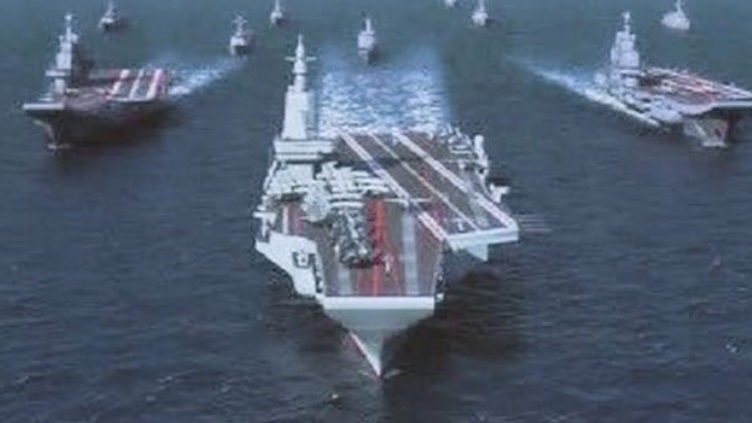
Computer-generated imagery has emerged showing what could be the design for China’s People’s Liberation Army Navy’s (PLAN’s) third aircraft carrier, which is believed to under construction at the Jiangnan Changxingdao shipyard in Shanghai.Released on 20 June, the image, which was shown during a meeting of senior China Shipbuilding Industry Corporation (CSIC) executives, depicts three carriers, two of which are configured for short take-off but arrested recovery (STOBAR) aircraft operations using a ski-jump; and a third one (in the centre of the image) configured for catapult-assisted take-off but arrested recovery (CATOBAR) operations.The image, which was initially posted on CSIC’s WeChat social media page but later deleted, can be interpreted as representing China’s two Kuznetsov-class carriers – Liaoning and an as yet unnamed one that is undergoing trials – and the third carrier, which had already been expected to have a flat deck and feature electromagnetic catapults rather than steam-powered ones.
link.
China Times also has a story on it.
Sunday, May 20, 2018
China's 2nd Aircraft Carrier is Undergoing Sea Trials
China launched its first domestically produced aircraft carrier earlier for sea trials this week at the northeastern port of Dalian, in the south of Liaoning Province, China. The new ship has not been named yet and carries the temporary designation “Type 001A”.The new Type 001A is a slightly larger vessel than China’s previous aircraft carrier, the Liaoning, that was purchased from Ukraine in 1999 and originally built in 1985 in the then-Soviet Union as a Kuznetsov-class aircraft cruiser. Liaoning has had three names: first christened as the Riga under Soviet use, then renamed the Varyag and finally the Liaoning after the Chinese purchase in 1999. Analysts report the primary role of the Liaoning has been a training vessel for the development of Chinese carrier doctrine and operations.The new Type 001A is 315 meters long and 75 meters wide as compared to the slightly smaller Liaoning that is 304 meters long and 70 meters wide. Both ships displace roughly 50,000 tons, significantly less than the Nimitz-class carriers with a loaded displacement of between 100,000–104,000 tons. The U.S. Nimitz-class carriers are also longer at 333 meters.
link.
China’s first domestically developed aircraft carrier left its northeastern port to begin sea trials on [May 13th], state media said, the latest milestone in the country’s efforts to modernize its military.
link.
China’s first homebuilt aircraft carrier has left for its first set of sea trials on Sunday, according to state-controlled media.The yet-unnamed Type 001A carrier was unmoored and moved by tugs from its berth at the Dalian shipyard and headed out to sea, according to photos released by the state-controlled Xinhua News Agency said on Sunday.“The sea trials will mainly test the reliability and stability of the carrier’s power system and other equipment,” the state-controlled agency said.“Construction on the carrier has been carried out as planned since it was launched in April last year, and equipment debugging, outfitting and mooring tests have been completed to make it ready for the trial mission at sea.”The length of the trials was not announced but a local notice to mariners restricted a portion of the Yellow Sea near the shipyard from Sunday to Friday.
link.
Sunday, October 08, 2017
China's Land Based Carrier Mockup is Changing
A recently published image of modifications made to China’s land-based aircraft carrier development facility at Wuhan reflects the ongoing work supporting the development of the country’s third aircraft carrier, commonly known as the Type 002.Published in Chinese online forums in early September, the image shows that the height of the island's forward upper superstructure on the carrier mock-up has been increased to facilitate faring in the array panels of the phased array radar.
link.
Friday, December 09, 2016
Russian Kuznetsov Aircraft Carrier Loses Su-33 due to Arrestor Hook Failure
The Russian Navy's Admiral Kuznetsov air wing suffered its second loss in less than a month when a Sukhoi Su-33 'Flanker' combat aircraft crashed into the sea following a landing mishap, the Kremlin confirmed on 5 December.
The multirole fleet defence fighter crashed into the Mediterranean Sea off the coast of Syria after one of the ship's arrestor cables snapped, state media quoted the Russian defence ministry as saying. The accident happened just days after a MiG-29KR 'Fulcrum' was forced to ditch into the sea on 14 November after a problem with Admiral Kuznetsov's arrestor cable had prevented it from landing before the pilot ran out of fuel. On both occasions, the pilots were rescued.
With these losses the carrier's fixed-wing combat force of at least five Su-33s and four MiG-29Ks has been depleted by about 20%, just weeks into its much vaunted debut operational deployment.
link.
Friday, December 02, 2016
Russian Naval Aircraft now Operating From Airbase, not Kuznetsov Aircraft Carrier
Many of the fast jets that were embarked on the Russia aircraft carrier Admiral Kuznetsov have been flown to the main Russian air base in Syria, Airbus Defence and Space satellite imagery obtained by IHS Jane's shows.
The imagery shows eight Russian Federation Navy Su-33 and one MiG-29KR jets alongside various Russian Aerospace Forces (VKS) aircraft at Humaymim Air Base in Latakia province on 20 November.
Kuznetsov can carry around 20 fast jets and is known to have embarked at least eight Su-33s for its current deployment in the Eastern Mediterranean, and at least four of the new MiG-29KR multirole fighters for the first time. One of the new jets crashed on 14 November, an incident that a Russian Ministry of Defence (MoD) statement attributed to an unspecified "equipment fault during an approach for deck landing".
link.
Friday, November 18, 2016
A MiG-29K From Russian Aircraft Carrier Crashed in the Mediterranean Sea
As reported by Combat Aircraft a Russian Navy Mig-29KUBR embarked aboard Adm. Kuznetsov aircraft carrier has crashed on Nov. 13.
The aircraft is one of the four naval Fulcrums operated by the 100th Independent Shipborne Fighter Aviation Regiment.
According to our sources, the incident occurred around 14.30Z and involved a two-seater Fulcrum in a formation of three Mig-29s operating from the carrier in the eastern Mediterranean Sea off Syria: whilst one of the remaining aircraft recovered aboard the Kuznetsov the third one diverted for unknown reasons to Syria.
Footage allegedly showing Mig-29s in the skies over Aleppo had happered earlier on the same day.
link.
China's 1st Aircraft Carrier Ready for Combat

China's first aircraft carrier is now ready to engage in combat, marking a milestone for a navy that has invested heavily in its ability to project power far from China's shores.
The Liaoning's political commissar said in an interview with Tuesday's Global Times newspaper that his ship is "constantly prepared to fight against enemies," signaling a change from its past status as a platform for testing and training.
Senior Captain Li Dongyou's comments appear to indicate that the ship has taken on its full aviation complement. Purchased as an incomplete hull from Ukraine more than a decade ago, it was commissioned in 2013.
China hasn't described specifically how it intends to use the Liaoning, but it is seen as helping reinforce China's increasingly assertive claims in the South China Sea in the face of challenges from the U.S. Navy and others.
Friday, September 09, 2016

Wednesday, August 03, 2016

Thursday, July 21, 2016
Flight Deck is Nearly Complete on China's First Indigenous Aircraft Carrier
Satellite imagery captured on 10 July reveals that most of the flight deck has been installed on China's first indigenous aircraft carrier (CV), the Type 001A, which is under construction at Dalian shipyard.
The Airbus Defence and Space image shows that significant progress has been made on the CV's hull since the last time construction was observed in late May 2016. For instance, between 17 May and 10 July most of the starboard and port flight deck overhanging sections were installed. The only significant flight deck component still absent was the bow's ski-jump section.
link.
Wednesday, July 13, 2016
Developing a new Schtorm Aircraft Carrier Might Cost Russia $15 Billion, but is being Offering to India
The cost of developing an aircraft carrier for the Russian Navy may have a price tag of 1 trillion rubles ($15 billion). The construction of such a ship may cause financial problems for both the Russian Defense Ministry and the whole of the country, expert Sergei Ischenko writes in an article on the Svobodnaya Pressa news website.
link.
Russian shipbuilding officials have offered New Delhi their nuclear-powered design for an Indian Navy’s aircraft carrier, according reports.
The Krylovsky State Research Center (KRSC) has offered the nuclear-powered Project 23000E Shtorm carrier to India via a delegation that visited the country last week, according to the report in Defense News.
The offer from the St. Petersburg design agency comes as the U.S. and the Indian Navy are cooperating on aircraft carrier technology. The Indians are interested in what tech the U.S. can share – particularly the Electromagnetic Aircraft Launch System (EMALS), the next generation carrier catapult technology that will be used on the Gerald R. Ford-class carriers (CVN-78).
link.
Thursday, July 07, 2016
India STILL has Problems With Russian Naval Fighters & 'new' Aircraft Carrier
There are still a number of problems with India's Russian-built Mikoyan MiG-29K/KUB aircraft, as well as with the aircraft carrier formerly known as Admiral Gorshkov that entered Indian Navy service in 2013, sources in India have told IHS Jane's .
The complaints about the MiG-29K/KUB aircraft are generally due to the inability of the Russian firm RSK-MiG to deliver a complete aircraft that incorporates all of the features promised in the contractual documents signed by both parties.
Indian experts who have visited the test base at Goa, where flight training with the aircraft is conducted, report that the MiG-29Ks are being delivered to India in a substandard configuration. The aircraft, said one specialist who visited the Goa base recently, "are literally being upgraded and brought up to spec while on the flightline".
The chief culprit in this dilemma, say both Indian and Russian specialists, are the combined embargoes enacted by the Ukrainian government that bar the export of any military-use items to Russia, along with the EU and US sanctions that prohibit the export of Western military components to Moscow. The 'workaround' has been for India to import these items directly, then have them integrated onto the aircraft on-site at the Goa base.
link.
Sunday, March 20, 2016

Tuesday, March 08, 2016
Second Chinese Aircraft Carrier to get J-15 Fighters, Displace 50,000 Tons
China's second aircraft carrier will be larger and will be equipped with J-15 fighter jets, a rear admiral and a member of the National Committee of the Chinese People's Political Consultative Conference said.
The new aircraft carrier will be larger than aircraft carrier Liaoning, though it will still carry the J-15, China's first-generation multipurpose carrier-borne fighter jet, Yin Zhuo - also a senior researcher with the People's Liberation Army Navy Equipment Research Center - was quoted by news site cnr.cn as saying Sunday.
The Liaoning has a full displacement of more than 50,000 tons, the Xinhua News Agency reported.
Yin said the new aircraft carrier will also feature a new design that will allow the vessel to carry more ammunition, aircraft and fuel, greatly improving its self-sufficiency and combat effectiveness at sea.
Yin also revealed that the aircraft on the new carrier will be similar to the Liaoning and will include early warning aircraft, anti-submarine aircraft and health evacuation helicopters, in addition to the J-15 fighters.
link.
Saturday, February 06, 2016
US Navy Work With India to Design Next Indian Aircraft Carrier Making Progress
India and the United States are making progress in talks on the joint development of an aircraft carrier for India, the top U.S. navy admiral said on Wednesday, potentially the biggest military collaboration between them.
The two countries agreed to work together on aircraft carrier technology as well as jet engines during U.S. President Barack Obama's visit to India last year in a strengthening of ties to balance China's expanding military power in the region.
The visiting chief of U.S. Naval Operations, John Richardson, said the two sides had held talks on a range of issues relating to the next generation Indian carrier from its design to construction.
A high-level U.S.-India joint working group is due to meet in New Delhi later this month, part of a series of meetings aimed at establishing broader cooperation on the design, development and production of the proposed Indian carrier.
"We are making very good progress, I am very pleased with the progress to date and optimistic we can do more in the future. That's on a very solid track," Richardson told reporters in New Delhi.
link.
Tuesday, January 05, 2016
China Confirms Building 2nd Aircraft Carrier

(img src)
China is building its second aircraft carrier, this time entirely with domestic technology, its Defense Ministry said Thursday, in a leap in its naval development that is increasingly tipping the regional balance of power.
The 50,000-ton vessel is being built in the northern port of Dalian and will be conventionally, rather than nuclear, powered, ministry spokesman Col. Yang Yujun told reporters at a news conference.
The yet-to-be-named vessel will carry J-15 fighter-bombers and other aircraft and use a ski jump mode for launching fixed-wing aircraft, Yang said. The J-15 is a copy of Russia's Sukhoi Su-33.
"After an overall consideration of various factors, the relevant authorities started the research and development of China's second aircraft carrier which is currently under independent design and construction," Yang said.
Monday, December 28, 2015
Subscribe to:
Posts (Atom)