Showing posts with label permafrost. Show all posts

Sunday, January 03, 2016

North Slope Permafrost Melting Faster Than Expected


New projections of permafrost change in northern Alaska suggest far-reaching effects will come sooner than expected, scientists reported this week at the fall meeting of the American Geophysical Union.

"The temperature of permafrost is rapidly changing," said Vladimir Romanovsky, head of the Permafrost Laboratory at the University of Alaska Fairbanks Geophysical Institute.

"For the last 30 years, the mean annual ground temperature at the top of permafrost on the North Slope has been rising," Romanovsky said. The mean annual ground temperature -- an average of all of the years' highs and lows at the Deadhorse research site -- was 17.6 degrees Fahrenheit (minus 8 degrees Celsius) in 1988, and now it's 28.5 F (minus 2 C). Researchers expect the average annual ground temperature to reach 32 F (0 C), the melting point of ice, in many areas.

"We believe this will be before 2100 at many locations within the North Slope," Romanovsky said.

Romanovsky and his team, including UAF's Dmitry Nicolsky and Santosh Panda, entered data from several models, as well as their own on-the-ground observations, into the Geophysical Institute Permafrost Laboratory model, which primarily examines effects of climate and surface disturbances on permafrost.

They projected what would happen to permafrost in two possible scenarios.

A moderate scenario assumes worldwide carbon dioxide emissions will continue to decline at the modest rate they are now. This will lead to carbon dioxide levels in the Earth's atmosphere leveling off by roughly 2050 and staying constant until the end of the century.

"In this scenario we will see substantial thawing of permafrost on Alaska's North Slope, but only in certain areas, particularly the foothills north of the Brooks Range," Romanovsky said.

The extreme scenario assumes worldwide carbon dioxide emissions continue at today's rates. In that case, permafrost thawing on the North Slope will be much more significant and will extend beyond the foothills and into the Arctic coastal plain, Romanovsky said. In this outcome, the results at 2050 would be similar to the outcome in the moderate scenario, but after 2050 permafrost thawing would accelerate. More than half of the permafrost on the North Slope would be thawing by 2100 in this scenario.

"Under these conditions, the permafrost will become unstable beneath any infrastructure such as roads, pipelines and buildings," Romanovsky said. "The result will be dramatic effects on infrastructure and ecosystems."

Thursday, October 23, 2014

Methanoflorens stordalenmirensis: A Potentially Potent Microbial Amplipher to Anthropogenic Global Warming

Tiny soil microbes are among the world's biggest potential amplifiers of human-caused climate change, but whether microbial communities are mere slaves to their environment or influential actors in their own right is an open question. Now, research by an international team of scientists from the U.S., Sweden and Australia, led by University of Arizona scientists, shows that a single species of microbe, discovered only very recently, is an unexpected key player in climate change.

The findings, published in the journal Nature, should help scientists improve their simulations of future climate by replacing assumptions about the different greenhouse gases emitted from thawing permafrost with new understanding of how different communities of microbes control the release of these gases.

Earlier this year, the international team discovered that a single species of microbe, previously undescribed by science, was prominent in permafrost soils in northern Sweden that have begun to thaw under the effect of globally rising temperatures. Researchers suspected that it played a significant role in global warming by liberating vast amounts of carbon stored in permafrost soil close to the Arctic Circle in the form of methane, a powerful greenhouse gas trapping heat in the Earth's atmosphere. But the actual role of this microbe — assigned the preliminary name Methanoflorens stordalenmirensis, which roughly translates to "methane-bloomer from the Stordalen Mire" — was unknown.

The new research nails down the role of the new microbe, finding that the sheer abundance of Methanoflorens, as compared to other microbial species in thawing permafrost, should help to predict their collective impact on future climate change.

"If you think of the African savanna as an analogy, you could say that both lions and elephants produce carbon dioxide, but they eat different things," said senior author Scott Saleska, an associate professor in the UA's Department of Ecology and Evolutionary Biology and director of the UA's new Ecosystem Genomics Institute. "In Methanoflorens, we discovered the microbial equivalent of an elephant, an organism that plays an enormously important role in what happens to the whole ecosystem."

Significantly, the study revealed that because of these microbial activities, all wetlands are not the same when it comes to methane release.

Wednesday, July 30, 2014

More Mysterious Giant Holes Have Appeared in Siberian Russia

Two more craters of unknown origin have been spotted in Russia's Siberia region, weeks after a similar-looking hole was found in the isolated northernmost area, a local paper reported.

The Siberian Times, an English-language newspaper, published pictures of two new giant holes discovered by reindeer herders, one located in the Yamal and the other in the Taymyr peninsula, both above the Arctic circle.

Thursday, July 10, 2014

Canada's Struggles With Climate Change Impacts

In 2006, reduced thickness of ice roads forced the Diavik Diamond Mine in Northern Canada to fly in fuel rather than try to transport cargo across melted pathways, at an extra cost of $11.25 million.

The mountain pine beetle outbreak in British Columbia—fueled by higher winter temperatures that allow insects to survive—expanded in recent years to be 10 times greater than any previously recorded outbreak in the province. Mortality rates of sockeye salmon, meanwhile, have increased because of higher water temperatures in the Fraser River.

These examples are among many in Canada's national climate assessment—an overview from the national government of existing climate science affecting the country. It also includes government and industry adaptation activities, such as new electricity forecasts for hydropower because of projected water flow shifts.

While focused on Canada, the overview holds relevance for global industries, such as oil sands developers potentially affected by floods and shippers traversing Canadian waterways, analysts say.

The report released by Natural Resources Canada—a third national assessment of climate impacts in the country—also provides more detail than a regional chapter on North America in the Intergovernmental Panel on Climate Change documents released this year.

Wednesday, October 30, 2013

Warming of Permafrost on Siberian Coast is Greatly Increasing Erosion


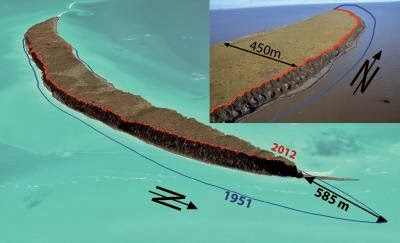
This photo illustration shows the erosion of the east-Siberian island Muostakh. The blue line marks ist coastal line in the year 1951, the red line presents its status in the year 2012. In the upper right corner one can see an aerial picture of the island's northern tip, taken in the year 2012. At its narrowest point the island is shrinking more than four meters per year.
The high cliffs of Eastern Siberia – which mainly consist of permafrost – continue to erode at an ever quickening pace. This is the conclusion which scientists of the Alfred Wegener Institute, Helmholtz Centre for Polar and Marine Research have reached after their evaluation of data and aerial photographs of the coastal regions for the last 40 years. According to the researchers, the reasons for this increasing erosion are rising summer temperatures in the Russian permafrost regions as well the retreat of the Arctic sea ice. This coastal protection recedes more and more on an annual basis. As a result, waves undermine the shores. At the same time, the land surface begins to sink. The small island of Muostakh east of the Lena Delta is especially affected by these changes. Experts fear that it might even disappear altogether should the loss of land continue.

The interconnectedness is clear and unambiguous: The warmer the east Siberian permafrost regions become, the quicker the coast erodes. "If the average temperature rises by 1 degree Celsius in the summer, erosion accelerates by 1.2 meters annually," says AWI geographer Frank Günther, who investigates the causes of the coastal breakdown in Eastern Siberia together with German and Russian colleagues, and who has published his findings in two scientific articles.
link.