Showing posts with label aviation week. Show all posts

Thursday, February 25, 2016

DARPA's Aviation Shopping List: Drones, X Planes & Hypersonics, oh my!

DARPA is up to mischief again. In some cases, mischief that has been delayed by budgets and elsewhere.

1. AFRE (Advanced Full-Range Engine) seems to be taking over from the old MOTR. Both were/are engines that were supposed to work from subsonic all the way up through high supersonic or even potentially low hypersonic speeds. This sounds a lot like the concept Lockheed's SR-72 was supposed to work with. This is at the the (re)kick off stage with a request for $9 M.

2. Hypersonic weapons! DARPA has two hypersonic weapon programs requested. HAWC (Hypersonic Air-breathing Weapon Concept), a hypersonic scramjet powered cruise missile as I understand it and has requested $49.5M for completing the first CDR and ground tests of the hydrocarbon powered scramjet. DARPA has also asked for $22.8M for TBG (tactical boost glide weapon): an air launched, rocket powered hypersonic boost glide warhead. They want to launch from existing aircraft and be compatible with the Navy's VLS system. The TBG is intended to be test launched by the end of 2017.

3. Despite rumors of the XS-1 being canned in December, due to fuel danger problems, it seems DARPA has requested an additional $50.5M for the small sat launcher.

4. DARPA has also requested $52M for a VTOL X Plane with a selection on source *this* quarter and have a flying demo by the end of 2017. Is this something leaking in from the Black? Should we call the move from the black to white world 'white washing?'

5. TERN gets another $12M for CDR and assembly of the VTOL Predator equivalent for shipboard use on destroyers, cruisers and frigates.

6. Finally, at least for this post, Gremlins, the effort to design and build UAVs that can be launched and recovered in the air gets an additional $36M requested.

I am really intrigued with the VTOL X Plane. If its jet powered, I'd be really surprised given the time frames. Maybe its not?

Wednesday, October 15, 2014

More on Lockheed's Fusion Reactor From Aviation Week


Hidden away in the secret depths of the Skunk Works, a Lockheed Martin research team has been working quietly on a nuclear energy concept they believe has the potential to meet, if not eventually decrease, the world’s insatiable demand for power.

Dubbed the compact fusion reactor (CFR), the device is conceptually safer, cleaner and more powerful than much larger, current nuclear systems that rely on fission, the process of splitting atoms to release energy. Crucially, by being “compact,” Lockheed believes its scalable concept will also be small and practical enough for applications ranging from interplanetary spacecraft and commercial ships to city power stations. It may even revive the concept of large, nuclear-powered aircraft that virtually never require refueling—ideas of which were largely abandoned more than 50 years ago because of the dangers and complexities involved with nuclear fission reactors.

Yet the idea of nuclear fusion, in which atoms combine into more stable forms and release excess energy in the process, is not new. Ever since the 1920s, when it was postulated that fusion powers the stars, scientists have struggled to develop a truly practical means of harnessing this form of energy. Other research institutions, laboratories and companies around the world are also pursuing ideas for fusion power, but none have gone beyond the experimental stage. With just such a “Holy Grail” breakthrough seemingly within its grasp, and to help achieve a potentially paradigm-shifting development in global energy, Lockheed has made public its project with the aim of attracting partners, resources and additional researchers.

Thursday, July 17, 2014

Bill Sweetman Takes a Look at Textron's Scorpion

My first reaction to photos of the Textron Airland Scorpion was not positive, I will admit. The tandem cockpit, twin canted vertical stabilizers and slender straight wing made it look too much like a Citation wearing a Super Hornet costume for Halloween.

From an operational viewpoint, it seemed to be at risk of falling between two stools: not that much more survivable than a light attack aircraft in the AT-6 or Tucano class, and, in a reconnaissance mission, able to carry the same kind of sensors as a special-mission King Air, but more expensive to buy and fly, and with one very busy weapon-systems operator in the rear seat.

Before I went to Farnborough, I ran those twin tails past some people I know who really design airplanes. The Scorpion passed this test: The fuselage was wide enough, I was told, to cause problems with body slipstream blanketing the tail at high angles of attack. Two tails could be lighter than the tall single fin that would be required to get some fin area above the body wake. (I’m looking at you, M-346.)

Next, it was a matter of venturing to the Textron display, located somewhere in Surrey, to talk to Textron Airland’s president, Bill Anderson, and chief engineer, Dale Tutt.

In person, the Scorpion is quite big. At 21,250 lb. max takeoff weight, it is about the size of the M-346 or a Citation Excel, it carries a 9,300 lb. useful load, and it stands well clear of the ground. As a jet, it offers much greater speed and altitude capability than a King Air or AT-6, Anderson points out.

Monday, March 31, 2014

Sweetman Might be on to Something: USAF Neither Confirms nor Denies Texas Mystery Plane


The identity of what appears to be a blended wing-body aircraft type photographed over Amarillo, Texas, on March 10 remains uncertain, with the U.S. Air Force declining any comment on the aircraft.

Three aircraft were observed flying in formation southwest of Amarillo around 4:20 p.m. CDT, by photographers on the fence line of the city's international airport. IbOne of the aircraft could be a B-2, but the clearest color photos and monochrome images enhanced (for contrast and resolution) with commercial software suggest a blended shape with a straight trailing edge. Steve Douglass, one of the photographers and an experienced aircraft observer, says the aircraft were “larger than fighter-size” and appeared similar in wingspan to commercial traffic.

The formation was not using Mode S transponders, according to a review of records at the Flightradar24 air-traffic-tracking site. Radio transmissions apparently associated with the flight were intercepted and recorded, possibly including the call sign “Sienna.”

An Air Force representative in Washington responded to queries about the aircraft, and about flight activities at that time and place, with the statement “I have nothing for you,” a phrase long associated with responses to queries about classified programs and operations. The 509th Bomb Wing at Whiteman AFB, Mo., home of the Air Force's B-2 fleet, says that none of its aircraft were operating near Amarillo on March 10. However, test units have also flown B-2s.

The fact that three aircraft were in formation suggests an aircraft that is operational or close to reaching that status. The unidentified aircraft are not likely to have been examples of the Northrop Grumman stealth reconnaissance drone known as the RQ-180 (AW&ST Dec. 9, 2013, p. 20) because unmanned air systems are seldom flown in formation of any kind. Likewise, the Lockheed Martin demonstrator that is reportedly being built to support the Long Range Strike-Bomber program is likely to be a one-off product.

Friday, March 28, 2014

Sweetman @ AvLeak Claims Plane Chasers in Texas Find Mystery Aircraft


As far as I know, this sort of thing has happened only once since 1956.

That was when British magazines started getting eyewitness accounts and grainy photos of the Lockheed U-2, then operating out of RAF Lakenheath on its first spy flights over the Soviet Union. Classified programs have been exposed in all sorts of ways since then - for example, the A-12 Blackbird was disclosed under a degree of pressure - but until the RQ-170 Sentinel was seen at Kandahar in 2007-09 there has been no such aircraft photographed before it was declassified. (And in the case of the RQ-170, the operational security people were not trying too hard.)

With that in mind, let's look at the photos taken by Steve Douglass and Dean Muskett of an aircraft seen over Amarillo on March 10.


hmmm.  I remember the doughnuts on a rope pix from the late 80s early 90s as well.

Sunday, December 01, 2013

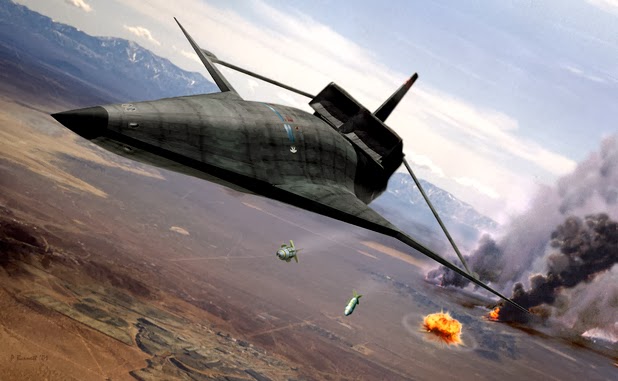
Hypersonics are not the New Stealth

Last week, Aviation Week published an opinion piece by Bill Sweetman which puts forth the argument hypersonics could be the next great advantage for the US and other countries taking the place of stealth technologies.  He lays out his arguments both in terms of physics and from the historical record.  I would like to tackle these two aspects of his argument and point out why he is wrong.

Before I begin, while I am going to argue - sort of - on the side of McNamara, I want to restate my contempt for the man.  McNamara did more damage to the US national security than almost any spy has ever done.  His legacy is the bloated, almost corrupt procurement processes which reward which cause incredible cost overruns and late delivery of weapons the US military needs. 

Furthermore, I want to state wholeheartedly I am in support of developing hypersonic technologies.  I strongly believe they are not only worth the trouble, but will bring new capabilities which we lack: prompt response and being able to overwhelm air defenses through extremely low response times are just two.  Having mucked around in material science, this is also an area I think will great benefit venturing into the hypersonic realm.   In addition, a hypersonic bomber when paired with stealth bombers makes the enemy have to prepare in two radically different ways: but this may not work and I'll explain later.

History First:

Sweetman lays out a good story about the history of the B-70 bomber, A-12, the SR-71 and the YF-12.  He states McNamara cancelled the B-70 and put the breaks on the development of the A-12 variants was because there was a strong belief the Soviets would develop missiles which would be able to take down any aircraft no matter what its altitude and speed.  McNamara then 'forced' the USAF to start designing around the idea of 'nap of the earth' flying, which Sweetman disparages.  Furthermore, he decalres McNamara was wrong: the S-200 and MiG-25 could not catch the SR-71 and no missile or aircraft was developed which could.

First off, he got something rather wrong.  Eisenhower began canning the B-70 program prior to Kennedy's election: Eisenhower restricted the development of the B-70 to a single plane!  In fact, Kennedy was in favour of the B-70 program until after he was elected and was given access to all the information: then he cancelled it.  Two very different administrations took the same view.  McNamara for all his sins, was not the villain here....despite Sweetman's stance.

Secondly, Sweetman states that the only way an SR-71 or B-70 could be taken down by a SAM (or AAW missile carried by a Mig-25) was if it was the 'instant sunshine' kind.  Guess what?  A lot of the SAMs, specifically the S-200 which he disparages, were armed with nuclear warheads.  It may seem insane to those of us which live in the early 21st century, but in the 1960s both sides deployed SAMs and AAMs with nuclear warheads.  

Third, it is true the SR-71 could not be caught without the use of a nuke.  And it is true Soviets never developed a SAM or aircraft which could catch the SR-71.  There was a really good reason: it was pointless.  Oh, not because it couldn't be done, but rather the SR-71 didn't provide anything which the spy satellites were not developing already.  Overflight was established for spy sats.  What made the SR-71 any scarier?  Nothing did.  It was an annoyance, nothing more.  One which could be herded somewhat with the MiG-25s, and later with MiG-31s, but really was not something which the Soviets needed to fear.  If its damned expensive, doesn't really help protect, why bother?  The Soviets saw it the same way and didn't.

Physics & the Future Next:

Even so, Sweetman goes on to state given no one has a way to catch a Mach 6 plane we ought to go and build either spy planes based on Lockheed's SR-72 concept or even bombers for the next generation bomber effort.

First off, there are missiles which can fly even faster which already exist.  Oh, to be sure, they are not intended for hitting aircraft.  After all, there are no aircraft which fly at Mach 6.  yet.  However, THAAD flies at Mach 8.  The PAC-3 Patriot Missile, which has a short range, flies at Mach 5.  The S-400 SAM flies at Mach 5.  As soon as hypersonic bomber appears, you bet one of these or some other missile will appear which will be able to intercept it.  The longest time frame would be ten years afterwards.  This is not the 1960s: material science as marched on, as has electronics and rocket fuel.

Secondly, bluntly, c is much faster than Mach 6.  "Huh?"  you say.  What's c?  For almost any physics geek, that ought to be obvious: c is the speed of light.  Lasers are coming out of the science fiction realm and onto the battlefield.  HELLADS, RELI, EXCALIBUR and the US Navy's FEL will all be fielded in the same time frame, if not sooner.  To go from horizon to horizon at Mach 6 takes over 45 seconds.  If a laser cannot bag something in 45 seconds, it won't be deployed.  In fact, a laser shoot down takes far less time than 45 seconds.  HELLADS, fwiw, is intended to be placed on aircraft, like the F-35A. While all of the above are American programs, one almost assuredly bet the Chinese are working on laser weapons as well and while Mach 6 aircraft are intended to handle high heat loads, lasers especially pulsed lasers, will induce higher loads, with greater shock than those materials will be able to handle.  With weapon grade lasers (100kj+), if you can see it, it dies.  Simple as that.  If you fly high, you're toast because we can see you for longer.  And to fly fast, you must fly high.

Why Build it When You Already Have the Capability:

You have to wonder what I mean, right?  No, I have no delusions of a Project Aurora.  That has never panned out.  The replacement for the SR-71 was the spy sat.  And for dealing with the need for a easily retaskable spy sat, we have the X-37B.  It works just fine.  And has flown several times.  It just needs a tweak to the system which gets it into space.  Gosh, DARPA's XS-1 program seems to fit just that.  For recon, there's no need for a SR-72.

What Use ARE Hypersonics Then?

Missiles, bluntly.  If you can fire a missile which can arrive faster than the decision time of a ship's commander from a platform that commander cannot see, then you have the advantage.  A stealthy aircraft which can pop off mach 5+ missiles can do far more damage than an aircraft which will have the IR signature of a meteor and fly way up high will.

Wrap up

Strawmen are bad to use for arguing.  The past does not reflect what Sweetman writes in his article.  The present and near future do not either.  Sweetman loves speed.  He has for a long, long time.  Its merely the future does not fit what he describes or wants.  Its far better to be not seen at all than zip along fast.  Once you are found, in the future, you die.  And there's no way to hide the Mach 6 IR signature in the era of IRST.

Friday, November 29, 2013

Sweetman @ AvWeek: Hypersonic Speed the New Stealth


Lockheed Martin has labeled the hypersonic technology to be used in the proposed SR-72 Mach 6 aircraft as the “new stealth.” It is really the old stealth, and it points to a classic example of how almost every military and political leader in Western defense fell in line behind a technical miscalculation.


He's wrong on a few points.  I ought to be well enough either on Sunday or Monday, a response will be posted. 

Friday, August 23, 2013

AvWeek: Russian PAK-FA/Sukhoi T-50 Expectd to Perform at MAKS 2013 Airshow


A highlight of the MAKS air show, which opens at Zhukovsky Airport near Moscow next week, is likely to be the demonstration of the Sukhoi T-50 PAK FA (Perspektivny Aviatsionny Kompleks Frontovoy Aviatsii—Future Tactical Air System) fighter.

The T-50 appeared at MAKS two years ago, but is now flying with updated control laws that expand its flight envelope. (The program had flown fewer than 100 test sorties between its January 2010 maiden flight and its MAKS debut.) Recent videos show the aircraft performing what appear to be sustained-altitude flat rotation maneuvers and high-angle-of-attack turns similar to those demonstrated at the Paris air show by the Su-35S. Four T-50 prototypes have now flown and a fifth is expected to fly by the end of the year. The first state acceptance trials are due to start in 2014, United Aircraft Corporation President Mikhail Pogosyan said earlier this year, and production should start in 2015.

Russian President Vladimir Putin has said that production aircraft will enter service in 2016. However, since the aircraft has yet to fly with its definitive engine, this most likely indicates that the Russian air force is reverting to Soviet-era practice by equipping an operational test unit with interim-standard aircraft while development of the objective system is completed.

Many details of the fighter's equipment and armament remain classified or unpublished. However, in recent months the Sukhoi design bureau has obtained several patents relating to the T-50, including the rationale behind the stealth fighter's configuration.

Saturday, June 29, 2013

Stealth in the 2020s


Aviation Week notes the three tiered approach the world has to stealth combatant aircraft.  Stealth manned aircraft, stealthy drones and reduced RCS aircraft.  Europe is going with reduced RCS manned aircraft and stealthy drones.  Russia is going with stealthy and nonstealthy manned aircraft (with big question mark about its unmanned efforts).  China is going stealthy all the way around, much like the US,  (or as much of this the US can afford).

The space to watch is probably the US Navy.  My guess would be you will see one or two wings of UCLASS UCAVs (probably X-47B derived).  Then a couple wings of F-35Cs.  You're going to have a wing of F/A-18Gs.  The remainder of the fixed wing aircraft will be F/A-18E/Fs until around 2030.  Then either it will be another replacement stealthy manned aircraft or UCAV. 

At any rate, compare and contrast the Russian T-50/PAK-FA vs the American F-22 underbellies.   Its so far from clean, which is necessary for stealth, I'm shocked.  Is that an ugly weld I see on the Russian?Wow.  Just plain wow.