Showing posts with label TERN. Show all posts

Thursday, February 25, 2016

DARPA's Aviation Shopping List: Drones, X Planes & Hypersonics, oh my!

DARPA is up to mischief again. In some cases, mischief that has been delayed by budgets and elsewhere.

1. AFRE (Advanced Full-Range Engine) seems to be taking over from the old MOTR. Both were/are engines that were supposed to work from subsonic all the way up through high supersonic or even potentially low hypersonic speeds. This sounds a lot like the concept Lockheed's SR-72 was supposed to work with. This is at the the (re)kick off stage with a request for $9 M.

2. Hypersonic weapons! DARPA has two hypersonic weapon programs requested. HAWC (Hypersonic Air-breathing Weapon Concept), a hypersonic scramjet powered cruise missile as I understand it and has requested $49.5M for completing the first CDR and ground tests of the hydrocarbon powered scramjet. DARPA has also asked for $22.8M for TBG (tactical boost glide weapon): an air launched, rocket powered hypersonic boost glide warhead. They want to launch from existing aircraft and be compatible with the Navy's VLS system. The TBG is intended to be test launched by the end of 2017.

3. Despite rumors of the XS-1 being canned in December, due to fuel danger problems, it seems DARPA has requested an additional $50.5M for the small sat launcher.

4. DARPA has also requested $52M for a VTOL X Plane with a selection on source *this* quarter and have a flying demo by the end of 2017. Is this something leaking in from the Black? Should we call the move from the black to white world 'white washing?'

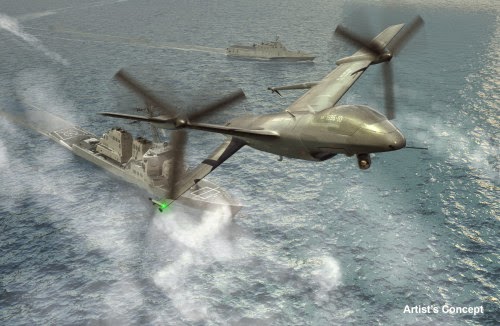
5. TERN gets another $12M for CDR and assembly of the VTOL Predator equivalent for shipboard use on destroyers, cruisers and frigates.

6. Finally, at least for this post, Gremlins, the effort to design and build UAVs that can be launched and recovered in the air gets an additional $36M requested.

I am really intrigued with the VTOL X Plane. If its jet powered, I'd be really surprised given the time frames. Maybe its not?

Tuesday, December 29, 2015

Northrop Wins $93M for DARPA TERN Drone


Northrop Grumman Systems Corp. Aerospace Systems, El Segundo, California, has been awarded a $93,076,636 Other Transaction Agreement for prototype project - Tactically Exploited Reconnaissance Node (Tern) program, Phase III. The Tern program will design, develop, and demonstrate enabling technologies and system attributes for a medium-altitude long-endurance unmanned air vehicle and shipboard-capable launch and recovery system allowing operations from smaller ships. The Tern Phase III program will focus on the design, fabrication, and testing of a prototype Tern Demonstration System. The face value of the OTA is $132,473,192 with a contractor's cost share of $39,396,556 and the total estimated government share of $93,076,636. Work will be performed in El Segundo, California; Newport News, Virginia; Benbrook, Texas; El Cajon, California; Cincinnati, Ohio; East Aurora, New York; Dulles, Virginia; Mojave, California and Spark, Nevada with an estimated completion of November 2017. Fiscal 2015 and 2016 research and development funds in the amount of $29,563,813 are being obligated at time of the award. DARPA, Arlington, Virginia, is the contracting activity (HR0011-16-9-0003).

Sunday, December 13, 2015

Northrop is Developing a Flying Wing Tailsitter for DARPA TERN

Northrop Grumman revealed a flying-wing tailsitter design as the company’s offering for an experimental unmanned air system that can bring Predator-sized payload and endurance to naval ships smaller than aircraft carriers.

The design concept forms the basis of Northrop’s proposal for the Defense Advanced Research Projects Agency’s Tern programme. DARPA plans to award the contract in January to build and fly a full-scale prototype from a barge or decommissioned navy ship, says Chris Hernandez, senior vice-president of research, technology and advanced design for Northrop.

At DARPA’s request, Northrop is not releasing pictures or drawings of its Tern concept, but displayed a model of the aircraft on a 11 December tour for journalists in Los Angeles.

Northrop’s unmanned Tern design harkens back to the manned Lockheed XFV-1 concept of the early 1950s, which also featured a tailsitter configuration with nose-mounted counter-rotating propellers to provide vertical thrust for take-off and landing and forward thrust in horizontal flight.

But Northrop adds to the tailsitter approach by combining the engine with a pure flying wing design, a hallmark of several of the company’s bomber and surveillance aircraft since the mid-1930s.

Wednesday, September 30, 2015

AeroVironment NOT Selected for DARPA's TERN Naval UAV


AeroVironment today announced it was informed by the Defense Advanced Research Projects Agency (DARPA) that the company was not selected to receive a phase III contract for DARPA’s Tern program. The announcement came after a competition for the phase III contract following successful phase I and II efforts.

Thursday, March 26, 2015

DARPA Selects Northrop Grumman, AeroVironment for TERN Ship-board UAV Program Phase 2

DARPA has awarded prime contracts for Phase 2 of Tern, a joint program between DARPA and the U.S. Navy’s Office of Naval Research (ONR). The goal of Tern is to give forward-deployed small ships the ability to serve as mobile launch and recovery sites for medium-altitude, long-endurance unmanned aerial systems (UAS). These systems could provide long-range intelligence, surveillance and reconnaissance (ISR) and other capabilities over greater distances and time periods than is possible with current assets, including manned and unmanned helicopters. Further, a capacity to launch and retrieve aircraft on small ships would reduce the need for ground-based airstrips, which require significant dedicated infrastructure and resources. The two prime contractors selected by DARPA are AeroVironment, Inc., and Northrop Grumman Corp.


My hope would be the TERN would be doing what is being touted for the UCLASS as an ISR platform.  A handful of TERNs could be based on the CVN and more scattered in the rest of the battlegroup.  The UCLASS would be then be the attack bird it ought to be.

Tuesday, October 14, 2014

DARPA's Strike & ISR MALE UAV Moving Forward


The US Defense Advanced Research Projects Agency (DARPA) is one step closer to demonstrating the launch and recovery of a medium-sized unmanned air vehicle (UAV) from a small vessel, following a $19 million preliminary design contract award to AeroVironment.

Under phase II of DARPA’s tactically exploited reconnaissance node (Tern) programme, the company will conduct “subscale flight demonstrations” over the next 12 months that will subsequently lead on to a sole-source phase III at-sea demonstration contract award.

DARPA launched the TERN effort in 2013, but joined with the US Navy’s Office of Naval Research (ONR) in May 2014 to continue the programme, which was retitled “Tern”.

The agency considers assets that provide worldwide airborne intelligence, surveillance and reconnaissance (ISR) as having weaknesses – specifically helicopters being limited by range and flight time, and manned and unmanned fixed-wing aircraft being restricted by large base and runway requirements.

“Tern envisions using smaller ships as mobile launch and recovery sites for medium-altitude long-endurance [MALE] unmanned aircraft,” DARPA says. “Ideally, Tern would enable on-demand, ship-based unmanned aircraft system operations without extensive, time-consuming and irreversible ship modifications.”

Tuesday, June 17, 2014

DARPA & US Navy ONR Ink Deal on TERN UAV for Surface Combatants

The U.S. Navy and the Defense Advanced Research Projects Agency (DARPA) have signed an agreement to launch a program to develop long-range reconnaissance drones that would launch from ships.

The program is based on an existing DARPA program called TERN, short for Tactically Exploited Reconnaissance Node, which has been exploring concepts for unmanned aerial systems that could operate from smaller Navy vessels.

"This represents a new approach to providing long-range, long-endurance aircraft based off Navy ships," Gil Graff, TERN deputy program manager from the Office of Naval Research (ONR) in Arlington, Virginia, said in a statement.

In modern warfare, the ability to strike mobile targets, or perform airborne surveillance and reconnaissance, has become critical, according to DARPA. However, current vehicles fall short in some regards — helicopters are limited by how long and how far they can fly, and existing manned and unmanned long-distance, fixed-wing aircraft require aircraft carriers or large land bases for takeoff and landing.

As an alternative, the TERN program would use smaller ships to launch and recover medium-altitude, long-range drones. The goal is to enable a full-scale demonstration, at sea, of a prototype drone launched from a vessel roughly equivalent to an Arleigh Burke-class destroyer, DARPA officials said.

Arleigh Burke-class destroyers are roughly 505 feet (154 meters) long, and are typically equipped with a variety of anti-submarine and anti-aircraft missiles.

The TERN program's initial phases will focus on preliminary designs for the unmanned vehicles. Five drone-makers are under contract for the first phase of testing; one or more groups will advance to the second phase; and one will be selected to build a full-scale prototype for ground-based testing and, ultimately, an at-sea launch and recovery demonstration, according to DARPA.
link.