Showing posts with label northrop grumman. Show all posts

Friday, August 02, 2019

NASA Sole Sources Gateway Habitation Module to Northrop

NASA has quietly decided to give Northrop Grumman a contract to build a “minimal” habitation module for its lunar Gateway after concluding it was the only company that could meet NASA’s schedule.

The agency made the determination in a low-key “Justification for Other Than Full and Open Competition” document published late July 19 on a procurement website, linked a special notice issued May 30 that stated that NASA intended to use an existing Next Space Technologies for Exploration Partnerships 2 (NextSTEP-2) program to procure the habitation module.

Under NextSTEP-2 Appendix A, NASA made awards in August 2016 to study concepts for habitation modules to six companies: Bigelow Aerospace, Boeing, Lockheed Martin, NanoRacks, Orbital ATK (now Northrop Grumman Innovation Systems, or NGIS) and Sierra Nevada Corporation. For all but NanoRacks, that work involved the development of ground prototypes followed by testing, which took place earlier this year at either NASA centers or company facilities.

In the May 30 filing, NASA said that, in “the interest of schedule, economy and efficiency,” it would procure one or more habitation modules it requires for the Gateway as a follow-on to NextSTEP-2 Appendix A. It didn’t specify the process by which it would select the company or companies to build those modules, beyond the use of justifications for other than full and open competition. It did allow other companies to submit information about their capabilities by June 13, but according to the agency none did so.

In the July 19 justification, NASA said it concluded Northrop Grumman was the only company that could provide a “minimal habitation module” on the agency’s desired schedule. “NGIS was the only NextSTEP-2 contractor with a module design and the production and tooling resources capable of meeting the 2024 deadline,” the document stated.

Wednesday, April 18, 2018

Orbital ATK Plans Next Generation Launcher Debut in 3 Years

Orbital ATK is preparing for the next phase of development for their Next Generation Launcher (NGL) – a solid and liquid fueled rocket designed for National Security, NASA science missions, and commercial flights. Under the current plan, Orbital ATK intends to introduce NGL from LC-39B at the Kennedy Space Center, FL, with certification flights in early 2021, with operational flights set to begin later that year.

NGL aims for debut in three years:

The progeny of NGL can be traced back to 2004, when then U.S. President George W. Bush announced the Constellation program, consisting of the crew launch vehicle known as Ares I – a five-segment Solid Rocket Booster (SRB) rocket, atop which sat a Liquid Oxygen/Liquid Hydrogen (LOX/LH2) upper stage.

A test flight variant of Ares I, known as Ares I-X, completed a successful test flight on 29 October 2009, shortly after which the Constellation program was cancelled by then U.S. President Barack Obama in favor of developing a more robust rocket that could carry both crew and cargo, the SLS, to locations Beyond Low Earth Orbit and shifting International Space Station crew rotation missions from NASA-made rockets to commercial rockets and capsules – a goal SpaceX and Boeing plan to fulfill.

Despite the Constellation program’s cancellation, Orbital ATK, the predecessor of which would have built the five-segment SRB for Ares I and the company that is now building the five-segment dual SRBs for SLS, continued to see a usefulness for the overall Ares I design. This initially translated in 2011 to the Liberty rocket, a five-segment SRB first stage with an Ariane V core serving as the upper stage.

link.

addendum: the new rocket is called the OmegA.

Friday, July 08, 2016

The Titan Winged Aerobot is an Intriguing Glider/Balloon Hybrid


With a suspected subterranean sea of liquid water, oceans of methane on the surface and an atmosphere that could give rise to non-water-based life, it's no surprise that scientists are keen to learn more about Saturn's moon Titan. To that end, a new joint project between the Global Aerospace Corporation (GAC) and Northrop Grumman Aerospace Systems (NGAS) is developing a new exploration vehicle designed to soar through the skies of that mysterious moon.

The proposed Titan Winged Aerobot (TWA) is inspired by Northrop Grumman's T-LEAF (Lifting Entry Atmospheric Flight) class of vehicles, which would allow the craft to gently enter the atmosphere before transitioning into flight mode. Once there, the TWA would operate like a hybrid balloon and glider, utilizing a unique buoyancy system to allow it to ascend and descend without the use of propulsion systems or flight control surfaces. Minimal moving parts means it could squeeze more juice out of a single radioisotope power source.

Thursday, April 14, 2016

Norhtrop Pushing Hard to Join Launch Industry Through XS-1 Contracts

Northrop Grumman might be "playing to win" the US Defense Advanced Research Projects Agency's XS-1 programme, but the aerospace firm's interest in a reusable spaceplane for rapidly launching small satellites runs far deeper than any one project or contract.

The company's vice-president of space systems resiliency Doug Young tells Flightglobal that Northrop will likely press forward with its XS-1 concept through "other ways and means" if it isn't downselected for the programme's $140 million demonstration phase.

Northrop is one of three industry teams sponsored by DARPA to bring its competing concept up to the preliminary design review stage. It's teamed with Virgin Galactic but wouldn't confirm if it is using the company's LauncherOne system as an expendable upper stage.

The other teams are Boeing – with Blue Origin – and Masten Space Systems, partnered with XCOR Aerospace.

Tuesday, December 29, 2015

Northrop Wins $93M for DARPA TERN Drone


Northrop Grumman Systems Corp. Aerospace Systems, El Segundo, California, has been awarded a $93,076,636 Other Transaction Agreement for prototype project - Tactically Exploited Reconnaissance Node (Tern) program, Phase III. The Tern program will design, develop, and demonstrate enabling technologies and system attributes for a medium-altitude long-endurance unmanned air vehicle and shipboard-capable launch and recovery system allowing operations from smaller ships. The Tern Phase III program will focus on the design, fabrication, and testing of a prototype Tern Demonstration System. The face value of the OTA is $132,473,192 with a contractor's cost share of $39,396,556 and the total estimated government share of $93,076,636. Work will be performed in El Segundo, California; Newport News, Virginia; Benbrook, Texas; El Cajon, California; Cincinnati, Ohio; East Aurora, New York; Dulles, Virginia; Mojave, California and Spark, Nevada with an estimated completion of November 2017. Fiscal 2015 and 2016 research and development funds in the amount of $29,563,813 are being obligated at time of the award. DARPA, Arlington, Virginia, is the contracting activity (HR0011-16-9-0003).

Wednesday, December 23, 2015

Northrop Grumman Wins Contract for 150 kilowatt Laser for Burke Class Destroyers


The U.S. Navy will get a peek at a future where high energy laser weapons could defend its ships against attack under a contract awarded Oct. 22 to Northrop Grumman Corporation (NYSE:NOC) by the Office of Naval Research (ONR).

Under the three-phase Laser Weapon System Demonstrator (LWSD) contract, the company will design, produce, integrate, and support the shipboard testing of a 150-kilowatt-class solid state (electric) laser weapon system.

The initial award of $53 million will support work planned for the next 12 months. The contract could grow to a total value of $91 million over 34 months if ONR exercises all of its contract options.

"Northrop Grumman is integrating the latest in high energy lasers with more than 40 years of experience as a laser weapon system integrator to protect sailors against last-minute, high impact threats," said Guy Renard, director and program manager, directed energy, Northrop Grumman Aerospace Systems. "For about the price of a gallon of diesel fuel per shot, we're offering the Navy a high-precision defensive approach that will protect not only its sailors, but also its wallet."

During Phase 1 of the LWSD contract, Northrop Grumman will develop a detailed design for the new system. Phase 2 will include assembly and ground test of the system, while Phase 3 will comprise at-sea testing of the system aboard the Navy's Self Defense Test Ship (SDTS). The Navy will lead this testing with Northrop Grumman providing technical support. The SDTS is the former USS Paul F. Foster (DD-964).

Sunday, December 20, 2015

Stealth Saga #18

UAV/UCAV:

British Aerospace has stated the Taranis has, in fact, had its last test flights.

France will continue the testing of the Neuron UCAV demonstrator through 2016.  Aviation Week has a nice photo gallery of the Neuron.

The US Navy's UCLASS got $300M in the final budget for a competition and must be a highly stealthy, strike platform.

AMCA:

India is getting  the F-414 Enhanced Engine for its AMCA Fifth Generation Fighter.

Tornado Replacement: 

Germany is looking at an optionally manned Tornado replacement.

Long Range Strike Bomber:

Boeing is doubling down on its protest about the LRS-B contract award and calling the selection process fundamentally flawed.

6th Generation American Fighters:


Northrop  FA-XX (left) and F-X (right).

 Northrop has released its latest concept for a Sixth Gen Fighter. It uses lasers and is a cranked kite. Thermal management due to the use of lasers is the primary concern given it is supposed to be a stealth aircraft.

Aviation Week also discusses Northrop's 6th gen concept.

Foxtrot Alpha also discusses the concept as well, but with some skepticism.

I venture my own opinions as well.

 F-35:

The USS America amphibious assault carrier, ahem, ship has been upgraded to work with the F-35B.

Norway has ordered six more F-35s.

Singapore is not in a rush to buy the F-35.

Israel is interested in F-35Bs now.

Japan has started putting together its first locally assembled F-35.

Israeli firms have earned $770 million worth of business for their part in the F-35.

Sunday, December 13, 2015

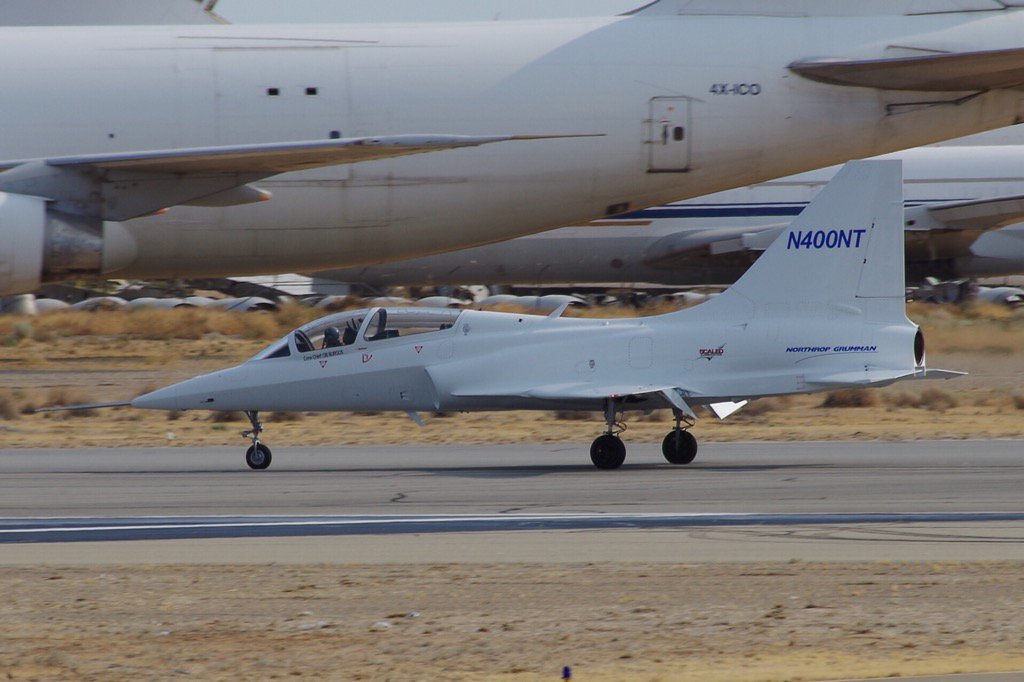
A “Slightly” Outdated Northrop Grumman’s T-X Advanced Trainer Looks a lot Like an Updated T-38

A private unveiling of a “slightly” outdated Northrop Grumman’s T-X advanced trainer model reveals an unmistakeable likeness with the T-38 Talon and a strategic focus on cost control to win the hotly-contested US Air Force competition.

Northrop plans to publicly unveil and fly an internally funded prototype of the company’s T-X trainer concept early next year. Offering a sneak-peek to journalists on 10 December, Tom Vice, president of Northrop’s Aerospace Systems sector, appeared visibly conflicted over whether he should give away key features of the concept up to the last concept.

In the end, he decided to lift the veil on the model, but not allow pictures. The aircraft unveiled early next year at Northrop’s flight test base in Mojave, California, will include small changes, he adds.

“When you’re in Mojave and see the final design you’ll see a slightly different airplane,” Vice says, “but this will give you a good indication of where we’re heading.”

The model revealed a low-winged trainer with cheek-mounted fan inlets, an area-ruled fuselage, a structural chine running backward from the nose and a conventional single tail. Comparisons to the existing T-38 design were unavoidable, a fact acknowledged by Kevin Mickey, vice-president of advanced design at Northrop.

Northrop is Developing a Flying Wing Tailsitter for DARPA TERN

Northrop Grumman revealed a flying-wing tailsitter design as the company’s offering for an experimental unmanned air system that can bring Predator-sized payload and endurance to naval ships smaller than aircraft carriers.

The design concept forms the basis of Northrop’s proposal for the Defense Advanced Research Projects Agency’s Tern programme. DARPA plans to award the contract in January to build and fly a full-scale prototype from a barge or decommissioned navy ship, says Chris Hernandez, senior vice-president of research, technology and advanced design for Northrop.

At DARPA’s request, Northrop is not releasing pictures or drawings of its Tern concept, but displayed a model of the aircraft on a 11 December tour for journalists in Los Angeles.

Northrop’s unmanned Tern design harkens back to the manned Lockheed XFV-1 concept of the early 1950s, which also featured a tailsitter configuration with nose-mounted counter-rotating propellers to provide vertical thrust for take-off and landing and forward thrust in horizontal flight.

But Northrop adds to the tailsitter approach by combining the engine with a pure flying wing design, a hallmark of several of the company’s bomber and surveillance aircraft since the mid-1930s.

Saturday, December 12, 2015

Another Look (with some Skepticism) at Northrop's 6th Generation Fighter Concept

Even as the Pentagon is struggling to figure out a way to afford and field its fifth-generation fighter of choice, the F-35 Joint Strike Fighter, the Navy and the USAF—along with industry—are looking at what comes next. This sixth-generation fighter initiative is loosely known as the “F-X program” for the USAF and the “FA-XX” for the Navy.

The F-X program will look to finally replace the F-15 Eagle, as well as the F-22 Raptor, and the FA-XX program aims to replace the F/A-18E/F Super Hornet. This new aircraft will be as much about reusable weaponry (lasers) as it is about expendable weaponry. Development of solid-state airborne laser capability is already well underway in the white world, and has most likely experienced other application gains in the black world.

Friday, December 11, 2015

Aviation Week on Northrop's 6th Generation Fighter Concept


Amid signs of growing U.S. Air Force and Navy interest in a sixth-generation combat aircraft, Northrop Grumman is accelerating studies of key technologies for directed energy weapons and thermal management, which it says will be fundamental to future capability.

The company, whose last venture into the air dominance arena in the 1980s, the YF-23, lost out to Lockheed Martin’s F-22 in the advanced tactical fighter contest, has unveiled new images of a pair of optionally manned, tailless concepts aimed at replacing the Raptor and the Boeing F/A-18E/F. While acknowledging there are still more unknowns than knowns about future requirements for the next generation air dominance (NGAD) aircraft, Northrop says technology to cope with dramatic growth in heat loads will be a key enabler to whatever needs emerge.

The increase in heat loads is driven by the development of advanced weapons, particularly airborne lasers, as well as more powerful electronics, sensors and propulsion systems. The issue, which has already been a factor in early test and operations of the F-35, is expected to challenge all NGAD concepts. Under Northrop’s NGAD umbrella this includes the U.S. Air Force’s F-X requirements (now set to embrace an F-15C replacement in addition to the F-22), as well as the Navy’s F/A-XX mission.

Unlike any previous generation of air dominance aircraft at this embryonic stage, the configuration will be directly impacted by the integration challenges of directed energy weapons. “One of the unique things that happened (on NGAD) is the convergence of aircraft and weapons,” says Tom Vice, Northrop Grumman Aerospace Systems president. Despite the miniaturization of laser technology and the switch from bulky chemical-based systems to solid-state, electric lasers, Vice says thermal management is still key.

[...]

Range will be another important design driver, though perhaps not for the usual reason. “We anticipate limited basing in the future,” says Hernandez. “If range is important, then you’ll need to carry a lot of weapons. The other thing we know is that the adversaries have been increasing their defensive capabilities. So survivability is going to be really important. So this looks like a little baby B-2. That’s Northrop’s sweet spot,” he adds.

Northrop Releases 6th Generation Fighter Concept, States Thermal Management Biggest Problem


Thermal management will be a critical factor in a brewing competition to replace hundreds of Lockheed Martin F-22s and Boeing F/A-18E/F Super Hornets, says a top Northrop Grumman executive.

Releasing a new artistic concept of a so-called sixth-generation fighter on 11 December, Northrop Aerospace Systems president Tom Vice singled-out the critical but often overlooked quality of managing all the heat generated by ever-more powerful weapons and sensors anticipated on future combat aircraft.

Northrop’s sixth-generation fighter concept shows the stealthy, swept-wing fighter using a powerful laser weapon to engage multiple targets. Even the best high-power lasers are only 32-33% efficient, meaning 2MW of heat is generated for every 1MW of energy that can be formed into a laser beam, Vice says.

That creates a difficult problem for a stealthy combat aircraft. Venting the heat offboard only raises the aircraft’s visibility to heat-sealing sensors. Another option is to develop a thermal accumulator, which is a path the Air Force Research Laboratory is pursuing under the INVENT programme. An electrical accumulator stores the energy onboard in the same way as a hydraulic accumulator, releasing the latent energy as necessary to generate a surge of power.

But Northrop’s sixth-generation fighter concept eschews the accumulator concept for thermal management. According to Vice, such a system imposes a limitation on the laser weapon’s magazine size or firing rate, forcing the pilot to exit combat until the accumulator is refilled with energy. Northrop is pursuing a concept instead that does not rely on accumulators or offboard venting to manage the heat, but Vice declines to elaborate on the company’s specific approach to solving the thermal management problem.

Monday, November 16, 2015

Pratt & Whitney Jet Engine to Power Long Range Strike Bomber (if GAO shoots down protest)

As the aerospace world anxiously awaits the Government Accountability Office’s verdict on whether to allow Northrop Grumman to begin construction on the Pentagon’s Long Range Strike-Bomber (LRS-B), new details help paint a clearer picture of who will build crucial parts and systems.

[...]

If Northrop builds LRS-B, GE Aviation will manufacture the primary and secondary power distribution systems, not the plane's engine, according to a source with knowledge of the program. GE was partnered with the Boeing-Lockheed Martin team on the power plant, the source said.

The news that GE is not the winning engine maker fuels speculation that Northrop's bomber will be powered by Pratt & Whitney engines. Although nothing is certain, some have hypothesized that LRS-B will use Pratt's F135 engines, according to a recent analysis by Jim McAleese.


The rumor is the engine is an ADVENT derivative with an F135 core.

Wednesday, November 11, 2015

The US Air Force Believes Long Range Strike Bomber Contract is Safe From Successful Protest

The US Air Force is “confident” that the award of the Long Range Strike-Bomber (LRS-B) contract to Northrop Grumman can withstand the protest recently filed by losing team Boeing and Lockheed Martin, top leadership said here today.

“I am confident that we collectively — and again, 'we' the Air Force, but we had independent peer reviews, as well — that, collectively, we did a very thorough job,” Secretary of the Air Force Deborah Lee James said during a Nov. 10 press conference at the Dubai Air Show. “The evaluation was done according to the [Request for Proposal] evaluation factors.”

The Pentagon announced Northrop as the winner for the competition, which aims to provide 80-100 new bombers for the service to replace the B-52 and B-1 fleets, on Oct. 27. On Nov. 6, Boeing and Lockheed filled their formal protest with the Government Accountability Office.

Friday, November 06, 2015

Some Oddities About LRS-B Contract and Protest Noted by AvWeek

Not surprisingly, the Long-Range Strike Bomber protest is on. Boeing and Lockheed Martin claim the Air Force’s selection of Northrop Grumman for the development and early production work – worth $23.5 billion – was bungled. The service failed to conduct a proper assessment of the risk for both teams to execute the work and neglected to account for modern advances in manufacturing and life-cycle maintenance, all of which would reduce the cost of such a program, according to Loren Thompson, a Washington DC-based analyst. Thompson’s think-tank receives funding from both Boeing and Lockheed Martin, and the latter employs him as a consultant; he publicly endorsed the Boeing/Lockheed Martin bid despite the requirements and source-selection criteria being classified. Thompson receives no funding from Northrop Grumman.

The losers filed their protest with the Government Accountability Office Nov. 6 after receiving their debrief Oct. 30 from the Air Force.

And, not surprisingly, the other protest is on. You see, in Washington, there’s the protest – filed with GAO and subject to a 100-day audit – and there’s the Protest – the political campaign to disparage the agency that made the alleged flawed choice and its entire strategy. The latter is designed as an end run to whatever the GAO may rule. By undercutting the agency and its strategy at the knees in Congress, pressure can force an agency into submission regardless of a GAO ruling.

These are two parallel but separate avenues in any defense contractor’s red book for major programs; all the contractors keep war plans for protests alongside the process of bidding for programs these days. I’ll outline the two strategies below.

[...]

One new data point: The estimated price of the bids! Ta-da! Thompson said in his Nov. 6 Forbes piece that the Air Force unfairly doubled the estimate at completion for the work of both contractors. He later told me that each bidder was in the $10-$11 billion range, far below that $23.5 billion independent cost estimate, with Northrop coming in at a lower cost. He did not, however, have the cost of the actual contract.

If this is true, and the Air Force padded both contractors’ bids by 100%, this would certainly be unusual and worth a second look.


Boeing and Lockheed Protest Long Strike Range Bomber Contract Award to Northrop

Boeing, which along with partner Lockheed Martin submitted the losing bid in the competition to build the US Air Force's new Long Range Strike Bomber, filed a protest Friday with the Government Accountability Office over the DoD awarding the contract to Northrop Grumman on Oct. 27.

The GAO now has 100 days to review the protest and issue a ruling.

Boeing and Lockheed Martin concluded the selection process for the Long Range Strike Bomber was fundamentally flawed, the companies said in a joint statement. Specifically, they take issue with the cost evaluation performed by the government for not properly rewarding the team's proposals to break the upward-spiraling historical cost curves of defense acquisitions, and for not properly evaluating the relative or comparative risk of Northrop Grumman's ability to perform, as required by the solicitation.

Tuesday, October 27, 2015

Stealth Saga #12: Northrop Does a Victory Lap

India has built an RCS range for its future aviation development.

The Long Range Strike Bomber contract was awarded to Northrop Grumman.  Very little information was shared with the public about the aircraft.  It is reported to be $511M per plane in 2010 dollars and $564M in 2016 dollars.  There are lots of rumors as to what happened.  First is that NG took a very conservative approach to the project to make sure they would not go over on the budget.  Lockheed/Boeing (BoLock) supposedly went heavy on the new tech.  They supposedly kept within the budget requirements, but it might have alarmed the air force for the potential for cost overruns.  The BoLock design was said to be much faster, but the Northrop bird was far stealthier.  Rumors are also the renderings of the NG bird are fairly accurate, though some are saying it looks more like a flying dorito like the A-12 was than the cranked kite.  Many are also attributing NG's work on the still classified RQ-180.  We are expecting a protest from BoLock.  Northrop has launched a fluffy website about the bomber.

Minor update:  Boeing will 'vigorously debate' whether or not to protest the award and will have a decision within two weeks.

Monday, October 26, 2015

Northrop Grumman Wins 150 kilowatt Solid State High Power Laser Weapon System Demonstrator Contract for $53M

Northrop Grumman Space and Mission Systems Corp., Redondo Beach, California, is being awarded a $53,151,809 cost-plus-fixed-fee contract for the Solid State High Power Laser Weapon System Demonstrator (LWSD) program. The Office of Naval Research funded the Maritime Laser Demonstrator (MLD) which was the first to demonstrate defeat of small boats at sea using a high energy laser. Recent advancements in the power and durability of commercially available solid state laser (SSL) technologies have enabled the Navy to execute a quick-reaction effort and operationally field an SSL weapon. The Navy Laser Weapon System (LaWS) AN/SEQ-3(XN-1) was installed on USS Ponce in the summer of 2014. After a series of test and certification steps, LaWS is now the first-ever fully approved laser weapon system deployed by any U.S. military service. The Office of Naval Research seeks to continue the advancement of SSL weapon system designs, architectures, and component technologies. The government believes that improvements in lethality may be achieved through maturation and optimization of a variety of system characteristics, including laser power, beam quality, beam director architecture, and other physical and optical aspects of the laser, beam director, and system design. Leveraging our experience and internal investments, the Northrop Grumman team is ready to fully support the three phases of the LWSD program. This contract contains options, which if exercised, will bring the contract value to $91,057,597.