Showing posts with label frigates. Show all posts

Wednesday, July 06, 2016

A Russian Frigate Continued to Harass an American Carrier Battle Group

A Russian frigate again came dangerously close to U.S. ships tasked with striking ISIS targets in Syria from the Eastern Mediterranean – coming within 150 yards of the Dwight D. Eisenhower carrier strike group while the carrier was conducting flight operations on Thursday, USNI News has learned.

According to an early incident report obtained by USNI News, the Russian Navy frigate Yaroslav Mudry (FF-777) made several erratic movements and inconsistent radio transmissions to the guided-missile cruiser USS San Jacinto (CG-56) about 6:00 A.M. EST on Thursday.

“The actions of FF-777 were abnormal as they displayed maneuvers rarely seen by professional mariners at sea combined with an aggressive approach toward [San Jacinto],” read the assessment.

A Navy official contacted by USNI News confirmed a Russian frigate the interaction was, “unsafe and unprofessional.”

The report accused 4,400-ton Mudry of coming within 150 yards of the cruiser and quickly turning away in a manner described as “highly unprofessional” and as a “high-risk maneuver,” according to the report.

Thursday, June 09, 2016

South Korea Launches First FFX-II Guided Missile Frigate

South Korea's Daewoo Shipbuilding and Marine Engineering (DSME) has launched the country's first FFX-II platform, the company confirmed with IHS Jane's on 7 June.

The ship, which has been named Daegu with pennant number 818, was launched on 2 June at the company's shipyard in Okpo. The FFX-II platform is a larger variant of the Incheon (FFX-I)-class ships that are in service with the Republic of Korea Navy (RoKN).

According to specifications provided by DSME, the platform features an overall length of 122 m and an overall beam of 14 m. The ship has a standard displacement of 2,800 tonnes and a full load displacement of 3,600 tonnes. Powered by one Rolls-Royce MT30 turbine engine and four diesel generators in a combined diesel-electric or gas configuration, the ship can attain a maximum speed of 30 kt, the company said.

The FFX-II platform is armed with one 127 mm Mk 45 Mod 4 naval gun and one aft-facing, six-barrelled, 20 mm Raytheon Phalanx close-in weapon system. The ship has also been equipped with a 16-cell Korean vertical launching system for defence against aerial threats and six 324 mm torpedo tubes for submarine prosecution.

Sunday, March 20, 2016

Littoral Combat Ship/frigate Program Woes now Spread to Congress

The future of the Littoral Combat Ship/frigate program is still far from decided with the split between factions spilling into a Tuesday Senate hearing.

It has been clear for months that the Navy and Defense Department do not see eye-to-eye on the issue of how many small surface combatants to buy and from how many shipyards. What began as a whispered-about schism turned public earlier this month, with Navy Secretary Ray Mabus telling a congressional subcommittee that decisions about the program’s future “will be made by the next administration and by Congress,” not by Defense Secretary Ash Carter.

On Tuesday, it became clear that difference of opinion exists in Congress, too.

At a Senate Armed Services Committee hearing on March 15, chairman Sen. John McCain (R-Ariz.) – a vocal critic of the LCS program – praised the decision to curtail production of what he called an expensive and unproven platform. Sen. Jeff Sessions (R-Ala.), in whose home state half of the LCSs are built, warned the discussion wasn’t over.

During his opening statement, McCain railed against the program.

“Initial cost-overruns more than doubled the cost of each Littoral Combat Ship, and development costs now exceed $3 billion and counting,” he said.

“Meanwhile, key warfighting capabilities of the LCS, including mine countermeasures and anti-submarine warfare, have fallen years behind schedule and remain unproven. Because of the long running cost, schedule, and performance issues with this program, I support the (Defense) Department’s proposal to down-select to one variant no later than 2019 and reduce the inventory objective to 40 ships. I am encouraged to see the Navy has begun the process of identifying the LCS replacement, and I hope we can transition to a more capable small surface combatant expeditiously.”

Thursday, December 17, 2015

US Navy Told to cut Littoral Combat Ship buy From 52 to 40, Downselect to one Design in FY2019

The US Navy's fight to buy 52 variants of its littoral combat ship (LCS) from two shipbuilders may have taken a fatal blow this week after the secretary of defense directed the service to cap its buy at 40 ships and pick only one supplier. The directive also orders the Navy to buy only one ship annually over the next four years, down from three per year.

Defense Secretary Ash Carter, in a Dec. 14 memo to Navy Secretary Ray Mabus, told the Navy to "reduce the planned LCS/FF procurement from 52 to 40, creating a 1-1-1-1-2 profile, for eight fewer ships in the FYDP, and then downselect to one variant by FY 2019."

FF is a Navy designation for frigate. Beginning with LCS 33, the Navy is planning to build a more heavily-armed LCS variant with the FF designation — the result of a 2014 directive from then-Defense Secretary Chuck Hagel to produce a more powerful ship.

The "1-1-1-1-2" profile would provide for one ship each year in 2017-2020 and two ships in 2021, the end of the current future years defense plan (FYDP).

Carter, in the Dec. 14 memo, directs the Navy to reallocate savings from the LCS/FF cuts to buy more F/A-18 and F-35 aircraft, more SM-6 surface-to-air missiles, and support Virginia Payload Module (VPM) development for future Virginia-class submarines. The VPM is an extra hull section that would be built into Block V submarines and mount four large vertical payload tubes.

The directive to cut the LCS comes in the face of strenuous Navy objections. The service has argued that building a ship takes much longer than ordering a new aircraft or missile.

Thursday, December 03, 2015

US Navy's Small Combat Ship/Frigate Will Retain Some Modularity from LCS

The US Navy's (USN's) future multimission frigate will retain some of the modular features found in the Littoral Combat Ship (LCS) but will do so in a manner "more innate and inherent" than the resident capability on board the original class, the officer responsible for acquiring the navy's small surface combatants said on 1 December.

Tuesday, October 20, 2015

Saudis buy Four Freedom Class LCS Properly Upgraded to Frigates (inclusive of VLS)

Four Lockheed Martin Freedom-class ship variants are set to form the backbone of the Royal Saudi Navy’s Eastern Fleet as part of a $11.25 billion foreign military sales case presented to Congress on Monday.

[...]

Lockheed as presented several sizes of the Freedom for foreign sales and is yet unclear what the final tonnage of the Saudi variant will be.

The quartet — as described in the DSCA notification — will emphasize traditional anti-air warfare and will be built around two eight-cell Lockheed Martin Mk 41 vertical launch system (VLS) and an Airbus TRS-4D active electronically scanned array (AESA) air search radar.

The list also included 532 Raytheon RIM-162 Evolved Sea Sparrow Missiles (ESSM) which can be loaded four to a Mk 41 cell. With 16 cells per hull, the Saudi Freedoms will be able to potentially field 64 anti-air missiles per-ship.

A December Naval Sea Systems Command contract award to Lockheed Martin included about $93 million for Mk 41 systems for Saudi Arabia, giving early hints to the direction of their SNEP II ship buys.

The ships will also field the 1980s era Boeing RGM-84 Harpoon Block II anti-ship missiles (ASM), anti-submarine warfare (ASW) sonar suites and torpedoes as well as an OTO Melara 76 mm main deck gun.


Ok, US Navy, the Saudis just paid for the engineering work to get the LCS' to have VLS.  Put it in the SSC frigate, damnit.

Friday, October 16, 2015

Littoral Combat Ship Derived Frigates Will NOT Retain LCS Speeds

Whereas a high sprint speed was a driving factor in designing the Littoral Combat Ship, the follow-on frigate will instead be optimized for lethality and survivability, the Navy’s frigate program manager said Thursday.

As the LCS program transitions to a multimission frigate, the 40-knot sprint speed requirement will go away to allow for more armor, more weapons, an over-the-horizon missile and full-time anti-torpedo protection, Capt. Dan Brintzinghoffer said at an American Society for Naval Engineers event.

This change, he said, is a recognition of simple physics.

“If we don’t change anything [in the hull design] and add a lot of weight, they’re not going to go as fast as they do today,” he said, noting that a total redesign to maintain the high speed is out of the question.
“It’s acknowledging the reality of physics: it’s heavier, it’s not going to go as fast, and it’s no longer a requirement they have to design to.”

Instead, he said the frigate will be more lethal, more survivable, and will be able to conduct surface warfare and ant-submarine warfare simultaneously, whereas the LCS had to choose only one mission package to work with at any given time.


Railgun, guys.  Just do it on the Independence derived frigate.

Friday, September 18, 2015

British Royal Navy Released a Video About new T-26 Frigate


The Royal Navy revealed more information about the design and capabilities of its new Global Combat Ship Type 26 frigate at the Defence and Security Equipment International exhibition in London.

The new design, which is much larger than the legacy Duke Type 23 class it replaces, would add significant anti-submarine warfare capabilities and features an “acoustically quiet design [that] prevents detection,” according to a video the Royal Navy released. It would also feature air defense systems and flexible open spaces to support a range of operations.

Wednesday, September 02, 2015

Saudi Arabia Buying 2 Lockheed Built Freedom Class LCS Derived Frigates for $1 Billion

Saudi Arabia is in advanced discussions with the U.S. government about buying two frigates based on a coastal warship that Lockheed Martin Corp is building for the U.S. Navy, and could reach agreement by the end of the year, according to sources familiar with the talks.

The frigate sale, valued at well over $1 billion, will be the cornerstone of a long-delayed multi billion dollar modernization of the Royal Saudi Navy’s Gulf-patroling eastern fleet of aging U.S. warships and would include smaller patrol boats. It underscores the strong business and military ties between the two countries, despite tensions over the U.S.-led Iran nuclear deal.

Paperwork for the Saudi deal could be finalized by year's end, the sources told Reuters this week. The larger modernization effort will encompass training, infrastructure and anti-submarine warfare equipment, and could include orders from other countries, the sources said.

link.

Amusingly, McCain et al want the minehunting UUV replaced on the LCS classes.

Sunday, May 03, 2015

Stretching my Image Manipulation Skills: USS MC Perry


meh.  Just playing around.  

The USS MC Perry at the top and the USS Independence at the bottom.  The original image is at the bottom, of course.

The railgun up front is what I am least happy with but at least its to proper proportion. Not overly happy with the SPY-1F either.

The ship and class need a new name since there's already a USNS Matthew Perry.

Friday, May 01, 2015

Mini Crazy Thought: the USS Matthew Calbraith Perry, What the LCS Derived FF/G Circa 2020 Ought to be

The US Navy has been buying rather small corvettes which have been called the Littoral Combat Ships. They are fast and intended to be patrol vessels of a sort to deal with the small swarming squadrons of gunboats or fast attack boats and pirates as well as provide for help when there are disasters, etc. They are quite fast at 44+ knots each. However, they are very lightly armed: in terms of armament, a Cold War Coast Guard Cutter (with Harpoons) would be able to take one out.

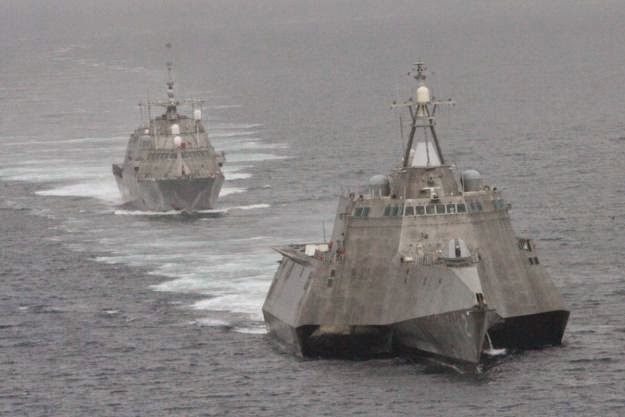
There are two flavors of them, the Freedom and the Independence classes.

However, there has been a huge hoolah about the fact they are so weakly armed and so expensive (between $450 million to $500 million each, neglecting government furnished equipment).  This prompted a call to cancel the LCS contract and for a replacement which could fight in a full bore battle rather than be glorified coast guard cutter (though admittedly, if they get the Hellfires actually installed, they will be able to kill things out further...a whole 5 miles).  Keep in mind, the ship they are 'replacing' is the Cold War Oliver Hazard Perry class frigate, which no matter how you slice it, they had far more firepower than either of the LCS.

The Navy as a result commissioned the Small Surface Combatant study to see if a full frigate was affordable and what industry could do.  Lockheed and Austal proposed upgraded versions of their LCS classes.  General Dynamics offered an nonpublic bid.  Huntington Ingalls offered an upgraded version of their National Security Cutter.  The Navy settled on modest upgrades to the LCS classes much to the eye rolling of their critics. 

It got me to thinking, what ought we to do, in my opinion?  

A seemingly segue, but its relevant: the US Navy canceled its Zumwalt class destroyers after ordering three.  They were too expensive is the usual commentary, having suffered through the development/procurement death spiral.  There's another consideration too: the Zumwalts were delayed sufficiently that newer technologies were on the cusp of making their armaments obsolete.  Frex, the Advanced Gun System will be outranged  by the railguns being testing at sea next year and the rounds for the railgun will be $25k each or less: far lower than the AGS'. 

While the Navy seriously needs to get its act together for its surface combatants, like getting a new destroyer and cruiser program started and done within budget and on time while dealing with future threats, I wondered what could you incorporate into a frigate.  And where would you want to start?

It does help if it is possible to use as much as the same equipment as before, propulsion, mechanical and hulls, just to save money.  That would imply an existing hull design.  That in turn, based on politics, means something built in the US.  That means one of the LCS or the National Security Cutter.  The cutter isn't in the navy logistical path, so it ought to be cut based on that.  That leaves us with Freedom and Independence.


The Freedom class is a steel hulled ship (a plus) with some room for growth with minimal changes and its faster than the Independence class (47 knots vs 44).  It has 180 tons which it can accept without adding sections and whatnot.  However, significant changes would need to take place for more.  Its internal volume is significantly smaller than the Independence, too.  However, a lot of the upgrades Lockheed proposed for the SSC variant were spot on.  However, some I'm considering here make that internal volume a significant problem. 

The Independence class is aluminum hulled and slower than the Freedom class.  Its also, in terms of volume, enormous.  It also has a very large flight deck.  It also has the capacity to take 210 tons (vs the Freedom 180) as part of its mission packages.

Due to the volume and more mass to work with, the Independence seems like the best starting place.


The 'proposed' Matthew Calbraith Perry class frigate:


for comparison, I left the Independence class under the 'proposed' Matthew Calbraith Perry class.
sorry, couldn't do a good railgun turret, esp in the front, so I left the old one. 
HEY!  Don't mock my meager image manipulation skills!   
The MCP has an enlarge upper superstructure (adding about 300 tons) allowing for the addition of another LM-2500+ (generating 35 MW of power, adding 100 tons) and its fuel stores.  The LM-2500s already installed are replaced with LM-2500+'s.
The aviation hangar is the same volume, but flight deck shrinks by a third: its still larger than the Freedom class' flight deck.  It retains the two SH-60 ASW helicopters, adds a second Fire Scout, and adds two TERNs. 

A hull sonar is added (probably at this point the same as the Burke's AN/SQS-53C, weighing 26 tons) and the towed sonar array is kept.  An Aegis combat system is added with an SPY-1F array, adding another 20ish tons and requiring 3 MW.

The proposed SeaRAM self protection missile system is kept and an additional 32 Mk 57 VLS cells (72 tons) are added.  I'd speculate you'd have a load out of 16 cells of 64 ESSM (or successor), 8 ASROC (or successor) and 8 LRASM.

For close in ASW problems, two sets of Mk 32 Torpedo tubes would be ideal (or a successor, really).  These would weigh a total of 5 tons.

Here's where things get a little radical.

While our little frigate packs the punch of some destroyers now with the configuration above, it doesn't explain why we needed the volume of the Independence class or the power from the LM-25.  By upgrading the current LM-2500s to LM-2500+'s, we get a enough power for the new sensors (sonar and radar) without sacrificing speed.  However, the new weapons require more power than what could be sacrificed even with the upgrade.  What are those?  Yup, lasers and railguns.

Proposed here is to replace the 57mm cannon with a 155mm railgun, like what is to be tested next year on the JHSV.  The range will certainly be longer 60+ km vs 17 km.  The impact damage certainly higher.  The railgun can also be used in an antimissile capacity.  The rounds are very cheap, relatively speaking.  Amusingly, the railgun itself is pretty light weight: around 15 tons, about the same as the 57mm cannon!  However, its pulsed power system is very heavy and takes up several shipping containers in size.  That enormous mission bay of the Independence ought to be able to fit the pulsed power system.  Additionally, the weight ought not to be over 180 tons.  Together with the railgun itself, this is around 200 tons.

The second 'radical weapon' would be a laser.  I don't mean the LAWS system, but rather a weapon's grade laser (100 kw+) which would be used for both small surface targets and anti air and anti missile roles.  Considering we want to have a very low dwell time, we need a megawatt (erm, really megajoule) class laser.  There are two ways to do this.  Either we can wait for the free electron laser (on track, but going slow) or use a solid state laser.  DARPA's HELLADS laser fits the bill and has demonstrated a weapon already at General Atomics.  One which GA is planning on integrating on its Avenger drone (which I took and ran with).  If we aggregated the HELLADS modules, we can get a megajoule/pulse class laser: you need a total of 20 modules.  If one is half a ton, then twenty is 10 tons more.  If you count in optics, beam director, and extra cooling and power, you're looking at somewhere around 30 tons.  And the power requirements!  Oh the power requirements!  Let's just leave it at 'gimme.'  Okok, each pulse minimally will need 1.2 megajoules and if you plan on having more than one pulse per second you need to multiply the number of pulses you want by the 1.2 MJ.  The absolute most you can get is 22 pulses/second. 

(yes the butchered RAM launcher on the top of the MCP doodle is meant to be a beam director.  stop mocking my art!).

Now the question is, 'how fat did our baby get?'

Truthfully, we have added 750 tons of structure, sensors and weapons.  That pushes our ship to being 3800 tons fully loaded...without the extra fuel for the LM-2500+ for the new weapons and sensors!  Fortunately, even if we are carrying an extra 400 tons of fuel, we are will still be able to eek out another 2 knots from the upgraded engines.

Now how expensive is our baby?  We get roughly a cost of $820 million vs $464M for an Independence class.

So.  Why?  Why do it?  Its almost twice as much as an Independence class LCS.

The first answer it gives the US a huge numerical edge with well equipped, well armed combatants: the Burkes cost $1.8B each.  For five Burkes, you can get 11 MC Perrys.  

Second, you have a ship which act as an escort for an aircraft carrier.  One of the amusing bits is the monster sized aircraft carriers can sprint far, far faster than the escorts can.  The escorts, destroyers, etc, can do around 30 more than 30 knots, but the carriers can do well over 40 knots with the nuclear reactors.  In emergencies, carriers have sprinted ahead and rendezvoused with different escorts at its destination or been forced to be unescorted at its destination.  While the MC Perry is not a Burke in terms of capability, it will have some distinct capabilities: lasers and railguns are rather cheap per shot.  And, this is done without needing to resort to nuclear power plants for your escorts.

Finally, even when the Burkes and Ticonderogas or follow-on replacements are present, these new FFGs add a distinct capability as advanced screening ships like the previous Perry Frigates did for the carrier battlegroups. 

Aren't the laser and railgun a little immature?

If the lead ship, called Matthew Calbraith Perry here, is laid down in 2020 as the SSC plan calls for, then commissioning will take place in 2024.  Ten years from now.  The railgun is most likely going to be replacing one of the Advanced Gun Systems on the USS Lyndon B Johnson, the last Zumwalt.  The USS LBJ will be commissioned in 2021, a year after the laying down of our proposed MCP.  The HELLADS program will have been wrapped up and could, like with LRASM, be transitioned into a procurement relatively easily.  


Now, do I think this will happen?  

...

Yer funny.

However, back in the mid 90s, a silly for fun project I did on Usenet caught the attention of the Navy before and they asked me to do a little analysis for them.  I did but didn't take what was offered afterwards.  While I doubt I'll be offered anything here, maybe, just maybe, this might tickle someone with influences own ideas and alter course a bit.  

Maybe. 


Afterword:  its becoming obvious in the coming world of hypersonic weapons and antiship ballistic missiles and potential peer naval powers, a lot of our Navy's kit needs replacing.  I am not talking about the ships: that too.  Rather I am talking about the missiles and whatnot.  The Standard Missile is being upgraded, so less worries there.  LRASM is in play, so good start, but progress towards a VLS launched hypersonic missile is needed.  Likewise for a hypersonic Tomahawk replacement.  The ESSM has a range of 10 miles....that's 10 seconds for a Mach 5 missile and 5 for Mach 10: if it misses or fails to take out the hypersonic missile, you're not getting a second shot at that distance.  

For that matter, ASROC definitely is old and ought to updated if not had a replacement made.   etc. 

Wednesday, February 25, 2015

Saudis Want LCS With Aegis, VLS

The long-sought-after deal to upgrade and replace Saudi Arabia's Eastern Fleet has taken a major step forward, sources said, with the January delivery of a letter of request (LoR) to the US detailing Saudi wishes.

Rear Adm. Jim Shannon, head of the US Navy International Program Office, reportedly obtained the LoR during a visit to Saudi Arabia. The letter marks a major step forward after years of talks and negotiations with the Saudis, who have also strongly considered French proposals to replace their fleet.

The French hold the preponderance of contracts in support of the Saudi's western, or Red Sea, fleet. France and the US are considered the primary contenders for the Eastern Fleet contract, said to be worth as much as $16 billion or higher.

Several sources said the Saudi LoR did not list specific ship designs, but rather gave general guidelines. Among the highlights are:

• Four 3,500-ton frigate-like warships, armed with vertical launch systems (VLS), capable of anti-air warfare and speeds of 35 knots

• 12 1,150-ton corvette-like warships

• 24 or so smaller patrol craft

The deal would include MH-60R helicopters to operate from the frigates, along with support and training.

One condition is the shipbuilder would be the prime contractor.

The US Navy is reportedly working to define details of the LoR, including what air radar the Saudis want to fulfill the anti-air requirement. Sources said that while no specific radar is listed in the LoR, the only system that fits the requirement is the SPY-1F lightweight Aegis system from Lockheed Martin.

SPY-1F is fitted only to Norway's Fridtjof Nansen-class frigates. All other Aegis warships — US cruisers and destroyers, foreign ships including those from Spain, Korea, Japan and Australia — carry the heavier SPY-1D antenna. While there is a high degree of commonality between the two versions, the 1F features smaller antennas and less power, resulting in shorter range.

Lockheed Martin and Austal USA have offered versions of their littoral combat ships fitted with VLS and phased-array radars, including the SPY-1F, both for export and most recently for the US Navy's Small Surface Combatant (SSC) competition conducted in 2014. In the end, the US Navy chose to forego Aegis and VLS on its SSCs, now designated as frigates.

Other than the LCS/SSC/frigate designs, there are no other US projects that would fit the 3,500-ton parameters of the Saudi frigate.


If I were the SecDef, I'd have the Saudis pay for development costs of the LCS with the real firepower of a frigate and then just add the minor improvements, relatively speaking, the US Navy needs.  Use those to replace the LCS with the minor upgrades that currently planned after the first 20 LCS.  Then they actually will be FF or really FFGs and worthy successors to the Oliver Hazard Perry frigates.

Friday, February 20, 2015

U.K. Ministry of Defence Awards BAe Contract to Develop 5,500 Ton Type 26 Frigate


The U.K. Ministry of Defence (MoD) has awarded a $1.32 billion (£859 million) contract to BAE Systems to develop a new class of frigate for the Royal Navy, the MoD announced on Friday.

The contract will set the stage for the planned 2016 start of construction for 13 Type 26 Global Combat Ship — the planned replacement for the Royal Navy’s existing 1980s-desgined Duke Type 23 frigates, according to a statement from BAE.

“The new contract will include investment in essential long lead items for the ships, shore testing facilities,” read the MoD statement.
“There will also be investment in key equipment for the first three ships – such as gas turbines, diesel generators and steering gear – allowing suppliers to plan, invest and secure their workforce on the project.”

The Type 26s are anticipated to be primary ship in the Royal Navy’s surface fleet as the class begins to come online starting the 2020s.

The design of the 5,500-ton large frigate-sized ships are significantly larger than the 3,600-ton Type 23s and eight will be optimized for anti-submarine warfare (ASW), according to U.S. Naval Institute’s Combat Fleets of the World.

The ships will field a vertical launch system for surface to surface and land attack missiles, a BAE 997 Artisan 3-D air surface search radar and have a crew of about 130 sailors.

The ships will likely be built in Glasgow, Scotland.

Wednesday, February 18, 2015

US Navy to Operate 4 LCS Singapore by 2018

Four US warships designed to fight in coastal areas similar to Southeast Asian waters will be operating out of Singapore by 2018, up from one currently, a senior US Navy official said Tuesday.

The "rotational deployment" of the vessels, called littoral combat ships (LCS), comes as China continues to flex its muscles in the South China Sea and tensions remain on the Korean Peninsula.

"We will soon see up to four LCS here in Singapore as we rotationally deploy Seventh Fleet ships," said Rear Adm. Charles Williams.

"We envision four ships here by May 2017 to sometime in 2018 ... but I think what you have is that by 2018, four LCS ships will be rotationally deployed here to Singapore."

Friday, February 13, 2015

The Argument the LCS Classes are Really Frigates

The die is cast and the U.S. Navy has made its big bet – the Littoral Combat Ship (LCS)-Next is going to be an uparmed and uparmored version of the current vessels that the service has redesignated as an FF, or fast frigate.

"These are not ‘L' class ships," Navy Secretary Ray Mabus said last month during his keynote address at the Surface Navy Association (SNA) National Symposium. "When I hear ‘L,’ I think amphib. I spend a good bit of my time explaining what ‘littoral’ is." It is a good time, he says, to re-establish Navy tradition for naming ships properly. "It’s a frigate. We’re going to call it one."

Of course calling it one won’t make it one. Many doubt the idea that that the modified LCS will live up to the true definition of a frigate. But perhaps it's about time to give the Navy a chance to prove out its case. The service brass says it has the ships it wants and everyone can argue over the next few years whether the decision is a good one, but the truth is that only time will tell whether the gamble will be worth it. Indeed, with the new Navy focus on “distributive lethality,” where every ship will be armed up as much as possible, it’s difficult and perhaps impossible now to foresee how the new FFs will fare in the future force structure.

Having said that, it’s also time to clear up a few things about LCS performance thus far that factored into the Navy’s LCS-FF decision.


Its an FFL, bit an FF.  (corvette, not a frigate)

Friday, January 30, 2015

Ukrainian War Causes Problems for new Russian Frigates


The Ukrainian military equipment embargo to Russia could cause delays in the construction of the Russian Navy’s new class of frigates and slow a planned modernization effort of Russia’s northern fleet, according to a Monday report in Jane’s Defence Weekly.

Russia’s 4,500 ton Admiral Gorshkov-class frigates (Project 22350) is powered – in part – by two M90FR gas turbines built by with Ukrainian manufacturer Zorya-Mashproekt.

With the embargo in place the task has shifted to Russian manufacturer NPO Saturn without the aid of the Ukrainians.

“Under the Russian government’s import substitution [program], it is understood that NPO Saturn is supposed to develop the capability to produce and test the M90FR by 2017,” reported Jane’s.

The shift could lead to delivery delays for the third and fourth ships in the class – Admiral Golovko and Admiral Isakov – both currently under construction by the Severnaya Verf shipyard in St. Petersburg, Russia.

The lack of Ukrainian cooperation could also affect the supply of spare parts and the Russian plans for maintenance and sustainment of the turbines.

Monday, January 26, 2015

Littoral Combat Ships' Survivability Questioned Again

Less than a month after U.S. Navy leaders announced modified versions of both variants of the Littoral Combat Ship would be the Navy’s pick for its for a more lethal and survivable small surface combatant, one of the chief LCS critics said the upgrades would do little to improve the survivability of the class.

Chief Pentagon weapon tester Michael Gilmore still remains fundamentally dissatisfied with the survivability of the Navy’s littoral combatant ship (LCS) and its upgraded follow-on, the small surface combatant (SSC).

“Notwithstanding reductions to its susceptibility” compared with the design of the first 32 ships, he told Bloomberg on Jan. 8.
“The minor modifications to the LCS will not yield a ship that is significantly more survivable.”

It remains to be seen, however, how the Navy can improve the other legs of the “survivability triangle” of a hull displacing 3,000 tons and is less than 425 feet in length.

Small ships have been historically unsurvivable. Modern small warships are not in any way the equivalent of the World War II predecessors. Every warship is a compromise in armament, endurance, speed and survivability. This is especially true of the LCS, as its modular operational profile demands absolute adherence to weight limitations.

Small warships are historically unsurvivable in combat. They have a shorter floodable length, reduced reserve buoyancy and more likely to be affected by fire and smoke damage than larger combatants. In both World Wars, losses in ships below 3000 tons in displacement far exceeded those of larger vessels.

In World War II, for example, the U.S. lost a total of 71 destroyers and 11 destroyer escorts — all under 3400 tons displacement and less than 400 feet in length.

By comparison, only 23 larger ships were lost. Part of that figure is undoubtedly due to their operational employment, but in simple terms of engineering and physics, larger ships are inherently more survivable than their smaller counterparts.

link. and again.

Monday, January 19, 2015

US Navy Redesignating Upgraded LCS Corvette Ships as Frigates (FF)

The US Navy (USN) has decided to classify its upgraded fast, shallow-water Littoral Combat Ship (LCS) as a frigate (FF), Secretary of the Navy Ray Mabus announced on 15 January at the Surface Navy Association national symposium near Washington, DC.

The FF designation comes only weeks after the USN announced that it would modify current LCS designs to accommodate increased lethality and survivability requirements in its small surface combatant fleet.


Monday, December 15, 2014

Taiwan to Purchase Four Perry Class Frigates

The Taiwanese government said has sets aside $176 million to buy two Oliver Hazard Perry as part of a potential four ship deal, Defense Minister David Lo said on Tuesday.

“We have the budget approved to purchase two of the frigates,” Lo said, reported news wire Reuters.
“We hope the U.S. will not be influenced by threats from China.”

China has long objected to U.S. — or any foreigners — selling arms to the island nation which China views as a part of its territory and has vocally condemned any defense trade with Taiwan.

“China firmly opposes foreign arms sale to Taiwan and any form of military technology exchanges and cooperation between Taiwan and foreign countries. This position is clear-cut and consistent,” Chinese Foreign Ministry spokesman Hong Lei said in November following an announcement on a separate sale of mine countermeasure ships to Taiwan.

“We ask relevant countries to respect China’s core interests, adhere to the one-China principle, neither sell arms to Taiwan in any form nor assist Taiwan in developing its military equipment, and take concrete actions to support the peaceful development of cross-strait relations and peaceful reunification of China.”

Earlier this year, the U.S. Senate approved a sale of up to four of the 3,000-ton Perry-class frigates to Taiwan, acting on a 2012 request from the country.

Monday, December 08, 2014

Britain Selects Mk 41 VLS for Type 26 Global Combat Ship

UK Secretary of State for Defence Michael Fallon has confirmed the selection of the strike-length Mk 41 Vertical Launch System (VLS) to meet the Flexible Strike Silo requirement for the Royal Navy's next-generation Type 26 Global Combat Ship (GCS).

Each ship will be fitted with three eight-cell modules in a silo sited forward of the bridge.

Fallon confirmed the decision to install a 24-cell Flexible Strike Silo fitted with Mk 41 launchers in a written response to Rory Stewart MP, chairman of the House of Commons Defence Committee. His statement said the VLS infrastructure "will be able to accommodate a range of missiles from long-range strike weapons (such as the Tomahawk land attack missile) to anti-ship missiles and anti-submarine rockets with the weapon payload being reconfigured to meet changing threats and missions".