Showing posts with label centaurs. Show all posts

Tuesday, January 05, 2016

The Different Flavours of Robopocalyptic Warfare

Automation is at the heart of the Pentagon’s ambitious “Third Offset Strategy,” launched last year with an anxious eye on advances in Russia and China. “China’s investing heavily in robotics and autonomy,” said the father of Offset, Deputy Secretary of Defense Bob Work, “and the Russian chief of General Staff, [Valeriy] Gerasimov, recently said….quote, ‘in the near future it is possible a fully robotized unit will be created capable of independently conducting military operations.’”

So there’s no question that robotic combat is coming. The question is how much input humans will still have — and different countries will take different approaches. After reporting, talking, and thinking on this topic for the past three years at Breaking Defense, I see three stark alternatives emerging. Call them Skynet, swarms, and centaurs:

Thursday, December 17, 2015

ALMA's Solar System Member: That's Too Fluffy or Really Dense

Tentative planetary orbital constraints of some scenarios for the possible new Solar System object recently discovered with ALMA

Authors:

Iorio

Abstract:

Some of the scenarios envisaged for the possible new Solar System object, whose discovery with the ALMA facility has been recently claimed in the literature, are preliminarily put to the test by means of the orbital motions of some planets of the Solar System. It turns out that the current ranges of admissible values for any anomalous secular precession of the perihelion of Saturn, determined in the recent past with either the EPM2011 and the INPOP10a planetary ephemerides without modeling the action of such a potential new member of the Solar System, do not rule out the existence of a putative Neptune-like pointlike perturber at about 2500 au. Instead, both a super-Earth at some hundreds of au and a Jovian-type planet up to 4000 au are strongly disfavored. An Earth-sized body at 100 au would have a density as little as ∼0.1−0.01 g cm−3, while an unusually large Centaur or (Extreme) Trans Neptunian Object with linear size of 220−880 km at 12−25 au would have density much larger than ∼1 g cm−3.

Wednesday, November 04, 2015

Neptune's Internal Temperature NOT Caused by Centaur Impacts

Assessing the contribution of centaur impacts to ice giant luminosities

Author:

Dodson-Robinson et al

Abstract:

Voyager 2 observations revealed that Neptune’s internal luminosity is an order of magnitude higher than that of Uranus. If the two planets have similar interior structures and cooling histories, Neptune’s luminosity can only be explained by invoking some energy source beyond gravitational contraction. This paper investigates whether centaur impacts could provide the energy necessary to produce Neptune’s luminosity. The major findings are (1) that impacts on both Uranus and Neptune are too infrequent to provide luminosities of order Neptune’s observed value, even for optimistic impact-rate estimates and (2) that Uranus and Neptune rarely have significantly different impact-generated luminosities at any given time. Uranus and Neptune most likely have structural differences that force them to cool and contract at different rates.

Wednesday, February 18, 2015

Updated Taxonomy of Trans-neptunian Objects and Centaurs

Updated taxonomy of trans-neptunian objects and centaurs: Influence of albedo

Authors:

Belskaya et al

Abstract:

We present updated classification of 258 trans-neptunian objects (TNOs) and centaurs based on their visible and near-infrared colors. With increasing quality and quantity of color measurements we distinguished again four classes of objects confirming the previous classification into the BB, BR, IR, and RR taxonomic groups. Increasing accuracy of color measurements results in smaller scatter on color–color plots and better separation of classes. Albedos do not have any noticeable impact on the classification except for the separation of a sub-group of the brightest bodies inside the BB group. On the other side, all the BR objects for which albedo estimations are available have dark surfaces, while the IR and RR groups contain objects both with dark and moderate albedos. Analysis of the distribution of the groups with respect to their orbital parameters confirmed previous findings. The BB and RR groups are populated mainly with classical objects having generally high or low orbital inclinations, respectively. Any centaur belongs to the IR group and only one centaur is classified as BB: this is a confirmation of the existence of two separate classes in this population.

Friday, February 13, 2015

YAGUMET STRIKE! Paper Attempts to Link Mass Extinctions & Giant Comet Impacts

Giant comets and mass extinctions of life

Author:

Napier

Abstract:

I find evidence for clustering in age of well-dated impact craters over the last 500 Myr. At least nine impact episodes are identified, with durations whose upper limits are set by the dating accuracy of the craters. Their amplitudes and frequency are inconsistent with an origin in asteroid breakups or Oort cloud disturbances, but are consistent with the arrival and disintegration in near-Earth orbits of rare, giant comets, mainly in transit from the Centaur population into the Jupiter family and Encke regions. About 1 in 10 Centaurs in Chiron-like orbits enter Earth-crossing epochs, usually repeatedly, each such epoch being generally of a few thousand years' duration. On time-scales of geological interest, debris from their breakup may increase the mass of the near-Earth interplanetary environment by two or three orders of magnitude, yielding repeated episodes of bombardment and stratospheric dusting. I find a strong correlation between these bombardment episodes and major biostratigraphic and geological boundaries, and propose that episodes of extinction are most effectively driven by prolonged encounters with meteoroid streams during bombardment episodes. Possible mechanisms are discussed.

Please take note of my Yet Another Grand Unified Mass Extinction Theory (YAGUMETS) and Stop Dreaming posts.

tl;dr: the evidence from the mass extinction must fit the perpetrator and each has its own distinctive fingerprints with the example of the Permian Extinction and KT/K-Pg Extinction (dino killer) as being very different.

Sunday, June 15, 2014

Did Large Retrograde Centaurs Originate in the Oort Cloud?

Large retrograde Centaurs: visitors from the Oort cloud?

Authors:

de la Fuente Marcos et al

Abstract:

Among all the asteroid dynamical groups, Centaurs have the highest fraction of objects moving in retrograde orbits. The distribution in absolute magnitude, H, of known retrograde Centaurs with semi-major axes in the range 6-34 AU exhibits a remarkable trend: 10% have H less than 10 mag, the rest have H greater than 12 mag. The largest objects, namely (342842) 2008 YB3, 2011 MM4 and 2013 LU28, move in almost polar, very eccentric paths; their nodal points are currently located near perihelion and aphelion. In the group of retrograde Centaurs, they are obvious outliers both in terms of dynamics and size. Here, we show that these objects are also trapped in retrograde resonances that make them unstable. Asteroid 2013 LU28, the largest, is a candidate transient co-orbital to Uranus and it may be a recent visitor from the trans-Neptunian region. Asteroids 342842 and 2011 MM4 are temporarily submitted to various high-order retrograde resonances with the Jovian planets but 342842 may be ejected towards the trans-Neptunian region within the next few hundred kyr. Asteroid 2011 MM4 is far more stable. Our analysis shows that the large retrograde Centaurs form an heterogeneous group that may include objects from various sources. Asteroid 2011 MM4 could be a visitor from the Oort cloud but an origin in a relatively stable closer reservoir cannot be ruled out. Minor bodies like 2011 MM4 may represent the remnants of the primordial planetesimals and signal the size threshold for catastrophic collisions in the early Solar System.

Sunday, April 06, 2014

Centaur Chiron, Haumea & Another Kuiper Belt Object Observed in the Ultraviolet by Hubble Space Telescope

FIRST ULTRAVIOLET REFLECTANCE MEASUREMENTS OF SEVERAL KUIPER BELT OBJECTS, KUIPER BELT OBJECT SATELLITES, AND NEW ULTRAVIOLET MEASUREMENTS OF A CENTAUR

Authors:

Stern et al

Abstract:

We observed the 2600-3200 Å (hereafter, mid-UV) reflectance of two Kuiper Belt Objects (KBOs), two KBO satellites, and a Centaur, using the Hubble Space Telescope (HST) Cosmic Origins Spectrograph (COS). Other than measurements of the Pluto system, these constitute the first UV measurements obtained of KBOs, and KBO satellites, and new HST UV measurements of the Centaur 2060 Chiron. We find significant differences among these objects, constrain the sizes and densities of Haumea's satellites, and report the detection of a possible spectral absorption band in Haumea's spectrum near 3050 Å. Comparisons of these objects to previously published UV reflectance measurements of Pluto and Charon are also made here.

Sunday, March 30, 2014

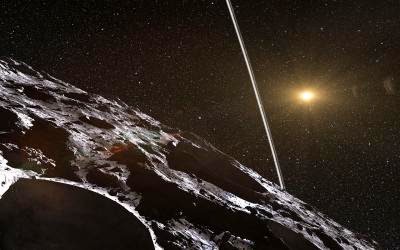
Centaur Asteroid 10199 Charilko has a Saturn-like Ring System


The rings of Saturn are one of the most spectacular sights in the sky, and less prominent rings have also been found around the other giant planets. Despite many careful searches, no rings had been found around smaller objects orbiting the Sun in the Solar System. Now observations of the distant minor planet [1] (10199) Chariklo [2] as it passed in front of a star have shown that this object too is surrounded by two fine rings.

"We weren't looking for a ring and didn't think small bodies like Chariklo had them at all, so the discovery — and the amazing amountof detail we saw in the system — came as a complete surprise!" says Felipe Braga-Ribas (Observatório Nacional/MCTI, Rio de Janeiro, Brazil) who planned the observation campaign and is lead author on the new paper.

Chariklo is the largest member of a class known as the Centaurs [3] and it orbits between Saturn and Uranus in the outer Solar System. Predictions had shown that it would pass in front of the star UCAC4 248-108672 on 3 June 2013, as seen from South America [4]. Astronomers using telescopes at seven different locations, including the 1.54-metre Danish and TRAPPIST telescopes at ESO's La Silla Observatory in Chile [5], were able to watch the star apparently vanish for a few seconds as its light was blocked by Chariklo — an occultation [6].

But they found much more than they were expecting. A few seconds before, and again a few seconds after the main occultation there were two further very short dips in the star's apparent brightness [7]. Something around Chariklo was blocking the light! By comparing what was seen from different sites the team could reconstruct not only the shape and size of the object itself but also the shape, width, orientation and other properties of the newly discovered rings.

The team found that the ring system consists of two sharply confined rings only seven and three kilometres wide, separated by a clear gap of nine kilometres — around a small 250-kilometre diameter object orbiting beyond Saturn.

Sunday, February 09, 2014

Using Cherenkov Telescopes for Outer Solar System Science

On the Use of Cherenkov Telescopes for Outer Solar System Body Occultations

Authors:

Lackey et al

Abstract:

Imaging Atmosphere Cherenkov Telescopes (IACT) are arrays of very large optical telescopes that are well-suited for rapid photometry of bright sources. I investigate their potential in observing stellar occultations by small objects in the outer Solar System, Transjovian Objects (TJOs). These occultations cast diffraction patterns on the Earth. Current IACT arrays are capable of detecting objects smaller than 100 meters in radius in the Kuiper Belt and 1 km radius out to 5000 AU. The future Cherenkov Telescope Array (CTA) will have even greater capabilities. Because the arrays include several telescopes, they can potentially measure the speeds of TJOs without degeneracies, and the sizes of the TJOs and background stars. I estimate the achievable precision using a Fisher matrix analysis. With CTA, the precisions of these parameter estimations will be as good as a few percent. I consider how often IACTs can observe occultations by members of different TJO populations, including Centaurs, Kuiper Belt Objects (KBOs), Oort cloud objects, and satellites and Trojans of Uranus and Neptune. The great sensitivity of IACT arrays means that they likely detect KBO occultations once every O(10) hours when looking near the ecliptic. IACTs can also set useful limits on many other TJO populations.