Showing posts with label early earth. Show all posts

Friday, October 28, 2016

Methane Did NOT Warm the Early Earth

For at least a billion years of the distant past, planet Earth should have been frozen over but wasn't. Scientists thought they knew why, but a new modeling study from the Alternative Earths team of the NASA Astrobiology Institute has fired the lead actor in that long-accepted scenario.

Humans worry about greenhouse gases, but between 1.8 billion and 800 million years ago, microscopic ocean dwellers really needed them. The sun was 10 to 15 percent dimmer than it is today--too weak to warm the planet on its own. Earth required a potent mix of heat-trapping gases to keep the oceans liquid and livable.

For decades, atmospheric scientists cast methane in the leading role. The thinking was that methane, with 34 times the heat-trapping capacity of carbon dioxide, could have reigned supreme for most of the first 3.5 billion years of Earth history, when oxygen was absent initially and little more than a whiff later on. (Nowadays oxygen is one-fifth of the air we breathe, and it destroys methane in a matter of years.)

"A proper accounting of biogeochemical cycles in the oceans reveals that methane has a much more powerful foe than oxygen," said Stephanie Olson, a graduate student at the University of California, Riverside, a member of the Alternative Earths team and lead author of the new study published September 26 in the Proceedings of the National Academy of Sciences. "You can't get significant methane out of the ocean once there is sulfate."

Sulfate wasn't a factor until oxygen appeared in the atmosphere and triggered oxidative weathering of rocks on land. The breakdown of minerals such as pyrite produces sulfate, which then flows down rivers to the oceans. Less oxygen means less sulfate, but even 1 percent of the modern abundance is sufficient to kill methane, Olson said.

Friday, September 16, 2016

Questioning the Late Heavy Bombardment's Impact on Earth


Authors:

Boehnke et al

Abstract:

The Late Heavy Bombardment (LHB), a hypothesized impact spike at ∼3.9 Ga, is one of the major scientific concepts to emerge from Apollo-era lunar exploration. A significant portion of the evidence for the existence of the LHB comes from histograms of 40Ar/39Ar “plateau” ages (i.e., regions selected on the basis of apparent isochroneity). However, due to lunar magmatism and overprinting from subsequent impact events, virtually all Apollo-era samples show evidence for 40Ar/39Ar age spectrum disturbances, leaving open the possibility that partial 40Ar* resetting could bias interpretation of bombardment histories due to plateaus yielding misleadingly young ages. We examine this possibility through a physical model of 40Ar* diffusion in Apollo samples and test the uniqueness of the impact histories obtained by inverting plateau age histograms. Our results show that plateau histograms tend to yield age peaks, even in those cases where the input impact curve did not contain such a spike, in part due to the episodic nature of lunar crust or parent body formation. Restated, monotonically declining impact histories yield apparent age peaks that could be misinterpreted as LHB-type events. We further conclude that the assignment of apparent 40Ar/39Ar plateau ages bears an undesirably high degree of subjectivity. When compounded by inappropriate interpretations of histograms constructed from plateau ages, interpretation of apparent, but illusory, impact spikes is likely.

Friday, September 09, 2016

Did Earth's Carbon Come From a Mercurcy Sized Protoplanetary Impact?


Research by Rice University Earth scientists suggests that virtually all of Earth's life-giving carbon could have come from a collision about 4.4 billion years ago between Earth and an embryonic planet similar to Mercury.

In a new study this week in Nature Geoscience, Rice petrologist Rajdeep Dasgupta and colleagues offer a new answer to a long-debated geological question: How did carbon-based life develop on Earth, given that most of the planet's carbon should have either boiled away in the planet's earliest days or become locked in Earth's core?

"The challenge is to explain the origin of the volatile elements like carbon that remain outside the core in the mantle portion of our planet," said Dasgupta, who co-authored the study with lead author and Rice postdoctoral researcher Yuan Li, Rice research scientist Kyusei Tsuno and Woods Hole Oceanographic Institute colleagues Brian Monteleone and Nobumichi Shimizu.

Wednesday, July 06, 2016

Did the Early Earth Have Multiple "North & South" Magnetic Poles?


New work from Carnegie's Peter Driscoll suggests Earth's ancient magnetic field was significantly different than the present day field, originating from several poles rather than the familiar two. It is published in Geophysical Research Letters.

Earth generates a strong magnetic field extending from the core out into space that shields the atmosphere and deflects harmful high-energy particles from the Sun and the cosmos. Without it, our planet would be bombarded by cosmic radiation, and life on Earth's surface might not exist. The motion of liquid iron in Earth's outer core drives a phenomenon called the geodynamo, which creates Earth's magnetic field. This motion is driven by the loss of heat from the core and the solidification of the inner core.

But the planet's inner core was not always solid. What effect did the initial solidification of the inner core have on the magnetic field? Figuring out when it happened and how the field responded has created a particularly vexing and elusive problem for those trying to understand our planet's geologic evolution, a problem that Driscoll set out to resolve.

Here's the issue: Scientists are able to reconstruct the planet's magnetic record through analysis of ancient rocks that still bear a signature of the magnetic polarity of the era in which they were formed. This record suggests that the field has been active and dipolar--having two poles--through much of our planet's history. The geological record also doesn't show much evidence for major changes in the intensity of the ancient magnetic field over the past 4 billion years. A critical exception is in the Neoproterozoic Era, 0.5 to 1 billion years ago, where gaps in the intensity record and anomalous directions exist. Could this exception be explained by a major event like the solidification of the planet's inner core?


Monday, May 30, 2016

Enzymatic Antioxidant Systems in Early Anaerobes

Enzymatic Antioxidant Systems in Early Anaerobes: Theoretical Considerations

Authors:

Ireneusz et al

Abstract:

It is widely accepted that cyanobacteria-dependent oxygen that was released into Earth's atmosphere ca. 2.5 billion years ago sparked the evolution of the aerobic metabolism and the antioxidant system. In modern aerobes, enzymes such as superoxide dismutases (SODs), peroxiredoxins (PXs), and catalases (CATs) constitute the core of the enzymatic antioxidant system (EAS) directed against reactive oxygen species (ROS). In many anaerobic prokaryotes, the superoxide reductases (SORs) have been identified as the main force in counteracting ROS toxicity. We found that 93% of the analyzed strict anaerobes possess at least one antioxidant enzyme, and 50% have a functional EAS, that is, consisting of at least two antioxidant enzymes: one for superoxide anion radical detoxification and another for hydrogen peroxide decomposition. The results presented here suggest that the last universal common ancestor (LUCA) was not a strict anaerobe. O2 could have been available for the first microorganisms before oxygenic photosynthesis evolved, however, from the intrinsic activity of EAS, not solely from abiotic sources.

Thursday, January 28, 2016

New Evidence Bolsters Theia Impact Forming Earth's Moon

The moon was formed by a violent, head-on collision between the early Earth and a "planetary embryo" called Theia approximately 100 million years after the Earth formed, UCLA geochemists and colleagues report.

Scientists had already known about this high-speed crash, which occurred almost 4.5 billion years ago, but many thought the Earth collided with Theia (pronounced THAY-eh) at an angle of 45 degrees or more -- a powerful side-swipe. New evidence reported Jan. 29 in the journal Science substantially strengthens the case for a head-on assault.

The researchers analyzed seven rocks brought to the Earth from the moon by the Apollo 12, 15 and 17 missions, as well as six volcanic rocks from the Earth's mantle -- five from Hawaii and one from Arizona.

The key to reconstructing the giant impact was a chemical signature revealed in the rocks' oxygen atoms. (Oxygen makes up 90 percent of rocks' volume and 50 percent of their weight.) More than 99.9 percent of Earth's oxygen is O-16, so called because each atom contains eight protons and eight neutrons. But there also are small quantities of heavier oxygen isotopes: O-17, which have one extra neutron, and O-18, which have two extra neutrons. Earth, Mars and other planetary bodies in our solar system each has a unique ratio of O-17 to O-16 -- each one a distinctive "fingerprint."

In 2014, a team of German scientists reported in Science that the moon also has its own unique ratio of oxygen isotopes, different from Earth's. The new research finds that is not the case.

"We don't see any difference between the Earth's and the moon's oxygen isotopes; they're indistinguishable," said Edward Young, lead author of the new study and a UCLA professor of geochemistry and cosmochemistry.

Young's research team used state-of-the-art technology and techniques to make extraordinarily precise and careful measurements, and verified them with UCLA's new mass spectrometer.

The fact that oxygen in rocks on the Earth and our moon share chemical signatures was very telling, Young said. Had Earth and Theia collided in a glancing side blow, the vast majority of the moon would have been made mainly of Theia, and the Earth and moon should have different oxygen isotopes. A head-on collision, however, likely would have resulted in similar chemical composition of both Earth and the moon.

"Theia was thoroughly mixed into both the Earth and the moon, and evenly dispersed between them," Young said. "This explains why we don't see a different signature of Theia in the moon versus the Earth."

Monday, May 25, 2015

Modeling the Early Earth-Moon Tidal Interaction

Early evolution of the Earth–Moon system with a fast-spinning Earth

Authors:

Wisdom et al

Abstract:

The isotopic similarity of the Earth and Moon has motivated a recent investigation of the formation of the Moon with a fast-spinning Earth (Cuk, M., Stewart, S.T., [2012]. Science, doi:10.1126/science.1225542). Angular momentum was found to be drained from the system through a resonance between the Moon and Sun. They found a narrow range of parameters that gave results consistent with the current angular momentum of the Earth–Moon system. However, a tidal model was used that was described as approximating a constant Q tidal model, but it was not a constant Q model. Here we use a conventional constant Q tidal model to explore the process. We find that there is still a narrow range of parameters in which angular momentum is withdrawn from the system that corresponds roughly to the range found earlier, but the final angular momentum is too low to be consistent with the Earth–Moon system. Exploring a broader range of parameters we find a new phenomenon, not found in the earlier work, that extracts angular momentum from the Earth–Moon system over a broader range of parameters. The final angular momentum is more consistent with the actual angular momentum of the Earth–Moon system. We develop a simple model that exhibits the phenomenon.

Tuesday, March 31, 2015

Another Take on the Earth After Theia

Terrestrial aftermath of the Moon-forming impact.

Authors:

Sleep et al

Abstract:

Much of the Earth's mantle was melted in the Moon-forming impact. Gases that were not partially soluble in the melt, such as water and CO2, formed a thick, deep atmosphere surrounding the post-impact Earth. This atmosphere was opaque to thermal radiation, allowing heat to escape to space only at the runaway greenhouse threshold of approximately 100 W m(-2). The duration of this runaway greenhouse stage was limited to approximately 10 Myr by the internal energy and tidal heating, ending with a partially crystalline uppermost mantle and a solid deep mantle. At this point, the crust was able to cool efficiently and solidified at the surface. After the condensation of the water ocean, approximately 100 bar of CO2 remained in the atmosphere, creating a solar-heated greenhouse, while the surface cooled to approximately 500 K. Almost all this CO2 had to be sequestered by subduction into the mantle by 3.8 Ga, when the geological record indicates the presence of life and hence a habitable environment. The deep CO2 sequestration into the mantle could be explained by a rapid subduction of the old oceanic crust, such that the top of the crust would remain cold and retain its CO2. Kinematically, these episodes would be required to have both fast subduction (and hence seafloor spreading) and old crust. Hadean oceanic crust that formed from hot mantle would have been thicker than modern crust, and therefore only old crust underlain by cool mantle lithosphere could subduct. Once subduction started, the basaltic crust would turn into dense eclogite, increasing the rate of subduction. The rapid subduction would stop when the young partially frozen crust from the rapidly spreading ridge entered the subduction zone.

Monday, August 04, 2014

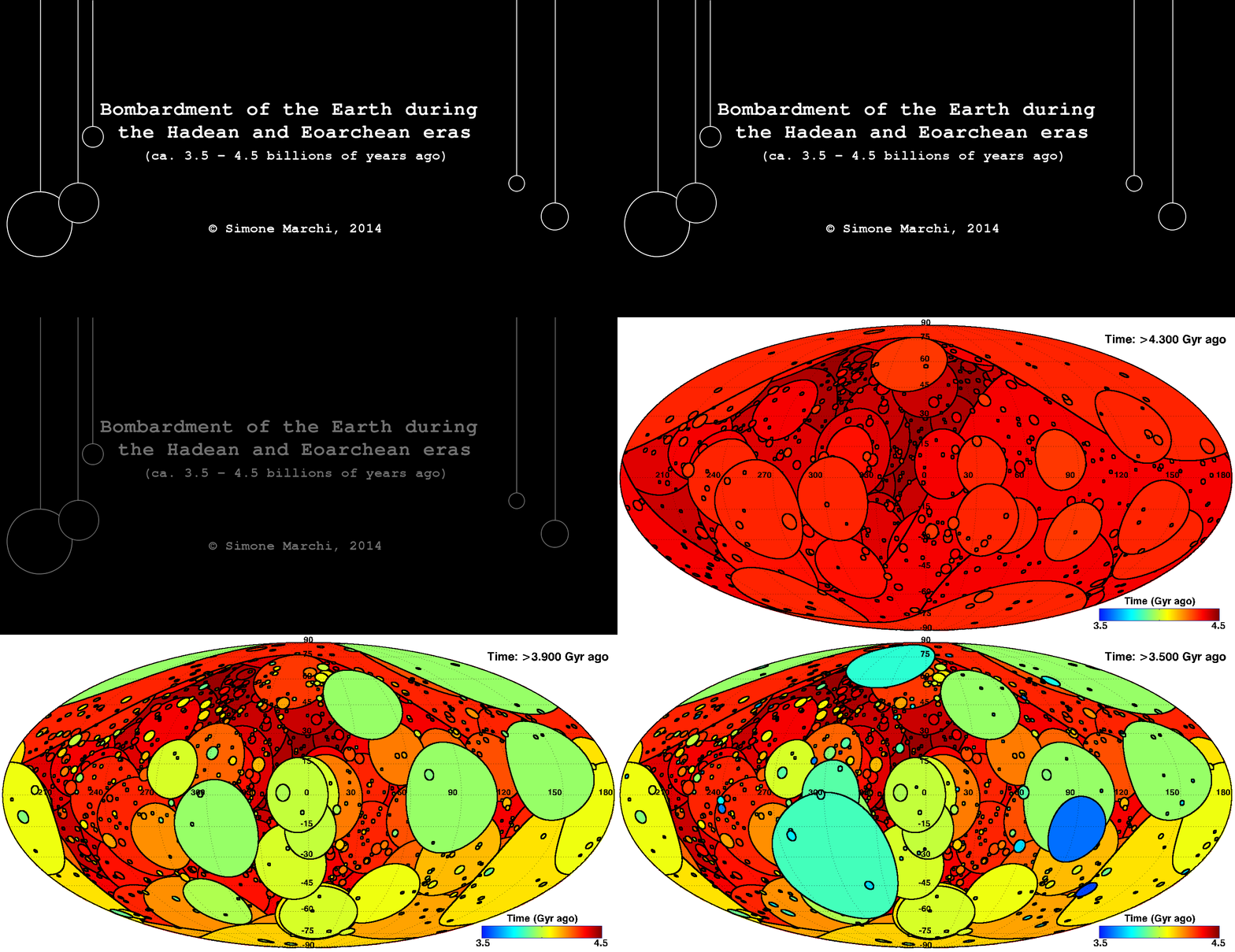
Late Heavy Bombardment Significantly Altered Hadean Earth


New research shows that more than four billion years ago, the surface of Earth was heavily reprocessed – or mixed, buried and melted – as a result of giant asteroid impacts. A new terrestrial bombardment model based on existing lunar and terrestrial data sheds light on the role asteroid bombardments played in the geological evolution of the uppermost layers of the Hadean Earth (approximately 4 to 4.5 billion years ago).

An international team of researchers published their findings in the July 31, 2014 issue of Nature.

"When we look at the present day, we have a very high fidelity timeline over the last about 500 million years of what's happened on Earth, and we have a pretty good understanding that plate tectonics and volcanism and all these kinds of processes have happened more or less the same way over the last couple of billion years," says Lindy Elkins-Tanton, director of the School of Earth and Space Exploration at Arizona State University.

But, in the very beginning of Earth's formation, the first 500 million years, there's a less well-known period which has typically been called the Hadean (meaning hell-like) because it was assumed that it was wildly hot and volcanic and everything was covered with magma – completely unlike the present day.

Terrestrial planet formation models indicate Earth went through a sequence of major growth phases: accretion of planetesimals and planetary embryos over many tens of millions of years; a giant impact that led to the formation of our Moon; and then the late bombardment, when giant asteroids, dwarfing the one that presumably killed the dinosaurs, periodically hit ancient Earth.

While researchers estimate accretion during late bombardment contributed less than one percent of Earth's present-day mass, giant asteroid impacts still had a profound effect on the geological evolution of early Earth. Prior to four billion years ago Earth was resurfaced over and over by voluminous impact-generated melt. Furthermore, large collisions as late as about four billion years ago, may have repeatedly boiled away existing oceans into steamy atmospheres. Despite heavy bombardment, the findings are compatible with the claim of liquid water on Earth's surface as early as about 4.3 billion years ago based on geochemical data.

A key part of Earth's mysterious infancy period that has not been well quantified in the past is the kind of impacts Earth was experiencing at the end of accretion. How big and how frequent were those incoming bombardments and what were their effects on the surface of the Earth? How much did they affect the ability of the now cooling crust to actually form plates and start to subduct and make plate tectonics? What kind of volcanism did it produce that was different from volcanoes today?"

"We are increasingly understanding both the similarities and the differences to present day Earth conditions and plate tectonics," says Elkins-Tanton. "And this study is a major step in that direction, trying to bridge that time from the last giant accretionary impact that largely completed the Earth and produced the Moon to the point where we have something like today's plate tectonics and habitable surface."

The new research reveals that asteroidal collisions not only severely altered the geology of the Hadean Earth, but likely played a major role in the subsequent evolution of life on Earth as well.


Sunday, January 19, 2014

Modeling the Results of Theia's Impact

Investigation of the Initial State of the Moon-Forming Disk: Bridging SPH Simulations and Hydrostatic Models

Authors:

Nakajima et al

Abstract:

According to the standard giant impact hypothesis, the Moon formed from a partially vaporized disk generated by a collision between the proto Earth and a Mars sized impactor. The initial structure of the disk significantly affects the Moon forming process, including the Moons mass, its accretion time scale, and its isotopic similarity to Earth. The dynamics of the impact event determines the initial structure of a nearly hydrostatic Moon forming disk. However, the hydrostatic and hydrodynamic models have been studied separately and their connection has not previously been well quantified. Here, we show the extent to which the properties of the disk can be inferred from Smoothed Particle Hydrodynamic (SPH) simulations. By using entropy, angular momentum and mass distributions of the SPH outputs as approximately conserved quantities, we compute the two dimensional disk structure. We investigate four different models: (a) standard, the canonical giant impact model, (b) fast spinning Earth, a collision between a fast spinning Earth and a small impactor, (c) sub Earths, a collision between two objects with half Earths mass, and (d) intermediate, a collision of two bodies whose mass ratio is 7:3. Our SPH calculations show that the initial disk has approximately uniform entropy. The disks of the fast spinning Earth and sub Earths cases are hotter and more vaporized (80-90% vapor) than the standard case (20%). The intermediate case falls between these values. In the highly vaporized cases, our procedure fails to establish a unique surface density profile of the disk because the disk is unstable according to the Rayleigh criterion. In these cases, we estimate non-unique disk models by conserving global quantities. We also develop a semi analytic model for the thermal structure of the disk, which requires only two inputs: the average entropy and the surface density of the disk.

Thursday, November 07, 2013

Evidence of a Microcontinent and Modern Plate Tectonics in MesoArchean India


An exotic Mesoarchean microcontinent: The Coorg Block, southern India

Authors:

M. Santosh, Qiong-Yan Yang, E. Shaji, T. Tsunogae, M. Ram Mohan and M. Satyanarayanan

Abstract:

Sandwiched between the Dharwar Craton in the north and the Neoarchean – Proterozoic crustal blocks to the south, the Coorg Block in southern India is composed dominantly of a suite of arc magmatic rocks including charnockites, TTG (tonalite-trondhjemite-granodiorite)-related granitoid suite and felsic volcanic tuffs together with minor accreted oceanic remnants along the periphery of the block. Coeval mafic and felsic magmatism with magma mixing and mingling in an arc setting is well represented in the block. Here we present the petrology, geochemistry, zircon U-Pb geochronology and Lu-Hf isotopes of all the major lithologies from this block. Computation of metamorphic P-T conditions from mineral chemical data shows consistent granulite-facies P-T conditions of 820-870 °C and up to 6 kbar. Our geochemical data from major, trace and REE on representative samples of the dominant rock types from the Coorg Block corroborate an arc-related signature, with magma generation in a convergent margin setting. The zircon data yield weighted mean 207Pb/206Pb ages of 3153.4 ± 9 to 3184.0 ± 5.5 Ma for syenogranites, 3170.3 ± 6.8 Ma for biotite granite, 3275 ± 5.1 Ma for trondhjemite, 3133 ± 12 to 3163.8 ± 6.9 Ma for charnockites, 3156 ± 10 to 3158.3 ± 8.2 for mafic enclaves, 3161 ± 16 Ma for diorite and 3173 ± 16 Ma for felsic volcanic tuff. An upper intercept age of 3363 ± 59 Ma and a lower intercept age of 2896 ± 130 Ma on zircons from a charnockite, as well as an evaluation of the Th/U values of the zircon domains against respective 207Pb/206Pb ages suggest that the Mesoarchean magma emplacement which probably ranged from greater than 3.3 to 3.1 Ga was immediately followed by metamorphism at ca. 3.0 to 2.9 Ga. The ages of magmatic zircons from the charnockites and their mafic granulite enclaves, as well as those from the volcanic tuff and biotite granite, are all remarkably consistent and concordant marking ca. 3.1 Ga as the peak of subduction-related crust building in this block, within the tectonic milieu of an active convergent margin. The majority of zircons from the Coorg rocks show Hf isotope features typical of crystallization from magmas derived from juvenile sources. Their Hf crustal model ages suggest that the crust building might have also involved partial recycling of basement rocks as old as ca. 3.8 Ga. The crustal blocks in the Southern Granulite Terrane in India preserve strong imprints of major tectonothermal events at 2.5 Ga, 2.0 Ga, 0.8 Ga and 0.55 Ga associated with various subduction-accretion-collision or rifting events. However, the Coorg Block is exceptional with our data suggesting that none of the above events affected this block. Importantly, there is also no record in the Coorg Block for the 2.5 Ga pervasive regional metamorphism that affected all the other blocks in this region. The geochronological data raise the intriguing possibility that this block is an exotic entity within the dominantly Neoarchean collage in the northern domain of the Southern Granulite Terrane of India. The Mesoarchean arc-related rocks in the Coorg Block suggest that the magma factories and their tectonic architecture in the Early Earth were not markedly different from those associated with the modern-style plate tectonics.