Authors:Lesage et alAbstract:Europa's surface exhibits morphological features associated with a low craters density that demonstrate a recent internal activity. In particular, the morphology of the smooth plains covering parts of the surface, and their relationship to the surrounding terrains suggest that they result from viscous liquid extrusions. Furthermore, recent literature explains the emplacement of liquid-related features, such as double ridges, lenticulae and chaos by the presence of liquid reservoirs beneath the surface. We model the ascent of liquid water through a dike or a pipe-like conduit, from a sub-surface reservoir to Europa's surface and derive the eruption time-scale and the total volume extruded at the end of the eruption, depending on the chamber volume and depth. We also estimate the freezing time of the sub-surface reservoir necessary to trigger an eruption. Considering available data for density and eutectic temperature of salt impurities recently proposed for Europa, we discuss their effect on the cryomagma freezing time and ascent. For plausible volumes and depths varying between 0.1 km3 ≤ V ≤ 10 km3 and 100 m ≤ H ≤ 10 km, the total extruded cryolava volume ranges from 105 to 108 m3 and the time scale of the eruptions varies from few minutes to few tens of hours. The freezing time-scale of the cryomagma pocket varies with the cryomagma composition: it varies between 102 to 103 years for a pure water cryomagma and from 102 to 104 years for a briny cryomagma.
Showing posts with label geology. Show all posts
Showing posts with label geology. Show all posts
Thursday, April 12, 2018
Cryomagma on Europa


Friday, December 16, 2016
A Scenario for the Formation of the First Continental Crust During the Archean
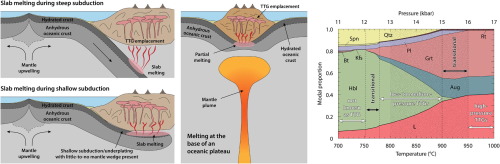
Authors:Palin et alAbstract:Rocks of tonalitic–trondhjemitic–granodioritic (TTG) composition preserved in Archaean terranes represent fragments of the Earth’s earliest-formed continental crust, and are thought to have formed via partial melting of hydrated metabasalt. The geodynamic environments in which such high-grade metamorphism and anatexis may have occurred in the early Earth is strongly debated. Constraining the pressure (P) and temperature (T) conditions at which melts of appropriate composition can be derived from protoliths containing plausible mineral assemblages is central to addressing this question. Phase equilibrium modelling has been undertaken for an enriched Archaean tholeiite bulk composition—a suggested protolith for early-Earth TTG magmas—using newly parameterised thermodynamic models that were specifically developed to evaluate the anatectic behaviour of metabasalt. Assuming minimal H2O saturation at the wet solidus, the potential fertility of the studied metabasalt is greatest if the solidus is crossed at a pressure of ∼11 kbar, where the solidus temperature reaches a minimum of ∼610 °C. Major-element compositions and proportions of calculated partial melts show the best correlation with those of natural Archaean TTGs when in the P–T range ∼800–950 °C and ∼10–18 kbar, which we suggest are optimal conditions for their petrogenesis. Normative geochemistry suggests that these melts would crystallise to broadly trondhjemitic or tonalitic lithologies. Calculated modal proportions of garnet, plagioclase, amphibole, and rutile in the residuum, which control diagnostic trace-element signatures in the melt, also show the best agreement with natural and experimental data at these conditions. Importantly, although partial melts calculated outside of this P–T range still produce TTG-like major-element compositions and normative mineralogies, they would poorly match the diagnostic trace-element signatures of natural Archaean examples owing to the absences of key minerals in the residuum. This optimal P–T range of 800–950 °C and 10–18 kbar defined herein is most likely to characterise metamorphism of hydrated basalt at the base of a 40-km-thick Archaean oceanic plateau/overthickened crust, or else tectonic underplating via shallow subduction, which we therefore suggest are the most likely tectonic settings for the formation of the first voluminous continental crust on the early Earth.
Friday, July 15, 2016
Rhyacian PaleoProterozoic Magnesite Deposits are NOT Deposited Under Hydrothermal Conditions
Genesis of a giant Paleoproterozoic strata-bound magnesite deposit: Constraints from Mg isotopes
Authors:
Dong et al
Abstract:
Giant strata-bound magnesite deposits are absent in modern and most Phanerozoic sedimentary environments but occur predominantly in Precambrian strata. These deposits may have formed directly through precipitation of evolved Mg-rich seawater in an evaporative shallow-marine setting or, alternatively, by epigenetic–hydrothermal replacement of the Mg-rich carbonate precursor. To test these hypotheses, we obtained the first Mg isotope data from the world’s largest strata-bound magnesite deposit belt, hosted by the ca. 2.1 Ga Dashiqiao Formation in Northeast China. The Mg isotope compositions (δ26Mg) of most magnesite ores in the Huaziyu deposit are heavier (–0.75 ± 0.26‰) than most Proterozoic sedimentary dolostones. The Mg isotope compositions and major and trace element data indicate that the magnesites are probably not of hydrothermal origin. Instead, a Mg-rich carbonate precursor precipitated from evaporating seawater in a semi-closed system. Diagenetic brines altered the Mg-rich carbonate precursor to magnesite. Subsequently, recrystallization during regional metamorphism produced coarsely crystalline and saddle magnesite. These interpretations are consistent with the geological features and other geochemical data (element concentrations and C and O isotopes) for the magnesite ores. Hence, we interpret the formation of the Huaziyu magnesite deposit to be dominated by evaporative sedimentation and brine diagenesis.
Wednesday, June 22, 2016
Evidence of Ectasian/Stenian MesoProterozoic River Morphology
Deeply channelled Precambrian rivers: Remote sensing and outcrop evidence from the 1.2 Ga Stoer Group of NW Scotland
Authors:
Ielpi et al
Abstract:
The current paradigm on Precambrian fluvial sedimentology assumes that pre-vegetation environments did not allow for the establishment of deep, stable channels. However, few studies have documented a continuum of fluvial-depositional architectures along km-scale transects where clusters of channel bodies can be observed in their entirety. The Stoer Group consists of a 1.2 Ga rift-basin fill, its type area occurring at Stoer Peninsula, NW Scotland. Ground observations on classic coastal sections are integrated with remote sensing on a restored transect 7 km wide, representing 400 m of stratigraphy. The transect spans a set of palaeovalleys carved on high-relief gneissic basement. Remote sensing and ground-based sedimentology unveil a set of depositional domains, including: (i) perennial channels filled with downstream-lateral accretionary bars; (ii) poorly drained muddy floodbasins; (iii) well-drained sandy floodbasins containing splays and distributary channels, at times meandering; (iv) gravelly piedmonts composed of talus cones and fluvial-fan deposits; and (v) aeolian fields comprising dunes, ponded interdunes, and sandsheets. These depositional domains reveal an original geomorphic complexity higher than previously recognized for Precambrian terrestrial environments.
The occurrence of clustered channel bodies alongside or within both muddy and sandy depositional domains indicates that stable fluvial channels developed independently from the cohesive nature of the substrate. Their development was possibly aided by drainage focusing along valley thalwegs. Three types of fluvial channels have been identified: laterally extensive, multistorey channels akin to mobile, weakly sinuous rivers; vertically stacked, multistorey channels reminiscent of confined, weakly sinuous rivers; and laterally extensive, multilateral channels, indicative of highly mobile, moderately sinuous rivers. Eighty-four preserved channel fills display width-to-thickness ratios fully overlapping with those of post-vegetation and modern braided rivers, disproving the commonly held notion that pre-vegetation rivers could only generate sheet-like sandbodies. This study provides new insights on Precambrian fluvial styles, and underscores the potential of remote-sensing methods to analyze very large exposures of fluvial rocks.
Friday, May 27, 2016
Three Different Types of Sedimentary Basins IDed From NeoProterozoic China
Neoproterozoic sedimentary basin evolution in southwestern Tarim, NW China: New evidence from field observations, detrital zircon U–Pb ages and Hf isotope compositions
Authors:
Zhang et al
Abstract:
Sedimentary basin evolution is intimately related to tectonic background and thus can serve as one of the most important indicators in deciphering the regional tectonic evolution process. Neoproterozoic volcanic-sedimentary sequences are well preserved along the southwestern margin of the Tarim Block in NW China and provide new insights into the Neoproterozoic tectonic evolution of the Tarim. In this contribution, we report the metamorphic deformation features and systematic detrital zircon U–Pb ages and Hf isotope compositions of the Neoproterozoic strata in SW Tarim. Geochronological data reveal that the greenschist-facies metamorphic and tightly folded Sailajiazitage Group (SG) volcanic-sedimentary sequence deposited during 860–830 Ma, the Ailiankate Group (AG) clastic rocks of low greenschist – facies metamorphism and intensive deformation deposited during 820–800 Ma, and the unmetamorphosed and undeformed late Neoproterozoic carbonate–clastic–tillite sequences, including the Silu Group (SLG) and the Qiakemakelieke Group (QG), deposited after 760 Ma. Two phases of glaciations from the QG in SW Tarim could be equivalent to the Beiyixi glaciation and the Altungol–Tereeken glaciation in north Tarim, respectively. Rock assemblages coupled with geochemistry of the SG bimodal volcanic rocks indicate its deposition in a back-arc basin. Rock assemblages, detrital zircon age spectra and its metamorphism and deformation features suggest that the AG clastic sequence most likely deposited at a foreland basin on the back-arc basin sedimentary package while the middle to late Neoproterozoic SLG and QG carbonate–clastic–tillite sequences deposited at a passive marginal and/or rift basins. The Neoproterozoic evolution process of the southwestern Tarim demonstrates that (1) the Neoproterozoic assemblage of the Tarim basement could have lasted till 760 Ma as evidenced by the Aksu blueschist-facies metamorphism and (2) its Pre-Nanhuaian basement could be composed of independent continental terranes. Furthermore, positive εHf(t) deviations in these detrital zircons suggest that the Rodinia plume could have effects on the Neoproterozoic igneous activities.
Monday, May 02, 2016
Was an Impact the Source of a Hadrean Zircon?
Authors:Kenny et alAbstract:Constraining the origin and history of very ancient detrital zircons has unique potential for furthering our knowledge of Earth's very early crust and Hadean geodynamics. Previous applications of the Ti-in-zircon thermometer to >4 Ga zircons have identified a population with relatively low crystallization temperatures (Tzirxtln) of ∼685 °C. This could possibly indicate wet minimum-melting conditions producing granitic melts, implying very different Hadean terrestrial geology from that of other rocky planets. Here we report the first comprehensive ion microprobe study of zircons from a transect through the differentiated Sudbury impact melt sheet (Ontario, Canada). The new zircon Ti results and corresponding Tzirxtln fully overlap with those of the Hadean zircon population. Previous studies that measured Ti in impact melt sheet zircons did not find this wide range because they analyzed samples only from a restricted portion of the melt sheet and because they used laser ablation analyses that can overestimate true Ti content. It is important to note that internal differentiation of the impact melt is likely a prerequisite for the observed low Tzirxtln in zircons from the most evolved rocks. On Earth, melt sheet differentiation is strongest in subaqueous impact basins. Thus, not all Hadean detrital zircon with low Ti necessarily formed during melting at plate boundaries, but at least some could also have crystallized in melt sheets caused by intense meteorite bombardment of the early, hydrosphere-covered protocrust.
Tuesday, February 23, 2016
Sunday, February 14, 2016
The Earth has an Unknown Source of Oxygen Inside its Mantle
Using a special high-pressure chamber, scientists have discovered two new iron oxides in experiments at DESY's X-ray light source PETRA III and other facilities. The discovery points to a huge, hitherto unknown oxygen source in the lower mantle of the Earth. The team led by Dr. Elena Bykova from the University of Bayreuth reports its results in the scientific journal Nature Communications.
Iron oxides in nature take on different forms. „The most common iron oxide is hematite, Fe2O3, which is the end product of many geological processes and the main source of iron for our civilization," explains Bykova. During the past five years, however, scientists have discovered other iron oxides like Fe4O5, Fe5O6, and Fe13O19 that form at high pressures and temperatures. Investigating the behaviour of hematite and magnetite (Fe3O4) further, Bykova and her colleagues used a special pressure chamber at DESY's measuring station for extreme conditions P02.2.
„In this so-called diamond anvil cell, a minute sample can be compressed between two diamonds to several hundred thousand times the atmospheric pressure while a meticulously aligned laser can also heat the sample through the transparent diamond anvils to several thousand degrees Celsius," explains DESY scientist Dr. Hanns-Peter Liermann, head of the measuring station and a co-author of the paper. At the same time, the exceptionally bright and small X-ray beam of PETRA III can track structural changes in the sample. Similar measurements were also made at the European Synchrotron Radiation Source ESRF in France and at the Advanced Photon Source APS in the US.
When the scientists applied a pressure of more than 67 gigapascals (about 670,000 times the standard atmospheric pressure) to their hematite samples and heated it to more than 2400 degrees Celsius, Fe2O3 decomposed and formed Fe5O7, an iron oxide that has not been seen before. These conditions correspond to roughly 1500 kilometres below the surface of the Earth. At an even higher pressure of 70 gigapascals, corresponding to about 1670 kilometres below the surface, magnetite decomposed and another new iron oxide formed, Fe25O32. The formation of both so far unknown compounds leads to the release of oxygen.
Although iron oxides do not normally exist in the bulk of the Earth' lower mantle, they can be transported there via subduction zones, where one tectonic plate dives under another. Hematite and magnetite are major components of so-called Banded Iron Formations (BIFs) and ironstones, huge sedimentary rock formations occurring on all continents. These formations may reach up to several hundred meters in thickness and hundreds of kilometres in length.Deposited in the world's oceans about two billions years ago, Banded Iron Formations form part of the ocean floor and are recycled into the Earth's interior by subduction to great depths, possibly extending to the core-mantle boundary region.
As the team now observed, at conditions corresponding to the middle of the Earth's lower mantle hematite and magnetite decompose releasing huge amounts of oxygen-rich fluid (as oxygen is usually liquid under these conditions). „We estimate that this source so far provided an amount of oxygen equivalent to eight to ten times the mass of oxygen in the atmosphere," says Bykova. "That's a surprise, and it is not quite clear what happens with the oxygen down there."
The oxygen-rich fluid could either locally oxidize surrounding materials or pass to the transition zone, or even to the upper mantle. "This remains to be explored", says co-author Dr. Maxim Bykov of the University of Bayreuth. "For now, we can only say that there is a huge source of oxygen in the mantle that can significantly affect geochemical processes by changing oxidation states and mobilizing trace elements. This will open a large new field of modelling."
link.
Monday, January 25, 2016
Pondering the Precambrian #1
A study used diamonds to suggest the start of plate tectonics was approximately 3.5 billion years ago during the PaleoArchean.
Carbon deposited in the PaleoArchean Australia appears to be biological in origin.
Carbon deposited in the PaleoArchean Australia appears to be biological in origin.
Another study claims plate tectonics started 3 billion years ago during the MesoArchean through the examination of granites and magnesium.
The Helen Iron Formation in Canada was formed during the NeoArchean, 2.75 billion years ago, in moderately deep water when underwater volcanism ceased for a time.
There is evidence of NeoArchean plate tectonics in India
There is evidence of NeoArchean plate tectonics in India
Oxygen levels during the PaleoProterozoic Great Oxygenation Event may have been higher than the following Proterozoic steady state.
Evidence of freshwater stromatolites have been found from the Stenian of Michigan in the Copper Harbor Conglomerate.
There is paleoclimatic evidence also from the Stenian of Michigan. The paleosols appear to indicate it was a floodplain.
There is paleoclimatic evidence also from the Stenian of Michigan. The paleosols appear to indicate it was a floodplain.
Evidence from the Doushantuo Formation in China suggest the Ediacaran there had a carbon anomaly and the phosphated embryos found predate the Gaskiers Glaciation.
Thursday, January 07, 2016
Au Contraire! The Holocene is NOT the Same as the Anthropocene

The Anthropocene is functionally and stratigraphically distinct from the Holocene
Authors:
Waters et al
Background:
Humans are altering the planet, including long-term global geologic processes, at an increasing rate. Any formal recognition of an Anthropocene epoch in the geological time scale hinges on whether humans have changed the Earth system sufficiently to produce a stratigraphic signature in sediments and ice that is distinct from that of the Holocene epoch. Proposals for marking the start of the Anthropocene include an “early Anthropocene” beginning with the spread of agriculture and deforestation; the Columbian Exchange of Old World and New World species; the Industrial Revolution at ~1800 CE; and the mid-20th century “Great Acceleration” of population growth and industrialization.
Sunday, December 27, 2015
Does a new Type of Hydrothermal Vent Explain how the Earth's Crust Cooled?
The first discovery of a new type of hydrothermal vent system in a decade helps explain the long observed disconnect between the theoretical rate at which the Earth's crust is cooling at seafloor spreading ridge flanks, and actual observations. It could also help scientists interpret the evidence for past global climates more accurately.
This discovery has been made by scientists at the National Oceanography Centre (NOC) and the University of Southampton using a combination of robot-subs and remotely operated vehicles operated by the NOC.
Dr Bramley Murton, who co-supervised this research, published today in Nature Communications, said "This will really improve our understanding of how the Earth's interior cools. Theory has long predicted that there must be more cooling in certain locations on the Earth's crust than we could account for using the known mechanisms....and this new class of hydrothermal vent system may account for that difference."
What makes these hydrothermal vent systems different is that the source of heat driving them comes from hot rock pushed towards the seabed by low angle faults, called tectonic spreading centres, rather than volcanic heat from magma chambers. Dr Murton has been involved in research that discovered tectonic seafloor spreading centres at a number of sites across the ocean floor.
link.
Saturday, December 26, 2015
Evidence of an Arc or Back Arc System From NeoArchean North China

A Neoarchean arc–back-arc system in Eastern Hebei, North China Craton: constraints from zircon U–Pb–Hf isotopes and geochemistry of dioritic–tonalitic–trondhjemitic–granodioritic (DTTG) gneisses and felsic paragneisses
Authors:
Bai et al
Abstract:
Dioritic–tonalitic–trondhjemitic–granodioritic (DTTG) gneisses are widely exposed in the Zunhua–Qinglong microblock of Eastern Hebei, North China Craton (NCC). LA–ICP–MS zircon U–Pb isotopic dating for the DTTG gneisses in the Qinglong area reveals that their magmatic precursors were emplaced between 2517 ± 10 and 2505 ± 23 Ma. Zircons of these DTTG gneisses exhibit positive ɛHf(t) values of 0.0 to +6.5, with adakite-like geochemical features represented by relatively high MgO, Mg# and (La/Yb)N ratios. Petrogenetic studies reveal that dioritic magmas were derived from depleted mantle peridotites that were strongly modified by slab-derived melts/fluids and that the tonalitic–trondhjemitic–granodioritic (TTG) magmas were formed by a high degree of fractional crystallization in the dioritic magmas with hornblende as the primary fractionated phase.
LA–ICP–MS zircon U–Pb isotopic analyses reveal that the protoliths of the felsic paragneisses in the Northern Zunhua area were deposited in the Late Neoarchean with a maximum depositional age of 2517 ± 20 Ma. Most of the detrital zircon grains display apparent 207Pb/206Pb ages from 3432 ± 20 to 2502 ± 21 Ma, with negative ɛHf(t) values of −15.4 to −2.4 and calculated TDMC ages between 3995 and 3368 Ma, suggesting that they were formed from the recycling of Eo- to Paleoarchean crustal materials closely related to the southeastern ancient continental crust of the interior Eastern Block. These data together with previous investigations reveal that the basement rocks of Zunhua–Qinglong microblock formed in a Neoarchean arc–back-arc system with the subduction direction from present northwest to southeast.
Thursday, December 24, 2015
The Anthropocene is Geologically Synomous With the Holocene
A new analysis of the fossil record shows that a deep pattern in nature remained the same for 300 million years. Then, 6,000 years ago, the pattern was disrupted -- at about the same time that agriculture spread across North America.
"When early humans started farming and became dominant in the terrestrial landscape, we see this dramatic restructuring of plant and animal communities," said University of Vermont biologist Nicholas Gotelli, an expert on statistics and the senior author on the new study.
In the hunt for the beginning of the much-debated "Anthropocene" -- a supposed new geologic era defined by human influence of the planet -- the new research suggests a need to look back farther in time than the arrival of human-caused climate change, atomic weapons, urbanization or the industrial revolution.
link.
Keep in mind, the Holocene dates from 10k years ago. 4k years, in the geological sense, is nothing and probably would not be detectable in 5 million years in the future. Furthermore, if the overkill hypothesis is correct, then the anthropocene started at the megafauna kills 10k years ago. Gosh. That's EXACTLY the Holocene.
The Holocene has priority based on publication date.
Let's stop using that stupid term.
Thursday, December 10, 2015
Seismometers Deployed Across West Antarctic Rift System and Marie Byrd Land Show Mantle Plume, Other Geological Intrigues
Planetary scientists would be thrilled if they could peel the Earth like an orange and look at what lies beneath the thin crust. We live on the planet's cold surface, but the Earth is a solid body and the surface is continually deformed, split, wrinkled and ruptured by the roiling of warmer layers beneath it.
The contrast between the surface and the depth is nowhere starker -- or more important -- than in Antarctica. What is causing the mysterious line of volcanoes that emerge from the ice sheet there, and what does it mean for the future of the ice?
"Our understanding of what's going on is really hampered because we can't see the geology," said Andrew Lloyd, a graduate student in earth and planetary sciences in Arts & Sciences at Washington University in St. Louis. "We have to turn to geophysical methods, such as seismology, to learn more," he said.
Lloyd helped deploy research seismometers across the West Antarctic Rift System and Marie Byrd Land in the austral summer of 2009-10. He then returned in late 2011 and snowmobiled more than 1,000 miles, living in a Scott tent, to recover the precious data.
The recordings the instruments made of the reverberations of distant earthquakes from January 2010 to January 2012 were used to create maps of seismic velocities beneath the rift valley. An analysis of the maps was published online in the Journal of Geophysical Research: Solid Earth on Nov. 12, 2015 (doi:10.1002/2015JB012455).
This is the first time seismologists have been able to deploy instruments rugged enough to survive a winter in this part of the frozen continent, and so this is the first detailed look at the Earth beneath this region.
Not surprisingly, the maps show a giant blob of superheated rock about 60 miles beneath Mount Sidley, the last of a chain of volcanic mountains in Marie Byrd Land at one end of the transect. More surprisingly, they reveal hot rock beneath the Bentley Subglacial Trench, a deep basin at the other end of the transect.
The Bentley Subglacial Trench is part of the West Antarctic Rift System and hot rock beneath the region indicates that this part of the rift system was active quite recently.
link.
Tuesday, December 01, 2015
More Evidence of NeoArchean Subduction From the North China Craton

Discovery of Neoarchean suprasubduction zone ophiolite suite from Yishui Complex in the North China Craton
Authors:
Santosh et al
Abstract:
The Archean tectonic realm of the North China Craton (NCC) is considered in recent models as a collage of several microblocks which were amalgamated along zones of ocean closure during late Neoarchean. Here we report the finding of a dismembered ophiolite suite from the southern margin of the Jiaoliao microblock in the interior of the unified Eastern Block of the NCC. The suite is composed of lherzolite, pyroxenite, noritic and hornblende gabbro, and hornblendite intruded by veins and sheets of leuco granite. Together with transposed layers and bands of metavolcanics and amphibolites, banded iron formation (BIF), and diabase dykes in the adjacent locations, the Yishui complex corresponds well with a dismembered suprasubduction zone ophiolite suite. Clinopyroxene in the pyroxenite and gabbroic rocks are Mg rich and range in composition from augite to diopside. Among orthopyroxenes, those in lherzolite shows the highest XMg of 0.84-0.85. Plagioclase in hornblende gabbro shows high anorthite content (An50 -64). Calcic amphiboles in the gabbroic rocks range in composition from ferropargasite to ferro-edenite, edenite and pargasite. Spinel inclusions in lherzolite are Cr-rich magnesiospinel. Geochemically, the mafic rocks from Yishui complex show subalkaline basaltic source, whereas the granitoids show volcanic arc affinity. The hornblende gabbro and gabbro, lherzolite and hornblendite show compositional similarity to E-MORB and N-MORB respectively. The lherzolite and hornblendite possess arc-related ultramafic cumulate nature, with overall features straddling the fields of IAT and IAT-MORB. The geochemical features are consistent with evolution in a suprasubduction regime with no significant crustal contamination. The majority of zircon grains in the Yishui suite exhibit magmatic texture and high Th/U ratios. Zircon grains from hornblendite define 207Pb/206Pb upper intercept age of 2538 ± 30 Ma. Zircons from the granite show ages of 2538 ± 16 Ma and 2503 ± 21 Ma, and those from the gabbros yield ages of 2503 ± 16 Ma and 2495 ± 10 Ma. The well defined major age peak at 2500 Ma is broadly coeval with Neoarchean ages reported from the microblocks in the North China Craton. The zircon Lu–Hf data from the Yishui suite display εHf(t) values between -2.5 and 5.0, with corresponding model ages suggesting magma derivation from Neoarchean juvenile sources together with limited reworked Paleo-Mesoarchean crustal components.
Our study is the first report of Neoarchean suprasubduction-type ophiolites from a locality far from the margins of the major crustal blocks and suture zones in the NCC and strengthens the concept that the craton is a mosaic of several microblocks with intervening oceans that closed along multiple subduction zones. We envisage that the amalgamation between the Xuhuai and the Jiaoliao microblocks resulted in the accretion of the Yishui suprasubduction zone ophiolitic assemblages onto the southern margin of the Jiaoliao microblock. The Neoarchean microblock amalgamation in the North China Craton provides new insights into continental growth in the early Earth and confirms that modern style plate tectonics might have been initiated early in the history of our planet.
Friday, November 13, 2015
Plate Tectonics Were Initiated by Mantle Plumes
Plate tectonics on the Earth triggered by plume-induced subduction initiation
Authors:
Gerya et al
Abstract:
Scientific theories of how subduction and plate tectonics began on Earth—and what the tectonic structure of Earth was before this—remain enigmatic and contentious. Understanding viable scenarios for the onset of subduction and plate tectonics is hampered by the fact that subduction initiation processes must have been markedly different before the onset of global plate tectonics because most present-day subduction initiation mechanisms require acting plate forces and existing zones of lithospheric weakness, which are both consequences of plate tectonics. However, plume-induced subduction initiation could have started the first subduction zone without the help of plate tectonics. Here, we test this mechanism using high-resolution three-dimensional numerical thermomechanical modelling. We demonstrate that three key physical factors combine to trigger self-sustained subduction: (1) a strong, negatively buoyant oceanic lithosphere; (2) focused magmatic weakening and thinning of lithosphere above the plume; and (3) lubrication of the slab interface by hydrated crust. We also show that plume-induced subduction could only have been feasible in the hotter early Earth for old oceanic plates. In contrast, younger plates favoured episodic lithospheric drips rather than self-sustained subduction and global plate tectonics.
Saturday, November 07, 2015
Super Volcanoes may NOT be Triggered by Internal Pressure Buildup
Supervolcanoes, massive eruptions with potential global consequences, appear not to follow the conventional volcano mechanics of internal pressure building until the volcano blows. Instead, a new study finds, such massive magma chambers might erupt when the roof above them cracks or collapses.
Knowledge of triggering mechanisms is crucial for monitoring supervolcano systems, including ones that lie beneath Yellowstone National Park and Long Valley, California, according to the study led by Patricia Gregg, University of Illinois professor of geology, in collaboration with professor Eric Grosfils of Pomona College and professor Shan de Silva of Oregon State University. The study was published in the Journal of Volcanology and Geothermal Research. Gregg also presented the findings this week at the annual meeting of the Geological Society of America.
link.
Tuesday, October 27, 2015
A Method for Classifying and Evaluating Biologically Altered Volcanic Rocks on Mars
A Hierarchical System for Evaluating the Biogenicity of Metavolcanic- and Ultramafic-Hosted Microalteration Textures in the Search for Extraterrestrial Life
Authors:
McLoughlin et al
Abstract:
The low-temperature alteration of submarine volcanic glasses has been argued to involve the activity of microorganisms, and analogous fluid-rock-microbial-mediated alteration has also been postulated on Mars. However, establishing the extent to which microbes are involved in volcanic glass alteration has proven to be difficult, and the reliability of resulting textural biosignatures is debated, particularly in the early rock record. We therefore propose a hierarchical scheme to evaluate the biogenicity of candidate textural biosignatures found in altered terrestrial and extraterrestrial basaltic glasses and serpentinized ultramafic rocks.
The hierarchical scheme is formulated to give increasing confidence of a biogenic origin and involves (i) investigation of the textural context and syngenicity of the candidate biosignature; (ii) characterization of the morphology and size range of the microtextures; (iii) mapping of the geological and physicochemical variables controlling the occurrence and preservation of the microtextures; (iv) in situ investigation of chemical signatures that are syngenetic to the microtexture; and (v) identification of growth patterns suggestive of biological behavior and redox variations in the host minerals. The scheme results in five categories of candidate biosignature as follows: Category 1 indicates preservation of very weak evidence for biogenicity, Categories 2 through 4 indicate evidence for increasing confidence of a biogenic origin, and Category 5 indicates that biogenic origin is most likely.
We apply this hierarchical approach to examine the evidence for a biogenic origin of several examples, including candidate bacterial encrustations in altered pillow lavas, granular and tubular microtextures in volcanic glass from the subseafloor and a Phanerozoic ophiolite, mineralized microtextures in Archean metavolcanic glass, and alteration textures in olivines of the martian meteorite Yamato 000593. The aim of this hierarchical approach is to provide a framework for identifying robust biosignatures of microbial life in the altered oceanic crust on Earth, and in extraterrestrial altered mafic-ultramafic rocks, particularly on Mars.
Monday, October 26, 2015
Academic Bun Fight: Panama Isthmus Closed Earlier Than Currently Thought (or did it)
Biological evidence supports an early and complex emergence of the Isthmus of PanamaThat was a bad analysis!!!
Authors:
Bacon et al
Abstract:
The linking of North and South America by the Isthmus of Panama had major impacts on global climate, oceanic and atmospheric currents, and biodiversity, yet the timing of this critical event remains contentious. The Isthmus is traditionally understood to have fully closed by ca. 3.5 million years ago (Ma), and this date has been used as a benchmark for oceanographic, climatic, and evolutionary research, but recent evidence suggests a more complex geological formation. Here, we analyze both molecular and fossil data to evaluate the tempo of biotic exchange across the Americas in light of geological evidence. We demonstrate significant waves of dispersal of terrestrial organisms at approximately ca. 20 and 6 Ma and corresponding events separating marine organisms in the Atlantic and Pacific oceans at ca. 23 and 7 Ma. The direction of dispersal and their rates were symmetrical until the last ca. 6 Ma, when northern migration of South American lineages increased significantly. Variability among taxa in their timing of dispersal or vicariance across the Isthmus is not explained by the ecological factors tested in these analyses, including biome type, dispersal ability, and elevation preference. Migration was therefore not generally regulated by intrinsic traits but more likely reflects the presence of emergent terrain several millions of years earlier than commonly assumed. These results indicate that the dramatic biotic turnover associated with the Great American Biotic Interchange was a long and complex process that began as early as the Oligocene–Miocene transition.
Appearance of an early closure of the Isthmus of Panama is the product of biased inclusion of data in the metaanalysisno! it wasn't, damnit!
Author:
Lessios
Extract:
In their PNAS article “Biological evidence supports an early and complex emergence of the Isthmus of Panama,” Bacon et al. (1) use data from molecular comparisons of terrestrial and marine organisms taken from the literature to estimate dates of rate shifts in migration. One of their conclusions is that “events separating marine organisms in the Atlantic and Pacific oceans [occurred] at ca. 23 and 7 Ma” (1). The authors base this conclusion on two kinds of molecular dating: (i) 31 dates from phylogenies with evolutionary rates calibrated from fossils at one or more nodes, and (ii) 52 dates from mitochondrial divergence between sister species on either side of the Isthmus taken from the review by Lessios (2) (note: complete data are available from the Dryad Digital Repository). For the latter, divergence was converted to time by assuming a mitochondrial DNA divergence rate of 2% per million years. Unfortunately, Bacon et al.’s (1) metaanalysis of separations of marine organisms contains unexplained omissions of data and mistakes. Nine of the fossil calibrated divergence values are wrong, and three are omitted (though present in publications used to derive other dates). Thirty-eight comparisons from Lessios (2) are excluded. Criteria for inclusion of data are not stated but, judging from the estimated dates, only data from Cytochrome c oxidase subunit 1 were taken into account, even though Lessios (2) presents data for multiple mitochondrial genes. This selectivity in the marine dataset of Bacon et al. (1) is hard to explain, because the terrestrial data come from various genes, and because eight comparisons of Cytochrome c oxidase subunit 1 of marine species are among those excluded.
Reply to Lessios and Marko et al.: Early and progressive migration across the Isthmus of Panama is robust to missing data and biases
Authors:
Bacon et al
Extract:
The emergence of the Isthmus of Panama left a major imprint on the biodiversity of the Americas. The connection between South and North America facilitated dispersal of terrestrial and freshwater organisms, while separating marine species between the eastern Pacific and Caribbean seas. Recent geological data have questioned the long-standing view of a Pliocene emergence of the Isthmus (1) and show that the Central American Seaway, defined as the deep oceanic seaway along the tectonic boundary of the South American plate and Panama arc, was already closed by 15–13 Ma (2). Caribbean–Pacific shallow water exchange probably continued, albeit intermittently, until a full closure at 3.5 Ma (1–3). Recently Bacon et al. (3) used molecular and fossil data to evaluate the timing, tempo, and directionality of biotic exchange and vicariance across the Isthmus, and tested whether biological data are congruent with recent geological evidence. Significant increases in terrestrial dispersals were found at ca. 20 and 6 Ma, and increases in marine vicariance at ca. 23 and 7 Ma. Similar patterns prevailed despite intrinsic differences among the taxonomic groups surveyed. This led Bacon et al. (3) to reject the assumption of a single closure of the Isthmus at ca. 3.5 Ma in favor of an older, more complex model of land emergence and biotic interchange.
Discovery of Hadean Crustal Materials in SW China
Discovery of Hadean–Mesoarchean crustal materials in the northern Sibumasu block and its significance for Gondwana reconstruction
Authors:
Li et al
Abstract:
The micro-continental blocks in SE Asia are thought to be derived from the East Gondwana which has a basement as old as Hadean–Mesoarchean. However, such old crustal materials have not been found anywhere in SE Asia. In this paper, we report the occurrence of the Hadean–Mesoarchean crustal materials in the northern Sibumasu block, SW China. Our finding is based on inherited zircon U–Pb ages and Hf isotope model ages of co-magmatic zircon crystals from early-Paleozoic S-type granitoids in the northernmost Sibumasu. LA-ICP-MS zircon U–Pb isotopic analysis reveals that some S-type granitoids in this region formed between 468 Ma and 447 Ma. These rocks are strongly peraluminous, with high A/CNK ratios > 1.2 and normative corundum content > 2 wt%, and have low CaO/Na2O ratios less than 0.3 which indicates that they formed by anatexis of metapelitic crustal rocks. The ca. 470–450 Ma S-type granitoids contain inherited zircon crystals as old as Mesoarchean (∼3.1 Ga). The ɛHf(t) values of zircon crystallized from the magmas of these rocks vary from −49 to +16, with major peaks approximately at −46, −35 and −27. The corresponding model ages for the formation of the source crust are ∼4.39 Ga, ∼3.62 Ga and ∼3.12 Ga. This, together with the discovery of ∼3.1 Ga inherited zircon in the granitoids, indicates that the northern Sibumasu block has Hadean–Mesoarchean crustal materials. A Gondwana-wide comparison of crustal formation time data reveals that these Hadean–Mesoarchean crustal materials show similar age distribution with the crusts of the Pilbara and Yilgarn Cratons, Western Australia. Their derivation analysis provides a new line of evidence for the majority view that the Sibumasu block was attached to NW Australia before its breakup from Gondwana.
Subscribe to:
Posts (Atom)