
link.
Ceres water regime: surface temperature, water sublimation and transient exo(atmo)sphere
Authors:
Formisano et al
Abstract:
Recent observations of water emission around Ceres suggest the presence of an ice layer on or beneath the surface of this asteroid. Several mechanisms have been suggested to explain these plumes, among which cometary-like sublimation seems to be plausible, since there is a correlation between the magnitude of the emission and the change in the heliocentric distance along the orbit. In this work, we applied a comet sublimation model to study the plausible scenarios that match with Herschel observations of the water flux (1026 molecules s−1). Each scenario is characterized by a well-defined set of physical and orbital parameters. Moreover, a study of the dynamic evolution of the H2O plume has been performed, showing that an optically thin transient atmospheric envelope, with a typical timescale of some tens of days, can be maintained by the H2O surface emission. Our simulations could be useful theoretical support for the Dawn NASA mission by giving a better understanding of the physical conditions for water sublimation and ice stability.
Widespread Excess Ice in Arcadia Planitia, Mars
Authors:
Bramson et al
Abstract:
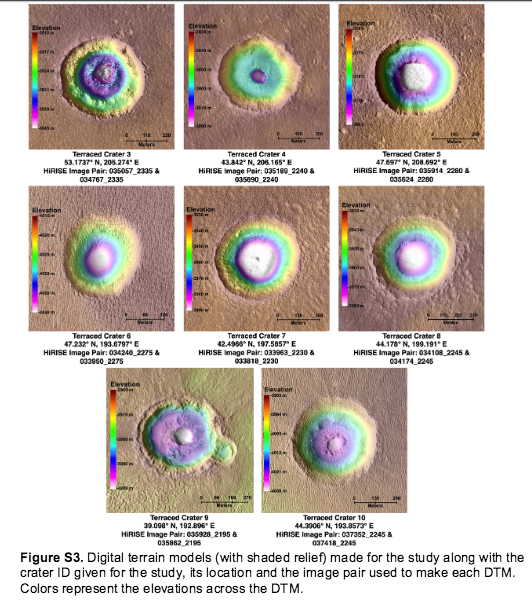
The distribution of subsurface water ice on Mars is a key constraint on past climate, while the volumetric concentration of buried ice (pore-filling versus excess) provides information about the process that led to its deposition. We investigate the subsurface of Arcadia Planitia by measuring the depth of terraces in simple impact craters and mapping a widespread subsurface reflection in radar sounding data. Assuming that the contrast in material strengths responsible for the terracing is the same dielectric interface that causes the radar reflection, we can combine these data to estimate the dielectric constant of the overlying material. We compare these results to a three-component dielectric mixing model to constrain composition. Our results indicate a widespread, decameters-thick layer that is excess water ice ~10^4 km^3 in volume. The accumulation and long-term preservation of this ice is a challenge for current Martian climate models.


Remnant buried ice in the equatorial Regions of Mars: Morphological Indicators Associated with the Arsia Mons Tropical Mountain Glacier Deposits
Authors:
Scanlon et al
Abstract:
The fan-shaped deposit (FSD) on the western and northwestern flanks of Arsia Mons is the remnant of tropical mountain glaciers, deposited several tens to hundreds of millions of years ago during periods of high spin-axis obliquity. Previous workers have argued that the Smooth Facies in the FSD contains a core of ancient glacial ice. Here, we find evidence that additional glacial ice remains preserved within several other landforms in the Smooth Facies and Ridged Facies. These include landforms that we interpret as kame and kettle topography on the basis of their distribution, size, and morphologies ranging progressively from knobs to degraded knobs to pits. We argue that some moraines in the Ridged Facies are ice-cored on the basis of their interactions with lava flows and the axial troughs at the crests of some moraines. We also argue that dunes with axial troughs, found in and surrounding the FSD, are the remnants of sediment-covered snow dunes formed by reworking of snow or glacial ice, and that the axial troughs form as tension cracks in the sediment and deepen by sublimation of the underlying ice. Long-term preservation of water ice in equatorial environments is assisted by a meters- to decameters-thick debris cover (lag) formed from sublimation of dirty ice, as well as burial beneath volcanic tephra and eolian deposits. This ancient ice could contain preserved biosignatures, provide information on Martian climate and atmospheric history, and serve as a resource for human exploration.

Amazonian thermokarst in Danielson crater, Arabia Terra region, Mars
Authors:
Baioni et al
Abstract:
This paper describe the possible ice-related landforms observed within Danielson crater which is centered at about 8°N and 353°E, in the region of southwestern Arabia Terra about 800 km south of Becquerel crater.
A morphological survey of the study area through an analysis of the available Mars images was performed. The features of the landforms were investigated through an integrated analysis of Reconnaissance Orbiter (MRO) High Resolution Imaging Science Experiment (HiRISE) and Context Camera (CTX) data.
Landforms interpreted as due to thermokarst processes, resembling similarly ice-related landforms found both in the cold-climate non-glacial regions of Earth, and putatively in other areas of Mars, was observed.
These landforms are attributed to the presence of ground ice/ice-melting processes reflect significant climatic changes and different climatic conditions than those existing now. Moreover, they appear to display young erosional age, suggesting that are probably young, probably of Amazonian age.

Expanded secondary craters in the Arcadia Planitia region, Mars: Evidence for tens of Myr-old shallow subsurface ice
Authors:
Viola et al
Abstract:
A range of observations indicates widespread subsurface ice throughout the mid and high latitudes of Mars in the form of both pore-filling and excess ice. It is generally thought that this ice was recently emplaced and is not older than a hundred thousand to a few millions of years old based on ice stability and orbital-induced climate change. We analyze the distribution of subsurface ice in Arcadia Planitia, located in the northern mid latitudes, by mapping thermokarstically expanded secondary craters, providing additional evidence for extensive excess ice down to fairly low latitudes (less than 40°N). We further infer the minimum age of this subsurface ice based on the ages of the four primary craters that are thought to be the source of a large portion of these secondaries, which yields estimates on the order of tens of millions of years old – much more ancient than anticipated. This estimated ancient age suggests that ice can be preserved in the shallow subsurface for long periods of time, at least in some parts of Arcadia Planitia where expanded secondary craters are especially abundant. We estimate the amount of ice lost to sublimation during crater expansion based on measurements of expanded secondary craters in HiRISE Digital Terrain Models. The loss is equivalent to a volume of ice between ∼140 and 360 km3, which would correspond to a global layer of 1–2.5 mm thick. We further argue that much more ice (at least 6000 km3) is likely preserved beneath the un-cratered regions of Arcadia Planitia since significant loss of this excess ice would have caused extensive terrain dissection and the removal of the expanded secondary craters. Both the loss of ice due to secondary crater expansion and the presence of this ice today have implications for the martian climate.
Lunar polar craters – Icy, rough or just sloping?
Authors:
Eke et al
Abstract:
Circular Polarisation Ratio (CPR) mosaics from Mini-SAR on Chandrayaan-1 and Mini-RF on LRO are used to study craters near to the lunar north pole. The look direction of the detectors strongly affects the appearance of the crater CPR maps. Rectifying the mosaics to account for parallax also significantly changes the CPR maps of the crater interiors. It is shown that the CPRs of crater interiors in unrectified maps are biased to larger values than crater exteriors, because of a combination of the effects of parallax and incidence angle. Using the LOLA Digital Elevation Map (DEM), the variation of CPR with angle of incidence has been studied. For fresh craters, CPR ∼0.7 with only a weak dependence on angle of incidence or position interior or just exterior to the crater, consistent with dihedral scattering from blocky surface roughness. For anomalous craters, the CPR interior to the crater increases with both incidence angle and distance from the crater centre. Central crater CPRs are similar to those in the crater exteriors. CPR does not appear to correlate with temperature within craters. Furthermore, the anomalous polar craters have diameter-to-depth ratios that are lower than those of typical polar craters. These results strongly suggest that the high CPR values in anomalous polar craters are not providing evidence of significant volumes of water ice. Rather, anomalous craters are of intermediate age, and maintain sufficiently steep sides that sufficient regolith does not cover all rough surfaces.
Survival of water ice in Jupiter Trojans
Authors:
Guilbert-Lepoutre et al
Abstract:
Jupiter Trojans appear to be a key population of small bodies to study and test the models of the Solar System formation and evolution. Because understanding the evolution of Trojans can bring strong and unique constraints on the origins of our planetary system, a significant observational effort has been undertaken to unveil their physical characteristics. The data gathered so far are consistent with Trojans having volatile-rich interiors (possibly water ice) and volatile-poor surfaces (fine grained silicates). Since water ice is not thermodynamically stable against sublimation at the surface of an object located at ~5 AU, such layering seems consistent with past outgassing. In this work, we study the thermal history of Trojans after the formation of a dust mantle by possible past outgassing, so as to constrain the depth at which water ice could be stable. We find that it could have survived 100 m below the surface, even if Trojans orbited close to the Sun for ~10,000 years, as suggested by the most recent dynamical models. Water ice should be found ~10 m below the surface in most cases, and below 10 cm in the polar regions in some cases.

A deadly bed of icy javelins could be awaiting any spacecraft that tries to land on some parts of the ice-covered world Europa, say researchers who have carefully modeled the ice processes at work on parts of the Jovian moon to detect features beyond the current low resolution images.
If the prediction of long vertical blades of ice is correct, it will not only help engineers design a lander to tame or avoid the sabers, but also help explain a couple of nagging mysteries about the strange moon.
Currently, the very best images of Europa only see 10 meters per pixel, at best, said Daniel Hobley of the University of Colorado. That means that if giant ice daggers do exist, they could still be several meters long and still escape detection.
To learn more, Hobley and his colleagues looked to Chile, where high in the mountains there are peculiar icy features called penitentes that are not found in polar regions.
"Penitentes are very, very sharp blades and spikes of ice," said Hobley. "They are famously well developed in Chile and only develop in the tropics on Earth."
The reason for the tropical location is that in order to sculpt the blade, the sun's rays must shine down almost vertically throughout the year so the light is always drilling down at the bottom of the crevices, between the blades, rather than the sides of the blades. In contrast, at higher latitudes the sun's angle changes dramatically through even a single season, so that light would shine on the sides of the blades and melt them before they had time to develop to any significant size.
The researchers also predict that penitentes, perhaps up to five meters long, could crowd Europa's surface in a wide band centered on the equator.


