Authors:Bernard et alAbstract:Assessing the onset and extent of Northern Hemisphere glaciation is required to understand Cenozoic climate change and its impact on topography. While the onset of accelerated Cenozoic erosion is generally associated with the Quaternary at mid-latitudes, some high-latitude passive margins may have undergone earlier glaciation starting at 38–30 Ma or even 45 Ma. Here we document a rapid phase of exhumation in the East Greenland margin between 68°N and 76°N starting at 30 ± 5 Ma. The timing is coincident with the dramatic worldwide fall of surface temperature at the Eocene-Oligocene transition. Our inference is based on apatite fission track and apatite helium data. We suggest that a transition from an Eocene fluvial to an Oligocene glacial-dominated landscape triggered a period of enhanced erosion. This study provides the first onshore potential evidence of the onset of continental ice in East Greenland margin at the Eocene-Oligocene transition (ca. 34 Ma), contemporaneously with the onset of Antarctica glaciation and erosion. Our interpretation is consistent with that based on the oldest ice-rafted debris found in the sedimentary records offshore East Greenland and implies that East Greenland exhibits the oldest onshore record of Cenozoic glacial erosion on Earth.
Showing posts with label oligocene. Show all posts
Showing posts with label oligocene. Show all posts
Friday, September 30, 2016
Evidence of Glaciation at the Eocene-Oligocene Boundary From Greenland


Thursday, August 04, 2016
The Eocene-Oligocene climate transition in the Central Paratethys
The Eocene-Oligocene climate transition in the Central Paratethys
Authors:
Ozsvárt et al
Abstract:
We studied two boreholes (Cserépváralja-1 and Kiscell-1) with continuous sedimentary records across the Eocene-Oligocene climate transition from the Central Paratethyan area. Assemblages of benthic foraminifera display a shift in dominance by epifaunal taxa in the late Eocene to shallow and deep infaunal taxa in the early Oligocene. Using the benthic foraminiferal oxygen index (BFOI), a decreasing trend of bottom-water oxygen levels is established across the Eocene-Oligocene transition (EOT), leading to the development of dysoxic conditions later in the early Oligocene.
Trends in δ18O and δ13C values measured on tests of selected benthic and planktic foraminifera roughly parallel those of the global record of stepped EOT δ18O increase and deviate only later in the early Oligocene, related to the isolation of the Paratethys. The overall similarity of the isotope curves and the presence of a planktic-benthic ecological offset suggest that the original isotope trends are preserved, despite the systematically more negative δ18O values. Of different scenarios, a quasi-uniform diagenetic overprint by fluids with low δ18O values, during burial or uplift, appears best supported. We conclude that the globally established isotopic expression of Antarctic ice sheet growth across the EOT may be recognizable in the Paratethys. Deviations from the global trends after the EOT were caused by regional paleoceanographic changes induced by the progressing Alpine orogeny and sea-level change, which led to a restricted connection with the open ocean, freshwater influx from increased precipitation, and gradual development of bottom-water oxygen depletion.
Friday, June 24, 2016
Nabotherium: a new Anthracothere From Oligocene Paleogene Egypt With Interesting Dental Adaptations
A new anthracothere (Artiodactyla) from the early Oligocene, Fayum, Egypt, and the mystery of African ‘Rhagatherium’ solved
Authors:
Sileem et al
Abstract:
Recent work on new anthracothere (Mammalia, Artiodactyla) specimens from the Jebel Qatrani Formation, early Oligocene, Fayum, Egypt, has revealed the presence of a new genus. Nabotherium new genus is described on the basis of a partial skull, several mandibular and maxillary specimens, and isolated teeth. The new genus exhibits a distinctive combination of features not seen in other Paleogene anthracotheres. The most noticeable characteristics of the new genus include the presence of large and well-developed upper and lower canines, caniniform third incisors, the presence of only a short diastema between the canine and first premolar, and broad, bunodont cheek teeth. This is in contrast to other contemporary anthracotheres, including other forms from the Fayum, which show a spatulate third incisor, a reduced canine, a much longer canine-premolar diastema, and more narrow, bunoselenodont cheek teeth. The presence of a relatively short rostrum with closely packed incisors, low-crowned and simple premolars, and low-crowned, bunodont molars indicates that members of the new genus would have been more efficient at crushing foods than slicing vegetation, and suggests a more varied herbivorous and frugivorous diet than was favored by other, more bunoselenodont Fayum anthracotheres.
Friday, May 06, 2016
Six Primates From Oligocene Paleogene China Discovered
In a study to be published this week in the journal Science, researchers describe unearthing a "mother lode" of a half-dozen fossil primate species in southern China.
These primates eked out an existence just after the Eocene-Oligocene transition, some 34 million years ago. It was a time when drastic cooling made much of Asia inhospitable to primates, slashing their populations and rendering discoveries of such fossils especially rare.
"At the Eocene-Oligocene boundary, because of the rearrangement of Earth's major tectonic plates, you had a rapid drop in temperature and humidity," said K. Christopher Beard, senior curator at the University of Kansas' Biodiversity Institute and co-author of the report. "Primates like it warm and wet, so they faced hard times around the world -- to the extent that they went extinct in North America and Europe. Of course, primates somehow survived in Africa and Southern Asia, because we're still around to talk about it." Because anthropoid primates -- the forerunners of living monkeys, apes and humans-- first appeared in Asia, understanding their fate on that continent is key to grasping the arc of early primate and human evolution.
"This has always been an enigma," Beard said. "We had a lot of evidence previously that the earliest anthropoids originated in Asia. At some point, later in the Eocene, these Asian anthropoids got to Africa and started to diversify there. At some point, the geographic focal point of anthropoid evolution -- monkeys, apes and humans -- shifted from Asia to Africa. But we never understood when and why. Now, we know. The Eocene-Oligocene climate crisis virtually wiped out Asian anthropoids, so the only place they could evolve to become later monkeys, apes and humans was Africa."
link.
Saturday, April 23, 2016
These are not the Paleogene Penguins you are Looking for
New late Eocene and Oligocene remains of the flightless, penguin-like plotopterids (Aves, Plotopteridae) from western Washington State, U.S.A.
Authors:
Mayr et al
Abstract:
We describe new plotopterids (Aves, Plotopteridae) from late Eocene and Oligocene strata in western Washington State, U.S.A. The specimens belong to four new species of these flightless, wing-propelled seabirds, three of which are named and assigned to two new supraspecific taxa, Olympidytes, gen. nov., and Klallamornis, gen. nov. We confirm previous observations on a high diversity of plotopterids in the Paleogene of North America, but because the fossils are from different formations, it remains elusive how many of the six currently recognized species from western Washington actually coexisted. Tonsala, the only previously described plotopterid taxon from the Olympic Peninsula, is likely to occupy a more basal phylogenetic position than the other plotopterids of this geographic area. Olympidytes and Klallamornis may be successive sister taxa of Copepteryx and Hokkaidornis from the late Oligocene of Japan, but a determination of the exact affinities of the new taxa requires the discovery of further fossils. Notably, the geochronologically youngest plotopterid, the early Miocene Plotopterum, differs from earlier taxa in plesiomorphic features and is here considered to be among the phylogenetically most basal plotopterids. The late Eocene basal Phocavis likewise temporally overlaps with more derived plotopterid taxa. The coexistence of basal and more derived plotopterids in the late Eocene may indicate a rapid evolution of plotopterids towards the late Eocene. The factors that allowed the persistence of basal taxa into the Miocene remain, however, elusive, and so are those that triggered the evolution of wing-propelled diving in these highly specialized birds.
Tuesday, April 05, 2016
The Behavior of the Antarctic Ice Sheet Across the Eocene-Oligocene Boundary Climate Change
Antarctic Ice Sheet variability across the Eocene-Oligocene boundary climate transition
Authors:
Galeotti et al
Abstract:
About 34 million years ago, Earth’s climate cooled and an ice sheet formed on Antarctica as atmospheric carbon dioxide (CO2) fell below ~750 parts per million (ppm). Sedimentary cycles from a drillcore in the western Ross Sea provide direct evidence of orbitally controlled glacial cycles between 34 million and 31 million years ago. Initially, under atmospheric CO2 levels of ≥600 ppm, a smaller Antarctic Ice Sheet (AIS), restricted to the terrestrial continent, was highly responsive to local insolation forcing. A more stable, continental-scale ice sheet calving at the coastline did not form until ~32.8 million years ago, coincident with the earliest time that atmospheric CO2 levels fell below ~600 ppm. Our results provide insight into the potential of the AIS for threshold behavior and have implications for its sensitivity to atmospheric CO2 concentrations above present-day levels.
Sunday, February 21, 2016
Ilbandornis woodburnei: A New Species of Oligocene/Miocene Flightless Mihirung
The extinct flightless mihirungs (Aves, Dromornithidae): cranial anatomy, a new species, and assessment of Oligo-Miocene lineage diversity
Authors:
Worthy et al
Abstract:
Giant flightless fowl (Aves, Dromornithidae) similar to the Northern Hemisphere gastornithids and weighing up to 350–650 kg evolved on Gondwana and existed in what is now Australia from the Eocene to the late Quaternary. Understanding cranial morphology of dromornithids has until now been based almost wholly on species of Dromornis, with that of species in three other genera either previously unknown or very fragmentary. Here we rectify this deficiency and describe a well-preserved cranium from the middle Miocene Bullock Creek Local Fauna referred to Ilbandornis woodburnei, rich, fragmentary crania, quadrates, pterygoids, and mandibles for the Oligo-Miocene Barawertornis tedfordi Rich, and additional material of the species of Ilbandornis. The morphological similarity of this cranial material suggests that the emu-sized B. tedfordi is a smaller precursor to and differs little from species of Ilbandornis. Dromornis murrayi, n. sp., from late Oligocene–Early Miocene sites at Riversleigh, based on cranial and postcranial elements, is the oldest and smallest species in its genus. Placed in the context of other data, these observations suggest that the dromornithids comprised only two lineages throughout the Oligo-Miocene. The Barawertornis-Ilbandornis lineage attained maximum diversity in the middle Miocene Bullock Creek and late Miocene Alcoota local faunas (LF), with two species in each, but the Dromornis lineage seems to have been monotypic throughout its temporal range. The low diversity of these giant galloanseres in Australia mirrors that of the giant herbivorous ratites (ostriches and kin), which similarly have low diversity where they coevolved with diverse mammalian faunas.
Saturday, January 02, 2016
Global Change Across the Oligocene-Miocene Transition
Global change across the Oligocene-Miocene Transition: High-resolution stable isotope records from IODP Site U1334 (equatorial Pacific Ocean)
Authors:
Beddow et al
Abstract:
The Oligocene – Miocene Transition (OMT) (~23 Ma) is interpreted as a transient global cooling event, associated with a large-scale Antarctic ice sheet expansion. Here, we present a 2.23 Myr long high-resolution (~3 kyr) benthic foraminiferal oxygen and carbon isotope (δ18O and δ13C) record from Integrated Ocean Drilling Program Site U1334 (eastern equatorial Pacific Ocean), covering the interval from 21.91 to 24.14 Ma. To date, five other high-resolution benthic foraminiferal stable isotope stratigraphies across this time-interval have been published, showing a ~1‰ increase in benthic foraminiferal δ18O across the OMT. However, these records are still few and spatially limited and no clear understanding exists of the global versus local imprints. We show that trends and the amplitudes of change are similar at Site U1334 as in other high-resolution stable isotope records, suggesting that these represent global deep-water signals. We create a benthic foraminiferal stable isotope stack across the OMT by combining Site U1334 with records from ODP Sites 926, 929, 1090, 1264 and 1218 to best approximate the global signal. We find that isotopic gradients between sites indicate inter- and intra-basinal variability in deep-water masses, and in particular note an offset between the equatorial Atlantic and the equatorial Pacific, suggesting that a distinct temperature gradient was present during the OMT between these deep water masses at low latitudes. A convergence in the δ18O values between infaunal and epifaunal species occurs between 22.8 and 23.2 Ma, associated with the maximum δ18O excursion at the OMT, suggesting climatic changes associated with the OMT had an effect on interspecies offsets of benthic foraminifera. Our data indicates a maximum glacioeustatic sea level change of ~50 m across the OMT.
Saturday, November 28, 2015
Apidium zuetina: a new Anthropoid Primate From Oligocene Paleogene Libya
During upheaval in Libya in 2013, a window of opportunity opened for scientists from the University of Kansas to perform research at the Zallah Oasis, a promising site for unearthing fossils from the Oligocene period, roughly 30 million years ago.
From that work, the KU-led team last week published a description of a previously unknown anthropoid primate -- a forerunner of today's monkeys, apes and humans -- in the Journal of Human Evolution. They've dubbed their new find Apidium zuetina.
Significantly, it's the first example of Apidium to be found outside of Egypt.
"Apidium is interesting because it was the first early anthropoid primate ever to be found and described, in 1908," said K. Christopher Beard, Distinguished Foundation Professor of Ecology and Evolutionary Biology and senior curator with KU's Biodiversity Institute, who headed the research. "The oldest known Apidium fossils are about 31 million years old, while the youngest are 29 million. Before our discovery in Libya, only three species of Apidium were ever recovered in Egypt. People had come up with the idea that these primates had evolved locally in Egypt."
Beard said evidence that Apidium had dispersed across North Africa was the key facet of the find. He believes shifting climatic and environmental conditions shaped the distribution of species of Apidium, which affected their evolution.
"We've found evidence that climate change -- not warming, but cooling and drying -- across the Eocene-Oligocene boundary probably is the root cause in kicking anthropoid evolution into overdrive," he said. "All of these anthropoids, which were our distant relatives, were living up in the trees -- none of them were coming down. When the world became cooler and dryer in this period, what was previously a continuous belt of forest became more fragmented. This created barriers to gene flow and movement of animals from one part of forest to what used to be adjacent forest."
With a forest broken up, there was an inhibition of gene flow that through time resulted in speciation, or the creation of new species, according to the KU researcher.
"Animals that are sequestered become different species over millions of years," Beard said. "As the climate oscillates again, you've got different species of Apidium. As forests expand and contract, now you've got competition between species of Apidium that have never seen each other before. One species outcompetes the other, the other goes extinct, and we think that's what we're picking up with this Libyan Apidium, which is related to the youngest and largest species of Apidium known from Egypt."
Beard said that Apidium zuetina would have been physically similar to modern-day squirrel monkeys from South America, but with smaller brains, and would have dined on fruits, nuts and seeds.
"We know that Apidium was a very active arboreal monkey, a really good leaper," he said. "We know they actually had fused lower-leg bones just above the ankle joint. That's really unusual for anthropoid primates, and the only reason for it to happen is because you like to jump a lot, as it stabilized the join between those bones and the ankle."
The team identified Apidium zuetina through detailed analysis of its teeth.
link.
Friday, October 09, 2015
Desmostylians Vacuumed up Their Aquatic Plants Diet, Didn't Chew
The identification of a new species belonging to the marine mammal group Desmostylia has intensified the rare animal's brief mysterious journey through prehistoric time, finds a new study.
A big, hippo-sized animal with a long snout and tusks -- the new species, 23 million years old, has a unique tooth and jaw structure that indicates it was not only a vegetarian, but literally sucked vegetation from shorelines like a vacuum cleaner, said vertebrate paleontologist and study co-author Louis L. Jacobs, Southern Methodist University, Dallas.
But unlike other marine mammals alive today -- such as whales, seals and sea cows -- desmostylians went totally extinct. Desmostylians, every single species combined, lived in an interval between 33 million and 10 million years ago.
Their strange columnar teeth and odd style of eating don't occur in any other mammal, The new specimens -- from at least four individuals -- were recovered from Unalaska, an Aleutian island in the North Pacific.
While alive, the creatures lived in what is now Unalaska's Dutch Harbor, where fishing boats depart on Discovery channel's "Deadliest Catch" reality TV show.
"The new animal -- when compared to one of a different species from Japan -- made us realize that desmos do not chew like any other animal," said Jacobs, a professor of earth sciences. "They clench their teeth, root up plants and suck them in."
To eat, the animals buttressed their lower jaw with their teeth against the upper jaw, and used the powerful muscles that attached there, along with the shape of the roof of their mouth, to suction-feed vegetation from coastal bottoms. Big muscles in the neck would help to power their tusks, and big muscles in the throat would help with suction.
"No other mammal eats like that," Jacobs said. "The enamel rings on the teeth show wear and polish, but they don't reveal consistent patterns related to habitual chewing motions."
link.
Thursday, October 08, 2015
Central Asia Became More Arid Across the Eocene-Oligocene Boundary
Onset of aridification by 34 Ma across the Eocene-Oligocene transition in Central Asia
Authors:
Sun et al
Abstract:
Cenozoic climate has changed markedly from a warm, wet climate to the present cool, dry glacial-interglacial cycles. The largest of these cooling steps is thought to have taken place across the Eocene-Oligocene transition. Terrestrial airborne eolian loess is a direct result of land aridification; therefore, the prolonged formation of thick eolian loess deposits provides a key to aridification history in the geological past. However, the oldest eolian loess in the Asian interior has been dated to only 25–22 Ma. Here we present new sedimentological, geochemical, and magnetostratigraphic data from Cenozoic sections in southwestern Mongolia to show that the earliest eolian dust accumulation occurred by 34 Ma, ∼10 m.y. earlier than currently believed. We suggest that this oldest eolian dust accumulation provides direct evidence for enhanced aridification across the Eocene-Oligocene transition in Central Asia; this is explicable by reduced moisture transport caused by prevailing westerlies during retreat of the Neotethys Ocean. These climatic changes were related to the changing regional plate configuration as well as to global cooling and ice-sheet growth in Antarctica.
Tuesday, October 06, 2015
Explaining the Helium-3 Enrichment of the Eocene-Oligocene Boundary With Gould's Belt
Gould’s Belt, interstellar clouds, and the Eocene–Oligocene helium-3 enhancement
Author:
Rubincam
Abstract:
Drag from hydrogen in the interstellar cloud which formed Gould’s Belt may have sent interplanetary dust particle (IDPs) and small meteoroids with embedded helium to the Earth, perhaps explaining part the helium-3 flux increase seen in the sedimentary record near the Eocene–Oligocene transition. Assuming the Solar System passed through part of the cloud, IDPs in the inner Solar System may have been dragged to Earth, while dust and small meteoroids in the asteroid belt up to centimeter size may have been dragged to the resonances, where their orbital eccentricities were pumped up into Earth-crossing orbits; however, this hypotheses does not explain the Popigai and Chesapeake Bay impacts.
Sunday, September 27, 2015
Antarctic ice Growth Before and After the Eocene-Oligocene Transition
Antarctic ice growth before and after the Eocene-Oligocene Transition: New estimates from clumped isotope paleothermometry
Authors:
Petersen et al
Abstract:
Across the Eocene-Oligocene transition, the oxygen isotopic composition (δ18O) of benthic and planktonic foraminifera increased by over 1‰. This shift is thought to represent a combination of global cooling and the growth of a large ice sheet on the Antarctic continent. To determine the contribution of each of these factors to the total change in δ18O, we measured the clumped isotopic composition of planktonic foraminifera tests from ODP Site 689 in the Southern Ocean. Near-surface temperatures were ~12°C in the intervals 0-1.5 Myr before and 1-2 Myr after the major (Oi-1) transition, in agreement with estimates made using other proxies at nearby sites. Temperatures cooled by 0.4 ± 1.1°C between these intervals, indicating that the long-term change in δ18O seen in planktonic foraminifera at this site is predominantly due to changes in ice volume. A larger instantaneous cooling may have occurred during Oi-1, but is not captured in this study due to sampling resolution. The corresponding change in the isotopic composition of seawater (δ18Osw) is 0.75 ± 0.23‰, which is within the range of previous estimates, and represents global ice growth equivalent to roughly ~110-120% of the volume of the modern Antarctic Ice Sheet, or ~80-90m of eustatic sea level change.
Monday, July 06, 2015
The Quasi Stable Patagonian Eocene–Oligocene Paleogene PaleoClimate's Evolutionary Implications
Quasi-static Eocene–Oligocene climate in Patagonia promotes slow faunal evolution and mid-Cenozoic global cooling
Authors:
Kohn et al
Abstract:
New local/regional climatic data were compared with floral and faunal records from central Patagonia to investigate how faunas evolve in the context of local and global climates. Oxygen isotope compositions of mammal fossils between c. 43 and 21 Ma suggest a nearly constant mean annual temperature of 16 ± 3 °C, consistent with leaf physiognomic and sea surface studies that imply temperatures of 16–18 °C. Carbon isotopes in tooth enamel track atmospheric δ13C, but with a positive deviation at 27.2 Ma, and a strong negative deviation at 21 Ma. Combined with paleosol characteristics and reconstructed Leaf Area Indices (rLAIs), these trends suggest aridification from 45 Ma (c. 1200 mm/yr) to 43 Ma (c. 450 mm/yr), quasi-constant MAP until at least 31 Ma, and an increase to ~ 800 mm/yr by 21 Ma. Comparable MAP through most of the sequence is consistent with relatively constant floral compositions, rLAI, and leaf physiognomy. Abundance of palms reflects relatively dry-adapted lineages and greater drought tolerance under higher pCO2. Pedogenic carbonate isotopes imply low pCO2 = 430 ± 300 ppmv at the initiation of the Eocene–Oligocene climatic transition. Arid conditions in Patagonia during the late Eocene through Oligocene provided dust to the Southern Ocean, enhancing productivity of silicifiers, drawdown of atmospheric CO2, and protracted global cooling. As the Antarctic Circumpolar Current formed and Earth cooled, wind speeds increased across Patagonia, providing more dust in a positive climate feedback. High tooth crowns (hypsodonty) and ever-growing teeth (hypselodonty) in notoungulates evolved slowly and progressively over 20 Ma after initiation of relatively dry environments through natural selection in response to dust ingestion. A Ratchet evolutionary model may explain protracted evolution of hypsodonty, in which small variations in climate or dust delivery in an otherwise static environment drive small morphological shifts that accumulate slowly over geologic time.
Monday, June 08, 2015
Rockies Explain Difference in Euro vs NorAm Mammalian Survival During Eocene-Oligocene Transition

Mountain uplift explains differences in Palaeogene patterns of mammalian evolution and extinction between North America and Europe
Authors:
Eronen et al
Abstract:
Patterns of late Palaeogene mammalian evolution appear to be very different between Eurasia and North America. Around the Eocene–Oligocene (EO) transition global temperatures in the Northern Hemisphere plummet: following this, European mammal faunas undergo a profound extinction event (the Grande Coupure), while in North America they appear to pass through this temperature event unscathed. Here, we investigate the role of surface uplift to environmental change and mammalian evolution through the Palaeogene (66–23 Ma). Palaeogene regional surface uplift in North America caused large-scale reorganization of precipitation patterns, particularly in the continental interior, in accord with our combined stable isotope and ecometric data. Changes in mammalian faunas reflect that these were dry and high-elevation palaeoenvironments. The scenario of Middle to Late Eocene (50–37 Ma) surface uplift, together with decreasing precipitation in higher-altitude regions of western North America, explains the enigma of the apparent lack of the large-scale mammal faunal change around the EO transition that characterized western Europe. We suggest that North American mammalian faunas were already pre-adapted to cooler and drier conditions preceding the EO boundary, resulting from the effects of a protracted history of surface uplift.
Monday, May 25, 2015
200k Years of Fire Played an Important Role Across the Eocene-Oligocene Boundary in Patagonia
Climate, dust, and fire across the Eocene-Oligocene transition, Patagonia
Authors:
Selkin et al
Abstract:
The Eocene-Oligocene transition (EOT) is typically interpreted as a time of drastic global cooling and drying associated with massive growth of a glacial icecap in Antarctica and the shift to an "icehouse" climate. The effects of this transition on the terrestrial environments, floras, and faunas of the Southern Hemisphere, however, have been unclear. Here we document simultaneous changes in fire regime and plant community in Patagonia, Argentina. Decreases in the concentration of magnetite in loessites from the Eocene-Oligocene Vera Member of the Sarmiento Formation correlate with decreases in the fraction of burnt palm phytoliths as well as more consistently palm-dominated phytolith assemblages. Association of magnetite and burnt palm phytoliths suggests intense wildfires, which appear to have been suppressed for ∼200 k.y. shortly after the EOT. The disappearance of fire-related characteristics near the EOT is possible if changes in regional wind patterns—consistent with observed changes in sediment particle sizes—caused changes in seasonal precipitation. These results imply a more important role for fire in structuring Eocene-Oligocene landscapes than previously thought.
Tuesday, March 24, 2015
An Impressive Hegetothere Notoungulate Assemblage from Oligocene Paleogene Argentina
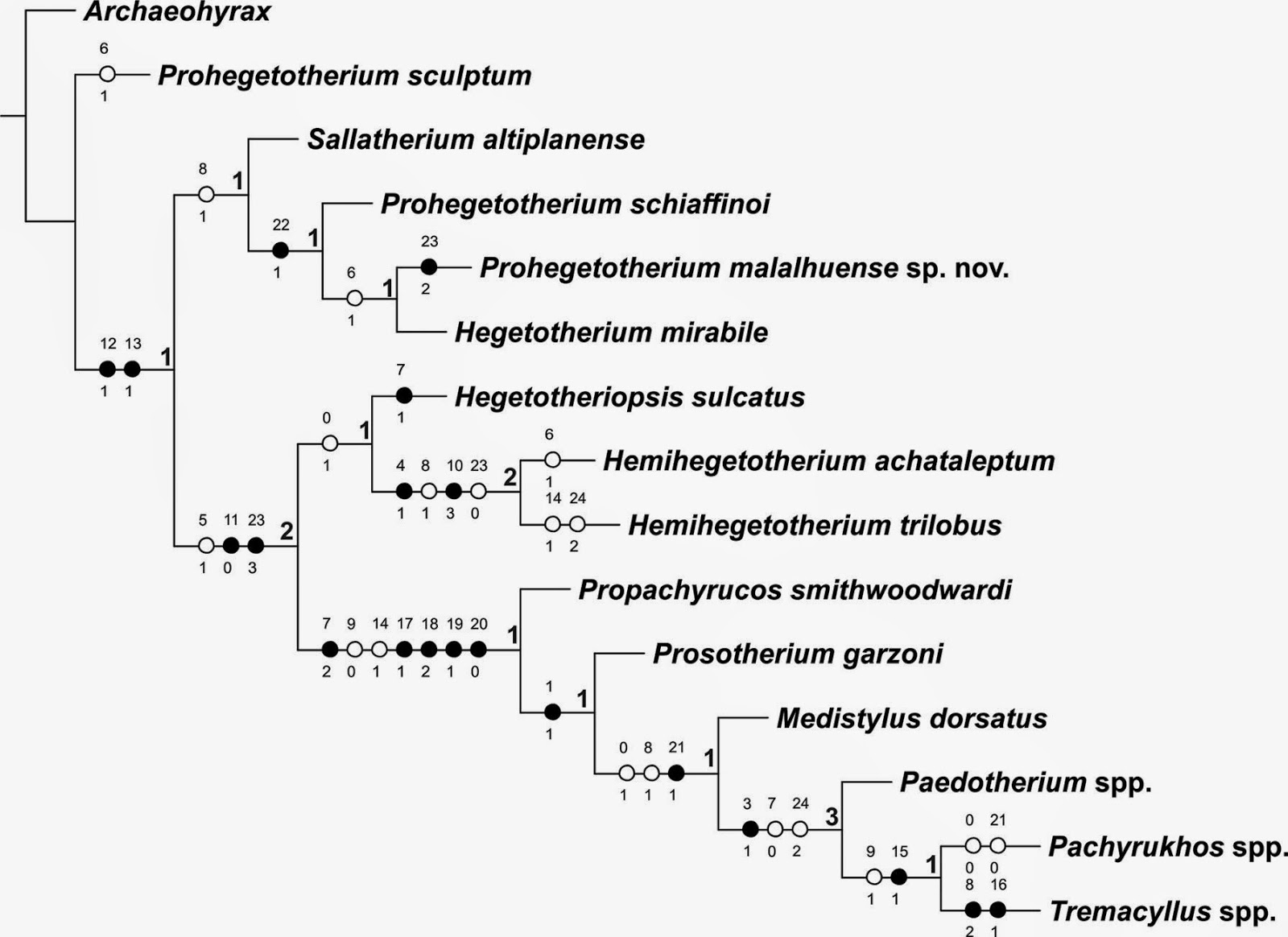
The Hegetotheriidae (Mammalia, Notoungulata) assemblage from the late Oligocene of Mendoza, central-western Argentina
Authors:
Cerdeño et al
Abstract:
This study describes new remains of Hegetotheriidae (Notoungulata), including a new species, from the Deseadan (late Oligocene) of Quebrada Fiera, Mendoza Province, Argentina. The assemblage is composed of four hegetotheriines, Prohegetotherium cf. P. sculptum, Prohegetotherium sp., Prohegetotherium schiaffinoi, and Prohegetotherium malalhuense, sp. nov., and the pachyrukhine Propachyrucos cf. P. simpsoni. The presence of Prosotherium cannot be totally discounted because lower molariforms are rather similar between the two pachyrukhine genera. The new species Prohegetotherium malalhuense, sp. nov., differs from all previously described hegetotheriines by having a lingually projecting, sharp parastyle and marked parastyle groove on the ectoloph of M2–3; talonid of m1–2 posterolabially projected; talonid of m3 with marked posterolabial groove; and the smaller size. Its phylogenetic affinities are not well resolved. Prohegetotherium is paraphyletic, with P. sculptum sister taxon to the remaining hegetotheres, and the new taxon more closely related to Hegetotherium mirabile than to P. schiaffinoi. The recognition of P. schiaffinoi and Prohegetotherium cf. P. sculptum emphasizes that the fauna from Quebrada Fiera shares elements with roughly contemporaneous Deseadan faunas from northern and southern latitudes, but important faunal particularities distinguish the region as well. The record of pachyrukhines at Quebrada Fiera more closely resembles Deseadan faunas in Patagonia than temporally correlative faunas from Bolivia and Uruguay, and indicates the presence of suitable habitats in mid-latitudes of Argentina for this hypselodont clade. Faunal affinities together with particular taxa from Quebrada Fiera appear to support a significant faunal provinciality in South America during the late Oligocene.
Monday, November 03, 2014
Examining Perissodactyl Enamel Isotopes to Determine Eocene-Oligocene Paleogene Climate
Zanazzi et alAbstract:The Eocene-Oligocene transition (~ 34 Ma) was one of the most pronounced episodes of climate change of the Cenozoic. In order to investigate this episode of global climate cooling in North America, we analyzed the carbon and oxygen stable isotope composition of the carbonate component of 19 perissodactyl (horse and rhino) tooth enamel samples from the Eocene-Oligocene rocks of the Cypress Hills Formation (southwestern Saskatchewan, Canada); we then compared the results with previously published data from the US Great Plains (Nebraska, South Dakota, and Wyoming).Average (± 1σ) perissodactyl enamel δ13C values (vs. V-PDB) in the Eocene (-8.8 ± 0.3‰) and Oligocene (-9.0 ± 0.3‰) are indistinguishable, suggesting no major change in mean annual precipitation in Saskatchewan across the transition. The δ13C values in Saskatchewan indicate the presence of arid ecosystems and are slightly higher than those in the US Great Plains, suggesting drier conditions at higher latitudes. With respect to oxygen isotopes, average (± 1σ) perissodactyl enamel δ18O values (vs. V-SMOW) in the Eocene (19.8 ± 2.0‰) and Oligocene (20.1 ± 3.6‰) are also indistinguishable, suggesting no change in the δ18O of meteoric precipitation across the transition in Saskatchewan. Enamel δ18O variability is much larger in the Oligocene vs. Eocene, indicating a large increase in temperature seasonality. This increase in enamel δ18O variability is much larger than that recorded in the US Great Plains, suggesting that higher latitudes are more sensitive to major episodes of climate change with respect to temperature seasonality. Finally, our data indicate no major change in the Oligocene vs. Eocene latitudinal gradient in local water δ18O in North America, which suggests no change in mean annual temperature gradients across the transition. This result supports the hypothesis that ascribes the climate change of the transition with a drop in atmospheric pCO2 because climate models show that this mechanism produces uniform cooling at mid-latitudes.
Monday, October 20, 2014
Profiling a Paleogene Orogen in Western North America
Profile of a paleo-orogen: High topography across the present-day Basin and Range from 40 to 23 Ma
Authors:
Cassel et al
Abstract:
Records of past topography connect Earth's deep interior to the surface, reflecting the distribution of heat and mass, past crustal structure, and plate interactions. Many tectonic reconstructions of the North American Cordillera suggest the presence of an Altiplano-like plateau in the location of the modern Basin and Range, with conflicting timing and mechanisms for the onset of surface-lowering extension and orogen collapse. Here we show, through a paleotopographic profile, that from the Eocene to the Oligocene a high, broad orogen stretched across Nevada, with a distinct crest that divided a continuous westward-draining slope extending to central California from an internally drained eastern Nevada plateau. This paleo-orogen maintained demonstrably higher-than-modern elevations, reaching 3500 m in the late Oligocene. Despite the long-term high gravitational potential energy of the crust supporting this topography, surface-lowering extension did not occur until the transition to a transform margin changed the external kinematic framework of the system. Maximum surface lowering was spatially decoupled from brittle upper crustal extension, requiring a large component of mid-crustal flow.
Wednesday, September 24, 2014
Embrithopod Palaeoamasia Evidence From Paleogene Anatolia
Latest evidence of Palaeoamasia (Mammalia, Embrithopoda) in Turkish Anatolia
Authors:
Sanders et al
Abstract:
Geological investigation of the Boyabat Basin in north-central Anatolia, Turkey, yielded palaeoamasid (Embrithopoda, Mammalia) gnathodental fossil specimens from two localities dated to the Eocene–Oligocene transition. These specimens include an upper incisor (BOY-1) and maxillary fragment preserving M2–M3 (BOY-2), and are geologically the youngest embrithopods known from Eurasia. The maxillary specimen is taxonomically more useful and, among embrithopods preserving the same molars, is most similar to the late Paleocene–middle Eocene Turkish palaeoamasid Palaeoamasia kansui. However, the new specimens are cautiously classified as Palaeoamasia, sp. nov., based on distinctions between BOY-2 and P. kansui in M3 morphology. Features distinguishing the M3 in BOY-2 are intermediate between those of P. kansui and the more derived Afro-Arabian arsinoitheriid embrithopods Arsinoitherium spp. and Namatherium blackcrowense, although the new Turkish specimens are stratigraphically too young to be ancestral to these middle Eocene–late Oligocene arsinoitheriids. Salient differences in dental and gnathic morphology between contemporaneous Eurasian and Afro-Arabian embrithopods indicate long, separate phylogenetic trajectories for these taxa, supporting the view that they are divisible at the family level into Palaeoamasidae and Arsinoitheriidae, respectively. Improved documentation of the lengthy paleogeographic separation of palaeoamasids and arsinoitheriids confirms that Afro-Arabia was sufficiently isolated from Eurasia during the Paleogene to limit embrithopods to rare sweepstakes dispersal between these landmasses.
Subscribe to:
Posts (Atom)