Showing posts with label powered armor. Show all posts

Thursday, June 23, 2016

US Army Wants, but Cannot Afford Iron Man Powered Armour

As difficult as any rocket is the engineering required to created powered armor that carries its own weight without burdening the wearer, an military exoskeleton like Heinlein’s Mobile Infantry or Marvel’s Iron Man. The Special Operations Command is researching such a system, TALOS, but when asked about its applicability to the rest of the Army, Allyn was skeptical.

“Currently, in the conventional force, I doubt we could afford it in the near term,” at least on any large scale, said Allyn. So are you at least interested? “I wouldn’t say as yet I’m interested because I try not to get interested in things I cant afford,” Allyn said with a smile. “I don’t go to the Jaguar and Mercedes dealerships.”

Of course, if the Army got more money, it could make different choices. Currently the service is “mortgaging” long-term modernization to pay for near-term readiness, Allyn said, which puts a damper on all new technologies. “The way out obviously is increased topline — and there’s not a likelihood of receiving that,” Allyn said.

Wednesday, June 01, 2016

US Special Forces on Track for TALOS Powered Armor Prototype in 2018

U.S. Special Operations Command is making progress researching, developing and testing a next-generation Iron Man-like suit designed to increase strength and protection and help keep valuable operators alive when they kick down doors and engage in combat, officials said.

The project, formally called Tactical Light Operator Suit, or TALOS, is aimed at providing special operators, such as Navy SEALs and Special Forces, with enhanced mobility and protection technologies, a Special Operations Command, or SOCOM, statement said.

"The ultimate purpose of the TALOS project is to produce a prototype in 2018. That prototype will then be evaluated for operational impact,” Lt. Cmdr. Matt Allen, SOCOM spokesman, told Scout Warrior.

Tuesday, October 06, 2015

TALOS Powered Armor Project on Track for 2018, Already Iterated Several Prototypes

After an American commando died kicking in a door during a raid in Afghanistan, the top commander of U.S. Special Operations vowed to prevent similar tragedies.

Two years later, the U.S. military is closer than ever to putting Iron Man on the front lines -- or at least something that closely mirrors the superhero's tech-forward suit of armor.

Unlike Hollywood's, the suit won't give its operator the ability to fly, but the real-life body armor may have one leg up on the fictional version: The military's suit will be made of liquid armor that can solidify on command.

Fitted with the protective gear -- the Tactical Assault Light Operator Suit, or TALOS -- troops would be more lethal and better protected, particularly the vulnerable first soldier to breach a compound.

An amalgam of academics, defense industry types and Pentagon personnel are trying to fine-tune the battery-powered exoskeleton, which would reduce strain on the body, provide superior ballistic protection and in-helmet technologies to boost communications and visibility.

Friday, September 25, 2015

A Discussion of the Special Forces' TALOS Powered Armor Effort

If you’ve seen any of the Iron Man movies, you know it’s all about the suit.

Tony Stark, as played by Robert Downey, Jr., is the epitome of suave wit—but without his metal shell, he’s just another engineer who’s made good. Once he’s sealed himself into his Autonomous Prehensile Propulsion Suit, though, he has everything from self-repair capabilities to plasma-based propulsion, all guided with the assistance of an advanced A.I. As a vehicle, it might not be as big as one of Larry Ellison’s catamarans, but it’s a lot flashier and can blow things up.

The exoskeleton is a technology platform that, while young, is gaining traction in industrial, medical and military circles. For several years, the U.S. Special Operations Command has been working on a Tactical Assault Light Operator Suit, or “TALOS,” that would provide “provide [infantry with] comprehensive ballistic protection and peerless tactical capability,” in the words of Gen. Joseph Votel, SOCOM’s commander.


Monday, May 11, 2015

Extraordinary Claim: Russia Will Have Military Thought Controlled Exoskeleton Prototype in 5 Years


The world’s most capable armies, the US, China, and Russia, are constantly trying to improve their strategic and warfare capabilities on the battlefield. This so-called “struggle” often involves improving the equipment of the infantry and other troops that are directly exposed to enemy fire.

We know that there is a project that has a goal to develop, an exoskeleton that will be commercially used. The Russian army is willing and is planning to find a way to upgrade some of its infantry units with such (exoskeleton) devices. The exoskeletons would allow soldiers improve their warfare abilities: huge jump, power tilting and throwing items, physical protection from bullets and smaller missiles, chemical and biological protection and built-in weapons.

With this kind of exoskeletons, Russian troops would be able to carry up to 300 kilograms of military equipment. For a comparison at the moment, a vehicle would be needed for that equipment. Additionally, exoskeletons will be controlled by brain impulses, which is significant progress in the field.

Alexander Cooley is the head of the department for the development and manufacturing of medical equipment in the Russian United Corporation for the production of instruments (Rostec). He has noted that the Russian army could have the prototypes no later than 5 years.


To say I am skeptical is an understatement.  Especially since the Russians recently released their own line of computer processors (import substitution anyone?) which are at least 5 years behind their equivalent American/Western designs.

Monday, March 09, 2015

Japanese Military Embraces its Anime Side, Begins Military Powered Armour Project


Last December, Japan’s defense research organization proposed allocating $7.5 million of its 2015 budget towards research into “highly mobile powered suits.”

Which sounds awesome. If anyone can craft Iron Man style robotic armor, it’s Japan, right? Don’t hold your breath. As the U.S. military has learned, exoskeletons are still a long way from the battlefield.


And War is Boring, especially James Simpson, is very, very skeptical.

Wednesday, January 28, 2015

Special Forces Defend TALOS Powered Armor Project


A Pentagon plan to build a real-life "Iron Man" suit has taken some lumps from fiscal hawks on Capitol Hill, but US Special Operations Command's acquisitions chief defended it Wednesday as a way to protect troops using cutting-edge technologies.

In October, the final "wastebook" from Sen. Tom Coburn, R-Okla., listed the Tactical Assault Light Operator Suit (TALOS) program among 100 federal programs he called wasteful. The report knocked TALOS' estimated $80 million budget as a fraction of the projected cost to produce a prototype.

TALOS, although intended as an exoskeleton that allows the wearer to tote heavy gear and an internal computing system, is also an effort to develop a new framework for inventing technologies and fielding them quickly, SOCOM acquisition executive James Geurts said at an industry conference here.

"TALOS to me isn't the Iron Man suit as it is protecting the guy or gal at his most vulnerable point, to give them the capabilities and protection they need to get their mission done," Geurts said. "Just doing an incremental approach to that isn't going to get us where we need to get to. Our collective challenge is to come up with new operating models that make sense."

SOCOM's director of science and technology, Anthony Davis, acknowledged the skeptical press surrounding the program, but said the program's goals are more modest than the "Iron Man" nickname suggests.

"That program is not about putting a nuclear cell on someone's chest and having them fly off to battle," Davis said at the conference. "It's about protecting the operator. The first guy going through the door is our most vulnerable operator."

Tuesday, December 30, 2014

Waiting for TALOS: Skepticism Expressed Over Functioning Powered Armor for Special Forces


It’s one of those recurring stories about military technology. The Pentagon is working on an armored combat suit loaded up to the elbows in sensors and communications gear. Any day now, American troops will leap into battle like Iron Man and War Machine.

There’s several projects underway in different branches and defense contractors. The military is working with Harvard University to develop a web-patterned exosuit worn under a soldier’s uniform. The Navy has an exoskeleton project which hopes to augment dockworkers’ physical strength. Lockheed Martin has its own powered exoskeleton project for infantry troops, known as HULC.

Special Operations Command’s plan is for an armored suit known as TALOS. It blew up into a viral sensation earlier in July 2014 after The Wall Street Journal reported SOCOM had teamed up with a Hollywood special effects company to design conceptual models for the armor.

But it’s likely going to remain just a concept for years.

On Dec. 18, SOCOM released a broad agency announcement to contractors with lots of interesting details about it wants in TALOS. There’s little in the details that’s absolutely required, but SOCOM considers everything from bio-mechanical sensors to robotic medical devices as highly desirable.

Thursday, May 29, 2014

Alpha Version of US Army TALOS Powered Armor Within a Month, Full Suit by August 2018

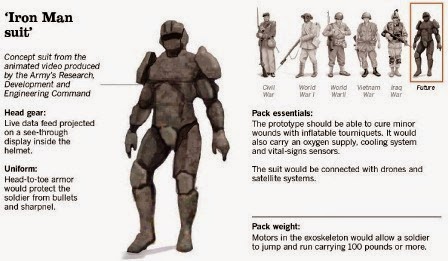
The United States military could soon have its very own Iron Man suit. The prototype is set to debut within weeks. The suit is a robotic exoskeleton designed to enhance human abilities in battle. Time will tell how well it compares to Tony Stark’s superhero suit, but the Tactical Assault Light Operator Suit (TALOS) is being devised to assist its wearer in lifting heavy loads, protect them from bullets and provide the lucky soldier with information concerning their environment using sensors, cameras and advanced displays. TALOS will have bulletproof armor, 360-degree cameras with built-in night vision capabilities, sensors that can detect injuries and apply wound-sealing foam.

The prototype of TALOS will be ready for release very soon but the more complete version will not be ready for a few years. According to Battelle, a science and technology research institute out of Columbus, it is expected to be ready for actual battle between 2016 and 2018.

In Greek mythology Talos was a giant man, or according to others maybe a bull, made of bronze that guarded the island of Crete. This giant was given the task of patrolling the island by walking around three times a day. Talos would drive pirates from the shore with a fiery death embrace or by throwing rocks.

TALOS is being developed by engineers at Massachusetts Institute of Technology (MIT), the United States Army Research, Development and Engineering Command (RDECOM), as well as other researchers at other academic institutions and businesses. The suit’s technology will be rigorously tested. According to William McRaven, head of the United States Special Operations Command, military personnel hopes to have operational systems join in battle no later than August 2018. If the suit is done correctly it will produce a revolutionary improvement in capability and survivability for special operations.

Wednesday, May 14, 2014

US Special Forces Gives Update on TALOS Powered Armor, Plans Field Testing in 5 Years

The U.S. Special Operations Command is using unprecedented outreach and collaboration to develop something special with revolutionary capabilities.

The Tactical Assault Light Operator Suit, or TALOS, is the vision of Navy Adm. William H. McRaven, SOCOM’s commander. He challenged industry and defense representatives at a SOCOM conference in May 2013 to come up with the concepts and technologies to make the suit a reality. The goal is to offer operators better protection, enhanced performance and improved situational awareness.

McRaven spoke more recently at a February 2014 National Defense Industry Association Special Operations/Low Intensity Conflict symposium, in Washington, D.C.

“The TALOS program is a collaboration of efforts,” McRaven said. “We are teaming with 56 corporations, 16 government agencies, 13 universities, and 10 national laboratories and we are leveraging the expertise of leading minds throughout the country to redefine the state of the art in survivability and operator capability.

“This innovative approach brings together the brightest minds in a national effort and we are already seeing astounding results in this collaboration. If we do TALOS right, it will be a huge comparative advantage over our enemies and give our warriors the protection they need in a very demanding environment.”

[...]

SOCOM’s goal, Fieldson said, is to have a TALOS prototype within the next year and to have the suit ready for full field testing within five years. That timetable is revolutionary for the military research, development and acquisition world, even for rapid-equipping programs.

As the only combatant command with acquisition authority, SOCOM is able to accelerate the TALOS project, Fieldson explained. The command’s acquisition executive and research and development staff share a building at MacDill Air Force Base, which he said promotes close collaboration and speedy decision-making.

“We have access that is nontraditional and that absolutely helps us,” Fieldson said. “We can bounce ideas back and forth against the leadership and ensure that what we are doing makes sense. I think that is critical to trying to develop this system within the timeline we are working toward.”

Also, in a departure from traditional development projects, SOCOM’s Acquisition Center staff established an innovation cell to lead the effort, advised by operators and focused on transforming business processes to solve the extreme integration challenges associated with TALOS.

“Because of the technical challenges and the compressed timeline, we are going to take more ownership on the government side than we typically take,” Fieldson said.

“We are going to go in and make some decisions that we sometimes rely on industry partners to make for us,” he said. “That allows us to reach out to a broader audience. That way, if there is a great idea in some nontraditional organization, we can integrate it” without relying on a commercial company to do so.

“We are really changing the process,” Fieldson said. “And the reason we are doing that is to try to streamline the overall effort and drive down both the cost and the schedule. That way, we get the best possible equipment to our force as quickly as possible.”

Although the TALOS is initially intended for special operators involved in high-risk missions, it has implications for the conventional force as well, Fieldson said.

Tuesday, April 29, 2014

TALOS Hobbled? Congress Tries to Rein in SoCOM & US Army Powered Armour Effort

Lawmakers today moved to tighten congressional control over U.S. Special Operations Command’s new “Iron Man” battle suit, expressing concerns that program officials are already mishandling the complex effort.

SOCOM recently launched a new website to promote its vision of elite commandos outfitted in futuristic, battle suits like those depicted in Hollywood blockbusters such as Marvel’s Iron Man series.

The Tactical Assault Light Operators Suit effort, known as TALOS, would provide operators with full-body ballistic protection and increased physical performance. It would also feature embedded antennas and computers designed to give operators increased situation awareness. It’s even supposed to keep the wearer cool in hot weather and warm in cold climates.

Despite “aggressive marketing efforts by USSOCOM,” members of the House Armed Services Committee want to know more about the program before funding is approved.

“The committee understands that present efforts are being used to survey current technologies and to better inform future requirements documents, and that USSOCOM intends to deliver a fully functional prototype assault suit by August 2018,” according to language in the Fiscal 2015 National Defense Authorization Bill released by the Subcommittee on Intelligence, Emerging Threats and Capabilities.

“The committee is concerned that these requirements are not being properly coordinated with related or complementary efforts at the Defense Advanced Research Projects Agency and the U.S. Army Natick Soldier Systems Command.”


link.

Wednesday, February 12, 2014

Adm. Michael McRaven: TALOS Suit Showing “astounding progress;” Program may Have Prizes for Innovation


Special operations types — like those who found and killed Osama bin Laden –may stand tall and do amazing things sometimes, but they tend to be fairly plain spoken. You rarely hear them say something is “astounding,” especially a new weapon. For example, one special operator recently awarded the Silver Star said he would have preferred “a cup of coffee and a thank you” to his medal ceremony.

So when Adm. Michael McRaven, the leader of Special Operations Command (SOCOM) told about 500 people that the so-called Iron Man suit under development by his command is showing “astounding progress,” my ears pricked up.

The admiral said he decided to push the suit because it was time for Special Forces troops to be able to go through a door, something they’ve done since their inception, with a better chance of living. We’ve reported on the suit before, when it was essentially an idea with a nicely-produced video to promote it. Things have progressed since then.

Three unpowered prototype suits are being assembled and should be delivered to SOCOM in June, McRaven said at the National Defense Industrial Association’s Special Operations/Low Intensity Conflict conference here. The first operating suit is due by August 2018. What will the “astounding progress” yield if all goes well? “That suit, if done correctly, will yield revolutionary increase in survivability and lethality,” McRaven said.

[...]

So Adm. McRaven wants to offer prizes like the $40 million Google Lunar XPRIZE, designed to spur “the safe landing of a private craft on the surface of the Moon.” I checked with several Pentagon sources and confirmed that McRaven and Kendall has talked, but SOCOM has not filed any papers yet to get the ball rolling.

The combination of a prize with industrial, governmental and educational cooperation is, McRaven said, “the future of how to do business.” But it won’t be how most of the Pentagon does business, because SOCOM is exempted from many of the military’s usual procurement rules to help it buy or develop things it needs as quickly as possible. So McRaven may get what he wants. But the rest of the military will just have to gawk and beg for some if he gets Iron Man suits that really work.

Tuesday, February 11, 2014

First Three Unpowered Special Forces TALOS Suit Prototypes to be Delivered This Summer


The head of U.S. Special Operations Command said the first prototypes of a new, Iron Man-like protective suit could be ready for testing this summer.

Navy Adm. William McRaven said three unpowered prototypes of the so-called Tactical Assault Light Operator Suit — known in military parlance as TALOS and dubbed the Iron Man suit after the one worn by the Marvel Comics superhero — are being assembled and expected to be delivered in June. The plan is to evaluate the technology with the goal of fielding a system by August 2018, he said.

“That suit, if done correctly, will yield a revolutionary improvement in survivability and capability for special operators,” McRaven said during the 25th annual Special Operations and Low-Intensity Conflict conference on Tuesday in Washington, D.C. The three-day event continues Wednesday and was organized by the National Defense Industrial Association, an Arlington, Va.-based trade group.

link.

Monday, October 21, 2013

US Special Forces Wants First TALOS Powered Armour Ready in Four to Five Years


U.S. Special Operations Command wants its operators to be protected with what it informally calls an Iron Man suit, named after the fictional superhero.

In September, U.S. Special Operations Command, known as SOCOM, made a Broad Agency Announcement for proposals for prototypes of the Tactical Assault Light Operator Suit, or TALOS.

The goal of TALOS is to provide ballistic protection to Special Operations Forces, along with fire-retardant capability, said Michel Fieldson, TALOS lead, SOCOM.

“We sometimes refer to it as the Iron Man suit, frankly to attract the attention, imagination and excitement of industry and academia,” he said.

“We’re hoping to take products we’re developing in several technology areas and integrating them into a consolidated suit to provide more protection for the [Special Operations Forces].”

Other technologies include sensors, communications, energy and material that can store and release energy to prevent injuries and increase performance.

Materials that can store and release energy might be similar to the Intrepid Dynamic Exoskeletal Orthosis, now used by some wounded warriors for lower leg limb injuries.

So TALOS would be something that wounded warriors might benefit from, he said.

Besides wounded warriors, Fieldson said Homeland Security and firefighters have expressed an interest in this technology. Also, it might eventually become available for other Soldiers.

“Our goal right now is to try to get the word out and bring industry partners together,” he said, since the technologies that will go into its development are varied and it is unlikely one contractor would be able to specialize in the entire ensemble.

The traditional approach, he said, was to pick a prime contractor, usually a traditional defense partner, give them the design requirements and let them come up with the solution. That would take a long time, he noted.

“In this case, the government will be the lead integrator and we’ll look to work with traditional or non-traditional partners in industry and academia who are innovative,” he said. “We’ll leave no stone unturned.”

The goal, he said, is to begin integrating capabilities over the next 12 months and have the first suit ready for full field testing in four to five years.

link.

Friday, May 31, 2013

US Army Starts Developing Powered Armor Under the TALOS Project


Army researchers are responding to a request from the U.S. Special Operations Command for technologies to help develop a revolutionary Tactical Assault Light Operator Suit.

The Tactical Assault Light Operator Suit, or TALOS, is an advanced infantry uniform that promises to provide superhuman strength with greater ballistic protection. Using wide-area networking and on-board computers, operators will have more situational awareness of the action around them and of their own bodies.

The U.S. Army Research, Development and Engineering Command, known as RDECOM, is submitting TALOS proposals in response to the May 15 request.

“There is no one industry that can build it,” said SOCOM Senior Enlisted Advisor Command Sgt. Maj. Chris Faris during a panel discussion at a conference at MacDill Air Force Base, Fla., recently, reported Defense Media Network.

The request, currently posted on Federal Business Opportunities, is looking for technology demonstration submissions from research and development organizations, private industry, individuals, government labs and academia to support the command-directed requirement issued by Adm. William McRaven, USSOCOM commander.

“[The] requirement is a comprehensive family of systems in a combat armor suit where we bring together an exoskeleton with innovative armor, displays for power monitoring, health monitoring, and integrating a weapon into that — a whole bunch of stuff that RDECOM is playing heavily in,” said. Lt. Col. Karl Borjes, an RDECOM science advisor assigned to SOCOM.

TALOS will have a physiological subsystem that lies against the skin that is embedded with sensors to monitor core body temperature, skin temperature, heart rate, body position and hydration levels.

Scientists at the Massachusetts Institute of Technology are currently developing armor made from magnetorheological fluids — liquid body armor — that transforms from liquid to solid in milliseconds when a magnetic field or electrical current is applied. Though still in development, this technology will likely be submitted to support TALOS.

“RDECOM cuts across every aspect making up this combat armor suit,” Borjes said “It’s advanced armor. It’s communications, antennas. It’s cognitive performance. It’s sensors, miniature-type circuits. That’s all going to fit in here, too.”

SOCOM demonstrations will take placeJuly 8-10, at or near MacDill Air Force Base.

The request asks participants to submit a white paper summary of their technology by May 31, describing how TALOS can be constructed using current and emerging technologies. A limited number of participant white papers will be selected and those selected will demonstrate their technologies.