Showing posts with label sam. Show all posts

Thursday, August 04, 2016

Russian Naval Air Defense Systems in Trouble


There have long been reports that the ongoing delays with the commissioning of the Admiral Gorshkov frigate have to do with defects in its air defense systems. These were thought to be primarily related to problems with integration of the Poliment Redut air defense missile system. The Poliment system was designed to be Russia’s answer to AEGIS, with four phased array antennas that are able to track 16 targets at the same time. The Redut system consists of four or eight vertical launch systems that launch three types of missiles. The 9M100 is the short-range missile, with a range of up to 15km. The 9M96M is the medium-range missile, with a range of 40-50km. Finally, the 9M96 long-range missile is supposed to have a range of up to 150km.

It now appears that the Redut’s problems are much more serious than just integration. A recent report notes that the Ministry of Defense has stopped trials of the system because of continuing problems with the 9M96 long-range missile. Specifically, the missiles appear to fail after three seconds of flight. Some reports indicate that the Redut system works well hitting targets up to 40km away, but fails in the long range. The implication is that the short and medium range missiles work well, but the long range missile does not. Nevertheless, this may be an improvement over previous results, as trials of the Redut system on the Steregushchiy class corvettes in 2014 showed that they were only able to hit targets at distances of up to 15km because the medium-range Furke-2 radar system was not functioning properly.

Wednesday, February 17, 2016

Scuffle in the South China Sea #25

China has stationed surface to air missiles on some of the artificial islands in the South China Sea.  And it has been confirmed by DOD.  And followed up.  Taiwan has also confirmed.  The missiles are HQ-9s.

China claims its entirely legal to base the missiles on its territory.

China also claims its had the facilities in place on the islands in place for years.

China has already hosted commercial flights, artillery and fighter jets on the islands.

Obama apparently will not get a joint statement at ASEAN about Chinese activities in the South China Sea.

Kerry says there will be very serious talks between the US and China over the South China Sea.

Wednesday, December 30, 2015

Russia Claims Surface to Air Missiles Able to Shoot Down Hypersonic Missiles by 2020

Russia's air defenses will have the ability to effectively repel hypersonic attacks by 2020, according to the Russian Ground Forces' Air Defense Force chief Alexander Leonov.

Russia’s Air Defense Force has focused its R&D efforts on second-to-none military equipment which will allow Moscow to effectively eliminate all types of enemy air attacks, including those using hypersonic technologies, RIA Novosti reported.

The news agency quoted the Russian Ground Forces' Air Defense Force chief Alexander Leonov as saying that the country's next generation air defense systems are set to enter service before the end of 2019.

"Creating next generation air defenses capable of effectively fighting all types of air attacks, including hypersonic ones, is one of the main directions of development of Russia's air defense forces until 2020," Leonov said.

Friday, November 27, 2015

China Confirms Su-35, S-400 Deals With Russia

Col. Wu Qian said the Su-35 project is “one of the areas in which China and Russia are willing to cooperate.”

He added that the S-400 acquisition is progressing smoothly.


Wednesday, November 18, 2015

Turkey Cancels $3.4 Bilion Purchase of Chinese Surface to air Missile Systems

Turkey has cancelled its USD4 billion T-Loramids long-range surface-to-air missile (SAM) system tender, for which China Precision Machinery Import and Export Corp (CPMIEC) was downselected in 2013 as the preferred provider.

The Turkish decision to cancel the long-stalled T-Loramids tender was first reported on 15 November by Reuters news agency, which quoted an official from the Turkish prime minister's office. Sources from the Turkish Defence Industries Undersecretariat (SSM) confirmed the report to IHS Jane's .


Monday, September 28, 2015

Russia Installing Advanced AntiAircraft Defenses in Syria to Protect Against...the Islamic State! yeah! That's it!

In keeping with its increasingly aggressive behavior over the past two years, Russia is deploying lethal and long-ranged anti-aircraft defenses to keep Western forces out of three key regions: the Baltics, the Black Sea, and, now, the Levant. From where NATO’s top commander Gen. Philip Breedlove sits, the Russian forces flowing into Syria don’t look like counter-terrorists out to stop the Islamic State, which Vladimir Putin has said is his highest priority. They look like the first pieces of a layered “anti-access/area denial” system that could complicate US and allied operations in Syria and well beyond.

“Anti-access/area denial, or A2/AD, is a growing problem,” Gen. Breedlove told the German Marshall Fund this afternoon, speaking just hours before Putin’s teeth-clenched meeting with President Obama on the sidelines of the UN General Assembly.

The northernmost danger zone or “bubble” is the oldest, based out of the Russian enclave of Kaliningrad between Poland and Lithuania. “Kaliningrad is a large platform for A2/AD capability,” Breedlove said. His subordinates Lt. Gen. Frank Gorenc and Lt. Gen. Ben Hodges have warned taht Kaliningrad-based missiles reach well into Polish airspace and could shut down NATO reinforcements to the Baltics in a crisis.

To the south, by contrast, Russia lacked a suitable forward base — until last year. “[Since] their occupation of Crimea, Russia has developed a very strong A2/AD capability in the Black Sea,” Breedlove said. “Essentially, their [anti-ship] cruise missiles range the entire Black Sea, and their air defense missiles range about 40 to 50 percent of the Black Sea.”

Now, it seems, comes Syria. “As we see these very capable air defense [systems] beginning to show up in Syria, we’re a little worried about another A2/AD bubble being created in the Eastern Mediterranean,” Breedlove said. “We see some very sophisticated air defenses going into these airfields. We see some very sophisticated air-to-air [fighter] aircraft going into these airfields.”

The Islamic State has no air force that Russia might use such sophisticated anti-aircraft weapons to counter, Breedlove continued. “These very sophisticated air defense capabilities are not about ISIL,” he argued, despite Putin’s publicly stated priorities.

Tuesday, January 20, 2015

US Navy Expands Use of SM-6 Missile From Five to 35 Warships


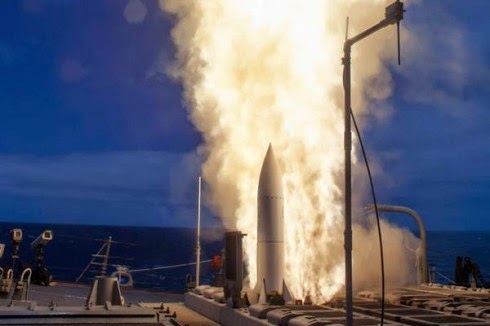
The Navy is massively expanding its planned use of the Standard Missile-6, a new high-tech ship-launched surface-to-air missile that can destroy enemy missiles, aircraft and unmanned systems.

In total, the Navy has authorized use of the SM-6 to expand from five ships to more than 35 ships.

“This effort is steeped in fleet requirements, focusing on delivering capability to support urgent operational needs in targeted areas of responsibility,” a Navy official told Military​.com

Previously, the SM-6 was only configured to fire from the most recent Aegis radar combat weapons system on Navy ships, a system called Aegis baseline nine. The Navy’s new authorization allows the SM-6 to integrate with the software and electronics used in Aegis Combat Weapon System baselines 5.3 and 3.A.0.

The Navy’s Aegis Weapon System, currently deployed on cruisers and destroyers, is a command and control technology using computers linked to a multi-function, phased array AN/SPY-1B radar. The high-powered, four megawatt Aegis radar is able to search and track more than 100 potential targets, Navy officials said.

“We came to the realization that we can do AAW(anti-air warfare) with baseline 5. That opened up a world of potential for concept of operations for the Navy –for fleet defense and area defense strategies,” said Mike Campisi, SM-6 program director, Raytheon.

The SM-6, which first became operational in December of last year, is engineered with both an active and semi-active seeker, giving it an increased ability to discern and discriminate targets when compared to other missiles, Campisi explained.

“It has capabilities to go over-the-horizon,” he said.

In addition to missile defense and defense against fixed and rotary wing aircraft, the SM-6 can also defend against land-attack and anti-ship cruise missiles in flight. Having an over-the-horizon ability against anti-ship cruise missiles could prove extremely advantageous as it brings the possibility of destroying them at much greater ranges.


Tuesday, December 02, 2014

Russia has Sold S-400 SAMs to China for $500 Million/Battalion

There’s reason this week to return to the issue of what the S-400 system costs. Specifically, what it might cost China.

Vedomosti reported Wednesday that Russia has signed a deal with China to sell it the S-400 / Triumf.

The business daily’s defense industry source claims the agreement inked by Rosoboroneksport and the Chinese military will send off not less than six battalions of the advanced SAM system for more than $3 billion.

That would be at least $500 million per battalion (against the previously ventured guess of about $320 million). Or in excess of $80 million per TEL.

Thursday, August 21, 2014

US Navy Tests SM-6 AAW Missile at White Sands Missile Range


The Navy’s Standard Missile is, as the bland name says, the Navy’s standard missile to defend the fleet against incoming strikes by enemy aircraft and anti-ship missiles. (Attacking enemy ships and ground targets is done by other missiles altogether). In recent years, though, the Raytheon-made missile has branched out. The standard Standard, the SM-2, is a straightforward fleet-defense weapon, with some capability to intercept targets over the land and even hit enemy ships. But the military is developing a long-range, high-altitude SM-3 variant to intercept ballistic missiles as they coast through space.

Then there’s the SM-6, first issued to the fleet last fall. “It’s the latest evolution of the Standard Missile family,” said Navy Cdr. Sidney Hodgson, the deputy program manager for the Standard series. (SM-4 and SM-5 never saw service). “It doesn’t replace the SM-2,” which will stay in service alongside the SM-6, he emphasized, but “it gives you increased firepower, it gives you extended range.”

To save costs, the Standard Missile Six is an unholy hybrid of the long-range rocket motor from the SM-3, the agile aerodynamic body of the SM-2, and the nose of an AMRAAM air-to-air missile, normally carried by fighter planes. It’s the borrowed AMRAAM components in particular that let the SM-6 pick out tricky targets like a cruise missile maneuvering at low altitude and low speed over land. Even in the desert, the land is never as smooth and flat as the sea, so a low-flying target can hide itself amidst the “ground clutter” of natural features — hills, rocks, buildings — that also show up on radar.

“What we were attempting to show was, [given] something that was subsonic, very low, could we discriminate and engage it?” said Raytheon’s senior program director for SM-6, Mike Campisi. “It was wonderful to see.”

Wednesday, July 09, 2014

Russia Tests S-500 Air Defense Missile

Russia has successfully test-launched a long-range interceptor missile which will be brought into service of a promising air defense missile system S-500, a source in the defense and industrial complex told ITAR-TASS on Monday.

“Test-launches were made in late June. All goals and tasks set within this event were fulfilled completely,” the source noted.

He noted that air defense system-producing concern Almaz-Antey was developing an air defense missile system of new generation S-500 fully in line with the deadlines set in the state-funded armament program until 2020.

Wednesday, April 02, 2014

Russia Sells S-400 Triumf to China

Plans to allow China to become the first export customer for Russia's Almaz-Antey S-400 Triumf (SA-21 'Growler') surface-to-air missile system are gaining momentum as President Vladimir Putin has approved the delivery of up to four systems, Russian newspaper Pravda reported on 31 March.

According to the paper, Putin has approved in principle the transfer of between two and four S-400 systems. Aleksey Fomin, director of the Federal Service for Military-Technical Cooperation, said that the negotiations which had been conducted over the last three years are now in the final stage.

The deal, should it progress, would mark a further deepening of the military-technical relationship between Russia and China.

Sunday, March 16, 2014

Russia may Transfer Manufacturing of 9K338 Igla-S MANPADS to Brazil

Russian-designed 9K338 Igla-S manportable surface-to-air missile (SAM) systems could be constructed in Brazil for export to third countries, the director general of Russian defence organisation KB Mashinostroyenia (KBM) has said.

The comments by Valery Kashin were reported by the Brazilian Defensa.com information service on 12 March, and come after Brazil confirmed in October last year that Brazil had signed a memorandum of understanding with Moscow concerning the procurement of KBM Igla-S SAMs and the KBP Design Bureau 96K6 Pantsir integrated gun and SAM system.

Thursday, February 27, 2014

India Successfully Tests Akash Surface to Air Missile

Akash, the indigenously designed developed and produced Surface to Air missile for the Indian Army, was once again successfully flight tested today at the Integrated Test Range (ITR), Chandipur.

These were part of a series of trials being conducted in various engagement modes from the first of Production Model system being produced to equip two regiments of Indian Army.

Both today’s flight destroying a target in receding ting mode, as well as the one conducted on 21st Feb 2014 destroying an approaching target, fully met the mission objectives and few more trials are planned in different engagement modes.

“Development and production of Akash weapon system with the active participation of DRDO labs, Public Sector Units (PSUs), Ordnance Factories, National R&D Laboratories, academic Institutions and about 200 private industries is yet another symbol of India’s strength in making indigenous weapon systems”, stated Shri Avinash Chander, Scientific Adviser to Raksha Mantri and Secretary Dept of Defence R&D, congratulating the production agencies, Indian Army and DRDO team. “The successful trials show the continuing excellence of Indian weapon systems”.

Akash is India’s first indigenously designed, developed and produced air defence system Surface to Air missile capable of engaging aerial threats upto a distance of approximately 25 kms. The multi target, multi directional, all weather air-defense system consisting of surveillance and tracking radars, control centers and ground support systems mounted on high mobility vehicles for the “Army” version of Akash is designed to enable integration with other air defense command and control networks through secured communication links.