Showing posts with label x-37b. Show all posts

Friday, August 09, 2019

X-37B Photographed in Orbit, has Surprising Ability


Skywatcher and satellite tracker Ralf Vandebergh of the Netherlands recently caught a rare glimpse of the U.S. Air Force's secretive X-37B space plane.

Vandebergh said he'd been hunting for the robotic spacecraft for months and finally managed to track it down in May. But it took a bit longer to get photos of the vehicle.

"When I tried to observe it again [in] mid-June, it didn't meet the predicted time and path," Vandebergh explained. "It turned out to have maneuvered to another orbit. Thanks to the amateur satellite observers' network, it was rapidly found in orbit again, and I was able to take some images on June 30 and July 2."

The X-37B's recent passes were almost overhead, Vandebergh added.


Apparently, the X-37B can change its orbit in a surprising way.

Tuesday, May 17, 2016

What is the X-37B Space Plane Been Doing in Orbit for Nearly a Year?

For years now, the program to develop the X-37B spacecraft has been shrouded in secrecy. Originally intended as part of a NASA project to develop a reusable unmanned spacecraft, this Boeing-designed spaceplane was taken over by the Department of Defense in 2004. And while it has been successfully tested on multiple occasions, there remain some unanswered questions as to its intended purpose and what has been taking place during these flights.

This, predictably, has lead to all kinds of rumors and speculation, with some suggesting that it could be a spy plane while others think that it is intended to deliver space-based weapons. It’s latest mission – which was dubbed OTV-4 (Orbital Test Vehicle-4) – has been especially clandestine. And after nearly a year in orbit, it remains unclear what the X37B has been doing up there all this time.

Thursday, October 08, 2015

Sierra Nevada Proposing DreamChaser as X-37B Alternative


Sierra Nevada Corporation (SNC) believes its Dream Chaser could be a viable alternative to the Boeing X-37B Orbital Test Vehicle for long-duration, recoverable experimentation in space.

The company says its vehicle, which is still in development, could be called upon to support the kinds of missions the US Air Force is currently conducting with the X-37B.

With an updated, folding-wing design unveiled earlier this year, SNC’s Dream Chaser can be launched inside a standard Atlas V or Delta IV payload fairing and can “stay on orbit well in excess of a year”, the company says.

SNC Space Systems corporate vice-president Mark Sirangelo says that while he cannot say what types of missions the Orbital Test Vehicle programme is trying to accomplish, Dream Chaser would be a larger and viable alternative to Boeing’s experimental spacecraft.

Friday, April 24, 2015

First Three X-37b Missions Were Vehicle Characterization, 4th Next Month for Experiments


The U.S. Air Force on Friday made its first public confirmation that the X-37B unmanned space shuttle will be launched next month on the fourth flight of an Orbital Test Vehicle.

“We are excited about our fourth X-37B mission,” said Randy Walden, the director of the Air Force Rapid Capabilities Office. “With the demonstrated success of the first three missions, we’re able to shift our focus from initial checkouts of the vehicle to testing of experimental payloads.”

The Air Force said its Rapid Capabilities Office had collaborated with several partners to test “new experiments on this fourth flight for the X-37B program.”

What’s more, the mission will test the performance of an experimental propulsion system jointly developed by the Air Force Research Laboratory and Space and Missile Systems Center, as well as a NASA advanced materials investigation.

“We’re very pleased with the experiments lined-up for our fourth OTV Mission OTV-4,” Walden said. “We’ll continue to evaluate improvements to the space vehicle’s performance, but we’re honored to host these collaborative experiments that will help advance the state-of-the-art for space technology.”

Tuesday, March 31, 2015

Mysterious US Air Force X-37B Space Plane to Launch on May 6th


With its new homeport in renovated NASA space shuttle hangars off in the distance, the Air Force’s X-37 mini spaceplane will be launched from Cape Canaveral on May 6 for its fourth journey into orbit.

The Orbital Test Vehicle will be the primary payload aboard the next United Launch Alliance Atlas 5 rocket, the 54th Atlas 5 and ULA’s 96th mission overall. The launch has a codename AFSPC 5 for the Air Force Space Command flight No. 5.

Liftoff is targeted some time between 9 a.m. and 1 p.m. EDT (1300-1700 GMT).

Thursday, October 23, 2014

Chinese are Concerned the X-37B is a Precursor to a Space Bomber

The return of the unmanned X-37B space plane last week after nearly two years in space has aroused some curiosity from space observers. It marks the completion of the third mission for the orbital test vehicle (OTV) system, the longest mission, with nearly 22 months of orbital time, and the first reuse of one of the two OTVs. Resembling a miniature space shuttle, the X-37B program has been publicly described by the U.S. Air Force as testing a variety of technologies, including "advanced guidance, navigation, and control; thermal protection systems; avionics; high temperature structures and seals; conformal reusable insulation; lightweight electromechanical flight systems; and autonomous orbital flight, reentry, and landing."

For the People's Republic of China (PRC), the maturation of the OTV is seen as part of the inevitable evolution of space systems towards military ends. As the Chinese People's Liberation Army (PLA) has been modernizing, its approach to warfare has steadily evolved, exploiting lessons derived from foreign wars. Of particular note to Chinese military thinkers has been the steadily advancing importance of space.

Just as aircraft initially provided reconnaissance and artillery observation, space systems are seen by Chinese military thinkers as a crucial part of modern warfare. From the Chinese perspective, space has played an essential role in fighting and winning "local wars under informationized conditions," from the first Gulf War through the Balkan conflicts to the wars in Afghanistan and Iraq. Space is essential, because one cannot fight the "non-contact, non-linear, non-symmetric" wars that are the hallmark of the Information Age without incorporating space systems, whether for forecasting meteorological conditions; for positioning, navigation, and timing in weapons guidance and troop movements; or for imaging and identifying enemy formations and undertaking battle damage assessment. Information Age wars, in the Chinese estimation, depend on space systems to gather, transmit, or otherwise exploit information.

But just as reconnaissance aircraft led to fighter planes to shoot down those reconnaissance planes, and there then developed bombers for both battlefield support and strategic bombing campaigns, Chinese thinkers have generally expected an eventual move towards "space-to-ground" operations to complement space information support, space offense, and space defense missions. An article from the Chinese military journal China Military Science in 2003, by a professor at the Chinese National Defense University, talked about the prospect of future space-ground conflict complementing traditional land, sea, and air conflict. The 2005 PLA textbook Military Astronautics notes the inevitability of space-ground operations as part of the development of military space systems. And a 2013 publication of PLA teaching materials similarly discusses space combat as divided into operations against space systems, and space-ground operations.

The Chinese appear to be concerned that the X-37B is the first stage towards developing that space-to-ground attack capability. It is unlikely that the Chinese, with their own robust space development effort, sees the X-37B itself as a space-bomber. The craft itself weighs about 11,000 pounds, while its payload bay is typically compared to that of a van or a pickup truck. Nonetheless, one Chinese article opined that, while the X-37B's payload was limited, it could nonetheless carry smaller munitions, or even nuclear weapons.

Friday, October 17, 2014

X-37B Returns From Orbit After 675


The U.S. Air Force's X-37B space plane has returned to Earth after spending nearly two years on a hush-hush orbital mission.

The X-37B space plane touched down at California's Vandenberg Air Force Base on Friday (Oct. 17) at 9:24 a.m. local Pacific time (12:24 p.m. EDT; 1624 GMT), ending a mission that kicked off in December 2012 and saw the unmanned vehicle circle Earth for an unprecedented 675 days.

"I'm extremely proud of our team for coming together to execute this third safe and successful landing," said Col. Keith Balts, commander of the 30th Space Wing, which is headquartered at Vandenberg, in a statement. "Everyone from our on-console space operators to our airfield managers and civil engineers take pride in this unique mission and exemplify excellence during its execution."

Just what the space plane was doing up there for so long remains unclear; details about X-37B missions — including the payloads carried to orbit — are officially classified.

Thursday, October 09, 2014

US Air Force Taking Over Space Shuttle Orbiter Processing Facility Bays 1 & 2 for X-37B

NASA’s Kennedy Space Center in Florida has entered into an agreement with the U.S. Air Force’s X-37B Program for use of the center’s Orbiter Processing Facility (OPF) Bays 1 and 2 to process the X-37B Orbital Test Vehicle for launch.

The OPF bays were last used during NASA’s Space Shuttle Program. With the agency’s transition to the Space Launch System rocket and Orion spacecraft, the agency currently does not have a mission requirement for the facilities. This agreement ensures the facilities will again be used for their originally-intended purpose — processing spacecraft.

“Kennedy is positioning itself for the future, transitioning to a multi-user launch facility for both commercial and government customers, while embarking on NASA’s new deep space exploration plans,” said Kennedy Center Director Robert Cabana. “A dynamic infrastructure is taking shape, designed to host many kinds of spacecraft and rockets.”

In addition to vehicle preparation for launch, the X-37B Program conducted testing at Kennedy’s Shuttle Landing Facility to demonstrate that landing the vehicle at the former shuttle runway is a technically feasible option.


Tuesday, April 08, 2014

US Navy Extending X-47B Testing, Getting Smart on UCLASS Procurement


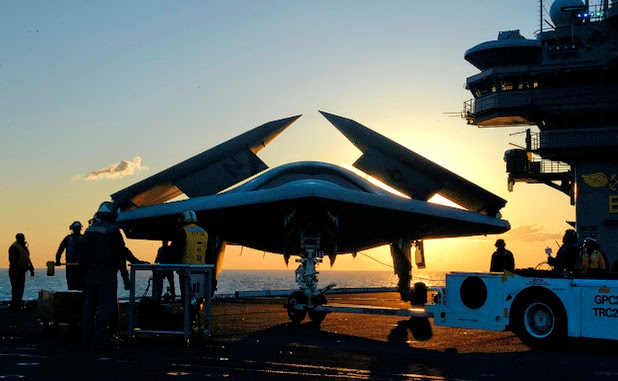
The U.S. Navy is preparing to conduct a new round of sea trials this summer with its X-47B stealthy aircraft to prove the unmanned system can clear the busy aircraft carrier deck in 90 sec. or less, just like its piloted counterparts.

This would allow for a more seamless flow of manned and unmanned launches and recoveries on deck, a key step toward earning unmanned aircraft a coveted parking space on American carriers in 2020.

In parallel, the Navy plans to finally issue a formal request for proposals (RFP) for its X-47B follow-on, called the Unmanned Carrier-Launched Airborne Surveillance and Strike (Uclass) system. A draft is expected by the end of the third week of this month, with a final version coming out in the summer, kicking off a long-awaited competition between Lockheed Martin, Boeing, Northrop Grumman and General Atomics to build the first combat unmanned aircraft installed into the carrier air wing.

link.

Monday, January 06, 2014

Boeing Expanding, Consolidating X-37B Operations at Cape Kennedy

Boeing will expand its presence in Florida by adding technology, engineering and support jobs at the Kennedy Space Center. Financial and employment details are not being disclosed.

Investments will be made to convert the former space shuttle facility, OPF-1, to a facility that would enable the U.S. Air Force to efficiently land, recover, refurbish, and re-launch the X-37B Orbital Test Vehicle (OTV), a 29-foot-long, reusable unmanned spacecraft.