

A New Leptoceratopsid (Ornithischia, Ceratopsia) with a Unique Ischium from the Upper Cretaceous of Shandong Province, China
Authors:
He et al
Abstract:
The partial skeleton of a leptoceratopsid dinosaur, Ischioceratops zhuchengensis gen. et sp. nov., was excavated from the bone-beds of the Upper Cretaceous Wangshi Group of Zhucheng, Shandong Province, China. This fossil represents the second leptoceratopsid dinosaur specimen recovered from the Kugou locality, a highly productive site in Zhucheng. The ischium of the new taxon is morphologically unique among known Dinosauria, flaring gradually to form an obturator process in its middle portion and resembling the shaft of a recurve bow. An elliptical fenestra perforates the obturator process, and the distal end of the shaft forms an axehead-shaped expansion. The discovery of Ischioceratops increases the known taxonomic diversity and morphological disparity of the Leptoceratopsidae.
A ceratopsian dinosaur from the Late Cretaceous of eastern North America, and implications for dinosaur biogeography
Author:
Longrich
Abstract:
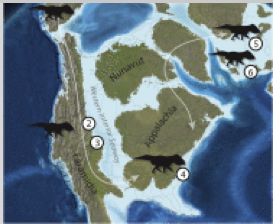
Tyrannosaurs and hadrosaurs from the Late Cretaceous of eastern North America (Appalachia) are distinct from those found in western North America (Laramidia), suggesting that eastern North America was isolated during the Late Cretaceous. However, the Late Cretaceous fauna of Appalachia remains poorly known. Here, a partial maxilla from the Campanian Tar Heel Formation (Black Creek Group) of North Carolina is shown to represent the first ceratopsian from the Late Cretaceous of eastern North America. The specimen has short alveolar slots, a ventrally projected toothrow, a long dentigerous process overlapped by the ectopterygoid, and a toothrow that curves laterally, a combination of characters unique to the Leptoceratopsidae. The maxilla has a uniquely long, slender and downcurved posterior dentigerous process, suggesting a specialized feeding strategy. The presence of a highly specialized ceratopsian in eastern North America supports the hypothesis that Appalachia underwent an extended period of isolation during the Late Cretaceous, leading the evolution of a distinct dinosaur fauna dominated by basal tyrannosauroids, basal hadrosaurs, ornithimimosaurs, nodosaurs, and leptoceratopsids. Appalachian vertebrate communities are most similar to those of Laramidia. However some taxa-including leptoceratopsids-are also shared with western Europe, raising the possibility of a Late Cretaceous dispersal route connecting Appalachia and Europe.


