A ceratopsian dinosaur from the Late Cretaceous of eastern North America, and implications for dinosaur biogeography
Author:
Longrich
Abstract:
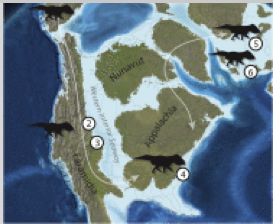
Tyrannosaurs and hadrosaurs from the Late Cretaceous of eastern North America (Appalachia) are distinct from those found in western North America (Laramidia), suggesting that eastern North America was isolated during the Late Cretaceous. However, the Late Cretaceous fauna of Appalachia remains poorly known. Here, a partial maxilla from the Campanian Tar Heel Formation (Black Creek Group) of North Carolina is shown to represent the first ceratopsian from the Late Cretaceous of eastern North America. The specimen has short alveolar slots, a ventrally projected toothrow, a long dentigerous process overlapped by the ectopterygoid, and a toothrow that curves laterally, a combination of characters unique to the Leptoceratopsidae. The maxilla has a uniquely long, slender and downcurved posterior dentigerous process, suggesting a specialized feeding strategy. The presence of a highly specialized ceratopsian in eastern North America supports the hypothesis that Appalachia underwent an extended period of isolation during the Late Cretaceous, leading the evolution of a distinct dinosaur fauna dominated by basal tyrannosauroids, basal hadrosaurs, ornithimimosaurs, nodosaurs, and leptoceratopsids. Appalachian vertebrate communities are most similar to those of Laramidia. However some taxa-including leptoceratopsids-are also shared with western Europe, raising the possibility of a Late Cretaceous dispersal route connecting Appalachia and Europe.
THE LAST GASP: TRACE FOSSILS TRACK DEOXYGENATION LEADING INTO THE FRASNIAN–FAMENNIAN EXTINCTION EVENT
Authors:
Boyer et al
Abstract:
The Frasnian–Famennian boundary is correlated with one of several Late Devonian extinction pulses that resulted in a significant decrease in diversity as well as ecological restructuring. This event is recognized within the globally correlated Upper Kellwasser interval that is well exposed and biostratigraphically well constrained in shale units of western New York State. The ichnological and geochemical signals of the interval stratigraphically below the Upper Kellwasser event at these localities provides insight into the onset of this important extinction event. Detailed analysis of ichnogeneric composition, relative size of burrow populations, amount of bioturbation, and trace metal concentrations vary in concert. Deep-penetrating, pyritized Skolithos burrows terminate abruptly at a thin, laminated black shale interval with enriched Mo levels, up to 31 ppm, and are overlain by an interval of gray-green bioturbated shales dominated by Chondrites. These textural and chemical shifts reveal that bottom-water oxygen levels decrease rapidly below the base of the Upper Kellwasser interval. Relative oxygen levels are interpreted to remain low through the Chondrites-dominated interval, with protracted stressed conditions followed by a gradual decrease to anoxic conditions within the Upper Kellwasser interval. These results suggest that, at least locally in the Appalachian Basin, bottom-water oxygen stress and/or fluctuating oxygen conditions were present leading up to the extinction event. This evidence does not support an instantaneous onset of anoxia as causal mechanism for extinction.

