Authors:Ryan et alAbstract:A partial skull (CMN 8804) of a ceratopsid from the upper unit of the Campanian Oldman Formation of Alberta is the first Canadian example of the newly established Nasutoceratopsini, a new subclade of Centrosaurinae defined as the stem-based clade of centrosaurine ceratopsids more closely related to Nasutoceratops titusi than to Centrosaurus apertus. The new clade is diagnosed, in part, by having a parietosquamosal frill lacking modified epimarginals; a small nasal horncore; large, rostrolaterally directed postorbital horncores; and a relatively short, deep face. Although the CMN 8804 taxon closely resembles Nasutoceratops, its phylogenetic position within Nasutoceratopsini is unresolved. The CMN 8804 taxon would have been contemporaneous with dinosaurs from the lower portion of the Dinosaur Park Formation 200 km to the northwest in Dinosaur Provincial Park. The presence of the CMN 8804 taxon in Alberta, and the approximately contemporaneous Nasutoceratops in Utah, indicates that the nasutoceratopsins persisted in both north and south Laramidia well after the first appearance (i.e., Coronosaurus brinkmani) of the newly defined Centrosaurini. This stem-based clade is composed of centrosaurine ceratopsids with well-adorned parietosquamosal frills and short postorbital horncores that are more closely related to Centrosaurus apertus than Pachyrhinosaurus canadensis. The rarity of nasutoceratopsins in the well-sampled sediments of Laramidia suggests that they may have had different ecological preferences than centrosaurins, or that their relatively non-diagnostic, fragmentary remains may be misidentified as other centrosaurins. The temporally (∼79–76 Ma) and geographically (Utah to Alberta) large distributions of Nasutoceratopsini weakens the hypothesis of distinct north and south Laramidian provinciality.
Showing posts with label campanian. Show all posts
Showing posts with label campanian. Show all posts
Friday, December 23, 2016
Nasutoceratopsini Ceratopsian From Campanian Cretaceous Alberta, Canada


Wednesday, July 06, 2016
Evidence of Parasites in Hadrosaurs From Campanian Cretaceous Canada
Trace fossils of possible parasites inside the gut contents of a hadrosaurid dinosaur, Upper Cretaceous Judith River Formation, Montana
Authors:
Tweet et al
Abstract:
Tiny sinuous trace fossils have been found within probable gut contents of an exceptionally preserved specimen of a hadrosaurid dinosaur, Brachylophosaurus canadensis, from the Judith River Formation of Montana. Approximately 280 examples of the trace fossils were observed in 19 samples of gut region material. The tubular structures typically are about 0.3 mm across. Many have thin calcareous linings or layers, and some exhibit fine surficial striae. At least two dozen of these trace fossils share walls with adjacent tubular traces, and this association can extend for several millimeters. While the trace fossils share some characteristics with fine rhizoliths, these features are most consistent with tiny burrows, or possibly body impressions, of worms (vermiform organisms) of uncertain biologic affinity. Such trace fossils have not been reported previously, and herein described as Parvitubulites striatus n. gen. n. sp. Either autochthonous (parasites) or allochthonous (scavengers) worms may have created the trace fossils, but taphonomic factors suggest that autochthonous burrowers are more likely. Several lines of evidence, such as constant diameters and matching directional changes, suggest that the paired trace fossils were made by two individuals moving at the same time, which implies sustained intraspecific contact. Parvitubulites striatus provides a rare record of interactions between terrestrial, meiofaunal-sized, soft-bodied invertebrates and a dinosaur carcass. The evidence that the worms may have parasitized a living hadrosaur and subsequently left traces of intraspecific behavior between individual worms adds unique information to our understanding of Mesozoic trophic interactions.
Thursday, May 19, 2016
Machairoceratops cronusi: a new Ornate Centrosaurine Ceratopsid From Campanian Cretaceous Utah

A New Centrosaurine Ceratopsid, Machairoceratops cronusi gen et sp. nov., from the Upper Sand Member of the Wahweap Formation (Middle Campanian), Southern Utah
Authors:
Lund et al
Abstract:
The Upper Cretaceous (middle-late Campanian) Wahweap Formation of southern Utah contains the oldest diagnostic evidence of ceratopsids (to date, all centrosaurines) in North America, with a number of specimens recovered from throughout a unit that spans between 81 and 77 Ma. Only a single specimen has been formally named, Diabloceratops eatoni, from the lower middle member of the formation. Machairoceratops cronusi gen. et sp. nov., a new centrosaurine ceratopsid from the upper member of the Wahweap Formation, is here described based on cranial material representing a single individual recovered from a calcareous mudstone. The specimen consists of two curved and elongate orbital horncores, a left jugal, a nearly complete, slightly deformed braincase, the left squamosal, and a mostly complete parietal ornamented by posteriorly projected, anterodorsally curved, elongate spikes on either side of a midline embayment. The fan-shaped, stepped-squamosal is diagnostic of Centrosaurinae, however, this element differs from the rectangular squamosal in Diabloceratops. Machairoceratops also differs in the possession of two anterodorsally (rather than laterally) curved epiparietal ornamentations on either side of a midline embayment that are distinguished by a posteromedially-oriented sulcus along the entire length of the epiparietal. Additionally, the parietosquamosal frill is lacking any other epiossifications along its periphery. Machairoceratops shares a triangular (rather than round) frill and spike-like epiparietal loci (p1) ornamentation with the stratigraphically lower Diabloceratops. Both parsimony and Bayesian phylogenetic analyses place Machairoceratops as an early-branching centrosaurine. However, the parsimony-based analysis provides little resolution for the position of the new taxon, placing it in an unresolved polytomy with Diabloceratops. The resultant Bayesian topology yielded better resolution, aligning Machairoceratops as the definitive sister taxon to a clade formed by Diabloceratops and Albertaceratops. Considered together, both phylogenetic methods unequivocally place Machairoceratops as an early-branching centrosaurine, and given the biostratigraphic position of Machairoceratops, these details increase the known ceratopsid diversity from both the Wahweap Formation and the southern portion of Laramidia. Finally, the unique morphology of the parietal ornamentation highlights the evolutionary disparity of frill ornamentation near the base of Centrosaurinae.
Spiclypeus shipporum: a new Ornate Chasmosaurine Ceratopsid From Campanian Cretaceous Montana

Spiclypeus shipporum gen. et sp. nov., a Boldly Audacious New Chasmosaurine Ceratopsid (Dinosauria: Ornithischia) from the Judith River Formation (Upper Cretaceous: Campanian) of Montana, USA
Authors:
Mallon et al
Abstract:
This study reports on a new ceratopsid, Spiclypeus shipporum gen et sp. nov., from the lower Coal Ridge Member of the Judith River Formation in Montana, USA, which dates to ~76 Ma (upper Campanian). The species is distinguished by rugose dorsal contacts on the premaxillae for the nasals, laterally projecting postorbital horncores, fully fused and anteriorly curled P1 and P2 epiparietals, and a posterodorsally projecting P3 epiparietal. The holotype specimen is also notable for its pathological left squamosal and humerus, which show varied signs of osteomyelitis and osteoarthritis. Although the postorbital horncores of Spiclypeus closely resemble those of the contemporaneous ‘Ceratops’, the horncores of both genera are nevertheless indistinguishable from those of some other horned dinosaurs, including Albertaceratops and Kosmoceratops; ‘Ceratops’ is therefore maintained as a nomen dubium. Cladistic analysis recovers Spiclypeus as the sister taxon to the clade Vagaceratops + Kosmoceratops, and appears transitional in the morphology of its epiparietals. The discovery of Spiclypeus adds to the poorly known dinosaur fauna of the Judith River Formation, and suggests faunal turnover within the formation.
Thursday, April 14, 2016
A new Cenrosaurine Ceratopsian From Campanian Cretaceous Mexico

A Centrosaurine (Dinosauria: Ceratopsia) from the Aguja Formation (Late Campanian) of Northern Coahuila, Mexico
Authors:
Rivera-Silva et al
Abstract:
While centrosaurines and ceratopsids in general are abundant in the Late Campanian of northern Laramidia, they are much less commonly found in southern Laramidia. This has supported hypotheses of dinosaur provinciality and endemism in the Late Cretaceous with the delineation of at least two separate faunal zones, north and south Laramidia. There have been 12 genera of centrosaurines recognized from northern Laramidia while two genera, Diabloceratops and Nasutoceratops, have been named from southern Laramidia. We present an osteological description and taphonomic outline for a new centrosaurine ceratopsid from the Aguja Formation of northern Coahuila, Mexico that is not currently diagnosable to the generic level, but likely represents a new taxon. Further, we have included three-dimensional surface scans of all material attributed to this animal. Considering the large number of centrosaurines from northern Laramidia, it is likely that cladistic analyses are biased towards this faunal zone. New findings of southern centrosaurines are needed to correct this bias. This discovery expands the range of centrosaurines south to Coahuila, Mexico and adds new information to better characterize the morphology and taxonomy of centrosaurines from southern Laramidia and their evolution in comparison to their northern counterparts.
Wednesday, April 13, 2016
Apatoraptor pennatus: a new Caenagnathid Oviraptorosaur From Cretaceous Canada
A new caenagnathid (Dinosauria: Oviraptorosauria) from the Horseshoe Canyon Formation of Alberta, Canada, and a reevaluation of the relationships of Caenagnathidae
Authors:
Funston et al
Abstract:
Our understanding of caenagnathids has benefited from recent discoveries, including nearly complete skeletons from the Hell Creek Formation of Montana. However, their phylogenetic relationships remain unclear. A new specimen from the Horseshoe Canyon Formation of Alberta has implications for the phylogeny and paleobiology of these creatures. The partial skeleton is articulated and includes a mandible, a full cervical and dorsal series of vertebrae, a right pectoral girdle and arm, a sternum, gastralia, a partial ilium, and a partial hind limb. The mandible is edentulous and the articular ridge is intermediate in form between Caenagnathus collinsi and Chirostenotes pergracilis. The neck is long and composed of at least 11 well-pneumatized cervical vertebrae with fused cervical ribs. The dorsal ribs have finger-like uncinate processes dissimilar in shape to those of other oviraptorosaurs. The pectoral girdle is large and typically maniraptoran, except that the glenoid of the scapulocoracoid faces laterally instead of posteroventrally. The arm is well muscled and can be interpreted to have been a pennibrachium, as indicated by ulnar papillae on the ulna. The manus is characterized by a short first metacarpal but an elongate phalanx I-1 and oviraptorid-like phalangeal proportions in the second digit. These and other features indicate that the specimen represents a new taxon, Apatoraptor pennatus, gen. et sp. nov. Phylogenetic analysis resolves the complicated relationships of Caenagnathidae and allows the evolution of display features to be traced throughout Oviraptorosauria.
Thursday, January 07, 2016
Kosmoceratops was NOT Present in Campanian Cretaceous Alberta & Saskatchewan

A Re-Evaluation of the Chasmosaurine Ceratopsid Genus Chasmosaurus (Dinosauria: Ornithischia) from the Upper Cretaceous (Campanian) Dinosaur Park Formation of Western Canada
Authors:
Campbell et al
Abstract:
Background
The chasmosaurine ceratopsid Chasmosaurus is known from the Upper Cretaceous (Campanian) Dinosaur Park Formation of southern Alberta and Saskatchewan. Two valid species, Chasmosaurus belli and C. russelli, have been diagnosed by differences in cranial ornamentation. Their validity has been supported, in part, by the reported stratigraphic segregation of chasmosaurines in the Dinosaur Park Formation, with C. belli and C. russelli occurring in discrete, successive zones within the formation.
Results/Conclusions
An analysis of every potentially taxonomically informative chasmosaurine specimen from the Dinosaur Park Formation indicates that C. belli and C. russelli have indistinguishable ontogenetic histories and overlapping stratigraphic intervals. Neither taxon exhibits autapomorphies, nor a unique set of apomorphies, but they can be separated and diagnosed by a single phylogenetically informative character—the embayment angle formed by the posterior parietal bars relative to the parietal midline. Although relatively deeply embayed specimens (C. russelli) generally have relatively longer postorbital horncores than specimens with more shallow embayments (C. belli), neither this horncore character nor epiparietal morphology can be used to consistently distinguish every specimen of C. belli from C. russelli.
Status of Kosmoceratops in the Dinosaur Park Formation
Kosmoceratops is purportedly represented in the Dinosaur Park Formation by a specimen previously referred to Chasmosaurus. The reassignment of this specimen to Kosmoceratops is unsupported here, as it is based on features that are either influenced by taphonomy or within the realm of individual variation for Chasmosaurus. Therefore, we conclude that Kosmoceratops is not present in the Dinosaur Park Formation, but is instead restricted to southern Laramidia, as originally posited.
Friday, January 01, 2016
Kawanectes lafquenianum: a new Elasmosaurid Plesiosaur From Campanian/Maastrichtian Cretaceous Patagonia
A SMALL BODY SIZED NON-ARISTONECTINE ELASMOSAURID (SAUROPTERYGIA, PLESIOSAURIA) FROM THE LATE CRETACEOUS OF PATAGONIA WITH COMMENTS ON THE RELATIONSHIPS OF THE PATAGONIAN AND ANTARCTIC ELASMOSAURIDS
Author:
O'Gorman
Abstract:
The systematics of the Late Cretaceous non-aristonectine elasmosaurids from Argentinean Patagonia are poorly known as there is no valid species currently recognized. Here a new non-aristonectine elasmosaurid: Kawanectes lafquenianum nov. comb. from the late Campanian–early Maastrichtian Allen Formation is diagnosed. Kawanectes lafquenianum is a distinctively small-bodied sized non-aristonectine elasmosaurid characterized by caudal vertebrae with marked laterally projected parapophyses, presence of pelvic bar, high ratio (~1.2) between humerus/femur length and a large posterodistal projection of the humerus which bears a posterior accessory articular facet. A phylogenetic analysis recovered K. lafquenianum closely related with Morenosaurus stocki, Vegasaurus molyi and Aristonectinae, showing the relationships between the elasmosaurids from Patagonia, Western Antarctic, and the Pacific coast of the USA. Kawanectes lafquenianum is part of the fauna of the coeval Allen and La Colonia formations that also comprises indeterminate aristonectines and polycotylids . This relatively high diversity plesiosaur fauna includes the three main morphotypes (aristonectines, non-aristonectines elasmosaurids and polycotylids), which is remarkable since the depositational environments of the Allen have been inferred as marginal marine to non-marine environments.
Wednesday, December 23, 2015
Polycotylus latipinnis: a Redescription of Polycotylid Plesiosaur From Campanian Cretaceous South Dakota
Polycotylus latipinnis Cope (Plesiosauria, Polycotylidae), a nearly complete skeleton from the Niobrara Formation (Early Campanian) of southwestern South Dakota
Authors:
Schumacher et al
Abstract:
A nearly complete skeleton of Polycotylus latipinnis (SDSM 23020) from the upper Niobrara Formation (early Campanian) of South Dakota (U.S.A) greatly improves information for this formerly poorly known taxon. Specimens SDSM 23020 and YPM 1125 (paratype P. latipinnis) exhibit numerous postcranial characters that distinguish Polycotylus, in particular presacral vertebral count, nature of chevron facets, unique ilia, and highly derived paddles including five epipodial ossifications and increased hyperphalangy. Greater vertebral and phalangeal counts of Polycotylus are accompanied by exceptional foreshortening; thus, the relative body and limb proportions are likely similar to less derived polycotylids, with fewer, more elongate vertebrae and phalanges. The complete skull, derived among polycotylids, has short temporal fenestrae, elongate frontals, exceptionally slender parasphenoid with prominent cultriform process, and exceptionally long extensions of the angulars and splenials within the mandibular symphysis. Cladistic analysis indicates that Polycotylus nests firmly within derived Polycotylidae as a potential sister taxon to Dolichorhynchops osborni and Trinacromerum, despite a ‘primitive’ presacral vertebral count. Future improvements in available data, in particular better information regarding basal polycotylids, and refinement of character selection to nullify homoplasy could significantly alter the tree structure to show distinct subgroups within Polycotylidae. North American polycotylids with elongate temporal fenestrae, elongate podials, and relatively long vertebrae are confined to occurrences of late Cenomanian and earliest Turonian age, whereas polycotylids distinctly foreshortened in these respects are restricted to post-Turonian occurrences. Ilium morphology is highly variable among polycotylids and, in addition to taxonomic utility, may be in part attributable to sexual dimorphism.
Tuesday, December 22, 2015
Boreonykus certekorum: a new High-latitude Dromaeosaurid Theropod From Upper Campanian Cretaceous Alberta
A high-latitude dromaeosaurid, Boreonykus certekorum, gen. et sp. nov. (Theropoda), from the upper Campanian Wapiti Formation, west-central Alberta
Authors:
Bell et al
Abstract:
Dromaeosaurids were rare components of most Late Cretaceous terrestrial ecosystems and are poorly known from high palaeolatitudes. New dromaeosaurid material, including a frontal and associated postcranial elements, is described from a dense monodominant ceratopsid bonebed on Pipestone Creek, near the city of Grande Prairie (Unit 3, Wapiti Formation, upper Campanian), central-western Alberta, Canada. This stratigraphic interval is significant because it records a period of terrestrial deposition at a time when much of the western interior of Canada and the United States was inundated by the Bearpaw Sea. A phylogenetic analysis recovers Boreonykus certekorum, gen. et sp. nov., as a derived eudromaeosaur, possibly within Velociraptorinae. The identification of a new dromaeosaurid from the Wapiti Formation simultaneously helps fill an important gap in the record of late Campanian dromaeosaurids, bolsters support for a partly endemic fauna within the Wapiti Formation, and potentially adds to the North American record of a predominantly Asian Velociraptorinae.
Thursday, December 17, 2015
Australia's Dryland, Fire Prone Vegetation Dominated Ecosystem Orginated in the Campanian Cretaceous, Predating the Rain Forests of the Cenozoic
New fossil evidence shows that Australia's fire-prone shrubland open vegetation originated at least 70 million years ago -- 40-50 million years earlier than previously thought.
The findings, published online ahead of print in the American Journal of Botany, reject prevailing wisdom that Australia was covered with rainforest until 40 million years ago, and that currently dominant native vegetation types evolved after that on a drying continent with increasing fire.
"I grew up and started working believing that this iconic Australian vegetation evolved under the influence of fires as the rainforests dried out, largely over the last 25 million years or so. But it now looks like our fire-prone vegetation has much more ancient origins," says co-author Professor Bob Hill, Executive Dean of the University of Adelaide's Faculty of Sciences.
"This dryland, fire-prone vegetation actually precedes the mega-rainforests and it somehow managed to survive through the wetter times."
link.
Tuesday, December 15, 2015
The Dinosaur Graveyards at Las Águilas, Mexico Were a Campanian Cretaceous River Delta Environment
Age and depositional environment of the “dinosaur graveyard” at Las Águilas, southern Coahuila, NE Mexico
Authors:
Vogt et al
Abstract:
Here we provide a detailed description of the upper Campanian sediment succession at Las Águilas, southern Coahuila, northeastern Mexico, including the first absolute age dating for this interval, paleoenvironmental reconstructions and taphonomic observations on the abundant dinosaur remains at the locality. Stratigraphic investigations of the dinosaur-bearing succession at the Las Águilas vertebrate fossil area near Porvenir de Jalpa reveal a diverse vertebrate assemblage, including dinosaurs, crocodilians and turtles. New findings in adjacent sites include eusuchian crocodylomorphs, four different kinds of turtles, dromaeosaurids, lambeosaurines, pterosaurs and elasmosaurid plesiosaurs. Strontium isotope measurements on fossil oyster shells provide an absolute age of 73 ± 1 Ma for the lower part of the Las Águilas section. The locality is thus of late Campanian age. The vertebrate, invertebrate and plant materials as well as the sediment structures observed in a 50 m thick predominantly siliciclastic succession of the Cerro del Pueblo Formation suggest deposition in an extensive delta plain environment. The facies succession indicates a short-termed cyclicity of limnic, brackish and shallow marine environments during the late Campanian–early Maastrichtian Cerro del Pueblo Formation with numerous layers containing dinosaur fossil remains.
Sunday, December 13, 2015
A new Late Campanian/Early Maastrichtian Forest Flora From Patagonia
A new Late Cretaceous (late Campanian to early Maastrichtian) wood flora from southern Patagonia
Authors:
Egerton et al
Abstract:
The Cerro Fortaleza Formation, in southernmost Patagonia (Argentina), contains a unique Late Cretaceous (Campanian) flora and fauna. This formation is characterized by lithified fluvial sands, overbank mud deposits, and paleosols deposited in fluvial, fluvial–palustrine, and coastal plain environments from the northeastern margin of the Austral (Magellanes) Basin. The overlying and underlying formations have been dated as Campanian and Maastrichtian, respectively. Therefore, the Cerro Fortaleza Formation putatively falls within the late Campanian–Maastrichtian. This formation is known for its diverse fauna including dinosaurs, fishes, and turtles. Furthermore, poorly preserved leaf impressions from indeterminate conifers and cycads have also been discovered but not yet described.
Fossil wood taxa from the Cerro Fortaleza Formation yields a diverse flora of gymnosperm wood but only two genera of angiosperm wood. Gymnosperm genera identified in this study include Agathoxylon, Planoxylon, Taxodioxylon, Cupressinoxylon, and Podocarpoxylon; and angiosperm genera identified include Hedycaryoxylon and Nothofagoxylon. This is the first record of Planoxylon, Taxodioxylon, Cupressinoxylon, and Hedycaryoxylon from Argentina. Additionally, this is the oldest occurrence of Nothofagoxylon in Argentina. Both the angiosperm and gymnosperm wood samples possess distinct growth rings, providing strong evidence for seasonal growth regimes in the region. All of the wood genera from the Cerro Fortaleza Formation, except Planoxylon, have also been described from Late Cretaceous sediments of the Antarctic Peninsula. Thus, the presence of these taxa in both regions supports Late Cretaceous plant dispersal between them. Despite sharing the same taxa, the floras from the Cerro Fortaleza Formation and the Antarctic Peninsula exhibit strikingly different relative abundances. The ratio of gymnosperm to angiosperm wood in the Cerro Fortaleza Formation is 75:25; whereas coeval floras from the Antarctic Peninsula are ~ 25:75. The floral differences between these locations may be a relict from a widespread older flora that included Antarctica, regional floristic variations or a result of different depositional and/or taphonomic controls in discrete paleoenvironments.
Tuesday, December 01, 2015
Blood Vessels From Campanian Cretaceous Hadrosaur Brachylophosaurus canadensis Confirmed

Researchers from North Carolina State University have confirmed that blood vessel-like structures found in an 80 million-year-old hadrosaur fossil are original to the animal, and not biofilm or other contaminants. Their findings add to the growing body of evidence that structures like blood vessels and cells can persist over millions of years, and the data not only confirm earlier reports of protein sequences in dinosaurs, they represent a significant advance in methodology.
Molecular paleontologist Tim Cleland, currently a postdoctoral researcher at the University of Texas at Austin, began the work while a graduate student at NC State. He demineralized a piece of leg bone from a Brachylophosaurus canadensis, a 30-foot-long hadrosaur that roamed what is now Montana around 80 million years ago. Cleland analyzed the demineralized bone with high resolution mass spectroscopy and found several distinct proteins from the cellular components of the blood vessels. One of these proteins, myosin, is found in the smooth muscles associated with the walls of blood vessels.
link.
Sunday, November 01, 2015
Ornithomimus was a VERY Fluffy Dinosaurs

An undergraduate University of Alberta paleontology student has discovered an Ornithomimus dinosaur with preserved tail feathers and soft tissue. The discovery is shedding light on the convergent evolution of these dinosaurs with ostriches and emus relating to thermoregulation and is also tightening the linkages between dinosaurs and modern birds.
"We now know what the plumage looked like on the tail, and that from the mid-femur down, it had bare skin," says Aaron van der Reest. This is the first report of such preserved skin forming a web from the femoral shaft to the abdomen, never before seen in non-avian dinosaurs. "Ostriches use bare skin to thermoregulate. Because the plumage on this specimen is virtually identical to that of an ostrich, we can infer that Ornithomimus was likely doing the same thing, using feathered regions on their body to maintain body temperature. It would've looked a lot like an ostrich." In fact, this group of animals—referred to as ornithomimids—is commonly referred to as "ostrich mimics."
Although the preserved feathers are extremely crushed due to sediment compaction, scanning electron microscopy reveals a three-dimensional keratin structure to the feathers on the tail and body. van der Reest made the initial discovery during his first year as an undergraduate student, supervised by Philip Currie, Canada's leading palentologist."It's pretty remarkable. I don't know if I've stopped smiling since."
link.
Saturday, October 03, 2015
Examing a Centrosaurus Bonebed: Another Herd of Campanian Cretaceous Ceratopsians Mass Killed by a Flood
TAPHONOMY OF A MONODOMINANT CENTROSAURUS APERTUS (DINOSAURIA: CERATOPSIA) BONEBED FROM THE UPPER OLDMAN FORMATION OF SOUTHEASTERN ALBERTA
Authors:
Chiba et al
Abstract:
The horned dinosaur Centrosaurus apertus from the Belly River Group (Campanian) is represented by multiple articulated skulls and skeletons, and is particularly notable for its occurrence in dozens of large-scale monodominant bonebeds, which have been found in the Dinosaur Park Formation across southern Alberta and Saskatchewan. Here we present a detailed taphonomic analysis of the first large-scale Centrosaurus apertus bonebed (McPheeters bonebed) from the Oldman Formation of southeastern Alberta. The McPheeters bonebed rivals the richest bonebeds in the Dinosaur Park Formation in terms of bone density and size, and the complete disarticulation of elements. The bonebed occurs in an overbank facies and is dominated by small bone clasts, suggesting that only low energy water current contributed to the formation of the bonebed before its final burial event. Patterns of taphonomic modification suggest that bones experienced little weathering, breakage, or scavenging. In turn, these conclusions are compatible with an overall interpretation of rapid burial in humid conditions after the disarticulation of elements. These taphonomic features are virtually identical to those seen in the well-documented bonebeds of this species in the Dinosaur Park Formation, which are interpreted to represent mass death events caused by seasonal tropical storms and associated large-scale flooding. Late Cretaceous dinosaur species typically have small geographic and stratigraphic ranges defined by the extent of single geological formations. The new bonebed extends the distribution of Centrosaurus apertus to the upper Oldman Formation, which is interpreted as more inland than the coastally influenced Dinosaur Park Formation, and suggests that mass death events related to seasonal tropical storms occurred over a broader geographic area and in a greater range of paleoenvironments than previously documented.
Tuesday, September 29, 2015
The PaleoBioDiversity of the Ecosystem of Romania's Hateg Island From the Campanian to the Terminal Maastrichtian Cretaceous
The East Side Story – The Transylvanian latest Cretaceous continental vertebrate record and its implications for understanding Cretaceous–Paleogene boundary events
Authors:
Csiki-Sava et al
Abstract:
The latest Cretaceous continental vertebrate faunas of the wider Transylvanian area figured prominently in discussions concerning the Cretaceous–Paleogene Boundary (K-Pg) events when they were first described by Nopcsa between 1897 and 1929, because they were assumed to be late Maastrichtian in age. Subsequently their age was reconsidered as early Maastrichtian, and were thus regarded of lesser importance in understanding the K-Pg boundary events in Europe and worldwide. Moreover, Transylvanian continental vertebrate assemblages (the so-called ‘Haţeg Island’ faunas) were often lumped together as a temporally restricted assemblage with a homogenous taxonomic composition. Recent fossil discoveries and more precise dating techniques have considerably expanded knowledge of the Transylvanian vertebrate assemblages, their ages, and their evolution. A synthesis of the available stratigraphic data allows development of the first comprehensive chronostratigraphic framework of the latest Cretaceous Transylvanian vertebrates. According to these new data, expansion of continental habitats and emergence of their vertebrate faunas started locally during the latter part of the late Campanian, and these faunas continued up to the second half of the Maastrichtian. During this time, long-term faunal stasis appears to have characterized the Transylvanian vertebrate assemblages, which is different from the striking turnovers recorded in western Europe during the same time interval. This suggests that there was no single ‘Europe-wide’ pattern of latest Cretaceous continental vertebrate evolution. Together, the available data shows that dinosaurs and other vertebrates were relatively abundant and diverse until at least ca. 1 million years before the K-Pg boundary, and is therefore consistent with the hypothesis of a sudden extinction, although this must be tested with future discoveries and better age constraints and correlations.
Monday, September 28, 2015
First Evidence of a Wild Fire From Campanian Cretaceous North Africa
The first evidence of paleo-wildfire from the Campanian (Late Cretaceous) of North Africa
Authors:
El Atfy et al
Abstract:
Although the fossil record of plant macro- and mesofossils, including fossil charcoal, is patchy geographically and temporally, such remains play an important role for the interpretation of paleoenvironmental and paleoclimatic developments in the continental realm. In Egypt, previous palynological studies on the Upper Cretaceous (Campanian) deposits suggested presence of lush subtropical forests, dominated by angiosperms and pteridophytes, which developed under warm and wet climatic conditions. In the present study, the occurrence of paleo-wildfires during the Late Cretaceous (Campanian) is presented for the first time, based on samples from a surface exposure in the vicinity of the Baris Oasis, south Western Desert, Egypt. Macroscopic charcoal was collected and subsequently analyzed under a stereomicroscope and scanning electron microscope (SEM). The charred wood remains were identified as belonging to gymnosperms, which were important components of the North African paleoflora during the Cretaceous. These charcoal remains represent the first verified occurrence of paleo-wildfires in Africa during the Campanian.
Monday, September 21, 2015
Mosaiceratops azumai: a new Basal Neoceratopsian From Turonian/Campanian Cretaceous China


A psittacosaurid-like basal neoceratopsian from the Upper Cretaceous of central China and its implications for basal ceratopsian evolution
Authors:
Zheng et al
Abstract:
Psittacosauridae (parrot-beaked dinosaurs) represents the first major radiation of ceratopsians (horned dinosaurs). However, psittacosaurids are divergent from the general morphology found in other ceratopsians, and this has resulted in their uncertain systematic position among ceratopsians. Here we describe a new basal neoceratopsian dinosaur, Mosaiceratops azumai gen. et sp. nov. based on a partial semi-articulated skeleton recovered from the Upper Cretaceous Xiaguan Formation of Neixiang County, Henan Province, China. Although our phylogenetic analysis supports this taxon as the most basal neoceratopsian, Mosaiceratops exhibits many features previously considered unique to the Psittacosauridae among the basal Ceratopsia. These include a relatively highly positioned external naris, a proportionally large premaxilla, the nasal extending ventral to the external naris, slender postorbital and temporal bars, a large notch between the basal tubera, and the edentulous premaxilla. Thus, the discovery of Mosaiceratops reduces the morphological disparity between the Psittacosauridae and other basal ceratopsians. Character optimization suggests that basal neoceratopsians have re-evolved premaxillary teeth; a major reversal previously unknown in any dinosaur clade. The new specimen also highlights the mosaic nature of evolution among early ceratopsians and supports the phylogenetic hypothesis that the Psittacosauridae is a relatively derived clade, rather than the most basal group of the Ceratopsia.
Monday, September 14, 2015
A new Leptoceratopsid Ceratopsian From Campanian Cretaceous Appalachia
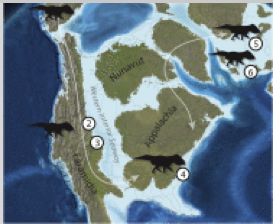
A ceratopsian dinosaur from the Late Cretaceous of eastern North America, and implications for dinosaur biogeography
Author:
Longrich
Abstract:
Tyrannosaurs and hadrosaurs from the Late Cretaceous of eastern North America (Appalachia) are distinct from those found in western North America (Laramidia), suggesting that eastern North America was isolated during the Late Cretaceous. However, the Late Cretaceous fauna of Appalachia remains poorly known. Here, a partial maxilla from the Campanian Tar Heel Formation (Black Creek Group) of North Carolina is shown to represent the first ceratopsian from the Late Cretaceous of eastern North America. The specimen has short alveolar slots, a ventrally projected toothrow, a long dentigerous process overlapped by the ectopterygoid, and a toothrow that curves laterally, a combination of characters unique to the Leptoceratopsidae. The maxilla has a uniquely long, slender and downcurved posterior dentigerous process, suggesting a specialized feeding strategy. The presence of a highly specialized ceratopsian in eastern North America supports the hypothesis that Appalachia underwent an extended period of isolation during the Late Cretaceous, leading the evolution of a distinct dinosaur fauna dominated by basal tyrannosauroids, basal hadrosaurs, ornithimimosaurs, nodosaurs, and leptoceratopsids. Appalachian vertebrate communities are most similar to those of Laramidia. However some taxa-including leptoceratopsids-are also shared with western Europe, raising the possibility of a Late Cretaceous dispersal route connecting Appalachia and Europe.
Subscribe to:
Posts (Atom)