Fire in a Weichselia-dominated coastal ecosystem from the Lower Cretaceous (Barremian) of the Kurnub Group in NW Jordan
Authors:
Abu Hamad et al
Abstract:
Large intervals of the Cretaceous are considered as a ‘high-fire’ period in Earth's history. However, so far most studies dealing in greater detail with the fossil evidence of palaeo-wildfires, i.e. fossil charcoal, originate from the northern hemisphere (i.e. North America, Europe, Asia) whereas there are large stratigraphic and geographic gaps on the Cretaceous southern continents. The present paper deals with the fossil contents (plant macro-remains, palynomorphs and charcoal) of a lignite lens from the lower part of the Lower Cretaceous Kurnub Group near King Talal Dam in Jordan. The data provide evidence for the repeated occurrence of palaeo-wildfires in coastal ecosystems on the northern margin of Gondwana during the Barremian. The fossil content of the lens indicates that the vegetation, which was repeatedly affected by fire, has been dominated by the matoniaceous tree fern Weichselia reticulata. Palynological data from the lignite, as well as the repeated occurrence of wildfires point to an at least seasonally dry (or at least less humid) climate during deposition of the lignite.
Showing posts with label barremian. Show all posts
Showing posts with label barremian. Show all posts
Wednesday, June 22, 2016
Evidence of Wild Fires From Barremian Cretaceous Jordan


Monday, March 28, 2016
Montirictus kuwajimaensis: a new Tritylodontid Mammaliamorph From Barremian/Aptian Cretaceous Japan
A new Early Cretaceous tritylodontid (Synapsida, Cynodontia, Mammaliamorpha) from the Kuwajima Formation (Tetori Group) of central Japan
Authors:
Matsuoka et al
Abstract:
We describe tritylodontid remains from the Lower Cretaceous Kuwajima Formation (Tetori Group) in central Japan as representing a new genus, Montirictus kuwajimaensis, gen. et sp. nov. Montirictus is a medium-sized tritylodontid genus characterized by upper cheek teeth having the cusp formula 2-2-2 with subequal cusps, buccal and lingual cusps retaining a crescentic shape with both buccal and lingual ridges anteriorly, and ‘V’-shaped buccolingual cross-sections of two anteroposterior grooves between the three cusp rows. Tentative dating of the Kuwajima Formation to the Barremian–Aptian makes it the stratigraphically youngest representative of a long-lived, globally distributed and abundant mammaliamorph lineage and extends the known geographic range of tritylodontids.
Saturday, March 12, 2016
Why did the Stegosaurs go Extinct in the Cretaceous?
Without doubt, stegosaurs were adversely affected by new conditions in the Cretaceous. Available data suggests that, right after their Jurassic heyday, stegosaurs suffered a loss of diversity similar to what sauropods endured - 57-89%. After this first setback, they were further battered, by Barremian time c. 127 Ma. Plated dinosaurs apparently vanished everywhere, except in Asia, where their last occurrences are dated Aptian-Albian. By mid K at the latest, Stegosauria was entirely gone. What caused plated beasts to wane and die out?
In their 2009 paper, Diversity patterns amongst herbivorous dinosaurs and plants during the Cretaceous, Butler et al. note an apparent correlation between the waning of certain plants (cycads, cycadophytes and bennattitalles) and the demise of stegosaurs. Citing earlier works suggesting an ecological association of plated dinosaurs and cycads (and close relatives) they suggest the disappearance of stegosaurs, from the start of the early Cretaceous to its end, mirrored the decline of such vegetation.
With their narrow snouts, stegosaurs do appear to have been specialized feeders, essentially limited to a specific type of plant. Ergo, they may have been vulnerable to loss of such flora. The available evidence however, suggests other factors may have been equally important, if not more so.
link.
Saturday, January 02, 2016
Comparing the Barremian/Aptian Cretaceous Ecologies of the Jehol and Wealden Biotas
A comparison of Barremian–early Aptian vertebrate assemblages from the Jehol Group, north-east China and the Wealden Group, southern Britain: the value of microvertebrate studies in adverse preservational settings
Author:
Sweetman
Abstract:
Vertebrates are a highly significant component of the Jehol Biota of northern Hebei, western Liaoning, and southeastern Inner Mongolia. Furthermore, Jehol vertebrate fossils from these areas are remarkable for their abundance and diversity, and for their taphonomy which has resulted in the preservation of large numbers of complete skeletons and of soft tissues including the feathers of birds and nonavian dinosaurs. In contrast, and also for taphonomic reasons, skeletons are extremely rare in the approximately coeval (Barremian–earliest Aptian) Lower Cretaceous Wealden Group of the Isle of Wight, southern England, UK. However, collection of isolated macro-remains over a period of almost 200 years has demonstrated that the Wealden Group, and in particular the Barremian Wessex Formation, contains Europe’s most diverse dinosaur assemblage. This assemblage, until the relatively recent discovery of China’s feathered nonavian dinosaurs and birds, appeared to be of comparable diversity to that of the Jehol Biota. Isolation of microvertebrate remains in an ongoing study commenced in 2002 has demonstrated that not only is the Wealden Group dinosaur assemblage more diverse than apparent from macro-remains and that it includes birds but also that it includes a high diversity of other aquatic, amphibious and terrestrial vertebrates. It is, therefore, now possible to make meaningful comparisons between the Jehol Biota and that of the Wealden Group of the Isle of Wight. Similarities and marked differences are apparent that reflect geographical separation, palaeoenvironmental factors and the remarkably small outcrop area available for the Wealden Group.
Thursday, December 31, 2015
Muiscasaurus catheti: A new Ophthalmosaurid Ichthyosaur From Barremian/Aptian Cretaceous Colombia
A new ophthalmosaurid ichthyosaur from the Early Cretaceous of Colombia
Authors:
Maxwell et al
Abstract:
Cretaceous ichthyosaurs were relatively diverse in temperate latitudes, but few species have been described from the palaeotropics. Here, we describe a new ophthalmosaurid ichthyosaur, Muiscasaurus catheti gen. et sp. nov., from the Barremian–Aptian aged Paja Formation of Colombia. This species is known only from a partial skull and differs from all other ichthyosaurs in the unusual configuration of the external narial opening, slender rostrum, narrow postorbital region, and gracile dentition. It is the second ichthyosaur described from the Paja Formation, suggesting moderate taxonomic and ecological ichthyosaur diversity in the region during the Early Cretaceous.
The Local Flora of a Riparian Ecosystem From Barremian Cretaceous Belgium
Local-scale analysis of plant community from the Early Cretaceous riparian ecosystem of Hautrage, Belgium
Authors:
Barral et al
Abstract:
Diversity properties and relative taxon abundance are explored to describe plant community local-scale spatial and temporal patterns during four ecological stages from the middle Barremian continental aquatic ecosystem of Hautrage, Mons basin, western Belgium. Taxon co-occurrence and correlations of taxon abundance are also analyzed to describe the main patterns of plant association within each stage and through time. Diversity, relative taxon abundance and taxonomic inventory greatly vary laterally and between ecological stages. Two of these stages show gradients in taxon richness and abundance reflecting probable edge effects. A reconstruction of the plant community evolution based on these four stages plus seven previously reported stages reveal a plant community mainly composed of the conifers Arctopitys, Brachyphyllum, Frenelopsis, and Pagiophyllum, and the ferns Gleichenites and Phlebopteris, maintained through time. Two main taxon association patterns are observed over space and time: 1) Arctopitys and Phlebopteris, and 2) Brachyphyllum, Gleichenites, Pagiophyllum. Conifer type 1, Elatides and Sphenopteris appear to have been spatially associated, whereas inverse relations between Cladophlebis and Phlebopteris and between Onychiopsis and Sphenopteris reflect possible niche overlap and competitive exclusion pressures. Three different successional stages are identified by the proportion of herbaceous and woody taxa and the presence/absence of Frenelopsis. Frenelopsis was a dominant taxon in mature community stages probably forming closed canopies, and having a negative effect on richness and abundance of other taxa. Our results evidence four intense and two less intense fire events through the series, suggesting that wildfires played an important role in the ecological succession of the plant community of Hautrage. Weichselia reticulata most probably played a key role in early successional stages, contributing in the regeneration of plant communities after wildfire disturbance events.
Wednesday, December 16, 2015
Morelladon beltrani: a new Sail-backed Styracosternan Ornithopod (duck bill) Dinosaur From Barremian Cretaceous Spain


A New Sail-Backed Styracosternan (Dinosauria: Ornithopoda) from the Early Cretaceous of Morella, Spain
Authors:
Gasulla et al
Abstract:
A new styracosternan ornithopod genus and species is here described based on a partial postcranial skeleton and an associated dentary tooth of a single specimen from the Arcillas de Morella Formation (Early Cretaceous, late Barremian) at the Morella locality, (Castellón, Spain). Morelladon beltrani gen. et sp. nov. is diagnosed by eight autapomorphic features. The set of autapomorphies includes: very elongated and vertical neural spines of the dorsal vertebrae, midline keel on ventral surface of the second to fourth sacral vertebrae restricted to the anterior half of the centrum, a posterodorsally inclined medial ridge on the postacetabular process of the ilium that meets its dorsal margin and distal end of the straight ischial shaft laterally expanded, among others. Phylogenetic analyses reveal that the new Iberian form is more closely related to its synchronic and sympatric contemporary European taxa Iguanodon bernissartensis and Mantellisaurus atherfieldensis, known from Western Europe, than to other Early Cretaceous Iberian styracosternans (Delapparentia turolensis and Proa valdearinnoensis). The recognition of Morelladon beltrani gen. et sp. nov. indicates that the Iberian Peninsula was home to a highly diverse medium to large bodied styracosternan assemblage during the Early Cretaceous.
Monday, December 07, 2015
Palm Pollen (!) From Barremian/Albian Cretaceous Patagonia
Early Cretaceous palm pollen tetrads from Patagonia, Argentina
Authors:
Martinez et al
Abstract:
Pollen tetrads and monads of spiny pollen grains with close affinities to palms have been found in several localities from the Lower Cretaceous (Barremian-Albian) of the Austral Basin (Magallanes), Patagonia (Argentina). When found dispersed, spiny and zonasulcate pollen grains, are commonly referred to the fossil genus Spinizonocolpites Muller, with close affinities to the extant palm Nypa. The Patagonian specimens were compared with fossil and extant members of the Arecaceae, showing close similarities in shape and sculpture with the primitive members of the subfamily Calamoideae. Nypa produces tetragonal tetrads different from the tetrahedral tetrads of the Spinizonocolpites-type recovered from Patagonia. The specimens were studied with LM and SEM. The polarity, aperture orientation and tetrad type allow segregating the Patagonian grains from the Nypoideae and relating it to the Calamoideae subfamily. These records suggest an antique origin of monocots and a probably initial diversification of calamoid palms during the Early Cretaceous in high latitudes of Gondwana. The presence of palmae during the Early Cretaceous in southern South America suggests a warm and humid climate, similar to that found in present days at tropics.
Saturday, December 05, 2015
Did a Magma Injection Into Organic Sediments at the Barremian/Aptian Boundary Release Carbon Gases, Trigger Oceanic Anoxic Event 1a?
The Early Cretaceous Barents Sea Sill Complex: Distribution, 40Ar/39Ar geochronology, and implications for carbon gas formation
Authors:
Ploteau et al
Abstract:
Mafic igneous rocks of Cretaceous age (80–130 Ma) scattered around the Arctic Ocean are commonly referred to as the High Arctic Large Igneous Province (HALIP). We have mapped out the distribution of HALIP igneous rocks in the Barents Sea region over the past decade based on integrated seismic–gravity–magnetic interpretation, field work, review of publications, and analyses of new and vintage borehole and field samples. The mapping reveals abundant igneous rocks in the northern and eastern Barents Sea covering an area of ~ 900,000 km2 with a conservative volume estimate of 100,000 to 200,000 km3 of intrusions. The igneous province is dominated by sheet intrusions injected into Triassic and Permian sedimentary rocks. Hydrothermal vent complexes are rare, and only two potential vent complexes have been identified on seismic data in the eastern Barents Sea. We have further done extensive radiometric dating of the igneous samples in the Barents Sea region. New 40Ar/39Ar dating of thirteen samples from Svalbard reveal ages of crystallization and alteration. The large age span (60–140 Ma for the raw ages) is likely due to partial or complete overprint of the K/Ar system in plagioclase, and the age of the magma emplacement is better represented by U/Pb TIMS ages. Only one of our 40Ar/39Ar analyses of plagioclase yielded a statistically valid age that is in line with the recently published U/Pb TIMS ages of 122–125 Ma. The new data clearly document that relying on published data from the K/Ar system can lead to erroneous conclusions on the age of crystallization in this province without a careful use of additional 40Ar/39Ar degassing data (i.e., K/Ca). We propose that the magmatism on Svalbard and Franz Josef Land represents a distinct magmatic event near the Barremian/Aptian boundary (125 Ma) in the Barents Sea. This Early Cretaceous Barents Sea magmatism resulted in the formation of the BSSC (Barents Sea Sill Complex). BSSC age rocks are also present in Arctic Canada (Sverdrup Basin) and on Bennett Island (New Siberia Islands). The massive injection of hot magma into potentially organic-rich sediments in the eastern and northern Barents Basin caused rapid organic matter maturation and formation of thermogenic gas and oil in contact aureoles. We estimate that up to 20,000 Gt of carbon were potentially mobilized, corresponding to 175 trillion barrels of oil equivalent. The production rates and fate of the carbon gases are uncertain. However, we speculate that rapid release of aureole greenhouse gases (methane) may have triggered the Oceanic Anoxic Event 1a (OAE1a) and the associated negative δ13C excursion in the Early Aptian. Some of the methane may also be trapped in the vast hydrocarbon gas accumulations found in the east Barents Basin.
Thursday, October 15, 2015
Spinolestes xenarthrosus: a Spiny, Furry Triconodont Mammal From Barremanian/Aptian Cretaceous Spain


A Cretaceous eutriconodont and integument evolution in early mammals
Authors:
Martin et al
Abstract:
The Mesozoic era (252–66 million years ago), known as the domain of dinosaurs, witnessed a remarkable ecomorphological diversity of early mammals. The key mammalian characteristics originated during this period and were prerequisite for their evolutionary success after extinction of the non-avian dinosaurs 66 million years ago. Many ecomorphotypes familiar to modern mammal fauna evolved independently early in mammalian evolutionary history. Here we report a 125-million-year-old eutriconodontan mammal from Spain with extraordinary preservation of skin and pelage that extends the record of key mammalian integumentary features into the Mesozoic era. The new mammalian specimen exhibits such typical mammalian features as pelage, mane, pinna, and a variety of skin structures: keratinous dermal scutes, protospines composed of hair-like tubules, and compound follicles with primary and secondary hairs. The skin structures of this new Mesozoic mammal encompass the same combination of integumentary features as those evolved independently in other crown Mammalia, with similarly broad structural variations as in extant mammals. Soft tissues in the thorax and abdomen (alveolar lungs and liver) suggest the presence of a muscular diaphragm. The eutriconodont has molariform tooth replacement, ossified Meckel’s cartilage of the middle ear, and specialized xenarthrous articulations of posterior dorsal vertebrae, convergent with extant xenarthran mammals, which strengthened the vertebral column for locomotion.
pop sci write up #1, #2 and #3.
Thursday, July 16, 2015

Thursday, July 09, 2015
Wait! What!?! Pterosaur Liaoxipterus brachycephalus had a CHAMELEON-like TONGUE?!
The Hyoid Apparatus of Liaoxipterus Brachycephalus (Pterosauria) and Its Implications for Food-catching Behavior
Authors:
Lü et al
Abstract:
The feeding behavior of pterosaurs was varied in different groups. Judging by the tooth morphologies and fossilized stomach contents of pterosaurs, the feeding habits included fish-eating, insect-eating, filtering small aquatic organisms, eating shelled crabs and snails, and fruit-eating. Because of the need for survival, they occupied different ecological niches, which determined their different food sources. Herein described is an almost complete, well-preserved hyoid apparatus of Liaoxipterus brachyognathus in comparison with the hyoid apparatus of the modern lizard Chameleon. The long processus lingualis (processus entoglossus) is similar to that of the modern lizard Chameleon, which captures prey by tongue, implying that Liaoxipterus might share a similar lingual feeding behavior. This phenomenon, plus its special tooth morphology, further suggests that it was an insect-eating rather than fish-eating pterosaur.
Friday, May 22, 2015
Deriving What the First Snakes Were Like
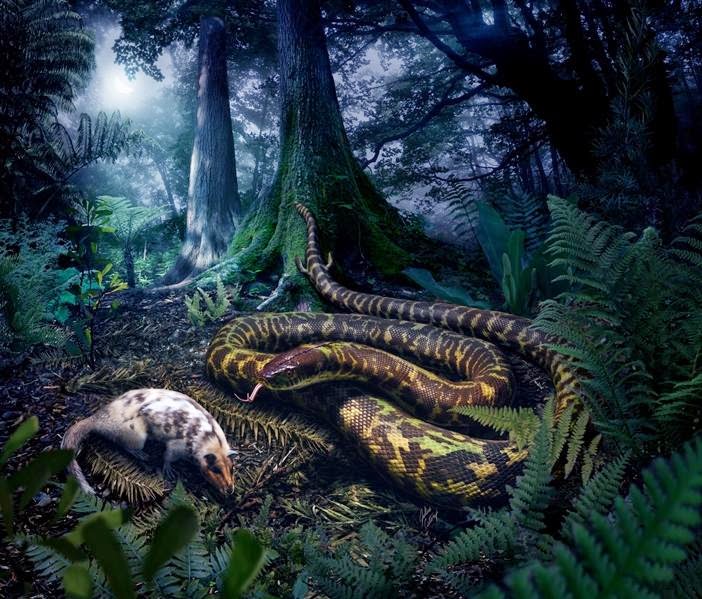
The original snake ancestor was a nocturnal, stealth-hunting predator that had tiny hindlimbs with ankles and toes, according to research published in the open access journal BMC Evolutionary Biology.
The study, led by Yale University, USA, analyzed fossils, genes, and anatomy from 73 snake and lizard species, and suggests that snakes first evolved on land, not in the sea, which contributes to a longstanding debate. They most likely originated in the warm, forested ecosystems of the Southern Hemisphere around 128 million years ago.
Snakes show incredible diversity, with over 3,400 living species found in a wide range of habitats, such as land, water and in trees. But little is known about where and when they evolved, and how their original ancestor looked and behaved.
Lead author Allison Hsiang said: "While snake origins have been debated for a long time, this is the first time these hypotheses have been tested thoroughly using cutting-edge methods. By analyzing the genes, fossils and anatomy of 73 different snake and lizard species, both living and extinct, we've managed to generate the first comprehensive reconstruction of what the ancestral snake was like."
By identifying similarities and differences between species, the team constructed a large family tree and illustrated the major characteristics that have played out throughout snake evolutionary history.
Their results suggest that snakes originated on land, rather than in water, during the middle Early Cretaceous period (around 128.5 million years ago), and most likely came from the ancient supercontinent of Laurasia. This period coincides with the rapid appearance of many species of mammals and birds on Earth.
The ancestral snake likely possessed a pair of tiny hindlimbs, and targeted soft-bodied vertebrate and invertebrate prey that were relatively large in size compared to prey targeted by lizards at the time. While the snake was not limited to eating very small animals, it had not yet developed the ability to manipulate prey much larger than itself by using constriction as a form of attack, as seen in modern Boa constrictors.
While many ancestral reptiles were most active during the daytime (diurnal), the ancestral snake is thought to have been nocturnal. Diurnal habits later returned around 50-45 million years ago with the appearance of Colubroidea - the family of snakes that now make up over 85% of living snake species. As colder night time temperatures may have limited nocturnal activity, the researchers say that the success of Colubroidea may have been facilitated by the return of these diurnal habits.
link.
Tuesday, February 24, 2015
Evidence Barremanian/Aptian Cretaceous Global Warming Tied to ‘Oceanic Anoxic Event 1a’

The Barremian and Aptian stepwise development of the ‘Oceanic Anoxic Event 1a’ (OAE 1a) crisis: integrated benthic and planktic high-resolution palaeoecology along the Gorgo a Cerbara stratotype section (Umbria-Marche Basin, Italy)
Authors:
Patruno et al
Abstract:
The Barremian and Aptian were times of global plate reconfiguration and profound changes in the ocean-climate system, culminating in the worldwide deposition of lower Aptian black shale layers (OAE1a). Based on high-resolution lithostratigraphic and micropalaeontological analyses, precursor conditions and timing of the anoxia are here reconstructed along a 33.06 m thick section in the proposed Barremian/Aptian boundary GSSP stratotype at Gorgo a Cerbara (Umbria-Marche Basin, Italy).
A non-uniform history of benthic foraminiferal diversification is interrupted by the Selli Level (= OAE1a) and by three turnover points for both benthic and planktic organisms, each highlighted by prominent breaks in lithology and outcrop morphology. The first two points, at ~ 1.4 Myr and ~ 20-50 Kyr prior to the onset of the OAE1a, correspond respectively to the nannoconid (= bathypelagic calcareous nannofossils) ‘decline’ and ‘crisis’ events, and separate: (a) pelagic limestone/chert-claystone lithological cycles of the uppermost Maiolica Formation, showing frequencies reminiscent of orbital eccentricity and containing an oligotrophic Barremian benthic and planktic assemblage, dominated by k-selected nannoconids and Rhizammina; (b) greenish-grey cherty marls of the lowermost Marne a Fucoidi Formation, associated to declining sedimentation rates and eutrophic early Aptian assemblages dominated by radiolarians and lituolid benthic foraminifera; and (c) anoxic radiolarites and shales of the carbonate-free Selli Level. High magnitude and frequency assemblage fluctuations occur between the nannoconid crisis (~ 25 cm below the lowermost OAE1a black shale layer) and the Selli Level base, with suggestions of bottom-water acidification. At ~ 2.5 Myr after the OAE1a end, a third turnover point in the basal reddish member of the Marne a Fucoidi, highlights ‘middle’ Aptian assemblages characterized by a bloom of early macroperforate planktic foraminifera (Hedbergella spp.) and appearances of new benthic species, marking a shift towards better oxygenation.
OAE1a oxygen and pelagic carbonate factory crises are here suggested to have been step-wise and linked to global warming conditions.
Monday, January 05, 2015
The Paleoenvironment of Barremian/Albian Cretaceous East Asia

Environment and ecology of East Asian dinosaurs during the Early Cretaceous inferred from stable oxygen and carbon isotopes in apatite
Authors:
Amiot et al
Abstract:
During the cold Late Barremian–Early Albian interval, terrestrial environments in East Asia were populated by rich and diverse vertebrate faunas characterized by a strong provincialism. The latitudinal gradient of temperature and the existence of geographic barriers likely accounted for some aspects of this heterogeneous distribution of faunas. Other factors, however, such as local environmental conditions and interactions within vertebrate communities, which could have influenced their distribution, have not yet been fully identified and understood. Therefore, new and published oxygen and carbon isotope compositions of apatite from Chinese and Thai reptiles (dinosaurs, crocodilians and turtles) have been analyzed and interpreted in terms of ecology, local air temperature and precipitation amounts. Differences in carbon and oxygen isotope compositions between various groups of sympatric plant-eating dinosaurs (sauropods, ornithopods and ceratopsians) indicate food resources partitioning among them most likely to avoid competition. Mid-latitude environments, where the Jehol Biota flourished, were submitted to cool temperate climatic conditions with Mean Air Temperature (MAT) of 10 ± 4 °C and Mean Annual Precipitations (MAP) of about 600 mm/yr compatible with the existence of forest environments. By contrast, sub-tropical regions, characterized by MAT of about 20–25 °C were either submitted to high amounts of seasonal precipitations (of about 1200 mm/yr in Thailand) or to significant aridity (MAP of about 400 mm/yr in South China). This difference in precipitation regime between Thailand and South China may be attributed to the occurrence of the Coastal Cordillera extending along the East margin of the South China block. These mountain ranges likely prevented humid air masses from the Pacific to penetrate some parts of South China, thus generating a “rain shadow effect”. Mosaic environments characterizing East Asia during the Late Early Cretaceous may have acted as a cradle for the origination of advanced dinosaur taxa that subsequently radiated over Eurasia and North America during the Late Cretaceous.
Thursday, December 04, 2014
Evidence of Barremian/Albian Cretaceous Anoxic Oceans Interrupted by Turbulent Mixing

Are Early Cretaceous environmental changes recorded in deposits of the Western part of the Silesian Nappe? A geochemical approach
Authors:
Wójcik-Tabo et al
Abstract:
The organic matter (OM)-rich, relatively monotonous sequence of upper Barremian–Albian deposits in the western part of the Silesian Nappe in the Polish Outer Carpathians, was investigated, using geochemical proxies to show environmental changes. The amounts of organic carbon (0.4–4.32 wt.% of TOC) co-vary with the concentration of S and/or redox sensitive trace elements (RSTE: Mo, U, Co, V, As). Kerogen is present as Type III and mixed Type II/III. Maceral assemblages consist of vitrinite, inertinite and liptinite. The carbon isotopic composition of the organic matter (δ13Corg) varies between − 25.38 and − 21.31‰ with an outlier at − 15.14‰. During the Early Cretaceous the Proto-Silesian Basin was the site of OM accumulation in a detrital oceanic anoxic event as a result of increased sedimentation rates of terrestrial organic matter. Runoff of terrestrial organic matter was accompanied by the production of plankton on an occasional basis. The marine matter contribution is inferred from occurrence of siliceous microfauna, the domination of short-chain n-alkanes, the distribution of sterane and prevalence of cholestane, and enrichment in nutrient elements (P2O5, Ba, Ag, Cd). The bottom waters could have been dysoxic to anoxic, with a mid-water oxygen minimum zone (OMZ) developed owing to the oxidation of organic matter. Anoxia is inferred from the lamination, pyritization patterns, RSTE concentration and low Pr/Ph and C23t/C30 H ratios. Intervals enriched in TOC and RSTE in the Veřovice Formation record pulses of marine productivity, preceded by volcanic (teshenite) and hydrothermal activity. They are referable to the following episodes: the Taxy (Barremian–Aptian), early Aptian Selli, Fallot and Paquier during the late Aptian and at the Aptian–Albian boundary. The initiation of turbidite deposition during the Albian led to bottom ventilation. The Lhoty Formation records the late Albian Toolebuc Episode, marked by a TOC peak, which resulted from the detrital flux. Acidic solution was responsible for reducing conditions in the sediment.
Monday, November 10, 2014
Aliaga molinensis: a Spalacotheriid ‘Symmetrodont’ Mammal From Barremian Cretaceous Spain

Spalacotheriid ‘symmetrodonts’ from the Early Cretaceous of Spain
Authors:
Cuenca-Bescós et al
Abstract:
Spalacotheriids, basal trechnotheres with an acutely angled, reversed-triangle pattern of major molar cusps, are relatively rare pan-Laurasian mammals that ranged through much of the Cretaceous but are generally not well represented in the fossil record. Herein we describe newly collected specimens from the Molino Alto 1 locality, Teruel Province, Spain, and review previously described materials from the nearby locality of Galve; the sites lie in the same horizon in the upper El Castellar Formation and are of early Barremian age. On this basis, we recognize and name Aliaga molinensis, gen. et sp. nov., and provisionally place in the same genus a previously described species, cf. Aliaga henkeli, comb. nov., which appears to be the largest known spalacotheriid. The two species are characterized by a distinctive, multicuspate cingulid on lower cheek teeth. Based on acuteness of molar cusp triangulation and other features (e.g., planar molar shearing surfaces, elongation and cusp pattern of penultimate premolar, reduction of last molar, simplification of upper molar crown pattern), the species are referred to the Spalacolestinae. This subfamily is most diverse in North America, where it ranged from Albian–Campanian, but first appears in the Barremian of Western Europe, supporting the hypothesis that the group had a Eurasian origin and later dispersed to North America.
Friday, October 03, 2014
Gulden Draak Knoll Microcontinent Found Off Western Australia

Discovery of a microcontinent (Gulden Draak Knoll) offshore Western Australia: Implications for East Gondwana reconstructions
Authors:
Gardner et al
Abstract:
Analysis of dredged samples from Gulden Draak Knoll demonstrate it is a submarine rifted continental fragment that lies at the boundary between the western Perth Abyssal Plain and Wharton Basin, Indian Ocean. The Knoll comprises a granulite facies basement, including pelitic paragneiss and mafic orthogneiss, with a Cambrian granite inferred to intrude the other rocks. Boulders and cobbles of felsic gneiss with Mesoproterozoic and Cambrian protolith ages were also sampled likely reflecting a complex basement to variable sedimentary and volcanic rocks. The U-Pb isotopic system in Archean and Mesoproterozoic zircon is significantly disturbed, reflecting Cambrian orogenesis that affected all samples. The protolith to garnet-sillimanite-biotite paragneiss has a maximum deposition age of 1163 ± 24 Ma and includes older detrital zircon grains with populations at c. 2.65 Ga and between 1.4-1.1 Ga. A younger population in this sample is interpreted as a mix of newly grown metamorphic zircon and isotopically reset zircon, implying the granulite facies metamorphism occurred at c. 511 ± 5 Ma. Protracted Cambrian orogenesis is indicated by a metamorphic age in the mafic orthogneiss of 530 ± 6 Ma and isotopic disturbance shortly following emplacement of granite (c. 540 Ma with zircon ages disturbed to 509 ± 7 Ma) and the protolith to the felsic orthogneiss (c. 528 Ma with zircon ages disturbed to 510 ± 3 Ma). Xenocrystic zircon grains in Cambrian rocks include Archean (c. 2839 ± 9 Ma) and Mesoproterozoic (1230–1370 Ma) populations also isotopically disturbed during Cambrian orogenesis. Igneous Cambrian zircon grains have less radiogenic Hf-isotope compositions (Hfi = 0.281821-0.281367) than Mesoproterozoic xenocrysts (Hfi = 0.282267-0.281993), indicating limited involvement of the Mesoproterozoic crust in granite production. A more likely source includes Archean crust represented by xenocrysts with Hfi = 0.281399-0.280863. The Gulden Draak Knoll is reconstructed in Gondwana (‘Leeuwin’ full-fit model) along strike of a major structure termed the Indo- Australo- Antarctic Suture (IAAS), recently mapped from geophysical interpretations in Wilkes Land, Antarctica. New isotopic data suggest basement rocks from the Gulden Draak Knoll have affinity to crust exposed either side of the IAAS. Determining if this structure is a suture zone sensu stricto remains to be tested.
Tuesday, July 29, 2014
A Very Large Carcharodontosaur Found in Barremian Cretaceous Spain
A large-bodied theropod (Tetanurae: Carcharodontosauria) from the Mirambel Formation (Barremian) of Spain
Authors:
Gasca et al
Abstract:
We describe an isolated distal femur of a large-sized theropod dinosaur from the Mirambel Formation, Teruel province, Spain. It comes from the Ladruñán-3 fossil locality, which represents a sandstone channel deposit that is early Barremian (Early Cretaceous) in age. This femur can be identified as belonging to an undetermined stem carcharodontosaurid allosauroid. The distal outline is similar to that of the basal carcharodontosaurid Acrocanthosaurus, which bears a ridge for the cruciate ligaments in the flexor groove and a deep but narrow extensor groove. This new carcharodontosaurid remnant extends the presence of this large-bodied theropod lineage in the Iberian Peninsula back to the early Barremian. The coexistence of carcharodontosaurids, ceratosaurians and spinosaurids in the Barremian of the Iberian Peninsula echoes the clade composition of large-bodied predator dinosaurs characteristic of other Early Cretaceous faunas in Gondwana. This suggests that Early Cretaceous Iberian ecosystems were as diverse as other Barremian European assemblages, with carcharodontosaurids being exclusive to Iberia.
Wednesday, July 16, 2014
Earliest Evidence of Semi-Aquatic Ferns From Hauterivian/Barremian Cretaceous Spain

Earliest record of semi-aquatic fern leaves (Family Marsileaceae) in the Mesozoic of Eurasia (Lower Cretaceous, Spain)
Authors:
Sender et al
Abstract:
In this paper we present new macrofossils of semi-aquatic fern Family Marsileaceae consisting of leaves and leaflets from the upper Hauterivian- lower Barremian Pinilla de los Moros Formation, Salas de los Infantes village, Burgos province, north of Spain. The leaves show two elliptic to flabellate-shaped leaflets that are joined to a petiole. Leaflets present entire margins and dichotomous anastomosed vein pattern. Comparison between the studied leaves and other marsileaceous leaves indicates close similarities with Regnellites nagashimae species. These leaves were deposited in a related fluvial environment near to the place where semi-aquatic plants grew. The studied macrofossils constitute at present the earliest record of leaves of Family Marsileaceae in the Mesozoic of Eurasia at the moment.
Subscribe to:
Posts (Atom)