An enigmatic aquatic snake from the Cenomanian of Northern South America
Authors:
Albino et al
Abstract:
We report the first record of a snake from the Cretaceous of northern South America. The remains come from the La Luna Formation (La Aguada Member, Cenomanian of Venezuela) and consist of several vertebrae, which belong to the precloacal region of the vertebral column. Comparisons to extant and extinct snakes show that the remains represent a new taxon, Lunaophis aquaticus gen. et sp nov. An aquatic mode of life is supported by the ventral position of the ribs, indicating a laterally compressed body. The systematic relationships of this new taxon are difficult to determine due to the scarcity of fossil material; it is, however, a representative of an early lineage of snakes that exploited tropical marine pelagic environments, as reflected by the depositional conditions of the La Aguada Member. Lunaophis is also the first aquatic snake from the Cenomanian found outside of the African and European Tethyan and Boreal Zones.
Showing posts with label snakes. Show all posts
Showing posts with label snakes. Show all posts
Friday, May 27, 2016
An enigmatic aquatic snake from the Cenomanian Cretaceous Venezuela


Monday, April 04, 2016
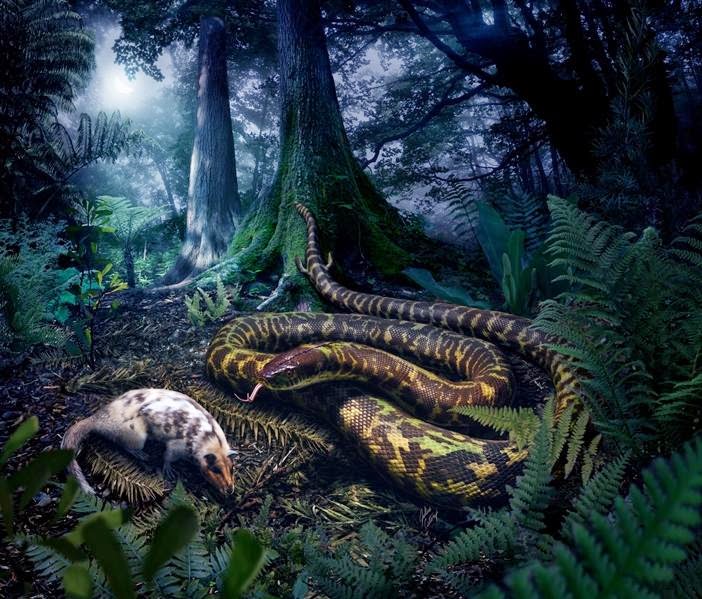
What Color was That Spanish Miocene Neogene Snake? Green and Black

Ten million years ago, a green and black snake lay coiled in the Spanish undergrowth. Once, paleontologists would have been limited to the knowledge they could glean from its colorless fossil remains, but now they know what the snake looked like and can guess how it acted. Researchers reporting on March 31 in Current Biology have discovered that some fossils can retain evidence of skin color from multiple pigments and structural colors, aiding research into the evolution and function of color.
So far, scientists filling the ancient-Earth coloring book with pigment have been limited to browns, blacks, and muddy reds when melanin lasts as organic material. No other pigments have been shown to survive fossilization. But this snake's skin was fossilized in calcium phosphate, a mineral that preserves details on a subcellular level.
The fossilized snakeskin maintained the unique shapes of different types of pigment cells, which would have created yellows, greens, blacks, browns, and iridescence while the animal was alive. The pigments themselves are now decayed, but with the cell shapes—specific to each kind of pigment—mineralized, there's enough information to reconstruct their colors.
"When you get fossil tissues preserved with this kind of detail, you're just gobsmacked when you're looking at it under the microscope," says first author Maria McNamara, a paleobiologist at University College Cork. "I was astounded. You almost can't believe what you're seeing."
link.
Saturday, January 09, 2016
Yellow-bellied Sea Snakes Wash up on Southern California Beach

A venomous sea snake washed up on a Southern California beach recently, striking fear in the hearts of beachgoers but eliciting excitement from the scientists who study these marine reptiles.
The stranded snake, which was dead when it was discovered on Dec. 12, was a yellow-bellied sea snake (Pelamis platura), the most widespread marine snake in the world. But despite its wide range of habitats, this snake isn't usually observed in the waters off the coast of Southern California, as it tends to keep to the warmer waters just south of that coastline, closer to Baja California, Mexico. Yet, in 2015, two of these critters washed up on California beaches, leading many to wonder why the snake is venturing outside its normal habitat.
link.
Sunday, December 27, 2015
"Extinct" Sea Snakes Rediscovered in Australia

Scientists from James Cook University have discovered two critically endangered species of sea snakes, previously thought to be extinct, off the coast of Western Australia.
It's the first time the snakes have been spotted alive and healthy since disappearing from their only known habitat on Ashmore Reef in the Timor Sea more than fifteen years ago.
"This discovery is really exciting, we get another chance to protect these two endemic Western Australian sea snake species," says study lead author Blanche D'Anastasi from the ARC Centre of Excellence for Coral Reef Studies at JCU.
"But in order to succeed in protecting them, we will need to monitor populations as well as undertake research into understanding their biology and the threats they face".
The discovery of the critically endangered short nose sea snake was confirmed after a Western Australia Parks and Wildlife Officer, Grant Griffin, sent a photo of a pair of snakes taken on Ningaloo Reef to Ms D'Anastasi for identification.
"We were blown away, these potentially extinct snakes were there in plain sight, living on one of Australia's natural icons, Ningaloo Reef," says Ms D'Anastasi.
link.
Monday, August 03, 2015
Tetrapodophis amplectus: That Controversial Four Legged Snake From Aptian Cretaceous Brazil


A four-legged snake from the Early Cretaceous of Gondwana
Authors:
Martill et al
Abstract:
Snakes are a remarkably diverse and successful group today, but their evolutionary origins are obscure. The discovery of snakes with two legs has shed light on the transition from lizards to snakes, but no snake has been described with four limbs, and the ecology of early snakes is poorly known. We describe a four-limbed snake from the Early Cretaceous (Aptian) Crato Formation of Brazil. The snake has a serpentiform body plan with an elongate trunk, short tail, and large ventral scales suggesting characteristic serpentine locomotion, yet retains small prehensile limbs. Skull and body proportions as well as reduced neural spines indicate fossorial adaptation, suggesting that snakes evolved from burrowing rather than marine ancestors. Hooked teeth, an intramandibular joint, a flexible spine capable of constricting prey, and the presence of vertebrate remains in the guts indicate that this species preyed on vertebrates and that snakes made the transition to carnivory early in their history. The structure of the limbs suggests that they were adapted for grasping, either to seize prey or as claspers during mating. Together with a diverse fauna of basal snakes from the Cretaceous of South America, Africa, and India, this snake suggests that crown Serpentes originated in Gondwana.
Friday, May 22, 2015
Deriving What the First Snakes Were Like
The original snake ancestor was a nocturnal, stealth-hunting predator that had tiny hindlimbs with ankles and toes, according to research published in the open access journal BMC Evolutionary Biology.
The study, led by Yale University, USA, analyzed fossils, genes, and anatomy from 73 snake and lizard species, and suggests that snakes first evolved on land, not in the sea, which contributes to a longstanding debate. They most likely originated in the warm, forested ecosystems of the Southern Hemisphere around 128 million years ago.
Snakes show incredible diversity, with over 3,400 living species found in a wide range of habitats, such as land, water and in trees. But little is known about where and when they evolved, and how their original ancestor looked and behaved.
Lead author Allison Hsiang said: "While snake origins have been debated for a long time, this is the first time these hypotheses have been tested thoroughly using cutting-edge methods. By analyzing the genes, fossils and anatomy of 73 different snake and lizard species, both living and extinct, we've managed to generate the first comprehensive reconstruction of what the ancestral snake was like."
By identifying similarities and differences between species, the team constructed a large family tree and illustrated the major characteristics that have played out throughout snake evolutionary history.
Their results suggest that snakes originated on land, rather than in water, during the middle Early Cretaceous period (around 128.5 million years ago), and most likely came from the ancient supercontinent of Laurasia. This period coincides with the rapid appearance of many species of mammals and birds on Earth.
The ancestral snake likely possessed a pair of tiny hindlimbs, and targeted soft-bodied vertebrate and invertebrate prey that were relatively large in size compared to prey targeted by lizards at the time. While the snake was not limited to eating very small animals, it had not yet developed the ability to manipulate prey much larger than itself by using constriction as a form of attack, as seen in modern Boa constrictors.
While many ancestral reptiles were most active during the daytime (diurnal), the ancestral snake is thought to have been nocturnal. Diurnal habits later returned around 50-45 million years ago with the appearance of Colubroidea - the family of snakes that now make up over 85% of living snake species. As colder night time temperatures may have limited nocturnal activity, the researchers say that the success of Colubroidea may have been facilitated by the return of these diurnal habits.
link.
Friday, March 27, 2015
Nidophis insularis: a Small Maastrichtian Cretaceous Snake Found in a Dinosaur Nest, but not Eating Eggs (hint, something small and toothy was eating it)

A Late Cretaceous madtsoiid snake from Romania associated with a megaloolithid egg nest – Paleoecological inferences
Authors:
Venczel et al
Abstract:
Here we report on the taphonomy and paleoecological implications of the first record of a small madtsoiid snake (Nidophis insularis) closely associated with a megaloolithid dinosaur egg nest. Taphonomic and sedimentologic evidence suggest that the snake was buried autochthonously within or nearby the egg nest, with at least partially articulated skeleton. Count of growth rings on the vertebral zygapophyses indicates that the holotype of Nidophis belonged to an adult individual approaching the limit of its maximum body size of about 1 m length. The presence of layers of arrested growth on the zygapophyses, together with other independent data (e.g., paleomagnetic data, sedimentology, paleosol development stage, stable isotope geochemistry) indicates that Nidophis lived under a semi-arid, seasonally variable subtropical climate, having alternative periods of active feeding. The trunk vertebrae with relatively low neural spines and without prezygapophyseal accessory processes indicate a relatively heavy-bodied, slowly-moving animal, one that probably had a semifossorial habit and was an active forager, but definitively not a dinosaur nest raider as suggested for certain large madtsoiid snakes (the Indian Sanajeh). Potential prey items, available around the dinosaur nesting area, probably ranged from small squamate eggs to various small vertebrates. Finally, one anterior trunk vertebra of the holotype displays distinct bite marks left by a small-sized and pointed-toothed predator, most probably a crocodyliform or a theropod, thus documenting that madtsoiids were also preyed upon.
Did mommy bring home a snack?
Tuesday, January 27, 2015
Three Oldest Known Snake Fossils Found From Jurassic Bathonian Jurassic Britain, Kimmeridgian Jurassic Portugal
Fossilized remains of four ancient snakes have been dated between 140 and 167 million years old - nearly 70 million years older than the previous record of ancient snake fossils - and are changing the way we think about the origins of snakes, and how and when it happened. The findings have been published in the prestigious peer-reviewed journal Nature Communications.


"The study explores the idea that evolution within the group called 'snakes' is much more complex than previously thought," says lead author and professor Michael Caldwell in the Faculty of Science at the University of Alberta. "Importantly, there is now a significant knowledge gap to be bridged by future research as no fossils snakes are known from between 140 to 100 million years ago."
The oldest known snake, from Southern England, near Kirtlington, Eophis underwoodi, is known only from very fragmentary remains and was a small individual, though it is hard to say how old it was at the time it died. The largest snake, Portugalophis lignites, from coal deposits in Portugal, near Guimarota, was a much bigger individual at nearly a meter or more in length. Several of these ancient snakes (Eophis, Portugalophis and Parviraptor) were living in swampy coastal areas on large island chains in western parts of ancient Europe, while the North American species, Diablophis gilmorei, is found in river deposits from some distance inland in Western Colorado.
This new study makes it clear that the sudden appearance of snakes, some 100 million years ago, reflects a gap in the fossil record, not an explosive radiation of early snakes. From 167 to 100 million years ago, some 70 million years, snakes were radiating and evolving towards the elongate, limb-reduced body plan characterizing the now well known, ~100-90 million year old, marine snakes from the West Bank, Lebanon, and Argentina, that still possess small but well developed rear limbs. As is always the case, the distribution of these newer oldest snakes, and the anatomy of the skull and skeletal elements, makes it clear that even older snake fossils are waiting to be found.
"Based on the new evidence and through comparison to living legless lizards that are not snakes," explains Caldwell, "the paper explores the novel idea that the evolution of the characteristic snake skull and its parts appeared long before snakes lost their legs."
link.
paper link.
Tuesday, May 06, 2014
Comparing Venomous Snakes to Dinosaurs to Discover Whether or not Dinosaurs had a Poisonous Bite
Venomous Dinosaurs and Rear-Fanged Snakes: Homology and Homoplasy Characterized
Author:
Currie
Abstract:
I develop an account of homology and homoplasy drawing on their use in biological inference and explanation. Biologists call on homology and homoplasy to infer character states, support adaptationist explanations, identify evolutionary novelties and hypothesize phylogenetic relationships. In these contexts, the concepts must be understood phylogenetically and kept separate: as they play divergent roles, overlap between the two ought to be avoided. I use these considerations to criticize an otherwise attractive view defended by Gould, Hall, and Ramsey & Peterson. By this view, homology and homoplasy can only be delineated qua some level of description, and some homoplasies (parallelisms) are counted as homologous. I develop an account which retains the first, but rejects the second, aspect of that view. I then characterize parallelisms and convergences in terms of their causal role. By the Strict Continuity account, homology and homoplasy are defined phylogenetically and without overlaps, meeting my restriction. Convergence and parallelisms are defined as two types of homoplasy: convergent homoplasies are largely constrained by external factors, while parallelisms are due to internal constraints.
Wednesday, December 25, 2013
Did the Ancestor of Extant Squamates (Lizards, Snakes) Give Birth to Live Young?
The ancestor of snakes and lizards likely gave birth to live young, rather than laid eggs, and over time species have switched back and forth in their preferred reproductive mode, according to research published in print in Ecology Letters Dec. 17.
"This is a very unusual and controversial finding, and a major overturn of an accepted school of thought," said Alex Pyron, Robert F. Griggs Assistant Professor of Biology in the Columbian College of Arts and Sciences at the George Washington University. "Before, researchers long assumed that the ancestor of snakes and lizards laid eggs, and that if a species switched to live birth, it never reverted back. We found this wasn't the case."
The findings push researchers' understanding of the evolution of live birth a lot further back in time to 175 million years ago, showing that live birth has a much more ancient past as a strategy than previously believed. The findings are backed by several recent plesiosaur and mosasaur fossil discoveries and the fossil record of a few lizards from the Cretaceous Period, which had embryos in the mother and had live birth.
Dr. Pyron analyzed an evolutionary tree containing all groups of squamates—the group that comprises lizards and snakes—which he and a team of researchers published in the journal BMC Evolutionary Biology earlier this year. The tree, which uses DNA sequencing technology to group thousands of lizards and snakes, includes all families and subfamilies and most genus and species groups.
link.
Monday, November 18, 2013
Studying Cenomanian Cretaceous Marine Snakes
Reevaluation of the anatomy of the Cenomanian (Upper Cretaceous) hind-limbed marine fossil snakes Pachyrhachis, Haasiophis, and Eupodophis
Authors:
Alessandro Palci, Michael W. Caldwell & Randall L. Nydam
Abstract:
New anatomical observations and reinterpretations of previously identified structures have resulted in new taxonomic diagnoses for the fossil hind-limbed marine snakes Pachyrhachis problematicus, Eupodophis descouensi, and Haasiophis terrasanctus. Among the most important conclusions of our study are the following: Haasiophis and Eupodophis show no evidence of possessing a laterosphenoid; Pachyrhachis and Eupodophis do retain a jugal; Haasiophis, like Eupodophis, has chevron bones in the caudal region; Haasiophis has a large number of unfused intercentra along the anterior portion of the precloacal column; the dentary of Pachyrhachis has numerous mental foramina (at least four); Pachyrhachis has at least one sacral vertebra with unfused sacral ribs. To test the effect of our new observations on the phylogenetic relationships of snakes, we ran three phylogenetic analyses using alternative outgroups to polarize the character transformations. The ingroup consisted of all well-preserved fossil snakes from the Cretaceous, the madtsoiids, and taxa that are representative of all major groups of extant snakes. The analyses yielded a series of most parsimonious trees that placed Pachyrhachis, Eupodophis, and Haasiophis either as a series of stem taxa at the base of the radiation of snakes (two analysis), or as members of a clade of fossil snakes that are the sister group of all living alethinopidians (one analysis).
Wednesday, May 08, 2013
Comprehensive Squamate Phylogeny Released

A George Washington University biologist and a team of researchers have created the first large-scale evolutionary family tree for every snake and lizard around the globe.
The findings were recently published in the journal BMC Evolutionary Biology. Alex Pyron, the Robert F. Griggs Assistant Professor of Biology in GW's Columbian College of Arts and Sciences, along with researchers from the City University of New York and Arizona State University, detail the cataloguing of 4,161 species of snakes and lizards, or squamates.
"Squamates include all lizards and snakes found throughout the globe, including around 9,500 species on every continent except Antarctica, and found in most oceans," said Dr. Pyron. "This is everything from cobras to garter snakes to tiny geckos to the Komodo Dragon to the Gila Monster. They range from tiny threadsnakes that can curl up on a dime to 10 feet monitor lizards and 30 foot pythons. They eat everything from ants to wildebeest."
The evolutionary family tree, or phylogeny, includes all families and subfamilies and most genus and species groups, said Dr. Pyron. While there are gaps on some branches of the tree, the structure of the tree goes a long way toward fully mapping every genus and species group.
"It's like building an incomplete family tree for your family, but with half of the 'children' sampled. You're in it, but not your brother, one of your cousins is, but not another. However, because it's so complete, we know where the missing relatives go because there's no longer as much mystery as to how the missing species, or cousins, are related, with a few notable exceptions for some remaining species.
"This is also a community effort. We sequenced hundreds of these species ourselves but took thousands more from public databases, building on the work of others."
Understanding how various snakes and lizards are connected to each other fills a major gap in knowledge, said Dr. Pyron, because before this, there were no single reference for how all lizards and snakes were related or what their classification was.
"A phylogeny and taxonomy is fundamental for all fields of biology that use lizards and snakes, to understand how to classify the species being studied, to interpret biological patterns in terms of relatedness, and even at a more basic level, to count how many species are in an area, for example, for conservation management purposes."
This project has been in the works since 2008 with the last five years being the most intense. It was funded by the National Science Foundation Postdoctoral Research Fellowship in Biological Informatics.
The researchers used DNA sequencing technology to genotype, or identify, the DNA of thousands of lizards and snakes.
Paper link. (its open access)
Monday, December 10, 2012
83% of All Squamates Were Wiped Out by Chicxulub Impact (and the president gets his own fossil lizard)

The asteroid collision widely thought to have killed the dinosaurs also led to extreme devastation among snake and lizard species, according to new research — including the extinction of a newly identified lizard species Yale and Harvard scientists have named Obamadon gracilis."The asteroid event is typically thought of as affecting the dinosaurs primarily," said Nicholas R. Longrich, a postdoctoral associate with Yale's Department of Geology and Geophysics and lead author of the study. "But it basically cut this broad swath across the entire ecosystem, taking out everything. Snakes and lizards were hit extremely hard."The study was scheduled for online publication the week of Dec. 10 in the Proceedings of the National Academy of Sciences.Earlier studies have suggested that some snake and lizard species (as well as many mammals, birds, insects and plants) became extinct after the asteroid struck the earth 65.5 million years ago, on the edge of the Yucatan Peninsula. But the new research argues that the collision's consequences were far more serious for snakes and lizards than previously understood. As many as 83 percent of all snake and lizard species died off, the researchers said — and the bigger the creature, the more likely it was to become extinct, with no species larger than one pound surviving.The results are based on a detailed examination of previously collected snake and lizard fossils covering a territory in western North America stretching from New Mexico in the southwestern United States to Alberta, Canada. The authors examined 21 previously known species and also identified nine new lizards and snakes.They found that a remarkable range of reptile species lived in the last days of the dinosaurs. Some were tiny lizards. One snake was the size of a boa constrictor, large enough to take the eggs and young of many dinosaur species. Iguana-like plant-eating lizards inhabited the southwest, while carnivorous lizards hunted through the swamps and flood plains of what is now Montana, some of them up to six feet long."Lizards and snakes rivaled the dinosaurs in terms of diversity, making it just as much an 'Age of Lizards' as an 'Age of Dinosaurs,'" Longrich said.The scientists then conducted a detailed analysis of the relationships of these reptiles, showing that many represented archaic lizard and snake families that disappeared at the end of the Cretaceous, following the asteroid strike.One of the most diverse lizard branches wiped out was the Polyglyphanodontia. This broad category of lizards included up to 40 percent of all lizards then living in North America, according to the researchers. In reassessing previously collected fossils, they came across an unnamed species and called it Obamadon gracilis. In Latin, odon means "tooth" and gracilis means "slender.""It is a small polyglyphanodontian distinguished by tall, slender teeth with large central cusps separated from small accessory cusps by lingual grooves," the researchers write of Obamadon, which is known primarily from the jaw bones of two specimens. Longrich said the creature likely measured less than one foot long and probably ate insects.
Paper link.
Wednesday, May 18, 2011
Cryptolacerta hassiaca: A New Basal Amphisbaenian
The recent discovery by researchers from the University of Toronto Mississauga and the Museum für Naturkunde Berlin, Germany of a tiny, 47 million-year-old fossil of a lizard called Cryptolacerta hassiaca provides the first anatomical evidence that the body shapes of snakes and limbless lizards evolved independently."This fossil refutes the theory that snakes and other burrowing reptiles share a common ancestry and reveals that their body shapes evolved independently," says lead author Professor Johannes Müller of Humboldt-Universität, Berlin.The fossil reveals that amphisbaenians are not closely related to snakes, but instead are related to lacertids, a group of limbed lizards from Europe, Africa and Asia. "This is the sort of study that shows the unique contributions of fossils in understanding evolutionary relationships," says Professor Robert Reisz from the University of Toronto Mississauga, the senior author of the study. "It is particularly exciting to see that tiny fossil skeletons can answer some really important questions in vertebrate evolution".The German research team, led by Müller and American graduate student Christy Hipsley, used X-ray computed tomography to reveal the detailed anatomy of the lizard's skull and combined the anatomy of Cryptolacerta and other lizards with DNA from living lizards and snakes to analyze relationships. Their results showed that Cryptolacerta shared a thickened, reinforced skull with worm lizards and that both were most closely related to lacertids, while snakes were related to monitor lizards like the living Komodo dragons.
The press release was badly written, IMNSHO.
Wednesday, February 04, 2009
Now THAT'S a SNAKE!


Excavations in Colombia co-organized by Carlos Jaramillo, staff scientist at the Smithsonian Tropical Research Institute in Panama and Jonathan Bloch, curator of vertebrate paleontology at the University of Florida's Florida Museum of Natural History, unearthed fossil remains of a new snake species named Titanoboa cerrejonensis.
Surrounded by huge trucks extracting coal from Cerrejon, one of the world's largest open-pit mines, researchers discovered fossilized bones of super-sized snakes and their prey, crocodiles and turtles, in the Cerrejon Formation, along with fossilized plant material from the oldest known rainforest in the Americas, which flourished at the site 58-60 million years ago.
Jason Head, the lead author of the new species description in the journal Nature, is a research associate at the Smithsonian's National Museum of Natural History and assistant professor of ecology and evolutionary biology at the University of Toronto Mississauga. Head, with David Polly, associate professor of geosciences at Indiana University, used the ratio between vertebral size and the length of existing snakes to estimate that this boa-like snake must have reached 13 meters (42 feet) in length and weighed more than a ton. Titanoboa, as it is now called, is the largest snake ever known, and was the largest non-marine vertebrate from the epoch immediately following the extinction of dinosaurs 65 million years ago.
What in the world was a snake THAT large eating in the paleocene of SoAm?
Thursday, November 06, 2008
Sea Snakes Only Drink Fresh Water

Sea snakes may slither in saltwater, but they sip the sweet stuff.
So concludes a University of Florida zoologist in a paper appearing this month in the online edition of the November/December issue of the journal Physiological and Biochemical Zoology.
Harvey Lillywhite says it has been the "long-standing dogma" that the roughly 60 species of venomous sea snakes worldwide satisfy their drinking needs by drinking seawater, with internal salt glands filtering and excreting the salt. Experiments with three species of captive sea kraits captured near Taiwan, however, found that the snakes refused to drink saltwater even if thirsty — and then would drink only freshwater or heavily diluted saltwater.
"Our experiments demonstrate they actually dehydrate in sea water, and they'll only drink freshwater, or highly diluted brackish water with small concentrations of saltwater — 10 to 20 percent," Lilywhite said.
Harold Heatwole, a professor of zoology at North Carolina State University and expert on sea snakes, termed Lillywhite's conclusion "a very significant finding."
"This result probably holds the key to understanding the geographic distribution of sea snakes," Heatwole said.
The research may help explain why sea snakes tend to have patchy distributions and are most common in regions with abundant rainfall, Lillywhite said. Because global climate change tends to accentuate droughts in tropical regions, the findings also suggest that at least some species of sea snakes could be threatened now or in the future, he added.
"There may be places where sea snakes are barely getting enough water now," he said. "If the rainfall is reduced just a bit, they'll either die out or have to move."
This is something to be considered for the extinct diapsid lineages. They may not have been able to get water from the sea...somehow I doubt it for the ichthyosaurs, but you never know. Have any ever been found in deep river deposits? What about mosasaurs and the others?
Subscribe to:
Posts (Atom)