Hydrothermal Conditions and the Origin of Cellular Life
Authors:
Deamer et al
Abstract:
The conditions and properties of hydrothermal vents and hydrothermal fields are compared in terms of their ability to support processes related to the origin of life. The two sites can be considered as alternative hypotheses, and from this comparison we propose a series of experimental tests to distinguish between them, focusing on those that involve concentration of solutes, self-assembly of membranous compartments, and synthesis of polymers.
Showing posts with label black smokers. Show all posts
Showing posts with label black smokers. Show all posts
Thursday, January 07, 2016
How to Test if Hydrothermal Vents Were the Origin of Life


Friday, July 17, 2015
Monday, January 19, 2015
The Awesome Evilness of Deep Sea Bacterial Viruses
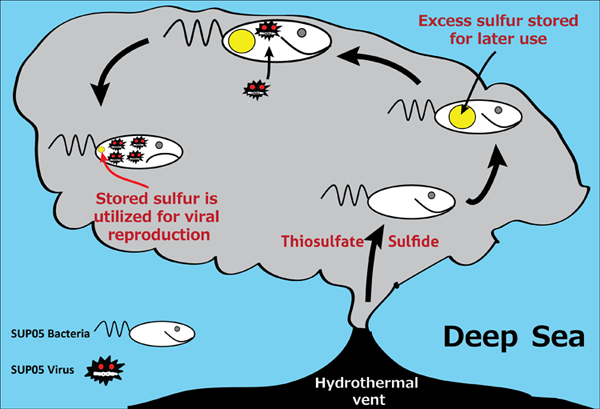
Sulfur Oxidation Genes in Diverse Deep-Sea Viruses
Authors:
Anantharaman et al
Abstract:
Viruses are the most abundant biological entities in the oceans and a pervasive cause of mortality of microorganisms that drive biogeochemical cycles. Although the ecological and evolutionary effects of viruses on marine phototrophs are well recognized, little is known about their impact on ubiquitous marine lithotrophs. Here, we report 18 genome sequences of double-stranded DNA viruses that putatively infect widespread sulfur-oxidizing bacteria. Fifteen of these viral genomes contain auxiliary metabolic genes for the α and γ subunits of reverse dissimilatory sulfite reductase (rdsr). This enzyme oxidizes elemental sulfur, which is abundant in the hydrothermal plumes studied here. Our findings implicate viruses as a key agent in the sulfur cycle and as a reservoir of genetic diversity for bacterial enzymes that underpin chemosynthesis in the deep oceans.
Thursday, May 08, 2014
Evidence of a Black Smoker Biota From PaleoArchean Australia?
Geochemistry and nano-structure of a putative ∼3,240 million-year-old black smoker biota, Sulfur Springs Group, Western Australia
Authors:
Wacey et al
Abstract:
Filaments of pyrite found within a volcanic hosted massive sulfide (VHMS) deposit from the ∼3,270-3,230 Ma Sulfur Springs Group of Western Australia have previously been interpreted as remnants of some of Earth's oldest thermophilic microbial communities. We here re-examine these pyrite filaments using a suite of in situ high spatial resolution techniques and provide new observations on their geochemistry, morphology, texture, distribution and habitat.
A number of the Sulfur Springs filaments retain geochemical evidence for remnants of organic material. This takes the form of patches of carbon and nitrogen enrichment seemingly enclosed within a completely pyritised filament. The distribution of this organic material closely resembles that observed in younger bona fide pyritised filamentous microbes. Most filaments also possess a distinctive sponge-like nano-porous pyrite texture, which is replicated in younger pyritised microfossils and bio-mediated pyrite framboids, and is consistent with pyrite nucleation in an organic matrix. New 3D analyses confirm previous observations of approximately uniform filament diameters, lack of branching, clustering of filaments, plus zones of filaments with preferred orientations. Multiple sulfur isotope analyses indicate that the sulfur for pyritisation likely came from a mixture of seawater and magmatic sources, consistent with a black smoker type habitat and permissive of the presence of life in this setting.
While these data are consistent with a biological interpretation for the Sulfur Springs filaments, perhaps as pyritised filamentous microorganisms or bundles of pyritised extra-cellular polymeric substances (EPS), the evidence is not compelling. Solid filament cross-sections and straight lengthwise morphology of most filaments resemble abiotic crystal needles or whiskers, while the parallel and radial alignments of filaments could be replicated by crystal growth patterns. Carbon and nitrogen enrichment could have occurred when organic material entrained within hydrothermal fluids was adsorbed onto these mineral crystals. Further work to obtain larger databases of nano-scale textures and morphologies from both biological and abiotic pyrite is needed before an abiotic formation mechanism can be confidently rejected.
Subscribe to:
Posts (Atom)