Showing posts with label virus. Show all posts

Thursday, February 06, 2020

Wuhan Virus Update

Officially, China says 28k are infected and 563 dead.  Personal projection for tomorrow is 33k and 660 dead.  By Monday, it will be 50k and 1k, imo.

A recent post on Tencent that went back down really fast claimed the infections and deaths are way, way higher than the official numbers.  The Wuhan coronavirus would have a 1:6 kill rate (over 16%) if accurate.

Another report says the infection rate is undercounted and makes it seem the deaths are at a higher percentage than they are.

Singapore has at least 28 infected and business people are getting infected when visiting.

The 12th US case has been detected in Wisconsin.

Two cruise ships are quarantined.  More than 10 tested positive on the cruise ship off Japan.


Monday, January 27, 2020

Wuhan Virus Update

By the time this gets published, China will probably have over 3,000 confirmed cases and over 80 deaths.  15 cities are in quarantine.  China has started suspending at least some of intercity travel services.  Hong Kong has started selectively blocking mainlanders from entering the territory.

China has started testing an HIV drug to see if it will work to combat the disease.

5 million people left Wuhan before the lockdown.

The US has 5 cases.  One of them is in Maricopa County, AZ.  Arizona is a noted location for the elderly to move to and the virus preferentially kills the elderly.  This could get exciting.

Several countries the world over now infections.  France and Africa (Gabon) appear to have their first cases.  It does not, yet, seem to be spreading within those countries.

The US and France are evacuating their citizens from Wuhan.  The Americans are being shipped to San Francisco.

The disease is infectious during the incubation period.  The incubation period is averaging 10 days, some as long as 14 days, some as short as 1.  The interesting case is the woman from Chicago: she was in Wuhan a month ago and came down with the symptoms only this last few days.  She may be an outlier or was in contact with someone with the virus more recently than her trip and has not been identified.  There are reports some people never seem to develop symptoms, but are carriers.

NY Times has fairly good updates.

Monday, January 20, 2020

New Chinese Respiratory Virus Outbreak Update

China will step up efforts to contain the coronavirus outbreak in Wuhan ahead of the Lunar New Year holidays as a rise in confirmed cases fanned fears the virus could spread to other countries.

...

Wuhan’s health authority confirmed earlier on Sunday 17 more cases of the virus in the city, bringing the total number of known patients there to 62.


Japan has confirmed its first case of infection from a newly-identified coronavirus that has killed one person and infected at least 40 more in China, as well as prompting a travel alert from the U.S. State Department.

link.

An outbreak of a new coronavirus in China has spread to more cities, Chinese authorities said on Monday, as the number of patients tripled and a third person died, stoking concerns about the containment of the virus.

link.

Nature states the new virus needs China to cooperate internationally.

Science notes folks are alarmed.

Friday, July 08, 2016

Is an Obscure Member of the Herpes Virus Family Causing Infertility?

A new study has found that the little-known member of the human herpesvirus family called HHV-6A infects the lining of the uterus in 43% of women with unexplained infertility but cannot be found in uterine lining of fertile women. The study was conducted by investigators at the University of Ferrara, Italy.

The study also found that the response of the immune system to the virus may contribute to making the uterus less hospitable to a fertilized egg. The virus seems to activate immune cells called natural killer cells in the uterus, and lead those cells to produce chemicals called cytokines. Cytokines are tools the immune system uses to orchestrate an attack on a foreign invader, like a virus. However, the activated immune system cells and abnormal levels of certain cytokines may make it harder for a fertilized egg to lodge in the uterus, and grow into a baby.

Tuesday, March 22, 2016

There are LOTS of Viruses Embedded in Your Genome

Discovery of unfixed endogenous retrovirus insertions in diverse human populations

Authors:

Wildshutte et al

Abstract:

Endogenous retroviruses (ERVs) have contributed to more than 8% of the human genome. The majority of these elements lack function due to accumulated mutations or internal recombination resulting in a solitary (solo) LTR, although members of one group of human ERVs (HERVs), HERV-K, were recently active with members that remain nearly intact, a subset of which is present as insertionally polymorphic loci that include approximately full-length (2-LTR) and solo-LTR alleles in addition to the unoccupied site. Several 2-LTR insertions have intact reading frames in some or all genes that are expressed as functional proteins. These properties reflect the activity of HERV-K and suggest the existence of additional unique loci within humans. We sought to determine the extent to which other polymorphic insertions are present in humans, using sequenced genomes from the 1000 Genomes Project and a subset of the Human Genome Diversity Project panel. We report analysis of a total of 36 nonreference polymorphic HERV-K proviruses, including 19 newly reported loci, with insertion frequencies ranging from less than 0.0005 to greater than 0.75 that varied by population. Targeted screening of individual loci identified three new unfixed 2-LTR proviruses within our set, including an intact provirus present at Xq21.33 in some individuals, with the potential for retained infectivity.

Saturday, November 07, 2015

Self Replicating Android App Source Code Released

Researchers from the Netherlands are working on a communications app so resilient that it can survive communications and power outages, natural disasters, and can self-replicate, mutate and spread virally between clusters of mobile phones, eventually across all mobile OSes.

In the paper Autonomous smartphone apps: self-compilation, mutation, and viral spreading [PDF], lead Paul Brusee and co-researcher Johan Pouwelse detail the development of a smart phone tool so resilient that it can compile itself, enabling a daisy-chained mesh network of smartphones which in effect act collectively as cell towers – which might themselves either have been destroyed by earthquakes or other disasters, or else have been turned off, monitored or interfered with by governments concerned about civilian aggregation.

The app replicates within the Android OS at the moment, though future work is anticipated to enable it to spread as easily between iOS and Windows phones, since it does not require root access in order to reproduce, and is not intended to be spread via stores such as Google Play or other centralised app repositories.


You can totally guess what I downloaded and started messing with.

Oh and brace yourselves.  With the source code release, there will probably be several bits of malware using this by the time you are this post.  This can't YET spread itself.  However...

Friday, October 30, 2015

Genetically Engineered Virus Developed for Fighting Cancer Approved by US Food and Drug Administration


An engineered herpesvirus that provokes an immune response against cancer has become the first treatment of its kind to be approved for use in the United States, paving the way for a long-awaited class of therapies. On 27 October, the US Food and Drug Administration (FDA) approved a genetically engineered virus called talimogene laherparepvec (T-VEC) to treat advanced melanoma. Four days earlier, advisers to the European Medicines Agency had endorsed the drug.

With dozens of ongoing clinical trials of similar ‘oncolytic’ viruses, researchers hope that the approval will generate the enthusiasm and cash needed to spur further development of the approach. “The era of the oncolytic virus is probably here,” says Stephen Russell, a cancer researcher and haematologist at the Mayo Clinic in Rochester, Minnesota. “I expect to see a great deal happening over the next few years.”

Many viruses preferentially infect cancer cells. Malignancy can suppress normal antiviral responses, and sometimes the mutations that drive tumour growth also make cells more susceptible to infection. Viral infection can thus ravage a tumour while leaving abutting healthy cells untouched, says Brad Thompson, president of the pharmaceutical-development firm Oncolytics Biotech in Calgary, Canada.

Thursday, October 08, 2015

Using a Virus to Permanently Sterilize Animals

Caltech biologists have developed a nonsurgical method to deliver long-term contraception to both male and female animals with a single shot. The technique--so far used only in mice--holds promise as an alternative to spaying and neutering feral animals.

The approach was developed in the lab of Bruce Hay, professor of biology and biological engineering at Caltech, and is described in the October 5 issue of Current Biology. The lead author on the paper is postdoctoral scholar Juan Li.

Hay's team was inspired by work conducted in recent years by David Baltimore and others showing that an adeno-associated virus (AAV)--a small, harmless virus that is unable to replicate on its own, that has been useful in gene-therapy trials--can be used to deliver sequences of DNA to muscle cells, causing them to produce specific antibodies that are known to fight infectious diseases, such as HIV, malaria, and hepatitis C.

Li and her colleagues thought the same approach could be used to produce infertility. They used an AAV to deliver a gene that directs muscle cells to produce an antibody that neutralizes gonadotropin-releasing hormone (GnRH) in mice. GnRH is what the researchers refer to as a "master regulator of reproduction" in vertebrates--it stimulates the release of two hormones from the pituitary that promote the formation of eggs, sperm, and sex steroids. Without it, an animal is rendered infertile.

In the past, other teams have tried neutralizing GnRH through vaccination. However, the loss of fertility that was seen in those cases was often temporary. In the new study, Hay and his colleagues saw that the mice--both male and female--were unable to conceive after about two months, and the majority remained infertile for the remainder of their lives.

"Inhibiting GnRH is an ideal way to inhibit fertility and behaviors caused by sex steroids, such as aggression and territoriality," says Hay. He notes that in the study, his team also shows that female mice can be rendered infertile using a different antibody that targets a binding site for sperm on the egg. "This target is ideal when you want to inhibit fertility but want to leave the individual otherwise completely normal in terms of reproductive behaviors and hormonal cycling."

Hay's team has dubbed the new approach "vectored contraception" and says that there are many other proteins that are thought to be important for reproduction that might also be targeted by this technique.


I am not at all afraid of whom might get this and the greater implications of this technology.  Nothing could possibly go wrong here!

Wednesday, September 23, 2015

The New Technique That Finds All Known Human Viruses in Your Blood

Ian Lipkin, a virus hunter from Columbia University, recently received a blood sample from colleagues at the National Institutes of Health. They came from a man who had received a bone-marrow transplant and had fallen mysteriously ill, with evidence of severely inflamed blood vessels. In analyzing a similar case a few years back, Lipkin had discovered a new polyomavirus, part of a family that can cause disease in people with compromised immune systems. Perhaps this new case would yield another new virus.

It didn't. Instead, when Lipkin's team ran the sample through a system that they had devised to detect human viruses, they found that the man was infected with dengue virus. In hindsight, that made sense—he had recently returned from Vietnam, where dengue is prevalent. But the thing is: The team wasn't looking for dengue virus.

“It wasn't what we anticipated, but we didn't have to make a priori decisions about what we planned to find,” Lipkin says. “When people analyze samples from people who are ill, they have some idea in mind. This is probably an enterovirus, or maybe it's a herpesvirues. They then do a specific assay for that particular agent. They don't usually have the capacity to look broadly.”

Evidence of a Giant Virus Battle in an Algae's Genome

Provirophages in the Bigelowiella genome bear testimony to past encounters with giant viruses

Authors:

Blanc et al

Abstract:

Virophages are recently discovered double-stranded DNA virus satellites that prey on giant viruses (nucleocytoplasmic large DNA viruses; NCLDVs), which are themselves parasites of unicellular eukaryotes. This coupled parasitism can result in the indirect control of eukaryotic cell mortality by virophages. However, the details of such tripartite relationships remain largely unexplored. We have discovered ∼300 predicted genes of putative virophage origin in the nuclear genome of the unicellular alga Bigelowiella natans. Physical clustering of these genes indicates that virophage genomes are integrated into the B. natans genome. Virophage inserts show high levels of similarity and synteny between each other, indicating that they are closely related. Virophage genes are transcribed not only in the sequenced B. natans strain but also in other Bigelowiella isolates, suggesting that transcriptionally active virophage inserts are widespread in Bigelowiella populations. Evidence that B. natans is also a host to NCLDV members is provided by the identification of NCLDV inserts in its genome. These putative large DNA viruses may be infected by B. natans virophages. We also identify four repeated elements sharing structural and genetic similarities with transpovirons—a class of mobile elements first discovered in giant viruses—that were probably independently inserted in the B. natans genome. We argue that endogenized provirophages may be beneficial to both the virophage and B. natans by (i) increasing the chances for the virophage to coinfect the host cell with an NCLDV prey and (ii) defending the host cell against fatal NCLDV infections.

Wednesday, September 09, 2015

Climate Change may Unleash Viruses Frozen in Arctic Tundra

Scientists said they will reanimate a 30,000-year-old giant virus unearthed in the frozen wastelands of Siberia, and warned climate change may awaken dangerous microscopic pathogens.

Reporting this week in the flagship journal of the US National Academy of Sciences, French researchers announced the discovery of Mollivirus sibericum, the fourth type of pre-historic virus found since 2003 -- and the second by this team.

Before waking it up, researchers will have to verify that the bug cannot cause animal or human disease.

To qualify as a "giant", a virus has to be longer than half a micron, a thousandth of a millimetre (0.00002 of an inch).

Mollivirus sibericum -- "soft virus from Siberia" -- comes in at 0.6 microns, and was found in the permafrost of northeastern Russia.

Climate change is warming the Arctic and sub-Arctic regions at more than twice the global average, which means that permafrost is not so permanent any more.

Thursday, August 06, 2015

Ancestral (but tailored) Adeno-associated Virus Created, may be Useful as Gene Therapy Vector

In Silico Reconstruction of the Viral Evolutionary Lineage Yields a Potent Gene Therapy Vector

Authors:

Zinn et al

Abstract:

Adeno-associated virus (AAV) vectors have emerged as a gene-delivery platform with demonstrated safety and efficacy in a handful of clinical trials for monogenic disorders. However, limitations of the current generation vectors often prevent broader application of AAV gene therapy. Efforts to engineer AAV vectors have been hampered by a limited understanding of the structure-function relationship of the complex multimeric icosahedral architecture of the particle. To develop additional reagents pertinent to further our insight into AAVs, we inferred evolutionary intermediates of the viral capsid using ancestral sequence reconstruction. In-silico-derived sequences were synthesized de novo and characterized for biological properties relevant to clinical applications. This effort led to the generation of nine functional putative ancestral AAVs and the identification of Anc80, the predicted ancestor of the widely studied AAV serotypes 1, 2, 8, and 9, as a highly potent in vivo gene therapy vector for targeting liver, muscle, and retina.

Tuesday, August 04, 2015

Explaining Endogenous Retroviruses

What are endogenous retroviruses —backwards viruses from within?

Endogenous retroviruses originate from retroviruses, which are a distinctive family of viruses that infect vertebrates. During infection, retroviruses enter host cells, and convert their RNA genomes to DNA by reverse transcription. This is in direct opposition to the central dogma of molecular biology, which states that the flow of genetic information passes from DNA to RNA, hence the name retrovirus. After reverse transcription, the DNA copy of the viral genome is integrated into the host genome, enabling expression of viral genes via the host cellular machinery to produce more viruses. Occasionally, integration occurs in a germline cell (those that produce sperm or eggs), allowing the retroviral insertion to be inherited by host progeny as an endogenous retrovirus or ‘ERV’ for short. The term endogenous is applied since ERVs are inherited in a similar manner to genes, residing within the host genome in every nucleated cell of the organism.

Saturday, May 30, 2015

Engineered Cold Sore Virus Used to Kill Cancer

It's a new weapon in the arsenal of cancer fighting treatments: utilizing genetically modified viruses to invade cancer cells and destroy them from the inside.

University of Louisville researcher Jason Chesney, M.D., Ph.D., deputy director of the James Graham Brown Cancer Center (JGBCC), and a team of international scientists found that stage IIIb to IV melanoma patients treated with a modified cold sore (herpes) virus had improved survival. The results of the findings were published recently in the Journal of Clinical Oncology.

UofL was one of the major sites for the phase III clinical trial involving 436 patients who received the viral immunotherapy, talimogene laherparepvec (T-VEC). Scientists genetically engineered the herpes simplex I virus to be non-pathogenic, cancer-killing and immune-stimulating. The modified herpes virus does not harm healthy cells, but replicates when injected into lesions or tumors, and then stimulates the body's immune system to fight the cancer.

"The results from this study are amazing," Chesney said. "Patients given T-VEC at an early stage survived about 20 months longer than patients given a different type of treatment. For some, the therapy has lengthened their survival by years. "

Monday, February 02, 2015

Humans Have Less Retrovirus Remnants in Genome, may be Linked to Developing Tool Use

Humans have fewer remnants of viral DNA in their genes compared to other mammals, a new study has found. This decrease could be because of reduced exposure to blood-borne viruses as humans evolved to use tools rather than biting during violent conflict and the hunting of animals.

Despite natural defence systems, a retrovirus occasionally infects a mammal's egg or sperm, and the virus's genetic code gets incorporated into the animal's own genome. This viral 'fossil' then passes down from generation to generation: we all carry remnants of DNA from viruses that infected our ancestors millions of years ago. These 'endogenous retroviruses' (ERVs) appear not to cause us any harm, even though they are known to result in diseases such as cancer in other animals.

A team of researchers from the University of Oxford and Plymouth University, UK, and the Aaron Diamond AIDS Research Center, USA, wondered if there was a combination of factors unique to humans that explained why these viral fossils in our genomes remain benign. They counted the number of times that retroviruses appear to have been integrated into an animal's genome in humans, comparing humans with 39 other mammalian species, including chimpanzees, dolphins and giant pandas.

Reporting their results in the journal Retrovirology, the researchers compared the genetic signature of the two edges of the virus. These edges are identical when the virus first invades the genome, but as they acquire random mutations over time, they slowly begin to diverge. By tracking this divergence, the research team could measure how long the retrovirus had spent in an animal's genome.

Using this measure, they found that, compared to other animals, far fewer retroviruses were incorporated into the genome for humans and other apes over the last 10 million years. Even compared to animals very similar to us, humans are unusual in not having acquired any new types of retroviruses into their DNA over the last 30 million years.

Monday, January 19, 2015

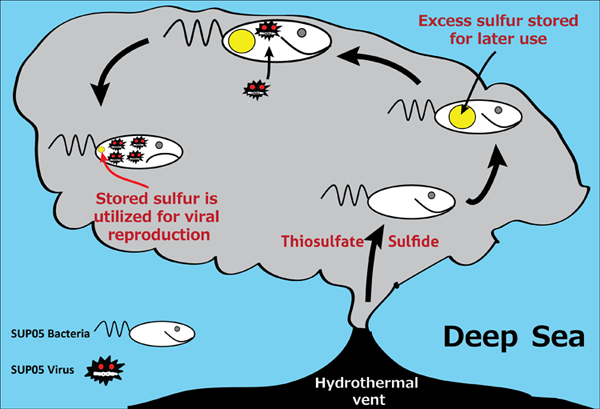
The Awesome Evilness of Deep Sea Bacterial Viruses


Sulfur Oxidation Genes in Diverse Deep-Sea Viruses

Authors:

Anantharaman et al

Abstract:

Viruses are the most abundant biological entities in the oceans and a pervasive cause of mortality of microorganisms that drive biogeochemical cycles. Although the ecological and evolutionary effects of viruses on marine phototrophs are well recognized, little is known about their impact on ubiquitous marine lithotrophs. Here, we report 18 genome sequences of double-stranded DNA viruses that putatively infect widespread sulfur-oxidizing bacteria. Fifteen of these viral genomes contain auxiliary metabolic genes for the α and γ subunits of reverse dissimilatory sulfite reductase (rdsr). This enzyme oxidizes elemental sulfur, which is abundant in the hydrothermal plumes studied here. Our findings implicate viruses as a key agent in the sulfur cycle and as a reservoir of genetic diversity for bacterial enzymes that underpin chemosynthesis in the deep oceans.

Friday, October 24, 2014

Ebola's Miocene Neogene Roots

A new study is helping to rewrite Ebola's family history.

The research shows that filoviruses — a family to which Ebola and its similarly lethal relative, Marburg, belong — are at least 16-23 million years old.

Filoviruses likely existed in the Miocene Epoch, and at that time, the evolutionary lines leading to Ebola and Marburg had already diverged, the study concludes.

The research was published in the journal PeerJ in September. It adds to scientists' developing knowledge about known filoviruses, which experts once believed came into being some 10,000 years ago, coinciding with the rise of agriculture. The new study pushes back the family's age to the time when great apes arose.

"Filoviruses are far more ancient than previously thought," says lead researcher Derek Taylor, PhD, a University at Buffalo professor of biological sciences. "These things have been interacting with mammals for a long time, several million years."

According to the PeerJ article, knowing more about Ebola and Marburg's comparative evolution could "affect design of vaccines and programs that identify emerging pathogens."

The research does not address the age of the modern-day Ebolavirus. Instead, it shows that Ebola and Marburg are each members of ancient evolutionary lines, and that these two viruses last shared a common ancestor sometime prior to 16-23 million years ago.

Wednesday, October 08, 2014

Could Ebola Reaching Central America or Caribbean Trigger a Mass Emigration?

The head of U.S. Southern Command (SOUTHCOM) warned an Ebola outbreak in Central America or the Caribbean could trigger a mass migration to the U.S. of people fleeing the disease and implied established Central American illegal trafficking networks could introduce the infected into the U.S., during remarks at a Tuesday panel on security issue in the Western Hemisphere at the National Defense University.

“If it comes to the Western Hemisphere, the countries that we’re talking about have almost no ability to deal with it — particularly in Haiti and Central America,” SOUTHCOM Commander, Marine Gen. John F. Kelly, said in response to a question of his near term concerns in the region.
“It will make the 68,000 unaccompanied minors look like a small problem.”

An Ebola outbreak could encourage the poor and increasingly desperate populations in Central American countries — like Honduras, Guatemala and El Salvador — to leave in droves.

Friday, July 11, 2014

Pithivirus is a Monster (in size)


Chantal Abergel and Jean-Michel Claverie were used to finding strange viruses. The married virologists at Aix-Marseille University had made a career of it. But pithovirus, which they discovered in 2013 in a sample of Siberian dirt that had been frozen for more than 30,000 years, was more bizarre than the pair had ever imagined a virus could be.

In the world of microbes, viruses are small — notoriously small. Pithovirus is not. The largest virus ever discovered, pithovirus is more massive than even some bacteria. Most viruses copy themselves by hijacking their host’s molecular machinery. But pithovirus is much more independent, possessing some replication machinery of its own. Pithovirus’s relatively large number of genes also differentiated it from other viruses, which are often genetically simple — the smallest have a mere four genes. Pithovirus has around 500 genes, and some are used for complex tasks such as making proteins and repairing and replicating DNA. “It was so different from what we were taught about viruses,” Abergel said.

The stunning find, first revealed in March, isn’t just expanding scientists’ notions of what a virus can be. It is reframing the debate over the origins of life.

Tuesday, June 24, 2014

Mammals do not use RNAi to Fight Viruses?

Biologists have long wondered if mammals share the elegant system used by insects, bacteria and other invertebrates to defend against viral infection. Two back-to-back studies in the journal Science last year said the answer is yes, but a study just published in Cell Reports by researchers at the Icahn School of Medicine at Mount Sinai found the opposite.

In the Mount Sinai study, the results found that the defense system used by invertebrates — RNA interferences or RNAi — is not used by mammals as some had argued. RNAi are small molecules that attach to molecular scissors used by invertebrates to cut up invading viruses.

Mammals use a form of RNAi to fine-tune the expression of hundreds of genes that coordinate development in the womb, says the study's senior author, Benjamin tenOever, PhD, Fishberg Professor in the Department of Medicine and Department of Microbiology at the Icahn School of Medicine at Mount Sinai. But it has never been clear that adult mammals use RNAi the same way that plants and insects do, he says. "Mammals have cell machinery that looks capable of producing RNAi to fight virus, but we believe it only helps to produce different small RNA products called microRNAs, which are not antiviral," Dr. tenOever says.

The correct answer matters because RNAi is being studied as a potential basis for new kinds of drugs for the treatment of hemophilia, beta-thalassemia and many viral infections, says Dr. tenOever.

"We believe our results settle a longstanding debate about whether mammals, including humans and mice, fight viruses using RNAi, and the answer is good news," he says. "Drug designers interested in using RNAi to treat disease have worried that if RNAi is part of the mammalian response to viral infections, RNAi-based agents could compromise a human's immune response, producing unintended consequences. That is not a concern now, based on our findings."

Mammals are known to fend off viruses with a system based on interferons, signaling proteins made by immune cells that amplify the body's attack on invaders. The finding that mammals do not use RNAi to fight viruses suggests that RNAi-based drugs could augment the existing interferon response in mammals, Dr. tenOever says. "We could harness this potent RNAi viral-killing machine when natural human immunity isn't enough."