Authors:Czaja et alAbstract:The first 2 b.y. of Earth's history was an important time for life when microbes evolved and diversified into essentially all of the metabolic forms that now exist. Because of feedbacks between biology and the surface environment, understanding Earth's biological history can help us understand the evolution of Earth itself. The morphological and geochemical evidence for this ancient biological history is sparse but is increasing. Here we report evidence for 2.52 Ga exceptionally large, organic, smooth-walled, coccoidal microfossils preserved in a deep-water black chert in the Gamohaan Formation of the Kaapvaal craton of South Africa. These fossils occur mainly as compressed solitary coccoids that range in size from 20 to 265 μm but occasionally occur in short chains of cells. Morphologically these fossils are similar to Proterozoic and Phanerozoic acritarchs and to certain Archean fossils interpreted as possible cyanobacteria. However, their exceptionally large size, simple cell wall microstructure, and paleoecological setting, as well as multiple sulfur isotope systematics of pyrite within the unit, suggest that the Gamohaan Formation fossils were sulfur-oxidizing bacteria similar to those of the modern genus Thiomargarita, organisms that live in anoxic and sulfidic deepwater settings. These are the oldest reported fossil sulfur bacteria and reveal a diversity of life and ecosystems, previously only interpreted from geochemical proxies, just prior to the Great Oxidation Event, a time of major atmospheric evolution.
Showing posts with label sulfur cycle. Show all posts
Showing posts with label sulfur cycle. Show all posts
Friday, October 28, 2016
Evidence of Sulfur Oxidizing Bacteria Prior to the Great Oxidation Event


Friday, October 14, 2016
Ediacaran Oceans had a Higher Sulfate Concentration
Authors:Zhou et alAbstract:Authigenic carbonate associated with anaerobic oxidation of methane (AOM), usually via microbial sulfate reduction (MSR) or ferric iron reduction, is generally characterized by extremely low δ13C values (<− 30‰, VPDB). This has been used as one of the major diagnostic features for the recognition of hydrocarbon seep carbonate in the geological past. Previous reports on Precambrian authigenic carbonates are rare, limiting our understanding of the effects of their deposition on the Earth's carbon isotopic mass balance. In this study, mainly based on petrographic features and pronounced negative δ13C values as low as − 38.1‰, we discovered authigenic calcite cement immediately above the cap dolostone in the basal Ediacaran Doushantuo Formation in the Jiulongwan section, Yangtze Gorges area, South China. Our observations not only provide direct evidence for the involvement of AOM during carbonate precipitation in the early Ediacaran (~ 635 Ma), but also suggest that the seawater sulfate concentrations in the early Ediacaran may have been higher than previously thought.
Friday, April 08, 2016
Oceanic Redox Conditions Across the Ediacaran/Cambrian Boundary
Redox variations and organic matter accumulation on the Yangtze carbonate platform during Late Ediacaran–Early Cambrian: Constraints from petrology and geochemistry
Authors:
Gao et al
Abstract:
In order to understand redox variations and organic matter accumulation on the Yangtze carbonate platform during the Late Ediacaran–Early Cambrian, petrological and geochemical studies of several wells were carried out in this work. Our data suggest that depositional environments were dominated by oxidizing bottom water conditions during the late Ediacaran, and evolved to anoxic conditions, triggered by blooms of microbial organisms in surface waters during the earliest Cambrian. Subsequently, massive release of H2S derived from both anaerobic recycling of organic matter and, probably, hydrothermal venting promoted a sulfidic ocean. The discovery of a Ni-Mo sulfide ore layer in the basal Cambrian implies that such a sulfidic condition spread onto the Yangtze carbonate platform interior during the late Cambrian Stage 2. Further, transgressive flooding led to widespread black shale deposition and persistently anoxic conditions, as indicated by geochemical proxies. During the late Ediacaran to earliest Cambrian, local and widespread phosphogenesis indicates that organic matter accumulation was intimately associated with microbial (especially cyanobacterial) blooms driven by phosphorus cycling. The organic matter accumulations in early Cambrian black shales, however, were in connection with anoxic bottom water conditions and intermittent replenishment of recycled organic phosphorus to surface waters.
Tuesday, December 29, 2015
Comparing Cretaceous Ocean Anoxic Events' Sulfur Cycling
Biogeochemical sulfur cycling during Cretaceous Ocean Anoxic Events: A comparison of OAE1a and OAE2
Authors:
Gomes et al
Abstract:
Biogeochemical sulfur cycling has varied widely over geologic time, mainly in response to changes in primary productivity and organic carbon burial, volcanism, weathering, and evaporite deposition. Several of these processes are explicitly linked to discreet (less than 1.2 Ma) intervals of widespread organic carbon burial, termed Ocean Anoxic Events (OAEs). During the Cretaceous, there is a highly distinctive ~4‰ negative excursion in the sulfur isotope composition of seawater sulfate (δ34SSO4) that is bracketed by the two most prominent OAEs (OAE1a and OAE2). This excursion lasted for ~25 Ma and has been variously attributed to enhanced volcanism, changes in weathering, evaporite burial, and/or changes in modes of organic carbon remineralization. We present new high-resolution carbon and sulfur isotope records from carbonate associated sulfate and pyrite for OAE1a and OAE2. OAE1a is characterized by a monotonic decrease in δ34SSO4 values. Both negative and positive δ34SSO4 excursions are associated with OAE2. To refine hypotheses for the observed changes in biogeochemical sulfur cycling associated with these events, we use a simple sulfur isotope box model. Both empirical and modeling results indicate that δ34SSO4 variability was dominated by input fluxes during OAE1a, whereas enhanced volcanism, weathering, and pyrite burial controlled δ34SSO4 records during OAE2. Our analysis supports the conclusion that Cretaceous marine sulfate concentrations were much lower than modern concentrations, and indicates that increases in marine sulfate occurred at the onset of both events. We conclude that increases in marine sulfate from low background concentrations, in conjunction with other environmental characteristics, contributed to the development of OAEs.
Friday, August 07, 2015
Evidence of the PaleoArchean Sulfur Cycle
Paleoarchean sulfur cycling: Multiple sulfur isotope constraints from the Barberton Greenstone Belt, South Africa
Authors:
Montinaro et al
Abstract:
Mass-dependent and mass-independent sulfur isotope fractionation archived in volcanic and sedimentary rocks from the Barberton Greenstone Belt (3550–3215 Ma), South Africa, provide constraints for sulfur cycling on the early Earth. Four different sample suites were studied: komatiites and tholeiites, barite, massive and disseminated sulfide ores, and non-mineralized black shales.
Variable but generally slightly positive δ34S values between −0.7 and +5.2‰, negative Δ33S values between −0.50 and −0.09‰, and a negative correlation between δ34S and Δ33S as well as between Δ33S and Δ36S for komatiites and tholeiites from the Komati Formation and from the Weltevreden Formation are outside the expected range of unfractionated juvenile sulfur. Instead, results suggest alteration of oceanic crustal rock sulfur through interactions with fluids that most likely derived their sulfur from seawater.
Barite from the Mapepe Formation displays positive δ34S values between +3.1 and +8.1‰ and negative Δ33S values between −0.77 and −0.34‰. The mass-independent sulfur isotope fractionation indicates an atmospheric sulfur source, notably photolytic sulfate, whereas the positive δ34S values suggest bacterial sulfate reduction of the marine sulfate reservoir.
Non-mineralized black shale samples from the presumed stratigraphic equivalent of the Mapepe Formation show positive δ34S values between 0.0 and +1.3‰ and positive Δ33S values between +0.59 and +2.45‰. These results are interpreted to result from the reduction of photolytic elemental sulfur, carrying a positive Δ33S signature.
Positive δ34S values ranging from +0.7 to +3.5‰ and slightly negative Δ33S values between −0.17 and −0.12‰ characterize massive and disseminated sulfides from the Bien Venue Prospect. Results suggest unfractionated juvenile magmatic sulfur source as the primary sulfur source, but a contribution from recycled seawater sulfate, which would be indicative of submarine hydrothermal activity, cannot be ruled out.
Massive and disseminated sulfides from the M’hlati prospect are distinctly different from massive and disseminated sulfide from the Bien Venue Prospect. They show negative δ34S values between −1.2 and −0.1‰ and positive Δ33S values between +2.66 and +3.17‰, thus, displaying a sizeable mass-independent sulfur isotopic fractionation. Again, these samples clearly exhibit the incorporation of an atmospheric MIF-S signal. The source of sulfur for these samples has positive Δ33S values, suggesting a connection with photolytic elemental sulfur.
In conclusion, the sulfur isotope signatures in Paleoarchean rocks from the Barberton Greenstone Belt are diverse and indicate the incorporation of different sources of sulfur. For komatiites and tholeiites, barite and massive and possibly also disseminated sulfides from Bien Venue, multiple sulfur isotopes are related to ambient seawater sulfate and its photolytic origin, while massive and disseminated sulfides from M’hlati and non-mineralized black shales are related to a second (photolytic elemental sulfur) end member.
Wednesday, June 17, 2015
Evidence of a Gradual Oxygenation of the Calymmian MesoProterozoic PaleoAtmosphere From Sulfur Isotopes

Sulfur isotope composition of carbonate-associated sulfate from the Mesoproterozoic Jixian Group, North China: Implications for the marine sulfur cycle
Authors:
Guo et al
Abstract:
The Mesoproterozoic has been traditionally viewed as a period of prolonged stability in terms of environmental and biological evolution, yet growing body of evidence suggests subtle, yet dynamic changes in marine biogeochemical cycles. In this study, we present a high-resolution analysis of carbonate-associated sulfate (CAS) from the Mesoproterozoic Jixian Group (1.6–1.4 Ga), North China. Combined with previously reported carbon isotopes from the same sections, sulfur isotope data provide insight into both oceanic chemistry and biospheric evolution during this period.
The sulfur isotopic composition of CAS in the Jixian Group displays high-amplitude variations with a total range from +3.7‰ to +51.9‰. Stratigraphic variation in δ34SCAS is most noted in the Wumishan Formation and records shifts of greater than 10‰ over stratigraphic thickness of 100–200 m, indicating a short residence time resulting from a limited oceanic sulfate reservoir. Differences in the pattern of isotopic variability between the Gaoyuzhuang and Wumishan formations suggest complex behavior of the marine sulfur cycle based on proximity of depositional environments to a local or regional chemocline, and the degree of mixing between adjacent environments. Deposition under predominantly oxic conditions favored a stable sulfate reservoir whose isotopic composition was controlled primarily by pyrite burial. By contrast, depositional environments proximal to euxinic waters were subject to rapid changes in both sulfate reservoir size and isotopic composition, resulting from growth and subsequent oxidation of a reactive hydrogen sulfide reservoir. Together, these units demonstrate the difficulty of interpreting marine sulfur cycling in a low oxygen, low sulfate world subject to a range of environmental controls.
Data also reveal a long-term positive trend in average δ34SCAS and δ13Ccarb from approximately +10‰ to ∼+20‰, and ∼−0.5‰ to +0.5‰, respectively, which is interpreted as reflecting prolonged organic carbon and pyrite burial. Burial of reduced carbon and sulfur may have resulted in a slow, but steady release of oxygen to the biosphere, ultimately driving a gradual increase in oceanic sulfate levels. Our study, combined with previous contributions from the late Mesoproterozoic, supports hypotheses of protracted biospheric oxygenation marked by a modest increase in oceanic sulfate concentrations through the Mesoproterozoic.
Monday, June 01, 2015
Academic Bun Fight Over Sulfur Cycling bacteria: Serial Convergence or 1.8 Billion Year Evolutionary Stasis?
Putative extremely long evolutionary stasis in bacteria might be explained by serial convergence
Authors:
Dvorak et al
Abstract:
In a recent paper, Schopf et al. (1) analyzed 1.8-Ga-old fossil sulfur bacteria and found an intriguing morphological similarity between fossil and modern species. Moreover, the authors showed that the deep-water sulfur cycling environment, where these bacteria reside, has not significantly changed throughout time. Thus, the authors hypothesize that this phenomenon is a result of an extreme evolutionary stasis in these bacteria. Such a static evolution is termed hypobradytelic and it has also been described in some cyanobacteria (2), where an evolutionary stasis is expected to be more than 2 Ga. However, these conclusions rely only on geological and morphological evidence.
Counterattack!
Reply to Dvořák et al.: Apparent evolutionary stasis of ancient subseafloor sulfur cycling biocoenoses
Authors:
Schopf et al
Abstract:
We thank Dvořák et al. for their comment (1) on our paper (2), in which we compare sulfur-cycling ∼1.8- and ∼2.3-Ga fossil communities with their modern counterparts and report that the community fabric of the fossil and modern microbes, as well as their organismal and cellular morphology, their interlinked energy-production via anaerobic sulfate-reduction and sulfur species oxidation, and their use of sulfate and nitrate to fuel this sulfur cycle appear to have remained unchanged over a segment of geological time equivalent to half the age of the Earth.
Tuesday, January 20, 2015
Evidence of the Sulfur Cycle During PaleoArchean
Micro-scale quadruple sulfur isotope analysis of pyrite from the ∼3,480 Ma Dresser Formation: New insights into sulfur cycling on the early Earth
Authors:
Wacey et al
Abstract:
We report in situ quadruple sulfur isotope analysis (32S, 33S, 34S and 36S) of a pyritized microbial mat from the ∼3,480 Ma Dresser Formation, Pilbara Craton, Western Australia. These data yield positive δ34S and Δ33S, indicative of sulfur sourced from a pool with similar character as the putative atmospheric elemental sulfur channel of Pavlov and Kasting (2002). Contrary to previous data from the Dresser Formation, however, this pyrite is heavily depleted in 36S with a Δ36S/Δ33S slope of c. -3.6, much steeper than slopes typically seen in other early Archean rock successions (Δ36S/Δ33S ≈ -1) which suggests either a different atmospheric signature for deposited S or a different pool altogether. Significant micro-scale isotopic heterogeneity is observed within the microbial mat (δ34S = +1.6‰ to +6.7‰; Δ33S = +0.4‰ to +2.6‰; Δ36S = -3.1‰ to -8.1‰), implying a role for microbial S metabolism. While metabolic S cycling has been shown to shift Δ36S to lower values, microbial metabolization of S does not appear sufficient to account for the full range of Δ36S.
We conclude that the isotopic composition of the pyrite was controlled by the relative proportions of mass independently fractionated (MIF) S0 and sulfate-derived sulfur incorporated into polysulfide pyrite precursors during reactions in the microbial mat. The dominance of the MIF-S0 isotopic signature (+δ34S, +Δ33S, -Δ36S) indicates that contributions from the sulfate-derived sulfur pool were relatively small, consistent with low concentrations of sulfate in Archean seawater, and that contributions from a non-sulfate pool were significant. Micro-scale isotopic heterogeneity in the pyrite points to mixing between the two sulfur pools in selected micro-environments within the microbial mat. The particularly negative Δ36S observed here reveals a 3,480 Ma sulfur reservoir with novel Δ36S/Δ33S chemistry whose significance now requires further investigation.
Monday, January 19, 2015
The Awesome Evilness of Deep Sea Bacterial Viruses
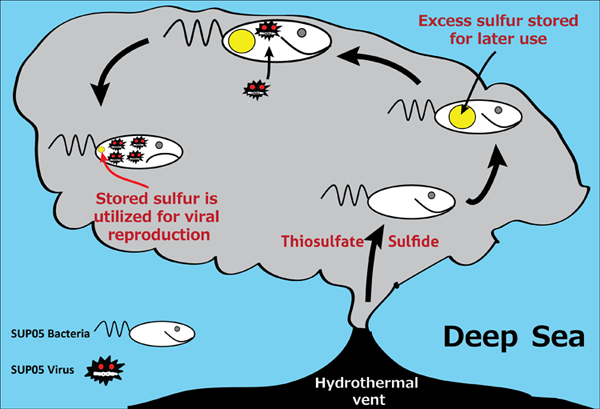
Sulfur Oxidation Genes in Diverse Deep-Sea Viruses
Authors:
Anantharaman et al
Abstract:
Viruses are the most abundant biological entities in the oceans and a pervasive cause of mortality of microorganisms that drive biogeochemical cycles. Although the ecological and evolutionary effects of viruses on marine phototrophs are well recognized, little is known about their impact on ubiquitous marine lithotrophs. Here, we report 18 genome sequences of double-stranded DNA viruses that putatively infect widespread sulfur-oxidizing bacteria. Fifteen of these viral genomes contain auxiliary metabolic genes for the α and γ subunits of reverse dissimilatory sulfite reductase (rdsr). This enzyme oxidizes elemental sulfur, which is abundant in the hydrothermal plumes studied here. Our findings implicate viruses as a key agent in the sulfur cycle and as a reservoir of genetic diversity for bacterial enzymes that underpin chemosynthesis in the deep oceans.
Tuesday, November 25, 2014
Evidence of a Sulfur Anomalies From NeoArchean
Neoarchean carbonate–associated sulfate records positive Δ33S anomalies
Authors:
Paris et al
Abstract:
Mass-independent fractionation of sulfur isotopes (reported as Δ33S) recorded in Archean sedimentary rocks helps to constrain the composition of Earth’s early atmosphere and the timing of the rise of oxygen ~2.4 billion years ago. Although current hypotheses predict uniformly negative Δ33S for Archean seawater sulfate, this remains untested through the vast majority of Archean time. We applied x-ray absorption spectroscopy to investigate the low sulfate content of particularly well-preserved Neoarchean carbonates and mass spectrometry to measure their Δ33S signatures. We report unexpected, large, widespread positive Δ33S values from stratigraphic sections capturing over 70 million years and diverse depositional environments. Combined with the pyrite record, these results show that sulfate does not carry the expected negative Δ33S from sulfur mass-independent fractionation in the Neoarchean atmosphere.
Friday, April 11, 2014
Sulfur Cycle Anonomalies Uncovered in Late Archean
SQUID–SIMS is a useful approach to uncover primary signals in the Archean sulfur cycle
Authors:
Fischer et al
Abstract:
Many aspects of Earth’s early sulfur cycle, from the origin of mass-anomalous fractionations to the degree of biological participation, remain poorly understood—in part due to complications from postdepositional diagenetic and metamorphic processes. Using a combination of scanning high-resolution magnetic superconducting quantum interference device (SQUID) microscopy and secondary ion mass spectrometry (SIMS) of sulfur isotopes (32S, 33S, and 34S), we examined drill core samples from slope and basinal environments adjacent to a major Late Archean (∼2.6–2.5 Ga) marine carbonate platform from South Africa. Coupled with petrography, these techniques can untangle the complex history of mineralization in samples containing diverse sulfur-bearing phases. We focused on pyrite nodules, precipitated in shallow sediments. These textures record systematic spatial differences in both mass-dependent and mass-anomalous sulfur-isotopic composition over length scales of even a few hundred microns. Petrography and magnetic imaging demonstrate that mass-anomalous fractionations were acquired before burial and compaction, but also show evidence of postdepositional alteration 500 million y after deposition. Using magnetic imaging to screen for primary phases, we observed large spatial gradients in Δ33S (greater than 4‰) in nodules, pointing to substantial environmental heterogeneity and dynamic mixing of sulfur pools on geologically rapid timescales. In other nodules, large systematic radial δ34S gradients (greater than 20‰) were observed, from low values near their centers increasing to high values near their rims. These fractionations support hypotheses that microbial sulfate reduction was an important metabolism in organic-rich Archean environments—even in an Archean ocean basin dominated by iron chemistry.
Subscribe to:
Posts (Atom)