Showing posts with label cahokia. Show all posts

Friday, December 23, 2016

Divining Cahokia's Rise and Fall


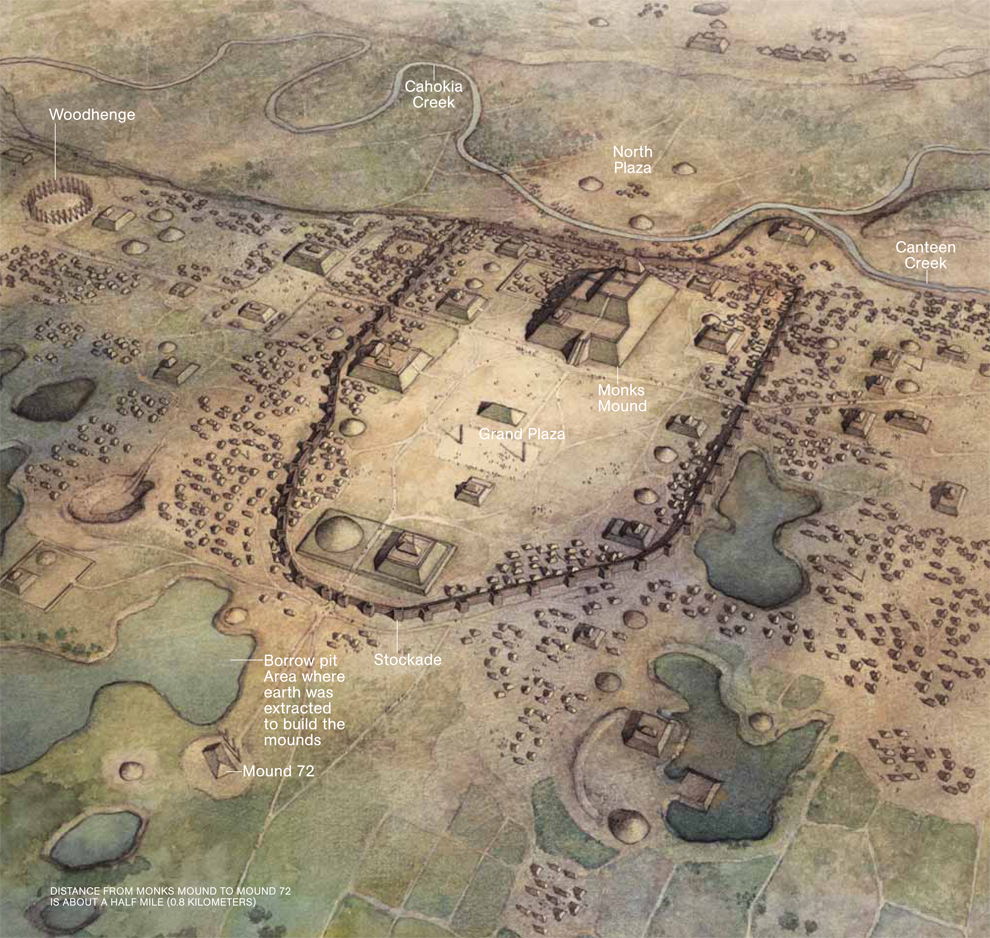
A thousand years ago, huge pyramids and earthen mounds stood where East St. Louis sprawls today in Southern Illinois. This majestic urban architecture towered over the swampy Mississippi River floodplains, blotting out the region's tiny villages. Beginning in the late 900s, word about the city spread throughout the southeast. Thousands of people visited for feasts and rituals, lured by the promise of a new kind of civilization. Many decided to stay.

At the city's apex in 1100, the population exploded to as many as 30 thousand people. It was the largest pre-Columbian city in North America, bigger than London or Paris at the time. Its colorful wooden homes and monuments rose along the eastern side of the Mississippi, eventually spreading across the river to St. Louis. One particularly magnificent structure, known today as Monk’s Mound, marked the center of downtown. It towered 30 meters over an enormous central plaza and had three dramatic ascending levels, each covered in ceremonial buildings. Standing on the highest level, a person speaking loudly could be heard all the way across the Grand Plaza below. Flanking Monk’s Mound to the west was a circle of tall wooden poles, dubbed Woodhenge, that marked the solstices.

Despite its greatness, the city’s name has been lost to time. Its culture is known simply as Mississippian. When Europeans explored Illinois in the 17th century, the city had been abandoned for hundreds of years. At that time, the region was inhabited by the Cahokia, a tribe from the Illinois Confederation. Europeans decided to name the ancient city after them, despite the fact that the Cahokia themselves claimed no connection to it.

Centuries later, Cahokia's meteoric rise and fall remain a mystery. It was booming in 1050, and by 1400 its population had disappeared, leaving behind a landscape completely geoengineered by human hands. Looking for clues about its history, archaeologists dig through the thick, wet, stubborn clay that Cahokians once used to construct their mounds. Buried beneath just a few feet of earth are millennia-old building foundations, trash pits, the cryptic remains of public rituals, and in some places, even, graves.

Wednesday, February 24, 2016

Did Cahokia Collapse due to Internal Strife?


Dr. Thomas E. Emerson and Dr. Kristin M. Hedman from the Illinois State Archaeological Survey-Prairie Research Institute at the University of Illinois present a new case for Cahokia's demise. The new theory was published in Southern Illinois University Press' volume, Beyond Collapse: Archaeological Perspectives on Resilience, Revitalization, and Transformation in Complex Societies. Emerson and Hedman contributed a chapter to the volume entitled, The Dangers of Diversity: The Consolidation and Dissolution of Cahokia, Native North America's First Urban Polity, that explores internal divisions that led to the collapse of Cahokia.

The archaeologists claim internal conflict by social, political, ethnic, and religious factions are a more reasonable description of events that led to Cahokia's collapse than environmental causes, as is the popular theory. They present new bioarchaeological evidence that demonstrates that as many as one-third of the Cahokian residents were immigrants and that these immigrants likely represented groups that were culturally, ethnically, and perhaps linguistically distinct from local populations. Emerson clarifies further,

Thursday, June 18, 2015

Academic Bun FIGHT! Questioning Cahokia's Fall Through a Great Flood

Great Flood?  Not the Cause!
Correlation does not equal causation: Questioning the Great Cahokia Flood

Authors:

Baires et al

Abstract:

Munoz et al. (1) present an argument for Cahokia’s demise focusing on a massive flood event ca. A.D. 1200. Although we recognize that a flood event may have occurred, we do not agree with their hypothesis that this event (i) caused the collapse of the largest Pre-Columbian city north of Mexico and (ii) occurred ca. A.D. 1200. Cahokians did not vacate the floodplain until after the mid-14th century, preceded by new communities and social relationships during the 11th to 13th centuries. We suggest the authors reconsider their data in conjunction with the prolific evidence for community persistence and revitalization initiated during the mid-12th century.

Damnit!  Yes, it did!

Reply to Baires et al.: Shifts in Mississippi River flood regime remain a contributing factor to Cahokia’s emergence and decline
Authors:

Munoz et al

Abstract:

Baires et al. (1) critique two aspects of our study (2): (i) whether a large flood event “caused the collapse of the largest Pre-Columbian city north of Mexico,” and (ii) the timing of one flood event (Flood Event V), which we reported to have a 95% confidence interval of A.D. 1100–1260. Instead, Baires et al. suggest Event V occurred during “several wetter periods during the late 13th to 15th centuries.”

To the first point, our paper never attributes Cahokia’s “collapse” to a single flood event. Instead, we show a temporal correspondence among midcontinental aridity, reduced megaflood frequency, and Cahokia’s emergence. We discuss the potential effects of floods on prehistoric populations in the floodplain and conclude that extensive flooding could have temporarily or permanently transformed Cahokia’s sociopolitical system. We note several independent lines of evidence that point to population decreases at Cahokia and the reorganization of its sociopolitical structure around A.D. 1200. We do not argue that Cahokia collapsed at this time, nor do we argue against community persistence after A.D. 1200. Therefore this first critique seems to be based on an oversimplified characterization of the arguments presented in our paper.

Wednesday, May 13, 2015

Cahokia Rise and Fall Coincided With Flood Frequency Shifts on Mississippi River

Cahokia’s emergence and decline coincided with shifts of flood frequency on the Mississippi River

Authors:

Munoz et al

Abstract:

Here we establish the timing of major flood events of the central Mississippi River over the last 1,800 y, using floodwater sediments deposited in two floodplain lakes. Shifts in the frequency of high-magnitude floods are mediated by moisture availability over midcontinental North America and correspond to the emergence and decline of Cahokia—a major late prehistoric settlement in the Mississippi River floodplain. The absence of large floods from A.D. 600 to A.D. 1200 facilitated agricultural intensification, population growth, and settlement expansion across the floodplain that are associated with the emergence of Cahokia as a regional center around A.D. 1050. The return of large floods after A.D. 1200, driven by waning midcontinental aridity, marks the onset of sociopolitical reorganization and depopulation that culminate in the abandonment of Cahokia and the surrounding region by A.D. 1350. Shifts in the frequency and magnitude of flooding may be an underappreciated but critical factor in the formation and dissolution of social complexity in early agricultural societies.

Monday, September 08, 2014

The Chocolate Junkies of Cahokia

A chocolate habit in ancient North America

Author:

Bawaya

Abstract:

For centuries, elite people in ancient Mesoamerica drank a foaming beverage made from the ground beans of the tropical Theobroma cacao tree. Served in cylindrical jars and spouted pitchers in grand cities and temples, this was a chocolate drink steeped in ritual. North America had its great prehistoric cities, too—for example, ancient Cahokia near St. Louis, Missouri, or Chaco Canyon in New Mexico—but for years most archaeologists assumed little contact between the cultures. Chocolate may change that picture, with the recent discovery of subtle residues of it in pots from Cahokia. Added to similar evidence from the Southeast and Southwest, the findings suggest regular trade in cacao—and movements of the people who imbued it with significance—between ancient Mesoamericans and their northern neighbors, says Dorothy Washburn, an archaeologist at the University of Pennsylvania Museum of Archaeology and Anthropology and co-author of a new paper. But the new work also reveals the complexities of such residue analysis, she says: Low levels of a certain alkaloid of T. cacao may be due to modern contamination.

Friday, April 18, 2014

1700 Years of Vegation and 900 Years of Intensive Land use From the Cahokia Region, Illinois

A record of sustained prehistoric and historic land use from the Cahokia region, Illinois, USA

Authors:
Munoz et al

Abstract:

In eastern North America, large prehistoric settlements were concentrated in and along the floodplains of the midcontinent, but few sedimentary records have been examined adjacent to these sites to evaluate the impacts of Native American land use on terrestrial ecosystems. Here we report a high-resolution and multiproxy paleoecological record from Horseshoe Lake, an oxbow lake in the central Mississippi River valley that is adjacent to the Cahokia site (Illinois, USA), the largest prehistoric settlement north of Mexico. Palynological and carbon isotope data document pronounced vegetation changes over the past 1700 yr driven primarily by land use, including 900 yr (450–1350 CE) of sustained prehistoric human impacts. Rapid forest clearance was followed closely by the proliferation of indigenous seed crops of the Eastern Agricultural Complex beginning ca. 450 CE, centuries before the emergence of Cahokia at 1050 CE. Agricultural intensification that included the use of maize (Zea mays subsp. mays) followed this initial clearance, with peak land use intensity between 900 and 1200 CE. A large flood event ca. 1200 CE marks the onset of agricultural contraction and Cahokia's decline. Reforestation follows the abandonment of the Cahokia region at ca. 1350 CE. The Horseshoe Lake record thus indicates that regional agricultural activity began abruptly at 450 CE and intensified over the following centuries, well before the formation of Cahokia and other large prehistoric settlements. The evidence that a major flood coincided with the onset of Cahokia's decline is noteworthy, but will require corroboration from additional records.

Tuesday, March 04, 2014

Pre Columbian Mississippi City Cahokia was a Melting Pot

New evidence establishes for the first time that Cahokia, a sprawling, pre-Columbian city situated at the confluence of the Missouri and Mississippi rivers, hosted a sizable population of immigrants.

Cahokia was an early experiment in urban life, said Thomas Emerson, who led the new analysis. Emerson is Illinois state archaeologist and the director of the Illinois State Archaeological Survey at the University of Illinois.

Researchers have traditionally thought of Cahokia as a relatively homogeneous and stable population drawn from the immediate area, he said. "But increasingly archaeologists are realizing that Cahokia at AD 1100 was very likely an urban center with as many as 20,000 inhabitants," he said. "Such early centers around the world grow by immigration, not by birthrate."

The new analysis, reported in the Journal of Archaeological Research, tested the chemical composition of 133 teeth from 87 people buried at Cahokia during its heyday. The researchers looked specifically at strontium isotope ratios in the teeth and in the remains of small mammals from the same area.

"Strontium isotope ratios in rock, soil, groundwater and vegetation vary according to the underlying geology of a region," the researchers wrote. "As an animal eats and drinks, the local strontium isotope composition of the water, plants and animals consumed is recorded in its skeletal tissues." Strontium signatures may not be unique to a location, Emerson said, but the ratios in a person's teeth can be compared to those of plants and animals in the immediate environment.

"Teeth retain the isotopic signature of an individual's diet at various periods of life depending on the tooth type sampled, ranging from in utero to approximately 16 years of age," the researchers wrote. The strontium signature in the teeth can be compared to that of their place of burial, to determine whether the person lived only in that vicinity. Early teeth and later teeth may have different strontium signatures, an indication that the person immigrated.

By analyzing the teeth of those buried in different locations in Cahokia, Emerson, state archaeological survey bioarchaeologist Kristin Hedman and graduate student Philip Slater discovered that immigrants formed one-third of the population of the city throughout its history (from about AD 1050 through the early 1300s).

Monday, November 04, 2013

Did a Great Flood Destroy the Native American Mississippian City of Cahokia?


One thousand years ago, on a floodplain of the Mississippi River near modern-day St. Louis, the massive Native American city known today as Cahokia sprang suddenly into existence. Three hundred years later it was virtually deserted.

The reasons for Cahokia's quick emergence and precipitous decline have been among the greatest mysteries in American prehistory, but new research suggests a possible cause of the city's demise: a catastrophic flood.

A team led by Samuel E. Munoz, a doctoral student at the University of Wisconsin, Madison, reported at the 2013 conference of the Geological Society of America that their study of sediment cores from a lake adjacent to the site of Cahokia reveals calamitous flooding of the area around 1200 C.E., just as the city was reaching its apex of population and power.

While analyzing cores from Horseshoe Lake, an oxbow lake that separated from the Mississippi River some 1,700 years ago, Munoz's team discovered a layer of silty clay 19 centimeters (7.5 inches) thick deposited by a massive ancient flood.

It's unlikely that the ancient floodwaters were high enough to inundate the ten-story mound at Cahokia's center, a structure now called Monk's Mound. (See "Cahokia: America's Forgotten City.") But a flood of such magnitude would have devastated croplands and residential areas, and may have made it impossible for a population numbering as many as 15,000 to continue inhabiting the area.
link.