Authors:Nooren et alAbstract:A remarkably long period of Northern Hemispheric cooling in the 6th century CE, which disrupted human societies across large parts of the globe, has been attributed to volcanic forcing of climate. A major tropical eruption in 540 CE is thought to have played a key role, but there is no consensus about the source volcano to date. Here, we present evidence for El Chichón in southern Mexico as the most likely candidate, based on a refined reconstruction of the volcano’s eruption history. A new chronological framework, derived from distal tephra deposits and the world’s largest Holocene beach ridge plain along the Gulf of Mexico, enabled us to positively link a major explosive event to a prominent volcanic sulfur spike in bipolar ice core records, dated at 540 CE. We speculate that voluminous tephra fall from the eruption had a severe environmental impact on Maya societies, leading to temporary cultural decline, site abandonment, and migration within the core area of Maya civilization.
Showing posts with label native americans. Show all posts
Showing posts with label native americans. Show all posts
Friday, January 06, 2017
A 6th Century Volcanic Eruption Disrupted Mayan Civilization


Potential Impacts of Precolumbian Disruption of the Amazon Rain Forest
Ancient human disturbances may be skewing our understanding of Amazonian forests
Authors:
McMichael et al
Abstract:
Although the Amazon rainforest houses much of Earth’s biodiversity and plays a major role in the global carbon budget, estimates of tree biodiversity originate from fewer than 1,000 forest inventory plots, and estimates of carbon dynamics are derived from fewer than 200 recensus plots. It is well documented that the pre-European inhabitants of Amazonia actively transformed and modified the forest in many regions before their population collapse around 1491 AD; however, the impacts of these ancient disturbances remain entirely unaccounted for in the many highly influential studies using Amazonian forest plots. Here we examine whether Amazonian forest inventory plot locations are spatially biased toward areas with high probability of ancient human impacts. Our analyses reveal that forest inventory plots, and especially forest recensus plots, in all regions of Amazonia are located disproportionately near archaeological evidence and in areas likely to have ancient human impacts. Furthermore, regions of the Amazon that are relatively oversampled with inventory plots also contain the highest values of predicted ancient human impacts. Given the long lifespan of Amazonian trees, many forest inventory and recensus sites may still be recovering from past disturbances, potentially skewing our interpretations of forest dynamics and our understanding of how these forests are responding to global change. Empirical data on the human history of forest inventory sites are crucial for determining how past disturbances affect modern patterns of forest composition and carbon flux in Amazonian forests.
Friday, December 23, 2016
Divining Cahokia's Rise and Fall

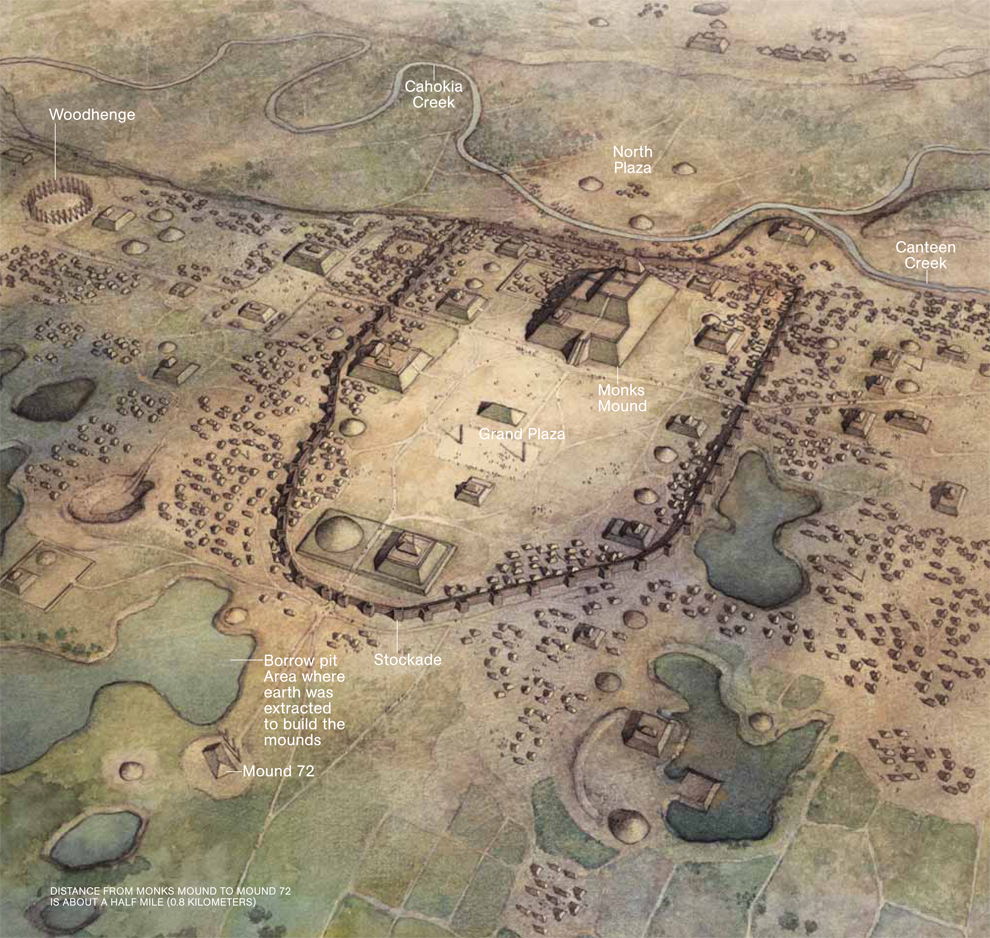
A thousand years ago, huge pyramids and earthen mounds stood where East St. Louis sprawls today in Southern Illinois. This majestic urban architecture towered over the swampy Mississippi River floodplains, blotting out the region's tiny villages. Beginning in the late 900s, word about the city spread throughout the southeast. Thousands of people visited for feasts and rituals, lured by the promise of a new kind of civilization. Many decided to stay.
At the city's apex in 1100, the population exploded to as many as 30 thousand people. It was the largest pre-Columbian city in North America, bigger than London or Paris at the time. Its colorful wooden homes and monuments rose along the eastern side of the Mississippi, eventually spreading across the river to St. Louis. One particularly magnificent structure, known today as Monk’s Mound, marked the center of downtown. It towered 30 meters over an enormous central plaza and had three dramatic ascending levels, each covered in ceremonial buildings. Standing on the highest level, a person speaking loudly could be heard all the way across the Grand Plaza below. Flanking Monk’s Mound to the west was a circle of tall wooden poles, dubbed Woodhenge, that marked the solstices.
Despite its greatness, the city’s name has been lost to time. Its culture is known simply as Mississippian. When Europeans explored Illinois in the 17th century, the city had been abandoned for hundreds of years. At that time, the region was inhabited by the Cahokia, a tribe from the Illinois Confederation. Europeans decided to name the ancient city after them, despite the fact that the Cahokia themselves claimed no connection to it.
Centuries later, Cahokia's meteoric rise and fall remain a mystery. It was booming in 1050, and by 1400 its population had disappeared, leaving behind a landscape completely geoengineered by human hands. Looking for clues about its history, archaeologists dig through the thick, wet, stubborn clay that Cahokians once used to construct their mounds. Buried beneath just a few feet of earth are millennia-old building foundations, trash pits, the cryptic remains of public rituals, and in some places, even, graves.
link.
Friday, July 08, 2016
Precolumbian Brazilian Pithouses Were Occupied for More Than two Centuries
Ancient inhabitants of the southern Brazilian highlands were no strangers to the types of home improvements we enjoy today, academics from the University of Exeter have found.
New research has shown for the first time how oversized pit houses in the southern Brazilian highlands were used for centuries thanks to careful repairs by generations of owners.
This is the first evidence that these oversized pit houses in region were continuously occupied.
Academics have demonstrated one house was occupied for more than two centuries.
link.
Friday, June 24, 2016
Studying the Expansion of the Squash Bee With PreColumbian Agriculture
Using genetic markers, researchers have for the first time shown how cultivating a specific crop led to the expansion of a pollinator species. In this case, the researchers found that the spread of a bee species in pre-Columbian Central and North America was tied to the spread of squash agriculture.
"We wanted to understand what happens when the range of a bee expands," says Margarita López-Uribe, a postdoctoral researcher at North Carolina State University and lead author of a paper describing the work. "What does that mean for its genetic variability? And if the genetic variability declines, does that harm the viability of the species?"
To explore these questions, researchers looked at the squash bee (Peponapis pruinosa), which is indigenous to what is now central Mexico and the southwestern United States. Squash bees are specialists, collecting pollen solely from the flowers of plants in the genus Cucurbita, such as squash, zucchini and pumpkins.
Before contact with Europeans, native American peoples had begun cultivating Cucurbita crops. Over time, these agricultural practices spread to the north and east.
"We wanted to know whether P. pruinosa spread along with those crops," López-Uribe says.
To find out, researchers looked at DNA from squash bee individuals, collected from throughout the species' range. P. pruinosa can now be found from southern Mexico to California and Idaho in the west, and from Georgia in the southeast to Quebec in the north.
By assessing genetic markers in each bee's DNA, the researchers could identify genetic signatures associated with when and where the species expanded.
link.
Friday, June 03, 2016
Did the PreColumbian Wari Empire Assimilate Rather Than Wipe out Areas?
The imperial dominance of the ancient Wari Empire at the Huaca Pucllana site in Lima, Peru, was likely not achieved through population replacement, according to a study published June 1, 2016 in the open-access journal PLOS ONE by Guido Valverde from the University of Adelaide, Australia, and colleagues.
Successive pre-Columbian civilizations existed in the central Andes of South America since the pre-ceramic period 5.5 kya, and ancient empires such as the Wari Empire (600 - 1100 AD) may have been important in shaping the region's demographic and cultural profiles. To investigate whether Wari dominance in the Peruvian Central Coast was based on population replacement or cultural diffusion, the authors of the present study sequenced the complete mitochondrial genomes of 34 individuals from the Huaca Pucllana archaeological site in Lima, Peru, who lived before, during, and after the Wari Empire, and assessed how the population's genetic diversity changed over time.
The researchers found that genetic diversity may only have changed subtly over this period, indicating population continuity over time with only minor genetic impact from Wari imperialism. The subtle genetic diversity shift found at this site may not be representative for the entire Wari territory, and more research is needed to characterize the overall influence of the Wari Empire. Nonetheless, the authors suggest that the Wari Empire may have exerted influence in this area through cultural diffusion rather than by replacement of the pre-existing population.
link.
How did the Southeast Maya Survive Volcanic Eruptions?
Across the centuries, forming cooperative networks beyond cultural boundaries has been a way to overcome natural disasters.
A Nagoya University researcher and his leading international research group discovered a Great Platform built with different kinds of stone at the archeological site of San Andrés, El Salvador, and challenged the prevailing theory regarding the sociocultural development of Southeastern Maya frontier.
San Andrés is located in the Zapotitan Valley, El Salvador, known as Southeastern Maya zone. Archaeological investigation conducted during 40's and 90's has shown that San Andrés had long human occupation beginning from the Middle Preclassic (ca. 600 BC) until the Early Postclassic (ca. AD 1200), in which had role as political, economic and religious center during the Late Classic period (AD 600-900). As San Andrés has been affected by numerous explosive eruptions -- at least three or four -- during the past two millennia, archaeologists have been interested to understand the role of volcanic eruptions in human history.
Between February and May of 2016, the research group led by Assistant Prof. Akira Ichikawa of the Institute for Advanced Research and at the Graduate School of Letters, Nagoya University, made a new discovery that allowed them to reconsider the recovery process from the volcanic eruption of Ilopango (ca. AD 400-450), which was one of the greatest Holocene eruptions in Central America. Assistant Prof. Ichikawa explained: "We have discovered a masonry platform just above the ash caused by the Ilopango eruption in San Andrés, which could prove that people reoccupied in such a devastated area even immediately after the enormous disaster occurred."
link.
Monday, April 11, 2016
How did the Maya Manage Their Water Resources?
Collection, storage and management of water were top priorities for the ancient Maya, whose sites in Mexico, Belize and Guatemala were forced to endure seven months out of the year with very little rainfall. As researchers expand their explorations of the civilization outside of large, elite-focused research site centers, aerial imagery technology is helping them locate and study areas that are showing them how less urbanized populations conserved water for drinking and irrigation. The NSF-supported research by Jeffrey Brewer, a doctoral student in the University of Cincinnati's Department of Geography, and Christopher Carr, a UC research assistant professor of geography, was presented at the 81st annual meeting of the Society of American Archaeology. The meeting takes place April 6-10, in Orlando, Florida.
link.
Wednesday, April 06, 2016
PreColumbian American Southwest Went Through Cycles of Boom/Bust
The heavily studied yet largely unexplained disappearance of ancestral Pueblo people from southwest Colorado is "the most vexing and persistent question in Southwestern archaeology," according to the New York Times.
But it's not all that unique, say Washington State University scientists. Writing in the journal Science Advances, they say the region saw three other cultural transitions over the preceding five centuries. The researchers also document recurring narratives in which the Pueblo people agreed on canons of ritual, behavior and belief that quickly dissolved as climate change hurt crops and precipitated social turmoil and violence.
"The process of releasing one's self from those canons, the process of breaking that down, can occur very quickly and occurred very quickly four times in the Pueblo past," said Kyle Bocinsky, a WSU adjunct faculty member in anthropology and director of sponsored projects for the Crow Canyon Archaeological Center in Cortez, Colo. The article grew out of work toward Bocinsky's WSU doctorate.
Funded by the National Science Foundation, Bocinsky, WSU Regents Professor Tim Kohler and colleagues analyzed data from just over 1,000 southwest archaeological sites and nearly 30,000 tree-ring dates that served as indicators of rainfall, heat and time. Their data-intensive approach, facilitated by climate reconstructions run at the National Center for Supercomputing Applications at the University of Illinois at Urbana-Champaign, gives a remarkably detailed picture of year-to-year changes.
This is particularly important as droughts of just five or ten years were enough to prompt major shifts in the small niches where Pueblo people grew maize, their major crop.
The niches, said Kohler, were "woven together with a web of ceremony and ritual that required belief in the supernatural" to ensure plentiful rain and good crops. When rains failed to appear, he said, the rituals were delegitimized.
"Then there's a point where people say, 'This isn't working. We're leaving,'" he said.
link.
Tuesday, April 05, 2016
Evidence of Invasive Species Introduced by Native Americans to the West Indies
Sr and Pb isotopic investigation of mammal introductions: Pre-Columbian zoogeographic records from the Lesser Antilles, West Indies
Authors:
Giovas et al
Abstract:
Recent efforts to reconstruct the anthropogenic paleozoogeography of introduced Neotropical mammals in the West Indies provide new analytical foundations for evaluating island and continental human interaction, exchange, colonization, and animal management. Key questions in these investigations concern the timing, source, population viability, and environmental impact of continental faunal translocations in the pre-Columbian insular Caribbean. To investigate these issues we analyzed 87Sr/86Sr, 206Pb/204Pb, 207Pb/204Pb, and 208Pb/204Pb isotope ratios from environmental samples and agouti (Dasyprocta sp.) and opossum (Didelphis cf. marsupialis) remains from Ceramic Age (500 BC – AD 1500) archaeological deposits on the islands of Nevis, Carriacou, and Mustique in the Lesser Antilles. This study was undertaken to assess the suitability of agouti and opossum tooth enamel for isotopic analysis, characterize local bioavailable Sr and Pb isotope ratios, and distinguish possible local and non-local agouti and opossum individuals. We demonstrate large intra-island variability in bioavailable Sr across multiple islands giving rise to potential equifinality in identifying taxa of non-local origin. We argue, consequently, for the necessity of comprehensive environmental sampling at the island scale to better define the range and mean of bioavailable Sr for a given locale. Our results further show that Pb isotope analysis of sampled taxa is problematized to varying degrees by modern anthropogenic lead contamination, even for well-preserved ‘clean’ tooth enamel from intact archaeological specimens and raise questions about the utility of this method for evaluating past animal translocations and the use of small mammals for establishing local bioavailable Pb. Despite these results, Sr data are sound and, in combination with vetted Pb ratios, indicate that agouti and opossum were established as living populations on Carriacou and Nevis as early as ca. AD 600/800, and possibly earlier. These results establish baseline data for evaluating exchange networks involving living animals or their parts, potential captive management of agouti and opossum, and the ecological impact of exotic species during the Pre-Columbian era in the West Indies.
Monday, April 04, 2016
Most Native American Genetic Lineages Were Wiped out During European Colonization
The first largescale study of ancient DNA from early American people has confirmed the devastating impact of European colonisation on the Indigenous American populations of the time.
Led by the University of Adelaide's Australian Centre for Ancient DNA (ACAD), the researchers have reconstructed a genetic history of Indigenous American populations by looking directly into the DNA of 92 pre-Columbian mummies and skeletons, between 500 and 8600 years old.
Published today in Science Advances, the study reveals a striking absence of the pre-Columbian genetic lineages in modern Indigenous Americans; showing extinction of these lineages with the arrival of the Spaniards.
"Surprisingly, none of the genetic lineages we found in almost 100 ancient humans were present, or showed evidence of descendants, in today's Indigenous populations," says joint lead author Dr Bastien Llamas, Senior Research Associate with ACAD. "This separation appears to have been established as early as 9000 years ago and was completely unexpected, so we examined many demographic scenarios to try and explain the pattern."
"The only scenario that fit our observations was that shortly after the initial colonisation, populations were established that subsequently stayed geographically isolated from one another, and that a major portion of these populations later became extinct following European contact. This closely matches the historical reports of a major demographic collapse immediately after the Spaniards arrived in the late 1400s."
link.
Wednesday, February 24, 2016
Did Cahokia Collapse due to Internal Strife?

Dr. Thomas E. Emerson and Dr. Kristin M. Hedman from the Illinois State Archaeological Survey-Prairie Research Institute at the University of Illinois present a new case for Cahokia's demise. The new theory was published in Southern Illinois University Press' volume, Beyond Collapse: Archaeological Perspectives on Resilience, Revitalization, and Transformation in Complex Societies. Emerson and Hedman contributed a chapter to the volume entitled, The Dangers of Diversity: The Consolidation and Dissolution of Cahokia, Native North America's First Urban Polity, that explores internal divisions that led to the collapse of Cahokia.
The archaeologists claim internal conflict by social, political, ethnic, and religious factions are a more reasonable description of events that led to Cahokia's collapse than environmental causes, as is the popular theory. They present new bioarchaeological evidence that demonstrates that as many as one-third of the Cahokian residents were immigrants and that these immigrants likely represented groups that were culturally, ethnically, and perhaps linguistically distinct from local populations. Emerson clarifies further,
link.
Wednesday, January 27, 2016
The Native American Depopulation From European Disease had Significant Ecological Impacts
There is little dispute that in the wake of European colonists' arrival in the New World, Native American populations were decimated by disease and conflict. But when it comes to the timing, magnitude, and effects of this depopulation -- it depends on who you ask.
Many scholars claim that disease struck the native population shortly after their first contact with Europeans, and spread with such ferocity that it left tell-tale fingerprints on the global climate. Others, however, argue that -- though still devastating -- the process was far more gradual, and took place over many years.
A new Harvard study, however, suggests both theories are wrong.
Led by Matt Liebmann, the John and Ruth Hazel Associate Professor of the Social Sciences in the Department of Anthropology, a team of researchers was able to show that, in what is now northern New Mexico, disease didn't break out until nearly a century after the first European contact with Native Americans, coinciding with the establishment of mission churches.
But when it did finally strike, the study shows, the effects of disease were devastating. In just 60 years, native populations dropped from approximately 6,500 to fewer than 900 among the 18 villages they investigated. The study is described in a Jan. 25, 2016 paper published in the Proceedings of the National Academy of Sciences.
In addition to Liebmann, the study was co-authored by Joshua Farella and Thomas Swetnam from the University of Arizona and Christopher Roos from Southern Methodist University.
"In the Southwest, first contact between native people and Europeans occurred in 1539," Liebmann said. "We found that disease didn't really start to take effect until after 1620, but we then see a very rapid depopulation from 1620 to 1680. (The death rate) was staggeringly high -- about 87 percent of the Native population died in that short period.
link.
Thursday, December 24, 2015
Was Amazonia Really Tamed by PreColumbian Natives?
Comment on Clement et al. 2015 ‘The domestication of Amazonia before European conquest’
Authors:
McMichael et al
Extract:
Clement et al. [1] paint a picture of cultural landscapes blanketing Amazonia prior to European arrival to the Americas in their recent publication entitled ‘The domestication of Amazonia before European conquest’. A colourful narrative indeed, but here we would like to comment on their misinterpretation of previously published literature, use of data that may not be associated with pre-Columbian activities, and the extrapolative nature of their review both in time and across space.
Precolumbian Mexican City of Teotihuacan may Have Kept Carnivores Captive
From Roman gladiatorial combat to Egyptian animal mummies, capturing and manipulating wild carnivores has long been a way for humans to demonstrate state or individual power. Historians and scientists alike have attempted to determine when humans first began to use carnivores to establish their place on the social ladder, one of the earliest examples being Moctezuma's 14th century zoo at the Aztec capital of Tenochtitlan. A recent PLOS ONE study, however, reveals evidence from the ruins of the Mexican city of Teotihuacan that may push back the date of captivating carnivores by 1000 years.
Between the first and sixth centuries A.D., Teotihuacan was one of the largest and most powerful urban cities in Mesoamerica and was home to at least 25,000 people. When the city reached the height of its influence around 1300-1500 A.D., its architects designed massive temples to show off the city's power. The ruins of three of these incredible temples still stand: the Temple of Quetzalcoatl, the Pyramid of the Sun, and the Pyramid of the Moon.
During excavations from 1998-2004, the authors of this study found rare artifacts and human and animal remains in chambers in the Pyramids of the Sun and the Moon. The authors focused the present study on the 194 animal remains, as they are evidence of one of the largest known animal sacrifices in Mesoamerica.
Of particular interest to the authors were the remains of carnivores like wolves, eagles, jaguars, and pumas, as we have little information about how humans related to carnivores prior to Montezuma's zoo in Tenochtitlan. Using isotope analysis and visual inspection of the bones, the authors were able to draw possible conclusions about the relationship between the carnivores in the chamber and the ancient inhabitants of Teotihuacan.
Visual examination of the animal skeletons suggested that some of the carnivores were kept in captivity. The authors found bone breaks and stress characteristic of captive animals – for example, three eagle skeletons showed stress on the lower part of the legs, where they may have been tied to a perch. Other deformities in the animal skeletons, such as bone fusion or abnormal growth, were evidence of infection, which typically only occur when animals are kept in close together in captivity.
link.
Sunday, November 22, 2015
Pre-Colvis Culture Monte Verde Archaelogical Site Yields Information on Earliest Known PaleoIndians
Stone tools, cooked animal and plant remains and fire pits found at the Monte Verde site in southern Chile provide greater interdisciplinary evidence that the earliest known Americans--a nomadic people adapted to a cold, ice-age environment--were established deep in South America more than 15,000 years ago. The research, led by Tom Dillehay, Rebecca Webb Wilson University Distinguished Professor of Anthropology, appears in the Nov. 18 issue of PLOS ONE.
[...]
The team recovered a total of 39 stone objects and 12 small fire pits associated with bones and some edible plant remains, including nuts and grasses. The bones tended to be small fragments, broken and scorched, indicating that the animals had been cooked. They often came from very large animals, like prehistoric llamas or mastodons, as well as smaller creatures like prehistoric deer and horses. The Monte Verde site was unlikely to have been able to support the kind of vegetation that those animals needed to eat, so they were likely killed and butchered elsewhere. The objects were radiocarbon dated and most were found to range in age from more than 14,000 to almost 19,000 years old.
The wide scattering suggests that the people who created these features were nomadic hunter-gatherers who might have camped for only a night or two before moving on. "Where they're going, we don't know, and where they're coming from, we don't know, but this would have been a passageway from the coast to the foothills of the Andes," Dillehay said. Dillehay believes that they may have come through Monte Verde because the terrain was more walkable than the surrounding bogs and wetlands, and because it provided access to stone to make tools.
link.
Thursday, November 05, 2015
Contrary Report: PreColumbian Populations Only Impacted Amazon Rain Forest Within a Day's Walk of the Rivers
New research led by Florida Institute of Technology shows that the impacts of indigenous people prior to European contact impacted riverside forests, but that such impacts were largely limited to an area within a day's walk from a river.
The findings by the international team of archaeobotanists, paleoecologists and ecologists will be published online in the paper "Anthropogenic influence on Amazonian forests in prehistory: An ecological perspective" on Oct. 28 in the Journal of Biogeography.
The new research, conducted using plant fossils, estimates of mammal density, remote sensing and human population modeling, reinforces that Amazonian forests may be very vulnerable to disturbance by logging , mining and other large enterprises. The study refutes an emerging theory from some archaeologists and anthropologists that Amazonian rain forests are the result of ancient managed landscapes - a notion that undermines the ecological view of these forests as fragile ecosystems.
"Nobody doubts the importance of human actions along the major waterways," said Mark Bush, professor of biological sciences at the Florida Institute of Technology and the lead author of the paper. "But whether humans had a greater impact on the ecosystem than any other large mammal has yet to be established in much of western Amazonia."
Dolores Piperno, curator of archaeobotany and South American archaeology at the American Museum of Natural History and co-author of the study, said the recent emphasis on Amazonia as a manufactured and domesticated landscape overstates the facts.
"At nearly the size of the continental United States, Amazonia is a vast landscape with considerable biotic and abiotic heterogeneity. Extrapolations being made from relatively few archaeological sites mainly located along water courses as to the overall effect of prehistoric human occupation must be tempered in the face of available and yet-to-be-accumulated empirical data."
link.
Sunday, November 01, 2015
Evidence of an Extended Stay in Beringia for Extant Mitochondrial Native American Lineages

Two contemporaneous mitogenomes from terminal Pleistocene burials in eastern Beringia
Authors:
Tackney et al
Abstract:
Pleistocene residential sites with multiple contemporaneous human burials are extremely rare in the Americas. We report mitochondrial genomic variation in the first multiple mitochondrial genomes from a single prehistoric population: two infant burials (USR1 and USR2) from a common interment at the Upward Sun River Site in central Alaska dating to ∼11,500 cal B.P. Using a targeted capture method and next-generation sequencing, we determined that the USR1 infant possessed variants that define mitochondrial lineage C1b, whereas the USR2 genome falls at the root of lineage B2, allowing us to refine younger coalescence age estimates for these two clades. C1b and B2 are rare to absent in modern populations of northern North America. Documentation of these lineages at this location in the Late Pleistocene provides evidence for the extent of mitochondrial diversity in early Beringian populations, which supports the expectations of the Beringian Standstill Model.
pop sci write up.
Thursday, October 15, 2015
The Epidemics From Columbian Contact in the Americas Caused the Little Ice Age
A team comprised of geological and environmental science researchers from Stanford University has been studying the impact that early European exploration had on the New World and have found evidence that they say suggests the European cold period from 1500 to 1750, commonly known as the Little Ice Age, was due to the rapid decline in native human populations shortly after early explorers arrived.
Following up on their paper published in 2008, the team has now brought their findings before the Geological Society of America. The researchers say that the population decrease, which came about due to the introduction of previously unknown diseases, led to the rapid reforestation of the Americas. This led to a sudden increase in the amount of carbon dioxide being pulled from the air, which meant the atmosphere wasn’t able to hold as much heat, which led to colder air covering Europe.
The team, led by visiting scholar Richard Nevle, came to this conclusion after analyzing charcoal remnants in soil and lake sediments left behind by early American inhabitants as they burned forests to make room for farmland. They found that starting approximately 500 years ago, the charcoal accumulations came to a virtual standstill, coinciding with the death of native peoples.
Nevle et al then got out their calculators and crunched the numbers. They estimate that for a population of some 40 to 80 million indigenous people, the total amount of deforested land would likely have amounted to something the size of California. And since most estimates suggest that close to 90 percent of the native peoples died or were killed after the Europeans arrived, that meant most of that land returned to forest. That many trees, they say, all of a sudden appearing, almost as if out of nowhere, could have resulted in a loss of some 2 to 17 billion tons of carbon dioxide from the air.
link.
This strengthens their case as they stated. It also has other implications:
1. Native Americans did NOT have a relationship different with the environment than Europeans. That myth came about with the Noble Savage nonsense and the fact the forests had recovered. HUmanity has NEVER lived in peace with nature. This just helps confirm other sources.
2. The Industrial Revolution DID end the Little Ice Age.
3. The effect the Maunder Minimum had was probably real, but far reduced.
Saturday, October 10, 2015
Determining the Lifestyles of PreColumbian Amazonian Tribes Through Linguistics

In my class on October 5, 2015, we talked about how ancestral languages can be reconstructed on the basis of their present-day descendants and how such linguistic reconstructions (particularly reconstructions of the vocabulary) can be used to reimagine the lives of the speakers of such ancestral languages. While most of our examples in class dealt with Indo-European languages (with a brief foray into the Polynesian world), here I would like to present another example where the same sort of socio-cultural reconstruction can be done on the basis of unwritten languages who offer us a rare glimpse into the lives of the their speakers’ linguistic ancestors. This example concerns three indigenous South American language families: Arawakan, Tukanoan, and Nadahup. These languages are spoken in the Upper Rio Negro region, on the border of Columbia and Brazil (see the map on the left adapted from muturzikin.com). The present-day Arawak languages are shown in pale-green, Tukanoan languages are shown in yellow, and Nadahup languages in brown. (The best-known language in the Nadahup family—at least in linguistic circles—is Nadëb, which exhibits the rarest Object-Subject-Verb order, found only in a handful of languages around the world, 4 in the WALS sample.) Of the three families, only the Nadahup is limited to this region, while Tukanoan languages are also spoken elsewhere through South America and Arawakan languages are found from Brazil to the Caribbean.
Subscribe to:
Posts (Atom)