Showing posts with label saturn. Show all posts

Tuesday, March 29, 2016

Preparing for the end of the Cassini Mission

SETI Institute researcher Matt Tiscareno will continue to be on the front lines as the famed Cassini spacecraft embarks on its final mission. NASA has announced that Tiscareno will be a Participating Scientist as Cassini prepares to take the best images of Saturn's rings ever made.

Since 2011, the Cassini Project has selected Participating Scientists to enhance the scientific return of the Cassini mission by broadening the community of researchers taking part in the analysis and interpretation of data. Tiscareno began working with the Cassini mission as a postdoc in 2004, and was first selected as a Participating Scientist in 2012. He is one of four such researchers selected this year by NASA.

Already among the most successful spacecraft missions in history – one whose discoveries have ranged from the geysers of Enceladus to the storms of Saturn, the seas of Titan, and enigmatic features in the rings – Cassini will spend its last year performing a "Grand Finale." It will repeatedly dive close to the rings and the planet for nearly a year, before finally plunging into Saturn in September 2017.

In addition to close-range measurements of Saturn's gravity and magnetic fields (both of which yield insights into the gas giant's interior structure), Cassini will directly sample the atmosphere and measure the mass of the rings. It will also make repeated passes very close to the rings – at distances only a few times the diameter of Earth. In such close proximity, Cassini can garner images with two to three times better resolution than those obtained during the main part of the mission.


Friday, March 25, 2016

Are Saturns Moons, Rings Less Than 100 Million Years Old?

New research suggests that some of Saturn's icy moons, as well as itsfamous rings, might be modern adornments. Their dramatic birth may have taken place a mere hundred million years ago, more recent than the reign of many dinosaurs.

"Moons are always changing their orbits. That's inevitable," says Matija Cuk, principal investigator at the SETI Institute. "But that fact allows us to use computer simulations to tease out the history of Saturn's inner moons. Doing so, we find that they were most likely born during the most recent two percent of the planet's history.

"While Saturn's rings have been known since the 1600s, there's still debate about their age. The straightforward assumption is that they are primordial – as old as the planet itself, which is more than four billion years. However, in 2012, French astronomers found that tidal effects – the gravitational interaction of the inner moons with fluids deep in Saturn's interior – are causing them to spiral to larger orbital radii comparatively quickly. The implication, given their present positions, is that these moons, and presumably the rings, are recent phenomena.

Cuk, together with Luke Dones and David Nesvorny of the Southwest Research Institute, used computer modeling to infer the past dynamic behavior of Saturn's icy inner moons. While our own moon has its orbit around Earth to itself, Saturn's many satellites have to share space with each other. All of their orbits slowly grow due to tidal effects, but at different rates. This results in pairs of moons occasionally entering so-called orbital resonances. These occur when one moon's orbital period is a simple fraction (for example, one-half or two-thirds) of another moon's period. In these special configurations, even small moons with weak gravity can strongly affect each other's orbits, making them more elongated and tilting them out of their original orbital plane.


Monday, February 22, 2016

Data From Cassini Complicates Case for Planet Nine in the Extreme Outer Solar System

Constraints on the location of a possible 9th planet derived from the Cassini data

Authors:

Fienga et al

Abstract:

To explain the unusual distribution of Kuiper Belt objects, several authors have advocated the existence of a super-Earth planet in the outer solar system. It has recently been proposed that a 10 M⊕ object with an orbit of 700 AU semi major axis and 0.6 eccentricity can explain the observed distribution of Kuiper Belt objects around Sedna. Here we use the INPOP planetary ephemerides model as a sensor for testing for an additional body in the solar system. We test the possibility of adding the proposed planet without increasing the residuals of the planetary ephemerides, fitted over the whole INPOP planetary data sample. We demonstrate that the presence of such an object is not compatible with the most sensitive data set, the Cassini radio ranging data, if its true anomaly is in the intervals [−130∘:−100∘] or [−65∘:85∘]. Moreover, we find that the addition of this object can reduce the Cassini residuals, with a most probable position given by a true anomaly v=117.8∘+11∘−10∘.

Saturday, January 09, 2016

Missions to Enceladus & Titan Allowed in Next New Frontiers Mission Proposal Round

NASA has added two potentially habitable moons of Saturn to the list of possible destinations for its next billion-dollar planetary science mission.

In a Jan. 6 “community announcement” email to scientists, NASA said that “Ocean Worlds,” which it defined as Saturn’s moons Titan and Enceladus, were now included in a set of six classes of missions that the agency would accept proposals for in the next New Frontiers competition in 2017.

“The Ocean Worlds theme for this announcement is tentatively focused on the search for signs of extant life and/or characterizing the potential habitability of Titan or Enceladus,” the announcement stated. The statement did not explain why Ocean Worlds theme was added to New Frontiers.

Scientists have found evidence in recent years that both moons could be habitable. Titan, Saturn’s largest moon, has a dense atmosphere and lakes of liquid hydrocarbon on its surface. Smaller Enceladus likely has an ocean of liquid water beneath its icy surface.

The decision comes after the House, in the report accompanying its version of a fiscal year 2016 appropriations bill, directed NASA to establish an “Ocean Worlds Exploration Program,” specifically citing discoveries made on Titan and Enceladus.

Thursday, November 05, 2015

The Hera Saturn Atmospheric Entry Probe Mission

The Hera Saturn Entry Probe Mission

Authors:

Mousis et al

Abstract:

The Hera Saturn entry probe mission is proposed as an M--class mission led by ESA with a contribution from NASA. It consists of one atmospheric probe to be sent into the atmosphere of Saturn, and a Carrier-Relay spacecraft. In this concept, the Hera probe is composed of ESA and NASA elements, and the Carrier-Relay Spacecraft is delivered by ESA. The probe is powered by batteries, and the Carrier-Relay Spacecraft is powered by solar panels and batteries. We anticipate two major subsystems to be supplied by the United States, either by direct procurement by ESA or by contribution from NASA: the solar electric power system (including solar arrays and the power management and distribution system), and the probe entry system (including the thermal protection shield and aeroshell). Hera is designed to perform in situ measurements of the chemical and isotopic compositions as well as the dynamics of Saturn's atmosphere using a single probe, with the goal of improving our understanding of the origin, formation, and evolution of Saturn, the giant planets and their satellite systems, with extrapolation to extrasolar planets. Hera's aim is to probe well into the cloud-forming region of the troposphere, below the region accessible to remote sensing, to the locations where certain cosmogenically abundant species are expected to be well mixed. By leading to an improved understanding of the processes by which giant planets formed, including the composition and properties of the local solar nebula at the time and location of giant planet formation, Hera will extend the legacy of the Galileo and Cassini missions by further addressing the creation, formation, and chemical, dynamical, and thermal evolution of the giant planets, the entire solar system including Earth and the other terrestrial planets, and formation of other planetary systems.

Saturday, August 01, 2015

The Hera Saturn Entry Probe Mission


The hera saturn entry probe mission

Authors:

Mousis et al

Abstract:

The Hera Saturn entry probe mission is proposed as an M–class mission led by ESA with a contribution from NASA. It consists of one atmospheric probe to be sent into the atmosphere of Saturn, and a Carrier–Relay spacecraft. In this concept, the Hera probe is composed of ESA and NASA elements, and the Carrier–Relay Spacecraft is delivered by ESA. The probe is powered by batteries, and the Carrier–Relay Spacecraft is powered by solar panels and batteries. We anticipate two major subsystems to be supplied by the United States, either by direct procurement by ESA or by contribution from NASA: the solar electric power system (including solar arrays and the power management and distribution system), and the probe entry system (including the thermal protection shield and aeroshell). Hera is designed to perform in situ measurements of the chemical and isotopic compositions as well as the dynamics of Saturn's atmosphere using a single probe, with the goal of improving our understanding of the origin, formation, and evolution of Saturn, the giant planets and their satellite systems, with extrapolation to extrasolar planets. Hera's aim is to probe well into the cloud-forming region of the troposphere, below the region accessible to remote sensing, to the locations where certain cosmogenically abundant species are expected to be well mixed. By leading to an improved understanding of the processes by which giant planets formed, including the composition and properties of the local solar nebula at the time and location of giant planet formation, Hera will extend the legacy of the Galileo and Cassini missions by further addressing the creation, formation, and chemical, dynamical, and thermal evolution of the giant planets, the entire solar system including Earth and the other terrestrial planets, and formation of other planetary systems.

Wednesday, April 22, 2015

Do Enceladus' Geysers Feed Saturn's E Ring?

TRACKING THE GEYSERS OF ENCELADUS INTO SATURN'S E RING

Authors:

Mitchell et al

Abstract:

We examine Cassini Imaging Science Subsystem images of the E ring taken over a period of almost 7 yr, from 2006 September to 2013 July, in which long, sinuous structures dubbed tendrils are present. We model these structures by numerically integrating the trajectories of particles launched from the sources of the most active geysers recently located along the four main fractures crossing the south polar terrain of the moon, and producing from these integrations synthetic images that we then compare to the real ones. We include the effects of charging and the electromagnetic forces on the particles in addition to the gravity of Saturn and Enceladus. We demonstrate that these structures are produced by the highest velocity particles erupting from the most active geysers and entering Saturn's orbit, and not perturbations of E ring particles by Enceladus. The detailed structures of the tendrils change with the orbital position of Enceladus, a finding likely to be the result of the diurnal variability in the source activity.

Do Methane Storms Drive the Dune Orientation on Titan?

Methane storms as a driver of Titan's dune orientation

Authors:

Charnay et al

Abstract:

Titan's equatorial regions are covered by eastward propagating linear dunes. This direction is opposite to mean surface winds simulated by Global Climate Models (GCMs), which are oriented westward at these latitudes, similar to trade winds on Earth. Different hypotheses have been proposed to address this apparent contradiction, involving Saturn's gravitational tides, large scale topography or wind statistics, but none of them can explain a global eastward dune propagation in the equatorial band. Here we analyse the impact of equinoctial tropical methane storms developing in the superrotating atmosphere (i.e. the eastward winds at high altitude) on Titan's dune orientation. Using mesoscale simulations of convective methane clouds with a GCM wind profile featuring superrotation, we show that Titan's storms should produce fast eastward gust fronts above the surface. Such gusts dominate the aeolian transport, allowing dunes to extend eastward. This analysis therefore suggests a coupling between superrotation, tropical methane storms and dune formation on Titan. Furthermore, together with GCM predictions and analogies to some terrestrial dune fields, this work provides a general framework explaining several major features of Titan's dunes: linear shape, eastward propagation and poleward divergence, and implies an equatorial origin of Titan's dune sand.

Saturday, May 17, 2014

How Jupiter and Saturn's Nitrogen Isotope Ratio Originated

The Origin of Nitrogen on Jupiter and Saturn from the 15N/14N Ratio

Authors:

Fletcher et al

Abstract:

The Texas Echelon cross Echelle Spectrograph (TEXES), mounted on NASA's Infrared Telescope Facility (IRTF), was used to map mid-infrared ammonia absorption features on both Jupiter and Saturn in February 2013. Ammonia is the principle reservoir of nitrogen on the giant planets, and the ratio of isotopologues (15N/14N) can reveal insights into the molecular carrier (e.g., as N2 or NH3) of nitrogen to the forming protoplanets, and hence the source reservoirs from which these worlds accreted. We targeted two spectral intervals (900 and 960 cm−1) that were relatively clear of terrestrial atmospheric contamination and contained close features of 14NH3 and 15NH3, allowing us to derive the ratio from a single spectrum without ambiguity due to radiometric calibration (the primary source of uncertainty in this study). We present the first ground-based determination of Jupiter's 15N/14N ratio (in the range from 1.4×10⁻³ to 2.5×10⁻³), which is consistent with both previous space-based studies and with the primordial value of the protosolar nebula. On Saturn, we present the first upper limit on the 15N/14N ratio of no larger than 2.0×10⁻³ for the 900-cm−1 channel and a less stringent requirement that the ratio be no larger than 2.8×10⁻³ for the 960-cm−1 channel (1σ confidence). Specifically, the data rule out strong 15N-enrichments such as those observed in Titan's atmosphere and in cometary nitrogen compounds. To the extent possible with ground-based radiometric uncertainties, the saturnian and jovian 15N/14N ratios appear indistinguishable, implying that 15N-enriched ammonia ices could not have been a substantial contributor to the bulk nitrogen inventory of either planet, favouring the accretion of primordial N2 from the gas phase or as low-temperature ices.

Thursday, April 24, 2014

Why Saturn Needs a Galileo-like Atmospheric Probe

Scientific rationale of Saturn's in situ exploration

Authors:

Mousis et al

Abstract:

Remote sensing observations meet some limitations when used to study the bulk atmospheric composition of the giant planets of our solar system. A remarkable example of the superiority of in situ probe measurements is illustrated by the exploration of Jupiter, where key measurements such as the determination of the noble gases abundances and the precise measurement of the helium mixing ratio have only been made available through in situ measurements by the Galileo probe. This paper describes the main scientific goals to be addressed by the future in situ exploration of Saturn placing the Galileo probe exploration of Jupiter in a broader context and before the future probe exploration of the more remote ice giants. In situ exploration of Saturn's atmosphere addresses two broad themes that are discussed throughout this paper: first, the formation history of our solar system and second, the processes at play in planetary atmospheres. In this context, we detail the reasons why measurements of Saturn's bulk elemental and isotopic composition would place important constraints on the volatile reservoirs in the protosolar nebula. We also show that the in situ measurement of CO (or any other disequilibrium species that is depleted by reaction with water) in Saturn's upper troposphere would constrain its bulk O/H ratio. We highlight the key measurements required to distinguish competing theories to shed light on giant planet formation as a common process in planetary systems with potential applications to most extrasolar systems. In situ measurements of Saturn's stratospheric and tropospheric dynamics, chemistry and cloud-forming processes will provide access to phenomena unreachable to remote sensing studies. Different mission architectures are envisaged, which would benefit from strong international collaborations.

Friday, February 14, 2014

Evolution of Titan's Atmosphere Since Formation


Evolution of Titan's major atmospheric gases and cooling since accretion

Authors:

Gilliam et al

Abstract:

This paper discusses two possible pathways of loss of the two main gases from Titan's post-accretional atmosphere, methane (CH4) and ammonia (NH3), by the mechanisms of thermal escape and emission from the interior coupled with thermal escape. The results give the decline of initial atmospheric gas masses to their present-day levels of 0.1 bar CH4 and 1.4 bar N2 (or equivalent 1.7 bar NH3, as a precursor of N2). From the published data on planetary and Titan's accretion rates, the accretion temperature was estimated as Tac=355 to 300 K. In the first 0.5 to 0.6 Myr after accretion, Titan's surface cools to 150 K and it takes about 5 Myr to cool to near its present temperature of 94 K. The present-day internal composition corresponds to the accreted Titan made of two solids, antigorite and brucite, that account for 59.5 wt%, and an outer shell of an aqueous solution of NH3+(NH4)2SO4 accounting for 40.0 wt%, and methane for a much smaller fraction of 0.6 wt%. In thermal escape of CH4 and NH3, based on the Maxwell-Boltzmann distribution of gas-molecule velocities, the initial gas mass N0 in the atmosphere is lost by a first-order flux, Nt=N0 exp(−kt), where t is time (yr) and k (yr−1) is a rate parameter that depends on temperature, gas molecular mass, atmosphere thickness, and Titan's escape velocity.

The computed initial Tac=355 K is too high and the two gases would be lost from the primordial atmosphere in several hundred years. However, emissions of CH4 and NH3 from the interior, at reasonable rates that do not deplete the Titan gas inventory and function for periods of different length of time in combination with thermal escape, may result in stable CH4 and NH3 atmospheric masses, as they are at the present. The periods of emissions of different magnitude of CH4 range from 6×10⁴ to 6×10⁵ yr, and those of NH3 are 55,000 to 75,000 yr.

At the lower Tac=300 K, thermal escape of gases alone allows their atmospheric masses to decrease from the primordial to the present-day levels in 50,000 to 70,000 years, when Titan's temperature has decreased to 245–255 K. Below this temperature, the NH3 atmospheric mass is comparable to the present-day N2 mass. Thermal escape does not contradict the existence of the photolytic sink of CH4 in the cooled Titan atmosphere. The thermal escape mechanism does not require arbitrary assumptions about the timing of the start and duration of the gas emissions from the interior.

Modeling Titan's Internal Structure

Librational response of a deformed 3-layer Titan perturbed by non-keplerian orbit and atmospheric couplings

Authors:

Richard et al

Abstract:

The analyses of Titan's gravity field obtained by Cassini space mission suggest the presence of an internal ocean beneath its icy surface. The characterization of the geophysical parameters of the icy shell and the ocean is important to constrain the evolution models of Titan. The knowledge of the librations, that are periodic oscillations around a uniform rotational motion, can bring piece of information on the interior parameters. The objective of this paper is to study the librational response in longitude from an analytical approach for Titan composed of a deep atmosphere, an elastic icy shell, an internal ocean, and an elastic rocky core perturbed by the gravitational interactions with Saturn. We start from the librational equations developed for a rigid satellite in synchronous spin-orbit resonance. We introduce explicitly the atmospheric torque acting on the surface computed from the Titan IPSL GCM (Institut Pierre Simon Laplace General Circulation Model) and the periodic deformations of elastic solid layers due to the tides. We investigate the librational response for various interior models in order to compare and to identify the influence of the geophysical parameters and the impact of the elasticity. The main librations arise at two well-separated forcing frequency ranges: low forcing frequencies dominated by the Saturnian annual and semi-annual frequencies, and a high forcing frequency regime dominated by Titan's orbital frequency around Saturn. We find that internal structure models including an internal ocean with elastic solid layers lead to the same order of libration amplitude than the oceanless models, which makes more challenging to differentiate them by the interpretation of librational motion.

Saturday, September 21, 2013

Titan Surface Brightness Changes Might be Evidence of Cryovolcanism

'Sotra Patera' and a possible equivalent on Earth, Kirishima volcano in Japan

Changes in surface brightness on Titan observed over four years by NASA’s Cassini spacecraft have added to evidence that cryovolcanism is active on Saturn’s largest Moon. Anezina Solomonidou has presented results at the European Planetary Science Congress (EPSC) 2013 in London.

The authors compared many volcanic-like features, such as flows, calderas and craters, with similar geological features found on the Earth to study the possibility of cryovolcanic activity within regions close to Titan’s equator.

Titan has an atmosphere rich in organic carbon-based compounds and has clouds and rains of liquid methane that mimic Earth’s water cycle. Its landscape is remarkably Earth-like with dunes and lakes, erosion due to weathering and tectonic-like features. Astronomers believe that beneath its icy surface there is an ocean of liquid water, possibly mixed with ammonia. The low number of impact craters seen on Titan suggests that the surface is relatively young and is therefore dynamic and active.

“All of these features, plus a need for a methane reservoir and volcanic activity to replenish the methane we have detected in the atmosphere, is compatible with the theory of active cryovolcanism on Titan,” said Solomonidou, of the Observatoire de Paris and National and Kapodistrian University of Athens.

Solomonidou and colleagues have investigated the potentially cryogenic regions of Tui Regio, Hotei Regio and Sotra Patera using Cassini’s Visual and Infrared Mapping Spectrometer (VIMS).

“We were able to penetrate the atmosphere with VIMS and view any changes in these surface features. Interestingly, the albedo (brightness) of two of the areas has changed with time,” explained Solomonidou. “Tui Regio got darker from 2005 to 2009 and Sotra Patera -- the most favorable cryovolcanic candidate on Titan -- got brighter between 2005 and 2006.”

Surface variations, together with spectral albedo properties and the presence of volcanic-like features, suggest that these cryovolcanic candidate regions are connected to Titan’s deep liquid ocean.

link.

The other thought is it might be "snow."


Thursday, August 29, 2013

Titan Doesn't Have Plate Tectonics


Saturn’s largest moon, Titan, is one of the solar system’s most fascinating destinations. It’s the second biggest moon in the solar system and the only one known to possess a thick atmosphere. The Cassini-Huygens mission has found it to be weirdly Earth-like, with rocky plains, languid lakes and even precipitation — only the world is so cold the rocks are probably water ice, and the lakes liquid methane. Now even its interior is giving up secrets, thanks to the gravitational data Cassini’s been gathering in its orbit around Saturn.

Astronomers had already suspected that Titan’s surface was a shell of water ice, with a subsurface (water) ocean lurking beneath. The new data, published in Nature this week, reveal that it’s a stronger, more rigid shell than previously thought, measuring at least 25 miles thick, and dozens of times more in some places.


Pop sci write up.

Thursday, August 08, 2013

Titan's Missing Waves


One of the most shocking discoveries of the past 10 years is how much the landscape of Saturn's moon Titan resembles Earth. Like our own blue planet, the surface of Titan is dotted with lakes and seas; it has river channels, islands, mud, rain clouds and maybe even rainbows. The giant moon is undeniably wet.

The "water" on Titan is not, however, H2O. With a surface temperature dipping 290 degrees F below zero, Titan is far too cold for liquid water. Instead, researchers believe the fluid that sculpts Titan is an unknown mixture of methane, ethane, and other hard-to-freeze hydrocarbons.

The idea that Titan is a wet world with its own alien waters is widely accepted by planetary scientists. Nothing else can account for the observations: NASA's Cassini spacecraft has flown by Titan more than 90 times since 2004, pinging the moon with radar and mapping its lakes and seas. ESA's Huygens probe parachuted to the surface of Titan in 2005, descending through humid clouds and actually landing in moist soil.

Yet something has been bothering Alex Hayes, a planetary scientist on the Cassini radar team at Cornell University.

If Titan is really so wet, he wonders, "Where are all the waves?"

Friday, May 24, 2013

Summer Hurricanes on Titan Coming?

Saturn's moon Titan might be in for some wild weather as it heads into its spring and summer, if two new models are correct. Scientists think that as the seasons change in Titan's northern hemisphere, waves could ripple across the moon's hydrocarbon seas, and hurricanes could begin to swirl over these areas, too. The model predicting waves tries to explain data from the moon obtained so far by NASA's Cassini spacecraft. Both models help mission team members plan when and where to look for unusual atmospheric disturbances as Titan summer approaches.

"If you think being a weather forecaster on Earth is difficult, it can be even more challenging at Titan," said Scott Edgington, Cassini's deputy project scientist at NASA's Jet Propulsion Laboratory, Pasadena, Calif. "We know there are weather processes similar to Earth's at work on this strange world, but differences arise due to the presence of unfamiliar liquids like methane. We can't wait for Cassini to tell us whether our forecasts are right as it continues its tour through Titan spring into the start of northern summer."

Titan's north polar region, which is bejeweled with sprawling hydrocarbon seas and lakes, was dark when Cassini first arrived at the Saturn system in 2004. But sunlight has been creeping up Titan's northern hemisphere since August 2009, when the sun's light crossed the equatorial plane at equinox. Titan's seasons take about seven Earth years to change. By 2017, the end of Cassini's mission, Titan will be approaching northern solstice, the height of summer.

Given the wind-sculpted dunes Cassini has seen on Titan, scientists were baffled about why they hadn't yet seen wind-driven waves on the lakes and seas. A team led by Alex Hayes, a member of Cassini's radar team who is based at Cornell University, Ithaca, N.Y., set out to look for how much wind would be required to generate waves. Their new model, just published in the journal Icarus, improves upon previous ones by simultaneously accounting for Titan's gravity; the viscosity and surface tension of the hydrocarbon liquid in the lakes; and the air-to-liquid density ratio.

"We now know that the wind speeds predicted during the times Cassini has observed Titan have been below the threshold necessary to generate waves," Hayes said. "What is exciting, however, is that the wind speeds predicted during northern spring and summer approach those necessary to generate wind waves in liquid ethane and/or methane. It may soon be possible to catch a wave in one of the solar system's most exotic locations."

The new model found that winds of 1 to 2 mph (2 to 3 kilometers per hour) are needed to generate waves on Titan lakes, a speed that has not yet been reached during Titan's currently calm period. But as Titan's northern hemisphere approaches spring and summer, other models predict the winds may increase to 2 mph (3 kilometers per hour) or faster. Depending on the composition of the lakes, winds of that speed could be enough to produce waves 0.5 foot (0.15 meter) high.

The other model about hurricanes, recently published in Icarus, predicts that the warming of the northern hemisphere could also bring hurricanes, also known as tropical cyclones. Tropical cyclones on Earth gain their energy from the build-up of heat from seawater evaporation and miniature versions have been seen over big lakes such as Lake Huron. The new modeling work, led by Tetsuya Tokano of the University of Cologne, Germany, shows that the same processes could be at work on Titan as well, except that it is methane rather than water that evaporates from the seas. The most likely season for these hurricanes would be Titan's northern summer solstice, when the sea surface gets warmer and the flow of the air near the surface becomes more turbulent. The humid air would swirl in a counterclockwise direction over the surface of one of the northern seas and increase the surface wind over the seas to possibly 45 mph (about 70 kilometers per hour).

"For these hurricanes to develop at Titan, there needs to be the right mix of hydrocarbons in these seas, and we still don't know their exact composition," Tokano said. "If we see hurricanes, that would be one good indicator that there is enough methane in these lakes to support this kind of activity. So far, scientists haven't yet been able to detect methane directly."

James found it first.

Thursday, January 17, 2013

Titan's Craters are Filling with Hydrocarbon Sand


Dunes of exotic, hydrocarbon sand are slowly but steadily filling in  [Titan's] craters, according to new research using observations from NASA's Cassini spacecraft.

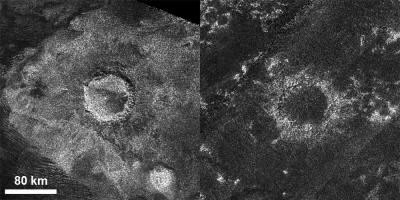
"Most of the Saturnian satellites – Titan's siblings – have thousands and thousands of craters on their surface. So far on Titan, of the 50 percent of the surface that we've seen in high resolution, we've only found about 60 craters," said Catherine Neish, a Cassini radar team associate based at NASA's Goddard Space Flight Center, Greenbelt, Md. "It's possible that there are many more craters on Titan, but they are not visible from space because they are so eroded. We typically estimate the age of a planet's surface by counting the number of craters on it (more craters means an older surface). But if processes like stream erosion or drifting sand dunes are filling them in, it's possible that the surface is much older that it appears."

"This research is the first quantitative estimate of how much the weather on Titan has modified its surface," adds Neish.

Titan is the only moon in the solar system with a thick atmosphere, and the only world besides Earth known to have lakes and seas on its surface. However, with a frigid surface temperature of around minus 290 degrees Fahrenheit (94 kelvins), the rain that falls from Titan's skies is not water but instead liquid methane and ethane, compounds that are normally gases on Earth.

Neish and her team made the discovery by comparing craters on Titan to craters on Jupiter's moon Ganymede. Ganymede is a giant moon with a water ice crust, similar to Titan, so craters on the two moons should have similar shapes. However, Ganymede has almost no atmosphere and thus no wind or rain to erode its surface.

"We found that craters on Titan were on average hundreds of yards (meters) shallower than similarly sized craters on Ganymede, suggesting that some process on Titan is filling its craters," says Neish, who is lead author of a paper about this research published online in the journal Icarus Dec. 3, 2012.

The team used the average depth-versus-diameter trend for craters on Ganymede derived from stereo images from NASA's Galileo spacecraft. The same trend for craters on Titan was calculated using estimates of the crater depth from data derived from images made by Cassini's radar instrument.

Titan's atmosphere is mostly nitrogen with a trace of methane and other, more complex molecules made of hydrogen and carbon (hydrocarbons). The source of Titan's methane remains a mystery because methane in the atmosphere is broken down over relatively short timescales by sunlight. Fragments of methane molecules then recombine into more complex hydrocarbons in the upper atmosphere, forming a thick, orange smog that hides the surface from view. Some of the larger particles eventually rain out on to the surface, where they appear to get bound together to form the sand.

"Since the sand appears to be produced from the atmospheric methane, Titan must have had methane in its atmosphere for at least several hundred million years in order to fill craters to the levels we are seeing," says Neish. However, researchers estimate Titan's current supply of methane should be broken down by sunlight within tens of millions of years, so Titan either had a lot more methane in the past, or it is being replenished somehow.

Team members say it's possible that other processes could be filling the craters on Titan: erosion from the flow of liquid methane and ethane for example. However, this type of weathering tends to fill a crater quickly at first, then more slowly as the crater rim gets worn down and less steep. If liquid erosion were primarily responsible for the infill, then the team would expect to see a lot of partially filled craters on Titan. "However, this is not the case," says Neish. "Instead we see craters at all stages; some just beginning to be filled in, some halfway, and some that are almost completely full. This suggests a process like windblown sand, which fills craters and other features at a steady rate."

All solid materials under stress flow very slowly over time. This is called viscous flow, and it is like what happens when someone takes a scoop out of a fresh tub of whipped cream -- the material slowly flows in to fill the hole and flatten the surface. Craters on icy satellites tend to get shallower over time as the ice flows viscously, so it's possible that some of the shallow craters on Titan are simply much older or experienced a higher heat flow than the similarly sized, fresh craters on Ganymede studied in this work.

However, Titan's crust is mostly water ice, and at the extremely low temperatures on Titan, ice shouldn't flow enough to account for such a large difference in depth compared to the Ganymede craters, according to the team. Also, just like stream erosion, deformation from viscous flow tends to happen rapidly at first, then more slowly as the material adjusts, so one would expect to see a lot of partially filled craters on Titan if its surface was deforming easily through viscous flow.

As Cassini flies past Titan on its multi-year tour of Saturn and its moons, the radar instrument gradually builds up a map of the surface. To date, the instrument has provided data in strips covering approximately 50 percent of Titan's surface. The craters measured by the team are all within about 30 degrees of the equator, a relatively dry region on Titan.

"However, the presence of liquids on the surface and in the near subsurface can also cause extensive modification to crater shape, as is observed on Earth," says Neish. "In the case of Titan, liquids consist of hydrocarbons, either as wet sediments (such as those observed at the Huygens landing site) or shallow marine environments (such as the lakes observed at the north and south poles). Craters formed in similar environments on Earth lack any significant surface topography, including the absence of a raised rim, as wet sediments slump into the crater. It is possible that the lack of topography associated with marine-target impacts may help to explain the relative scarcity of impact craters observed near the poles of Titan. If Titan's polar regions are saturated by liquid hydrocarbons, craters formed in those regions may lack any recognizable topographic expression."

Wednesday, January 09, 2013

Titan's Lakes Appear to Have Floating Hydrocarbon Ice


It's not exactly icing on a cake, but it could be icing on a lake. A new paper by scientists on NASA's Cassini mission finds that blocks of hydrocarbon ice might decorate the surface of existing lakes and seas of liquid hydrocarbon on Saturn's moon Titan. The presence of ice floes might explain some of the mixed readings Cassini has seen in the reflectivity of the surfaces of lakes on Titan.

"One of the most intriguing questions about these lakes and seas is whether they might host an exotic form of life," said Jonathan Lunine, a paper co-author and Cassini interdisciplinary Titan scientist at Cornell University, Ithaca, N.Y. "And the formation of floating hydrocarbon ice will provide an opportunity for interesting chemistry along the boundary between liquid and solid, a boundary that may have been important in the origin of terrestrial life."

Titan is the only other body besides Earth in our solar system with stable bodies of liquid on its surface. But while our planet's cycle of precipitation and evaporation involves water, Titan's cycle involves hydrocarbons like ethane and methane. Ethane and methane are organic molecules, which scientists think can be building blocks for the more complex chemistry from which life arose. Cassini has seen a vast network of these hydrocarbon seas cover Titan's northern hemisphere, while a more sporadic set of lakes bejewels the southern hemisphere.

Up to this point, Cassini scientists assumed that Titan lakes would not have floating ice, because solid methane is denser than liquid methane and would sink. But the new model considers the interaction between the lakes and the atmosphere, resulting in different mixtures of compositions, pockets of nitrogen gas, and changes in temperature. The result, scientists found, is that winter ice will float in Titan's methane-and-ethane-rich lakes and seas if the temperature is below the freezing point of methane -- minus 297 degrees Fahrenheit (90.4 Kelvins). The scientists realized all the varieties of ice they considered would float if they were composed of at least 5 percent "air," which is an average composition for young sea ice on Earth. ("Air" on Titan has significantly more nitrogen than Earth air and almost no oxygen.)

If the temperature drops by just a few degrees, the ice will sink because of the relative proportions of nitrogen gas in the liquid versus the solid. Temperatures close to the freezing point of methane could lead to both floating and sinking ice - that is, a hydrocarbon ice crust above the liquid and blocks of hydrocarbon ice on the bottom of the lake bed. Scientists haven't entirely figured out what color the ice would be, though they suspect it would be colorless, as it is on Earth, perhaps tinted reddish-brown from Titan's atmosphere.

"We now know it's possible to get methane-and-ethane-rich ice freezing over on Titan in thin blocks that congeal together as it gets colder -- similar to what we see with Arctic sea ice at the onset of winter," said Jason Hofgartner, first author on the paper and a Natural Sciences and Engineering Research Council of Canada scholar at Cornell. "We'll want to take these conditions into consideration if we ever decide to explore the Titan surface some day."

Cassini's radar instrument will be able to test this model by watching what happens to the reflectivity of the surface of these lakes and seas. A hydrocarbon lake warming in the early spring thaw, as the northern lakes of Titan have begun to do, may become more reflective as ice rises to the surface. This would provide a rougher surface quality that reflects more radio energy back to Cassini, making it look brighter. As the weather turns warmer and the ice melts, the lake surface will be pure liquid, and will appear to the Cassini radar to darken.