Showing posts with label ssgn. Show all posts

Wednesday, October 28, 2015

US Navy Checking to See if ALL Virginia Class Nuclear Submarines can be Built with Virginia Payload Module Starting in 2019

The Program Executive Office for Submarines would like to see the Virginia Payload Module built into all its Block V subs from a warfighting perspective but will have to verify that doing so will not hurt ongoing Virginia sub construction or upcoming Ohio Replacement Program construction..

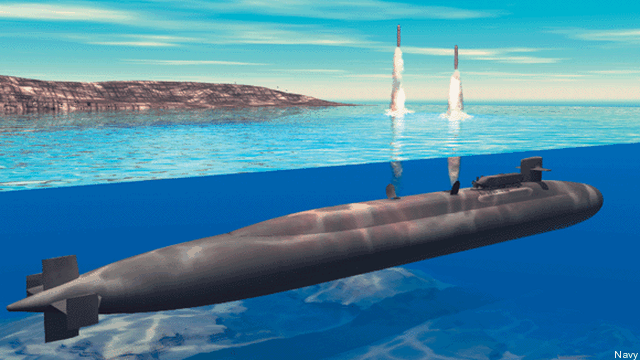
PEO Subs executive director George Drakeley said last week at the annual Naval Submarine League symposium that the Virginia Payload Module would help the Virginia-class attack subs (SSN-774) replace the SSGN guided missile subs.

“The warfighters have come to love that platform,” Drakeley said of the SSGNs.
“Those ships are getting used and used hard,” with parts wearing out earlier than expected due to heavy use in the fleet.

“The VPM is the follow-on basically for SSGNs, and with the kind of support it has, the program is actually probably in pretty good shape,” he said.
“Right now the plan of record is to build one VPM a year starting in [Fiscal Year 2019] through the shipbuilding plan. There is now kind of support for the possibility of, after we start building Virginia VPM … to make all of the Virginias VPM-Virginias. I think that makes sense from a shipbuilding point of view, and from a capability for the Navy” point of view, he said.

Thursday, October 22, 2015

US Navy Considering Adding Anti Ship Missiles Back to Submarine Force

The Navy is investigating adding an anti-ship missile to its submarine force — bringing it inline with the majority of the world naval submarines, the director of Naval Reactors said on Wednesday.

In response to a question from the audience at the 2015 Naval Submarine League Symposium, Adm. Frank Caldwell said the Navy was exploring adding the capability to the fleet.

“For this audience, I’ll tell you we are considering that and we are taking some some steps to delivering that kind of capability to our submarine force and I can’t really say anymore than that,” he said.

The U.S. submarine fleet did use the UGM-84A Harpoon anti-ship missile but that Harpoon variant was retired in 1997. The current primary attack submarines is the anti-ship weapon is Mk 48 heavy torpedo and is limited in its range relative to anti-ship missiles developed and deployed with foreign navies.

In particular, Russian and Chinese submarines field a variety of anti-ship missiles with ranges that far exceed the Mk-48s.

Friday, April 03, 2015

China Unveils new Type-093G Nuclear Fast Attack Submarine


The Chinese Navy is preparing to commission three new, nuclear-powered attack submarines with a vertical launching system able to fire supersonic anti-ship missiles, a report from China Daily said.

The China Central Television showed satellite pictures earlier this week of the three submarines anchored at an unidentified port claiming that the new submarines are China’s most advanced Type-093G attack submarines.

“The Type-093G is reported to be an upgraded version of Type-093, China’s second-generation nuclear-powered attack submarine, which entered active service several years ago. With a teardrop hull, the submarine is longer than its predecessor and has a vertical launching system,” according to the China Daily report.

The Chinese navy’s website said the new variant is engineered to reduce noise, improve speed and mobility and fire China’s latest YJ-18 supersonic anti-ship missile, according to the report.


Wednesday, October 29, 2014

Russian Yasen Class Nuclear Submarine More Capable Than Best Los Angeles Class SSN

One of the U.S. Navy’s top submarine officers was so impressed with Russia’s new Project 885 nuclear attack boats that he had a model of K-329 Severodvinsk built for his office.

Rear Adm. Dave Johnson, Naval Sea Systems Command’s (NAVSEA) program executive officer (PEO) submarines said he had the model of Severodvinsk placed outside his office in a common area so that he could look at it every day on his way to his office.

“We’ll be facing tough potential opponents. One only has to look at the Severodvinsk, Russia’s version of a [nuclear guided missile submarine] (SSGN). I am so impressed with this ship that I had Carderock build a model from unclassified data.” Johnson said last week during the Naval Submarine League’s symposium in Falls Church, Va.
“The rest of the world’s undersea capability never stands still.”

The Russian attack boat had been in construction since 1993 and only entered sea trials late in 2011. The boat finally became operational earlier this year. A cash-strapped Russian Federation had to repeatedly delay completion of the submarine in the chaos that followed the collapse of the Soviet Union.

Severodvinsk is the most capable Russian attack submarine ever built and leverages many of the technologies the Soviet Union invested in during the 1970s and 1980s.

Wednesday, April 16, 2014

Russian Overhauling 10 Nuclear Submarines

Russian Navy commander-in-chief Admiral Viktor Chirkov has announced that more than ten third-generation nuclear-powered attack and cruise missile submarines will be modernised before the end of this decade.

The repair and overhaul programme was previously publicised, but earlier reports did not specify the number of boats to be updated.

An official spokesman told news agencies that Chirkov said they include Akula (Shchuka-B/Project 971)-class and Sierra I (Barrakuda/Project 945)-class nuclear-powered attack submarines (SSNs) and Oscar-class (Antey/Project 949) guided-missile submarines (SSGNs).

Wednesday, March 12, 2014

US Navy Studying Submarine Launched Hypersonic Missiles


In September 2014 the US Navy (USN) plans to award one or two USD5 million 13-month (with a possible 12-month extension) Conventional Prompt Strike (CPS) trade studies and demonstration studies to identify technology options for launchers, missiles and glide bodies, architectures, and associated


That was via Jane's in my RSS reader, but the link seems to have been taken offline or some such.  

Tuesday, January 28, 2014

US Navy Testing UUV Deployer for SSGNs


The Navy and General Dynamics Electric Boat are testing a prototype of an unmanned underwater vehicle engineered to launch from the missile tube of a cruise missile submarine.

Called the Universal Launch and Recovery Module, the system houses, launches and recovers an underwater vehicle, a Lockheed-built 10,000-pound prototype vehicle called Marlin, from the submarine’s missile tube.

The system is showing promise in early testing and is slated to go sea aboard a guided missile, nuclear powered submarine (SSGN) next year, Electric Boat officials said.

“This is real prototyping to actually go and exercise the system before we put it on an SSGN and take it to sea,” Adm. David Johnson, Program Executive Officer, Submarines, said at the 2013 Naval Submarine League Annual Symposium, Va., in October.

The system is designed for a range of potential underwater missions to include counter-mine patrol, sonar or other intelligence, surveillance and reconnaissance (ISR) missions.

“Submarines have the ability to get really close to something. That is a big advantage,” said Franz Edson, director, mission systems & business development, General Dynamics Electric Boat.

The prototype vehicle is hooked up to temporary hydraulics and engineered to acquire a buoy at the top of the missile tube using a transponder, said Edson.

“It comes out of a tube, rotates, and then deploys. It goes off and does its thing — mine warfare, ISR, etc. –Then it comes back and it mates with that buoy before it is brought back down into the tube,” Edson said.

Once a tactical version of the technology is built, it will fill up the launch tube out to 60-inches in diameter and stretch as long as 23-feet, Edson said. The vehicle could weigh up to 30,000-pounds, he added.

Wednesday, November 13, 2013

Chinese Navy Making Significant Capability Gains

For the first time in the country’s history, China’s sea-based nuclear deterrent nears initial operational capability (IOC), according to a forthcoming report by a US congressional commission on China.

China’s JL-2 submarine-launched ballistic missile could reach IOC later this year, according to an early draft of the report by the US-China Economic and Security Review Commission.

With a range of 4,000 nautical miles, the People’s Liberation Army Navy (PLAN) will have its first credible sea-based nuclear deterrent against the US mainland, mated with the Type 094 Jin-class nuclear ballistic missile submarine (SSBN). China has deployed three Jin-class SSBN and “probably will field two additional units by 2020.”

The report also states that China is pursuing two new classes of nuclear submarines — the Type 095 guided-missile attack submarine (SSGN) and the Type 096 SSBN. The Type 096 will likely “improve the range, mobility, stealth, and lethality” of the PLAN’s nuclear deterrent.

US military facilities on Guam are coming into conventional missile range for China, according to the report.

Though China does not have the ability to strike land targets with sea-based cruise missiles, the report states China’s navy is developing a land-attack cruise missile capability, most likely with the Type-095 SSGN and Luyang-III (Type 052D) guided-missile destroyer. This will enhance China’s “flexibility for attacking land targets throughout the Western Pacific, including US facilities in Guam.”