Monday, April 14, 2008

Stanford's Take on Placenta Genetics

Researchers at the Stanford University School of Medicine have uncovered the first clues about the ancient origins of a mother's intricate lifeline to her unborn baby, the placenta, which delivers oxygen and nutrients critical to the baby's health.

The evidence suggests the placenta of humans and other mammals evolved from the much simpler tissue that attached to the inside of eggshells and enabled the embryos of our distant ancestors, the birds and reptiles, to get oxygen.

"The placenta is this amazing, complex structure and it's unique to mammals, but we've had no idea what its evolutionary origins are," said Julie Baker, PhD, assistant professor of genetics. Baker is senior author of the study, which will be published in the May issue of Genome Research.

The placenta grows inside the mother's uterus and serves as a way of exchanging gas and nutrients between mother and fetus; it is expelled from the mother's body after the birth of a baby. It is the only organ to develop in adulthood and is the only one with a defined end date, Baker said, making the placenta of interest to people curious about how tissues and organs develop.

Beyond being a biological curiosity, the placenta also plays a role in the health of both the mother and the baby. Some recent research also suggests that the placenta could be a key barrier in preventing or allowing molecules to pass to the unborn baby that influence the baby's disease risk well into adulthood.

"The placenta seems to be critical for fetal health and maternal heath," Baker said. Despite its major impact, almost nothing was known about how the placenta evolved or how it functions.

Baker and Kirstin Knox, graduate student and the study's first author, began addressing the question of the placenta's evolution by determining which genes are active in cells of the placenta throughout pregnancy in mice.

They found that the placenta develops in two distinct stages. In the first stage, which runs from the beginning of pregnancy through mid-gestation, the placental cells primarily activate genes that mammals have in common with birds and reptiles. This suggests that the placenta initially evolved through repurposing genes the early mammals inherited from their immediate ancestors when they arose more than 120 million years ago.

In the second stage, cells of the mammalian placenta switch to a new wave of species-specific genes.


Ok. So what I am taking away from this.

1. Egg laying /was/ basal for synapsids and monotremes retain that. (sorry, Dr Ward; re Out of Thin Air speculation)

2. Gene reuse is kewl.

3. Nailing down a divergence between marsupials and placentals is going to be really hard using placenta genes.

4. The fact that the 'second stage' is species specific makes me wonder how diverse in differences those genes are. Are they radically different ones? Very similar ones? or...?

Modeling the Greatest Extent Varanid's Bite


The fearsome Komodo dragon is the world's largest living lizard and can take very large animal prey: now a new international study has revealed how it can be such an efficient killing machine despite having a wimpy bite and a featherweight skull.

A member of the goanna family with ancestors dating back more than 100 million years, the dragon (Varanus komodoensis) uses a combination of 60 razor-sharp serrated teeth, powerful neck muscles and what researchers are calling a "space-frame" skull to butcher prey with awesome efficiency, the study found.

They note that the dragon – inhabiting the central Indonesian islands of Komodo, Rinca, Flores, Gili Motang and Gili Dasami – shares the feeding and dental characteristics of extinct dinosaurs, sharks and sabre-toothed cats. Scientists Karen Moreno and Stephen Wroe from the University of New South Wales have used a computer-based technique called Finite Element Analysis (FEA) to test the bite force and feeding mechanics of the predator. Their findings are to be published in the latest issue of the Journal of Anatomy.

Normally used in the analysis of trains, planes and cars, the technique allowed the team to "reverse engineer" nature's design to assess the mechanical forces that a Komodo skull can handle. "The Komodo has a featherweight, space-frame skull and bites like a wimp," according to Wroe, "but a combination of very clever engineering, and wickedly sharp teeth, allow it to do serious damage to even buffalo-sized prey.

“The Komodo displays a unique hold and pull-feeding technique," says Dr Wroe. "Its delicate skull differs greatly from most living terrestrial large prey specialists, but it’s a precision instrument, beautifully optimised to make the most of its natural cranial and dental properties.

"Unlike most modern predators, Varanus komodoensis applies minimal input from the jaw muscles when killing and butchering prey. But it compensates using a series of actions controlled by its postcranial muscles. A particularly interesting feature of the skull's performance is that it reveals considerably lower overall stress when these additional forces driven by the neck are added to those of the jaw-closing muscles.

"This remarkable reduction in stress in response to additional force is facilitated partly by the shape of the bones, but also by the way bone of different strengths are arranged within the skull."


Keeping this in mind, people ought to try modeling the bite forces of theropods. Since they had some pretty light weight and funky skulls themselves, the same technique might be of use. If this hasn't been done already.

Friday, April 11, 2008

A Thing of Techno Beauty

Oh! That SINKING Ship! Again!


I find it terribly amusing when people go out of their way to point to something that is short term and use that as a means to say that the world will be X Y or Z based on extrapolating linearly to the nth+ridiculous degree. The current favourite is kicking the USA or its dollar (currently). Previously, it was Peak Oil. Or Japan taking over the world. Or...

It doesn't really matter what it is. People have a habit of taking the NOW and extrapolating it ridiculously. Every single economic BOOM that the US has seems to be one of these. The ones I saw were the PC boom & aerospace boom of the 1980s. Then there was the internet boom/dotcoms of the 90s. Then, my favourite, the real estate boom of the Oughts. Everyone gets this idea that it will go on and on and on. Never a bust. Yet EVERY single time there is one.

Right now the recession we are in and the status of the dollar. The current woes are, frankly, to have been expected. There is such a thing as the business cycle. The US with the real estate boom - and bust - is going through that cycle right now. What makes it worse was the fact that the last boom was done with credit that was above and beyond what was a good idea. That importation of currency for the credit is what has caused the dollar free fall as the economy went pop, the money flowed out of the country. That, of course, made things a bit worse. The cycle will turn though and we'll climb back out. The Next Boom wil rise and crest and fall. And again. And again. To make the claim that This Is The End of The USA is silly. Sinking ship, pah.

I have to confess I do think there are nontrivial issues with the United States. Our educational system is in shambles. We are getting fat. We have a political system that is waaaaaaaaaaaaaaaay over polarized again. We have a large underclass that we don't dare speak of in anything but contempt. We have a medical system that's mildly foobed. We also have nontrivial social security and medicare problem racing towards us.

All of them are addressable. All of them can be fixed. In fact, the system is moving to do just that. Declaring that the ship is sinking is disingenius at best.

E.O. Lawrence Postdoctoral Fellowship Program

Ernest Orlando Lawrence Berkeley National Laboratory (LBNL) is a multi-program national research facility operated by the University of California for the Department of Energy (DOE). The Laboratory's fundamental mission is to provide national scientific leadership and technological innovation to support DOE objectives.

The E.O. Lawrence Postdoctoral Fellowship Program provides challenging opportunities to conduct research in areas supportive of the LBNL mission. Fellows become integral members of Laboratory research teams, where they gain exposure to current national issues, share and exchange innovative ideas and techniques, and enhance their professional development.

Fellows also have access to a valuable combination of outstanding professional staff, scientific equipment and facilities, and ongoing research and development available at other participating laboratories. LBNL research areas include Computing Sciences, Physical Sciences, Energy Sciences, Biosciences, and General Sciences. (An organization chart with links to divisions of each research area is available here.)


Click on the title for more info.

Thursday, April 10, 2008

55+ Million Year Old Grand Canyon

New geological evidence indicates the Grand Canyon may be so old that dinosaurs once lumbered along its rim, according to a study by researchers from the University of Colorado at Boulder and the California Institute of Technology.

The team used a technique known as radiometric dating to show the Grand Canyon may have formed more than 55 million years ago, pushing back its assumed origins by 40 million to 50 million years. The researchers gathered evidence from rocks in the canyon and on surrounding plateaus that were deposited near sea level several hundred million years ago before the region uplifted and eroded to form the canyon.

A paper on the subject will be published in the May issue of the Geological Society of America Bulletin. CU-Boulder geological sciences Assistant Professor Rebecca Flowers, lead author and a former Caltech postdoctoral researcher, collaborated with Caltech geology Professor Brian Wernicke and Caltech geochemistry Professor Kenneth Farley on the study.

"As rocks moved to the surface in the Grand Canyon region, they cooled off," said Flowers. "The cooling history of the rocks allowed us to reconstruct the ancient topography, telling us the Grand Canyon has an older prehistory than many had thought."

The team believes an ancestral Grand Canyon developed in its eastern section about 55 million years ago, later linking with other segments that had evolved separately. "It's a complicated picture because different segments of the canyon appear to have evolved at different times and subsequently were integrated," Flowers said.

The ancient sandstone in the canyon walls contains grains of a phosphate mineral known as apatite -- hosting trace amounts of the radioactive elements uranium and thorium -- which expel helium atoms as they decay, she said. An abundance of the three elements, paired with temperature information from Earth's interior, provided the team a clock of sorts to calculate when the apatite grains were embedded in rock a mile deep -- the approximate depth of the canyon today -- and when they cooled as they neared Earth's surface as a result of erosion.

Apatite samples from the bottom of the Upper Granite Gorge region of the Grand Canyon yield similar dates as samples collected on the nearby plateau, said Caltech's Wernicke. "Because both canyon and plateau samples resided at nearly the same depth beneath the Earth's surface 55 million years ago, a canyon of about the same dimensions of today may have existed at least that far back, and possibly as far back as the time of dinosaurs at the end of the Cretaceous period 65 million years ago."

One of the most surprising results from the study is the evidence showing the adjacent plateaus around the Grand Canyon may have eroded away as swiftly as the Grand Canyon itself, each dropping a mile or more, said Flowers. Small streams on the plateaus appear to have been just as effective at stripping away rock as the ancient Colorado River was at carving the massive canyon.


55 million years ago was 10 million short of having dinosaurs roaming its edges...sheesh.

The 2000th Post: Annexing Mexico


An Introduction:


I rather like the idea of the US becoming a more integrated, federal from the get-go EU. In some ways it already is one and I have come across many texts as I have been reading that point out in relative terms that how decentralized the US is government wise. There are many countries that would definitely benefit from integration into the US and it would benefit the US by injecting new blood, challenges, and opportunities. It would also solve a nontrivial amount of issues for ourselves. One of those would be the 'fixing', permanently, our issues with Mexico.

I have to admit that annexing Mexico has been a long term hobby horse of mine: I have posted about the idea before. I had planned on posting more on the idea, but have been distracted with other things. Writing posts on adding other countries in a manner other than RAHRAH! EAT THEM! YUM! takes a lot of work and there's a long 1/4 finished post on the subject that needs a lot more work before even as much as is written ever sees the light of the blogosphere! Or is that the blight of the blogosphere?! ;)

For many reasons, I think it would be a good idea to undertake the annexation, not the least of which is that we completely solve that southern border thing. So long as we annex nations with the intent to make them states within a generation and do not put them into the bullshit category of 'unincorporated territory' (see Puerto Rico, Guam, Northern Marianas, etc's status ), I think this is a doable and even close to ideal act.

Actually, after I have been pondering it for the past year, I think annexing Mexico would be the third nation on the list. Canada is actually the zero-th, but I am not going to go over that right now, so relax Randy and James...but not too much. My annexationist taste buds are still longing to munch on some Canadian Bacon. ;) Because of the recent Absolut Vodka ad, I am going to walk through a scenario, perhaps my preferred scenario at the moment of what would happen given annexing Mexico. This is my so-called retaliation post I joked about. However the post itself is not a joke.

Let us consider that as I pointed out in the previous post, a recent poll found that 60% of all Mexicans would like to move to the US. If the midway figures are close to correct about the number of illegal immigrants of Mexican origin are correct, 10% of Mexico's population is already here in the States. That's a whopping 70% of the population that wants to live or is living in America. Convince another 5% that they ought to join up and we're in business. The harder sell would actually be on the northern side of the border. However, to accomplish that would take a lot different sort of work. The idea is plausible, if not terribly likely at this point unless someone convincing and prestigious were to take up the cause. Lone bloggers hardly count. ;)

What Would Will Do?

Assuming that the referendum on annexation passed in Mexico and the US Senate likewise accepted the treaty, what would I want the annexation treaty to look like? After all, the mechanics of annexation and granting of statehood (statehoods? Is that even an Anglically correct word?) to Mexico is really, really important. After all, given that crazy stupid unincorporated territory status, Mexicans could find themselves annexed, noncitizens (Yes, we have American Nationals rather than only Citizens for status of people born within the United States), and unable to immigrate. That would be detestable. So what would I do?

First off, I would make sure that Mexico was an incorporated territory with a time table for each Mexican state (or groupings of states) to evolve from a territory to an American state. None would take longer than 25 years after annexation. The first state that would be transferred from territory status to statehood would be Greater Mexico - see below - five years after annexation (Veracruz and Jalisco probably next and then the northern tier of Mexican states). The idea would be to transform one or two territories into states each year thereafter. The last of them would transfer no later than 25 years, as I said, after annexation. IMNSHO, not all Mexican states ought to translate into American states directly, see below.

Secondly, all Mexican citizens would automatically become American citizens immediately. That means all the freedoms and responsibilities acquired therein. That also means that as many as truly want to can move wherever within the US. My bet is that the rural regions drain into the older American States while the cities stay largely intact.

Thirdly, the federal government of the United States would guarantee that each territory would have a budget of $2 billion allocated to it independent of any and all locally collected taxes. This would be decided on by the Feds for development and improvement of the territories. No more than three quarters would go to infrastructure projects. The majority of the rest would be put to anticorruption measures, especially in reforming the judiciary and police. Once the territories transition to states, this goes away and they would have to rely on earmarks just like everybody else. Which territory that would make the leap to statehood would be selected based on economic status and corruption reduction, btw. Anyways, initially this would be a bill of $64 billion per year. After five years, when Greater Mexico became a state, it would decrease to $52 billion. When Baja California becomes a state, it would drop by $4 billion and Yucatan by $6 billion. Uh, why?


The reason is that these are the proposed states from made from Mexico's. If you note, there are a total of twenty-five of them. There are thirty one states in Mexico today and the federal district. There were some consolidations that I thought through a bit when I started thinking through the map of an annexed Mexico.

The first and foremost is the creation of the state I have been calling Greater Mexico, but would really be called just 'Mexico.' There is already one of the United Mexican States with that name and it absorbs the Federal District, Morelos, Puebla, Tlaxcala, and Hidalgo. As noted above, this would be the first state admitted into the Union as a full state five years after annexation. It would have a total population of 33,132,831 - assuming no population shifts, which as we noted would be false, big time - making it second only to California in the Union in the Electoral College and House of Representatives. One of the biggest drivers for its creation was actually because Mexico City, the capital, sprawls across most of these states.

Also consolidated was Baja California and Baja California Sur to make a territory and ultimately state with the population of 3,356,639. That would place it between Connecticut and Iowa in electoral importance. However, given that I believe that once Mexico is annexed that Baja California would become Florida West - even more so than now - then I expect that this population will swell big time.

Finally, also consolidated into the territory and ultimately state of Yucatan was Yucatan, Quintana Roo, and Campeche. This made a state of 3,708,987 souls making it roughly as important as Oregon in the electoral mix once it too becomes a state.

FWIW, as a last note, sadly, I think that Chiapas and Oaxaca would be the last territories to make the leap to statehood. I could be wrong though.


What Happens After Annexation on a Social & Economic Level?


That's a pretty good question. Here's my take.

Immediately after annexation, there will be a big time recession in the Mexican territories. You have to keep in mind the nominal minimum wage in Mexico is far, far lower than in the US. A nontrivial amount of jobs would initially be lost because a lot of industry is dependent on those abysmal wages to be competitive. Remove that and...poof. That said, at federal minimum wage rates, which people there would be willing to work at, the economy would recovery within two to three years. With the removal of corruption, I suspect that the Mexican territorial and state economies would just plain boom. It was suggested to me that it would be as much as 7% per year, sustained. Until the Mexican states neared convergence with the rest of the country, that's a brisk clip to be developing at. And a nice tax base to add if I may point out.

Part of the jobs losses though would be mitigated by the fact that a nontrivial number of people would simply leave the Mexican Territories in the first five years, prior to Mexico becoming a state. It may be as much as the 60% that the polls state would happen if they had no barriers as would be the case here. On the other hand, people do a lot of talk and with the federal spending in the Mexican Territories and the jump in wages, it's going to cut that migration nontrivially. My guess is that 30% of our new citizens would migrate north to the new states. that will have a nontrivial impact on low skill and unskilled labor forces in the Northern States. Unfortunately, it would take some pretty big time investment in training and education to lift that group up and try to mitigate the impact, but...it wouldn't necessarily work as well as we'd hope.

That said, social security is fixed for a at least a couple more generations. :)

Not all population shifts will be to the north. There will be a nontrivial southern moving component. It could be as much as 5% of the northern population (15 million people, plus or minus). The biggest ones will be the opportunists - of course! - and also something of an underwhelming surprise of retirees. I could easily see, in fact would almost bet the farm on, Greater Baja California becoming Desert Florida West with five plus million retirees moving there for the cheaper living and nice climate. That's happening to some extent now. If Baja was an American state...then there would be a boom in biomedical industries (nurses anyone?) and all the support functions and fun industries - restaurants! leisure industries! etc! Oh my! - to absorb the capital of the retirees' collective spending. Baja California's population might increase from 3.3 million to as much as 12 million.

Additionally, I bet the rural states in Mexico would have the biggest drain while Baja and the states with large urban sites would either remains stable or grow. Greater Mexico would probably have remained stable or even grown. I suspect one of the biggest losers might actually be some of the old border states on either side: the biggest reasons for the Mexican border states to have such large populations just...evaporated. Instead of the Rust Belt, do we get the Dust Belt?

At any rate, I'll have to wrap up there for now. I'm waaaay out of time and there's too much to do.

Wednesday, April 09, 2008

Blog Party like its 1999!

I am updating my blogroll once more with The World We Don't Live In and Catalogue of Organisms. Both are very worthwhile blogs and I strongly recommend that you check them out.

I am working on my loonie politics post next. It might come late today. Or tomorrow. I have to go talk to a machinist at some point today.

Tuesday, April 08, 2008

THIS CALLS FOR RETALIATION! (lol)


Noel of Halfway Down the Danube brought his back to my attention. I found it amusing when I heard about and saw it before: no, I am not terribly offended. I find it...funny. That fact probably offends as many people as does the advert itself.

However, since I have my 2000th post coming up very soon and I wanted to do something more interesting than yet another news link. To that end, I am going to trot out my loonie political leaning: I am an expansionist. I think that there are other countries that are juicy, tasty, and ought to be eaten. ahem. I mean other countries that ought to be considered to be offered a place within our our political union[1]. To that end, I think I am going to try to get out a "retaliation" of what I would do when annexing Mexico.

1. But not the BS position of unincorporated territory. Colonies are bad, folks.

What-if 100m Sea Rise?


Must. Make. Seaway. From Uber Aral. To. Arctic.

Barbourula kalimantanensis, lungless

Monday, April 07, 2008

First Lungless Frog Found

Researchers have confirmed the first case of complete lunglessness in a frog, according to a report in the April 8th issue of Current Biology, a publication of Cell Press. The aquatic frog Barbourula kalimantanensis apparently gets all the oxygen it needs through its skin.

Previously known from only two specimens, two new populations of the aquatic frog were found by the team during a recent expedition to Indonesian Borneo.

“We knew that we would have to be very lucky just to find the frog,” said David Bickford of the National University of Singapore. “People have been trying for 30 years. But when we did and I was doing the initial dissections—right there in the field—I have to say that I was very skeptical at first [that they would in fact lack lungs]. It just did not seem possible. We were all shocked when it turned out to be true for all the specimens we had from Kalimantan, Indonesia.

“ The thing that struck me most then and now is that there are still major firsts (e.g., first lungless frog!) to be found out in the field,” he added. “All you have to do is go a little ways beyond what people have done before, and—voila!”

Of all tetrapods (animals with four limbs), lunglessness is only known to occur in amphibians. There are many lungless salamanders and a single species of caecilian, a limbless amphibian resembling an earthworm, known to science. Nevertheless, Bickford said, the complete loss of lungs is a particularly rare evolutionary event that has probably only occurred three times.

The discovery of lunglessness in a secretive Bornean frog supports the idea that lungs are a malleable trait in amphibians, which represent the evolutionary sister group to all other tetrapods, according to the researchers. Barboroula kalimantanensis lives in cold, fast-flowing water, they noted, so loss of lungs might be an adaptation to a combination of factors: a higher oxygen environment, the species’s presumed low metabolic rate, severe flattening of their bodies that increases the surface area of their skin, and selection for negative buoyancy—meaning that the frogs would rather sink than float.


tres kewl. Something for Darren to blog about some time.

Sunday, April 06, 2008

Bone Yard XVII


Bone Yard XVII is up at Greg Laden's place. He seems confused with his own Bone Yard XIII!

Friday, April 04, 2008

Skulls of Tower of London Lions Found


An extinct breed of lion from North Africa was held at the Tower of London in medieval times, a new study shows.

A pair of skulls unearthed from the tower's moat in the 1930s belonged to Barbary lions, a subspecies that has since died out in the wild.

The discovery suggests that descendants of Barbary lions may still survive in captivity, which could help efforts to resurrect the dark-maned breed, researchers say.

The lions' North African roots were revealed by analysis of mitochondrial DNA, a genetic marker passed between females.

What's more, the DNA reveals that the two animals represent the oldest confirmed Barbary lion remains in the world, the study team said.

The findings are reported in the current issue of the journal Contributions to Zoology.


Can they bring them "back?" NO JP style, but...read the article.

Thursday, April 03, 2008

NATO to Ukraine: [DENIED]

NATO decided Thursday not to put Georgia and Ukraine on track to join the alliance after vehement Russian opposition, but the alliance pledged that the strategically important Black Sea nations will become members one day.

[...]

French and German concern over Russia's reaction dashed the two former Soviet republics' hopes of being granted a "membership action plan" that bring them into the alliance within the next five to 10 years.


So, in other words, expect them to fall back into the Russosphere. You have no idea how mad this makes me. other nations were granted a MAP when there were nontrivial, even a majority! against the accession to NATO. Then through education (NATO isn't going to make your country into a. slaves, b. a colony, or c. eat your babies) remarkably they came around to more than accepting, but rather supporting it in a big way.

Right when they needed a bone, the Western political forces of Ukraine just got a cold shoulder. A MAP isn't membership. A MAP is a plan and possibility of membership if conditions are met to a sufficient degree. Negotiating the MAP would take time. Implementing the MAP would take a lot longer. In that time education can happen. There's also nothing preventing a plebiscite at the end for the country to make up its mind before formally joining.

The Orangers needed a bone. One small bone! And Germany and France couldn't give it up. I hope the Orangers are going to be able to resist the backlash that's coming back home now. Ukrainians are already sore over the restrictions on them visiting or emigrating. This will be seen in the exact same light.

This is going to be bad for the Orangers. Mark my words.

An Article on Synthetic Biology

It is science so new that even Harvard does not yet offer a formal course in it, although some of the field's pioneering research has been done at the university as well as down the avenue at MIT.

Sometimes called "genetic engineering on steroids," synthetic biology is a fuzzily-defined but fast-emerging science that some believe will transform genetic approaches to research in medicine, energy, ecology, agriculture, and more in the coming decades. At heart, it is about building living entities from lifeless chemicals.

Instead of just modifying existing organisms - as genetic engineers have done for 30 years - synthetic biologists are itching to build all-new life forms from artificial DNA.

"The idea is to synthesize DNA in an organized way, so we don't have to rely on nature to make useful things," said Pamela A. Silver, a Harvard Medical School professor, who will teach the university's first synthetic biology course in the fall.


Synthetic biology looks more and more to change genetic engineering into something that really is like modern engineering with a catalog of parts that can be repeatably used. This has huge potential....and of course, there are already people complaining that the researchers are "playing god" ...especially since there's a plan to unveil the first purely synthetic organism - a bacteria - by year's end.

Wow.

Think about that a second.

Now to twist the tails of those that are against this:

And Man said, "Let there be Life," and there was and it wriggled and swam within the petri dish and he saw that it was good. It was dusk and dawn of another age.

Cosmic Rays Not Responsible for Climate Change

New research has dealt a blow to the skeptics who argue that climate change is all due to cosmic rays rather than to man-made greenhouse gases. The new evidence shows no reliable connection between the cosmic ray intensity and cloud cover.

Lauded and criticised for offering a possible way out of the dangers of man made climate change, UK TV Channel 4's programme "The Great Global Warming Swindle", broadcast in 2007, suggested that global warming is due to a decrease in cosmic rays over the last hundred years.

This would cause a decrease in the production of low clouds allowing more heat from the sun to warm the Earth and cause global warming.

Research published today, Thursday 3 April, in the Institute of Physics' Environmental Research Letters shows how a team from Lancaster and Durham Universities sought a means to prove the correlation between the ionizing cosmic rays and the production of low cloud cover.

Previous research had shown a possible hint of such a correlation, using the results of the International Satellite Cloud Climatology Project, and this had been used to propose that global warming was all down to cosmic rays.

The new research shows that change in cloud cover over the Earth does not correlate to changes in cosmic ray intensity. Neither does it show increases and decreases during the sporadic bursts and decreases in the cosmic ray intensity which occur regularly.


One down. Another dumkopf to shoot in the head coming up! Deniers keep coughing up hairballs sticky with nasty unimaginably stupidness.

More Linky Goodness

I found two blogs lately that are interesting to read and should deserve a moment of your attention.

The first one is often linked to by others already. That would be Lord Geekington. Cameron has a lot of interesting stuff there. I found him because he was writing about sabre teeth in mammals and mentioned that other synapsid line with the uber fangs. Google Alerts can be my friend!

Secondly, JP has a nifty blog of her own, Pacific Slope Blog. Find bugs, germs, and academic adventures in the desert, check her written words out. Love the cholla pic, JP! Evil little SOB of a plant though it is. I always thought that it'd make a great natural barbwire fence if grown densely enough.

Check them out and enjoy!


Wednesday, April 02, 2008

What Am I?

Titan Topography Unvieled


Over at the Planetary Society's blog. Go take a look.

Looks like we have height differentials of 4k feet. Not exactly small!

CO2 Emission Reduction Assumptions Overly Optimistic

Reducing global emissions of carbon dioxide (CO2) over the coming century will be more challenging than society has been led to believe, according to a new research commentary appearing April 3 in Nature.

The authors, from the University of Colorado at Boulder, the National Center for Atmospheric Research (NCAR) in Boulder, and McGill University in Montreal, say the Intergovernmental Panel on Climate Change (IPCC) has significantly underestimated the technological challenges of reducing CO2 emissions. The study, "Dangerous Assumptions," concludes that the IPCC is overly optimistic in assuming that, even without action by policymakers, society will develop and implement new technologies to dramatically reduce the growth of future emissions.

"In the end, there is no question whether technological innovation is necessary--it is," write the authors in the Nature commentary. "The question is, to what degree should policy focus explicitly on motivating such innovation" The IPCC plays a risky game in assuming that spontaneous advances in technological innovation will carry most of the burden of achieving future emissions reductions, rather than focusing on those conditions that are necessary and sufficient for those innovations to occur."

Recent changes in "carbon intensity"--CO2 emissions per unit of energy consumed--already are higher than those predicted by the IPCC because of rapid economic development, says lead author Roger Pielke Jr. of the University of Colorado. In Asia, for instance, the demands of more energy-intensive economies are being met with conventional fossil-fuel technologies, a process expected to continue there for decades and eventually move into Africa.

In estimating the emissions reductions required for CO2 concentration stabilization, the IPCC divides future emissions changes into those that will occur spontaneously (such as in the absence of climate policies) and those that are policy driven. This division hides the full challenge associated with stabilizing the amount of carbon dioxide in the atmosphere. The Nature commentary points out, for example, that to stabilize CO2 levels at around 500 parts per million (compared to the present level of about 390 ppm), the IPCC scenarios assume that 57 to 96 percent of the total carbon removed from the energy supply over the coming century would occur spontaneously.

"According to the IPCC report, the majority of the emission reductions required to stabilize CO2 concentrations are assumed to occur automatically," says Pielke. "Not only is this reduction unlikely to happen under current policies, but we are moving in the opposite direction right now. We believe these kinds of assumptions in the analysis blind us to reality and could potentially distort our ability to develop effective policies."


Should I have put this under the "Global Warming is Inevitable" title?

Eocene?

Permian?

Flip a coin?

Actually, it'll be different than either one. The Permian went from a cold climate to a hot one: from glaciers, like now, to uber double plus hot. However, it had a global, largely unsegmented ocean (save the Tethys) and a single supercontinent (or near enough). The Eocene never had a transition from a glacial state like we or the Permian did. However, it did have the global equatorial oceanic current since the Straits of Panama hadn't closed yet.

The post global warming climate is going to be something...new. So long as its not going up to Permian levels (more than 10 C more than now) then we're not going to see a second extinction on that level. So, no end of the world, folks.

A VERY Young Planet?


An embryonic planet detected outside our Solar System could be less than 2,000 years old, astronomers say.

The ball of dust and gas, which is in the process of turning into a Jupiter-like giant, was detected around the star HL Tau, by a UK team.

Research leader Dr Jane Greaves said the planet's growth may have been kickstarted when another young star passed the system 1,600 years ago.

Details were presented at the UK National Astronomy Meeting in Belfast.


Interesting...interesting.

Oh and its the VLA which means NM rides again. ;)

Tuesday, April 01, 2008

Deserts as Carbon Sinks

The sands of the desert are an important and forgotten storehouse of carbon dioxide taken from the world’s atmosphere, scientists heard today (Wednesday 2 April 2008) at the Society for General Microbiology’s 162nd meeting being held this week at the Edinburgh International Conference Centre.

“Desert soils are unusual because the sand grains at the surface are bound together into a crust by bacteria, reducing wind erosion and adding nutrients to the soil. Deserts cover over one third of the world’s land surface and yet our understanding of their contribution to the atmospheric carbon dioxide balance is poor”, says Dr Andrew Thomas of Manchester Metropolitan University.

Sands like those in the Kalahari Desert of Botswana are full of cyanobacteria. These drought resistant bacteria can fix atmospheric carbon dioxide, and together they add significant quantities of organic matter to the nutrient deficient sands.

“We know that globally there is a huge exchange of carbon between the atmosphere and the soil. As average global temperatures rise, scientists are concerned that bacteria will break down organic matter in soils more rapidly, releasing more carbon dioxide into the atmosphere”, says Dr Thomas. “However, there have been very few actual field studies of this carbon exchange through world soils and little information on how they respond to temperature and moisture changes. This is particularly true for deserts. Here the bacteria have to be able to cope with long periods without rain and extreme temperatures, so they lie dormant in the desert soil only springing to life when there is enough moisture”.

The exchange or flux of carbon between the soils and the atmosphere is much smaller over deserts than for areas with more organically rich soils, but the sheer size of deserts makes it globally significant. Even small changes in the carbon balance of desert soils will also be important locally, where soil organic matter underpins fragile ecosystems currently supporting millions of poor pastoral farmers.

“We discovered that even after light rainfall, the gains and losses of carbon dioxide through the sands of the Kalahari Desert were similar in size to those reported for more organic rich grassland soils. Despite being short lived, these raised pulses of activity are a significant and previously unreported contributor to atmospheric carbon dioxide” says Dr Thomas. “Global climate change models have forgotten them”.


hmmmm. Must. Water. Desert. mmmm.

Viral...Oxygen?

Some of the oxygen we breathe today is being produced because of viruses infecting micro-organisms in the world’s oceans, scientists heard today (Wednesday 2 April 2008) at the Society for General Microbiology’s 162nd meeting being held this week at the Edinburgh International Conference Centre.

About half the world’s oxygen is being produced by tiny photosynthesising creatures called phytoplankton in the major oceans. These organisms are also responsible for removing carbon dioxide from our atmosphere and locking it away in their bodies, which sink to the bottom of the ocean when they die, removing it forever and limiting global warming.

“In major parts of the oceans, the micro-organisms responsible for providing oxygen and locking away carbon dioxide are actually single celled bacteria called cyanobacteria,” says Professor Nicholas Mann of the University of Warwick. “These organisms, which are so important for making our planet inhabitable, are attacked and infected by a range of different types of viruses.”

The researchers have identified the genetic codes of these viruses using molecular techniques and discovered that some of them are responsible for providing the genetic material that codes for key components of photosynthesis machinery.

“It is beginning to become to clear to us that at least a proportion of the oxygen we breathe is a by-product of the bacteria suffering from a virus infection,” says Professor Mann. “Instead of being viewed solely as evolutionary bad guys, causing diseases, viruses appear to be of central importance in the planetary process. In fact they may be essential to our survival.”

Viruses may also help to spread useful genes for photosynthesis from one strain of bacteria to another.


If someone ahs more detail on what was presented, please send a link!

On Rotation

I have another rotation this week. That means my life is going to be a bloody rotten mess for the next seven days. All my regular readers and friends have heard me say that before. However, I thought I would take a second and write about what that means. The simplest form of it means that I am the point of contact (POC or pock as we pronounce it) for all the tens of millions of dollars of systems on the floor. However, that's a deceptive way of saying what my responsibilities are.

First and foremost I am responsible for keeping those systems up. That means monitoring them through our different ways of doing so (not going to detail that here, sorry). When one of them coughs or sneezes I have to investigate and do log trawling and diagnosis even on systems that I don't normally work with except for when I am on rotation. My normal day job is to work on the center wide file system and its hosting cluster. When I go on rotation, I end up taking care of the IBM SP5 cluster and Cray XT4 (amongst others).

This doesn't happen merely during the daylight hours. I carry a pager and if something bad happens then I have to get up and take care of it. that means that if there is an issue that I need to be able to think and respond when I have little to no sleep for extended periods. My longest war with a machine, the now defunct seaborg, lasted nearly 30 hours. Then I had to call my boss and declare I was close to nonfunctional and had to have someone else take over. My worst serial marathon session was when I had multiple outages (3) in four days. That means that the machine was considered unusable and I needed to work with the vendor (in this case IBM) to resolve the issue. It, uh, sucked.

I am not as it seems doing this alone though. We have a team that is divided up based on machine. Some are assigned to the Cray. Others to the IBM. Still others to the linux clusters. Or SGI. If I cannot figure out the problem, and I cannot even discern what is happening well enough to work with an engineer from the vendor, then I am supposed to seek out help. I tend not to do this as much as others. We're also supposed to document everything that happens during our week: what happened, why, and how we resolved it. This is tedious at best and can get messy when the center goes through a meltdown (rare, but it happens). However, it's absolutely crucial: we need to be able to figure out what happened and why especially if some bits are actually trouble nodes or there's buggy software....and there are far more bugs in our stuff than yours.

Consider then number of Crays there are in the world. Then consider the number of PCs. uh huh. We have a lot less people out there running into all the edge cases than you do. Except at the same time, we have to have utilization rates that exceed 90 percent and even 95 percent if at all possible. That's. Really. Hard. Only the best HPC centers can even come close to this. It's something that NERSC has largely done after breaking in the machines we get. it's something we're rather proud of. It's also something that exhausts us.

Rotation comes around right now once every 11 weeks. It was "luck" that this has happened more often for me recently, but that's not the norm these days. When I was first hired, there were four people on rotation and that meant they were going on once per month. If I think that people get strung out now, all I have to do is think back to June, 2001. However, no matter what, whoever is coming off of rotation is strung out and dead. Even when we make a system as a whole more stable, there are still thousands of parts (19k processors in our XT4) and even if you have a 99.99% daily reliability rate...uh huh. yep. You have a lot of things happening still.

Normally for me, I get paged nightly a couple times. It's not unheard of for me to not get more than a single hour of contiguous sleep. Yet again, I - and everyone in my group - is expected to be able to go from sleep-to-attack or dead-to-critical thinking mode in minimal time. This really isn't your average sysadmin job. It's harder and more demanding. People breath down your neck when a $30 to 50 million dollar machine face plants. it's not even strictly just a sysadmin job.

We do some system coding. We do a lot of debugging. We get to do esoteric things with computers that I hadn't even dreamed of before coming here. We work with software that has a user base that you can almost count on your fingers and toes. We also get to participate and work with some of the truly brilliant people in the world. Sometimes you get to do some cutting edge work beyond what we normally do.

Y'know, it's a fantastic job. if you have nerves of steel, endurance, and are quick minded. This isn't for your average guy tht thinks rebooting the computer is going to solve anything.

And that, folks, is rotation for my group at NERSC.

2nd Chinese Lunar Mission To Be Orbiter

China's second unmanned lunar mission, Chang'e 2, will be a lunar orbiter, not a rover as implied earlier by Chinese reports.

Planned for launch in 2009-2010, it will carry somewhat different instrumentation than Chang'e 1, but will make no attempt to land, according to Ye Peijiam, who helped design the highly successful Chang'e 1. That spacecraft is still operating in lunar orbit.

The first Chinese moon landing attempt will not be made until about 2012 with a lunar rover that could be followed by a sample return mission as early as 2017. Both vehicles will be powered in part by nuclear power generators. The rover and sample return spacecraft will be launched by China's new oxygen/hydrogen powered Long March 5 rocket series still undergoing ground tests.


The Chinese seem to be building up a steady lunar exploration program. No leap and bounds, but steady, solid progress and exploration.

More Hydrogen From Algae


As gas prices continue to soar to record highs, motorists are crying out for an alternative that won’t cramp their pocketbooks.

Scientists at U.S. Department of Energy’s Argonne National Laboratory are answering that call by working to chemically manipulate algae for production of the next generation of renewable fuels – hydrogen gas.

“We believe there is a fundamental advantage in looking at the production of hydrogen by photosynthesis as a renewable fuel,” senior chemist David Tiede said. “Right now, ethanol is being produced from corn, but generating ethanol from corn is a thermodynamically much more inefficient process.”

Some varieties of algae, a kind of unicellular plant, contain an enzyme called hydrogenase that can create small amounts of hydrogen gas. Tiede said many believe this is used by Nature as a way to get rid of excess reducing equivalents that are produced under high light conditions, but there is little benefit to the plant.

Tiede and his group are trying to find a way to take the part of the enzyme that creates the gas and introduce it into the photosynthesis process.

The result would be a large amount of hydrogen gas, possibly on par with the amount of oxygen created.

“Biology can do it, but it’s making it do it at 5-10 percent yield that’s the problem,” Tiede said. “What we would like to do is take that catalyst out of hydrogenase and put into the photosynthetic protein framework. We are fortunate to have Professor Thomas Rauchfuss as a collaborator from the University of Illinois at Champaign-Urbana who is an expert on the synthesis of hydrogenase active site mimics.”


This is a press release before the work has been done, really, folks, but an interesting idea all the same. Let's hope that the ANL guys are not just talking...forgive me, for I know what I do...vaporware.

Putin: Link Alaska & Siberia!

Vladimir Putin, the Russian president, is to raise plans for a tunnel to link his country with America when he meets his US counterpart, George W Bush, next Sunday.

The 64-mile tunnel would run under the Bering Strait between Chukotka, in the Russian far east, and Alaska; the cost is estimated at £33 billion.

Roman Abramovich, the owner of Chelsea football club and governor of Chukotka, has invested £80m in the world’s largest drill but has denied that it is linked with the development.

Proposals for such a tunnel were approved by Tsar Nicholas II in the early 20th century but were abandoned during the Soviet era. If finally built, the tunnel would allow rail connections between London and New York.

A Kremlin spokesman confirmed last week that Putin seeks to build “a real bridge” between Russia and America when he meets Bush at the Black Sea resort of Sochi.


oy.

It sounds like a great way to line someone's pockets in Russia.

I think we ought to pass on this one.

PS I really wish this WAS an April Fool's post!

Monday, March 31, 2008

Stellar Peanuts!


Astronomers have spied a faraway star system that is so unusual, it was one of a kind -- until its discovery helped them pinpoint a second one that was much closer to home.

In a paper published in a recent issue of the Astrophysical Journal Letters, Ohio State University astronomers and their colleagues suggest that these star systems are the progenitors of a rare type of supernova.

They discovered the first star system 13 million light years away, tucked inside Holmberg IX, a small galaxy that is orbiting the larger galaxy M81. They studied it between January and October 2007 with the Large Binocular Telescope (LBT) on Mt. Graham in Arizona.

The star system is unusual, because it's what the astronomers have called a "yellow supergiant eclipsing binary" -- it contains two very bright, massive yellow stars that are very closely orbiting each other. In fact, the stars are so close together that a large amount of stellar material is shared between them, so that the shape of the system resembles a peanut.


A little bit of something kewl from the Heavens!

Can NASA Afford Them?

It will be weeks, months, or perhaps longer until we get an accurate picture of why the head of NASA’s Science Mission Directorate, Alan Stern, unexpectedly resigned last week, along with the agency’s chief scientist. One suspects that the reasons are budget related, but frankly, at this stage no one other than those directly involved really knows. The long-term science program that Stern and Griffin had proposed in the 2009 budget submission was as realistic as any government plan could be. It took into account the situation of the agency as a whole and gave the scientists some—but not all—of what they wanted.

It was disappointing to see that NASA would have to cut out some of the Mars missions that it had hoped to fly, but the big and very ambitious Mars Sample Return mission is now planned for the end of the next decade. Developing the technology and building the infrastructure for this project will strain future budgets and make extraordinary demands on the skills of academia and industry.

In contrast, the proposed “flagship mission” to either Jupiter or Saturn, which is now scheduled to launch in 2017, will not require any fantastically heroic feats of engineering. Designing and building any spacecraft that can survive such a trip and effectively gather useful scientific information is not going to be easy, but will not push the state of the art the way the Mars Sample Return will.

Paying for both missions at about the same time will not be easy, especially if NASA continues to be kept on what is, in relation to what they are expected to do, a near starvation diet. The idea that a major flagship mission can be launched, even with support from European and Japanese partners, with a US expenditure of $2 billion is just not realistic. If that sum could be doubled then NASA would be able to begin work on the project with a reasonable expectation that politically damaging cost overruns and delays could be avoided.


I would like to think that we could afford both of these missions, to build the Orion spacecraft, and more. However, a lot depends on the political capital that the next President of the US is willing to spend on space related issues. Truthfully, based on every president that has taken office since LBJ, that's not going to be much at all.

If it were really up to me, I'd be popping off robotic missions all over the place! Three to Mars every launch window: one orbiter and two surface missions of some kind: rovers, landers, or aerial vehicles. I'd send a mission to Venus or Mercury every three years. I'd also like to see a lunar mission AND a small body mission every year. I'd love to pop off an outer systems mission every three or four years too. Except let's look at that price tag: Mars, $1.5 billion/year; Mer/Ven, $200 million/year; Lun/SB, $750 million/year; Outer Sys, $1.2 billion/year. There ought to be a $1 billion/year for interesting ideas or challenging missions. That's nearly $5 billion/year for direct mission costs for the 'routine' missions, nevermind the upgrading of infrastructure necessary to make it work (DSP upgrades, frex). that would probably take it up to somewhere around $8 billion.

That doesn't count aeronautics research. That doesn't count astronomy research. That doesn't count earth observation research. That doesn't count any other basic science research. That doesn't count human space flight: all of you know that I really want a lot more manned space exploration and definitely not just goign 'round and round in low Earth orbit.

To get all of what I want out of NASA you would be looking at tripling or quadrupling NASA's budget. We're talking around $48 - 64 billion per year. Somehow I doubt that it's even remotely politically feasible.

...especially when they're talking about whether or not NASA can afford an outer systems mission and a sample return from Mars!

Nonfossilized Cellulose from the Permian Period

The cover story for the April issue of the journal Astrobiology, the new research also pushes back the earliest direct evidence of biological material on Earth by about 200 million years.

Cellulose is the tough, resilient substance best-known as the major structural component of plant matter. It is one of the most abundant biological materials on Earth, with plants, algae and bacteria generating an estimated 100 gigatons each year. Prehistoric forms of cellulose were made by cyanobacteria, the blue-green algae and bacteria still found in almost every conceivable habitat on land and in the oceans, which is known to have been present on Earth 2.8 billion years ago.

Jack D. Griffith, Ph.D., Kenan Distinguished Professor of microbiology and immunology at the UNC School of Medicine, found cellulose microfibers in samples he took from pristine ancient salt deposits deep beneath the New Mexico high desert.

“The age of the cellulose microfibers we describe in the study is estimated to be 253 million years old. It makes these the oldest native macromolecules to date to have been directly isolated, visualized and examined biochemically,” said Griffith, who is also a virology professor at the UNC Lineberger Comprehensive Cancer Center.


The samples came from the WIPP site near Carlsbad, NM.

There are two things that are very exciting about this for me. The obvious one is that they recovered biological material from 253 million frakkin years ago! I mean Holy shibbit!

Second, if they have samples from 253 million years ago, they probably have samples that cross the PT Boundary. This was tropical or near tropical at the time. What sort of fossils from that area might there be given the climate at the time?

Keep your ears perked!

Thursday, March 27, 2008

That SoAm Croc from Africa

via National Geographic News.


Definitely not like geosaurus, Zach!

84 yo Takes Down Would-be Teen Mugger

A boy in his mid-teens learned Wednesday afternoon that it is not a good idea to try to rob a former U.S. Marine at knifepoint, even if the former Marine is 84 years old, police said today.

Santa Rosa police Sgt. Steve Bair said that's what happened around 2 p.m. in the 1600 block of Fourth Street. The elderly man was walking with a grocery bag in each arm when the boy approached him with a large knife, Bair said.

The boy said, "Old man, give me your wallet or I'll cut you," Bair said. The man told the boy he was a former Marine who fought in three wars and had been threatened with knives and bayonets, Bair said.

The man then put his bags on the ground and told the boy that if he stepped closer he would be sorry. When the boy stepped closer, the man kicked him in the groin, knocking him to the sidewalk, Bair said. The ex-Marine picked up his grocery bags and walked home, leaving the boy doubled over, Bair said.


ROFLMAO.

dumb kid.

PR Governor Charged with Fraud


Puerto Rican Gov. Anibal Acevedo Vila and 12 associates face charges related to the financing of three of Acevedo's campaigns, according to a federal indictment unsealed Thursday.

Acevdeo faces 19 charges, including conspiracy, making false statements and wire fraud.

Acevedo, 48, and legal adviser Inclan Bird are accused of soliciting, accepting and reimbursing illegal "conduit contributions" from Acevedo's family and staff. Conduit contributions are those made by one person in the name of another.

In addition, "a group of Philadelphia-area businessmen solicited, accepted, and then reimbursed illegal conduit contributions from their own Philadelphia-area family members and staff" on behalf of Acevedo, a Justice Department news release said.

The governor also is accused of conducting unreported fundraising and making unrecorded vendor payments during his 2004 campaign "in order to raise and spend far more than the limited amount to which they had agreed," according to the release.

Ouch. However, with the complicated view of the Feds by Puerto Ricans this may or may not actually end his career over the longer term. He is a super delegate for the Democractic Convention though. Does this impact his voting eligibility there at all?

More here.

Sulfur and Chlorine in Late Cretaceous Deccan Magmas and Eruptive Gas Release

(kewl pic, huh?)

Large-volume pahoehoe lava flows erupted 67 to 65 million years ago, forming the Deccan Traps, India. The impact of these flood basalt eruptions on the global atmosphere and the coeval end-Cretaceous mass extinction has been uncertain. To assess the potential gas release from this volcanism, we measured sulfur and chlorine concentrations in rare glass inclusions inside crystals and on glassy selvages preserved within lavas. Concentrations range from ~1400 parts per million of S and 900 parts per million of Cl in inclusions down to a few hundred parts per million in the lava. These data indicate that eruptions of Deccan lavas could have released at most 0.103 weight % of S, yielding up to 5.4 teragrams of SO2 per cubic kilometer of lava. A more conservative estimate is 0.07 weight % of S and 0.04 weight % of Cl, yielding 3.5 teragrams of SO2 and 1 teragram of HCl for every cubic kilometer of lava erupted. The flows were very large in volume, and these results imply that huge amounts of S and Cl gases were released. The environmental impact from even individual eruptions during past flood basalt activity was probably severe.
hm. Another Vulcanists Strike Back Paper. Now the problem I have is not with the science wrt the geochemistry. It looks pretty good as far as I can tell. They did some very good work. This is the sort of science that needs to be done to test theories. That said, the only caveat is that they need to have it verified by another team. Like all scientific discoveries, it needs to be tested. otherwise, we would end up with a lot more fullerene at the PT Boundary embarrassments. That said, there needs to be more than merely sampling the lava flows from the Deccan Traps to back up this claim. There are two ways to test this idea - that out gassing from the Deccan Traps caused climate problems, namely erratic cooling, and acid rain.

The first one is to go through the isotope ratios from the time period that the Deccan Traps are supposed to be erupting. There are multiple isotopes that can be used for determining whether or not the Cretaceous had an erratic climate in terms of temperature changes. The most famous is the ratios of oxygen isotopes. It should be noted that there needs to be isotopic shifts that are chronogeologically specific to the time period in question that support their hypothesis. IIRC, there was no shift in the isotopes that in that time frame. At least the ones wrt climate. I'll verify tonight with my copy of Mass Extinctions and Their Aftermath (every extinction in there has a nice discussion of the isotope ratios and shifts thereof).

It should be noted that one of the traditional bits of evidence that the climate was cooling was that the fact that the Cretaceous inland seas receded (the "Oceans of Kansas"). If you look at a temperature graph across the KT Boundary there's not much shift at least under the current research. Furthermore, the recession of the inland seas now looks like it may be because of the expansion of the Atlantic...something that was not caused by any climate changes (though the Atlantic did change the climate!)

The second test is to check whether or not there is evidence of a sulfur induced "impact" globally (and I don't mean an asteroid smashing either). Originally, this was suggested as one of the kill mechanisms for the asteroid/comet impact theory: the Yucatan has strata that are very high in sulfur content and the vaporization of that rock would have dumped all that sulfur into the atmosphere and came back down as acid rain. Now, in this case, the vulcanists are stating the Deccan Traps could have done this as well since the evidence is insanely stacked against the KT Extinction being anything like the PT Extinction where the PT has been pretty much sown up as being caused volcanically (please see my post, Stop Dreaming). In either case, if there was acid rain, there ought to be evidence of either chemical weathering or ph-sensitive species die offs.

At this point I am unaware of anything that has been published about chemical weathering related to sulfuric acid at the KT boundary or the globally distributed sections chronospecifically associated with the Deccan Traps. I could be wrong and perhaps some readers could point me to papers that might have been done taht I haven't seen. I don't believe that this has been looked at yet. However, I could be very, very wrong. However, should there be evidence of it, it's not proof that either the impact or the eruptions would have been the cause. The specific ratios of sulfur isotopes will have to be examined and compared with the ones from the Yucatan and those that the team that produced this paper have resolved. Since the Yucatan's sources of sulfur ought to be different and laid down over a longer time period than during the Deccan Traps, there should be a different ratio. Whichever matches the that evidence at the KT boundary would probably be the source...and that would be evidence of which caused the die off.

On the other hand, there ought to be a lot of die offs of critters that are specifically sensitive to changes in water pH. Freshwater fish and amphibians ought to have been disproportionately whacked by anything that dumped tons of sulfuric acid into their habitats. That would cascade up the food chain and munge anything associated with freshwater. Yet...yet...this didn't happen as far as we can tell. If you were associated with the brownwater ecosystems you largely marched through the KT Extinction in better shape than anyone else. This would suggest that the brown water ecosystems continued to have nutrient influxes even when the terrestrial environment had been devastated and whatever caused the die-off on land didn't effect the brown water ecosystem. Or couldn't. That would probably rule out a sulfuric acid kill mechanism from either model.

So where does this leave us? Probably not much different than we were before. There has been some nice geochemical work about the outgassing of the Deccan Traps. This is scientifically good and useful research. In reading the paper and the extrapolations that the vulcanists involved are trying to connect the Deccan Traps with climatic and biotic effects that are quite contrary to the one extinction event that has been linked to vulcanism.

In fact, these effects have been proposed by the impactists. That thought is...interesting. hrm.

As a parting thought, I have to wonder if they could extract out information about the carbon isotopes frm that same source as they did for the chlorine and sulfur. Just a thought.

Wednesday, March 26, 2008

Once Upon the Permian: Beaked Bites of a Lost Lineage


Imagine you were standing out in the field and there grazing was a herd. It wouldn't be a herd of cattle. It couldn't be. Cows didn't exist. Mammals didn't exist. You...well... you must have been borrowing the TARDIS or hitched a little with HG Wells or Marty McFly, because there are no people. In fact, even if there were cattle, they would probably starve: there was nothing even closely related to grass or any other flowering plant rooted anywhere in the world. No, in the days of the end Permian, when Gorgons ruled the world, the thing that looked up at you in the field as a member of the heard didn't even look like a cow. With its semi-sprawled posture and beaked face, it was no cow. It and the other members of its herd were something different. It was something that survived far better than the Gorgons, its original predators. Its descendants would outlast the sabre fanged menaces to the early Cretaceous at least. Alas, they didn't make it to the present or even into the Cenozoic as far as we can tell. They're your cousins umpty million years removed. Those creatures with their bleary eyed gaze, beaked mouth, and - possibly - hairy bodies that oggle you in their semi-sprawled state are dicynodonts.
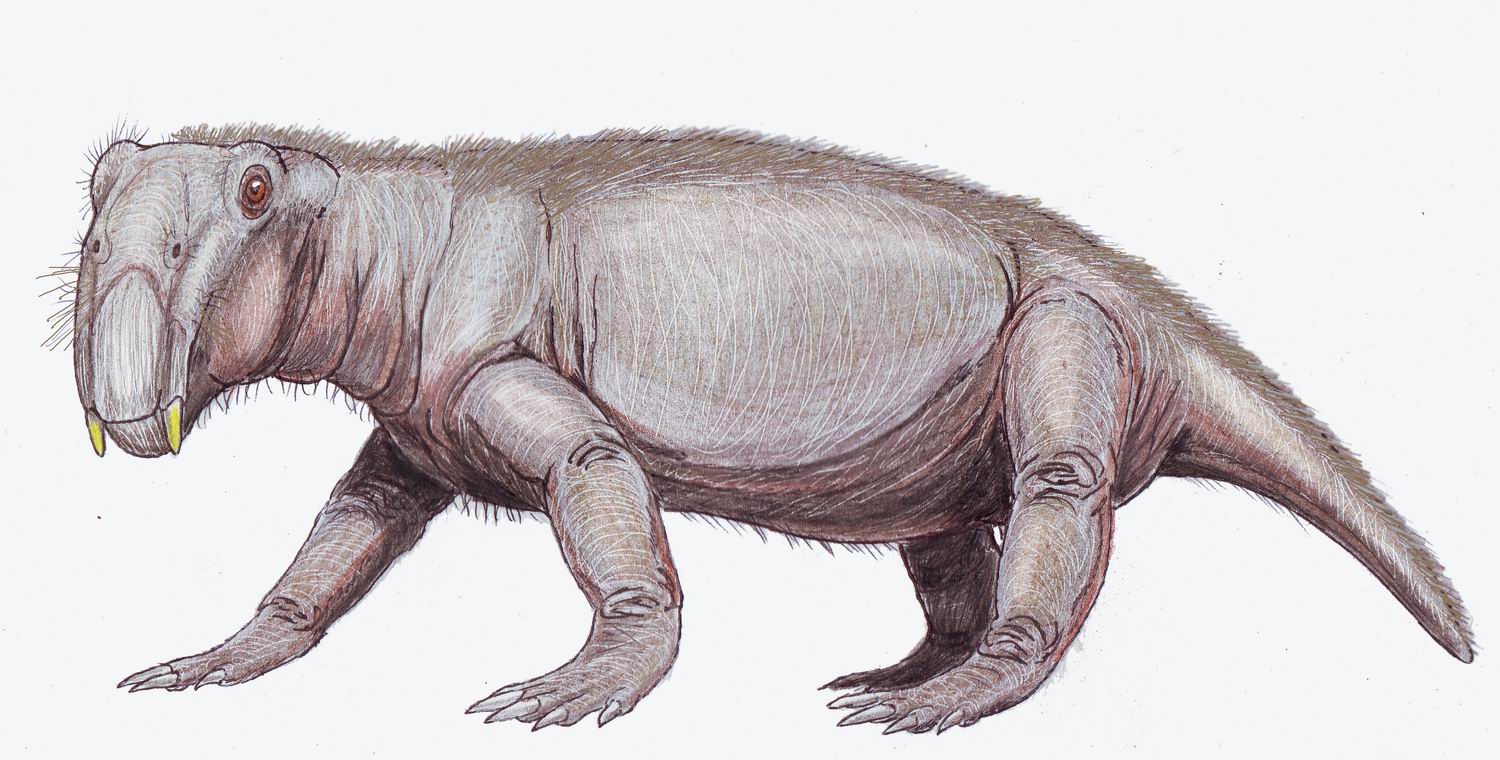

The dicynodonts are moderately more famous than the Gorgons. They are one of the major actors in the Late Permian Ecosystem and were probably one of the main sources of prey for the gorgons. What they are most famous for though is not the Permian Era, but just afterwards, on the other side of the Permian Mass Extinction, in the Early Triassic. That would be because Lystrosaurus would become the most successful and wide spread critter until the advent of Humanity.


They were found on every continent of the modern world: in truth, back then, it was all one giant supercontinent called Pangaea. Even so, they ranged from pole to pole, across virtually all terrains and environments. Lystrosaurus was what we call a disaster taxon: a species or genus of critter or plant that exploits the clearing of niches by some sort of extinction event. In this case, the ultimate of extinctions (to date) is what cleared the actors so the Lystrosaurus' time strutting and fretting on the geological stage would be noticeable at all. Unfortunately, multiple times, this time period has been called "When Pigs Ruled the Earth." Alas. Partially that's because they were approximately pig sized and generalist herbivores of a sort. I believe that the origin of the phrase can be traced back to Dr Micheal Benton, since I encountered something similar to it when reading his book on the subject. However, let's back up a minute, or perhaps better yet, several million years and discuss the chronology of the dicynodonts before - and after! - Lystrosaurus.

The dicynodonts appeared during the great radiation of synapsids in the Middle Permian, around 230 million years ago, alongside the Gorgons and numerous others. The dicynodonts ranged in size from moles and gophers to as large as hippos. They were exclusively herbivores. It was thought for a very long time that they were largely wiped out by the Triassic-Jurassic Mass Extinction with a mere handful surviin into the early Jurassic and petering out there as the dinosaurs took over. Remarkably, there was a singular fossil found in Australia from the early Cretaceous from an unknown dicynodont. It came from a region that contained exclusively Cretaceous strata and thus precluded this being a reworked fossil. This is a good example of a Lazarus Taxon or Ghost Lineage. It's exciting that the megafauna therapsids held out so long, but in some ways given the fauna of what is now Australia and then a part of Gondwanaland, it shouldn't be was much of a surprise.

Australia has been something of a refugium for animals for a very, very long time. Obviously, the fauna of Australia is pretty unique now. However, even back in the Cretaceous this is true. For a moment, this bares discusses, because its something of an enigma. While our late surviving dicynodont is one good example, there are others as well. Another excellent example is Koolasuchus. This is a Temnospondyl that seems, as far as we can tell, to have been the last of its kind. It lived in rift valleys that were too cold in winter for crocodiles to survive in and presumably lived a similar life style. Another good example of Australia's odd and unique refugium status is that of the dominance of the Hypsilophodonts long after they were supplanted elsewhere. The most famous of the Hypsilophodonts from Australia is the odd, but interestingly dark adapted Leaellynasaura amicagraphica. As to why this is the case, since Australia was a part of the greater Gondwana, we're not sure. The only guess is that Australia and Antarctica might have been more isolated because of the rising Cretaceous continental seaway transgressions. However, we're not sure, because it would be thought that Australia should have something similar in fauna to at least the late Jurassic pan-Gondwanan...yet...it doesn't. It truly is odd. At any rate, let's return to our subject at hand, the dicynodonts.


So what makes a dicynodont a dicynodont? The name dicynodont literally means "Two" (di) "dog" (cyn) "tooth" (dont). The dicynodonts lost most of their teeth, including all of their incisors, through their own convoluted evolution except those two tusks that reminded their early discoverers of dog's teeth, especially the canines. Even so, some of the dicynodonts lost even those. So what did they eat with? Something that was unique among the synapsids: they had a beak. Instead of dicynodont, perhaps they ought to have been called psittacostiosaurs (bird mouth reptiles/lizards) or psittacoaazosaurs (pretty much the same thing) rather than refer to the tusks. Their jaws were something extraordinary though. They had a shearing action that, as far as I have found to date, is unique among the synapsids. To show it, I am going to swipe a picture from what is probably one of the best websites on the therapsids online:


In some ways, it reminds of how the Gorgons would thrust their jaws forward to get around their sabre teeth. The closest analogs to their seem to have been either the ceratopsians or the rhynchosaurs. Their beaks filled the role of incisors and their own bony plates or dental batteries would sheer the plant matter into smaller bits to be digested. Our own molars crush and grind. Their equivalents were closer in function to our incisors....which seems a little odd to us with the generalized mammalian set of teeth. It is interesting that this chewing arrangement arose three different times in three different very unrelated lineages. This tells us that the arrangement of teeth and chewing as such was useful for some reason. Also interestingly when this arrangement arose in the dicynodonts, it was the first complex chewing mechanism to have evolved.

There are other characteristics that characterize up the dicynodonts, one that was important was the arrangement of their legs. We have a pretty good picture of how the dicynodont legs evolved over time. Originally, soon after their appearance in the fossil record, they were sprawlers, that is to say that they had their legs jutted out not unlike a crocodilian does, looking as though they are in the start position to do push-ups. At the start, botht he front and back legs were like this. Over time though, and especially in the larger specimens, the hind legs were pulled in under the body to support its larger weight and possibly deal with the the improved respiratory system that may have accompanied it. Based on fossil footprints from South Africa's Karoo Basin, the locomotion of the dicynodonts was something more akin to a slow waddle than anything else: these guys were not going to outrun anyone. On the other hand, based on their bite, they might have given their predators quite a fight.

Their senses were not as developed our mammalian line. Their hearing was poor and limited to lower frequencies rather like the Gorgons. The acute sense of hearing that we take advantage of to listen to Mozart or try to remove as much as possible by playing the ipod too loud is a mammalian derived characteristic: our earbones as call them are derived from our ancestors' jaw bones. Interestingly, it seems at though the sense of smell for a dicynodont was not very developed either. Unlike the Gorgons, they had no reason to track anything by smell, but on the other hand, they couldn't get a whiff of a stinky Gorgon until it was too late. Their eye sight seems to have been pretty good and they would have relied on that as their means of detecting danger and getting around.

There are a few other distinguishing characteristics as well. Finishing up with the head, their's was heavy. Really heavy. They had extensive musculature across their back to support it. They would have had thick, meaty necks if we were to see them. In fact, several vertebrae were fused for attachment purposes if I have understood correctly. Dicynodont bodies were also tubular. They were eating machines and their bodies were built for it. They had a short tail for a therapsid. It probably didn't look like a mammalian tail though.

One thing that we seem to know is that the dicynodonts were definitely social. The Placerias Quarry has what seems to have been a herd of Placerias that died there, possibly due to a drought.
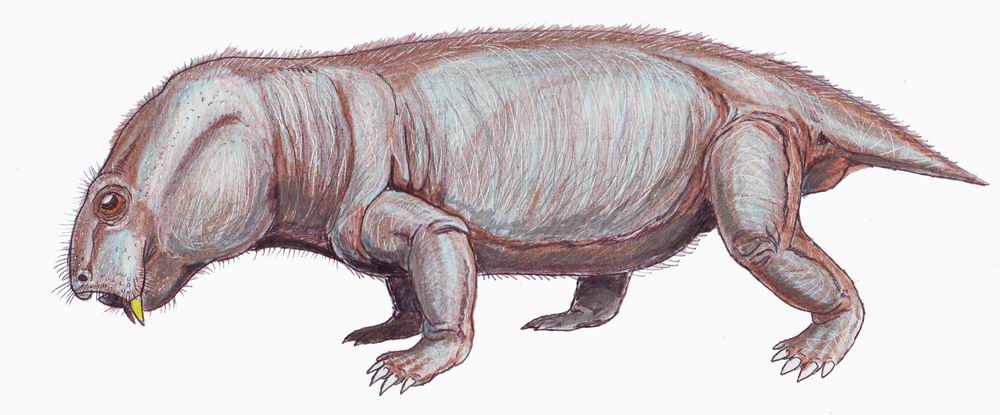

What don't we know? Simply. A lot. We don't know if the dicynodonts laid eggs or had life birth or something in between. Based on recent work though for the genes related to producing egg yolks, there's a good chance that laying eggs is the basal position for the synapsids in general. There's also the possibility that the dicynodonts gave milk. However, we really don't know and it depends on when lactating evolved. Was it before or after the split off of our ancestors and our subjects here? we don't know. There's working being done though. Likewise, we don't know if they were hairy or not. No dicynodont mummies have been found. There was some fossilized skin of a therapsid (or possibly two), but neither was a dicynodont; however, what those skin samples showed, despite the drawings above that show hair, was that there was none. There is no mention in the literature that I have perused that dicynodonts had any identifying marks on the skulls that suggest that they had nerve endings for whiskers. Though that would have made them even more...odd...looking. Finally, no one really seems to know whether or not these creatures were warm blooded or not.


Most likely the original main carnivores of the dicynodonts were the Gorgons. However, the therocephalians and the large croc-like amphibians probably munched on them as well. As time went by the archosaurs took over that role after the Permian Extinction wiped out the previous fillers of that role. In the end, you can imagine that theropods were doing the dirty work in what is now Gondwana at the twilight of the dicynodonts. Just imagine, a big allosaur ripping apart a carcass instead of that Euchambersia. Talk about an odd, odd visual. It's almost like one of those B movies where they mix up all the different dinosaurs from different periods. Except...it was real.

That said, it is very possible that the dicynodonts made it to the end of the Cretaceous. What a bitter irony it would be that they made it through all those millions of years of dinosaur dominance and two of the five major mass extinctions only to get munged by a rock from the sky. Such a pity. After all, they might have had a chance to do the Lystrosaurus dance again. Then again, what would have happened had they not had most of their families wipe out by the Permian Extinction? What would they have done had they survived the KT impact? Assuming that they made it to the KT, of course.

However, just because I am me and can't help myself: let's play a little what-if here. By luck, there's a microsized dicynodont that lived off shore of Gondwana. It's suffered island dwarfing and is about a half meter long. The Great Rock in the Sky pours itself into the Caribbean and the dinos dies. Well, the non avians ones. By a fluke that didn't happen OTL, the small dicynodonts get rafted off their island before they die out as they did in OTL. ATL they end up on Australia and are able to find just enough food to survive the months of darkness that crashed the Mesozoic ecosystems. Then in Australia, because they have the size edge on the mammals, they grow large and in charge...for the herbivore role. At least for a time. I could easily see a Paleogene in Australia and Antarctica with large sized dicynodonts. Past that? Whose to say...

To wrap up, I hope that you all have enjoyed our little exploration of the dicynodonts. My apologies that this is not as long or nearly as high of quality as the post on the Gorgons. I am under a lot more of a time crunch these days and I have been using this as a means to relax as I dig through articles and try to write this. I'll be revisiting the dicynodonts when Zach and I finally get the No Permian Extinction Post & Art done. It'll be a while though. Too much to do with the mischief and not enough time.

Hey, if there's anyone out there with $30k to burn on a sponsorship lemme know. I am getting tons of expensive goodies for my side project but no cash. Need cash. Machinists don't get paid on software, hardware, or other goodies. Sheesh.