Swiss Post, Swiss WorldCargo and Matternet are jointly testing the commercial use of logistics drones. The three companies are investigating specific uses of drone technology and examining the cost-effectiveness of these business ideas. They will be carrying out drone tests in July 2015 for this purpose. The widespread use of drones is not expected within the next five years. The focus is primarily on their use in exceptional cases or the transport of special items.

Imagine a fleet of driverless taxis roaming your city, ready to pick you up and take you to your destination at a moment's notice. While this may seem fantastical, it may be only a matter of time before it becomes reality. And according to a new study from Lawrence Berkeley National Laboratory (Berkeley Lab), such a system would both be cost-effective and greatly reduce per-mile emissions of greenhouse gases.
The analysis found that the per-mile greenhouse gas emissions of an electric vehicle deployed as a self-driving, or autonomous, taxi in 2030 would be 63 to 82 percent lower than a projected 2030 hybrid vehicle driven as a privately owned car and 90 percent lower than a 2014 gasoline-powered private vehicle. Almost half of the savings is attributable to "right-sizing," where the size of the taxi deployed is tailored to each trip's occupancy needs.
The results were published online today by Nature Climate Change in an article titled, "Autonomous taxis could greatly reduce greenhouse gas emissions of U.S. light-duty vehicles," co-authored by Berkeley Lab scientists Jeffery Greenblatt and Samveg Saxena.
"When we first started looking at autonomous vehicles, we found that, of all the variables we could consider, the use of autonomous vehicles as part of a shared transit system seemed to be the biggest lever that pointed to lower energy use per mile," said Greenblatt.
Many automakers and other companies are working on autonomous cars. Right-sizing is cost-effective for both the fleet owner and for passengers, and small one- and two-seat vehicles are being explored by researchers and companies. To illustrate the concept, consider a single passenger with no luggage versus a party of four passengers with suitcases. The single passenger would require a much smaller taxi than the party of four, saving money for vehicle owners and passengers. Right-sizing, of course, assumes a fleet of taxis managed by a single entity.
"Most trips in the U.S. are taken singly, meaning one- or two-seat cars would satisfy most trips," Greenblatt said. "That gives us a factor of two savings, since smaller vehicles means reduced energy use and greenhouse gas emissions."
Another factor contributing to lower emissions for autonomous taxis is a cleaner electric grid. By 2030 power plants are expected to be using more renewable energy and emitting less pollution, meaning the greenhouse gas intensity of electricity will be lower.
Self-driving cars have additional efficiencies that have been covered in other research, such as the ability to drive closely behind other autonomous cars to reduce wind resistance ("platooning"), optimally routing trips, and smoother acceleration and braking. "These are all incremental, but they do add up," Greenblatt said. "However, we didn't even include these effects in our baseline results, and we still get huge savings without them."
CS/NERSC Seminar: NERSC's relationship with the Joint Genome Institute
Berkeley Lab – Computing Sciences Seminar Series
Date:
Tuesday, May 12, 2015
Time:
12:00pm - 1:00pm
Location:
NERSC OSF 943, Conference Room 238
Speaker:
Kjiersten Fagnan
JGI-NERSC
Title:
NERSC's relationship with the Joint Genome Institute
Abstract:
Have you ever wondered what the JGI does? Or why they generate so many tickets? Or why they need so many large file systems? In thisbrown bag I'll give an overview of the JGI, the science they do and how NERSC supports them. I'll cover their data management system, JAMO, some of the workflows and pipelines they run to process data and talk a little bit about the joint projects we have to improve the JGI's scientific computing practices.
Taking careful aim with a quadrillion watt laser, researchers at the US Department of Energy’s Lawrence Berkeley National Lab claim to have managed to speed up subatomic particles to the highest energies ever recorded for a compact accelerator. By blasting plasma in their tabletop-size laser-plasma accelerator, the scientists assert that they have produced acceleration energy of around of 4.25 giga-electron volts. Acceleration of this magnitude over the short distances involved correlates to an energy rise 1,000 times greater than that of a traditional – and very much larger – particle accelerator.
The Large Hadron Collider (LHC) at CERN, for example, is some 17 miles (27 km) in circumference, and accelerates particles by way of a series of sequential, modulated electromagnetic fields contained in a metal cavity. This is perfectly fine for anything up to about 100 mega-electron volts per meter before things go awry and the metal cavity starts to break apart.
By comparison, the tiny Berkeley Lab accelerator achieves its world record by accelerating electrons inside a plasma tube just 9 cm (3.5 in) long up to a speed that would normally take an average particle accelerator many, many miles to achieve (if at all), and in a unit that sits comfortably on the top of a laboratory table.
To be fair to traditional particle accelerators, laser-plasma accelerators take a completely different approach to exciting particles to such enormous energy levels. In this case, the experiment was realized with the assistance of one of the most powerful lasers in the world, the Berkeley Lab Laser Accelerator (BELLA). This laser system produces a beam of light equivalent to a quadrillion watts of power (a petawatt), which the Berkeley researchers used to focus on the very small, straw-like tube that contained the plasma of their particle accelerator. Though, in this initial experiment, it was limited to pulses of a "mere" 0.3 PW or 300,000 gigawatts.
Not long ago, it would have taken several years to run a high-resolution simulation on a global climate model. But using some of the most powerful supercomputers now available, Lawrence Berkeley National Laboratory (Berkeley Lab) climate scientist Michael Wehner was able to complete a run in just three months.
What he found was that not only were the simulations much closer to actual observations, but the high-resolution models were far better at reproducing intense storms, such as hurricanes and cyclones. The study, "The effect of horizontal resolution on simulation quality in the Community Atmospheric Model, CAM5.1," has been published online in the Journal of Advances in Modeling Earth Systems.
"I've been calling this a golden age for high-resolution climate modeling because these supercomputers are enabling us to do gee-whiz science in a way we haven't been able to do before," said Wehner, who was also a lead author for the recent Fifth Assessment Report of the Intergovernmental Panel on Climate Change (IPCC). "These kinds of calculations have gone from basically intractable to heroic to now doable."
Using version 5.1 of the Community Atmospheric Model, developed by the Department of Energy (DOE) and the National Science Foundation (NSF) for use by the scientific community, Wehner and his co-authors conducted an analysis for the period 1979 to 2005 at three spatial resolutions: 25 km, 100 km, and 200 km. They then compared those results to each other and to observations.
One simulation generated 100 terabytes of data, or 100,000 gigabytes. The computing was performed at Berkeley Lab's National Energy Research Scientific Computing Center (NERSC), a DOE Office of Science User Facility. "I've literally waited my entire career to be able to do these simulations," Wehner said.
The higher resolution was particularly helpful in mountainous areas since the models take an average of the altitude in the grid (25 square km for high resolution, 200 square km for low resolution). With more accurate representation of mountainous terrain, the higher resolution model is better able to simulate snow and rain in those regions.
"High resolution gives us the ability to look at intense weather, like hurricanes," said Kevin Reed, a researcher at the National Center for Atmospheric Research (NCAR) and a co-author on the paper. "It also gives us the ability to look at things locally at a lot higher fidelity. Simulations are much more realistic at any given place, especially if that place has a lot of topography."

Certain primordial stars—those between 55,000 and 56,000 times the mass of our Sun, or solar masses—may have died unusually. In death, these objects—among the Universe’s first-generation of stars—would have exploded as supernovae and burned completely, leaving no remnant black hole behind.
Astrophysicists at the University of California, Santa Cruz (UCSC) and the University of Minnesota came to this conclusion after running a number of supercomputer simulations at the Department of Energy’s (DOE's) National Energy Research Scientific Computing Center (NERSC) and Minnesota Supercomputing Institute at the University of Minnesota. They relied extensively on CASTRO, a compressible astrophysics code developed at DOE's Lawrence Berkeley National Laboratory’s (Berkeley Lab’s) Computational Research Division (CRD). Their findings were recently published in Astrophysical Journal (ApJ).
First-generation stars are especially interesting because they produced the first heavy elements, or chemical elements other than hydrogen and helium. In death, they sent their chemical creations into outer space, paving the way for subsequent generations of stars, solar systems and galaxies. With a greater understanding of how these first stars died, scientists hope to glean some insights about how the Universe, as we know it today, came to be.
“We found that there is a narrow window where supermassive stars could explode completely instead of becoming a supermassive black hole—no one has ever found this mechanism before,” says Ke-Jung Chen, a postdoctoral researcher at UCSC and lead author of the ApJ paper. “Without NERSC resources, it would have taken us a lot longer to reach this result. From a user perspective, the facility is run very efficiently and it is an extremely convenient place to do science.”
Researchers studying organic material from dinosaur bones have been able to show that the organic material in the samples contained original soft tissue material from Mesozoic dinosaurs. The x-ray techniques at the ALS were key to showing a possible mechanism for this unexpected preservation—iron nanoparticles associated with dinosaur blood vessels were identified at the ALS. Researchers hypothesized that the iron had come from dinosaurs’ blood and muscle cells during decay, and were able to identify iron-facilitated reactions that contribute to preservation. If these reactions occur in other organisms that end in the fossil record, similar preservation may allow the identification of molecular evolutionary relationships, rates and direction of evolutionary change, and eventually the characterization of other traits that have, until now, remained beyond scientists’ grasp.
It took every inch of the Large Hadron Collider's 17-mile length to accelerate particles to energies high enough to discover the Higgs boson. Now, imagine an accelerator that could do the same thing in, say, the length of a football field. Or less.
That is the promise of laser-plasma accelerators, which use lasers instead of high-power radio-frequency waves to energize electrons in very short distances. Scientists have grappled with building these devices for two decades, and a new theoretical study predicts that this may be easier than previously thought.
The authors are Carlo Benedetti, Carl Schroeder, Eric Esarey, and Wim Leemans, physicists at Lawrence Berkeley National Laboratory's Berkeley Lab Laser Accelerator (BELLA) Center. Their paper, "Plasma wakefields driven by an incoherent combination of laser pulses: A path towards high-average power laser-plasma accelerators," appears in the May Special Issue of Physics of Plasmas, from AIP Publishing.
If their models prove correct, they could help lower the cost of high-energy physics research -- the Large Hadron Collider cost $9 billion -- as well as many other industrial and medical applications of accelerators.
Laser-plasma accelerators work by blasting a powerful laser beam into a plasma, a cloud of unattached electrons and ions.
"The effect is like the wake of boat speeding down a lake. If the wake was big enough, a surfer could ride it," Leemans, who heads the BELLA Center, explained.
"Imagine that the plasma is the lake and the laser is the motorboat. When the laser plows through the plasma, the pressure created by its photons pushes the electrons out of the way. They wind up surfing the wake, or wakefield, created by the laser as it moves down the accelerator," he said.
The fast moving electrons leave the heavy ions behind. As they separate, they create gigantic electric fields, 100 to 1,000 times larger than those in conventional accelerators.
This is how they accelerate electrons so rapidly. For example, Stanford's Linear Accelerator Center takes two miles to drive an electron to 50 billion electron volts (GeV). Leemans' experimental laser-plasma accelerator takes electrons to more than 1 GeV in slightly more than 1 inch.
It takes a lot of laser power to generate a wakefield. For example, BELLA's petawatt (1 quadrillion watts) laser has a 10 meter x 10 meter footprint. It generates 400 times more power than all the world's power plants combined, though only for 40 femtoseconds (40 quadrillionths of a second).
Unfortunately, it takes BELLA's laser a full second to recharge and send a second pulse. High-energy physics research requires tens of thousands of pulses per second. Many other applications would benefit from multiple pulses per second.
BELLA's laser has the highest repetition rate of any petawatt laser in the world. Building a faster petawatt laser would require a heroic feat of engineering.
Several European researchers have suggested using an array of smaller lasers to produce one enormous pulse. Since less powerful lasers recharge faster, they could produce hundreds or even thousands of pulses per second and sustain a wakefield over many meters.
The hurdle they needed to overcome was how to synchronize hundreds of lasers so they all pulsed within less than a femtosecond of one another.
Such precision would be expensive and presents serious technical problems. But the concept of combining lasers got Leemans' team thinking.
What if the beam was not perfect? What if it were just good enough to rapidly raise the photon pressure on the electrons? Could we get away with it, they wondered.
According to the model presented in Physics of Plasmas, they could. Leemans compares it to pushing a swing.
"Instead of one big push, we would give it many smaller pushes at roughly the same time. It's not quite perfect, but the swing doesn't really care. It averages over all these little pushes and up it goes."
Representatives from D-Wave, the first commercial quantum computing company, will discuss the company’s technologies at 9:30 a.m. Tuesday, May 6, in Bldg. 50A-5132. The presentation will briefly review D-Wave and its products – which claims to have built the world’s first commercial quantum computing systems. D-Wave has created a unique quantum computer that uses superconducting circuits to create systems with up to 500 qubits in a “quantum annealing” architecture. The talk will cover the hardware, architecture, programming models and some applications. The company released its first commercial system, the D-Wave One™ quantum computer in 2010. In 2013, D-Wave shipped its 512-qubit D-Wave Two™ system.
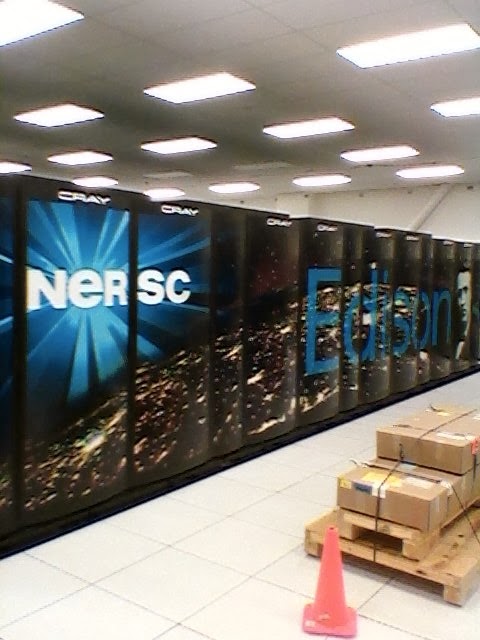
The U.S. Department of Energy’s (DOE) National Energy Research Scientific Computing (NERSC) Center and Cray Inc. announced today that they have signed a contract for a next generation of supercomputer to enable scientific discovery at the DOE’s Office of Science (DOE SC).
Lawrence Berkeley National Laboratory (Berkeley Lab), which manages NERSC, collaborated with Los Alamos National Laboratory and Sandia National Laboratories to develop the technical requirements for the system.
The new, next-generation Cray XC supercomputer will use Intel’s next-generation Intel® Xeon Phi™ processor –- code-named “Knights Landing” -- a self-hosted, manycore processor with on-package high bandwidth memory and delivers more than 3 teraFLOPS of double-precision peak performance per single socket node. Scheduled for delivery in mid-2016, the new system will deliver 10x the sustained computing capability of NERSC’s Hopper system, a Cray XE6 supercomputer.
NERSC serves as the DOE SC’s primary high performance computing (HPC) facility, supporting more than 5,000 scientists annually on over 700 projects. The $70 million plus contract represents the DOE SC’s ongoing commitment to enabling extreme-scale science to address challenges such as developing new energy sources, improving energy efficiency, understanding climate change, developing new materials and analyzing massive data sets from experimental facilities around the world.
[...]
To highlight its commitment to advancing research, NERSC names its supercomputers after noted scientists. The new system will be named “Cori” in honor of bio-chemist and Nobel Laureate Gerty Cori, the first American woman to receive a Nobel Prize in science.
Technical Highlights
Cori the supercomputer will have over 9300 Knights Landing compute nodes and provide over 400 gigabytes per second of I/O bandwidth and 28 petabytes of disk space. The contract also includes an option for a “Burst Buffer,” a layer of NVRAM that would move data more quickly between processor and disk, allowing users to make the most efficient use of the system while saving energy. The Cray XC system features the Aries high-performance interconnect linking the processors, which also increases efficiency. Cori will be installed directly into the new Computational Research and Theory facility currently being constructed on the main Berkeley Lab campus.


One out of every five sun-like stars in our Milky Way galaxy has an Earth-sized planet orbiting it in the Goldilocks zone—not too hot, not too cold—where surface temperatures should be compatible with liquid water, according to a statistical analysis of data from NASA’s Kepler spacecraft by Erik Petigura, a graduate student at the University of California, Berkeley (UC Berkeley).
Petigura and his colleague Andrew Howard, now at the University of Hawaii, Manoa, spent three years developing a transit search pipeline called TERRA that is optimized for finding small planets. When they used this tool on supercomputers at the Department of Energy’s (DOE’s) National Energy Research Scientific Computing Center (NERSC) to analyze nearly four years of Kepler observations, the scientists determined that our galaxy could contain as many as 40 billion habitable Earth-sized planets.

Nature designed lignin, the tough woody polymer in the walls of plant cells, to bind and protect the cellulose sugars that plants use for energy. For this reason, lignin is a major challenge for those who would extract those same plant sugars and use them to make advanced biofuels. As part of their search for economic ways to overcome the lignin challenge, researchers at the Joint BioEnergy Institute (JBEI) have characterized the enzymatic activity of a rain forest microbe that breaks down lignin essentially by breathing it.
"Using a combination of transcriptomics and proteomics we observed the anaerobe Enterobacter lignolyticus SCF1 as it grows on lignin," says Blake Simmons, a chemical engineer who heads JBEI's Deconstruction Division. "We detected significant lignin degradation over time by absorbance, suggesting that enzymes in E. lignolyticus could be used to deconstruct lignin and improve biofuels production. Our results also demonstrate the value of a multi-omics approach for providing insight into the natural processes of bacterial lignin decomposition."
Not only does lignin inhibit access to cellulose, the by-products of lignin degradation can also be toxic to microbes employed to ferment sugars into fuels. This makes finding microbes that can tolerate a lignin environment a priority for biofuels research. Tropical rainforests harbor anaerobic microbes that actually utilize lignin as their sole source of carbon. Kristen DeAngelis, a microbial ecologist formerly of JBEI and now with the University of Massachusetts, has led expeditions to the Luquillo Experimental Forest where she and her crew harvested soil microbes.
"Tropical soil microbes are responsible for the nearly complete decomposition of leaf plant litter in as little as eighteen months," she says. "The fast growth, high efficiency and specificity of enzymes employed in the anaerobic litter deconstruction carried out by these tropical soil bacteria make them useful templates for improving biofuel production."
In an earlier study at JBEI led by DeAngelis, E. lignolyticus SCF1 is a member, was shown to be capable of anaerobic lignin degradation, but the enzymes behind this degradation were unknown. Through their multi-omics approach plus measurements of enzyme activities, DeAngelis, Simmons and their colleagues were able to characterize the mechanisms by which E. lignolyticus SCF1 is able to degrade lignin during anaerobic growth conditions.

CS Seminar: Toward Smart-tuned Krylov-based Methods for Future Extreme Computing
Berkeley Lab – Computing Sciences Seminar
Date: Thursday, August 15, 2013
Time: 11:00am - 12:00pm
Location: Bldg. 50F, Room 1647
Speaker: Serge G. Petiton
Maison de la Simulation/CNRS and University Lille 1, Sciences et Technologies
Title: Toward Smart-tuned Krylov-based Methods for Future Extreme Computing
Abstract:
Exascale hypercomputers are expected to have highly hierarchical architectures with nodes composed by lot-of-core processors and accelerators. The different programming levels (from clusters of processors loosely connected to tightly connected lot-of-core processors and/or accelerators) will generate new difficult algorithm issues. New methods should be defined and evaluated with respect to modern state-of-the-art of applied mathematics and scientific methods.
Krylov linear methods such as GMRES and ERAM are now heavily used with success in various domains and industries despite their complexity. Their convergence and speed greatly depends on the hardware used and on the choice of the Krylov subspace size and other parameters which are difficult to determine efficiently in advance. Moreover, hybrid Krylov Methods would allow reducing the communications along all the cores, limiting the reduction only through subsets of these cores. Added to their numerical behaviours and their fault tolerance properties, these methods are interesting candidates for exascale/extreme matrix computing. Avoiding communication strategies may also be developed for each of the instance of these methods, generating complex methods but with high potential efficiencies. These methods have a lot of correlated parameter which may be optimized using auto/smart-tuning strategies to accelerate convergence, minimize storage space, data movements, and energy consumption.
In this talk, we first will present some basic matrix operations utilized on Krylov methods on clusters of accelerators, with respect to a few chosen sparse compressed formats. We will discuss some recent experiments on a cluster of accelerators concerning comparison between orthogonal, incompletely orthogonal and non-orthogonal Krylov Basis computing. Then, we will discuss some results obtained on a cluster of accelerators to compute eigenvalues using the MERAM method with respect to the restarting strategies. We will survey some auto/smarttunning strategies we proposed and evaluated for some of the Krylov method parameters. As a conclusion, we will propose auto-tuning strategies for future hybrid methods on post-petascale computers, on the road to exascale hybrid methods.
Joint wok with: Nahid Emad (U. Versailles), Leroy Drummond (LBNL), France Boillod and Christophe Calvin (CEA), Langshi Chen (CNRS), Maxime Hugu
Performance Analysis Gap: Processor Complexity Keeps Climbing – Developers Are More Naïve Than EverBerkeley Lab – Computing Sciences SeminarDate: Thursday, August 8, 2013Time: 10:00am - 11:00amLocation: Bldg. 50F, Room 1647Speaker: Wucherl YooComputer Science DepartmentUniversity of IllinoisAbstract:The performance analysis gap is widening as processor complexity keeps climbing and developers are becoming more naïve than ever. Seemingly suitable programs can run correctly, but may suffer from hidden hardware bottlenecks that can severely hinder performance. Performance Monitoring Unit (PMU) events can provide programmers with unique and powerful insights into performance problems in their programs, but interpreting these events has been a significant challenge. While the conventional performance tuning tools can measure and visualize hardware events, they lack automatic identification of dominant resource bottlenecks and significant manual effort is required from experts to interpret the hardware events.ARGH!IDK if I can make it. I really ought to, but,,,

From solar cells to optoelectronic sensors to lasers and imaging devices, many of today's semiconductor technologies hinge upon the absorption of light. Absorption is especially critical for nano-sized structures at the interface between two energy barriers called quantum wells, in which the movement of charge carriers is confined to two-dimensions. Now, for the first time, a simple law of light absorption for 2D semiconductors has been demonstrated.
Working with ultrathin membranes of the semiconductor indium arsenide, a team of researchers with the U.S. Department of Energy (DOE)'s Lawrence Berkeley National Laboratory (Berkeley Lab) has discovered a quantum unit of photon absorption, which they have dubbed "AQ," that should be general to all 2D semiconductors, including compound semiconductors of the III-V family that are favored for solar films and optoelectronic devices. This discovery not only provides new insight into the optical properties of 2D semiconductors and quantum wells, it should also open doors to exotic new optoelectronic and photonic technologies.
"We used free-standing indium arsenide membranes down to three nanometers in thickness as a model material system to accurately probe the absorption properties of 2D semiconductors as a function of membrane thickness and electron band structure," says Ali Javey, a faculty scientist in Berkeley Lab's Materials Sciences Division and a professor of electrical engineering and computer science at the University of California (UC) Berkeley. "We discovered that the magnitude of step-wise absorptance in these materials is independent of thickness and band structure details."