When paleontologists at the University of Washington cut into the fossilized jaw of a distant mammal relative, they got more than they bargained for -- more teeth, to be specific.
As they report in a letter published Dec. 8 in the Journal of the American Medical Association Oncology, the team discovered evidence that the extinct species harbored a benign tumor made up of miniature, tooth-like structures. Known as a compound odontoma, this type of tumor is common to mammals today. But this animal lived 255 million years ago, before mammals even existed.
"We think this is by far the oldest known instance of a compound odontoma," said senior author Christian Sidor, a UW professor of biology and curator of vertebrate paleontology at the Burke Museum of Natural History and Culture. "It would indicate that this is an ancient type of tumor."
Before this discovery, the earliest known evidence of odontomas came from Ice Age-era fossils.
"Until now, the earliest known occurrence of this tumor was about one million years ago, in fossil mammals," said Judy Skog, program director in the National Science Foundation's Division of Earth Sciences, which funded the research. "These researchers have found an example in the ancestors of mammals that lived 255 million years ago. The discovery suggests that the suspected cause of an odontoma isn't tied solely to traits in modern species, as had been thought."

The terrestrial end-Permian mass extinction in South China
Authors:
Zhang et al
Abstract:
The end-Permian mass extinction reflects the most severe life crisis during the Phanerozoic and was associated with major global environmental changes. However, the consistency of the time and pattern of the terrestrial and marine extinctions remains controversial. In this paper, we presented detailed analyses of the high-resolution biostratigraphical and geochemical data from terrestrial sections in South China. Our analyses show that the transitional Kayitou Formation actually recorded the process of terrestrial mass extinction as evidenced by the mass disappearance of the Gigantopteris megaflora in the lower part, the dramatic reduction in abundance of palynomorphs in the middle, and the last occurrences of plant remains and abundant charcoal fossils in the uppermost part. It is associated with a distinct negative shift of δ13Corg, beginning in the middle part of the formation, which is correlative with that in the top of Bed 26 at the marine Meishan section. In addition, the Kayitou Formation is characterized by a distinct shift of lithofacies of fresh lake-swamp or river flat environment from olive/grey/black mudstone, siltstone, fine to coarse sandstone in the lower part to gradually increasing maroon rocks, to purely maroon mudrocks with poorly-sorted breccia, calcic palaeosols and calcareous nodules in the lowest part of the Dongchuan Formation, which indicates a dramatic collapse of soil system associated with rapid deforestation and climatic warming and drying. In the coastal area, the Kayitou Formation contains marine beds with the typical Permian–Triassic mixed faunas and floras which are correlative with the latest Changhsingian marine mixed fauna 1 at Meishan. The Kayitou Formation also recorded a distinct transgression that began in the latest Changhsingian. All above phenomena suggest that the Kayitou Formation is actually the witness of the terrestrial end-Permian mass extinction; and it is mostly or entirely of latest Changhsingian (Permian), rather than Triassic age.


A new eutherocephalian (Therapsida, Therocephalia) from the upper Permian Madumabisa Mudstone Formation (Luangwa Basin) of Zambia
Authors:
Huttenlocker et al
Abstract:
A new therocephalian therapsid, Ichibengops munyamadziensis, gen. et sp. nov., is described on the basis of two partial skulls from the upper Permian (Wuchiapingian) upper Madumabisa Mudstone Formation of the Luangwa Basin, Zambia. The specimens offer insights into the diversity of therocephalians in a poorly sampled region, preserving unique maxillary structures, dental morphology that is intermediate between basal therocephalians and eutherocephalians, and a maxillovomerine bridge forming an incipient secondary palate. A phylogenetic analysis of 135 craniodental and postcranial characters from 56 therapsid taxa (including 49 therocephalians) recovered I. munyamadziensis as the sister taxon of the Russian Chthonosaurus, with both taxa resolving near the hofmeyriid + whaitsiid + baurioid clade (either as the sister group to this clade or nested near whaitsiids). Ichibengops shares with Chthonosaurus several features, including a ventral maxillary flange in which the upper postcanines are situated (also in Lycosuchus), anteroposteriorly short suborbital vacuities with strongly scalloped anterior borders, a furrowed or ridged surface texture on the palatal surface of the palatine, and a possible maxillovomerine bridge (although this latter structure is incompletely preserved in Chthonosaurus). The new taxon, along with its proposed relationship to Chthonosaurus, adds to a list of sister-group pairs of Wuchiapingian tetrapods in southern Gondwana and Laurasia, indicating that effective, though largely unknown, dispersal routes persisted in Pangea at least through early late Permian times.
Charred wood of Prototaxoxylon from the Wuchiapingian Wutonggou Formation (Permian) of Dalongkou, northern Bogda Mountains, northwestern China
Authors:
Wan et al
Abstract:
Charred wood occurs sporadically in sedimentary rocks in China. A marcroscopic charcoal with well-preserved anatomical structure is described from the Wuchiapiangian Wutonggou Formation in the southern part of Dalongkou section, northern Bogda Mountains in the Junggar Basin, northwestern China. It is characterized by uniseriate radial tracheidal pitting, taxaceous tertiary spiral thickenings in the tracheidal walls, uniseriate tangential tracheidal pitting, homogeneous, uniseriate, 2-10 cells high xylem rays, and 1-2 pits in each cross-field. It is assigned to Prototaxoxylon uniseriale Prasad. The uniseriate, bordered, contiguous, rarely separate tangential pitting of P. uniseriale is evidenced clearly for the first time. The features of this species shows a close affinity with conifers. The coniferous charred wood may have been derived from an extrabasinal forest, perhaps from upland environment deep within the hinterland, according to results of modern taphonomic research.

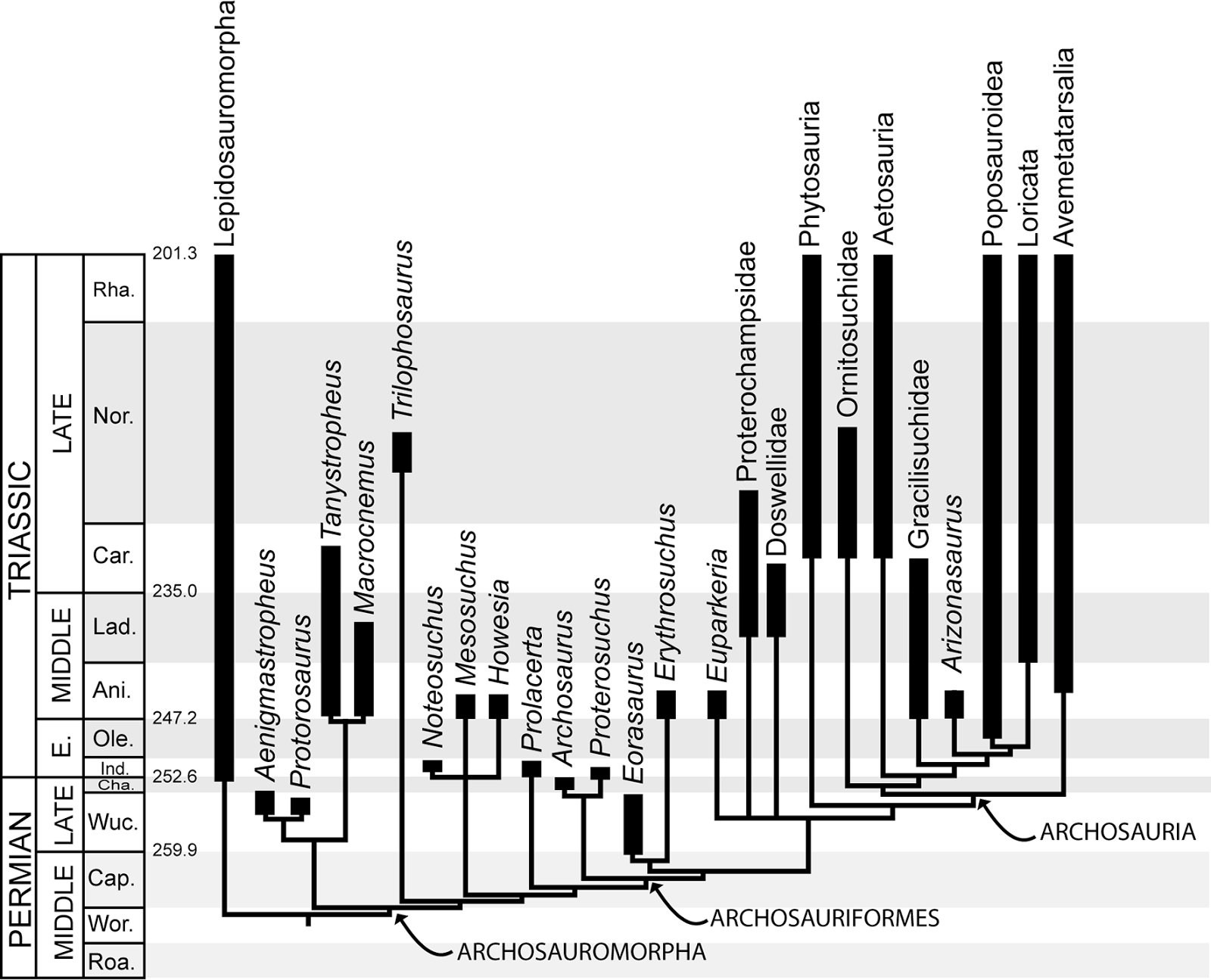
The Origin and Early Radiation of Archosauriforms: Integrating the Skeletal and Footprint Record
Authors:
Bernardi et al
Abstract:
We present a holistic approach to the study of early archosauriform evolution by integrating body and track records. The ichnological record supports a Late Permian–Early Triassic radiation of archosauriforms not well documented by skeletal material, and new footprints from the Upper Permian of the southern Alps (Italy) provide evidence for a diversity not yet sampled by body fossils. The integrative study of body fossil and footprint data supports the hypothesis that archosauriforms had already undergone substantial taxonomic diversification by the Late Permian and that by the Early Triassic archosauromorphs attained a broad geographical distribution over most parts of Pangea. Analysis of body size, as deduced from track size, suggests that archosauriform average body size did not change significantly from the Late Permian to the Early Triassic. A survey of facies yielding both skeletal and track record indicate an ecological preference for inland fluvial (lacustrine) environments for early archosauromorphs. Finally, although more data is needed, Late Permian chirotheriid imprints suggest a shift from sprawling to erect posture in archosauriforms before the end-Permian mass extinction event. We highlight the importance of approaching palaeobiological questions by using all available sources of data, specifically through integrating the body and track fossil record.
Septomedullopitys szei sp. nov., a new gymnospermous wood from Lower Wuchiapingian (Upper Permian) continental deposits of NW China, and its implication for a weakly seasonal humid climate in mid-latitude NE Pangaea
Authors:
Wan et al
Abstract:
Septomedullopitys szei sp. nov. is described from the Wuchiapingian Wutonggou Formation of Tarlong Valley, southern Bogda Mountains, Xinjiang, in northwestern China. The stem has a heterogeneous pith ca. 15–20 mm in diameter, and containing numerous linear secretory ducts and parenchymatous bands. Primary xylem is endarch and the tracheids contain scalariform thickenings. Secondary xylem is of the Protophyllocladoxylon type. Comparisons with contemporaneous gymnospermous woods containing either heterogeneous pith with ducts or Protophyllocladoxylon-type secondary xylem from the Angara palaeocontinent indicate that the Tarlong stem represents a new Permian morphotaxon for the region. The presence of coprolites, borings, and spindle-shaped cavities within the stem suggests well-developed animal–plant–fungi interactions. The occurrence of numerous growth interruptions and absence of true growth rings within the stem suggest weak seasonality of annual precipitation. The interruptions suggest a humid climate with short-term, nonperiodic droughts.

A new specimen of the temnospondyl Australerpeton cosgriffi from the late Permian of Brazil (Rio do Rasto Formation, Paraná Basin): comparative anatomy and phylogenetic relationships
Authors:
Eltink et al
Abstract:
A new temnospondyl specimen from the Rio do Rasto Formation (late Permian, Paraná Basin) of south Brazil is composed of a left mandible, right pelvis, femur, tibia, and fibula. Preserved lower jaws are rare for Australerpeton cosgriffi, and the weak ossification of the temnospondyl postcranium renders their preservation generally uncommon. A detailed comparative description of the material allowed its assignment to Australerpeton cosgriffi, and yielded new information about the morphology of mandible, pelvis, and hind limb of that taxon. This long-snouted temnospondyl has uncertain affinities and has been assigned either to stereospondyl Rhinesuchidae or to archegosaurid Platyoposaurinae. Reassessment of the phylogenetic placement of Australerpeton cosgriffi, with information drawn from the new specimen, confirms a basal stereospondyl position, between Peltobatrachus pustulatus and Rhinesuchidae. The synapomorphies shared with other stereospondyls include tabular and exoccipital contacting in the paroccipital process; parasphenoid articulates with corpus of the pterygoid forming a broad contact along the lateral margins of the parasphenoid plate; internal carotid passes through the dorsal surface of the parasphenoid plate; and parasphenoid denticles field enlarged to a transverse ‘belt’ extending between the pterygoid-parasphenoid articulations. Accordingly, Australerpeton cosgriffi represents one of the first stereospondyls, and the oldest long-snouted member of the group. The Paraná Basin can be included within the stereospondyl ancestral range, and dispersion and diversification of this clade appears to have happened before the Permo-Triassic boundary.

The Origin and Early Evolution of Sauria: Reassessing the Permian Saurian Fossil Record and the Timing of the Crocodile-Lizard Divergence
Authors:
Ezcurra et al
Abstract:
Sauria is the crown-group of Diapsida and is subdivided into Lepidosauromorpha and Archosauromorpha, comprising a high percentage of the diversity of living and fossil tetrapods. The split between lepidosauromorphs and archosauromorphs (the crocodile-lizard, or bird-lizard, divergence) is considered one of the key calibration points for molecular analyses of tetrapod phylogeny. Saurians have a very rich Mesozoic and Cenozoic fossil record, but their late Paleozoic (Permian) record is problematic. Several Permian specimens have been referred to Sauria, but the phylogenetic affinity of some of these records remains questionable. We reexamine and review all of these specimens here, providing new data on early saurian evolution including osteohistology, and present a new morphological phylogenetic dataset. We support previous studies that find that no valid Permian record for Lepidosauromorpha, and we also reject some of the previous referrals of Permian specimens to Archosauromorpha. The most informative Permian archosauromorph is Protorosaurus speneri from the middle Late Permian of Western Europe. A historically problematic specimen from the Late Permian of Tanzania is redescribed and reidentified as a new genus and species of basal archosauromorph: Aenigmastropheus parringtoni. The supposed protorosaur Eorasaurus olsoni from the Late Permian of Russia is recovered among Archosauriformes and may be the oldest known member of the group but the phylogenetic support for this position is low. The assignment of Archosaurus rossicus from the latest Permian of Russia to the archosauromorph clade Proterosuchidae is supported. Our revision suggests a minimum fossil calibration date for the crocodile-lizard split of 254.7 Ma. The occurrences of basal archosauromorphs in the northern (30°N) and southern (55°S) parts of Pangea imply a wider paleobiogeographic distribution for the group during the Late Permian than previously appreciated. Early archosauromorph growth strategies appear to be more diverse than previously suggested based on new data on the osteohistology of Aenigmastropheus.
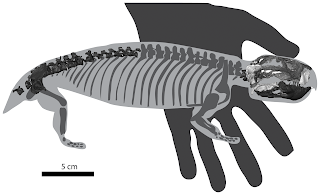

Bringing Dicynodonts Back to Life: Paleobiology and Anatomy of a New Emydopoid Genus from the Upper Permian of Mozambique
Authors:
Castanhinha et al
Abstract:
Dicynodontia represent the most diverse tetrapod group during the Late Permian. They survived the Permo-Triassic extinction and are central to understanding Permo-Triassic terrestrial ecosystems. Although extensively studied, several aspects of dicynodont paleobiology such as, neuroanatomy, inner ear morphology and internal cranial anatomy remain obscure. Here we describe a new dicynodont (Therapsida, Anomodontia) from northern Mozambique: Niassodon mfumukasi gen. et sp. nov. The holotype ML1620 was collected from the Late Permian K5 formation, Metangula Graben, Niassa Province northern Mozambique, an almost completely unexplored basin and country for vertebrate paleontology. Synchrotron radiation based micro-computed tomography (SRµCT), combined with a phylogenetic analysis, demonstrates a set of characters shared with Emydopoidea. All individual bones were digitally segmented allowing a 3D visualization of each element. In addition, we reconstructed the osseous labyrinth, endocast, cranial nerves and vasculature. The brain is narrow and the cerebellum is broader than the forebrain, resembling the conservative, “reptilian-grade” morphology of other non-mammalian therapsids, but the enlarged paraflocculi occupy the same relative volume as in birds. The orientation of the horizontal semicircular canals indicates a slightly more dorsally tilted head posture than previously assumed in other dicynodonts. In addition, synchrotron data shows a secondary center of ossification in the femur. Thus ML1620 represents, to our knowledge, the oldest fossil evidence of a secondary center of ossification, pushing back the evolutionary origins of this feature. The fact that the specimen represents a new species indicates that the Late Permian tetrapod fauna of east Africa is still incompletely known.