Korean trackway of a hopping, mammaliform trackmaker is global first from the Cretaceous
Authors:
Kim et al
Abstract:
A trackway of a small hopping mammaliform trackmaker from the Jinju Formation (Lower Cretaceous) of the Jinju City area, Korea, is the first of this type reported from the Mesozoic of Asia, and globally. The animal left a narrow trackway (∼20 mm wide) with small tetradactyl footprints averaging less than 10 mm in diameter. Only two footprints registered with each hop (mean length 41 mm) thus indicating a bipedal gait. All trackway evidence suggests a small “mouse-like” trackmaker. Previous reports of trackways made by hopping tetrapods from the Mesozoic are rare and presently restricted to ichnogenus Ameghinichnus isp. indet., from the Jurassic of Argentina. Ichnogenus Musaltipes from the Cenozoic of North America, is the only other ichnogenus representing a hopping mammal. The Korean specimen here named Koreasaltipes jinjuensis, is different from these aforementioned ichnogenera in digit count, digit proportion and trackway configuration, as well as lack of tail trace. Koreasaltipes jinjuensis is from a lake shore paleoenvironment associated with nematode tracks (Cochlichnus isp.), other small tetrapod tracks attributed to avian theropods (birds), pterosaurs and crocodylomorphs, as well as larger saurischian dinosaurs.
Showing posts with label trackways. Show all posts
Showing posts with label trackways. Show all posts
Friday, February 10, 2017
Evidence of a Hopping, Bipedal Mammaliform From Cretaceous Korea


Friday, November 04, 2016
Irish Middle Devonian Trackways Were Deposited in Semi Arid Environs
Ichnology and depositional environment of the Middle Devonian Valentia Island tetrapod trackways, south-west Ireland
Authors:
Stössel et al
Abstract:
Nine tetrapod trackways are described from the Middle Devonian continental Valentia Slate Formation on the north-eastern coast of Valentia Island in County Kerry, Ireland. The trackways occur at three sites – Dohilla, Coosadillisk and Culoo Head – the latter two being recorded for the first time. Morphological and taphonomic analyses of the trackways suggest they were made by populations of similar tetrapods, but of varying size (body length = 0.5 to 1 m; width = 0.15 to 0.30 m), that moved in some cases by terrestrial locomotion and in others possibly by a slow “paddling gait” while the substrate was submerged by very shallow floodwater. Sedimentological facies analysis of the trackway-bearing sequences has been carried out for the first time and shows that the preserved trackways are associated with the late stages of (1) a principal river channel margin (Coosadillisk), (2) a minor floodplain drainage channel (Culoo Head) and (3) a sand-rich crevasse splay/medial alluvial-ridge environment (Dohilla). The Valentia Island tetrapods inhabited marginal environments of proximal river channels less than 20 km from the northern margin of the Munster Basin, where hinterland drainage basins probably provided reliable sources of water in an overall semi-arid climate. It is proposed that the more perennial river channel belts crossing the basin would have provided conducive route ways that allowed ancestral tetrapods to migrate (greater than 170 km) northwards into the continent from postulated shallow marine habitats as they evolved this capability over a potential 4–5 million year period during the Middle Devonian.
Friday, August 05, 2016
A Giant Abelisaurus Theropod Foot Print Found in Bolivia
A footprint measuring over a metre wide has been discovered in the southern American country of Bolivia. It's thought to have been made by an Abelisaurus, a meat-eating dinosaur that walked the Earth millions of years ago. Palaeontologist Sebastian Apesteguia went to the site of the discovery.
link.
Tuesday, May 03, 2016
A Dinosaur Footprint Found From Carnian Triassic Spain?

Spain says a footprint of a dinosaur that roamed the area 230 million years ago has been found in northeastern Catalonia, and says it's the best preserved dinosaur print seen so far in the Iberian Peninsula.
The print of a reptile-like creature called an Isochirotherium — an ancestor of dinosaurs and crocodiles — was discovered in early April by a person out walking in Olesa de Montserrat, 40 kilometers (25 miles) north of Barcelona.
link.
Thursday, January 07, 2016
The Paleoenvironments of the Catalan Pyrenees From the Middle Permian Through the Olenekian Triassic
Constraining the Permian/Triassic transition in continental environments: Stratigraphic and paleontological record from the Catalan Pyrenees (NE Iberian Peninsula)
Authors:
Mujal et al
Abstract:
The continental Permian-Triassic transition in southern Europe presents little paleontological evidence of the Permian mass extinction and the subsequent faunal recovery during the early stages of the Triassic. New stratigraphic, sedimentological and paleontological analyses from Middle-Upper Permian to Lower-Middle Triassic deposits of the Catalan Pyrenees (NE Iberian Peninsula) allow to better constrain the Permian-Triassic succession in the Western Tethys basins, and provide new (bio-) chronologic data. For the first time, a large vertebra attributed to a caseid synapsid from the ?Middle Permian is reported from the Iberian Peninsula - one of the few reported from western Europe. Osteological and ichnological records from the Triassic Buntsandstein facies reveal a great tetrapod ichnodiversity, dominated by small to medium archosauromorphs and lepidosauromorphs (Rhynchosauroides cf. schochardti, R. isp. 1 and 2, Prorotodactylus-Rotodactylus, an undetermined Morphotype A and to a lesser degree large archosaurians (chirotheriids), overall suggesting a late Early Triassic-early Middle Triassic age. This is in agreement with recent palynological analyses in the Buntsandstein basal beds that identify different lycopod spores and other bisaccate and taeniate pollen types of late Olenekian age (Early Triassic). The Permian caseid vertebra was found in a playa-lake setting with a low influence of fluvial water channels and related to the distal parts of alluvial fans. In contrast, the Triassic Buntsandstein facies correspond to complex alluvial fan systems, dominated by high-energy channels and crevasse splay deposits, hence a faunal and environmental turnover is observed. The Pyrenean biostratigraphical data show similarities with those of the nearby Western Tethys basins, and can be tentatively correlated with North African and European basins. The Triassic Pyrenean fossil remains might rank among the continental oldest records of the Western Tethys, providing new keys to decipher the Triassic faunal biogeography and recovery.
Monday, January 04, 2016
Very Diverse Dinosaur Trackway has Ornithopod and Pterosaur Traces Amongst Lots of Theropod and Sauropods Tracks
A diverse saurischian (theropod–sauropod) dominated footprint assemblage from the Lower Cretaceous Jiaguan Formation in the Sichuan Basin, southwestern China: A new ornithischian ichnotaxon, pterosaur tracks and an unusual sauropod walking pattern
Authors:
Xing et al
Abstract:
A sample of fallen blocks of fluvial sandstone from the Lower Cretaceous Jiaguan Formation of Sichuan Province yielded an assemblage of dinosaur and pterosaur tracks preserved as natural impressions and casts. Collectively the assemblage reveals 132 tracks representing at least 30 trackways of tridactyl and didactyl theropods, sauropods, ornithopods and pterosaurs. Ichnotaxonomically, the trackways of small tridactyl theropods (pes lengths 7–18 cm) are indeterminable, whereas the trackway of a small didactyl dromaeosaur (pes length up to 7.5 cm) is tentatively assigned to cf. Velociraptorichnus. The sauropod trackways are assigned to cf. Brontopodus based on the medium to nearly wide-gauge pattern. Other characteristics are the U-shaped manus and strong heteropody. One sauropod trackway shows a peculiar pattern with a lack of left manus imprints, and an unusual position and rotation of right manus imprints. Different scenarios and explanations for this phenomenon are discussed. Ornithopod trackways are the most abundant in the sample and characterized by pes imprints of a small biped that are assigned here to the new ichnospecies Caririchnium liucixini. It is characterized by an unusual broad shape and weak mesaxony. Bivariate analysis of different Caririchnium ichnospecies reveals increasing mesaxony toward the larger forms, a trend that is the reverse of typical theropod ichnotaxa, where large imprints have weak mesaxony. Three isolated, small pterosaur tracks (two manus, one pes) are visible on a single surface. They show strong similarities to the widespread ichnogenus Pteraichnus. This is the ninth report of tetrapod tracks from the Jiaguan Formation in recent years and represents one of the most diverse assemblages recorded to date. It is also rare evidence of typical didactyl dromaeosaur tracks and the co-occurrence of sauropod and ornithopod tracks in a fluvial depositional environment representing arid climate conditions.
Keywords
Tuesday, December 29, 2015
Dinosaur Tracks From Middle Jurassic Isle of Skye

A newly discovered collection of rare dinosaur tracks is helping scientists shed light on some of the biggest animals ever to live on land.
Hundreds of footprints and handprints made by plant-eating sauropods around 170 million years ago have been found on the Isle of Skye in Scotland.
The discovery - which is the biggest dinosaur site yet found in Scotland - helps fill an important gap in the evolution the huge, long-necked animals, which were the biggest of the dinosaurs.
Scientists at the University of Edinburgh identified the tracks in layers of rock, which would have been at the bottom of a shallow, salt water lagoon when the prints were made.
By analysing the structure of the footprints, the team found that the dinosaurs were early, distant relatives of more well-known species, such as Brontosaurus and Diplodocus. The Skye dinosaurs likely grew to at least 15 metres in length and weighed more than 10 tonnes.
The footprints - the largest of which is 70 cm in diameter - are the first sauropod tracks to be found in Scotland. Until now, the only evidence that sauropods lived in Scotland came from a small number of bone and teeth fragments.
Fossils from the Middle Jurassic Period are extremely rare, and the Isle of Skye is one of the few places in the world where they can be found.
The discovery is helping scientists to reimagine the habitats and lifestyles of the world's biggest dinosaurs. Together with similar tracks found recently in other parts of the world, the Skye trackways reveal that sauropods spent lots of time in coastal areas and shallow water. It was previously thought that large dinosaurs were purely land-dwellers.
link.
Monday, November 23, 2015
Were the Tidal Flats of Maastrichtian Cretaceous Catalonia a Safe Haven for Sauropods From Theropods?
Transitional environments of the lower Maastrichtian South-Pyrenean Basin (Catalonia, Spain): The Fumanya Member tidal flat
Authors:
Oms et al
Abstract:
Sedimentological, palaeontological and geochemical data provide detailed evidence of a marine-to-lagoon environmental succession around the Campanian-Maastrichtian boundary in the Ibero-Armorican domain. This regression is recorded by the succession of several environments of the south-central Pyrenees basin: open marine mixed shelf, marine restricted mixed shelf (both rudist-rich), tidal flat, lagoon and fluvial dominated. The tidal flat setting belongs to the Fumanya Member here described, which is the base of the Posa and Massana formations (Tremp Group). The Fumanya Member is 5 m thick, is built up of marly limestones and was an elongated tidal mudflat (100 km long, 25 km wide) developed in a foreland trough and was separated from the Atlantic Ocean by an island-barrier system. In the lagoon environment, marginal marine waters and continental fresh waters alternated as documented by geochemistry and fossil molluscs. The Fumanya Member is a dinosaur megatracksite, reporting the roaming activity only of sauropods in tidal flats, a likely secure area against predators. Feeding activity of these herbivores took place in the lagoonal-lacustrine environments of the Posa Formation above the Fumanya Member.
Tuesday, October 20, 2015
Trackway Compositions Appear to Indicate PaleoEnvironment, Biome in Early Permian Spain
Palaeoenvironmental reconstruction and early Permian ichnoassemblage from the NE Iberian Peninsula (Pyrenean Basin)
Authors:
Mujal et al
Abstract:
Recent finds of tetrapod ichnites in the red-bed and volcaniclastic succession of the Iberian Pyrenean Basin permits an assessment of the faunal diversity and palaeoenvironment of a late early Permian setting. The tetrapod ichnoassemblage is inferred with the aid of photogrammetry and constituted by Batrachichnus salamandroides, Limnopus isp., cf. Amphisauropus (these three ichnotaxa present associated swimming traces, assigned to Characichnos), cf. Ichniotherium, Dromopus isp., cf. Varanopus, Hyloidichnus isp. and Dimetropus leisnerianus. These ichnotaxa suggest the presence of temnospondyls, seymouriamorphs, diadectomorphs, araeoscelids, captorhinids and synapsid pelycosaurs as potential trackmakers. These faunas correlate to the late early Permian. Two ichnoassociations correspond to two different palaeoenvironments that were permanently or occasionally aquatic (meandering fluvial systems and unconfined runoff surfaces, respectively). Ichnotaxa in the fluvial system is more diverse and abundant than in the runoff surfaces system. The Iberian Pyrenean ichnoassemblage reveals the faunistic connection and similarities among nearing basins (Spain, southern France and Morocco) differing from the Central European basins (i.e. German Tambach Formation). Based on the palaeogeography and the climate models of the early Permian, we suggest the correlation of ichnofaunal composition with different palaeoclimate biomes. This results in a diffuse boundary of Gondwana–Laurasia land masses, indicating no geographic barriers but a possible climate control on the faunal distribution. Further studies, integrating data from distant tracksites, should refine these biome boundaries.
Tuesday, June 23, 2015
Archosauriforms Radiated, Became Parasagittal During Late Permian
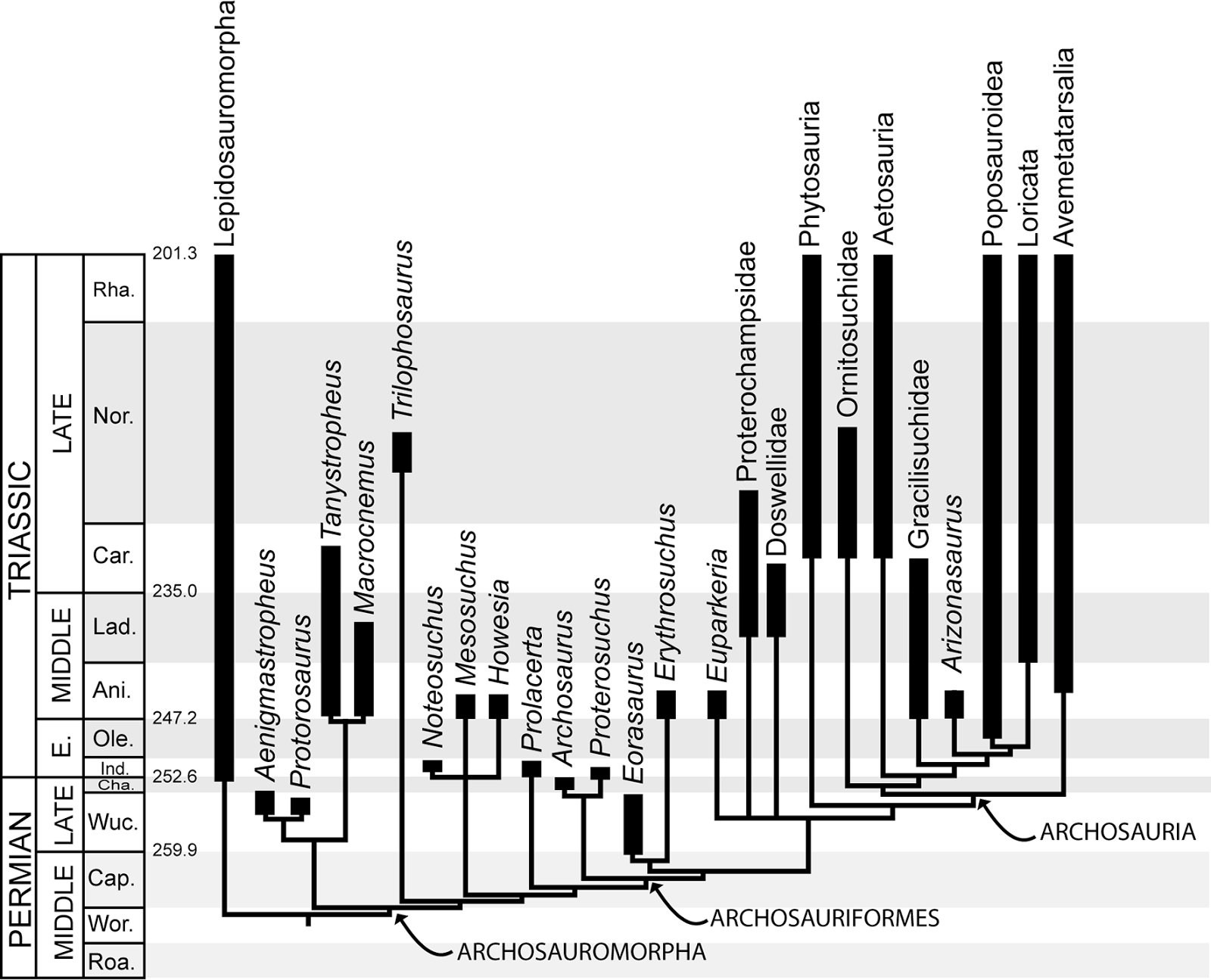
The Origin and Early Radiation of Archosauriforms: Integrating the Skeletal and Footprint Record
Authors:
Bernardi et al
Abstract:
We present a holistic approach to the study of early archosauriform evolution by integrating body and track records. The ichnological record supports a Late Permian–Early Triassic radiation of archosauriforms not well documented by skeletal material, and new footprints from the Upper Permian of the southern Alps (Italy) provide evidence for a diversity not yet sampled by body fossils. The integrative study of body fossil and footprint data supports the hypothesis that archosauriforms had already undergone substantial taxonomic diversification by the Late Permian and that by the Early Triassic archosauromorphs attained a broad geographical distribution over most parts of Pangea. Analysis of body size, as deduced from track size, suggests that archosauriform average body size did not change significantly from the Late Permian to the Early Triassic. A survey of facies yielding both skeletal and track record indicate an ecological preference for inland fluvial (lacustrine) environments for early archosauromorphs. Finally, although more data is needed, Late Permian chirotheriid imprints suggest a shift from sprawling to erect posture in archosauriforms before the end-Permian mass extinction event. We highlight the importance of approaching palaeobiological questions by using all available sources of data, specifically through integrating the body and track fossil record.
Tuesday, May 26, 2015
Evidence Stegosaurs Could Swim


Could stegosaurs swim? Suggestive evidence from the Middle Jurassic tracksite of the Cleveland Basin, Yorkshire, UK
Authors:
Romano et al
Abstract:
Ichnological evidence from the Ravenscar Group (Middle Jurassic) of Yorkshire reveals a distinctive type of swimming track associated with walking tracks of the ichnogenus Deltapodus. The morphology of the prints suggests that both track types were made by the same type of animal. Since Deltapodus is interpreted as having been made by a stegosaur, the associated footprints suggest that stegosaurs could swim. This has significant implications for their palaeobiology and dispersal. The swimming prints are assigned to the ichnotaxon Characichnos isp.
Wednesday, March 25, 2015
A key for Understanding Cisuralian Permian Tetrapod Ichnofaunas

The Gerola Valley site (Orobic Basin, Northern Italy): A key for understanding late Early Permian tetrapod ichnofaunas
Authors:
Marchetti et al
Abstract:
A taxonomic study has been carried out on the historical Gerola Valley locality (Pizzo del Diavolo formation, late Cisuralian), which represents one of the best tetrapod ichnosites of the whole Southern Alps (North Italy). With respect to previous studies, the ichnoassociation is now enlarged and lists the following taxa: Amphisauropus, Dromopus, Erpetopus, Hyloidichnus, Limnopus, Varanopus. The optimal preservation of the material, which in some cases shows even traces of the skin, allowed the recognition of a new morphotype of Varanopus. The invertebrate ichnoassociation is newly described and is representative of impoverished Scoyenia and Mermia ichnofacies. A detailed facies analysis of the uppermost arenitic-pelitic lithofacies of the Pizzo del Diavolo formation, which revealed the most abundant fossil content (Locality 1) and of two new localities (pelitic facies, Localities 2, 3) shows a transition from shallow lacustrine to floodplain and alluvial fan environments under a generally dry climate. Besides the taxonomic revision of vertebrate tracks, the final aims of our study are: i) the depositional, palaeoenvironmental and climatic reconstruction of this sector of the Orobic Basin through an integration of palaeontological data and facies analysis; and ii) the regional correlation of this key stratigraphic succession with other coeval ichnofaunas in Pangaea.
Monday, February 23, 2015
Giant Sloth Megatherichnum Trackway From Miocene Neogene Argentina is NOT Bipedal

Late Miocene ground sloth footprints and their palaeoenvironment: Megatherichnum oportoi revisited
Authors:
Melchor et al
Abstract:
Fossil footprints of ground sloths are mostly restricted to the late Miocene to Pleistocene of South America. This study is focused on the oldest known ground sloth trackways, Megatherichnum oportoi Casamiquela, 1974 from the late Miocene Río Negro Formation of northern Patagonia. The section logged at the study site, near Carmen de Patagones (Buenos Aires province), includes the uppermost part of the middle member (marine) and the upper member (aeolian) of the Río Negro Formation. Identified sedimentary facies can be grouped into four facies associations: tidal flat, aeolian dune, dry/damp interdune and wet interdune (shallow lacustrine). M. oportoi trackways are preserved in an upper intertidal mixed flat. Associated trace fossils belong to a wet aeolian system developed close to the sea coast and were mostly preserved in interdune facies. These include Poaceae root and stem traces and Nagtuichnus meuleni (Chlamyphorinae burrow) in dry interdune facies, indeterminate tetrapod footprints in damp interdune facies, Lockeia siliquaria and chevron-like trace fossils (bivalve resting and horizontal locomotion traces) in wet interdune facies (shallow lakes), and Palaeophycus tubularis in aeolian dune facies. The most likely trackmaker of M. oportoi is Pyramiodontherium sp. (Megatheriinae), recorded from the same stratigraphic unit at Chubut province, with a body mass ranging from 2.5 to 3.6 tonnes. M. oportoi is interpreted as a quadrupedal trackway of a late Miocene ground sloth without overlap of the pes on the manus. The previously proposed bipedal interpretation for the trackway requires angles of gait in excess of those permitted for such a large and heavy animal. Pleistocene ground sloth trackways are distinctive because of the much smaller size of the fore footprint. For the latter examples, a quadrupedal locomotion with overlap of the pes on the manus may be applied.
Tuesday, January 20, 2015
Early Tetrapods Lived in Shallow Tideless Lagoons in Eifelian Devonian Poland

Palaeonvironments of the Eifelian dolomites with earliest tetrapod trackways (Holy Cross Mountains, Poland)
Authors:
Narkiewicz et al
Abstract:
The Eifelian dolomites in the Zachełmie Quarry (Holy Cross Mountains, Poland) contain trackways and tracks of tetrapods 390-391 Ma old, and thus the oldest known so far. The environments of the trackway-bearing beds have been investigated using sedimentological, palaeontological, geochemical and palaeomagnetic methods. The reconstructed tetrapod habitats comprised shallow-water lagoons separated from an open marine basin by sparsely vegetated islands and spits. The lagoonal waters were well-aerated and a few-meters deep at most, undergoing periodic desiccation. The dolomitic sediments, primarily of microbial origin, formed in tropical waters of slightly modified marine composition. Oxygen isotope data obtained from the dolomicrites suggest water temperatures around 30 °C. The seasonal semi-arid to subhumid climate, deduced from paleosol characteristics, was probably of a tropical monsoonal type. The degree of restriction of the lagoonal system evolved from relatively open, evaporation-dominated towards increasingly closed, fresh-water influenced.
The detailed observations of the footprint-bearing beds, as well as the characteristics of the tracks, indicate that they were formed mostly under subaqueous conditions, by wading, walking on the bottom or swimming animals. Lack of tidal indicators in the restricted Zachełmie lagoons argues against previous concept that tidal flats served as a food source for the early tetrapods. Nor is a hypothesis of flooded woodlands confirmed as a habitat promoting the “fish-to-tetrapod” transition. We propose that functional limbs emerged among aqueous animals that acquired their locomotional capabilities in a shallow lagoonal water before attempting longer excursions on land.
Wednesday, December 31, 2014
Toarcian Jurassic Gregarious Tritylodontid (?) Therapsid Dunefield Trackways Suggest Colonial, Prairie Dog-like Lifestyle

TRACKWAYS OF A GREGARIOUS, DUNEFIELD-DWELLING, EARLY JURASSIC THERAPSID IN THE AZTEC SANDSTONE OF SOUTHERN NEVADA
Authors:
Rowland et al
Abstract:
We describe and interpret a tracksite in the Lower Jurassic Aztec Sandstone in Valley of Fire State Park, southern Nevada. The site contains approximately one hundred tracks of the ichnogenus Brasilichnium, arranged in twelve, subparallel trackways, all on the same foreset bedding plane. The Brasilichnium trackmaker was most probably a fossorial, tritylodontid therapsid. Sedimentologicial analyses indicate that the trackway surface is a wind-ripple horizon with a primary dip of about 25°, and that the animals climbed straight up the slip face of the dune. A combination of features leads us to conclude that the footprints were impressed into a crust of moist, cohesive sand, leaving two modes of preserved tracks: (1) shallow, well-defined tracks without associated sand crescents, and (2) deeper, less well defined tracks with associated sand crescents. We interpret this assemblage of tracks to record gregarious behavior in a mixed-age group of tritylodontid therapsids. In the correlative Navajo Sandstone, other researchers have documented the presence of complex networks of burrows concentrated in elevated mounds, reminiscent of colonies of North American prairie dogs. The Brasilichnium trackmaker is a good candidate to have excavated the burrows. Although we cannot directly associate the Brasilichnium trackmaker with the burrow complexes, we hypothesize that these gregarious, fossorial animals lived in prairie-dog–town–like colonies. This study supports the aridity food-distribution hypothesis, which posits that the patchy distribution of food resources in arid environments creates selective pressure for colonial behavior.
Friday, November 21, 2014
Trackway From Ediacaran NeoProterozoic Newfoundland Confirmed as Metazoan (Animal)

CONFIRMING THE METAZOAN CHARACTER OF A 565 MA TRACE-FOSSIL ASSEMBLAGE FROM MISTAKEN POINT, NEWFOUNDLAND
Authors:
Liu et al
Abstract:
Surface locomotory trace fossils from the Mistaken Point Formation of Newfoundland, dated at ∼ 565 Ma, suggest that organisms capable of controlled locomotion and possessing muscular tissue may have existed among Avalonian Ediacaran macrofossil assemblages. Here we describe the Mistaken Point trace-fossil assemblage in full, discuss its stratigraphic context within the Mistaken Point Formation, and explore the competing hypotheses for the formation of the traces. We find that the trace fossils, preserved within a turbidite succession in a deep-marine depositional environment, are not attributable to abiogenic structures, to Ediacaran tubular or filamentous body fossils, to rangeomorph stems, or to a host of late Ediacaran and early Phanerozoic ichnofossils. Specimens within the assemblage show some similarities to the ichnogenera Helminthoidichnites and Archaeonassa, but discrepancies in certain aspects of their structure mean that we do not formally attribute them to these ichnotaxa at this time. The Mistaken Point ichnofossils possess morphological characteristics indicative of formation by an organism with a round base. Comparison with traces formed by modern organisms of such character appears to rule out formation by protistan, echinoderm, or annelid styles of movement, but is consistent with organisms moving via muscular controlled locomotion in a similar way to some modern mollusks and actinian cnidarians. We suggest therefore that the Mistaken Point trace-fossil assemblage reveals the presence of muscular metazoans in late Ediacaran deep-marine ecosystems. Such organisms cannot yet be attributed to specific phyla, but their inferred locomotory mechanisms share closest similarities with those utilized by extant actinians.
Thursday, November 20, 2014
Artinskian Permian Tetrapod Footprints From Spain


Permian Tetrapod Footprints From The Spanish Pyrenees
Authors:
Voigt et al
Abstract:
Paleozoic tetrapod footprints are a common and well-known phenomenon in almost all large European countries except for Spain. Here we report on hitherto unpublished vertebrate tracks from Permian red-beds of the south-central Pyrenees that with regard to their relative abundance, diversity and quality of preservation are suitable to fill this gap of knowledge. The described tracks come from two localities in muddy to fine-grained, sandy, alluvial plain deposits in the lower third of the Peranera Formation of the Erill-Castell Basin near Les Iglésies, northern Catalonia. The tracks can be assigned to five ichnogenera, i.e., Batrachichnus Woodworth, 1900, Limnopus Marsh, 1894, Varanopus Moodie, 1929, Hyloidichnus Gilmore, 1927, and Dromopus Marsh, 1894, that we interpret as footprints of temnospondyls, captorhinomorphs, and araeoscelids or similarly sized sauropsids with a lacertoid foot pattern. This ichnofossil assemblage is most similar to ichnofaunas from the Hermit Formation of the Grand Canyon, Arizona, the upper Abo and Robledo Mountains formations of New Mexico, and the main trace fossil site of the Tiddas Basin, Morocco, suggesting a late Early Permian (Artinskian) age for this stratigraphic level of the Peranera Formation. Considering the relative abundance and diversity of captorhinomorph footprints, the new Spanish tracefossil localities may cover the onset of the Early Permian radiation of non-diapsid eureptiles. The thick Late Paleozoic red-bed successions of the south-central Pyrenees have the potential to also bear footprints of otherwise unknown early therapsids, so systematic fossil prospecting of this area is strongly recommended.
Wednesday, November 19, 2014
Westphalian Pennsylvanian Carboniferous Trackways From Morocco
First Occurrence of Tetrapod Footprints from Westphalian Strata of the Sidi Kassem Basin, Central Morocco
Authors:
Lagnaoui et al
Abstract:
The Sidi Kassem Basin is the only limnic basin of Westphalian age in Morocco. It is built up of 1,250 m of alluvio-fluvial to lacustrine deposits that have so far yielded plant fossils and invertebrate remains only. Recent exploration for fossil tetrapod footprints in floodplain-deposits of the basin revealed a moderately diverse vertebrate ichnofauna composed of tracks assigned to cf. Batrachichnus Woodworth, 1900; cf. Hylopus Dawson, 1882; Dimetropus Romer and Price, 1940; and Notalacerta Butts, 1891. The tracks can be referred to temnospondyl, anamniote reptiliomorph, non-therapsid synapsid (pelycosaur), and captorhinomorph trackmakers. The described ichnoassemblage is important in at least three aspects: (1) It suggests an Early to mid-Pennsylvanian age for the footprint-bearing strata of the study area. (2) It is the oldest association of tetrapod footprints from Africa. (3) It is the first evidence of the relatively rare ichnogenera cf. Hylopus and Notalacerta outside of North America and Europe. Judged from the variety of tetrapod tracks and previously collected floral remains, the Sidi Kassem Basin must have represented a well-established continental ecosystem during Pennsylvanian time. Further exploration for trace and body fossils of Palaeozoic vertebrates in this basin may be important for the reconstruction of early tetrapod evolution.
Tuesday, November 11, 2014
Aptian Cretaceous Trackway From Angola Contains Dinosaurs, Crocodilian & a Racoon Sized Mammaliaform Prints


Unexpectedly one of the largest diamond mines in Africa, Catoca in Angola, holds 118 million year old dinosaur, crocodile and large mammal tracks. The mammal tracks show a raccoon-sized animal, during a time when most were no larger than a rat.
Nearly 70 distinct tracks were recovered in the Catoca mine in Angola. All the tracks were found in a small sedimentary basin, formed about 118 Ma, during the Early Cretaceous, in the crater of a kimberlite pipe.
The most important of these finds are those whose morphology is attributable to a large mammalian trackmaker, the size of a modern raccoon. There is no evidence from bones or teeth of such a large Early Cretaceous mammal from Africa or elsewhere in the World. The most comparably sized mammalian skeleton is known from China, and is 4-7 Ma older than the Angolan tracks. It has an estimated head-body length between 42 and 68 cm, but because it is missing hands and feet, a comparison with the tracks from Catoca is not possible.
link.
Wednesday, October 15, 2014
Earliest Eocene Paleogene Bird Tracks Found in China

First Record of Bird Tracks from Paleogene of China (Guangdong Province)
Authors:
Xing et al
Abstract:
The record of Paleogene bird traces is quite scarce, especially when compared with the Mesozoic. Avian tracks have been reported mainly from western North America and the Middle East, with some sites also present in Europe and Sumatra. Here the first record of Eocene bird tracks from East Asia is reported. The track bearing level is recorded at the upper part of the Huayong Formation (lower Eocene), one of the continental units of the Sanshui Basin.
More than 350 footprints were documented from three collected slabs. Many footprints were found in trackways, five morphotypes were identified and assigned to four ichnotaxon: Gruipeda sp., Aviadactyla sp., Avipeda sp., and Fuscinapeda sp. The ichnotaxonomical identifications are supported by canonical variate analysis (CVA) based on the better preserved traces. These surfaces show a varied ichnofaunal assemblage composed of small and medium shorebirds, large “game” birds, crane-like birds and heron-like birds, providing a more complete picture than was previously known of Early Eocene avian faunal assemblages in Asia
Subscribe to:
Posts (Atom)