An Early Triassic polar predator ecosystem revealed by vertebrate coprolites from the Bulgo Sandstone (Sydney Basin) of southeastern Australia
Authors:
Niedźwiedzki et al
Abstract:
Vertebrate trace fossils often provide a measure of cryptic biodiversity, and are especially pertinent when skeletal remnants are exceptionally rare. The Lower Triassic (lower Olenekian) Bulgo Sandstone at Long Reef in the Sydney Basin of southeastern Australia constitutes just such a deposit, having yielded isolated bones of giant capitosaurian temnospondyls and proterosuchid archosauriforms, together with abundant coprolites that are geochemically rich in elemental phosphate and carbon denoting vertebrate predators. Microstructural analysis of these preserved droppings reveals occasional bone fragments, fish scales, insect cuticles, plant material and bacterial traces (pseudomorph voids), as well as silicate mineral particles. REE concentrations indicate that burial and early diagenesis occurred explicitly within fluvial sediments. Furthermore, external morphological characterization permits attribution of spiral coprolites to chondrichthyan or osteichthyan fishes, polygonal, ovoid–spherical and typically flattened feces to temnospondyls, and conspicuously large cylindrical droppings to archosauriforms or other amniote apex predators. Collectively, the Bulgo Sandstone coprolite assemblage thus offers new insights into ecosystem structure and palaeoenvironment in what was an earliest Triassic near polar setting. Such data compliments the documented skeletal record, but indicates a greater range of aquatic and possibly terrestrial carnivores — the latter being enigmatically sparse in the Australian Triassic and yet detected here via the hitherto underexplored trace fossil evidence of their ecological presence.
Showing posts with label archosauriform. Show all posts
Showing posts with label archosauriform. Show all posts
Friday, December 02, 2016
Coprolites Give Evidence of Early Triassic Polar Predators


Friday, November 11, 2016
Litorosuchus somnii: A new Armored and Aquatic Archosauriform From Ladinian Triassic China
Authors:Li et alAbstract:Reptiles have a long history of transitioning from terrestrial to semi-aquatic or aquatic environments that stretches back at least 250 million years. Within Archosauria, both living crocodylians and birds have semi-aquatic members. Closer to the root of Archosauria and within the closest relatives of the clade, there is a growing body of evidence that early members of those clades had a semi-aquatic lifestyle. However, the morphological adaptations to a semi-aquatic environment remain equivocal in most cases. Here, we introduce a new Middle Triassic (245–235 Ma) archosauriform, Litorosuchus somnii, gen. et sp. nov., based on a nearly complete skeleton from the Zhuganpo Member (Ladinian [241–235 Ma]) of the Falang Formation, Yunnan, China. Our phylogenetic analyses suggest that Litorosuchus is a stem archosaur closely related to the aberrant Vancleavea just outside of Archosauria. The well-preserved skeleton of L. somnii bears a number of morphological characters consistent with other aquatic-adapted tetrapods including: a dorsally directed external naris, tall neural spines and elongate chevrons in an elongated tail, a short and broad scapula, webbed feet, long cervical vertebrae with long slender ribs, and an elongated rostrum with long and pointed teeth. Together these features represent one of the best-supported cases of a semi-aquatic mode of life for a stem archosaur. Together with Vancleavea campi, the discovery of L. somnii demonstrates a growing body of evidence that there was much more diversity in mode of life outside Archosauria. Furthermore, L. somnii helps interpret other possible character states consistent with a semi-aquatic mode of life for archosauriforms, including archosaurs.
Friday, March 11, 2016
Teyujagua paradoxa: a new sister Taxon to Archosauriformes From Olenekian Triassic Brazil


An exceptional fossil skull from South America and the origins of the archosauriform radiation
Authors:
Pinheiro et al
Abstract:
Birds, dinosaurs, crocodilians, pterosaurs and their close relatives form the highly diverse clade Archosauriformes. Archosauriforms have a deep evolutionary history, originating in the late Permian, prior to the end-Permian mass extinction, and radiating in the Triassic to dominate Mesozoic ecosystems. However, the origins of this clade and its extraordinarily successful body plan remain obscure. Here, we describe an exceptionally preserved fossil skull from the Lower Triassic of Brazil, representing a new species, Teyujagua paradoxa, transitional in morphology between archosauriforms and more primitive reptiles. This skull reveals for the first time the mosaic assembly of key features of the archosauriform skull, including the antorbital and mandibular fenestrae, serrated teeth, and closed lower temporal bar. Phylogenetic analysis recovers Teyujagua as the sister taxon to Archosauriformes, and is congruent with a two-phase model of early archosauriform evolution, in response to two mass extinctions occurring at the end of the Guadalupian and the Permian.
The paper is open access.
There is also a PR summary.
Tuesday, January 05, 2016
Archosauriforms From a Flood Plain in Late Triassic Argentina
Archosauriform remains from the Late Triassic of San Luis province, Argentina, Quebrada del Barro Formation, Marayes–El Carrizal Basin
Authors:
Gianechini et al
Abstract:
Here we present archosauriform remains from ‘Abra de los Colorados’, a fossiliferous locality at Sierra de Guayaguas, NW San Luis Province. Two fossiliferous levels were identified in outcrops of the Quebrada del Barro Formation (Norian), which represent the southernmost outcrops of the Marayes–El Carrizal Basin. These levels are composed by massive muddy lithofacies, interpreted as floodplain deposits. The specimens consist of one incomplete maxilla (MIC-V718), one caudal vertebra (MIC-V719), one metatarsal (MIC-V720) and one indeterminate appendicular bone (MIC-V721). The materials can be assigned to Archosauriformes but the fragmentary nature and lack of unambiguous synapomorphies preclude a more precise taxomic assignment. The maxilla is remarkably large and robust and represents the posterior process. It preserved one partially erupted tooth with ziphodont morphology. This bone shows some anatomical traits and size match with ‘rauisuchians’ and theropods. MIC-V719 corresponds to a proximal caudal vertebra. It has a high centrum, a ventral longitudinal furrow, expanded articular processes for the chevrons, a posteriorly displaced diapophysis located below the level of the prezygapophyses, and short prezygapophyses. This vertebra would be from an indeterminate archosauriform. MIC-V720 presents a cylindrical diaphysis, with a well-developed distal trochlea, which present resemblances with metatarsals of theropods, pseudosuchians, and silesaurids, although the size matches better with theropods. MIC-V721 has a slender diaphysis and a convex triangular articular surface, and corresponds to an indeterminate archosauriform. Despite being fragmentary, these materials indicate the presence of a diverse archosauriforms association from Late Triassic beds of San Luis. Thus, they add to the faunal assemblage recently reported from this basin at San Juan Province, which is much rich and diverse than the coeval paleofauna well known from Los Colorados Formation in the Ischigualasto–Villa Union Basin.
Tuesday, June 23, 2015
Archosauriforms Radiated, Became Parasagittal During Late Permian
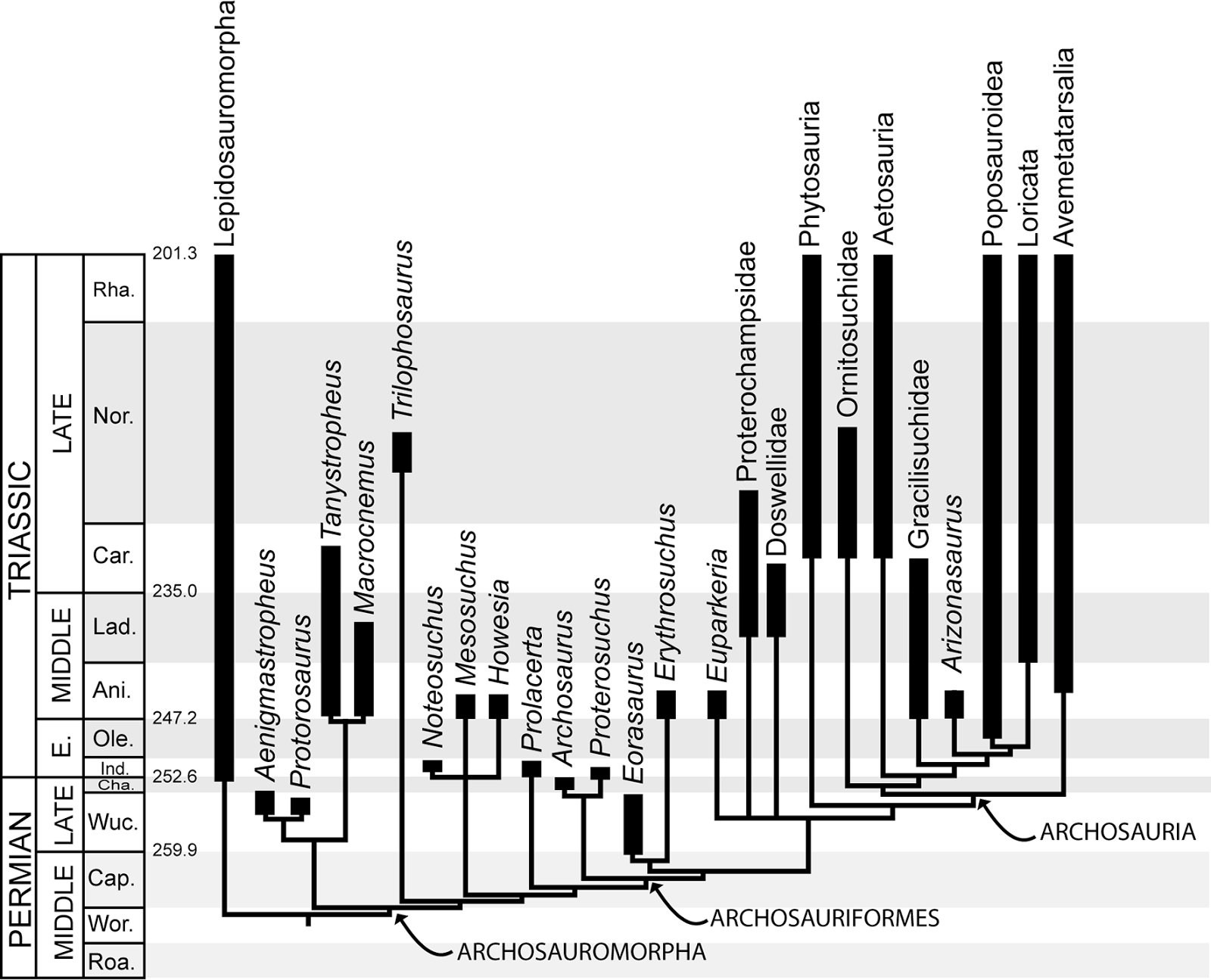
The Origin and Early Radiation of Archosauriforms: Integrating the Skeletal and Footprint Record
Authors:
Bernardi et al
Abstract:
We present a holistic approach to the study of early archosauriform evolution by integrating body and track records. The ichnological record supports a Late Permian–Early Triassic radiation of archosauriforms not well documented by skeletal material, and new footprints from the Upper Permian of the southern Alps (Italy) provide evidence for a diversity not yet sampled by body fossils. The integrative study of body fossil and footprint data supports the hypothesis that archosauriforms had already undergone substantial taxonomic diversification by the Late Permian and that by the Early Triassic archosauromorphs attained a broad geographical distribution over most parts of Pangea. Analysis of body size, as deduced from track size, suggests that archosauriform average body size did not change significantly from the Late Permian to the Early Triassic. A survey of facies yielding both skeletal and track record indicate an ecological preference for inland fluvial (lacustrine) environments for early archosauromorphs. Finally, although more data is needed, Late Permian chirotheriid imprints suggest a shift from sprawling to erect posture in archosauriforms before the end-Permian mass extinction event. We highlight the importance of approaching palaeobiological questions by using all available sources of data, specifically through integrating the body and track fossil record.
Thursday, February 19, 2015
Wachholz: a new Norian Triassic Fossilierous Site in Brazil


Wachholz, a new exquisite dinosaur-bearing fossiliferous site from the Upper Triassic of southern Brazil
Authors:
Müller et al
Abstract:
The present contribution reports a new fossiliferous site from the Caturrita Formation (Upper Triassic of Paraná Basin, Southern Brazil), which yields articulate, complete, associated, and exceptionally well-preserved dinosaur specimens, together with the sole occurrence of an isolated tooth ascribed to a carnivore indetermined archosauriform. These specimens increase the sauropodomorph record from this geological unit. A preliminary evaluation of such specimens suggests that sauropodomorph dinosaurs could have been more abundant in Norian Faunas from southern Brazil, considering the increased sampling here reported. So far, about six specimens are previously recognized (disregarding Guaibasaurus) from the Caturrita Formation, and here we add four specimens, or even five if consider an additional autopodium. Also, the morphology of the isolated carnivorous-type tooth differs from other described carnivorous archosauriform teeth from the Caturrita Formation. Hence, it might represent a still undescribed taxon. Further studies of these specimens will certainly provide new data regarding biostratigraphy, phylogeny, paleoecology, and taphonomy, as this new fossiliferous locality preserves one of the most representative dinosaur records from the Norian worldwide.
Monday, January 26, 2015
Dongusuchus efremovi: an Archosauriform Reevaluated From Anisian Triassic Russia

The osteology and systematic position of Dongusuchus efremovi Sennikov, 1988 from the Anisian (Middle Triassic) of Russia
Authors:
Niedźwiedzki et al
Abstract:
European Russia has yielded several fragmentary but potentially important archosauriform specimens from the Middle Triassic, but these have been only briefly described in the literature. One of these puzzling taxa is Dongusuchus efremovi Sennikov, 1988, described from the Donguz Svita. We present a redescription of Dongusuchus efremovi, which includes the first photographic atlas and thorough anatomical description of the holotype and referred specimens. This taxon is shown to be a gracile, probably fast-running species with elongate and slender limbs. A phylogenetic analysis recovers Dongusuchus efremovi as an early-diverging, non-archosaurian archosauriform. Previous work had suggested that this taxon was a ‘rauisuchid’. The gracile proportions of the femur and somewhat wedge-shaped head, however, are unusual for basal archosauriforms and are similar to the plesiomorphic state in crocodile and avian-line crown archosaurs. Several Early-Middle Triassic basal archosauriforms and early members of the crocodile and avian lineages were gracile with elongate, slender limbs. This suggests that the limb morphology of Dongusuchus efremovi may be plesiomorphic for Archosauria and proximal clades.
Tuesday, December 16, 2014
Pseudochampsa ischigualastensis: a new Genus for a Proterochampsid From Carnian (?) Triassic Brazil

Osteology of Pseudochampsa ischigualastensis gen. et comb. nov. (Archosauriformes: Proterochampsidae) from the Early Late Triassic Ischigualasto Formation of Northwestern Argentina
Authors:
Trotteyn et al
Abstract:
Proterochampsids are crocodile-like, probably semi-aquatic, quadrupedal archosauriforms characterized by an elongated and dorsoventrally low skull. The group is endemic from the Middle-Late Triassic of South America. The most recently erected proterochampsid species is “Chanaresuchus ischigualastensis”, based on a single, fairly complete skeleton from the early Late Triassic Ischigualasto Formation of northwestern Argentina. We describe here in detail the non-braincase cranial and postcranial anatomy of this species and revisit its taxonomy and phylogenetic relationships. The phylogenetic analysis recovered ‘Chanaresuchus ischigualastensis’ as part of a trichotomy together with Gualosuchus reigi and Chanaresuchus bonapartei. Accordingly, “Chanaresuchus ischigualastensis” can be potentially more closely related to Gualosuchus reigi, or even Rhadinosuchus gracilis, than to Chanaresuchus bonapartei. In addition, after discussing previously claimed synapomorphies of Chanaresuchus, we could not find unambiguous support for the monophyly of the genus. As a result, we propose here the erection of the new genus Pseudochampsa for ‘Chanaresuchus ischigualastensis’, which results in the new combination Pseudochampsa ischigualastensis. The information provided here about the anatomy and taxonomy of Pseudochampsa ischiguaslastensis will be useful for future quantitative analyses focused on the biogeography and macroevolutionary history of proterochampsids.
Monday, December 15, 2014
Phylogenetics of Euparkeriids

Systematics of putative euparkeriids (Diapsida: Archosauriformes) from the Triassic of China
Authors:
Sookias et al
Abstract:
The South African species Euparkeria capensis is of great importance for understanding the early radiation of archosauromorphs (including archosaurs) following the Permo–Triassic mass extinction, as most phylogenetic analyses place it as the sister taxon to crown group Archosauria within the clade Archosauriformes. Although a number of species from Lower–Middle Triassic deposits worldwide have been referred to the putative clade Euparkeriidae, the monophyly of Euparkeriidae is controversial and has yet to be demonstrated by quantitative phylogenetic analysis. Three Chinese taxa have been recently suggested to be euparkeriids: Halazhaisuchus qiaoensis, ‘Turfanosuchus shageduensis’, and Wangisuchus tzeyii, all three of which were collected from the Middle Triassic Ermaying Formation of northern China. Here, we reassess the taxonomy and systematics of these taxa. We regard Wangisuchus tzeyii as a nomen dubium, because the holotype is undiagnostic and there is no convincing evidence that the previously referred additional specimens represent the same taxon as the holotype. We also regard ‘Turfanosuchus shageduensis’ as a nomen dubium as we are unable to identify any diagnostic features. We refer the holotype to Archosauriformes, and more tentatively to Euparkeriidae. Halazhaisuchus qiaoensis and the holotype of ‘Turfanosuchus shageduensis’ are resolved as sister taxa in a phylogenetic analysis, and are in turn the sister taxon to Euparkeria capensis, forming a monophyletic Euparkeriidae that is the sister to Archosauria+Phytosauria. This is the first quantitative phylogenetic analysis to recover a non-monospecific, monophyletic Euparkeriidae, but euparkeriid monophyly is only weakly supported and will require additional examination. Given their similar sizes, stratigraphic positions and phylogenetic placement, the holotype of ‘Turfanosuchus shageduensis’ may represent a second individual of Halazhaisuchus qiaoensis, but no apomorphies or unique character combination can be identified to unambiguously unite the two. Our results have important implications for understanding the species richness and palaeobiogeographical distribution of early archosauriforms.
Monday, November 17, 2014
Garjainia madiba: a new Species of Erythrosuchid Archosauriform From Olenekian Triassic South Africa

A New Species of Garjainia Ochev, 1958 (Diapsida: Archosauriformes: Erythrosuchidae) from the Early Triassic of South Africa
Authors:
Gower et al
Abstract:
A new species of the erythrosuchid archosauriform reptile Garjainia Ochev, 1958 is described on the basis of disarticulated but abundant and well-preserved cranial and postcranial material from the late Early Triassic (late Olenekian) Subzone A of the Cynognathus Assemblage Zone of the Burgersdorp Formation (Beaufort Group) of the Karoo Basin of South Africa. The new species, G. madiba, differs from its unique congener, G. prima from the late Olenekian of European Russia, most notably in having large bony bosses on the lateral surfaces of the jugals and postorbitals. The new species also has more teeth and a proportionately longer postacetabular process of the ilium than G. prima. Analysis of G. madiba bone histology reveals thick compact cortices comprised of highly vascularized, rapidly forming fibro-lamellar bone tissue, similar to Erythrosuchus africanus from Subzone B of the Cynognathus Assemblage Zone. The most notable differences between the two taxa are the predominance of a radiating vascular network and presence of annuli in the limb bones of G. madiba. These features indicate rapid growth rates, consistent with data for many other Triassic archosauriforms, but also a high degree of developmental plasticity as growth remained flexible. The diagnoses of Garjainia and of Erythrosuchidae are addressed and revised. Garjainia madiba is the geologically oldest erythrosuchid known from the Southern Hemisphere, and demonstrates that erythrosuchids achieved a cosmopolitan biogeographical distribution by the end of the Early Triassic, within five million years of the end-Permian mass extinction event. It provides new insights into the diversity of the Subzone A vertebrate assemblage, which partially fills a major gap between classic ‘faunal’ assemblages from the older Lystrosaurus Assemblage Zone (earliest Triassic) and the younger Subzone B of the Cynognathus Assemblage Zone (early Middle Triassic).
Wednesday, October 22, 2014
Induan/Olenekian Triassic South African Proterosuchid Archosauriforms Revised

Figure 11. Skull and lower jaw reconstructions of Proterosuchus species from the Lystrosaurus AZ of South Africa. A, juvenile of Proterosuchus fergusi (based on RC 59 and BP/1/4016); B, adult of Proterosuchus fergusi (based on BSPG 1934 VIII 514, GHG 231, RC 846); C, Proterosuchus alexanderi; and D, Proterosuchus goweri in left lateral views. Abbreviations: a1, a2, a4, diagnostic characters 1, 2 and 4 of Proterosuchus alexanderi; P1–3, diagnostic characters 1–3 of Proterosuchus; g1–7, diagnostic characters 1–7 of Proterosuchus goweri; f1–6, diagnostic characters 1–6 of Proterosuchus fergusi. Characters with asterisks indicate autapomorphies. All scale bars represent 20 mm.
Taxonomy of the proterosuchid archosauriforms (Diapsida: Archosauromorpha) from the earliest Triassic of South Africa, and implications for the early archosauriform radiation
Authors:
Ezcurra et al
Abstract:
Proterosuchidae is one of the first clades of Archosauriformes (archosaurs and closely related species) to appear in the fossil record, with the richest sample of the group coming from the Lystrosaurus Assemblage Zone (earliest Triassic) of South Africa. Four nominal proterosuchid species were described from South Africa during the twentieth century (Proterosuchus fergusi, Chasmatosaurus vanhoepeni, Chasmatosaurus alexanderi and Elaphrosuchus rubidgei), but interpretations of their taxonomy have been widely disparate. The most recent taxonomic revision concluded that P. fergusi is the only valid species and that the other nominal species are junior subjective synonyms of this taxon. This proposal was based on the interpretation that anatomical differences between the nominal species could be explained as a result of ontogenetic changes and/or post-mortem deformation. The recent discoveries of multiple new South African proterosuchid specimens provide an impetus to revisit their taxonomy. Based upon a comprehensive re-examination of all known specimens, as well as examination of other proterosuchid taxa in collections worldwide, we conclude that the holotype of Proterosuchus fergusi is undiagnostic. As a result, we propose a neotype (RC 846) for the species. ‘Chasmatosaurus vanhoepeni’ and ‘Elaphrosuchus rubidgei’ are considered subjective junior synonyms of P. fergusi. ‘Chasmatosaurus’ alexanderi is considered a valid species, for which we propose the new combination P. alexanderi comb. nov. A third species, P. goweri sp. nov., is erected on the basis of a single specimen (NMQR 880). All three species recognized here are taxonomically distinct from a previously described archosauriform maxilla from the lower Lystrosaurus AZ. As a result, we recognize a minimum of four archosauriform species following the Permo-Triassic mass extinction in South Africa. Our results suggest a greater species richness of earliest Triassic archosauriforms than previously appreciated, but that archosauriform morphological disparity remained low and did not expand until the late Early Triassic – early Mid-Triassic.
Thursday, October 02, 2014

Friday, July 18, 2014
First Phytosaur Found in Carnian/Norian Triassic Portugal
Authors:Mateus et alAbstract:The Triassic was first defined based on the characteristic threefold sequence of rocks that crops out across much of Europe, and many of the first records of Triassic dinosaurs, crocodile-line archosaurs, and other vertebrates were discovered in Great Britain, France, Switzerland, and Germany. These discoveries helped paint a general picture of the Triassic as a critical transitional interval in Earth’s history, during which Earth recovered from a devastating extinction and more modern terrestrial ecosystems composed of dinosaurs, crocodylomorphs, squamates, and mammals were first established (e.g., Sues and Fraser, 2010). Over the past 50 years, however, the focus of Triassic vertebrate research has shifted to the fossil-rich deposits of South America and western and northeastern North America. The European record has been overshadowed, but new discoveries are stimulating a major expansion of Triassic vertebrate work across Europe, especially in Germany and Poland (e.g., Gower, 1999; Dzik, 2001; Schoch, 2006; Dzik and Sulej, 2007).Despite considerable exposures of Triassic terrestrial sedimentary rock, the Iberian Peninsula of southwestern Europe has to date contributed little to this renewed focus on the European Triassic vertebrate record. This situation is changing with recent descriptions of Triassic terrestrial vertebrates from Spain (e.g., Fortuny et al., 2011) and Portugal (Witzmann and Gassner, 2008; Steyer et al., 2011). Here, we describe the first Iberian record of a major clade of Triassic vertebrates, the long-snouted, semiaquatic phytosaurs that are part of the great post-Permian archosauromorph radiation (e.g., Stocker and Butler, 2013). This specimen, the posterior end of a mandible and associated teeth, was discovered in southern Portugal, 2.7 m above and about 5 m lateral to a bonebed of the temnospondyl Metoposaurus in a mudstone unit within the same stratigraphic section as Central Atlantic Magmatic Province (CAMP) basalts, in a classic northern Pangean rift sequence (Fig. 1). The discovery of this specimen helps to better constrain the age of the Portuguese site and provides further evidence that basal phytosaurs were widely distributed in areas with a monsoonal-type climate during the Triassic (e.g., Buffetaut, 1993; Brusatte et al., 2013).
Thursday, October 17, 2013
A New Specimen of Shansisuchus shansisuchus From Ladinian Triassic China

A New Specimen of Shansisuchus shansisuchus Young, 1964 (Diapsida: Archosauriformes) from the Triassic of Shanxi, China
Authors:
WANG Runfu, XU Shichao, WU Xiaochun, LI Chun, WANG Suozhu
Abstract:
Shansisuchus shansisuchus Young, 1964 was restudied on the basis of a new specimen. Some anatomical features that were either briefly or not described at all in the original study were detailed. The new specimen not only provides further information on the skull anatomy and the vertebral column but also expands the range of the geographical distribution of the taxon. With new information, the diagnosis of S. shansisuchus was emended and its phylogenetic relationships were further analyzed. S. shansisuchus differs from other archosauriforms primarily in the presence of a large subnarial fenestra anterior to the antorbital fenestra, tongue-in-groove articulations between the ascending process of the premaxilla and nasal and between the premaxilla and maxilla, a tall and posterodorsally directed ascending process of the maxilla, a knee-shaped process of the postorbital projecting into the orbit, a broad descending process of squamosal distally well forked and a large, deeply bow-shaped intercentrum tightly anchoring/capping the sharp ventral edges of two neighboring centra together in cervical and at least first eight dorsal vertebrae. With additional information derived from the new specimen, the phylogenetic relationships of S. shansisuchus were reanalyzed; it is closely related to Erythrosuchus-Vjushkovia clade.
Thursday, October 03, 2013
Asperoris mnyama: New Anisian Triassic Archosauriform From Tanzania
.png)
A New Archosauriform (Reptilia: Diapsida) from the Manda Beds (Middle Triassic) of Southwestern Tanzania
Authors:
Sterling J. Nesbitt, Richard J. Butler and David J. Gower
Abstract:
Background
Archosauria and their closest relatives, the non-archosaurian archosauriforms, diversified in the Early and Middle Triassic, soon after the end-Permian extinction. This diversification is poorly documented in most Lower and Middle Triassic rock sequences because fossils of early groups of archosauriforms are relatively rare compared to those of other amniotes. The early Middle Triassic (? late Anisian) Manda beds of southwestern Tanzania form an exception, with early archosaur skeletons being relatively common and preserved as articulated or associated specimens. The Manda archosaur assemblage is exceptionally diverse for the Middle Triassic. However, to date, no non-archosaurian archosauriforms have been reported from these rocks.
Methodology/Principal Findings
Here, we name a new taxon, Asperoris mnyama gen. et sp. nov., from the Manda beds and thoroughly describe the only known specimen. The specimen consists of a well-preserved partial skull including tooth-bearing elements (premaxilla, maxilla), the nasal, partial skull roof, and several incomplete elements. All skull elements are covered in an autapomorphic highly rugose sculpturing. A unique combination of character states indicates that A. mnyama lies just outside Archosauria as a stem archosaur within Archosauriformes, but more precise relationships of A. mnyama relative to other early archosauriform clades (e.g., Erythrosuchidae) cannot be determined currently.
Conclusions/Significance
Asperoris mnyama is the first confirmed non-archosaurian archosauriform from the Manda beds and increases the morphological and taxonomic diversity of early archosauriforms known from the Middle Triassic. The direct association of A. mnyama with species referable to Archosauria demonstrates that non-archosaurian archosauriforms were present during the rise and early diversification of Archosauria. Non-archosaurian archosauriforms and archosaurs co-occur in fossil reptile assemblages across Pangaea from the late Early Triassic to the end of the Late Triassic.
Tuesday, April 16, 2013
Doswelliidae Fossil Found in Ladinian Triassic Europe

A new archosauriform reptile from the Middle Triassic (Ladinian) of GermanyHat tip, Chinleana.
Authors:
1. Rainer R. Schoch (a)
2. Hans-Dieter Sues (b)
Affiliations:
a. Staatliches Museum fur Naturkunde, Rosenstein 1, D-70191 Stuttgart, Germany
b. Department of Paleobiology, National Museum of Natural History, Smithsonian Institution, MRC 121, PO Box 37012, Washington, DC 20013-7012, USA
Abstract:
Numerous well-preserved skeletal remains of a distinctive armoured archosauriform reptile from the Lower Keuper (Erfurt Formation; Middle Triassic: Ladinian: Longobardian) of Baden-Württemberg (Germany) represent a new taxon, Jaxtasuchus salomoni gen. et sp. nov. The dermal armour of Jaxtasuchus comprises transverse rows of four rectangular osteoderms each in the cervical, dorsal and caudal regions, with the individual plates closely resembling those of Doswellia kaltenbachi from Carnian strata in North America. The long and low maxilla of Jaxtasuchus held at least 15 teeth. The labial and lingual surfaces of the tall, only slightly recurved crowns of the maxillary teeth bear distinct vertical ridges and smooth mesial and distal carinae. The cervical region of the vertebral column is long. Phylogenetic analysis places Jaxtasuchus as the sister taxon to
Doswellia in Doswelliidae sensu Desojo et al. (2011). Doswelliidae is diagnosed by the coarsely reticulate, incised ornamentation of osteoderms composed of central regular pits of subequal size and contour, and a mostly smooth anterior articular lamina on each osteoderm. The discovery of Jaxtasuchus confirms that Doswelliidae had a wide palaeogeographical distribution during the latter half of the Triassic.
Subscribe to:
Posts (Atom)