Therian mammals experience an ecomorphological radiation during the Late Cretaceous and selective extinction at the K–Pg boundary
Authors:
Grossnickle et al
Abstract:
It is often postulated that mammalian diversity was suppressed during the Mesozoic Era and increased rapidly after the Cretaceous–Palaeogene (K–Pg) extinction event. We test this hypothesis by examining macroevolutionary patterns in early therian mammals, the group that gave rise to modern placentals and marsupials. We assess morphological disparity and dietary trends using morphometric analyses of lower molars, and we evaluate generic level taxonomic diversity patterns using techniques that account for sampling biases. In contrast with the suppression hypothesis, our results suggest that an ecomorphological diversification of therians began 10–20 Myr prior to the K–Pg extinction event, led by disparate metatherians and Eurasian faunas. This diversification is concurrent with ecomorphological radiations of multituberculate mammals and flowering plants, suggesting that mammals as a whole benefitted from the ecological rise of angiosperms. In further contrast with the suppression hypothesis, therian disparity decreased immediately after the K–Pg boundary, probably due to selective extinction against ecological specialists and metatherians. However, taxonomic diversity trends appear to have been decoupled from disparity patterns, remaining low in the Cretaceous and substantially increasing immediately after the K–Pg extinction event. The conflicting diversity and disparity patterns suggest that earliest Palaeocene extinction survivors, especially eutherian dietary generalists, underwent rapid taxonomic diversification without considerable morphological diversification.
Showing posts with label adaptive radiation. Show all posts
Showing posts with label adaptive radiation. Show all posts
Friday, June 17, 2016
Therian Mammals Started an Ecomorphical Evolutionary Radiation PRIOR to the Extinction of the Dinosaurs


Monday, October 26, 2015
How Carnivores Adaptively Radiative After a Continental Faunal Exchange

Continental faunal exchange and the asymmetrical radiation of carnivores
Authors:
Pires et al
Abstract:
Lineages arriving on islands may undergo explosive evolutionary radiations owing to the wealth of ecological opportunities. Although studies on insular taxa have improved our understanding of macroevolutionary phenomena, we know little about the macroevolutionary dynamics of continental exchanges. Here we study the evolution of eight Carnivora families that have migrated across the Northern Hemisphere to investigate if continental invasions also result in explosive diversification dynamics. We used a Bayesian approach to estimate speciation and extinction rates from a substantial dataset of fossil occurrences while accounting for the incompleteness of the fossil record. Our analyses revealed a strongly asymmetrical pattern in which North American lineages invading Eurasia underwent explosive radiations, whereas lineages invading North America maintained uniform diversification dynamics. These invasions into Eurasia were characterized by high rates of speciation and extinction. The radiation of the arriving lineages in Eurasia coincide with the decline of established lineages or phases of climate change, suggesting differences in the ecological settings between the continents may be responsible for the disparity in diversification dynamics. These results reveal long-term outcomes of biological invasions and show that the importance of explosive radiations in shaping diversity extends beyond insular systems and have significant impact at continental scales.
Thursday, July 30, 2015
Persistent Oceanic Anoxia, Mass (?) Extinction Separate Cambrian, Ordovician Explosions
Persistent oceanic anoxia and elevated extinction rates separate the Cambrian and Ordovician radiations
Authors:
Saltzman et al
Abstract:
Recurrent mass extinction events (at "biomere"—a biostratigraphic unit—boundaries) characterize the middle Cambrian to Early Ordovician (Tremadocian) time interval that is between the major Cambrian and Ordovician radiations of animal life. A role for anoxia in maintaining elevated extinction rates in the late Cambrian has been proposed based on coincidence of an extinction with positive excursions in δ13Ccarb and δ34SCAS (CAS—carbonate-associated sulfate). Here we examine an Early Ordovician extinction event at the base of the North American Stairsian Stage (upper Tremadocian), and demonstrate concurrent onset of positive excursions in δ13C and δ34S inferred to reflect enhanced organic matter burial under anoxic waters. Sea-level rise may have brought anoxic waters onto the shelf to initiate extinctions. The evidence for δ13C excursions and elevated extinction rates appears to wane in the Tremadocian, consistent with progressive oxygenation of the oceans reaching a threshold that helped facilitate initial stages of the Great Ordovician Biodiversification Event.
Evidence for a Mid-Jurassic Adaptive Radiation in Mammals

Evidence for a Mid-Jurassic Adaptive Radiation in Mammals
Authors:
Close et al
Abstract:
A series of spectacular discoveries have transformed our understanding of Mesozoic mammals in recent years. These finds reveal hitherto-unsuspected ecomorphological diversity that suggests that mammals experienced a major adaptive radiation during the Middle to Late Jurassic [ 1 ]. Patterns of mammalian macroevolution must be reinterpreted in light of these new discoveries [ 1–3 ], but only taxonomic diversity and limited aspects of morphological disparity have been quantified [ 4, 5 ]. We assess rates of morphological evolution and temporal patterns of disparity using large datasets of discrete characters. Rates of morphological evolution were significantly elevated prior to the Late Jurassic, with a pronounced peak occurring during the Early to Middle Jurassic. This intense burst of phenotypic innovation coincided with a stepwise increase in apparent long-term standing diversity [ 4 ] and the attainment of maximum disparity, supporting a “short-fuse” model of early mammalian diversification [ 2, 3 ]. Rates then declined sharply, and remained significantly low until the end of the Mesozoic, even among therians. This supports the “long-fuse” model of diversification in Mesozoic therians. Our findings demonstrate that sustained morphological innovation in Triassic stem-group mammals culminated in a global adaptive radiation of crown-group members during the Early to Middle Jurassic.
Tuesday, June 23, 2015
Archosauriforms Radiated, Became Parasagittal During Late Permian
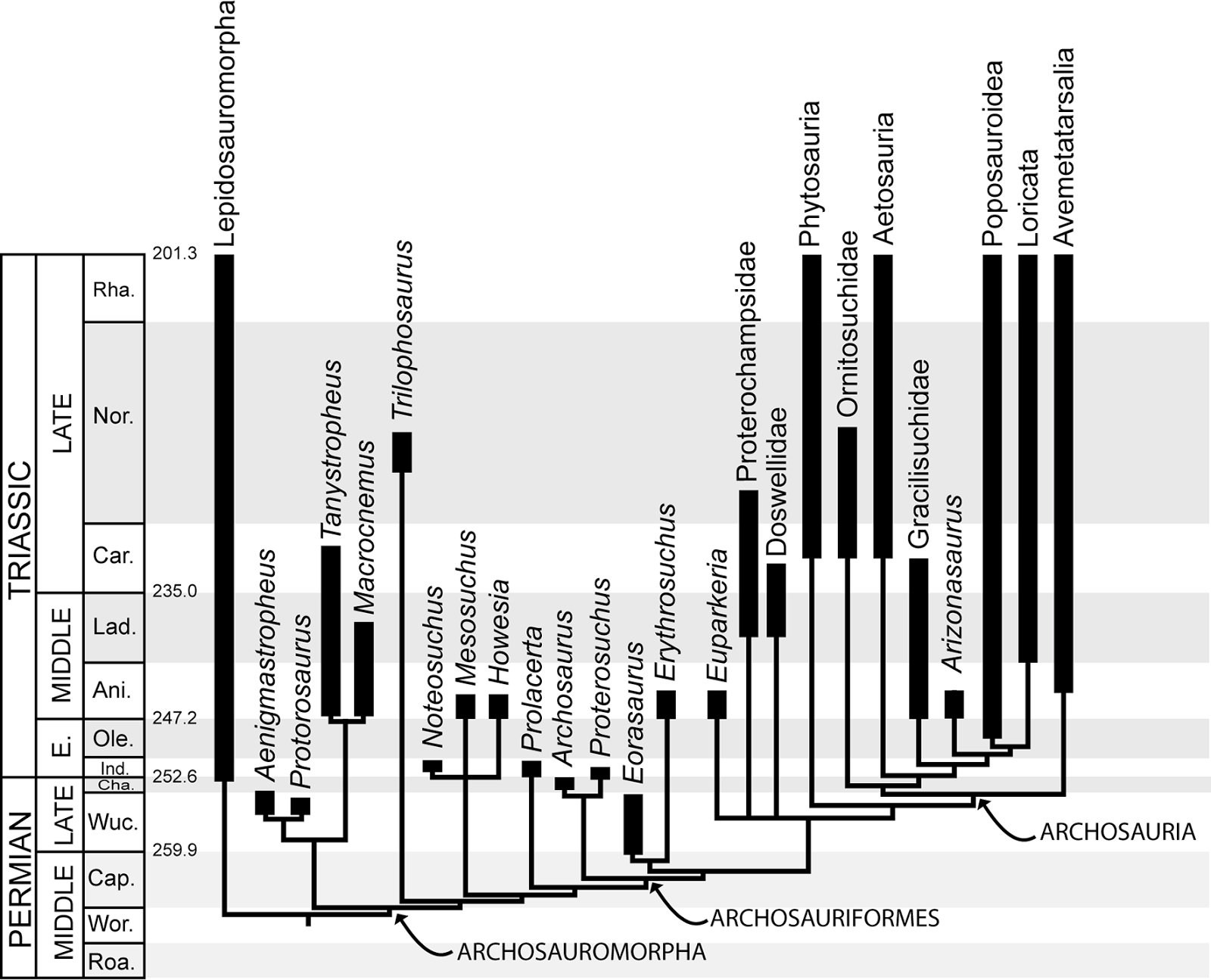
The Origin and Early Radiation of Archosauriforms: Integrating the Skeletal and Footprint Record
Authors:
Bernardi et al
Abstract:
We present a holistic approach to the study of early archosauriform evolution by integrating body and track records. The ichnological record supports a Late Permian–Early Triassic radiation of archosauriforms not well documented by skeletal material, and new footprints from the Upper Permian of the southern Alps (Italy) provide evidence for a diversity not yet sampled by body fossils. The integrative study of body fossil and footprint data supports the hypothesis that archosauriforms had already undergone substantial taxonomic diversification by the Late Permian and that by the Early Triassic archosauromorphs attained a broad geographical distribution over most parts of Pangea. Analysis of body size, as deduced from track size, suggests that archosauriform average body size did not change significantly from the Late Permian to the Early Triassic. A survey of facies yielding both skeletal and track record indicate an ecological preference for inland fluvial (lacustrine) environments for early archosauromorphs. Finally, although more data is needed, Late Permian chirotheriid imprints suggest a shift from sprawling to erect posture in archosauriforms before the end-Permian mass extinction event. We highlight the importance of approaching palaeobiological questions by using all available sources of data, specifically through integrating the body and track fossil record.
Monday, May 11, 2015
No Sign of an Adaptive Radiation for Canids?
Iterative adaptive radiations of fossil canids show no evidence for diversity-dependent trait evolution
Author:
Slater
Abstract:
Many of the most diverse lineages of animals and plants are hypothesized to have arisen via the process of adaptive radiation. Most modern definitions of adaptive radiation focus on the role of ecological opportunity in regulating rates of morphological diversification. Using the rich fossil record of North American canids (wolves, foxes, and their relatives), I found no relationship between past diversity and rates of body size or tooth shape evolution. Instead, phenotypic evolution is directed toward adaptively optimal morphologies, such as large size or broad molars, without changes in the rate at which diversity accumulates. If these kinds of processes are common, we may need to rethink many of our ideas about the origins of morphological diversity.
Tuesday, March 24, 2015
Was the Ediacaran/Cambrian Radiation Unique?
Was the Ediacaran—Cambrian radiation a unique evolutionary event?
Author:
Erwin
Abstract:
The extent of morphologic innovation during the Ediacaran—Cambrian diversification of animals was unique in the history of metazoan life. This episode was also associated with extensive changes in the redox state of the oceans, in the structure of benthic and pelagic marine ecosystems, in the nature of marine sediments, and in the complexity of developmental interactions in Eumetazoa. But did the phylogenetic and morphologic breadth of this episode simply reflect the unusual outcome of recurrent evolutionary processes, or was it the unique result of circumstances, whether in the physical environment, in developmental mechanisms, or in ecological interactions? To better characterize the uniqueness of the events, I distinguish among these components on the basis of the extent of sensitivity to initial conditions and unpredictability, which generates a matrix of possibilities from fully contingent to fully deterministic. Discriminating between these differences is important for informing debates over determinism versus the contingency in the history of life, for understanding the nature of evolutionary theory, and for interpreting historically unique events.
Wednesday, November 05, 2014
Nundasuchus songeaensis: a new Anisian Triassic Pseudosuchian Archosaur From Tanzania

A new archosaur from the Manda beds (Anisian, Middle Triassic) of southern Tanzania and its implications for character state optimizations at Archosauria and Pseudosuchia
Authors:
Nesbitt et al
Abstract:
The presence of early pseudosuchians and avemetatarsalians in Anisian beds of Africa demonstrates that the archosaur radiation was well underway by the beginning of the Middle Triassic. The rapid radiation produced a variety of forms, but many of the unique, well-diagnosed Late Triassic clades (e.g., Aetosauria, Ornithosuchidae) lack diagnosable members from the Middle Triassic. Here, we introduce a new Middle Triassic archosaur, Nundasuchus songeaensis, gen. et sp. nov., with an unusual mix of apomorphic character states found within Pseudosuchia and just outside Archosauria. The holotype consists of partial skeleton, including representative postcranial elements and parts of the skull. We added Nundasuchus songeaensis, gen. et sp. nov., into the two most comprehensive early archosaur phylogenetic data sets available, and in both analyses the new taxon falls within Pseudosuchia. However, a number of plesiomorphic archosaurian character states (e.g., posterolaterally directed tuber of the calcaneum) optimize as local autapomorphies of the new taxon within Pseudosuchia in our analyses. Therefore, we tested alternative hypotheses of relationships for the new taxon by utilizing constraint trees. The analyses resulted in little change in the relationships and structure of other Triassic archosaur clades, but changed optimizations of certain character states and character support at the base of Pseudosuchia and Archosauria. Our analyses suggest that the complex evolution of character-state changes at the base of Archosauria is inhibiting our understanding of the relationships of early Pseudosuchia and, in turn, Archosauria.
Thursday, October 16, 2014
How Rails Radiated in the Eocene Paleogene
Eocene Diversification of Crown Group Rails (Aves: Gruiformes: Rallidae)
Authors:
Garcia et al
Abstract:
Central to our understanding of the timing of bird evolution is debate about an apparent conflict between fossil and molecular data. A deep age for higher level taxa within Neoaves is evident from molecular analyses but much remains to be learned about the age of diversification in modern bird families and their evolutionary ecology. In order to better understand the timing and pattern of diversification within the family Rallidae we used a relaxed molecular clock, fossil calibrations, and complete mitochondrial genomes from a range of rallid species analysed in a Bayesian framework. The estimated time of origin of Rallidae is Eocene, about 40.5 Mya, with evidence of intrafamiliar diversification from the Late Eocene to the Miocene. This timing is older than previously suggested for crown group Rallidae, but fossil calibrations, extent of taxon sampling and substantial sequence data give it credence. We note that fossils of Eocene age tentatively assigned to Rallidae are consistent with our findings. Compared to available studies of other bird lineages, the rail clade is old and supports an inference of deep ancestry of ground-dwelling habits among Neoaves.
Wednesday, October 01, 2014
Three Evolutionary Radiations of Sharks During the Famennian Devonian

Paleogeographical and paleoecological constraints on paleozoic vertebrates (chondrichthyans and placoderms) in the Ardenne Massif: Shark radiations in the Famennian on both sides of the Palaeotethys
Authors:
Derycke et al
Abstract:
Three chondrichthyan radiations are registered in the Famennian of the Ardenne Massif (Belgium). These radiations are already observed in Morocco and in the Carnic Alps, their acme being related with the early expansa transgression. Comparisons of univariate statistical descriptors like Margalef richness and Shannon–Wiener diversity index show variations between both margins of the Paleotethys, variations interpreted in terms of trophic relationships. The Ardenne area, a northern shallow carbonate platform is characterized during the Famennian by endemic shark taxa with durophagous dentition. The southern open deep-sea area, the Variscan Sea, contains large placoderms probably disclosing a negative feedback on “cladodont” chondrichthyans. This supports the hypothesis that the Armorica platelet behaved like a barrier between the central southern Laurussia and northern Gondwana.
Wednesday, June 11, 2014
Did Dinosaurs Succeed due to a Large Scale Adaptive Radiation?

Rates of Dinosaur Body Mass Evolution Indicate 170 Million Years of Sustained Ecological Innovation on the Avian Stem Lineage
Authors:
Benson et al
Abstract:
Large-scale adaptive radiations might explain the runaway success of a minority of extant vertebrate clades. This hypothesis predicts, among other things, rapid rates of morphological evolution during the early history of major groups, as lineages invade disparate ecological niches. However, few studies of adaptive radiation have included deep time data, so the links between extant diversity and major extinct radiations are unclear. The intensively studied Mesozoic dinosaur record provides a model system for such investigation, representing an ecologically diverse group that dominated terrestrial ecosystems for 170 million years. Furthermore, with 10,000 species, extant dinosaurs (birds) are the most speciose living tetrapod clade. We assembled composite trees of 614–622 Mesozoic dinosaurs/birds, and a comprehensive body mass dataset using the scaling relationship of limb bone robustness. Maximum-likelihood modelling and the node height test reveal rapid evolutionary rates and a predominance of rapid shifts among size classes in early (Triassic) dinosaurs. This indicates an early burst niche-filling pattern and contrasts with previous studies that favoured gradualistic rates. Subsequently, rates declined in most lineages, which rarely exploited new ecological niches. However, feathered maniraptoran dinosaurs (including Mesozoic birds) sustained rapid evolution from at least the Middle Jurassic, suggesting that these taxa evaded the effects of niche saturation. This indicates that a long evolutionary history of continuing ecological innovation paved the way for a second great radiation of dinosaurs, in birds. We therefore demonstrate links between the predominantly extinct deep time adaptive radiation of non-avian dinosaurs and the phenomenal diversification of birds, via continuing rapid rates of evolution along the phylogenetic stem lineage. This raises the possibility that the uneven distribution of biodiversity results not just from large-scale extrapolation of the process of adaptive radiation in a few extant clades, but also from the maintenance of evolvability on vast time scales across the history of life, in key lineages.
Wednesday, April 09, 2014
Analysis of Lewisuchus admixtus Suggests Dinosauromorphs had a Bushy Phylogeny

Osteology of the Middle Triassic archosaur Lewisuchus admixtus Romer (Chañares Formation, Argentina), its inclusivity, and relationships amongst early dinosauromorphs
Authors:
Bittencourt et al
Abstract:
Lewisuchus admixtus is an enigmatic early dinosauriform from the Chañares Formation, Ladinian of Argentina, which has been recently considered a member of Silesauridae. Yet, it differs markedly from Late Triassic silesaurids in dental and vertebral anatomy. Indeed, a detailed redescription of its holotype allowed the identification of several features of the skeleton previously unrecognized amongst silesaurids. These include pterygoid teeth, a dorsomedial posttemporal opening on the otoccipital, foramina associated with cranial nerves X–XII on the caudal region of the prootic–otoccipital, and postaxial neck/trunk vertebrae with craniocaudally expanded neural spines. The presence of a single row of presacral scutes was also confirmed. Some elements previously referred to, or found associated with, the holotype, including a lower jaw, pedal elements and an astragalus, more probably correspond to proterochampsid remains. The anatomical information available for the holotype of L. admixtus was rescored into a new phylogenetic dataset for dinosauromorphs, mostly based on previous works. Lewisuchus admixtus and Pseudolagosuchus major are treated as distinct OTUs because their preserved skeletons mostly lack overlapping parts. The parsimony analysis supports the basal position of L. admixtus within dinosauriforms, prior to the silesaurid–dinosaur split, rather than at the base of Silesauridae. This suggests that a higher number of early dinosauriform clades branched in the Middle and Late Triassic than previously suggested.
Subscribe to:
Posts (Atom)