Direct weakening of tropical circulations from masked CO2 radiative forcing
Author:
Merlis
Abstract:
Climate models robustly simulate weakened mean circulations of the tropical atmosphere in direct response to increased carbon dioxide (CO2). The direct response to CO2, defined by the response to radiative forcing in the absence of changes in sea surface temperature, affects tropical precipitation and tropical cyclone genesis, and these changes have been tied to the weakening of the mean tropical circulation. The mechanism underlying this direct CO2-forced circulation change has not been elucidated. Here, I demonstrate that this circulation weakening results from spatial structure in CO2’s radiative forcing. In regions of ascending circulation, such as the intertropical convergence zone, the CO2 radiative forcing is reduced, or “masked,” by deep-convective clouds and high humidity; in subsiding regions, such as the subtropics, the CO2 radiative forcing is larger because the atmosphere is drier and deep-convective clouds are infrequent. The spatial structure of the radiative forcing reduces the need for the atmosphere to transport energy. This, in turn, weakens the mass overturning of the tropical circulation. The previously unidentified mechanism is demonstrated in a hierarchy of atmospheric general circulation model simulations with altered radiative transfer to suppress the cloud masking of the radiative forcing. The mechanism depends on the climatological distribution of clouds and humidity, rather than uncertain changes in these quantities. Masked radiative forcing thereby offers an explanation for the robustness of the direct circulation weakening under increased CO2.
Showing posts with label atmospheric circulation. Show all posts
Showing posts with label atmospheric circulation. Show all posts
Saturday, October 17, 2015
Decreased Tropical Ciruclation Under Global Warming?


Monday, January 26, 2015
3d Modeling of Pluto's Atmosphere

An Atmospheric General Circulation Model for Pluto with Predictions for New Horizons
Author:
Zalucha
Abstract:
Results are presented from a 3-D Pluto general circulation model (PGCM) that includes a subsurface model and volatile cycle. Conductive heating and cooling are present, as is non-local thermodynamic equilibrium (non-LTE) heating by methane at 2.3 and 3.3 microns, non-LTE cooling by heating by methane at 7.6 microns, and LTE CO rotational line cooling. This model is novel in that it has both detailed subsurface and atmospheric model components. Yet, there is little dependence of the model results on surface albedo, emissivity, or conductivity. Predictions are also provided for the Alice and REX instruments on New Horizons and for ground-based stellar occultations. Due to the weak temperature gradients, Alice (both solar and background star consultations) and REX are predicted to observe nearly the same temperature profiles on immersion and emersion. In the stratosphere, differences of up to 20 K are possible, while at higher altitudes (100-350 km), the differences are as large as 10 K. For both methane concentration and initial surface pressure, it should be possible to distinguish between the 0.2 and 1.0 methane concentrations and 8 and 24 microbar initial surface concentrations used here. For the ground-based stellar occultation, there is a detectable difference between light curves with the different methane concentrations used here, but not for the initial surface pressures.
Wednesday, January 21, 2015
Atmospheric Rivers Like the Pineapple Express Caused Major Antarctic Storms in 2009, 2011

Extreme weather phenomena called atmospheric rivers were behind intense snowstorms recorded in 2009 and 2011 in East Antarctica. The resulting snow accumulation partly offset recent ice loss from the Antarctic ice sheet, report researchers from KU Leuven.
Atmospheric rivers are long, narrow water vapour plumes stretching thousands of kilometres across the sky over vast ocean areas. They are capable of rapidly transporting large amounts of moisture around the globe and can cause devastating precipitation when they hit coastal areas.
Although atmospheric rivers are notorious for their flood-inducing impact in Europe and the Americas, their importance for Earth's polar climate - and for global sea levels - is only now coming to light.
In this study, an international team of researchers led by Irina Gorodetskaya of KU Leuven's Regional Climate Studies research group used a combination of advanced modelling techniques and data collected at Belgium's Princess Elisabeth polar research station in East Antarctica's Dronning Maud Land to produce the first ever in-depth look at how atmospheric rivers affect precipitation in Antarctica.
link.
Friday, December 19, 2014
Titan's "Hydrology" is Exotic and Different From Earth's


Titan’s liquids: Exotic behavior and its implications on global fluid circulation
Authors:
Tan et al
Abstract:
Based on a validated model for cryogenic chemical systems, referred to as CRYOCHEM (“Cryogenic Chemistry Model”), surface liquids on Titan are shown to exhibit exotic behavior of density increase with temperature but decrease with pressure, unless the temperature falls below 89.8 K. It is also the case for the atmospheric liquid condensates below an altitude where the liquid density is minimum. The exotic behavior is of compositional origin, which does not have an analog in the atmosphere and liquid water on Earth. As the latitudinal and seasonal variations of surface temperature are known, it is possible to map out the global liquid and vapor density variations as well as the equilibrium phase compositions, which will be useful as inputs for atmospheric general circulation models (GCMs) and investigations of Titan’s methane-equivalent of Earth’s hydrological cycle, local subsurface alkanology (equivalent to hydrology on Earth), lake convection, and clastic and chemical sedimentation in the lakes. Further, the density variations can be used to derive a general idea about global fluid circulation in the upper crust based on averaged conditions on Titan. The surface liquid should tend to flow toward the hottest spot on Titan and a return flow occurs beneath the surface, thus providing analogies with thermohaline circulation in Earth’s oceans. The vapor phase, on the other hand, has ordinary properties that make the global atmospheric circulation similar to the Hadley cell on Earth, but Titan’s cycle reaches the polar regions. The calculated compositions of surface liquids are more methane-rich than other models indicated, thus qualitatively in the right direction to satisfy polar-lake compositions deduced from loss tangents. However, quantitatively there remains a need to find yet more accurate liquid compositions and an optimum equilibrium within constraints of the atmospheric measurements.
Thursday, December 18, 2014
Is Titan's Sand Dune Patterning an Artifact of Milankovitch Cycles?
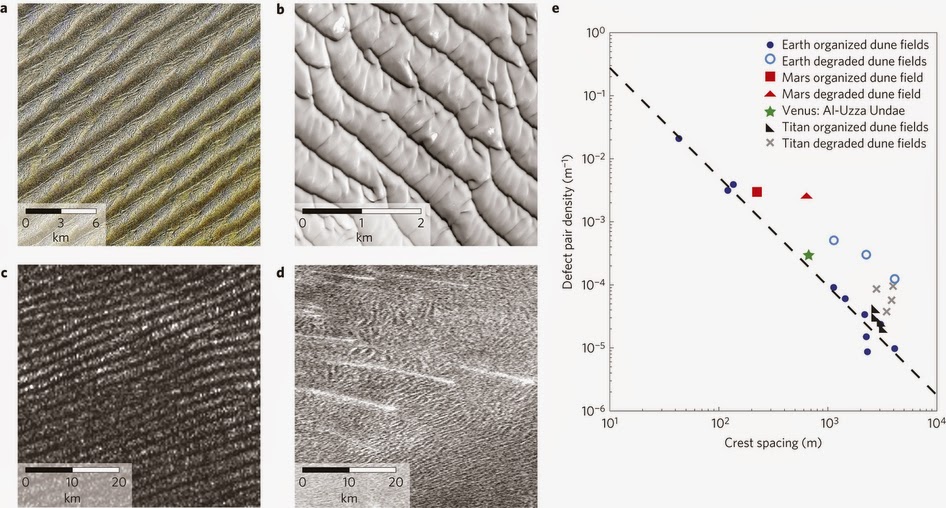
Sand dune patterns on Titan controlled by long-term climate cycles
Authors:
Ewing et al
Abstract:
Linear sand dunes cover the equatorial latitudes of Saturn’s moon Titan and are shaped by global wind patterns. These dunes are thought to reflect present-day diurnal, tidal and seasonal winds, but climate models have failed to reproduce observed dune morphologies with these wind patterns. Dunes diagnostic of a specific wind or formative timescale have remained elusive. Here we analyse radar imagery from NASA’s Cassini spacecraft and identify barchan, star and reoriented dunes in sediment-limited regions of Titan’s equatorial dune fields that diverge by 23° on average from the orientation of linear dunes. These morphologies imply shifts in wind direction and sediment availability. Using a numerical model, we estimate that the observed reorientation of dune crests to a change in wind direction would have taken around 3,000 Saturn years (1 Saturn year ∼ 29.4 Earth years) or longer—a timescale that exceeds diurnal, seasonal or tidal cycles. We propose that shifts in winds and sediment availability are the product of long-term climate cycles associated with variations in Saturn’s orbit. Orbitally controlled landscape evolution—also proposed to explain the distribution of Titan’s polar lakes—implies a dune-forming climate on equatorial Titan that is analogous to Earth.
Friday, November 28, 2014
A new Radiative Transfer Method for Venus General Circulation Models
A new fast and flexible radiative transfer method for Venus general circulation models
Authors:
Mendonça et al
Abstract:
We present a new radiation scheme for the Oxford Planetary Unified Model System for Venus, suitable for the solar and thermal bands. This new and fast radiative parameterisation uses a different approach in the two main radiative wavelength bands: solar radiation View the MathML source(0.1–5.5μm) and thermal radiation View the MathML source(1.7–260μm). The solar radiation calculation is based on the δ-Eddington approximation (two-stream-type) with an adding layer method. For the thermal radiation case, a code based on an absorptivity/emissivity formulation is used.
The new radiative transfer formulation implemented is intended to be computationally light, to allow its incorporation in 3D global circulation models, but still allowing for the calculation of the effect of atmospheric conditions on radiative fluxes. This will allow us to investigate the dynamical-radiative-microphysical feedbacks. The model flexibility can be also used to explore the uncertainties in the Venus atmosphere such as the optical properties in the deep atmosphere or cloud amount.
The results of radiative cooling and heating rates and the global-mean radiative-convective equilibrium temperature profiles for different atmospheric conditions are presented and discussed. This new scheme works in an atmospheric column and can be easily implemented in 3D Venus global circulation models.
Thursday, October 09, 2014
Evidence Walker Circulation is Weakening Over the Pacific Ocean
Equatorial Pacific coral geochemical records show recent weakening of the Walker Circulation
Authors:
Carilli et al
Abstract:
Equatorial Pacific ocean-atmosphere interactions affect climate globally, and a key component of the coupled system is the Walker Circulation, which is driven by sea surface temperature (SST) gradients across the equatorial Pacific. There is conflicting evidence as to whether the SST gradient and Walker Circulation have strengthened or weakened over the late 20th century. We present new records of SST and sea surface salinity (SSS) spanning 1959-2010 based on paired measurements of Sr/Ca and δ18O in a massive Porites coral from Butaritari atoll in the Gilbert Islands, Republic of Kiribati, in the central-western equatorial Pacific. The records show 2-7 year variability correlated with the El Niño-Southern Oscillation (ENSO) and corresponding shifts in the extent of the Indo-Pacific Warm Pool, and decadal-scale signals related to the Pacific Decadal Oscillation. In addition, the Butaritari coral records reveal a small but significant increase in SST (0.39 °C) from 1959 to 2010 with no accompanying change in SSS, a trend that persists even when ENSO variability is removed. In contrast, larger increases in SST and SSS are evident in coral records from the equatorial Pacific Line Islands, located east of Butaritari. Taken together, the equatorial Pacific coral records suggest an overall reduction in the east-west SST and SSS gradient over the last several decades, and a recent weakening of the Walker Circulation.
Monday, August 18, 2014
Tropical Waters may Become More Oxygenated From Global warming
As the complex story of climate change unfolds, many of the endings are grim. But there are exceptions. Predictions that the lowest-oxygen environments in the ocean would get worse may not come to pass. Instead, University of Washington research shows climate change, as it weakens the trade winds, could shrink the size of these extreme low-oxygen waters.
"The tropics should actually get better oxygenated as the climate warms up," said Curtis Deutsch, a UW associate professor of oceanography. He is lead author of the study published Aug. 8 in Science.
Warmer water contains less gas, so climate change is expected to reduce oxygen levels worldwide. Observations show this is already taking place in many places. Declines during the past 20 years in the tropical low-oxygen zones, the lowest-oxygen waters on the planet, had led to a 2008 study proposing that these zones would also get worse over time.
Tropical regions are usually associated with an abundance of life, but they have some of the most inhospitable places for ocean dwellers. The oxygen minimum zones off Mexico and Peru have oxygen levels already too low to support most animals (so, unlike in other low-oxygen zones, here there's no risk of killing fish).
But when those levels drop even further, a particular group of bacteria, which can use nitrogen instead of oxygen as a source of energy, thrive. Nitrogen is an essential and very scarce nutrient for marine plants. When oxygen levels get low enough for that particular group of bacteria to take over, significant amounts of the ocean's fertilizer get deep-sixed to the bottom of the tropical ocean.
The new paper shows that water flowing into the tropics is indeed likely to get lower in oxygen, decreasing the initial oxygen supply. But demand will also shift under climate change. Specifically, as the trade winds weaken, the whole sequence of events that feeds this bacterial food chain will slow down, and the low-oxygen zone will shrink.
link.
Wednesday, July 30, 2014
How High Carbon dioxide Effects Atmospheric Circulation
Effects of explicit atmospheric convection at high CO2
Authors:
Arnold et al
Abstract:
The effect of clouds on climate remains the largest uncertainty in climate change predictions, due to the inability of global climate models (GCMs) to resolve essential small-scale cloud and convection processes. We compare preindustrial and quadrupled CO2 simulations between a conventional GCM in which convection is parameterized and a “superparameterized” model in which convection is explicitly simulated with a cloud-permitting model in each grid cell. We find that the global responses of the two models to increased CO2 are broadly similar: both simulate ice-free Arctic summers, wintertime Arctic convection, and enhanced Madden–Julian oscillation (MJO) activity. Superparameterization produces significant differences at both CO2 levels, including greater Arctic cloud cover, further reduced sea ice area at high CO2, and a stronger increase with CO2 of the MJO.
Subscribe to:
Posts (Atom)