Space is mostly vast and empty. So whenever we notice something like ripples on a lake, on the frozen moon of a gas giant, we take notice.
At a meeting of the American Geophysical Union in San Francisco this week, it was reported that Cassini images of Saturn's moon Titan showed light being reflected from the Ligeia Mare, a frigid sea of hydrocarbons on that moon. Subsequent images showed the same phenomenon on two other seas of Titan, as well. These are thought to be waves, the first waves detected anywhere other than Earth, and suggest that Titan has more geophysical activity than previously thought.
Surfers on Earth, known for seeking out remote and secretive locations, shouldn't get too excited. According to mathematical modelling and radar imagery, these waves are only 1.5 cm (0.6 inches) tall, and they're moving only 0.7 metres (2.3 feet) per second. Plus, they're on a sea of liquid hydrocarbons—mostly methane—that is a frigid -180 degrees Celsius (-292 F.)
Planetary scientists are taking note, though, because these waves show that Titan has an active environment, rather than just being a moon frozen in time. It's thought that the change in seasons on Titan is responsible for these waves, as Titan begins its 7 year summer. Processes related to the changing seasons on Titan have created winds, which have cause these ripples.
Eclipse-induced changes of Titan's meteorology at equinox
Authors:
Tokano et al
Abstract:
Titan experiences solar eclipses by Saturn on ∼20 consecutive orbits around equinox for durations of up to ∼6 hours. The impact of these eclipses on Titan's surface, lower atmosphere and middle atmosphere is investigated by a global climate model. When an eclipse commences, the surface temperature on the subsaturnian side drops by up to 0.3 K, so that the diurnal maximum surface temperature remains lower than on the antisaturnian side, which is never eclipsed. By contrast, the tropospheric air temperature does not abruptly decrease during the eclipses because of the large thermal inertia, but the diurnal mean temperature slightly decreases. The surface wind at low latitudes becomes less gusty in the presence of eclipse due to damping of turbulence. The troposphere outside the planetary boundary layer is not sensitive to eclipses. In most parts of the stratosphere and mesosphere the temperature decreases by up to 2 K due to eclipses, but there are also layers, which experience relative warming due to thermal contraction of the underlying layers. The temperature in the middle atmosphere rapidly recovers after the end of the eclipse season. Eclipse-induced cooling and warming changes the zonal wind speed by a few m s−1 due to thermal wind adjustment to changing latitudinal temperature gradients.
Simulating Titan’s methane cycle with the TitanWRF General Circulation Model
Authors:
Newman et al
Abstract:
Observations provide increasing evidence of a methane hydrological cycle on Titan. Earth-based and Cassini-based monitoring has produced data on the seasonal variation in cloud activity and location, with clouds being observed at increasingly low latitudes as Titan moved out of southern summer. Lakes are observed at high latitudes, with far larger lakes and greater areal coverage in the northern hemisphere, where some shorelines extend down as far as 50°N. Rainfall at some point in the past is suggested by the pattern of flow features on the surface at the Huygens landing site, while recent rainfall is suggested by surface change. As with the water cycle on Earth, the methane cycle on Titan is both impacted by tropospheric dynamics and likely able to impact this circulation via feedbacks. Here we use the 3D TitanWRF General Circulation Model (GCM) to simulate Titan’s methane cycle. In this initial work we use a simple large-scale condensation scheme with latent heat feedbacks and a finite surface reservoir of methane, and focus on large-scale dynamical interactions between the atmospheric circulation and methane, and how these impact seasonal changes and the long term (steady state) behavior of the methane cycle. We note five major conclusions: (1) Condensation and precipitation in the model is sporadic in nature, with interannual variability in its timing and location, but tends to occur in association with both (a) frequent strong polar upwelling during spring and summer in each hemisphere, and (b) the Inter-Tropical Convergence Zone (ITCZ), a region of increased convergence and upwelling due to the seasonally shifting Hadley cells. (2) An active tropospheric methane cycle affects the stratospheric circulation, slightly weakening the stratospheric superrotation produced. (3) Latent heating feedback strongly influences surface and near-surface temperatures, narrowing the latitudinal range of the ITCZ, and changing the distribution – and generally weakening the strength – of upwelling events. (4) TitanWRF favors low latitude ‘cloudiness’ around northern spring equinox as the ITCZ moves from south to north across the equator, versus the opposite time of year. (5) TitanWRF produces drying of low and mid latitudes with net transport of surface methane to high latitudes, and shows persistent hemispheric asymmetry in the methane cycle such that the favored pole for surface methane is the one with winter occurring closest to perihelion.
NASA’s Cassini spacecraft has detected a massive, never-before-seen icy cloud at the south pole of Saturn’s huge moon Titan.
The newly spotted feature—part of a cloud system known as the south polar vortex—suggests that winter in the southern hemisphere of Titan will be even colder than predicted, scientists said.
The atmospheric signal “looks pretty normal, then BOOM!, increases,” indicating the presence of a brand-new cloud, said Cassini participating scientist Carrie Anderson, of NASA’s Goddard Space Flight Center in Greenbelt, Maryland. “I was so excited, I pretty much fell out of my chair.”
Electron-molecule chemistry and charging processes on organic ices and Titan’s icy aerosol surrogates
Authors:
Pirim et al
Abstract:
Electron-induced polymerization processes and charging events that can occur within Titan’s atmosphere or on its surface were simulated using electron irradiation and dissociative electron attachment (DEA) studies of nitrogen-containing organic condensates. The DEA studies probe the desorption of H− from hydrogen cyanide (HCN), acetonitrile (CH3CN), and aminoacetonitrile (NH2CH2CN) ices, as well as from synthesized tholin materials condensed or deposited onto a graphite substrate maintained at low temperature (90–130 K). The peak cross sections for H− desorption during low-energy (3–15 eV) electron irradiation were measured and range from 3 × 10⁻²¹ to 2 × 10⁻¹⁸ cm2. Chemical and structural transformations of HCN ice upon 2 keV electron irradiation were investigated using X-ray photoelectron and Fourier-transform infrared spectroscopy techniques. The electron-beam processed materials displayed optical properties very similar to tholins produced by conventional discharge methods. Electron and negative ion trapping lead to 1011 charges cm−2 on a flat surface which, assuming a radius of 0.05 μm for Titan aerosols, is ∼628 charges/radius (in μm). The facile charge trapping indicates that electron interactions with nitriles and complex tholin-like molecules could affect the conductivity of Titan’s atmosphere due to the formation of large negative ion complexes. These negatively charged complexes can also precipitate onto Titan’s surface and possibly contribute to surface reactions and the formation of dunes.


Possible temperate lakes on Titan
Authors:
Vixie et al
Abstract:
We analyze southern mid-latitude albedo-dark features on Titan observed by Cassini’s Visual and Infrared Mapping Spectrometer (VIMS). In exploring the nature of these features we consider their morphology, albedo, and specular reflectivity. We suggest that they represent candidates for potential temperate lakes. The presence of lakes at the mid-latitudes would indicate that surface liquid can accumulate and remain stable away from Titan’s poles. Candidate lakes were identified by looking for possible shorelines with lacustrine morphology. Then, we applied an atmospheric correction that empirically solved for their surface albedo. Finally, we looked for a specular reflection of the sky in the identified candidates. Using this prescription, we find two candidates that remain as potential temperature lakes. If candidate features do represent temperate lakes on Titan, they have implications for formation mechanisms such as clouds and rainfall or, in low elevation areas, percolation and subsurface flow. Clouds were observed near candidate lake locations on the T66 flyby and this latitude band showed many clouds during southern summer. Our techniques can be applied to areas of Titan that lack RADAR coverage to search for mid- and low-latitude lakes in the future.

GCM simulations of Titan's middle and lower atmosphere and comparison to observations
Authors:
Lora et al
Abstract:
Simulation results are presented from a new general circulation model (GCM) of Titan, the Titan Atmospheric Model (TAM), which couples the Flexible Modeling System (FMS) spectral dynamical core to a suite of external/sub-grid-scale physics. These include a new non-gray radiative transfer module that takes advantage of recent data from Cassini-Huygens, large-scale condensation and quasi-equilibrium moist convection schemes, a surface model with "bucket" hydrology, and boundary layer turbulent diffusion. The model produces a realistic temperature structure from the surface to the lower mesosphere, including a stratopause, as well as satisfactory superrotation. The latter is shown to depend on the dynamical core's ability to build up angular momentum from surface torques. Simulated latitudinal temperature contrasts are adequate, compared to observations, and polar temperature anomalies agree with observations. In the lower atmosphere, the insolation distribution is shown to strongly impact turbulent fluxes, and surface heating is maximum at mid-latitudes. Surface liquids are unstable at mid- and low-latitudes, and quickly migrate poleward. The simulated humidity profile and distribution of surface temperatures, compared to observations, corroborate the prevalence of dry conditions at low latitudes. Polar cloud activity is well represented, though the observed mid-latitude clouds remain somewhat puzzling, and some formation alternatives are suggested.


Titan’s liquids: Exotic behavior and its implications on global fluid circulation
Authors:
Tan et al
Abstract:
Based on a validated model for cryogenic chemical systems, referred to as CRYOCHEM (“Cryogenic Chemistry Model”), surface liquids on Titan are shown to exhibit exotic behavior of density increase with temperature but decrease with pressure, unless the temperature falls below 89.8 K. It is also the case for the atmospheric liquid condensates below an altitude where the liquid density is minimum. The exotic behavior is of compositional origin, which does not have an analog in the atmosphere and liquid water on Earth. As the latitudinal and seasonal variations of surface temperature are known, it is possible to map out the global liquid and vapor density variations as well as the equilibrium phase compositions, which will be useful as inputs for atmospheric general circulation models (GCMs) and investigations of Titan’s methane-equivalent of Earth’s hydrological cycle, local subsurface alkanology (equivalent to hydrology on Earth), lake convection, and clastic and chemical sedimentation in the lakes. Further, the density variations can be used to derive a general idea about global fluid circulation in the upper crust based on averaged conditions on Titan. The surface liquid should tend to flow toward the hottest spot on Titan and a return flow occurs beneath the surface, thus providing analogies with thermohaline circulation in Earth’s oceans. The vapor phase, on the other hand, has ordinary properties that make the global atmospheric circulation similar to the Hadley cell on Earth, but Titan’s cycle reaches the polar regions. The calculated compositions of surface liquids are more methane-rich than other models indicated, thus qualitatively in the right direction to satisfy polar-lake compositions deduced from loss tangents. However, quantitatively there remains a need to find yet more accurate liquid compositions and an optimum equilibrium within constraints of the atmospheric measurements.
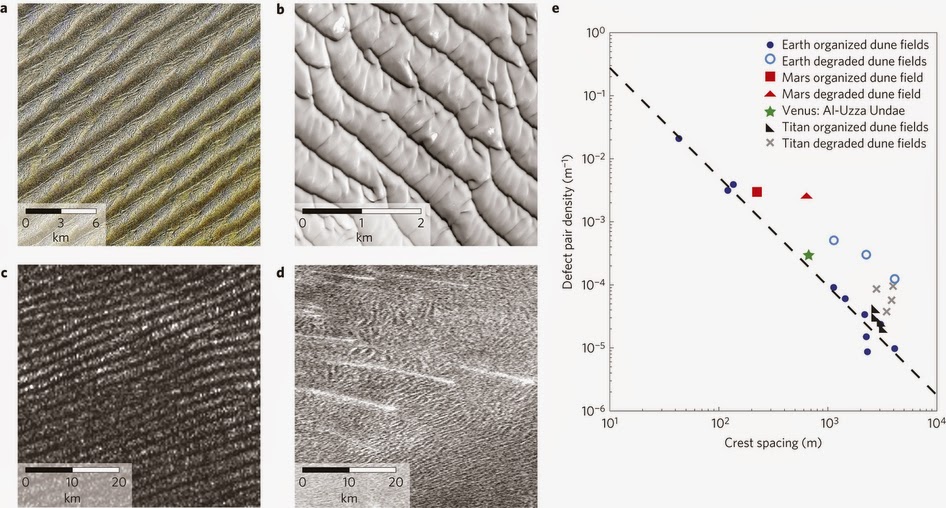
Sand dune patterns on Titan controlled by long-term climate cycles
Authors:
Ewing et al
Abstract:
Linear sand dunes cover the equatorial latitudes of Saturn’s moon Titan and are shaped by global wind patterns. These dunes are thought to reflect present-day diurnal, tidal and seasonal winds, but climate models have failed to reproduce observed dune morphologies with these wind patterns. Dunes diagnostic of a specific wind or formative timescale have remained elusive. Here we analyse radar imagery from NASA’s Cassini spacecraft and identify barchan, star and reoriented dunes in sediment-limited regions of Titan’s equatorial dune fields that diverge by 23° on average from the orientation of linear dunes. These morphologies imply shifts in wind direction and sediment availability. Using a numerical model, we estimate that the observed reorientation of dune crests to a change in wind direction would have taken around 3,000 Saturn years (1 Saturn year ∼ 29.4 Earth years) or longer—a timescale that exceeds diurnal, seasonal or tidal cycles. We propose that shifts in winds and sediment availability are the product of long-term climate cycles associated with variations in Saturn’s orbit. Orbitally controlled landscape evolution—also proposed to explain the distribution of Titan’s polar lakes—implies a dune-forming climate on equatorial Titan that is analogous to Earth.


Numerical simulation of tides and oceanic angular momentum of Titan’s hydrocarbon seas
Authors:
Tokano et al
Abstract:
Tides and tidal currents in Titan’s hydrocarbon seas are numerically simulated by a 3-dimensional ocean circulation model using a bathymetry map constrained by Cassini. These predictions are used to calculate the tidally induced variations of the oceanic angular momentum of the seas. The tides behave as a quasi-standing wave with anti-nodes at the northern and southern shores. The tidal currents in Kraken Mare are mainly oriented along the major axis of the sea and are dominated by fast hydraulic currents through a narrow strait. The axial oceanic angular momentum primarily changes due to redistribution of liquids in Kraken Mare and maximizes when there is ebb at the northern shore and flood at the southern shore. On the other hand, variations of the equatorial oceanic angular momentum are contributed by both tides and tidal currents. The oceanic torque between sea and sea bottom is minor compared to its atmospheric counterpart, i.e. the mountain torque between atmosphere and mountains.
Evidence of Titan's Climate History from Evaporite Distribution
Authors:
MacKenzie et al
Abstract:
Water-ice-poor, 5-μm-bright material on Saturn's moon Titan has previously been geomorphologically identified as evaporitic. Here we present a global distribution of the occurrences of the 5-μm-bright spectral unit, identified with Cassini's Visual Infrared Mapping Spectrometer (VIMS) and examined with RADAR when possible. We explore the possibility that each of these occurrences are evaporite deposits. The 5-μm-bright material covers 1\% of Titan's surface and is not limited to the poles (the only regions with extensive, long-lived surface liquid). We find the greatest areal concentration to be in the equatorial basins Tui Regio and Hotei Regio. Our interpretations, based on the correlation between 5-μm-bright material and lakebeds, imply that there was enough liquid present at some time to create the observed 5-μm-bright material. We address the climate implications surrounding a lack of evaporitic material at the south polar basins: if the south pole basins were filled at some point in the past, then where is the evaporite?


