Showing posts with label rhaetian. Show all posts

Friday, November 11, 2016

A New Dinosauromorph & Carnivorous Sauropod Ancestor Fossils Discovered in Norian/Rhaetian Triassic Brazil


Authors:

Cabreira et al

Abstract:

Dinosauromorpha includes dinosaurs and other much less diverse dinosaur precursors of Triassic age, such as lagerpetids [1]. Joint occurrences of these taxa with dinosaurs are rare but more common during the latest part of that period (Norian-Rhaetian, 228–201 million years ago [mya]) [2, 3]. In contrast, the new lagerpetid and saurischian dinosaur described here were unearthed from one of the oldest rock units with dinosaur fossils worldwide, the Carnian (237–228 mya) Santa Maria Formation of south Brazil [4], a record only matched in age by much more fragmentary remains from Argentina [5]. This is the first time nearly complete dinosaur and non-dinosaur dinosauromorph remains are found together in the same excavation, clearly showing that these animals were contemporaries since the first stages of dinosaur evolution. The new lagerpetid preserves the first skull, scapular and forelimb elements, plus associated vertebrae, known for the group, revealing how dinosaurs acquired several of their typical anatomical traits. Furthermore, a novel phylogenetic analysis shows the new dinosaur as the most basal Sauropodomorpha. Its plesiomorphic teeth, strictly adapted to faunivory, provide crucial data to infer the feeding behavior of the first dinosaurs.

Wednesday, January 06, 2016

"Giant" Pterosaur Found at Rhaetian (?) Triassic Oasis "Sandpit"

Scientists have found an unprecedented cache of fossils of weird animals that thrived at a desert oasis some 200 million years ago, providing a snapshot of a place and time that have long been a mystery.

The fossils include the bones of a fanged flying predator and creatures that looked, one scientist says, like tiny crocodiles with a Chihuahua's legs. Small reptiles whose "hands" resemble a mole's lived alongside dinosaurs that scampered on their hind legs.

Researchers suspect that many of the fossils represent entirely new species.

"Probably almost everything we're finding (at the site) is previously unknown to science," says Dan Chure of Dinosaur National Monument, one of the site's co-discoverers. "It's just an amazing paleontological candy shop."

The fossils are "a spectacular find," agrees University of Utah paleontologist Randall Irmis, who isn't involved in the project. "We so rarely get sites that preserve such a variety of different animals from the beginning of the age of dinosaurs."

The animals at the site should help illuminate the period just before the mass extinction that allowed the dinosaurs to take over the Earth, Irmis says. The fossils also illuminate exactly what was living in the vast sand box that filled what is now the western United States, where fossils from the Late Triassic fossils are scarce.

Wednesday, December 23, 2015

The Implications of the Pollen of the Norian/Rhaetian Triassic New Mexico

Palynology of the upper Chinle Formation in northern New Mexico, U.S.A.: Implications for biostratigraphy and terrestrial ecosystem change during the Late Triassic (Norian–Rhaetian)

Authors:

Lindström et al

Abstract:

A new densely sampled palynological record from the vertebrate-bearing upper Chinle Formation at Ghost Ranch in the Chama Basin of northwestern New Mexico provides insights into the biostratigraphy and terrestrial ecosystem changes during the Late Triassic of northwestern Pangaea. Spore-pollen assemblages from the Poleo Sandstone, Petrified Forest, and 'siltstone' members are dominated by pollen of corystospermous seed ferns (Alisporites) and voltziacean conifers (Enzonalasporites, Patinasporites). Other abundant taxa include Klausipollenites gouldii and the enigmatic fused tetrad Froelichsporites traversei, whereas spores of ferns and fern allies are generally rare. The assemblages are correlated with Zone III Chinle palynofloras of previous authors. The lower assemblages contain rare occurrences of typical Zone II taxa, namely Cycadopites stonei, Equisetosporites chinleanus and Lagenella martini, that may either be reworked or represent relictual floral elements. Marked step-wise losses of species richness, along with only minor appearances of new taxa, led to a total 50% drop in range-through diversity during the late Norian of the Chama Basin. Correlations with other Chinle records in the western U.S. reveal differences in the stratigraphic ranges of some spore-pollen taxa, likely attributable to local/regional differences in environmental conditions, such as groundwater availability, precipitation, nutrients, and temperature, rather than stratigraphic miscorrelation. This is interpreted as a consequence of environmental stress resulting from increased aridity coincident with the northward movement of Pangaea. Similarly, major differences between the western and eastern U.S. and northwest Europe can be attributed to floral provincialism governed by climatic zones during the Late Triassic.

Thursday, December 10, 2015

Norian/Rhaetian Triassic Sichuan Basin, China had two Warm, Humid and two Cooler, Drier PaleoClimate Events

Late Triassic palynofloras in the Sichuan Basin, South China: Synthesis and perspective

Authors:

Li et al

Abstract:

Mesozoic strata are well developed and exposed continuously across the Sichuan Basin, South China. In particular, the Upper Triassic strata yield diverse and abundant spore-pollen fossils, providing a significant reference for the study of palaeoenvironmental variations across the Triassic–Jurassic transition where mass extinctions were occurring. In this paper, we summarize the major progress on Late Triassic palynological studies in this basin. To date, 151 genera (454 species) of sporomorph fossils have been reported from the Late Triassic strata in the Sichuan Basin. Three palynological assemblages are distinguished for the Late Triassic in the Sichuan Basin. Late Triassic vegetation in the Sichuan Basin shows a remarkable predominance of ferns, followed by conifers and cycads/ginkgophytes, and conifers show a distinct increase in abundance in the latest Triassic. In general, the Late Triassic palaeoclimate in the Sichuan Basin was tropical-subtropical, humid and warm. A synthesis of the data shows that the Late Triassic did not have a constant paleoclimate in the Sichuan Basin, several climatic events are recognized: two warm and humid climate events in Norian-Rhaetian time, coupled with a cooler and drier condition in the latest Late Triassic. Further investigations in higher resolution at more continuous sections in the Sichuan Basin are needed to better understand the Late Triassic vegetation response, climate changes, as well as palaeoecosystem variations across the Triassic–Jurassic boundary.

Tuesday, November 17, 2015

Haramiyidans Were NOT Mammals or Closely Related to Multituberculates According to Evidence From Rhaetian Triassic Greenland


Mandibular and dental characteristics of Late Triassic mammaliaform Haramiyavia and their ramifications for basal mammal evolution

Authors:

Luo et al

Abstract:

As one of the earliest-known mammaliaforms, Haramiyavia clemmenseni from the Rhaetic (Late Triassic) of East Greenland has held an important place in understanding the timing of the earliest radiation of the group. Reanalysis of the type specimen using high-resolution computed tomography (CT) has revealed new details, such as the presence of the dentary condyle of the mammalian jaw hinge and the postdentary trough for mandibular attachment of the middle ear—a transitional condition of the predecessors to crown Mammalia. Our tests of competing phylogenetic hypotheses with these new data show that Late Triassic haramiyids are a separate clade from multituberculate mammals and are excluded from the Mammalia. Consequently, hypotheses of a Late Triassic diversification of the Mammalia that depend on multituberculate affinities of haramiyidans are rejected. Scanning electron microscopy study of tooth-wear facets and kinematic functional simulation of occlusion with virtual 3D models from CT scans confirm that Haramiyavia had a major orthal occlusion with the tallest lingual cusp of the lower molars occluding into the lingual embrasure of the upper molars, followed by a short palinal movement along the cusp rows alternating between upper and lower molars. This movement differs from the minimal orthal but extensive palinal occlusal movement of multituberculate mammals, which previously were regarded as relatives of haramiyidans. The disparity of tooth morphology and the diversity of dental functions of haramiyids and their contemporary mammaliaforms suggest that dietary diversification is a major factor in the earliest mammaliaform evolution.

Tuesday, June 16, 2015

The Unstable Paleoenvironmental Reasons why Dionsaurs Didn't Dominate the Late Triassic Tropics


Extreme ecosystem instability suppressed tropical dinosaur dominance for 30 million years

Authors:

Whiteside et al

Abstract:

A major unresolved aspect of the rise of dinosaurs is why early dinosaurs and their relatives were rare and species-poor at low paleolatitudes throughout the Late Triassic Period, a pattern persisting 30 million years after their origin and 10–15 million years after they became abundant and speciose at higher latitudes. New palynological, wildfire, organic carbon isotope, and atmospheric pCO2 data from early dinosaur-bearing strata of low paleolatitudes in western North America show that large, high-frequency, tightly correlated variations in δ13Corg and palynomorph ecotypes occurred within a context of elevated and increasing pCO2 and pervasive wildfires. Whereas pseudosuchian archosaur-dominated communities were able to persist in these same regions under rapidly fluctuating extreme climatic conditions until the end-Triassic, large-bodied, fast-growing tachymetabolic dinosaurian herbivores requiring greater resources were unable to adapt to unstable high CO2 environmental conditions of the Late Triassic.

tsk, tsk.  Multiple instances of wild fire during the Triassic.  Can't have had too bad of an oxygen crash.  All we need to finish that theory are examples from the jurassic.

Tuesday, May 26, 2015

Giving a Crap: Understanding Polish Norian-Rhaetian Triassic PaleoEcologies Through Carnivore Coprolites


Coprolites of Late Triassic carnivorous vertebrates from Poland: An integrative approach

Authors:

Zatoń et al

Abstract:

Vertebrate coprolites derived from Upper Triassic terrestrial deposits of southern Poland have been subjected to various analytical methods in order to retrieve information about their composition, producer’s diet and nature of the microscopic structures preserved in the groundmass. Morphologically, the coprolites have been classified into four morphotypes, of which only three were further analysed due to their good state of preservation. Their groundmass are composed of francolite, a carbonate-rich apatite, in which abundant coccoid structures are preserved. Based on various microscopic and organic geochemical techniques, they are interpreted as fossilized bacteria which could have mediated the phosphatization of the faeces. The thin sectioning revealed that the coprolites consist of those containing exclusively bone remains, and those preserving both bone and plant remains. Those coprolites preserving only vertebrate remains are suggestive for exclusive carnivorous diet of the producers. However, the interpretation of coprolites consisting of both vertebrate and plant remains is more debatable. Although they may attest to omnivory, it cannot be excluded that potential producers were carnivorous and occasionally ingested plants, or accidentally swallowed plant material during feeding. The latter may involve predation or scavenging upon other herbivorous animals. The potential producers may have been animals that foraged in or near aquatic habitats, such as semi-aquatic archosaurs and/or temnospondyls. This is supported by the presence of ostracode and other aquatic arthropod remains, and fish scales within the coprolites, as well as by the presence of specific biomarkers such as phytanic and pristanic acids, which are characteristic constituents of fish oil. The preservation of such labile organic compounds as sterols, palmitin, stearin or levoglucosan attests for rapid, microbially-mediated mineralization of the faeces at very early stages of diagenesis.

Tuesday, May 05, 2015

A new Norian/Rhaetian Triassic Vertebrate Assemblage from Argentina

A NEW LATE TRIASSIC VERTEBRATE ASSEMBLAGE FROM NORTHWESTERN ARGENTINA

Authors:

Martínez et al

Abstract:

The Quebrada del Barro Formation (QBF) is part of the continental Marayes-El Carrizal Basin, in NW Argentina. Here we report a diverse faunal assemblage recently discovered at the Quebrada del Barro Formation, along with a preliminary discussion of the taxonomic status and affinities of numerous vertebrate specimens found at two localities of this unit. The new vertebrate association includes remains of at least 12 different new species related to six major vertebrate groups: Cynodontia, Testudinata, Sphenodontia, Pseudosuchia, Pterosauria, and Dinosauromorpha. The most abundant specimens in this faunal assemblage are opisthodontian sphenodonts, tritheledontid cynodonts and basal sauropodomorph dinosaurs, but the assemblage also includes diagnostic remains of lagerpetid dinosauromorphs, theropods, pterosaurs, basal crocodylomorphs, and stem testudinatans. Several of these groups have also been reported for the Los Colorados Formation (LCF), although the two units differ in their taxonomic content at the species level and in the relative abundance of different taxonomic groups. A comparison of these two faunal assemblage suggest the fauna of QBF is younger than that of LCF and we tentatively assess a late Norian–Rhaetian age for the QBF. Some of the specimens reported here are known from well-preserved specimens and contain important new information for understanding the evolution of these groups, which underscores the relevance of the QBF fauna for assessing the dynamics of the major groups of vertebrates that dominated the terrestrial ecosystems during the early Mesozoic in Pangea.

Monday, April 13, 2015

Evidence of Orbital Climate Forcing at the Triassic/Jurassic Boundary

Triassic–Jurassic climate in continental high-latitude Asia was dominated by obliquity-paced variations (Junggar Basin, Ürümqi, China)

Authors:

Sha et al

Abstract:

Empirical constraints on orbital gravitational solutions for the Solar System can be derived from the Earth’s geological record of past climates. Lithologically based paleoclimate data from the thick, coal-bearing, fluvial-lacustrine sequences of the Junggar Basin of Northwestern China (paleolatitude ∼60°) show that climate variability of the warm and glacier-free high latitudes of the latest Triassic–Early Jurassic (∼198–202 Ma) Pangea was strongly paced by obliquity-dominated (∼40 ky) orbital cyclicity, based on an age model using the 405-ky cycle of eccentricity. In contrast, coeval low-latitude continental climate was much more strongly paced by climatic precession, with virtually no hint of obliquity. Although this previously unknown obliquity dominance at high latitude is not necessarily unexpected in a high CO2 world, these data deviate substantially from published orbital solutions in period and amplitude for eccentricity cycles greater than 405 ky, consistent with chaotic diffusion of the Solar System. In contrast, there are indications that the Earth–Mars orbital resonance was in today’s 2-to-1 ratio of eccentricity to inclination. These empirical data underscore the need for temporally comprehensive, highly reliable data, as well as new gravitational solutions fitting those data.

Tuesday, January 13, 2015

Transitional Fossil Molar Tooth From Morganucodont Mammaliaform Hallautherium Found From Norian/Rhaetian Triassic Poland

Mammal-like tooth from the Upper Triassic of Poland

Authors:

Świło et al

Abstract:

Recent Triassic discoveries have extended the record of near-mammals (Mammaliaformes) back to the Norian, about 215 Ma, and reveal a significant diversity of Late Triassic (Norian-Rhaetian) forms. We now add to this Late Triassic diversity a nearly complete double-rooted right lower molariform tooth (ZPAL V.33/734) from the Polish Upper Triassic that is significant because it comes from uppermost Norian–lower Rhaetian rocks and is the first discovery of a mammal-like tooth in the Mesozoic of Poland. The described tooth shows transitional dental morphology between advanced cynodonts and mammaliaforms and it appears to represent a basal mammaliaform (genus Hallautherium), probably belonging to Morganucodonta.

Wednesday, December 10, 2014

New specimen of Placodont Psephoderma alpinum From Norian/Rhaetian Triassic Switzerland

New specimen of Psephoderma alpinum (Sauropterygia, Placodontia) from the Late Triassic of Schesaplana Mountain, Graubünden, Switzerland

Authors:


Neenan et al

Abstract:


Psephoderma alpinum is an armoured, durophagous placodont known from the alpine Late Triassic. Here we present a new, well-preserved isolated skull discovered in the Alplihorn Member (Late Norian–Early Rhaetian) of the Kössen Formation, Schesaplana Mountain, which straddles the Swiss/Austrian border. Micro-computed tomographic (µCT) scanning was used to create an accurate osteological reconstruction of the specimen, the first time this has been conducted for Psephoderma. We thus clarify disputed anatomical features from previous descriptions, such as a lack of a lacrimal and a pineal foramen that is enclosed by the parietal. We also present the first description based on µCT data of the lateral braincase wall, sphenoid region and some cranial nerve canals for Psephoderma, with the location of the hypophyseal seat, cerebral carotid foramina, dorsum sellae, prootic foramen, lacrimal foramen, as well as all dental foramina being described. This specimen represents the first skull of Psephoderma recovered in Switzerland, and features such as poorly-sutured braincase elements and its relatively small size compared to other known specimens may indicate that it was a sub-adult.

Tuesday, November 11, 2014

Megazostrodon chenali & Rosierodon anceps: new Rhaetian Triassic Morganucodont Mammals From France


Earliest known European mammals: a review of the Morganucodonta from Saint-Nicolas-de-Port (Upper Triassic, France)

Authors:

Debuysschere et al

Abstract:

The Rhaetian locality of Saint-Nicolas-de-Port (France) has yielded the most abundant and diverse mammalian assemblage known from the Late Triassic. Most of the material remains undescribed. We review here the morganucodonts from Saint-Nicolas-de-Port. We identify the upper and lower molariforms of the genus Brachyzostrodon. We also identify in the site Morganucodon peyeri, previously known from the Late Triassic of Hallau (Switzerland), as well as the genera Paceyodon and Paikasigudodon. The description of the new species Megazostrodon chenali sp. nov. extends the stratigraphical and geographical range of the genus, previously known from the Early Jurassic of southern Africa. Finally, another new morganucodont, Rosierodon anceps gen. et sp. nov., is described. The Morganucodonta is recognized as the most diverse order of Late Triassic mammals. Current fossil data suggest that Europe was the centre of initial diversification of morganucodonts at the end of the Triassic, and that morganucodonts were not much affected by the extinction event at the Triassic/Jurassic transition.

Friday, September 26, 2014

Evidence From French Rhaetian Triassic Ichthyosaurs Experienced Severe Turnover From the Triassic-Jurassic Mass Extinction

Ichthyosaurs from the French Rhaetian indicate a severe turnover across the Triassic–Jurassic boundary

Authors:

Fischer et al

Abstract:

Mesozoic marine reptiles went through a severe turnover near the end of the Triassic. Notably, an important extinction event affected ichthyosaurs, sweeping a large part of the group. This crisis is, however, obscured by an extremely poor fossil record and is regarded as protracted over the entire Norian–earliest Jurassic interval, for the lack of a more precise scenario. The iconic whale-sized shastasaurid ichthyosaurs are regarded as early victims of this turnover, disappearing by the middle Norian. Here we evaluate the pattern of this turnover among ichthyosaurs by analysing the faunal record of two Rhaetian localities. One locality is Autun, eastern France; we rediscovered in this material the holotypes or partial ‘type’ series of Rachitrema pellati, Actiosaurus gaudryi, Ichthyosaurus rheticus, Ichthyosaurus carinatus and Plesiosaurus bibractensis; a revised taxonomic scheme is proposed. The second assemblage comes from a new locality: Cuers, southeastern France. Both these assemblages provide several lines of evidence for the presence of shastasaurid-like ichthyosaurs in the Rhaetian of Europe. These occurrences suggest that both the demise of shastasaurids and the sudden radiation of neoichthyosaurians occurred within a short time window; this turnover appears not only more abrupt but also more complex than previously postulated and adds a new facet of the end-Triassic mass extinction.

Wednesday, August 06, 2014

Chirothere Trackways Found in Norian/Rhaetian Triassic China


First chirothere and possible grallatorid footprint assemblage from the Upper Triassic Baoding Formation of Sichuan Province, southwestern China

Authors:

Xing et al

Abstract:

Trackways of archosaurs have recently been discovered in sandstones of the Upper Triassic (Norian-Rhaetian) Baoding Formation of Panzhihua City in southern Sichuan Province, China. Based on their overall-morphology, pes imprints are of characteristic chirotheriid shape showing a compact and symmetrical anterior group of digit traces II–IV with the trace of digit III being longest, and a posterolaterally positioned, long and slender trace of digit V. Imprints of digit I and the manus are not preserved. This could be related to substrate conditions and the relatively shallow impressions, even if peculiarities in the gait such as overstep of the manus by the pes or bipedal movement cannot completely be excluded. Ichnotaxonomically, the imprints are assigned tentatively to cf. Chirotherium. There are some similarities with the type ichnospecies C. barthii from the Middle Triassic that has a global distribution and that was described also from the Guanling Formation (Middle Triassic) of adjacent Guizhou Province. However, the long and slender digit V that lacks a distinct large oval basal pad, the relatively short stride/step length, the low pace angulation, and the slight inward rotation of the imprints toward the midline are different. The peculiar shape of digit V and the lack of digit I in all imprints also precludes an assignment to the common Late Triassic ichnogenus Brachychirotherium or similar ichnotaxa such as Pseudotetrasauropus. An isolated tridactyl footprint on the same surface is different in shape from the chirotheriid ones by the stronger mesaxony and narrower digit divarication. It is considered here as a possible large grallatorid. This is the first occurrence of tetrapod footprints in the Baoding Formation of Sichuan Province and the second record of chirotheriids in the Triassic of China. The Baoding Formation has also yielded a characteristic Upper Triassic flora with cycads, filicopsids, gingkos, and conifers as well as bivalve fossils. The depositional environment can be designated as fluvial-lacustrine with occasional opening to marine areas. Considering biostratigraphic and palaeobiogeographic aspects, the late occurrence of chirotheriids cf. Chirotherium in China supports the view that basal crown-group archosaurs with a distinct tendency toward a functionally tridactyl pes developed and dispersed in parallel to typical tridactyl dinosaurs.

Tuesday, August 05, 2014

Triassic-Jurassic Extinction Probably Caused by Global Warming Rather Than Ocean Acidification

Radiolarian biodiversity dynamics through the Triassic and Jurassic: implications for proximate causes of the end-Triassic mass extinction

Authors:

Kocsis et al

Abstract:

Within a ∼60-Myr interval in the Late Triassic to Early Jurassic, a major mass extinction took place at the end of Triassic, and several biotic and environmental events of lesser magnitude have been recognized. Climate warming, ocean acidification, and a biocalcification crisis figure prominently in scenarios for the end-Triassic event and have been also suggested for the early Toarcian. Radiolarians, as the most abundant silica-secreting marine microfossils of the time, provide a control group against marine calcareous taxa in testing selectivity and responses to changing environmental parameters. We analyzed the origination and extinction rates of radiolarians, using data from the Paleobiology Database and employing sampling standardization, the recently developed gap-filler equations and an improved stratigraphic resolution at the substage level. The major end-Triassic event is well-supported by a late Rhaetian peak in extinction rates. Because calcifying and siliceous organisms appear similarly affected, we consider global warming a more likely proximate trigger of the extinctions than ocean acidification. The previously reported smaller events of radiolarian turnover fail to register above background levels in our analyses. The apparent early Norian extinction peak is not significant compared to the long-term trajectory, and is probably a sampling artifact. The Toarcian Oceanic Anoxic Event, previously also thought to have caused a significant radiolarian turnover, did not significantly affect the group. Radiolarian diversity history appears unique and complexly forced, as its trajectory parallels major calcareous fossil groups at some events and deviates at others.

Monday, July 21, 2014

Fire Scars Found on Petrified Wood From Late Triassic Chinle Formation


First known fire scar on a fossil tree trunk provides evidence of Late Triassic wildfire

Authors:

Byers et al

Abstract:

Fire scars are well known to fire ecologists and dendrochronologists worldwide, and are used in dating fires and reconstructing the fire histories of modern forests. Evidence of fires in ancient forests, such as fossil charcoal (fusain), is well known to paleontologists and has been reported in geologic formations dating back to the Late Devonian. We describe what we conclude is a fire scar on a fossil tree trunk from the Late Triassic Chinle Formation of southeastern Utah (~ 200–225 Ma). The external features of the prehistoric scar match those of modern fire scars better than those of scars created by other kinds of wounding events. The fossil specimen also exhibits a number of changes in wood anatomy similar to those reported in modern fire-scarred trees, including a band of very small tracheids that indicate growth suppression immediately associated with the scarring event; an area with a tangential row of probable traumatic resin ducts; and a significant increase in tracheid size following the scarring event that indicates a growth release. No fire scar resembling those in modern trees has previously been described in petrified wood as far as we can determine. The presence of a fire scar not only provides further evidence of ancient fires, but also shows that at least some individual trees survived them, indicating that fire could have been an ecological and evolutionary force in forests at least as early as the Late Triassic.

Wednesday, July 02, 2014

Dicynodont Coprolites From Norian/Rhaetian Triassic Poland


Putative dicynodont coprolites from the Upper Triassic of Poland

Authors:

Bajdek et al

Abstract:

A significant number (more than 100) of brown to dark and silty, carbonate or pyrite-mineralized, in part organic carbon-rich, spherical or oval-shaped structures have been collected from the Upper Triassic (uppermost Norian-lower Rhaetian) sediments of the Lipie Śląskie clay-pit at Lisowice near Lubliniec town, Poland. Their geological context, morphology, content, geochemistry and association with skeletal remains suggest they are faecal masses of a sizable herbivorous tetrapod. The only large herbivore known from the site is a giant 5 metre-long dicynodont (Synapsida: Anomodontia), represented by numerous bones and also by large, oval-shaped footprints. The putative dicynodont coprolites were collected from mudstone and siltstone with numerous organic remains that were deposited in anoxic conditions. In addition, REEs and other trace element concentrations suggest that the burial environment and diagenesis of these coprolites were under anoxic conditions. SEM and thin section images of the coprolite matrix show numerous nests with pyrite (probably bacterial in origin) and large amount of mineral particles.. The putative dicynodont coprolites contain also amorphous, dark organic matter, poorly preserved palynomorphs, small fragments of plant cuticle. Detailed characteristic of these coprolites reveals possible implications for the ecology and physiology of the source animal species. The delta 13C values of the gymnosperm cuticle and dark organic matter measured in three coprolites is − 23.4‰, − 21.2 ‰ and − 20.3 ‰, all average. The evidence from these coprolites suggests that dicynodonts processed plant soft elements into very small pieces, but wood fragments were found also in a mass accumulation in two coprolites.

Tuesday, May 20, 2014

The Rhaetian Lasted Four Million Years

Towards accurate numerical calibration of the Late Triassic: High-precision U-Pb geochronology constraints on the duration of the Rhaetian

Authors:

Wotzlaw et al

Abstract:

Numerical calibration of the Late Triassic stages is arguably the most controversial issue in Mesozoic stratigraphy, despite its importance for assessing mechanisms of environmental perturbations and associated biologic consequences preceding the end-Triassic mass extinction. Here we report new chemical abrasion–isotope dilution–thermal ionization mass spectrometry zircon U-Pb dates for volcanic ash beds within the Aramachay Formation of the Pucara Group in northern Peru that place precise constraints on the age of the Norian-Rhaetian boundary (NRB) and the duration of the Rhaetian. The sampled ash bed–bearing interval is located just above the last occurrence of the bivalve Monotis subcircularis, placing this stratigraphic sequence in the uppermost Norian, perhaps ranging into the earliest Rhaetian. Zircon U-Pb dates of ash beds constrain the deposition age of this interval to be between 205.70 ± 0.15 Ma and 205.30 ± 0.14 Ma, providing precise constraints on the age of the NRB. Combined with previously published zircon U-Pb dates for ash beds bracketing the Triassic-Jurassic boundary, we estimate a duration of 4.14 ± 0.39 m.y. for the Rhaetian. This ends a prolonged controversy about the duration of this stage and has fundamental implications for the rates of paleoenvironmental deterioration that culminated in the end-Triassic mass extinction.

Thursday, May 01, 2014

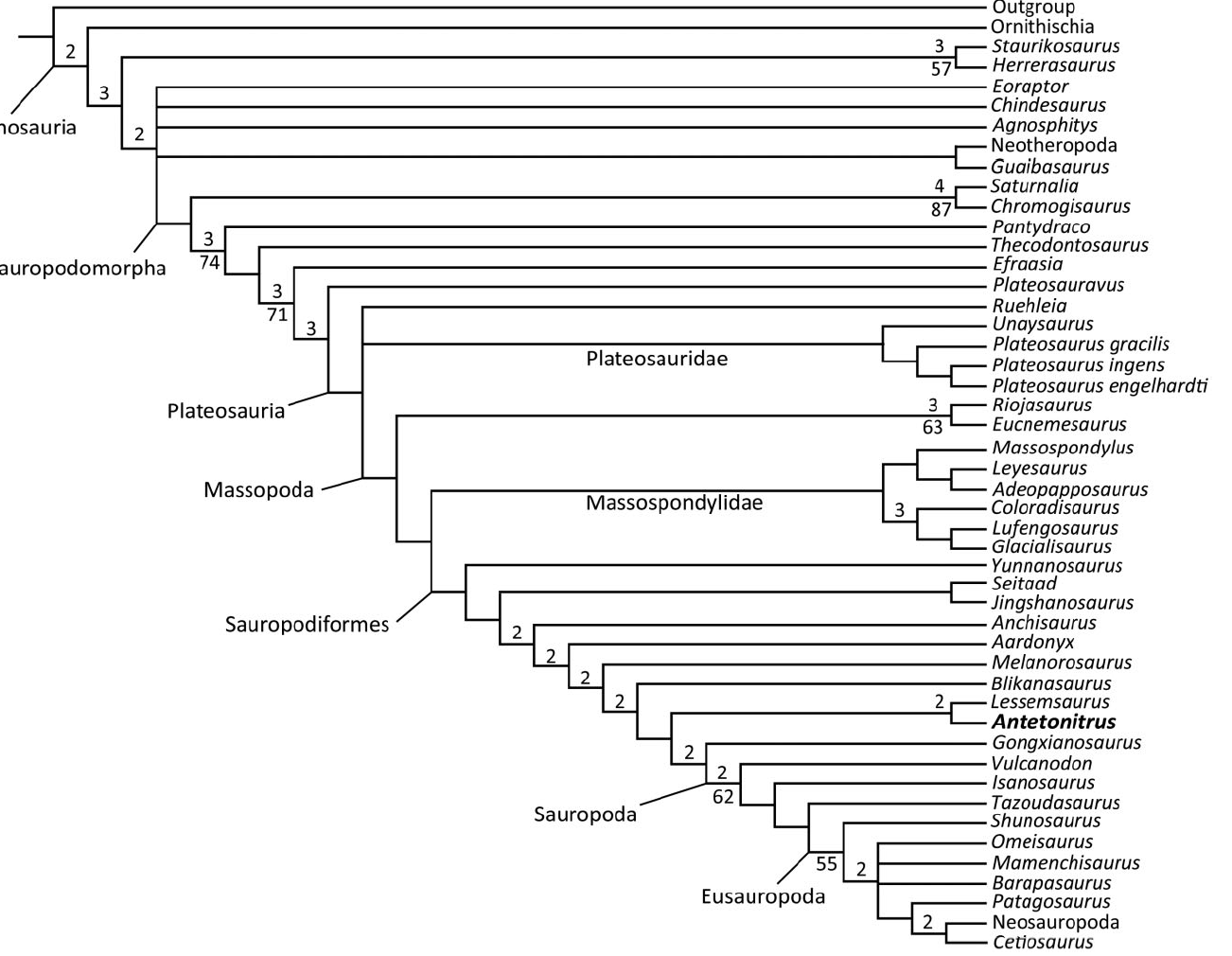
Antetonitrus ingenipes: A Sauropodiforme From Carnian/Rhaetian Triassic South Africa


The complete anatomy and phylogenetic relationships of Antetonitrus ingenipes (Sauropodiformes, Dinosauria): implications for the origins of Sauropoda

Authors:

McPhee et al

Abstract:

We present a comprehensive description and phylogenetic analysis of the important transitional sauropodomorph Antetonitrus ingenipes. New information sheds light on the stepwise acquisition of sauropod-like traits just prior to the Triassic/Jurassic boundary. Although the forelimb of Antetonitrus and other closely related sauropodomorph taxa retains the plesiomorphic morphology typical of a mobile grasping structure, the changes in the weight-bearing dynamics of both the musculature and the architecture of the hindlimb document the progressive shift towards a sauropodan form of graviportal locomotion. Nonetheless, the presence of hypertrophied muscle attachment sites in the femur of Antetonitrus suggests the retention of an intermediary form of facultative bipedalism. The term Sauropodiformes is adopted here and given a novel definition intended to capture those transitional sauropodomorph taxa occupying a contiguous position on the pectinate line towards Sauropoda. A re-examination of the biased distribution of Sauropodomorpha in the earliest Jurassic suggests the presence of genuine palaeo-environmental processes that may have excluded the large-bodied, graviportal taxa from participating in a number of Early Jurassic ecosystems.

Monday, March 17, 2014

Plateosaurus engelhardti was an Obligate Biped


Motion range of the manus of Plateosaurus engelhardti von Meyer, 1837

Authors:

Reiss et al

Abstract:

The mode of locomotion of the basal sauropodomorph Plateosaurus engelhardti, known from numerous finds from the late Triassic of Central Europe, has been extensively debated. Some early and recent research results indicate that the forelimb could not play role in quadrupedal locomotion. Other authors suggested facultative or even permanent quadrupedality. This would require adaptations of the range of motion and the stability of the manual digits to the high forces caused by locomotion. An analysis of the hyperextension capabilities of the hand can therefore determine if the manus is adapted for locomotion. This study examines the capabilities of the manus of P. engelhardti using digital 3D modeling. The motion ranges of the digits were simulated in a computer-aided engineering (CAE) program, and the hyperextension capability of the entire manus was tested.

We find that the hand of Plateosaurus was not able to support the animal during quadrupedal locomotion, but may rather have been a specialized grasping organ. Therefore, P. engelhardti must have been an obligate biped.