Once Upon the Permian...While I have been working on my Permian ecology post, I have come AGAIN to realize that the world of paleontology lacks some good accessible works on the therapsids. There are a few, but they are ridiculously priced and few and far between. I have been thinking for some time that we need to get
Darren to write a general book on the subject, but my contribution to that cause is going to be a little ways off.
While exploring the
therapsids, the Late
Permian Ecology, and the
Permian Extinction, I have been increasingly fascinated by our cousins that are no longer with us. Of the various different critters, I have been reading about the dicynodonts, gorgonopsids, and therocephalians. The therocephalians are of those three the most mammalian. I'll save these guys for another time. The other two are rather interesting and really different from ourselves.
The
dicyondonts, however, are one of the two of those that are really different from mammals: they're our relatives as synapsids, but they have beaks, bite and chew rather differently than anything mammalian. The most famous of these happens to be
Lystrosaurus. However, they are not going to be the topic of the post.
The remaining therapsids that I find so fascinating, gorgonopsids, are going to be the actual objects of this post's focus of attention. They are equally fascinating and interesting critters. They are not what you would expect at all. They are not reptiles. They are not mammals. They are something, fascinatingly unique. In some ways, it is really too bad that none of them made it past the Permian Extinction. They are a engrossing subject.
 They're WHAT?!
The first gorgon was described by
Richard Owen in 1876 in his book
Fossil Reptilia of South Africa. It had been excavated from the
Karoo Basin in South Africa. Owen and others did a disservice to our cousins the Gorgons and, for that matter, the rest of the extended "family" found in the Karoo. He referred to them as mammal-like
reptiles. This miscategorization has lasted even until today.
Synapsids, which the therapsids including the gorgons and our own fellow mammals, are not reptiles. We're all
amniotes which is not all the same thing.
To be sure, it's not really fair to criticize Owen for that. He was working in a time when people were just starting to figure out the natural world. The world had been categorized in simpler terms: mammals were fuzzy, gave milk, and warm blooded. Reptiles were scaly and cold blooded. They were distinct categories and rather different. As far as they could tell there were big gaps between the reptiles and mammals and nothing that might be somewhere between existed.
That's what these fossils seemed to show. They had a few traits that fit with mammals. There were a lot more, at that first blush, were like reptiles. Hence, they got the name "mammal-like reptiles." The name has definitely been persistant. When I was growing up it was around and even now in some of my daughter's books the synapsids, especially the
therapsids, are still referred to by that misnomer.
So what are they really? We'll do a quick run down. Synapsids are not really reptiles, but developed along side the
diapsids and
anapsids. They are all descended, probably, from a single common ancestor that developed from amphibians (note: not modern
lissamphibia, Lissamphibia is only one category of greater amphibia) during the
Carboniferous Period. They developed adaptions to terrestrial life that allowed them to break the necessity to return to water for breeding or to keep their skin moist as has been suggested as necessary for many paleo amphibian types and, definitely, all modern ones.
From there, two or three lineages, depending on whom you read, split. One is the synapsids: they had one hole on each side of the skull for the jaw muscles to attach to. These gave rise to the famous
Dimetrodon, one of my daughter's favourite critters, the gorgons, and mammals. Another was the diapsids and as you might guess from their name, their skulls had two holes. These gave rise to lizards, pterosaurs, dinosaurs, and birds. The last group, the anapsids, is best known by those that are left today: the turtles. They did have a number of number of relatives in the past, but most went extinct during the
Permian Extinction.

The synapsids would eventually give rise to what we group together and call the therapsids. Of the groups I mentioned in the beginning of the post, the one that does not appear in the above family tree is the dicynodonts: that's because they are within Anomodontia. This is where we tie back into the
actual topic of the post: the gorgons, seen above as gorgonopsia.
 A Gaze Out of Legend
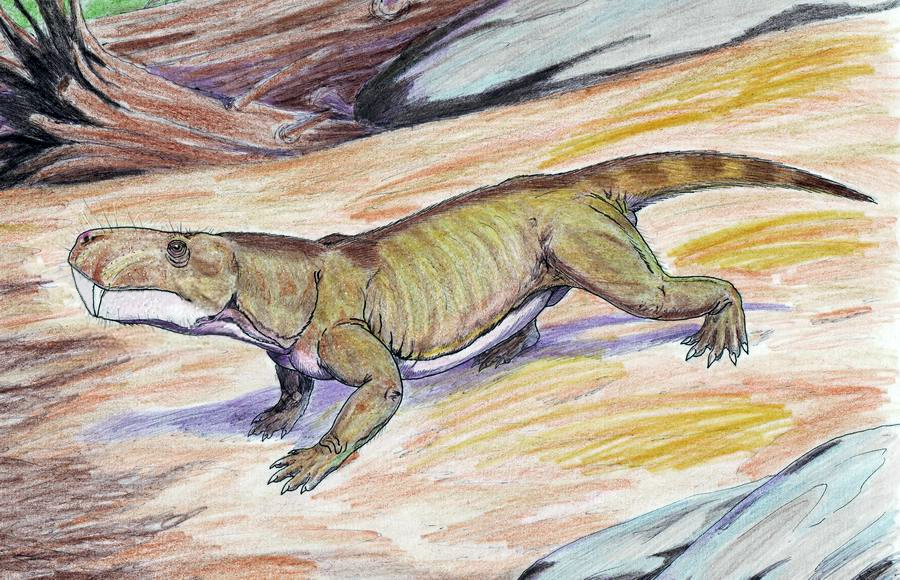
At a first glance, the gorgons look like they are something of a cross between a dog and a lizard. Almost as though some poor pit bull woke up from a night that had one too many drinks to find it had done something wild and crazy with a
Komodo Dragon. Then she had to live with the consequences of it. oy. Or perhaps you might think they're just fugly otters. Either way, they do seem like they are out of someone's nightmare and made flesh - or fossil! - as it might be.
The next most striking thing about the gorgonopsids, if you were to look at them, is that they pack one big honking canine tooth. In fact, they are one of the first of our line, the synapsids, to have developed a sabre tooth, long, long, long before smilodon or the other felids. Like the sabre tooths of the
Cenozoic, there's a lot of question with respect to how the gorgonopsids used their uber 'canines' to kill. Now if only I could get Manabu Sakamoto of
The Raptor's Nest to take a look
like he did for Smilodon...*hint*hint* (However...[1])
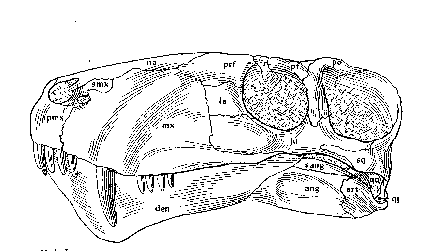
Since we're on the topic of the teeth, let's take a look at them in general. The first big note is that like most synapsids, the gorgonopsids were
heterodonts. That is to say, they had a mix of different sized teeth for different functions. It's pretty easy to see from the sabre tooth mentioned before and the incisors. However, the post canine teeth are pretty small, fewer than in earlier synapsids, and, most importantly, in the skulls recovered so far, show no regular wear patterns. This strongly implies that the gorgons didn't actually
chew. They bit, ripped, and tore off their food to swallow it. When they tore meat off the carcass they would thrust their lower jaw forward to allow them to bite off meat without the interference of their sabre teeth. It possibly would have allowed them to scrape meat pretty efficiently off of bones, etc. that would have been otherwise left to scavengers.
If you also take a look, at their skulls, and the papers associated with them, you will find out more about the gorgonopsid senses. One of the discoveries is that in at least one gorgonopsid skull there seems to be a very well developed sense of smell. A
VERY well developed sense of smell. In fact, their nose is so developed that some have suggested that this is evidence of endothermy, but we'll discuss that later. On the flip side, gorgonopsids had very
poor hearing. From what has been written that I have access to, they had hearing good enough for low frequency sounds, but little to none for the higher frequencies. It could hear a herd of dicynodonts or
scutosauruses trundle along, but not the buzz of flying insect. This tells us that it could have used its hearing to get a general idea of where prey was at, but could not track them if they were, well, whistling. More likely is that they tracked their prey with their sense of smell which was pretty good and their vision which also appears to have been quite good. Also odd and interesting is that in the skulls there appears to be evidence of, well, for lack of a better word: whiskers. What in the world a gorgonopsid would use whiskers for is an interesting question!
Interestingly, this ties in with another bit: there appears to have been one confirmed skin impression for the therapsids. This was for
Estemmenosuchus. There were hints in what I have read that there was one for a gorgonopsid, but it might be that the authors were conflating the two. The skin impression was
not what you would expect if you were examining a reptile. It was
smooth. There were no impressions at all of scales. Zip. Nada. There were
pores. Yes,
pores. However, there was
no sign of hair. The gorgons might have had whiskers, but no hair. Odd that picture. If you were to try to imagine therapsid skin, think rhinoceros and you might be there. Partially, okay? So how does this also tie in with the sense of smell? It would seem that its very likely that like mammals today, scent glands were present. This means that gorgonopsids - and other therapsids - could have had scent and visual displays instead of sonic ones for mating and courtship. No howling. No singing or chirping. Though there might have been some impressive displays, even brutal ones, visually. And aromatically.
Moving postcranially for the moment, there are two notable features. The first one is the stance of the legs. Most reconstructions have them slightly sprawled in the front. Some, however, disagree pretty strongly. There seems to be something of an on going fight that echoes the ones reconstructing the
ceratopsians. These have been a little more muted only because the gorgonopsids are not nearly as popular. Interestingly, it does seem that those that are arguing for the more sprawled state of the front legs state that the joints are interestingly reminiscent of crocodilian ones. Namely, they think, that the gorgons would have had a 'high walk' and a 'low walk' like crocodiles do today. What's at stake though if we argue over the reconstruction of the forelegs? What's at stake is speed: how fast could a gorgon run? If they were not able to do a high walk, the answer is "slowly." On the other hand, if they only did a "high walk" then we're likely to have seen them more as oddball wolves or bears or whatnot. BTW, no one seems to argue over the rear legs, they were straight under the body like modern mammals and, - interestingly! - ceratopsians.
The second postcranial detail to consider deals with whether or not the gorgonopsids had a diaphragm respiratory system like modern mammals. The answer is...we don't know. The rib arrangement on the specimens that were published on would rule against this, but I haven't found a paper on the "
completest gorgonopsid skeleton ever found"as yet about any studies of that specimen's respiratory system though. On the other hand, Ward, I believe, stated in one of his books that it turned out not to be a gorgon after all. Anyways, if the gorgons lacked a diaphragm for breathing then again, it would cripple them for sustained pursuit of their prey or rivals unlike modern mammals or large avians. However, based on the trackways that have been found in South Africa from dicynodonts, the gorgons wouldn't have had to run fast to go after them: the dicynodonts waddled rather slowly. Both bits would lend credence to
Ward's hyp/hyperoxia hypothesis for having a major impact on evolution as he outlined in
Out of Thin Air, especially as to why the Gorgons didn't make it through the Permian Extinction.
 Warm of Heart? Hot Bodied?
One of the big debates with regard to the gorgons is whether or not they were
endothermic. While they didn't have the diaphragm lung setup, they may well have still been endothermic. Some hold that the bone growth patterns do not support endothermy. Animals that are endothermic grow their bones one way, and those that are
ectothermic grow them rather differently. The gorgons' bones to date seem to lean towards ectothermy. On the other hand, the nasal configuration is one only found in modern mammals...which are exclusively endotherms. The problem is that other than the bone development, the other traits from the fossil skeletons are a bit weak one way or another for supporting endothermy. The question is whather or not these traits might have developed in the therapsid line
prior to becoming warm blooded. It looks like there is a good chance here that is the case since the way that I have seen the bone growth for gorgons described fits that of an ectotherm. With the above it looks pretty solid that the gorgonopsids were ectotherms and had they survived until the dinosaurs had started evolving, they would have been outcompeted. However, there is a very interesting bit of evidence is that almost equally compelling that runs contrary to the bone growth.
This evidence is actually paleoecological in nature. In modern ecosystems, if the predators in the ecology are endotherms, they make up a very small percentage of the total individual animals living in that ecology: the predators require far, far more prey to maintain their metabolism and that prey
must be able to sustain its population. If the predators are ectotherms, they make up a vastly larger number of individuals percentage wise of the total living in that ecology. If we take a look at the ecologies where the gorgonopsids lived, what do we see? We actually see predator to prey ratios that match our modern ecologies. This would
very strongly imply that they are endothermic.
One area that is
not controversial is that the gorgonopsids wherever they lived were the top predators. There are three general locales that have provided gorgonopsids. The first two are the most famous: the Karoo of South Africa and the Urals of near Perm, Russia (whence the
Permian gets its name). The third locale is in
China. This would be the Shangshihezi Formation (Upper Shihezi Formation) of
Jiyuan, Henan. Apparently, the fossils there are of very poor preservation though and I have only found
one reference to them so far. In every place, the gorgons dominated the top predator niches. They varied from dog sized to quite large in Russia,
Inostrancevia, which apparently grew at times to be as large as 4.3m (14 ft) long. If I were a betting man, I'd probably go for an
Inostrancevia eating the Grizzly, personally.
However, how they hunted
is controversial. Some maintain that their brains were underdeveloped and too small for real social interaction. Many of the detractors of social gorgons state that they were probably solitary hunters. However, there's an issue, While there were some truly large gorgons, like
Inostrancevia, the majority were dog size or a bit larger. Since a good chunk of their prey were heavily armored anapsids, the
pareiasaurs, either the gorgons would have only preyed on the wounded, near dead, or young if they were solitary hunters. Or! they would have had to have worked together to bring down an adult pareiasaur. There are a good number of researchers that have suggested that the gorgons were pack hunters, or at least the moderate sized ones. The question is then, is there any evidence of any kind that might settle this? In fact there is. The Synapsids seem to have been social long prior to the evolution of the gorgons.
There is, however, another bit of paleobiology about gorgonopsids that is controversial: did they care for their young? Really it's nothing more than an extension of the question of just how social these beasts were. There are some workers that hold they laid their eggs and walked away. As far as I can tell, no eggs of a gorgon, or any therapsid, have yet been found. As an aside, its possible they weren't
oviviparus at all: Ward brings it up. However, it appears that the question of sociality and especially of parental care might have predated the evolution of the therapsids in the synapsid line. This past fall,
Dr Both-Brink of The National Museum (of South Africa)
reported finding very strong fossil evidence of an adult pelycosaur in a "family group" with four juveniles. If this holds up and more supporting evidence is found, baring in mind that the only surviving synapsids, the mammals, uniformly care for their young and are social from the very extreme of the monotremes to the other of end of the spectrum of humans, bats and bear: we all care for our young. The simplest explanation is that parental care and sociality are primitive relative to the therapsids. To prove it, we need more fossils of prior to and continuing through the therapsid evolution. As for the gorgons? It will be a challenge to nail this one down past supposition: gorgon fossils are not very common at all and there are a mere handful of locales with terrestrial sequences at all for the time frame that gorgons existed. Perhaps in time, we'll get lucky.
 Articulus finis
The Gorgons had a good run of it. They first appeared in the Middle Permian and lasted up to the Permian Extinction. While that is far better than our own hominid line has done to date, the gorgons have seem to have "only" survived for 20 million years. In comparison, the Cenozoic - the so-called Age of Mammals comprised of the Paleogene and Neogene - is 65 million years in length. Or alternately, the theropods were the dominate - and virtually only - megafauna carnivores in the Mesozoic lasted in the same niche of top carnivore for well over 165 million years as the gorgons did for a "mere" 20 million years.
Their reign of terror was cut short by the Permian Extinction, as noted. You have to wonder what would they have evolved into had the Permian Extinction been skipped: imagine that the Permian didn't "end" until the Triassic of our timeline. What-if the the radical changes and innovations of the Permian had another fifty million years? Or even another twenty-three million years! Would the trend for size increase continued? Would we have seen 7+ meter long gorgonopsids that would have had ubercanines that would make a T rex pass out? Ones that were used to feed on dicynodonts that were the size of elephants? Or larger? Or would the therapsids, cut down so much by the PT Event, have generated even more odd and interesting critters? Ones that we would have have even imagined. After the exposition of the Permian Terrestrial Ecology, then I hope to do a speculative extended Permian evolution (ie What-if No Permian Extinction & consequences) in the vein of the
Specworld works. I could use some collaborators (*
hint*
hint*).
In any rate, in our timeline, the gorgonopsids did succumb to the Permian Extinction. Was it because their main prey animals died out (ie the giant anapsids)? Or was it that one last remnant population get trapped by hypoxic highlands in a single remaining "lush" valley where they might have made it through to the Triassic only to be wiped out by a storm that carried in some rather nasty hydrogen sulfide contaminated rain? Or were the last Gorgons huddled, panting around slowly dwindled waterhole in the middle of a dying oasis in the midst of the grinding, expanding, desolate desert? We don't know. We can't know. Just ask
Signor and Lipps.
What the gorgons from what we have found so far, did produce what looks like 25 unique genera and 41 different species. That's none too bad really since there are only
two places where there are chronologically appropriate, fossiliferous strata good enough to undercover nameable taxa: the Chinese locale has only produced low quality examples that while generally recognizable as coming from this or that family are simply unsuitable to be used for more exacting identification. That's too bad. There are so few late Permian terrestrial sequences out there, never mind ones that cross the PT boundary, that it almost feels like a crime against paleontology.
T'were I a rich man, I'd be paying for geologists and paleo types to go out into the places where we don't have good geological maps to find more good locales. Tying back to the phylogeny aspect of the gorgons for a moment, if I were also a rich man, I'd be paying for a serious and up to date cladistic and phylogenic review. Perhaps when I get old and retire, I'll go back and get a PhD[2] in paleontology to work to cover the therapsids more. :D
There you have it: a basic run down on the Gorgons, the fearsome toothed, non-reptile semi-mammals from the closing chapter of the Paleozoic. I hope that it was at least somewhat satisfying. And worth the wait. I really needed to excise a lot of this from the long promised Permian Terrestrial Ecology post (it was expounded on a bit here).

1. Hmmm. There appears to have been some work done by a former Bristol type: a one Ian Jenkins, but he's apparently not there anymore since I emailed and it bounced. I have found
some (pdf) abstracts about the reevolution of gorgonopsid like "craniodental adaptations" in moschorhinid therocephalians after the PT Event. Apparently, whatever exact niche that drove the gorgonopsids to evolve their uber fangs to hunt was still present
despite the PT Extinction munching on so much. Perhaps a Raptor's Nest review of the above for the unannoited.
2. If I ever get my undergrad in physics done.