Wednesday, March 26, 2008

Guarinisuchus munizi: An African Croc in SoAm


A fossil of a new species of prehistoric crocodile found in Brazil and presented here Wednesday has led scientists to believe the reptile benefited from the [KT mass] extinction ... to migrate from across the Atlantic.

Guarinisuchus munizi -- the "warrior of the seas," as the crocodile has been dubbed -- is believed to have had its origins in Africa some 200 million years ago.

But the remains of a jaw, skull and vertebra discovered in Palaeocene deposits of northeastern Brazil suggests the species set off for new territory 62 million years ago, according to researchers.

"They left the African continent and are believed to have occupied zones in South America, and later regions in North America," paleontologist Maria Somalia Viana told a media conference in Rio de Janeiro.

She added that, back then, "Africa and the northeast point of Brazil were much closer than today."

The reptile, which grew to around three meters (10 feet) and was perfectly adapted to living in the ocean, apparently took advantage of the extinction of bigger marine lizards called mosasaurs to dominate the waters, another paleontologist, Alexander Kellner, said.

The Guarinisuchus munizi became "the main predators, together with sharks, in shallow marine Palaeocene environments" the researchers from the federal universities of Pernambuco and Rio de Janeiro theorized in their paper published in the Proceedings of the Royal Society B.


hmmm. How well adapted was it to the ocean? Was it like geosaurus? Or was it more like the modern salt water crocodile?

Dinosaur fossil found on bus in Peru


Officials found the fossil of a giant dinosaur jawbone while investigating a suspicious package on a bus in the mountains of Peru on Tuesday.

The fossil, weighing some 19 pounds, was found in the cargo hold of the bus, which was headed for the capital of Lima, and had been sent on the bus company's package service.

"They began to check the package because it didn't have anything to indicate what was inside. They were worried about its weight, opened it and found the fossil," said Kleber Jimenez, a local police officer.

Peru has struggled for years to combat trafficking of fossils and artifacts. Recently Yale University in the United States agreed to return thousands of pieces taken from the ancient Inca citadel of Machu Picchu to Peru.

"The jawbone that was found could be from a triceratops, even though dinosaurs like that have never been found in southern Peru," Pablo de la Vera Cruz, an archeologist at the National University in Arequipa in southern Peru, said after examining police photos.


Okay, guys. This that a ceratopsian jaw? It looks more like a mammal jaw. Maybe a proboscidean?

Molybdenum Defiency Delayed Animal Evolution?

A deficiency of oxygen and the heavy metal molybdenum in the ancient deep ocean may have delayed the evolution of animal life on Earth for nearly two billion years.

Dr Simon Poulton, Civil Engineering and Geosciences, Newcastle University, was part of an international team of biogeochemists who took part in the University of California-led study.

The study’s results are published in today’s edition of Nature (27th March).

‘For decades it was assumed that the ocean became oxygenated shortly after an initial rise in atmospheric oxygen about 2.4 billion years ago,’ said Dr Poulton. ‘This study provides independent confirmation that there was a major delay in the oxygenation of the ocean, and furthermore, it now appears that the availability of molybdenum may have played a crucial role in animal evolution.

‘At last, a coherent picture of the environmental conditions that led to the evolution of animal life is emerging.’

The researchers arrived at their conclusion after tracking molybdenum in black shales, a kind of sedimentary rock rich in organic matter found in the ocean. Molybdenum is a key micronutrient for the life-forms that control the production of oceanic and atmospheric oxygen.

Following the initial rise of oxygen in the Earth’s atmosphere 2.4 billion years ago, oxygen was transferred to the surface ocean to support oxygen-demanding micro-organisms. However, the diversity of these single-celled life forms remained low, and their multi-cellular [descendents - fixed WB] (animals) did not appear until about 600 million years ago.

Suspecting that deficiencies in oxygen and molybdenum might explain this evolutionary lag, the team measured the abundance of molybdenum in ancient marine sediments over time to estimate how much of the metal had been dissolved in the seawater in which the sediments formed.

The researchers found significant, firsthand evidence for a molybdenum-depleted ocean compared to the high levels measured in today’s oxygen-rich seawater.

‘These molybdenum depletions may have retarded the development of complex life such as animals for almost two billion years of Earth’s history,’ said project leader Professor Timothy Lyons, at the University of California’s Department of Earth Sciences. ‘The amount of molybdenum in the ocean probably played a major role in the development of early life.

‘As in the case of iron today, molybdenum can be thought of as a life-affirming micro-nutrient that regulates the biological cycling of nitrogen in the ocean.

That's interesting. Everyone has been focusing on just oxygen for a very long time yet it may have been the right combination of nutrients at the right time for the actual evolution of multicellular life. That's a rather more complicated question than merely there being enough oxygen in the ocean. What other nutrients were necessary, but not present in the ocean for a long, long time?

Tuesday, March 25, 2008

More on the Wilkins Ice Shelf


Satellite imagery from the University of Colorado at Boulder's National Snow and Ice Data Center shows a portion of Antarctica's massive Wilkins Ice Shelf has begun to collapse because of rapid climate change in a fast-warming region of the continent.

While the area of collapse involves 160 square miles at present, a large part of the 5,000-square-mile Wilkins Ice Shelf is now supported only by a narrow strip of ice between two islands, said CU-Boulder's Ted Scambos, lead scientist at NSIDC. "If there is a little bit more retreat, this last 'ice buttress' could collapse and we'd likely lose about half the total ice shelf area in the next few years."

In the past 50 years, the western Antarctic Peninsula has experienced the biggest temperature increase on Earth, rising by 0.9 degree F per decade. "We believe the Wilkins has been in place for at least a few hundred years, but warm air and exposure to ocean waves are causing a breakup," said Scambos, who first spotted the disintegration activity in March.

Satellite images indicate the Wilkins began its collapse on Feb. 28. Data revealed that a large iceberg, measuring 25.5 by 1.5 miles, fell away from the ice shelf's southwestern front, triggering a runaway disintegration of 220 square miles of the shelf interior. The Wilkins Ice Shelf is a broad sheet of permanent floating ice on the southwest Antarctic Peninsula roughly 1,000 miles south of South America.

The edge of the shelf crumbled into the sky-blue pattern of exposed deep glacial ice that has become characteristic of climate-induced ice shelf breakups such as the Larsen B ice shelf breakup in 2002, said Scambos. A narrow beam of intact ice about 3.7 miles wide was protecting the remaining shelf from further breakup as of March 23.


A bit more info.

Wilkins Ice Shelf Threatened


British Antarctic Survey has captured dramatic satellite and video images of an Antarctic ice shelf that looks set to be the latest to break out from the Antarctic Peninsula. A large part of the Wilkins Ice Shelf on the Antarctic Peninsula is now supported only by a thin strip of ice hanging between two islands. It is another identifiable impact of climate change on the Antarctic environment.

Scientists monitoring satellite images of the Wilkins Ice Shelf spotted that a huge (41 by 2.5 km) km2 berg the size of the Isle of Man appears to have broken away in recent days – it is still on the move.

Glaciologist Ted Scambos from the University of Colorado alerted colleagues Professor David Vaughan and Andrew Fleming of the British Antarctic Survey (BAS) that the ice shelf looked at risk. After checking daily satellite pictures, BAS sent a Twin Otter aircraft on a reconnaissance mission to check out the extent of the breakout.

Professor Vaughan, who in 1993 predicted that the northern part of Wilkins Ice Shelf was likely to be lost within 30 years if climate warming on the Peninsula were to continue at the same rate, says,

“Wilkins is the largest ice shelf on the Antarctic Peninsula yet to be threatened. I didn’t expect to see things happen this quickly. The ice shelf is hanging by a thread – we’ll know in the next few days or weeks what its fate will be.”

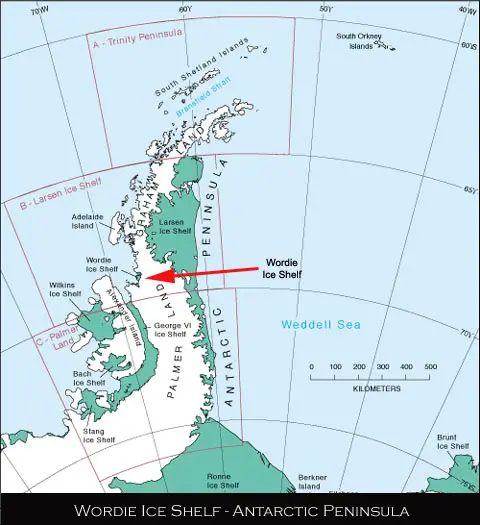
That's a good map of the different ice shelves. While it was meant for pointing out the Wordie Ice Shelf, the Wilkins (and others) are easy to find there.

More on the PT Extinction "Revision"

National Geographic has an article on the proposed changes to the PT Extinction model. It's a bit and better more of the same as yesterday's links. What really caught my eye though was the following map of the terrestrial hypoxic conditions:


Now compare that with a map of the mountainous terrain of the time.


Looks like we have a nontrivial correlation to me.

Monday, March 24, 2008

A Mexican Ceratopsian

Scientists have discovered a new species of plant-eating dinosaur in Mexico whose large neck frill and three giant horns helped it attract mates and fight predators on a jungly beach 72 million years ago.

Mexico's Coahuila desert -- now rocky and cactus-filled -- was once covered by ocean where dinosaurs of all kinds thrived along the coast and hid from a giant relative of the fierce predator Tyrannosaurus rex.

Paleontologists say they have found evidence of a new species here related to the Triceratops, known to have the largest head of any animal ever to have walked the earth.

The new species is slightly smaller at around 23 feet (7 meters) than most Triceratops, but its three-foot-long (0.9 meter) horns were just as big. Holes in its neck frill would also have set it apart.

The scientific name of the new dinosaur will not be revealed until the end of the year, said Scott Sampson, a curator from Utah Museum of Natural History who helped make the discovery with Mexican investigators.

It will be only the second dinosaur species named in Mexico after scientists in February announced a new duck-billed dinosaur from the same region called Velafrons coahuilensis, which cruised the ancient beaches in large herds.

Scientists say they expect to find evidence of dozens of other new dinosaur and plant species buried in Coahuila's rich sediment in coming years.

"This is just the beginning," said Martha Aguillon, a paleontologist at the local museum near the Rincon Colorado fossil beds in the northern state of Coahuila.

The new three-horned species likely used its massive horns to fight off meat-eating predators.

But scientists say the flamboyant head armor and neck frills were also an important part of courtship rituals, showing dominance with head-butting battles much like modern-day horned animals such as antelope.

"That whole section of the head was for sexual display, it was all ornamentation," said paleontologist Terry Gates, who works with Sampson at the University of Utah museum and is also one of the scientists behind the Velafrons discovery.

"The females liked it," he added, with a chuckle.


Sorry, Zach, this is an uber tease: "The scientific name of the new dinosaur will not be revealed until the end of the year, said Scott Sampson, a curator from Utah Museum of Natural History who helped make the discovery with Mexican investigators."

I wonder why they brought this up...now. Y'know, instead of when they were going to name it.

Modifications to the PT Extinction Model?

There's a paper out about computer simulation of the atmosphere at the time of the Permian-Triassic Boundary and during the PT Extinction. The model aimed at determining whether or not the hydrogen sulfide had a great an impact upon the atmospheric chemistry. As currently theorized H2S has a huge impact upon the event and may have been one of the main kill mechanisms.

There were probably two ways that H2S was such a powerful kill mechanism. The first was directly: H2S is a nasty chemical. As the waters of the Permian Ocean warmed and became more and more anoxic, bacteria that produce the stuff became more and more common until very large parts of the ocean were belching the stuff. More and more depths of the sea became poisoned. The warmth of the ocean combined with the anoxia and hydrogen sulfide is probably the main killing mechanism in the sea.

There is a suspicion that in the terrestrial environs, hydrogen sulfide killed in three ways. The first is the classic acid rain scenario. The second is direct inhalation or exposure near the ocean. Finally, and possibly the most important many variants of the model is the mixing with the upper atmosphere. Up there, it would react with the ever important ozone that protects life from all that harmful UV radiation. When it did, the UV blasted the terrestrial ecosystems in a pretty nasty way. It also, by reacting with the ozone, made it possible to extend the period of time that the methane hydrate belching would continue to oven cook the planet in conjunction with the carbon dioxide coughed up in massive amounts by the Siberian Traps. I blogged some time ago about the Permian Triassic Extinction. That was the current understanding of the PT Extinction mechanism. Then along came this paper. So how much does this paper change that understanding? What does the paper say?

The paper proposes that based on their own 2 D modeling that there was no way for the hydrogen sulfide to be transported to the upper atmosphere where the ozone layer is reside. One of the primary problems with this is, according to the paper, the tropics are an oxiding zone that would remove the hydrogen sulfide from circulation prior to updrafting. Obviously they had a chem model attached and are confident in their findings. Their paper appeared in Nature Geoscience.

Color me skeptical, but I am going to have to wait until I have a moment to read the whole paper to see what they have to say. That moment isn't now. This week is crunch week for the mischief project. I'm getting sponsors, but will it be enough? We shall see!

That said, a hat tip goes to Paleoblog for calling this to my attention.

Saturday, March 22, 2008

Bone Yard XVI


Welcome to the 16th Boneyard Paleo Carnival. Let us dig back through time and strata to see what the blogosphere has worked out of the sediments of knowledge. Like my last hosting, this BY will follow the convention that the posts that deal with the more recent eras and periods will come first. So let us begin.

First up, not even out of the Holocene, Dr Micheal Ryan from Paleoblog brings our attention to the hands bones of Hadropithecus stenognathus, one odd lemur.

(Picture added for clarity for the following; pic credit, AMNH)

We wander back further and find ourselves looking in the mirror of our past in the Pleistocene, following the evolution and bushy branching of the hominid line. The controversy over our relatives, the so-called Hobbits, rages on. Greg Laden discusses the recent paper that staked out the claims that Homo floresiensis is in fact a separate species. John Hawks also weighs in on the H floresiensis and Palau pygmy population discoveries. John has been a busy beaver in general. He also has interesting posts on the Neandertals: their linguistic capabilities and whether or not genetic drift was responsible for their divergence from Homo sapiens. He also found the time to discuss the paleoecology at Hadar and the new study about Orrorin's bipediality. Afarensis also has a good post on the Palau island dwarfed skeletons.

Diverging from the hominid line, we find that over at The World We Don't Live In, there's a very good discussion of the deinotheres being tapir convergent probisceans. Also discussed there are the ever fascinating second attempt at theropods in the Cenozoic and whether or not Megatherium americanum was a carnivore specializing in glyphodonts!

Over at Nimravid's Blog, we have the discussion of a rather interesting and unique carnivore, Simocyon. Also discussed is the diet of big sabre tooth felids.

Chris Taylor over at Catalogue of Organisms has the odd ball of a whale that seems to thought it was a walrus!

Over at Archaeozoology, the discussion of the oldest known fossil of the rabbit family is quite interesting. Equally interesting, the discovery of fossil rhino bones has brought into question whether or not Anatolia was truly isolated up to the Oligocene as has been thought.

Transition backing across the iridium layer, we find ourselves working through the Mesozoic strata. Therein lies some interesting posts themselves. First up is whether or not the Deccan Traps were responsible for the demise of the dinosaurs over at Everything Dinosaur. My own post on the subject languished alas.

Amanda at Self-designed Student titillates us with another discussion of Dino Teen Sex. (degenerate dinos must repent!)

The ever reputable Darren Naish of Tetrapod Zoology comments on dual discoveries of the Cretaceous. The first being Nemicolopterus crypticus with Darren pointing out this fossil looks a lot like an underage representative of a known pterosaur and he continues on the uber sized anuran of Madagascar. He also has the most unforgivable set of pictures under the title of LOLSAUROPOD!

Zach Miller up at When Pigs Fly Returns has a great drawing (and the reasoning behind it) of Nyctosaurus. He also has up his latest Guess the Dino (no, that's not what its called).

Both Brian Switek of Laelaps and Manabu Sakamoto of the Raptor's Nest have good posts (here and here) about Megalosaurus and its problematic status. Manabu goes on to delightfully discuss Velociraptor mongoliensis and whether or not the uber alligatoroid Deinosuchus was cotemporal with T rex. Brian turns his attention to the newly discovered Cretaceous plesiosaur, Nichollsia borealis.

Over at the Sauropod Vertebra Picture of the Week, there is a fascinating expose on whether or not all giant sized sauropods exhibited pneumaticity. There's a uber tease about a giant vertebra found at the earliest Jurassic!

My own The Dragon's Tales has the OMG moment that the pterosaurs also had teen sex! Bad archosaur! Bad!

In the very early Mesozoic, Scott at the Coherent Lighthouse gives us a wonderful head study of Euparkaria.

Straddling the Mesozoic/Paleozoic transition with the Permian Extinction, I raised the question, based on the very recent research on the genetics of casein and the pseudogenes for vitellogenin, whether or not the nonmammalian therapsids might have been nursed their young. Just how basal is milk in the synapsid line?

Over at Real Climate, they take a hammer out to yet another claim of periodicity.

Brian Switek and Nimravid both blog about the complexity and evolution at the Ediacaran and Cambrian Explosions (here and here).

In the Vendian, Micheal Ryan at Paleoblog highlights the Ediacaran life form of Funisia dorothea.

And that, my fossilized friends, is the Boneyard Carnival for this edition. If I missed anyone, please drop me a note, and I will add your post. The Bone Yard XVII will be appearing at Greg Laden's place in two weeks. Until then, enjoy! And post more original work, folks! We're also lacking for Paleozoic posts here!

Friday, March 21, 2008

Dude! Get your hand off me!


I know this is Santa Fe, but...

Mexican American Integration & Education Study

Second-, third- and fourth-generation Mexican Americans speak English fluently, and most prefer American music. They are increasingly Protestant, and some may even vote for a Republican candidate.

However, many Mexican Americans in these later generations do not graduate from college, and they continue to live in majority Hispanic neighborhoods. Most marry other Hispanics and think of themselves as "Mexican" or "Mexican American."

[...]

Telles and Ortiz noted that some Mexican Americans were able to move into the mainstream more easily than other minorities. Mexican immigrants who came to the United States as children and the children of immigrants tended to show the most progress, perhaps spurred by optimism and an untainted view of the American Dream.

"A disproportionate number, though, continue to occupy the lower ranks of the American class structure," the sociologists said. "Certainly, later-generation Mexican Americans and European Americans overlap in their class distributions. The difference is that the bulk of Mexican Americans are in lower class sectors but only a relatively small part of the European American population is similarly positioned."

More than any other factor, Telles and Ortiz said, education accounted for the slow assimilation of Mexican Americans in most social dimensions. The low educational levels of Mexican Americans have impeded most other types of integration.

"Their limited schooling locks many of them into a future of low socioeconomic status," they said. "Low levels of education also predict lower rates of intermarriage, a weaker American identity, and a lower likelihood of registering to vote and voting."


Education is key to virtually everything in this country. Whether formal or self education, it has become crucial that people have the equivalent of a bachelor's degree to any real degree of success any more. Even so, it's no guarantee that you will be able to use the knowledge gained to get anywhere in life.

It should be noted that one of the great assimilation tools that the US has traditionally had was the public educational system. Peer pressure combined with a monolithic, inclusive education has taken peoples of disparate backgrounds and molded them into being 'Americans.'

My wife is an ESL student. She's taken ESL classes and they have helped her. Yet, some of the classes for ESL at the secondary school level were not aimed at bridging into English as a first language classes. It should be the goal. The singular goal. First and last and everything between goal. If for no other reason that it creates a huge parallel infrastructure that helps eat budgets and that is a disastrous thing for our underfunded educational system as it is.

Anyways, take a read. It's interesting stuff up there. I'll be hunting for a copy of the book.

Saturn Moon Titan May Have Underground Ocean


Saturn's moon Titan may have an underground ocean on which its crust slides like a giant, floating icecap, pushed and pulled by climate-driven winds.

The discovery, to be announced in tomorrow's issue of the journal Science, was made when scientists tried to match corresponding features on radar maps created during two-and-a-half years of flybys by the Cassini spacecraft.

Each of the flybys had mapped a swath of the moon's surface; on 19 occasions, the craft crossed over the same areas twice.

But on the revisits, easily recognizable geologic features weren't at the expected coordinates, with some of them out of place by about 20 miles (30 kilometers).

Obviously, hills and valleys weren't swapping places, said Bryan Stiles, a radar engineer at NASA's Jet Propulsion Laboratory in Pasadena, California.

Rather, the maps didn't align because Titan's surface wasn't rotating at quite the expected rate.

That was a surprise, because scientists had thought that Saturn's enormous gravity would keep the same side of Titan pointed directly at the planet, just as one side of Earth's moon always faces us.

One possible explanation was that Titan's rotation had been altered by a large, recent asteroid impact. But such impacts occur infrequently, Stiles said.

A more likely prospect, he said, is that Titan's crust is moving on top of something more slippery than rock or ice.

"There has to be some effect causing the spin to be different from what we had thought. And the most obvious cause that we can come up with is this deep ocean."


It is beginning to sound like a lot of the icy moons have subterranean oceans. I have to speculate here that this may be a universal characteristic of icy bodies greater than a certain mass. Much like the iron core aspects of our own terrestrial style worlds.

On the other hand, this seems like an excellent SF setting. Imagine a world where Europa-esque life arose under the all encompassing ice cap. Then intelligent life arises and realized there's a whole lot more above the great cold world. The first expedition beyond is undertaken and...they pop up in the middle of a methane rather than water based ecology. Much whackiness ensues.

Richardson to Endorse Obama

(that picture has a funky angle on it or something)

New Mexico Gov. Bill Richardson, the nation's only Hispanic governor, is endorsing Sen. Barack Obama for president, calling him a "once-in-a-lifetime leader" who can unite the nation and restore America's international leadership.

Richardson, who dropped out of the Democratic race in January, is to appear with Obama on Friday at a campaign event in Portland, Ore., The Associated Press has learned.

The governor's endorsement comes as Obama leads among delegates selected at primaries and caucuses but with national public opinion polling showing Sen. Hillary Rodham Clinton pulling ahead of him amid controversy over statements by his former pastor.

Richardson has been relentlessly wooed by Obama and Clinton for his endorsement. As a Democratic superdelegate, the governor plays a part in the tight race for nominating votes and could bring other superdelegates to Obama's side. He also has been mentioned as a potential running mate for either candidate.


I am not a fan or Richardson whatsoever despite his credentials and what he has done for me personally. A lot of this is personal. It has to do with what he helped orchestrate against a friend's family. He has been fingered as the major source of information to the media (aka leaks) that time and again made as much pro-gov spin as possible (biasing the media). This could be seen as something I am just ticked about and its my problem.

Let's stop and look at him now. Richardson has been tagged as a lame duck governor and he's just biding his time until he's tapped for something in Washington in the presumed next administration. Do you remember his boasting about making health care available in New Mexico to one and all? it's dead. Really dead. As soon as he stopped campaigning for President, he stopped pushing for it. New Mexico as a whole is a very poor state. The majority of NMicans would have really benefited from this. If Richardson was really serious about this issue, rather than merely grandstanding for the party primaries, he'd be still pushing for this in the NM legislature. He's not.

Draw your own conclusions.

Anyways, Richardson has endorsed Obama. From what I can read of the Democratic Party tea leaves, this is something that will carry some positive weight within the party. This is something of a slap to the Clintons since Richardson has been so close with them.

It's notable that Richardson only done this after it looks like Obama's going to get the nomination.

Thursday, March 20, 2008

Tuatara Undergoing Rapid Evolution

In a study of New Zealand’s [...] tuatara, evolutionary biologist, and ancient DNA expert, Professor David Lambert and his team from the Allan Wilson Centre for Molecular Ecology and Evolution recovered DNA sequences from the bones of ancient tuatara, which are up to 8000 years old. They found that, although tuatara have remained largely physically unchanged over very long periods of evolution, they are evolving - at a DNA level - faster than any other animal yet examined. The research will be published in the March issue of Trends in Genetics.

“What we found is that the tuatara has the highest molecular evolutionary rate that anyone has measured,” Professor Lambert says.

The rate of evolution for Adélie penguins, which Professor Lambert and his team have studied in the Antarctic for many years, is slightly slower than that of the tuatara. The tuatara rate is significantly faster than for animals including the cave bear, lion, ox and horse.

“Of course we would have expected that the tuatara, which does everything slowly – they grow slowly, reproduce slowly and have a very slow metabolism – would have evolved slowly. In fact, at the DNA level, they evolve extremely quickly, which supports a hypothesis proposed by the evolutionary biologist Allan Wilson, who suggested that the rate of molecular evolution was uncoupled from the rate of morphological evolution.”


Interesting that.

Wednesday, March 19, 2008

Why Global Warming is Inevitable Part N + (I Forget)


China's greenhouse gas emissions are rising much faster than expected and will overshadow the cuts in global emissions expected due to the Kyoto Protocol, according to a new study.

Forecasts from the Intergovernmental Panel on Climate Change (IPCC) had predicted that China's carbon dioxide (CO2) emissions would rise by about 2.5 to 5 percent each year between 2004 and 2010.

But the estimates are two to four times too low, according to new research led by Maximilian Auffhammer of the University of California, Berkeley.

The study calculated that for the period from 2004 to 2010, China's CO2 emissions will have grown by at least 11 percent a year.

"The emissions growth rate is surpassing our worst expectations, and that means the goal of stabilizing atmospheric CO2 is going to be much, much harder to achieve," Auffhammer said.


Especially when China refuses to do anything about its national carbon foot print until 2050. Considering that China's carbon output has surpassed the US and its economy is smaller, meaning its - oh forgive me for saying this - less carbon efficient per capita. As the Chinese population as a whole raises its standard of living with the methods that China has been using, we're all just plain screwed.

Then there's India.

If we're lucky, it'll be Back to the Eocene.

If we're unlucky, it'll be a return of the Permain End Times.

Mare Nostrum Envy: Future Meets Beauty


One of my coworkers came back from a conference and showed us the the pictures of the Spanish HPC site. Or should that be sight? All of us in my group had instant computer room envy. I mean, WOW. Would you look at that! Our computer room is as bright white dull as they come. And half empty right now since seaborg - my rotational nemesis - was retired.

Finally!


Someone is producing some just plain awesome Permian therapsid art out there. Whoever you are, please, keep it up! This is just wonderful!

Did Pre Mammalian Therapsids Have Milk?


A new paper by David Brawand, Walter Wahli, and Henrik Kaessmann investigates the transition in offspring nutrition by comparing the genes of representatives of these three different mammalian lineages with those of the chicken—an egg-laying, milkless control. The authors found that there are similar genetic regions in all three mammalian lineages, suggesting that the genes for casein (a protein found in milk) arose in the mammalian common ancestor between 200 and 310 million years ago, prior to the evolution of the placenta.

Eggs contain a protein called vitellogenin as a major nutrient source. The authors looked for the genes associated with the production of vitellogenin, of which there are three in the chicken. They found that while monotremes still have one functional vitellogenin gene, in placental and marsupial mammals, all three have become pseudogenes (regions of the DNA that still closely resemble the functional gene, but which contain a few differences that have effectively turned the gene off). The gene-to-pseudogene transitions happened sequentially for the three genes, with the last one losing functionality 30-70 million years ago.

Therefore, mammals already had milk before they stopped laying eggs. Lactation reduced dependency on the egg as a source of nutrition for developing offspring, and the egg was abandoned completely in the marsupial and placental mammals in favor of the placenta. This meant that the genes associated with egg production gradually mutated, becoming pseudogenes, without affecting the fitness of the mammalian lineages.

We knew that milk arose before the split between the mammal lineages. In all probability the gene for casein problably arose at the younger end of their projected chronology. However, there's the possibility that this arose much earlier in the synapsid line.

Just imagine: lactating Dimetrodons. boggle.

It would blur the line between the various therapsid lines if it did hold true. Now if we found evidence of hair too...

Tuesday, March 18, 2008

Arthur C Clarke Has Died

He was 90 years old.

Clinton's Position on Puerto Rico


"Hillary goes after the Boricua vote," said the island's main daily, El Nuevo Dia, in a front-page headline that referred to Puerto Ricans by their nickname. Other dailies also splashed Clinton's remarks on Puerto Rico across their front pages.

[...]

The New York senator said she would vigorously advance plans that would let Puerto Rico decide if it wants to remain a commonwealth or become a U.S. state or an independent nation.

Clinton also pledged to provide new tax benefits to create jobs in Puerto Rico, which is struggling through a second year of recession, and to return some federal land on the outlying island of Vieques — formerly a U.S. Navy bombing range — to local residents.


Her adviser may be a statehood supporter, but Hillary remains whatever you want her to be so long as you vote for her. Say anything, eh? hmmm...

Frigid Earth?

A planet roughly the size of Earth could be tracing a vast, elliptical orbit at the outer edge of our solar system—and astronomers in Japan think they know where to find it.

The presence of this unnamed body has been suggested before, noted Tadashi Mukai, a professor at Kobe University's department of earth and planetary sciences.

"We have been able to identify more than 1,100 objects beyond Neptune since 1992, and a huge number of objects are showing large orbital eccentricities and elliptical orbits," Mukai said.

This suggests that a body with sizeable mass must be influencing the movement of these objects by exerting a gravitational pull.

But the extreme distance and unusual orbit of the elusive "Planet X" have made it difficult to spot even with the most advanced telescopes.

In a paper appearing in an upcoming issue of the Astronomical Journal, Mukai and colleagues propose that other researchers have simply been looking in the wrong place.

"We have reached our conclusions from simulations that explain the orbital elements," Mukai said.

"We are now looking in places that we have not looked before, and I think we will be able to see the planet within the next five or ten years."


Another Planet X hunt? Is it really planet X though? Y'know since Pluto got demoted.

Retasking the DOE NNSA Labs?

The nation's nuclear weapons agency, already committed to slashing the size of America's battle-ready arsenal of bombs and warheads, is planning major cutbacks and transformations at its complex of laboratories and bomb-making plants across the country - including Livermore and Los Alamos.

Barred by Congress from developing new warheads to replace the decaying weapons of the Cold War, the agency intends to harness the skills of its scientists and engineers for research into counterterrorism, intelligence and nuclear nonproliferation, while continuing to assure that the remaining weapons stockpile is "safe and reliable," said Thomas d'Agostino, director of the National Nuclear Security Administration.

Even so, the plans by d'Agostino's agency to revamp the complex of nuclear research and weapons production sites are controversial.


First off, it should be noted that the NNSA Labs - Los Alamos, Livermore, Sandia - have always done research that has little to nothing to do with nuclear weapons. There was one division dedicated to that work at LANL while I was there and a few that gave nontrivial support. However, a lot of good science of all sorts was conducted (including the Human Genome Project) and other programs pursued (including SDI). The work I got to do while at LANL wrt astronomy was emphatically not nuke weapon related.

That said, I do think it would be a mistake to get rid of nuclear weapons. I do not believe that international treaties and guarantees will ever be able to remove them, nevermind the means to produce them. The basic inherit advantage that these grant when held is simply overwhelming. You don't have to use them. Merely have them. For any weapon, if it is neglected it becomes useless. Having a nice big muzzle loader might look scary when in fact it is anything but that and especially when its rusty and might misfire on you.

On the other hand, the ens of thousands that were kept during the Cold War are ridiculous. We do not need that many to blast virtually any nation into the pages of history. At most, I feel, we need between 600 - 900 nuclear weapons. No more.

Monday, March 17, 2008

IDK WTF to do

My wife's mouth hurts. We had some extensive work done some time ago when she came under my insurance. Since then, she's had issues with her mouth hurting. We keep going back to the dentist I've had for some time and they tinker a bit here and there, but generally throw up their hands saying either they don't know what's wrong or there's nothing wrong or its in her head.

I can see she's in pain. I can see she's hurting. Her dental hygiene is impeccable according to the dentist. In fact so clean that there's no point in the dentist cleaning or polishing her teeth. Yet Lyuda's still in pain.

We just got back from another appointment and it was pointless. Nada was figured out. It was a complete waste of an hour and a half. I needed to get stuff done for work - we thought they were going to open up the crown to take a look, always fun - and Lyuda needed to meet with a prof. I was unhappy, but Lyuda was even more than that to the nth degree.

It looks like we're going to change dentists. It's too bad. They've done some good work for me, but...geez this is ridiculous.

Ex Mex


As some of you know, Mexico and the politics of immigration have been one of my main reading themes these days. I really want to get a better understanding of what is going on here. There is an awful lot of FUD out there about the illegal immigrants. That said, it is one of the most important issues that we have today. We have 12 million illegals in the country. They're mostly not bad people, just individuals that are seeking a better life. Just like the rest of the immigrants that are seeking to come to the us. Just like Americans, they work for it. Often times they work under some rather nasty conditions and there's de nada they can do because if they complain to the cops, well, they're illegal and could quite probably be deported for it. That said, they are, despite what some corners would like us to believe, criminals: they have most definitely broken the law in a nontrivial way.

Yeah, I am a 'rule of law' stickler and not just here: if you don't like the law, get it changed, but until then, follow it. Considering the immigration nightmares we've faced trying to get Lyuda's family to immigrate, we have some nontrivial biases here too. It really pisses us off that we have been unable to get my sister-in-law here as either a student or under the fact that she is an ubercompetent, trained professional in an in demand field (nurse), yet can get past the evil embassy.

That said, I really want to fill out my opinion with more facts than merely personal experience. There's more to this than merely my personal feelings of frustration, anger, and idealism: there are real people with real hopes, dreams, and needs involved seeking a life that they can't get in their home country. In the vast majority of the cases that would be Mexico.

The books I have read about the subject have been from the right (oy) to the left (ugh) on the political spectrum, but before I picked up Ex Mex the only books on the immigration issue that I had read were all written by Americans. While I had read some Mexican history books that had been contributed to by Mexicans, mostly they too had been written by Americans in Mexico. I do have a tome sitting up on the to-read stack that is a Mexican history written exclusively by a Mexican historian in English, I hadn't gotten to it yet due to its size. I have had a reading cycle that has been going something like this: mischief related reading (normally embedded or real time computing)->paleo related reading->Mexican/immigration politics & history->mischief related reading. I couldn't take too much time between getting back to the mischief related reading since I am cramming as much into my brain as fast as I can, yet still I needed a mental rinse between each lathering so to speak. Hence, Krauze's tome is simply too long at this point.

On the other hand, Castenada's Ex Mex seemed the right length and was explicitly on the immigration issue and written from the Mexican point of view. So! I picked it up and read it as soon as the next cycle came around. Unfortunately, I am very disappointed with the book. Taking a line from my wife as she learns how to appease her English profs, the book was super-repetitious. It kept looping through the same information in different chapters. At times I could swear I was reading the exact same text as from a previous chapter. Perhaps this is a writing style in Spanish, IDK, but since I don't - to my everlasting shame - read Spanish, I can't say. However, when rendered into English, its pretty awkward and makes for a unpleasant read. The total amount of original information contained in the book, and that which is worth making the effort to read, could have been contained in a single, much smaller essay or magazine article.

That said, there are bits that are interesting and worth reading. None of the books I've read to date on Mexican history touched much on the Bracero Program. In fact, I barely knew it existed, nevermind that it was a 'bitter' experience for Mexicans. Castenada highlights this and points out that the idea of a guest worker program is nothing new. I'm not really fond of the idea because of my liberal-ish thoughts that this would lead to the same problems that have arisen elsewhere (frex, the Turks in Germany).

One tidbit that I hadn't heard before is that there is a strong opinion among demographers, according to the author, that somewhere between 2016-2022, the immigration flow will largely stop. Huh?! I hadn't heard that before. My own head in sand? Or something that people in the political debate just didn't want to discuss? The reasons are pretty good that they argue this. The reason is that fertility is continuing to fall in Mexico just as it is all over the world and not just in the first world countries. Virtually all nations are falling to or below replacement levels. Mexico is no exception (fwiw, amusingly, the US is one notable exception). If the trends hold true, Mexicans will reach a population growth that matches their job growth somewhere between 2016-2022. At that point the economy will provide enough jobs and wages that immigration pressure will fall off and probably end completely. That's interesting. I have to think through whether or not I buy it. Castaneda isn't sure he buys it. Even so, it's worth pondering.

One of the other points that make me take notice is that the Mexicans have a looooong history of coming to US illegally and the government - and Americans in general - just looking the other way. When Americans state that we are a nations of laws and that Mexicans, if they want to come here, should follow the rules, the Mexicans have a "huh!? What rules?!" The reason being that even though we had a set immigration policy, when it came to the Mexicans, we haven't enforced it, almost ever[1], over the course of one hundred years plus that the illegal immigration has been happening. Therefore, it has seemed and still does to the Mexicans that they had a special status, a special unsaid exemption and that those of us that talk of the "Rule of Law" are hypocrites. In some ways, they have a point, but only in some. We ought to acknowledge that we shouldn't have done that and that we did, but work to improve the situation, imo.

There's more in the book, but for the most part, I can't say a lot of it was that original. There bits (Mexicans have swung wildly from condemning anyone that leaves Mexico as traitors to declaring them heroes, frex) , pieces (almost ten percent of Mexico's population now resides in the US), and nibbles (Mexico tried in the 1970s to set up cross border cultural associations for the Latinos and Hispanics in the US of Mexican descent, but it failed badly since they viewed themselves as Americans of Mexican descent who loved Mexico, but not Mexican nationals), but by and large I have to say that if you would like to read this one, I'd wait until its in the bargain bin or pick it up used. I felt a bit cheated and disappointed by the book. The insight wasn't that deep. The prose and organization was awkward. The amount of new information, despite being written by the former foreign minister of Mexico, wasn't that large. Alas.

1. Notable exception being Operation Wetback.

Saturday, March 15, 2008

The Story of Borscht


The above article is an interesting one. The recipes that are discussed are interesting as are the people divulging them. My wife's family has their own absolutely delicious recipe. It's radically different than any above. I'll post it some time, but not tonight. Too much to do. Suffice to say, you start with no sweet beets. ick. Sweet borscht is not to my taste at all. However, like the above recipes, it takes a loooong time to make.

Friday, March 14, 2008

well gosh

I got a little writing done on the dicynodont post today.

I tackled issues at work and took care of my daughter as well.

I had planned on reviewing Ex Mex, but....

Some huge things mischief related came up and over the top today in a very good way! There are some clarifications that need to take place, but I have my first sponsor for my trouble I have been trying to get into. I'm bouncing. My wife's going to go nuts. In fact I have so much energy right now its as though I was just given 4 cups of coffee.


Geez. I probably need to go for a run or at least the gym to bleed this off.

So Begin the Carbon Trade Wars


European Union leaders threatened the United States and China with trade sanctions Friday if the world's two biggest polluters don't commit to ambitious cuts in greenhouse gases by next year.

The warning came as the economic downturn focused European leaders on the impact on industry of their groundbreaking agreement last year to cut carbon emissions by 20 percent from 1990 levels by 2020.

EU leaders want similar commitments from other major economies by next year, when a conference on global warning is to take place in Copenhagen, Denmark. Otherwise they say European companies will need protection from unfair competition from heavily polluting rivals in China and the United States — the world's biggest emitters of carbon dioxide.

In a declaration issued after a two-day summit, the 27 EU leaders warned: "If international negotiations fail, appropriate measures can be taken" to protect European industry.

French President Nicolas Sarkozy went further. "Our main concern is to set up a mechanism that would allow us to strike against the imports of countries that don't play by the rules of the game on environmental protection," he told reporters Friday.


hmmm. A new mechanism for decoupling? Or are we on the cusp of a deglobalization period? After all the Democrats are painting themselves into a corner wrt NAFTA. The Europeans are talking carbon tariffs that are protectionist. What happens to the economies of the world if this takes place (and it probably will) and the Chinese continue to charge ahead in their horribly inefficient carbon economy and the dollar keeps going boing-boing?

France sells Brazil Nuke Sub (SSN)


France and Brazil are expected to sign a strategic defence agreement by the end of this year which covers the joint production of two submarines - one of them nuclear-powered - and 50 military helicopters, Reuters reports from Brasilia.

"We should sign all the necessary documents in June or July," Brazilian Defense Minister Nelson Jobim said, adding that a Brazilian subsidiary of Eurocopter is to build the helicopters.

France and Brazil will create a joint venture to build at least one conventional submarine, followed by a second boat with nuclear propulsion developed by Brazil. It would be the first nuclear-powered submarine (SSN) developed outside an established nuclear power.

"I don't see any obstacle (to the submarine deal). There's political agreement," Jobim said."We won't have a dissuasive force in the Atlantic if we don't have a fast tool -- the nuclear submarine -- with domestic participation," Jobim said. SSNs are among the fastest warships extant, with unlimited range.


To be really effective, the need at least 4 so one can be on station at any given time. However, this could be just the start and that Brazil is getting itself trained up on using an SSN first. They are substantially different in operations and tactics than a SSK. I think this would be the first real sale of an SSN to another country too. India leased one from Russia and promptly returned it as a radiological nightmare. It is interesting that Brazil will probably get a permanent SSN before India which has had a program to develop them natively since the 1970s. The article also mentions that Argentina wants one (like they can really afford one)! Return of the ABC powers? Sorta?

Thursday, March 13, 2008

Saved By the Dam! Sea Level Rise Would Be Higher


Dams and reservoirs have stored so much water over the past several decades that they have masked surging sea levels, a new study says.

But dam building has slowed, meaning sea levels could rise more quickly than researchers predicted in a 2007 Intergovernmental Panel on Climate Change (IPCC) report.

Sea levels have been rising for decades, due mostly to global warming caused by greenhouse gases.

The oceans are on average about 6.3 inches (16 centimeters) higher now than in 1930, when they started a noticeable upward climb. Melting glaciers and ice caps, along with ocean warming—water expands as it heats up—are the main culprits behind the increase.

But the new study shows that reservoirs are also an important factor. Rather than adding to sea-level rise, however, they have counteracted it by storing more water on land.

Since 1930 the storage of water has prevented a total of about 1.2 inches (3 centimeters) of sea-level rise.

Without dams, sea levels would have risen 30 percent more than they already have, according to research led by Benjamin Chao of National Central University in Taiwan.

Chao and colleagues report their findings in tomorrow's issue of the journal Science.


That's...interesting. Some of the sea level rise that has happened - or should have happened - has been masked. It's a nontrivial amount too! 30%! Unless the Chinese and Indians go nuts (and Africans? Is that even geographically doable at all?) building dams that masking is going away. The article suggests that it might effectively double the expected sea level rise.

Oy

I was an an industrial conference for half of yesterday that had de nada to do with work. It has to do with my mischief plans and was on my own time. However, when people asked where I work, it did come up. Then I had to explain that was the day job. However, work wouldn't stay away. Namely, a few people stated that even though I was there for something else, they wanted to come speak to us (at work) about HPC related things: the conference was about embedded tech, fwiw, the extreme other end of the spectrum in computing from HPC. There were encouraging things that came out of the conference wrt my mischief at hand, but that will have to wait until things are signed and sealed before I'll say anything more.

As I said though, work kept coming up. There's one of the architect's of Intel's embedded chips that wants to come talk to us. There's also some others as well. However, the prize moment of the conference was when a chip architect from a company that really ought to know better flashed up a slide with my favourite phrase on it and I let out of very audible gasp-cough-groan. The presenter gave me a look. The audience members gave me a befuddled look. I didn't say anything more. I did chase him down about why in the world that an embedded developer would want to use a 70 watt chip when most are hoping for single digit watt requirements.

However, let me say this and let me say this once. The next time I see

a supercomputer on a chip

the presenter is gonna get ripped to shreds, BBQed, and then used for a good sloppy joe in public and in front of the whole audience. This was a technical audience, not a marketing crew. People were there who were the ones that do the development, not the manadroids or marketoads. Next time you trot this canard out in front of me, be prepared for pure holy hell.

Expect no mercy.

Expect no quarter.

You have been warned.

Wednesday, March 12, 2008

Pterosaurs had Teen Sex too!


Pterosaurs, like their dinosaur relatives, didn't wait until they were fully grown to have sex, a new study suggests.

Researchers examined microscopic tree ring-like growth markings in hundreds of bones from a species of the extinct flying reptiles discovered in central Argentina in the 1990s.

The Pterodaustro guiñazui bones came from multiple individuals, including an embryo inside an egg and adults with wingspans between 1 to 8 feet (0.3 to 2.5 meters).

P. guiñazui lived during the mid-Cretaceous, about a hundred million years ago.

[...]

he team found that the pterosaur attained about 53 percent of its adult body size in just two years.

At that point, the flying reptile was likely sexually mature. Its growth continued slowly for three or four more years.

"Then they stopped growing and maybe they didn't live much longer," said paleontologist and study co-author Luis Chiappe, director of the Dinosaur Institute at the Natural History Museum in Los Angeles, California.

The finding shows that the flying reptiles, like dinosaurs, did not grow throughout their entire lives—as do modern turtles and crocodiles, Chiappe said.

Chiappe, Chinsamy-Turan, and Laura Cordornú from the National University of San Luis in Argentina described the growth patterns of the pterosaur last month in the journal Biology Letters.


no wonder they didn't survive the KT. Degenerates!

Tuesday, March 11, 2008

Down for the Count


The Baird Family is being attacked by a nasty lil virus here. We'll resume blogging when we're better.

Thursday, March 06, 2008

Cretaceous Sea Level Fall Caused by Tectonics, not Cooling


About 80 million years ago—a time when dinosaurs ruled the Earth—global sea levels were roughly 560 feet (170 meters) higher than they are today, according to a new study.

[...]

The finding stems from more than a decade of effort to virtually reconstruct ancient ocean basins to understand how their size and depth have changed since the Cretaceous, which lasted from 145.5 to 65.5 million years ago.

The result is a dramatic image of historic sea level change that goes beyond what is expected in the coming decades due to rapid global warming-induced ice cap melting.

"There're natural processes that also contribute to sea level change and are in fact independent of ice cap melting," said Dietmar Müller, a geologist at the University of Sydney in Australia.

In fact, the data reveal that the long-term trend in sea levels since the Cretaceous has been downward, said Müller, who led the study appearing in tomorrow's issue of the journal Science.

[...]

According to the new study, a key factor in sea level change is the creation and spreading of new ocean crust along underwater mountain chains called mid-ocean ridges, Müller said.

"As the ocean floor moves away from the hot and shallow mid-ocean ridges into parts of the abyssal plains, it cools and sinks," he explained.

Currently the mid-ocean ridges lie, on average, 1.6 miles (2.5 kilometers) beneath sea level, while the abyssal plains sit 3.7 miles (6 kilometers) deep.

"That's a huge difference, and if you change the relative proportion of mid-ocean ridges and abyssal plains in the ocean basins, you change [the ocean's] volume, and this is what we have tried to reconstruct," he said.

The team found that, during the late Cretaceous, huge mid-ocean ridges wrapped around the planet, making the global ocean much shallower on average than it is today.

In particular, a mid-ocean ridge system in an ancient ocean called Panthalassa—the precursor to the Pacific—was a crucial force driving sea level change through time, Müller said.

Much of that system no longer exists, which largely explains why sea levels have fallen over the last 80 million years.


So...the retreat of the Intra-American sea had nada to do with cooling at the end of the Cretaceous. hmmm. That seems to completely disagree with past posters and does agree with...


For fun they do an extrapolation of the world's maps with sea level rise and fall.

An Albuquerque Journal OpEd on Aetogate

Thorough Airing Ends Up a Waste of Oxygen

The scientists who allege their ideas were poached by the acting director of New Mexico Museum of Natural History and Science deserve a thorough airing of the charges. That's what Stuart Ashman, the cabinet secretary overseeing the museum, said when he called for a review of his decision that the charges were without merit. But it is hard to be confident that a thoroughly objective airing is what they got.

Selection of the panel that echoed Cultural Affairs Secretary Ashman's decision might be seen as predetermining the conclusion. Three of its members are on the museum's board. Two members selected to bring an outside perspective to the review have collaborated with the museum's acting director, Spencer Lucas, on research and have been mentioned by him in the dedications of his books. One of them declared Lucas' innocence before the panel convened.

When it did convene, the panel heard from Lucas, but not from the scientists who assert Lucas snatched their ideas about a fossil representing a species previously unknown, then beat them to the publication punch by taking the shortcut of the newsletter produced by his own museum.

Lucas is poorly served by a process so one-sided that it does nothing to clear the cloud above the solid reputation he has achieved.

Apparently more familiar with juried art shows than with juries selected for objectivity, Ashman fell short of the goal of a thorough airing of the matter. That task now falls to a more appropriate forum, the ethics panel of the Society of Vertebrate Paleontology.


I have stood a bit aloof to this mostly because I'm not a paleo type in real life and I do not want to get too mixed up in yet another bit of academic nastiness. However, the results of the Aetogate accusation review by the review board put together by the State of New Mexico's Secretary of Cultural Affairs is a joke. Since I know a number of you are New Mexicans, please take a look and read up on what has been happening. Academic honesty is damnably important and I'd like to think that New Mexicans find this all very...disturbing. Enough so, I hope, to drop a letter into the mail at least for your governor and perhaps more.

Wednesday, March 05, 2008

Wikipedia. Corrupt?

Jimmy Wales, the Internet whiz famous for creating the online, user-edited encyclopedia Wikipedia, is facing allegations on two fronts that he abused the trust of the community he helped build.

Former Wikipedia employee Danny Wool is alleging that Wales misused money from the Wikimedia Foundation, the nonprofit group that oversees the site.

At the same time, Wales has been hit with concerns that he inappropriately tinkered with a Wikipedia entry on behalf of a girlfriend, a television news commentator, whom he abruptly dumped last week.

Wales and the foundation both insist there has been no wrongdoing regarding his spending. But that hasn't stopped allegations from spreading on the Internet.


All's Wool that Ends Wool is the place where the allegations are being made...a bit messy though.

(here's spreading the claims a tad more)

Holy Hibernating Halibut!

The 'Antarctic Cod' (Notothenia coriiceps, pictured above) became isolated from its warmer water cousins around 30 million years ago when the Antarctic circumpolar current was formed.

Scientists have discovered an Antarctic fish species that adopts a winter survival strategy similar to hibernation. Reporting this week in the journal PLoS ONE, the online journal from the Public Library of Science, scientists from British Antarctic Survey (BAS) and the University of Birmingham reveal, for the first time, that the Antarctic ‘cod’ Notothenia coriiceps effectively ‘puts itself on ice’ to survive the long Antarctic winter.

The study showed that the fish activate a seasonal ‘switch’ in ecological strategy – going from one that maximises feeding and growth in summer to another that minimises the energetic cost of living during the long, Antarctic winter. The research demonstrates that at least some fish species can enter a dormant state, similar to hibernation that is not temperature driven and presumably provides seasonal energetic benefits. Scientists already know that Antarctic fish have very low metabolic rates and blood ‘antifreeze’ proteins that allow them to live in near-freezing waters. This study demonstrates that Antarctic fish - which already live in the ‘slow lane’ with extremely low rates of growth, metabolism and swimming activity - can in fact further depress these metabolic processes in winter
tres kewl.

Ukrainian News: If you didn't know...

Ukraine and Russia are having another gas war:

Russia and Ukraine were locked in a gas dispute Wednesday after Moscow cut 50 percent of supplies to the neighbouring state, leading Kiev to warn of possible disruption for the European Union.

Late on Tuesday the Russian gas monopoly Gazprom said that if Kiev did not return to the negotiating table Moscow could make a further reduction in gas supplies to the ex-Soviet neighbour, in addition to a 50 percent cut already implemented over Monday and Tuesday.

The dispute centres on a 600 million dollar (395 million euro) debt that Gazprom claims from the western neighbour.

Ukraine's Prime Minister Yulia Tymoshenko has been insisting on the abolition of a murky intermediary company that has been handling Ukrainian payments for gas from both Russia and ex-Soviet Turkmenistan, RosUkrEnergo.

She has also regularly insisted on a review of prices paid by Russia for transit of gas across Ukrainian territory to EU nations to the west.


So it continues...as soon as a government that Russia doesn't like gets elected, they start up another gas row.

*sighs*


Oh, and the Party of Regions remains a PITA, even if its one that's fracturing. maybe.

Tuesday, March 04, 2008

536 AD was not a good year

"during this year a most dread portent took place. For the sun gave forth its light without brightness… and it seemed exceedingly like the sun in eclipse, for the beams it shed were not clear."

- Procopius of Caesarea


Real Climate wrote up a good post on how there appears to have been an equatorial volcanic eruption circa 536 AD as the source of the climate issues of 535 - 536 AD. Go take a look.

After the Dinosaurs


I just finished reading After the Dinosaurs. It wasn't a bad read whatsoever. Often it was quite engaging. The writer, Donald Prothero, definitely has some nontrivial skills in producing some prose that is not dessicated to mummification and gives a pretty good overview of the last 65 million years of climatic and mammalian evolution (with tidbits of reptiles and birds). Not being a mammalian specialist - in truth paleo stuff is a hobby, not a profession, so I couldn't be a specialist in anything really - I have been taking everything he said with a grain of salt: not because he's necessarily wrong, but as a precaution as I slowly creep towards understanding the Cenozoic as a whole in both climate and biological aspects. Either way though there were some surprising aspects to Prothero's book.


One of the things that came across was the pure vehemence that Dr Prothero has wrt the possibility that impacts could cause extinctions. He spends a considerable number of pages discussing the KT Extinction and why he feels that it could not be caused by an impact. Furthermore, later on he spends a nontrivial amount of wordage showing that the Eocene extinctions were not caused by the numerous recorded impacts there [I haven't read much on the Eocene extinctions as yet, so I will withhold commentary there]. The vehemence was striking though. At one point he was arguing that the the impactists were 'twisting' evidence to suit them!

There is a long and nasty history of mud slinging wrt mas extinction studies especially between those for and against the KT Impact Extinction Theory. The most famous of that being Dr Luis Alvarez's public slamming of vertebrate paleontologists in the New York Times as 'stamp collectors.' This hasn't let up as far as I can tell especially between Drs Smitt and Keller. oy. At some point I am going to do a post on the subject, but not quite yet.

One of the interesting and odd bits that came out of the book was on human evolution (keeping with Bryan's request that we put in something for the Pleistocene for the next Boneyard). The interesting and odd bit was that Prothero suggested that due to some recent work that Homo erectus survived up until 27k years ago well within the Pleistocene and damned near being Holocene in its age: even outsurviving the Neandertals! The reference is to book by a sometimes collaborator, CC Swisher. This predates the whole excitement over Homo floresiensis and in the same neighborhood, no less! Makes you wonder just how provincial that area was hominid wise. Then again the peoples that swept down into Australia had already been through, so how H erectus could have hung on since it shares a niche with plain, ole, nasty us would be challenging.

Another interesting bit was that about the evolution, migration, and extinction of the primates in North America. It seems that Plesiadapiformes were not only common, but along with the Multituberculates made up the arboreal mammalian fauna: what we would now think of as squirrels. They were quite common and really diverse. In fact, the mammals of North America were pretty endemic at this point. Then came during the Eocene, something of another invasion with the Adapids and Omomyids invading from either Europe or Asia depending on what the new discoveries actually reveal. This drove the locals extinct by the end of the Eocene and ironically the new invaders would end up extinct as well. I have Prothero's other book on the Eocene-Oligocene transition and I'll be reading that in the near future as well, but after a another round of political and technical books.


The last discussion that really caught my interest, of course, dealt with the so-called overkill hypothesis or the 6th mass extinction. In discussing it, Prothero has some good points. However, his arguing style isn't terribly persuasive largely because there are inconvenient things that he glosses over wrt the human caused extinctions. OTOH, he does point out that it is very likely that humans had a nontrivial contribution to the extinction: after all islands around the world have been devastated by aboriginal peoples around the world and today all societies are having a serious impact on the environment. However, the radically changing environment, he argues, had to play a role too.

Something that we all should keep in mind is that our world as we see it and know it, even without the impacts mankind has had is truly young: the Amazon didn't cover its whole territory during the Pleistocene, in fact, it was only extent in small, small patches. It may not have even been close to its current size until much less than 10k years ago. That is something that is rather sobering! It brings up the question then of whether or not the vast diversity we see in the Amazon is the result of it being a tropical rain forest, or is it because we are seeing the slamming together and unification of multiple isolated populations from scattered forests that grew together. Are we actually observing stable ecologies there? Or are we observing a chaotic situation that we wouldn't even notice had we been looking at this in the form of fossils some x million years hence. I don't have any answers to this, but based on what I took away from reading Pielou's work some time ago is that we are not in a period of ecological stability even without mankind's environmental damage.

My own position so far and with only some reading on the subject is that humanity is probably the primary suspect in the extinction of the megafauna, but not the only one. I strongly agree with what Dr Hallam stated in one of the books I reviewed almost two years ago:

The sombre picture outlined above should dispel once and for all the romantic idea of the superior ecological wisdom of nonWestern and pre-colonial societies. The notion of the noble savage living in harmony with Nature should be despatched to the realm of mythology where it belongs. Human beings have never lived in harmony with nature.

amen.

That said, I don't think its impossible in the future though. Optimist I am. ;)

At any rate, I am out of time for today. I just wanted to share a few thoughts and reactions to the latest paleo book I read. Please feel free to comment on them. :)


1. Odd tree that one. Kenyapithecus had two species. One being K. rudolfensis? This is from the Leakey's, right? Also what is Homo cepranensis?