Tuesday, January 20, 2009

Cheese and Chile

I originally wanted to write a response to the discussion that I have been having with an anonymous individual wrt his/her opinion about the methane calthrates having caused the Permian Extinction. And the Cretaceous Extinction. And others. This is the so-called Methane Calthrate Gun Hypothesis. When I first engaged the poster, I held out that maybe there was something that he (or she) knew that I did not and that their anon posting was a desire to cover for their position: as a note, anon posting for those that read this is very off putting and based on past experience is 99% of the time just a cover for stupidity. I like said, however, I do tend to like to listen now and again to those with commentaries about the Imperial Apparel situation...but some times that leads me into tolerating more than I ought. There's a time and a place for evisceration. I had planned that for tonight.

However, that won't be the post for tonight. The gutting will wait for later.

Unfortunately, I had a mild distraction. That distraction is the cheese that is sitting in the fridge. It's a Cotswold. A yummy Cotswold with garlic and onion. I've thought about doing a post on cheeses for a while. My wife is something of a cheese nut and I've been enjoying the ride.

We normally shop at Trader Joe's for our dairy products, but occasionally will pick them up at Whole Foods and Berkeley Bowl. I grew up with the standard cheeses: cheddar, jack, Romano, mozzarella, and Parmesan. Nothing really exciting save for the singular time that my father brought home some truly pungent Limberger! Holy frak!

That said, Lyuda has a definitely far more regined palate when it comes to cheeses. She tends to have a preference for soft or blue cheeses. Bree, an oozing, uber creamy Bree, is one of her favorites. However, I've found several that I rather like. They are not always still available. However, I'll do a run through all the same.

The first is that Cotswold that is currently available from TJs. It's really good. It's also an endangered species atm in the fridge. We've also fallen in love with a Danish Blue: I'm not much of a blue fan, but this one is striking and then some. For a looooong time we were hooked on a smoked Monterrey Jack: it was equally amazing. It looked really bad, but tasted oh-so good. Finally, there was this Moroccan Spiced Cheddar, oil and pimentos, several spices that I've only heard of but not tasted til then. Wow.

Unfortunately, the smoked Jack and spiced Cheddar are no longer available at TJ's and I've not seen them elsewhere. :(

We have hit up a local creamery a few times. Up in Marin is the Cowgirl Creamery. It has a shop up in Point Reyes and another over at the Ferry Building (the nicely reopened one) in SF proper. East Bayers, hop the BART to the Embarcaderro and it's right there. There are also a number of rather good food shops besides that one. It's a foodie mall. lol. Anyways, the CGC is okay as far as I am concerned, but Lyuda really likes it.

Anyways, yes, I am tired. Too much rocket, HPC, and little kiddo. Not to mention spouse and just keeping up with the day-in, day-out everything else has been a little overwhelming as well.

Oh, one more commercial bit from TJ's: They have Hatch Green Chile now. Roasted and in a can like the Ortega stuff, milder than water, but it has the exquisite taste of back home if not the fire (this is California and the lot of them are terrified of a mild chile, witness that abomination they call the Anaheim). I've been eating it straight with cottage cheese (woo! tie back!), serving with eggs, and a bunch more. It's been great to taste home a bit without spending an arm and a leg. So go buy some if your TJ's is close by. I want this item to have a long and happy life on TJ's shelves.

What? Don't really know how to use it? Lemme give you an example:

Take a frying pan and melt a pat of butter. Preferably more than enough to cover the bottom of your pan. Place on medium. Sprinkle in garlic (granules are best, but powder works), sage, and black pepper. Let it infuse the butter. Take chicken breast and rub with salt and pepper. Then place the breast in the pan and cover. Flip a few times. Throw in about a quarter of a diced onion and 3 sliced mushrooms. Saute. When the mushrooms are almost ready, squeeze in a 1/4 to 1/2 of a juicy lime. I normally sprinkle a little more salt in. Then cover. Wait until a good chunk of the lime juice is evaporated and then add a 1/4 to 1/2 can of the Hatch Green Chile. Turn up the heat and brown the chicken a bit, but don't over cook the chile. It ought to pop a few times and be consistently hot. Remove from heat. Remove chicken from pan and place on plate. Remove mushrooms, onions and chile. Place atop the chicken. Grate Jack cheese over the chicken and chile+ admixture. Serve.

Can be done w/o the mushrooms, but must have the onions and chile. You can reduce the lime, but don't eliminate it. Good combo! Lime, chile, garlic, sage, and mushrooms (and onion too).

Anyways, cheese and chile. And I need to hit the sack. I'm getting up in a few hours. oy.

PlanetSpace Protests Commericial ISS Resupply Contracts

Losing bidder PlanetSpace has filed a protest of NASA's Commercial Resupply Services (CRS) awards to SpaceX and Orbital Sciences Corp.

Under contracts awarded earlier this month totaling $3.5 billion, SpaceX of Hawthorne, Calif., and Orbital of Dulles, Va., will launch unpiloted vehicles to deliver pressurized and unpressurized cargo to the International Space Station (Aerospace DAILY, Jan. 5).

Chicago-based PlanetSpace, which includes Lockheed Martin, ATK and Boeing, proposed the space shuttle-derived Athena III for station resupply. The protest effectively stops the program until the U.S. Government Accountability Office (GAO) either dismisses or upholds the protest. GAO has 90 days from the filing of the protest to render its ruling.


"Our prices are so cheap you won't believe them!"

The problem is...we don't. At all.

This is the traditional defense contractors in a new guise. EVERYTHING they do is underbid and suffers massive cost overruns.

I Didn't Realize...

I am reading Dogs: Their Fossil Relatives and Evolutionary History. I'm about 3/4 done.

I just didn't realize that they were almost strictly a North American lineage that had been restricted to our continent until extremely recently.

Hmmm.

*hand waves*


No dogs in the Old World. Or rather there was a single species that goes over to the Old World and it doesn't do well for whatever reason and is extinct by the time humanity is ready to domesticate (sorta the reverse of what happened with the Hyena lineage in OTL. However, dogs are present in the New World.

Would there be a replacement for the canids domestically? Could there be? Cats aren't dogs and cheetahs are about the closest thing that a big cat can produce that would domesticate well, except they just gotta run for their courtships to be successful...Most other cats are just not social enough, too.

A bear line then? hmmm.

What do others think?

Just what was filling the dog niche in the Old World prior to canids? Hyenas?

Bird Brains Ensured Survival Across KT?

The Cretaceous–Tertiary mass extinction 65 million years ago may have wiped out the dinosaurs, but those that survived – the ancestors of today’s birds – may have done so because of their bird brains.

Analysis of computer tomography (CT) scans of fossilised bird skulls shows they had a more developed, larger brain than previously thought.

‘Birds today are the direct descendents of the Cretaceous extinction survivors, and they went on to become one of the most successful and diverse groups on the planet,’ says Natural History Museum palaeontologist (fossil expert), Dr Stig Walsh.

‘There were other flying animals around, such as pterosaurs and older groups of birds,’ says Dr Walsh, ‘but we’ve not really known why the ancestors of the birds we see today survived the extinction event and the others did not. It has been a great puzzle for us – until now.’

A larger and more complex brain may have given them a competitive advantage over the other more ancient birds and pterosaurs, helping them to better adapt when the environment changed after the mass extinction event.
Larger brains in living birds

Species of living birds that have larger brains are more likely to live in more socially complex groups and exhibit more complex and flexible behaviour than those with smaller brains.

For instance, members of the crow family have large brains, and some make and use tools, inventing cunning ways to find food.

Previous research has suggested birds with larger brains are more likely to survive if introduced to new environments than those with smaller brains.

These results suggest that this kind of behavioural flexibility was already a characteristic of the ancestors of modern birds before the Cretaceous–Tertiary extinction event.
Surviving the aftermath

‘In the aftermath of the extinction event, life must have been especially challenging,’ says Dr Walsh.

‘Birds that were not able to adapt to rapidly changing environments and food availability did not survive, whereas the flexible behaviour of the large-brained individuals would have allowed them to think their way around the problem.’


hmmm.

Hmmmmm.

I'm not sure I buy this one.

First Terrestrial Exoplanet Detected?

In June of 2008, astronomers announced the finding of one of the smallest exoplanets yet around a normal star other than the Sun. The planet – believed to be a rocky exo-world — was found through a microlensing event, and was estimated to be 3.3 times the size of Earth, orbiting a brown dwarf star. But new analysis suggests the star may be larger than first thought, making the planet smaller than the original estimates. Astronomers say the exoplanet, called MOA-2007-BLG-192-L b could weigh just 1.4 Earths - less than half the original estimate. Observations over the next few months should be able to test the prediction.

Most known "exoplanets" are huge gas giants, hundreds of times Earth's mass, and are discovered by detecting the wobble they induce in their parent stars.

But researchers found the planet and star using the gravitational microlensing technique. This is where two stars line up perfectly from our point of view here on Earth. As the two stars begin to line up, the foreground star acts as a lens to magnify and distort the light from the more distant star. By watching how this brightening happens, astronomers can learn a tremendous amount about the nature of both the foreground and background star.

In this case, there was an additional gravitational distortion from the planet orbiting the foreground star MOA-2007-BLG-192L, which astronomers were able to tease out in their data.

However, analyzing these events takes time, because there are so many variables to take into account, including the sizes of planet and star, their separation, and the distance from Earth.

Initially, the team believed that this host star was a brown dwarf - an object too small to sustain nuclear fusion, as normal stars do. That suggested MOA-2007-BLG-192-L b weighed 3.3 Earths.

But more recent observations suggest the parent star is actually heavier than first thought - a type of star called a red dwarf, team member Jean-Philippe Beaulieu of the Paris Astrophysical Institute reported last week at a meeting of the Royal Astronomical Society in London.

That suggests the planet weighs just 1.4 Earths. In size terms, that makes it a near twin of our own planet, closer in mass than any known planet except Venus.


It all hinges on that stellar mass observation...

Friday, January 16, 2009

Can Tesla Qualify?


Tesla Motors has defied skeptics by delivering an electric sports car many said would never see a showroom. But to develop a sedan with broader appeal and get a battery plant up and running, Tesla says, it needs $450 million in loans from the Obama Administration. That raises a thorny question: Are taxpayer dollars earmarked for green technology best gambled on small startups such as Tesla or big but troubled players including General Motors (GM) and Ford (F)?

Tesla deserves some credit. The Silicon Valley upstart has raised some $195 million in capital—albeit more than a third of it from Chairman and CEO Elon Musk—and has built the first car that runs on cutting-edge lithium ion batteries. Technologically, Tesla's Roadster is a winner. It travels 240 miles on a charge before it needs to plug in—more than twice as far as BMW's soon-to-debut Mini E. After initially losing $40,000 apiece on the sports car, Musk says he's now making money on each Roadster.

Eager to build a sedan, Musk is pinning his hopes on the U.S. Energy Dept. The DOE is offering two kinds of credit lines: one for companies working on alternative energy projects and one for carmakers developing green vehicles. Automakers may apply for both kinds of credit, which they can access as a project hits key milestones.

To qualify for DOE money, Musk needs to prove Tesla is viable. "We'll be profitable in five months," he says. He also needs to raise tens of millions of dollars in matching funds. Given the business environment, that won't be easy. In what some industry watchers deem an act of desperation, Musk aims to ask potential buyers of the new sedan to pay a big chunk of the $50,000 sticker price up front. Yet the car won't be ready until 2011, and that's only if the government gives him credit. Musk acknowledges that customers would be putting "their money at risk."


I really want a Roadster. It's way out of my budget for right now, but I keep praying the company will stay in business until I can afford one. That said, I wish they'd do more than a sedan. They had been working on a mini van before their recent credit issues. All I can say is go, Elon, go!

Korean Triceratops Fossil?!

This may only be a Protoceratops, but with the recent announcement of a Chinese neoceratopsian...

First Disease Linked to Global Warming?

An epidemic of the viral disease nephropathia epidemica (NE) has been linked to increases in the vole population caused by hotter summers, milder winters and increased seedcrop production by broadleaf trees. Research published in BioMed Central's open access International Journal of Health Geographics links outbreaks of this rodent-borne disease to known effects of global warming.

Dr Jan Clement from the Department of Microbiology & Immunology at Belgium's Rega Institute (University of Leuven) worked with a team of medical researchers and bioscience-engineers to investigate outbreaks of NE in Belgium. Dr. Clement founded the Belgian Hantavirus Reference Centre in 1985, and noted that of the 2,200 cases since then, 828 (37.6%) occurred in just the last three years, 2005-2007. The epidemic has been shown to extend to neighboring countries such as France, Germany, The Netherlands, and Luxembourg. He said, "This animal-borne disease, scarcely known before 1990, has been increasing in incidence in Belgium with a cyclic pattern, reaching epidemic proportions since 2005. The fact that the growing combined effect of hotter summer and autumn seasons is matched by the growth of NE in recent years means this epidemic can be considered an effect of global warming".

NE is caused by infection with Puumala virus (PUUV), which is spread by the bank vole, a rodent common throughout most of Europe. The authors believe that warmer weather causes increases in the amount of 'mast', plant seeds from oak and beech trees, that forms the voles' staple diet. This plethora of food results in increases in the vole population and warm summers raise the chances that people will visit the forests where the voles live. According to Clement, "Since 1993, each NE peak has been preceded by increased autumnal mast formation the year before, resulting in yearly NE numbers significantly higher than those during the mast years themselves".


Interesting, if it holds up. Diseases appearing in places they were not common before has been predicted for quite a while. hmm. Malaria in...northern Germany? An interesting, if disturbing, possibility.

Thursday, January 15, 2009

Mars Methane...and/or Water?


Now was that H2 detection from CH4 or H2O?


A team of NASA and university scientists has achieved the first definitive detection of methane in the atmosphere of Mars. This discovery indicates the planet is either biologically or geologically active.

The team found methane in the Martian atmosphere by carefully observing the planet throughout several Mars years with NASA's Infrared Telescope Facility and the W.M. Keck telescope, both at Mauna Kea, Hawaii. The team used spectrometers on the telescopes to spread the light into its component colors, as a prism separates white light into a rainbow. The team detected three spectral features called absorption lines that together are a definitive signature of methane.

"Methane is quickly destroyed in the Martian atmosphere in a variety of ways, so our discovery of substantial plumes of methane in the northern hemisphere of Mars in 2003 indicates some ongoing process is releasing the gas," said Michael Mumma of NASA's Goddard Space Flight Center in Greenbelt, Md. "At northern mid-summer, methane is released at a rate comparable to that of the massive hydrocarbon seep at Coal Oil Point in Santa Barbara, Calif." Mumma is lead author of a paper describing this research that will appear in Science Express on Thursday.

Methane, four atoms of hydrogen bound to a carbon atom, is the main component of natural gas on Earth. Astrobiologists are interested in these data because organisms release much of Earth's methane as they digest nutrients. However, other purely geological processes, like oxidation of iron, also release methane.

"Right now, we do not have enough information to tell whether biology or geology -- or both -- is producing the methane on Mars," Mumma said. "But it does tell us the planet is still alive, at least in a geologic sense. It is as if Mars is challenging us, saying, 'hey, find out what this means.' "

If microscopic Martian life is producing the methane, it likely resides far below the surface where it is warm enough for liquid water to exist. Liquid water is necessary for all known forms of life, as are energy sources and a supply of carbon.

"On Earth, microorganisms thrive about 1.2 to 1.9 miles beneath the Witwatersrand basin of South Africa, where natural radioactivity splits water molecules into molecular hydrogen and oxygen," Mumma said. "The organisms use the hydrogen for energy. It might be possible for similar organisms to survive for billions of years below the permafrost layer on Mars, where water is liquid, radiation supplies energy, and carbon dioxide provides carbon. Gases, like methane, accumulated in such underground zones might be released into the atmosphere if pores or fissures open during the warm seasons, connecting the deep zones to the atmosphere at crater walls or canyons."

It is possible a geologic process produced the Martian methane, either now or eons ago. On Earth, the conversion of iron oxide into the serpentine group of minerals creates methane, and on Mars this process could proceed using water, carbon dioxide and the planet's internal heat. Although there is no evidence of active volcanism on Mars today, ancient methane trapped in ice cages called clathrates might be released now.


From here.

Also Carl Zimmer live blogged the press conference.

Venus had Oceans and Continents

The planet Venus, now hellishly hot and dry, may have once have been far more like Earth, with oceans and continents. That is the implication of new research claiming to see evidence for granite highlands on the planet in data almost two decades old.

In 1990, NASA's Galileo spacecraft detected nighttime infrared emissions coming from Venus' surface. Analysing these data, an international team led by planetary scientist George Hashimoto, now at Okayama University, Japan, found that Venus's highland regions emitted less infrared radiation than its lowlands.

One interpretation of this lower infrared emission from the highlands, say the authors, is that they are composed largely of 'felsic' rocks, particularly granite. Granite, which on Earth is found in continental crust, requires water for its formation. The results are published in the Journal of Geophysical Research1.


And their abstract:

Felsic highland crust on Venus suggested by Galileo Near-Infrared Mapping Spectrometer data

George L. Hashimoto

Laboratory for Earth and Planetary Atmospheric Science, Organization of Advanced Science and Technology, Kobe University, Kobe, Japan

Maarten Roos-Serote

Lisbon Astronomical Observatory, Lisbon, Portugal

Seiji Sugita

Department of Complexity Science and Engineering, Graduate School of Frontier Science, University of Tokyo, Kashiwa, Japan

Martha S. Gilmore

Department of Earth and Environmental Sciences, Wesleyan University, Middletown, Connecticut, USA

Lucas W. Kamp

Jet Propulsion Laboratory, California Institute of Technology, Pasadena, California, USA

Robert W. Carlson

Jet Propulsion Laboratory, California Institute of Technology, Pasadena, California, USA

Kevin H. Baines

Jet Propulsion Laboratory, California Institute of Technology, Pasadena, California, USA

We evaluated the spatial variation of Venusian surface emissivity at 1.18 μm wavelength and that of near-surface atmospheric temperature using multispectral images obtained by the Near-Infrared Mapping Spectrometer (NIMS) on board the Galileo spacecraft. The Galileo NIMS observed the nightside thermal emission from the surface and the deep atmosphere of Venus, which is attenuated by scattering from the overlying clouds. To analyze the NIMS data, we used a radiative transfer model based on the adding method. Although there is still an uncertainty in the results owing to the not well known parameters of the atmosphere, our analysis revealed that the horizontal temperature variation in the near-surface atmosphere is no more than ±2 K on the Venusian nightside and also suggests that the majority of lowlands likely has higher emissivity compared to the majority of highlands. One interpretation for the latter result is that highland materials are generally composed of felsic rocks. Since formation of a large body of granitic magmas requires water, the presence of granitic terrains would imply that Venus may have had an ocean and a mechanism to recycle water into the mantle in the past.


The Universe Today also has a run down.


Wednesday, January 14, 2009

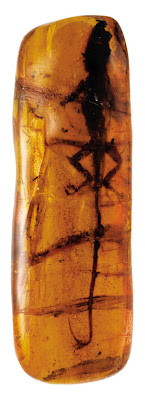
Anyone Want to Give Me A Slightly Belated Bday Present?


Oligocene from the Dominican Republic is what they say. Sure is purty.

TEH STOOPID Damages Priceless Olmec Sculptures

(dark spots are the stains)
Mexico is restoring nearly two dozen pre-Hispanic Olmec sculptures damaged by an American woman and two Mexican men.

The three were arrested Sunday for allegedly throwing a grape juice-and-oil mixture on the statues as part of a bizarre religious act. The mixture left dark stains on the porous stone carvings in the Gulf state of Tabasco.

ARRRRRRRRRRRRRRRRRGGGGGGGGGGGGGGGH!

A Plea to My Alaskan Readers


Can't you guys keep her at home? Please? Find some excuse. I'm begging you all! PLEASE!

Another Permian Map


Zach, we'll use this one.

Ptomacanthus Braincase Causing a Stir?


The earliest known braincase of a shark-like fish has shown some assumptions about the early evolution of vertebrates are "completely wrong," experts say.

The 415-million-year-old specimen of a Ptomacanthus is only the second known example of a braincase from an Acanthodian, a long-extinct group of fossil fish that existed near the time that bony fish and cartilaginous fish—animals with skeletons made up of a type of connective tissue—split off into separate branches.

The other braincase, from a species called Acanthodes, dates to a hundred million years after the Acanthodian group came into existence, casting most of this period of the group's evolution into shadow.

"We've known about [Acanthodians] for 150 years or more, but the braincase has always been missing," said study lead author Martin Brazeau, a Ph.D. student at Uppsala University in Sweden. "To fit it in now is kind of exceptional."

Before this discovery, most scientists believed that the braincases of Acanthodians resembled those of bony fish, and were thus related to this type of animal.

But data from the new fossil support an emerging idea that the ancient group of fish included a diverse tableau of shapes and characteristics that defy clear-cut categories.


hmmm. Sounds like the Pre PT Extinction therapsids vs mammals today. If there were no mass extinctions life might not be as differentiated into the groups that we recognize today.

To The Last I Grapple With Thee


Rest In Peace.

He was, BTW, so much more than this, but he was really an impressive man in general.

Probably Related to What Doug Just Sent Me


Stretching the Envelope of Past Surface Environments: Neoproterozoic Glacial Lakes from Svalbard

Huiming Bao,1* Ian J. Fairchild,2 Peter M. Wynn,3 Christoph Spötl4

The oxygen isotope composition of terrestrial sulfate is affected measurably by many Earth-surface processes. During the Neoproterozoic, severe "snowball" glaciations would have had an extreme impact on the biosphere and the atmosphere. Here, we report that sulfate extracted from carbonate lenses within a Neoproterozoic glacial diamictite suite from Svalbard, with an age of ~635 million years ago, falls well outside the currently known natural range of triple oxygen isotope compositions and indicates that the atmosphere had either an exceptionally high atmospheric carbon dioxide concentration or an utterly unfamiliar oxygen cycle during deposition of the diamictites.

1 Department of Geology and Geophysics, E235 Howe-Russell Complex, Louisiana State University, Baton Rouge, LA 70803, USA.
2 School of Geography, Earth and Environmental Sciences, University of Birmingham, Birmingham B15 2TT, UK.
3 Department of Geography, University of Lancaster, Lancaster LA1 4YQ, UK.
4 Institut für Geologie und Paläontologie, Leopold-Franzens-Universität Innsbruck, Innrain 52, 6020 Innsbruck, Austria.


Nat Geo has a Popsci version of the above. Now if only I had the paper. Interesting that the Ediacaran had so many interesting and oddball things happening in it. Or is this Cryogenian?

Related link.

Different time frames from what Doug sent me. I didn't get a chance to read what he had. That covers the Great Oxidization Event: here and here. The GOE was 1.8 billion years older. There was a lot more sulfur in the atmosphere then though like both the Ediacaran-Cryogenian Boundary and GOE.

Two Exoplanet Atmospheric Thermal Emissions Detected


Two independent groups have simultaneously made the first-ever ground-based detection of extrasolar planets thermal emissions. Until now, virtually everything known about atmospheres of planets orbiting other stars in the Milky Way has come from space-based observations. These new results, accepted for publication in Astronomy & Astrophysics, open a new frontier to studying these alien worlds and are especially critical because the major space-based workhorse to these studies, the Spitzer telescope, will soon run out of cryogens, highly limiting its capabilities.

One team of scientists observed a planet named OGLE-TR-56b, which is a "hot Jupiter." Hot Jupiters are massive planets that orbit very close to their stars, whipping around them in 2 to 3 days. Since they are so close to their stars, they are believed to be hot enough to emit radiation in the optical and near-infrared wavelengths and be detectable from Earth. The orbit of OGLE-TR-56b carries it behind its host star from the perspective of an observer on Earth, but a challenge to observing is that the planet is faint and in a crowded field, located in the direction of the center of our galaxy, about 5,000 light years away.

[...]

n the other study, published in the same issue of the journal, astronomers in the Netherlands detected thermal emission in the near-infrared from another exoplanet named TrES-3b, also from the ground. Information about atmospheres of hot Jupiters from Spitzer studies has helped both sets of scientists. The hot Jupiters Spitzer has observed have similar atmospheric properties, in particular thermal inversions, in which a warm layer holds a cooler layer underneath. "OGLE-TR-56b is hotter than any that Spitzer has seen so far," said López-Morales. "At over 4400° F it's the hottest atmosphere yet measured. It is way too hot for silicon or iron clouds to form, which would keep it dark—typical of the hot Jupiters that Spitzer had found. It's comforting to know that when Spitzer goes out of service, studies like these two will be able to keep the field alive.


very kewl...ermmm...

Hardy's Paradox Resolved?

Over the course of nearly two years of work, Steinberg and then-student Jeff Lundeen, now a research associate at the National Research Council of Canada, built a complicated quantum optical experiment and developed new theoretical tools. In essence, they combined Hardy's Paradox with a new theory known as weak measurement proposed by Tel Aviv University physicist Yakir Aharonov, showing that in one sense, one can indeed talk about the past, resolving the paradox. Weak measurement is a tool whereby the presence of a detector is less than the level of uncertainty around what is being measured, so that there is an imperceptible impact on the experiment. "We found that all of the seemingly paradoxical conclusions in Hardy's Paradox can, in fact, be experimentally verified," says Steinberg, "but that the use of weak measurement removes the contradiction."

"Until recently, it seemed impossible to carry out Hardy's proposal in practice, let alone to confirm or resolve the paradox," he says. "We have finally been able to do so, and to apply Aharonov's methods to the problem, showing that there is a way, even in quantum mechanics, in which one can quite consistently discuss past events even after they are over and done. Weak measurement finds what is there without disturbing it."


whoaWhoaWHOAWHOAWHOA!!!!!!!!!!!!!!

That even needs a blink tag.

Now let's see if everyone agrees with what they found.

You can observe and not disturb.

duuuuuuuuuuuuuuuude.

USAF/DARPA's Secret Sat Inspections?

In a top secret operation, the U.S. Defense Dept. is conducting the first deep space inspection of a crippled U.S. military spacecraft. To do this, it is using sensors on two covert inspection satellites that have been prowling geosynchronous orbit for nearly three years.

The failed satellite being examined is the $400 million U.S. Air Force/Northrop Grumman Defense Support Program DSP 23 missile warning satellite. It died in 2008 after being launched successfully from Cape Canaveral in November 2007 on the first operational Delta 4-Heavy booster.

Since the U.S. is now demonstrating the ability to do such up close rendezvous and inspection of American spacecraft in geosynchronous orbit, it means USAF now has at least a "call up capability" to do the same to non-U.S. spacecraft like those from Russia and China.

The operation, at nearly 25,000 miles altitude, reveals a major new U.S. military space capability, says John Pike who heads GlobalSecurity.Org, a military think tank.

"There is not much we do in space any more that is really new, but this is really new," Pike tells Spaceflightnow.com.

Although being used in this operation to obtain data on a failed U.S. spacecraft, such inspections of especially potential enemy spacecraft, is something the Pentagon has wanted to do since the start of the space age, Pike says.

The Orbital Sciences and Lockheed Martin "Mitex" inspection spacecraft involved are part of a classified Defense Advanced Research Projects Agency (DARPA) technology development program. When initially launched on a Delta 2 from Cape Canaveral in 2006, the project involved maneuvering around and inspecting each other at geosynchronous altitude.

But there is no unclassified data to indicate whether the two spacecraft may have secretly paid visits to one or more non-U.S. spacecraft in the geosynchronous arc that circles the Earth at about 22,300 miles altitude, much like the Capital Beltway circles Washington, D.C.

A U.S. Defense Dept. analyst speaking on deep background says although a visit to a non-U.S. satellite is doubtful, the demonstration will cause concern, especially among Chinese government military analysts in Beijing. He said they will see the capability as a new U.S. intelligence tool that could theoretically also enable a sneak anti-satellite attack in geosynchronous orbit.


IF the Mitex sats were actually able to go and inspect satellites, it's a fascinating capability that we've developed with a lot of potential.