Authors:Feng et alAbstract:Sulfate-driven anaerobic oxidation of methane (SD-AOM) supports chemosynthesis-based communities and limits the release of methane from marine sediments. Formation of authigenic carbonates at active methane seeps is promoted by SD-AOM stoichiometry. While distinctively small δ18O/δ34S slopes of pore fluid sulfate have been shown to typify modern methane-rich environments, identification of such environments has been difficult for the geological past due to the lack of sedimentary pore fluids. However, if the isotopic composition of sulfate were archived in authigenic carbonate during early diagenesis, carbonate-associated sulfate (CAS) should display the characteristic δ18O-δ34S pattern. To test this hypothesis, we investigated the δ18OCAS, δ34SCAS, and 87Sr/86Sr signatures of authigenic carbonate minerals from three modern and two ancient methane-seep provinces. The data obtained demonstrate that all deposits regardless of age or location display consistently small δ18OCAS/δ34SCAS slopes (∼0.3) and CAS does not represent ambient seawater but pore-water sulfate. This finding confirms the utility of CAS as a recorder of SD-AOM in methane-rich environments. In addition, we report that aragonites bear higher CAS contents, 87Sr/86Sr ratios closer to that of contemporary seawater, and a larger δ18OCAS/δ34SCAS slope than calcites, reflecting the shallower formation depth of aragonite where pore-water has a composition close to that of seawater with high concentrations of sulfate. The new proxy can be used to constrain the record of SD-AOM through most of Earth history by measuring the δ18O and δ34S values of CAS of methane-derived diagenetic carbonates including but not limited to seep carbonates.
Showing posts with label bacteria. Show all posts
Showing posts with label bacteria. Show all posts
Friday, October 28, 2016
A carbonate-based proxy for sulfate-driven anaerobic oxidation of methane


Friday, September 23, 2016
Evidence of Terrestrial Life From Archean Paleosols

Authors:Retallack et alAbstract:Coastal-plain paleosols in the 3.0 Ga Farrel Quartzite of Western Australia have organic surface (A horizon) and sulfate-rich subsurface (By) horizons, like soils of the Atacama Desert of Chile, Dry Valleys of Antarctica, and 3.7 Ga paleosols of Mars. Farrel Quartzite paleosols include previously described microfossils, permineralized by silica in a way comparable with the Devonian Rhynie Chert, a well known permineralized Histosol. Five microfossil morphotypes in the Farrel Quartzite include a variety of spheroidal cells (Archaeosphaeroides) as well as distinctive large spindles (new genus provisionally assigned to cf. Eopoikilofusa). Previously published cell-specific carbon isotopic analyses of the Farrel Quartzite microfossils, and unusually abundant sulfate considering a likely anoxic atmosphere, allow interpretation of these morphotypes as a terrestrial community of actinobacteria, purple sulfur bacteria, and methanogenic Archaea.
Friday, August 12, 2016
Evidence of Bacteria Producing Soil at the PaleoArchean/MesoArchean Boundary
Authors:Sabhan et alAbstract:Regionally traceable paleosols in the lower Moodies Group of the Barberton greenstone belt (ca. 3.22 Ga, northeastern South Africa and Swaziland) contain locally abundant silicified nodules, originally composed of pedogenic carbonates and sulfates, interbedded with heavy-mineral laminae dominated by pyrite. Pyrite grains show rounded detrital cores and secondary idiomorphic rims with trace element concentrations and δ34S ratios clearly different from those of the cores. While cores have low Co and Ni concentrations and high Co/Ni ratios, rims show as much as 5.5 wt% of these elements and low Co/Ni ratios, reflecting the weathering of nearby ultramafic rocks. In-situ sulfur isotope analyses of pyrite cores show δ34SVCDT (Vienna Canyon Diablo troilite) values between +5‰ and –5‰, while the rims show δ34VCDT values between –20‰ and –24.5‰, suggesting biogenic fractionation of sulfur. The close spatial association and microtextural evidence for nearly contemporaneous formation of the pedogenic sulfate nodules and the secondary pyrite rims suggests microbial processing of sulfur in the paleosols, which provided reduced and 34S-depleted sulfur for the growth of authigenic pyrite. This indicates that vadose-zone soil-forming processes in the Archean involved not only physical and chemical modification of moist, unconsolidated sediment in a terrestrial environment but also already included its microbiological modification.
Friday, May 06, 2016
23 Species of Bacteria That Grow Under Martian Atmospheric Conditions
Twenty-Three Species of Hypobarophilic Bacteria Recovered from Diverse Ecosystems Exhibit Growth under Simulated Martian Conditions at 0.7 kPa
Authors:
Schuerger et al
Abstract:
Bacterial growth at low pressure is a new research area with implications for predicting microbial activity in clouds and the bulk atmosphere on Earth, and for modeling the forward contamination of planetary surfaces like Mars. Here, we describe experiments on the recovery and identification of 23 species of bacterial hypobarophiles (def., growth under hypobaric conditions of approximately 1–2 kPa) in 11 genera capable of growth at 0.7 kPa. Hypobarophilic bacteria, but not archaea or fungi, were recovered from soil and non-soil ecosystems. The highest numbers of hypobarophiles were recovered from Arctic soil, Siberian permafrost, and human saliva. Isolates were identified through 16S rRNA sequencing to belong to the genera Carnobacterium, Exiguobacterium, Leuconostoc, Paenibacillus, and Trichococcus. The highest population of culturable hypobarophilic bacteria (5.1 × 10⁴ cfu/g) was recovered from Colour Lake soils from Axel Heiberg Island in the Canadian Arctic. In addition, we extend the number of hypobarophilic species in the genus Serratia to six type-strains that include S. ficaria, S. fonticola, S. grimesii, S. liquefaciens, S. plymuthica, and S. quinivorans. Microbial growth at 0.7 kPa suggests that pressure alone will not be growth-limiting on the martian surface or in Earth's atmosphere up to an altitude of 34 km.
Friday, January 08, 2016
Copper Age Mummy Ötzi was Infected With Ulcer Causing Bacterium, Helicobacter pylori
Scientists are continually unearthing new facts about Homo sapiens from the mummified remains of Ötzi, the Copper Age man, who was discovered in a glacier in 1991. Five years ago, after Ötzi's genome was completely deciphered, it seemed that the wellspring of spectacular discoveries about the past would soon dry up. An international team of scientists working with paleopathologist Albert Zink and microbiologist Frank Maixner from the European Academy (EURAC) in Bozen/Bolzano have now succeeded in demonstrating the presence of Helicobacter pylori in Ötzi's stomach contents, a bacterium found in half of all humans today. The theory that humans were already infected with this stomach bacterium at the very beginning of their history could well be true. The scientists succeeded in decoding the complete genome of the bacterium.
When EURAC's Zink and Maixner first placed samples from the Iceman's stomach under the microscope in their ancient DNA Lab at EURAC, almost three years ago, they were initially sceptical.
"Evidence for the presence of the bacterium Helicobacter pylori is found in the stomach tissue of patients today, so we thought it was extremely unlikely that we would find anything because Ötzi's stomach mucosa is no longer there," explains Zink. Together with colleagues from the Universities of Kiel, Vienna and Venda in South Africa as well as the Max Planck Institute for the Science of Human History in Jena, the scientists tried to find a new way to proceed. "We were able to solve the problem once we hit upon the idea of extracting the entire DNA of the stomach contents," reports Maixner. "After this was successfully done, we were able to tease out the individual Helicobacter sequences and reconstruct a 5,300 year old Helicobacter pylori genome."
The scientists found a potentially virulent strain of bacteria, to which Ötzi's immune system had already reacted. "We showed the presence of marker proteins which we see today in patients infected with Helicobacter," said the microbiologist.
link.
Sunday, October 11, 2015
Electricity Generating Bacteria Produce "Firewall" Against Euxinia
Cable bacteria generate a firewall against euxinia in seasonally hypoxic basins
Authors:
Seitaj et al
Abstract:
Seasonal oxygen depletion (hypoxia) in coastal bottom waters can lead to the release and persistence of free sulfide (euxinia), which is highly detrimental to marine life. Although coastal hypoxia is relatively common, reports of euxinia are less frequent, which suggests that certain environmental controls can delay the onset of euxinia. However, these controls and their prevalence are poorly understood. Here we present field observations from a seasonally hypoxic marine basin (Grevelingen, The Netherlands), which suggest that the activity of cable bacteria, a recently discovered group of sulfur-oxidizing microorganisms inducing long-distance electron transport, can delay the onset of euxinia in coastal waters. Our results reveal a remarkable seasonal succession of sulfur cycling pathways, which was observed over multiple years. Cable bacteria dominate the sediment geochemistry in winter, whereas, after the summer hypoxia, Beggiatoaceae mats colonize the sediment. The specific electrogenic metabolism of cable bacteria generates a large buffer of sedimentary iron oxides before the onset of summer hypoxia, which captures free sulfide in the surface sediment, thus likely preventing the development of bottom water euxinia. As cable bacteria are present in many seasonally hypoxic systems, this euxinia-preventing firewall mechanism could be widely active, and may explain why euxinia is relatively infrequently observed in the coastal ocean.
Friday, September 11, 2015
Kabuno Bay's Iron Oxidizing Bacteria Give Clues to Earth's Archean and Proterozoic Oceans
An isolated, iron-rich bay in the heart of East Africa is offering scientists a rare glimpse back into Earth's primitive marine environment, and supports theories that tiny microbes created some of the world's largest ore deposits billions of years ago.
According to University of British Columbia (UBC) research published this week in Scientific Reports, 30 per cent of the microbes in the Democratic Republic of the Congo's Kabuno Bay grow by a type of photosynthesis that oxidizes (rusts) iron rather than converting water into oxygen like plants and algae.
"Kabuno Bay is a time machine back to the Earth's early history when iron-rich ocean chemistry prevailed," said Marc Llirós of the University of Namur, first author of the paper.
"The bay is giving us real-world insight into how ancient varieties of photosynthesis may have supported Earth's early life prior to the evolution of the oxygen producing photosynthesis that supports life today," said UBC geomicrobiologist Sean Crowe, senior author of the study.
While iron-respiring bacteria were discovered in 1993, the new Scientific Reports study provides evidence that microorganisms could have been directly involved in depositing the Earth's oldest iron formations.
Before 2.3 billion years ago, there was little oxygen in the atmosphere but plenty of dissolved iron and many organisms like bacteria derived energy by metabolizing the metal. Many researchers believe iron-metabolizing microbes might have turned plentiful dissolved iron into minerals, which then settled out of seawater and deposited along the ocean floor.
link.
Monday, June 01, 2015
Academic Bun Fight Over Sulfur Cycling bacteria: Serial Convergence or 1.8 Billion Year Evolutionary Stasis?
Putative extremely long evolutionary stasis in bacteria might be explained by serial convergence
Authors:
Dvorak et al
Abstract:
In a recent paper, Schopf et al. (1) analyzed 1.8-Ga-old fossil sulfur bacteria and found an intriguing morphological similarity between fossil and modern species. Moreover, the authors showed that the deep-water sulfur cycling environment, where these bacteria reside, has not significantly changed throughout time. Thus, the authors hypothesize that this phenomenon is a result of an extreme evolutionary stasis in these bacteria. Such a static evolution is termed hypobradytelic and it has also been described in some cyanobacteria (2), where an evolutionary stasis is expected to be more than 2 Ga. However, these conclusions rely only on geological and morphological evidence.
Counterattack!
Reply to Dvořák et al.: Apparent evolutionary stasis of ancient subseafloor sulfur cycling biocoenoses
Authors:
Schopf et al
Abstract:
We thank Dvořák et al. for their comment (1) on our paper (2), in which we compare sulfur-cycling ∼1.8- and ∼2.3-Ga fossil communities with their modern counterparts and report that the community fabric of the fossil and modern microbes, as well as their organismal and cellular morphology, their interlinked energy-production via anaerobic sulfate-reduction and sulfur species oxidation, and their use of sulfate and nitrate to fuel this sulfur cycle appear to have remained unchanged over a segment of geological time equivalent to half the age of the Earth.
Tuesday, April 21, 2015
PaleoArchean Apex Microfossils are Hydrothermal Minerals, NOT Biogenic Fossils
New analysis of world-famous 3.46 billion-year-old rocks by researchers from the University of Bristol, the University of Oxford and UWA (the University of Western Australia) is set to finally resolve a long running evolutionary controversy.
The new research, published this week in Proceedings of the National Academy of Sciences USA, shows that structures once thought to be Earth's oldest microfossils do not compare with younger fossil candidates but have, instead, the character of peculiarly shaped minerals.
In 1993, US scientist Bill Schopf described tiny carbon-rich filaments within the 3.46 billion-year-old Apex chert (fine-grained sedimentary rock) from the Pilbara region of Western Australia, which he likened to certain forms of bacteria, including cyanobacteria.
These 'Apex chert microfossils' - between 0.5 and 20 micrometres wide - soon became enshrined in textbooks, museum displays, popular science books and online reference guides as the earliest evidence for life on Earth. In 1996, these structures were even used to test and help refute the case against 'microfossils' in the Martian meteorite ALH 84001.
Even so, their curious colour and complexity gave rise to some early questions. Gravest doubts emerged in 2002, when a team led by Oxford's Professor Martin Brasier (co-author of this current study) revealed that the host rock was not part of a simple sedimentary unit but rather came from a complex, high-temperature hydrothermal vein, with evidence for multiple episodes of subsurface fluid flow over a long time. His team advanced an alternative hypothesis, stating that these curious structures were not true microfossils but pseudofossils formed by the redistribution of carbon around mineral grains during these hydrothermal events.
Although other research teams have since supported the hydrothermal context of Professor Brasier, the 'Apex microfossil' debate has remained hard to resolve because scientific instrumentation has only recently reached the level of resolution needed to map both chemical composition and morphology of these 'microfossils' at the sub-micrometre scale.
link.
Monday, January 19, 2015
The Awesome Evilness of Deep Sea Bacterial Viruses
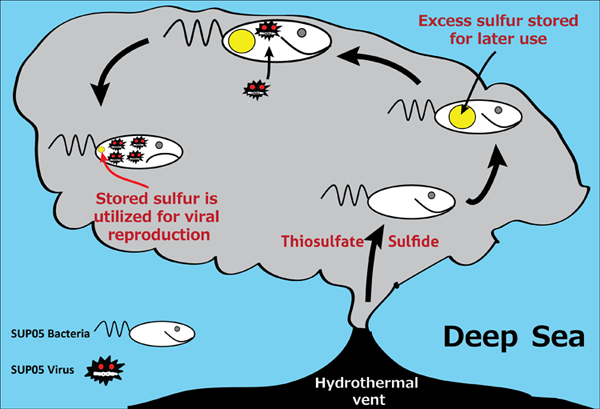
Sulfur Oxidation Genes in Diverse Deep-Sea Viruses
Authors:
Anantharaman et al
Abstract:
Viruses are the most abundant biological entities in the oceans and a pervasive cause of mortality of microorganisms that drive biogeochemical cycles. Although the ecological and evolutionary effects of viruses on marine phototrophs are well recognized, little is known about their impact on ubiquitous marine lithotrophs. Here, we report 18 genome sequences of double-stranded DNA viruses that putatively infect widespread sulfur-oxidizing bacteria. Fifteen of these viral genomes contain auxiliary metabolic genes for the α and γ subunits of reverse dissimilatory sulfite reductase (rdsr). This enzyme oxidizes elemental sulfur, which is abundant in the hydrothermal plumes studied here. Our findings implicate viruses as a key agent in the sulfur cycle and as a reservoir of genetic diversity for bacterial enzymes that underpin chemosynthesis in the deep oceans.
Thursday, January 01, 2015
Major Clades of Archaea Originated by Pursuing Bacteria Down Alleyways to Beat Them Unconscious and Riffle Their Genetic Pockets

Origins of major archaeal clades correspond to gene acquisitions from bacteria
Authors:
Nelson-Sathi et al
Abstract:
The mechanisms that underlie the origin of major prokaryotic groups are poorly understood. In principle, the origin of both species and higher taxa among prokaryotes should entail similar mechanisms—ecological interactions with the environment paired with natural genetic variation involving lineage-specific gene innovations and lineage-specific gene acquisitions. To investigate the origin of higher taxa in archaea, we have determined gene distributions and gene phylogenies for the 267,568 protein-coding genes of 134 sequenced archaeal genomes in the context of their homologues from 1,847 reference bacterial genomes. Archaeal-specific gene families define 13 traditionally recognized archaeal higher taxa in our sample. Here we report that the origins of these 13 groups unexpectedly correspond to 2,264 group-specific gene acquisitions from bacteria. Interdomain gene transfer is highly asymmetric, transfers from bacteria to archaea are more than fivefold more frequent than vice versa. Gene transfers identified at major evolutionary transitions among prokaryotes specifically implicate gene acquisitions for metabolic functions from bacteria as key innovations in the origin of higher archaeal taxa.
Wednesday, November 26, 2014
Evidence of Sulfur Eating Bacteria From NeoArchean Brazil
Large sulfur isotope fractionations associated with Neoarchean microbial sulfate reduction
Authors:
Zhelezinskaia et al
Abstract:
The minor extent of sulfur isotope fractionation preserved in many Neoarchean sedimentary successions suggests that sulfate-reducing microorganisms played an insignificant role in ancient marine environments, despite evidence that these organisms evolved much earlier. We present bulk, microdrilled, and ion probe sulfur isotope data from carbonate-associated pyrite in the ~2.5-billion-year-old Batatal Formation of Brazil, revealing large mass-dependent fractionations (approaching 50 per mil) associated with microbial sulfate reduction, as well as consistently negative Δ33S values (~ –2 per mil) indicative of atmospheric photochemical reactions. Persistent 33S depletion through ~60 meters of shallow marine carbonate implies long-term stability of seawater sulfate abundance and isotope composition. In contrast, a negative Δ33S excursion in lower Batatal strata indicates a response time of ~40,000 to 150,000 years, suggesting Neoarchean sulfate concentrations between ~1 and 10 μM.
Wednesday, October 29, 2014
Fossil Evidence of Iron Oxidizing Bacteria From the Great Oxidation Event
Fossil evidence of iron-oxidizing chemolithotrophy linked to phosphogenesis in the wake of the Great Oxidation Event
Authors:
Crosby et al
Abstract:
The oxygenation of Earth's atmosphere allowed for the diversification of metabolisms to include those that rely on oxygen and its derivatives. For example, chemolithotrophic oxidation of sulfide and iron both require oxygen or nitrate as terminal electron acceptors. A growing number of oxygen-utilizing chemolithotrophs are known to accumulate intracellular polyphosphate as an energy reserve that allows them to adapt to the fluctuating redox conditions in their distinctive-gradient habitats. Polyphosphate is also thought to play an important role in the formation of phosphatic mineral deposits. Here we present fossil evidence of iron-oxidizing bacteria preserved as filamentous iron oxides within phosphatic Paleoproterozoic stromatolites. The filaments include twisted stalks similar to those produced by modern iron-oxidizing bacteria that are known to metabolize polyphosphate and inhabit steep redox gradients. Fossil iron-oxidizing bacteria preserved within some of the oldest known phosphorites serve as indicators of O2-Fe(II) gradients that may have supported microbially mediated phosphogenesis via polyphosphate metabolism and/or an active iron redox pump.
Monday, August 18, 2014
Last Universal Common Ancestor of all Life on Earth had a Leaky Membrane, Lived in Deep Sea Vents

All life on Earth came from one common ancestor – a single-celled organism – but what it looked like, how it lived and how it evolved into today's modern cells is a four billion year old mystery being solved by researchers at UCL using mathematical modelling.
Findings published today in PLOS Biology suggest for the first time that life's Last Universal Common Ancestor (LUCA) had a 'leaky' membrane, which helps scientists answer two of biology's biggest questions:
1. Why all cells use the same bizarre, complex mechanism to harvest energy
2. Why two types of single-celled organism that form the deepest branch on the tree of life – bacteria and archaea – have completely different cell membranes
The leakiness of the membrane allowed LUCA to be powered by energy in its surroundings, most likely vents deep on the ocean floor, whilst holding in all the other components necessary for life.
The team modelled how the membrane changed, enabling LUCA's descendants to move to new, more challenging environments and evolve into two distinct types of single-celled organism, bacteria and archaea, creating the deepest branch of the tree of life.
Bacteria and archaea share many common features such as genes, proteins and mechanisms of reading DNA, initially leading scientists to believe they were just different types of bacteria. Their classification changed in the 1970's after extreme differences were found in the way they replicate DNA and in the structure of their cell membrane. As they both stemmed from LUCA, scientists set out to find answers in the structure and function of LUCA's membrane.
Dr Nick Lane (UCL Biosciences) who led the study said, "I find this work just beautiful – it constrains a sequence of steps going from the strange cell that seems to have been the ancestor of all life today, right through to the deep division between modern cells. From a single basic idea, the model can explain the fundamental differences between bacteria and archaea. Is it right? I'd like to think so, but more importantly, it makes some clear predictions that we plan to test in the future."
Data from the study strongly suggest that LUCA lived in the area where ancient seawater, dense with positively charged particles called protons, mixed with warm alkaline vent fluid, which contained few protons. The difference in the concentration of protons across these two environments enabled protons to flow into the cell, driving the production of a molecule called adenosine triphosphate (ATP) which powered the growth of cells, just as it does today. However, unlike modern cells the scientists believe this could only happen if the membrane was 'leaky', enabling protons to leave the cell spontaneously so more protons could enter to power growth.
Dr Lane said: "In these deep sea vents, there is a continuous flow of alkaline fluids, which mix with the ocean waters. When they mix, the fluids neutralise each other, and that stops any build-up of charge which would otherwise prevent protons flowing into the cell. If the first cells had leaky membranes, then protons could enter and then be neutralised, or leave again, almost as if there was no barrier at all. What we've shown is that the rate at which protons enter and leave is high enough to power the growth of cells via proteins embedded in the membrane. So LUCA could have been powered by natural proton gradients in vents, but only if it had a really leaky membrane, completely unlike today's cells."
To escape from these seabed vents, LUCA had to adapt its membrane to pump protons out of the cell, in order for them to flow back in again to help drive ATP production. The study suggests that the bacteria and archaea developed completely different cell membrane structures and proton pumps, whilst keeping the same machinery for powering growth. It also explains why they differ in fundamental traits that depend on the membrane such as DNA replication.
link.
Thursday, May 08, 2014
Evidence of a Black Smoker Biota From PaleoArchean Australia?
Geochemistry and nano-structure of a putative ∼3,240 million-year-old black smoker biota, Sulfur Springs Group, Western Australia
Authors:
Wacey et al
Abstract:
Filaments of pyrite found within a volcanic hosted massive sulfide (VHMS) deposit from the ∼3,270-3,230 Ma Sulfur Springs Group of Western Australia have previously been interpreted as remnants of some of Earth's oldest thermophilic microbial communities. We here re-examine these pyrite filaments using a suite of in situ high spatial resolution techniques and provide new observations on their geochemistry, morphology, texture, distribution and habitat.
A number of the Sulfur Springs filaments retain geochemical evidence for remnants of organic material. This takes the form of patches of carbon and nitrogen enrichment seemingly enclosed within a completely pyritised filament. The distribution of this organic material closely resembles that observed in younger bona fide pyritised filamentous microbes. Most filaments also possess a distinctive sponge-like nano-porous pyrite texture, which is replicated in younger pyritised microfossils and bio-mediated pyrite framboids, and is consistent with pyrite nucleation in an organic matrix. New 3D analyses confirm previous observations of approximately uniform filament diameters, lack of branching, clustering of filaments, plus zones of filaments with preferred orientations. Multiple sulfur isotope analyses indicate that the sulfur for pyritisation likely came from a mixture of seawater and magmatic sources, consistent with a black smoker type habitat and permissive of the presence of life in this setting.
While these data are consistent with a biological interpretation for the Sulfur Springs filaments, perhaps as pyritised filamentous microorganisms or bundles of pyritised extra-cellular polymeric substances (EPS), the evidence is not compelling. Solid filament cross-sections and straight lengthwise morphology of most filaments resemble abiotic crystal needles or whiskers, while the parallel and radial alignments of filaments could be replicated by crystal growth patterns. Carbon and nitrogen enrichment could have occurred when organic material entrained within hydrothermal fluids was adsorbed onto these mineral crystals. Further work to obtain larger databases of nano-scale textures and morphologies from both biological and abiotic pyrite is needed before an abiotic formation mechanism can be confidently rejected.
Thursday, December 12, 2013
Hints the Last Universal Common Ancestor for Bacteria and Archaea was Cold Adapted
The molecular signal for the adaptation to cold temperature during early life on EarthI missed this the first time for some reason.
Authors:
Groussin et al
Abstract:
Several lines of evidence such as the basal location of thermophilic lineages in large-scale phylogenetic trees and the ancestral sequence reconstruction of single enzymes or large protein concatenations support the conclusion that the ancestors of the bacterial and archaeal domains were thermophilic organisms which were adapted to hot environments during the early stages of the Earth. A parsimonious reasoning would therefore suggest that the last universal common ancestor (LUCA) was also thermophilic. Various authors have used branch-wise non-homogeneous evolutionary models that better capture the variation of molecular compositions among lineages to accurately reconstruct the ancestral G + C contents of ribosomal RNAs and the ancestral amino acid composition of highly conserved proteins. They confirmed the thermophilic nature of the ancestors of Bacteria and Archaea but concluded that LUCA, their last common ancestor, was a mesophilic organism having a moderate optimal growth temperature. In this letter, we investigate the unknown nature of the phylogenetic signal that informs ancestral sequence reconstruction to support this non-parsimonious scenario. We find that rate variation across sites of molecular sequences provides information at different time scales by recording the oldest adaptation to temperature in slow-evolving regions and subsequent adaptations in fast-evolving ones.
Monday, November 18, 2013
Great Oxidation Event had Profound Impact on Phosphorus in the Orosirian PaleoProterozoic

Two billion years ago the Earth system was recovering from perhaps the single-most profound modification of its surface environments: the oxygenation of the atmosphere and oceans. This led to a series of major changes in global biogeochemical cycles, as a team around Aivo Lepland of the Norwegian Geological Survey NGU reports in the latest online edition of "Nature Geoscience".
This also resulted in the distribution of one of life's key elements, phosphorous. Studies on the unique organic-rich Zaonega rock formation preserved in Carelia, NW Russia, with an age of around two billion years has revealed an astonishing result: "The formation of Earth's earliest phosphorites was influenced strongly, if not controlled completely, by the activity of sulfur bacteria", says co-author Richard Wirth of the GFZ German Research Centre for Geosciences, who analyzed the rock samples with an electron microscope. "This activity occurred in an oil field setting that had been influenced by active volcanism and associated venting and seeping." In the modern world, sulfur bacteria inhabit upwelling vent and seep areas known as "Black Smokers" and mediate phosphorite formation. The authors therefore conclude that the formation of the earliest worldwide phosphorites 2 billion years ago can be linked to the establishment of sulfur bacteria habitats, triggered by the oxygenation of the Earth.
link.
Tuesday, November 12, 2013
Evidence Found in PaleoArchean Australian Deposits of Bacterial Mats

Reconstructing the rise of life during the period of Earth's history when it first evolved is challenging. Earth's oldest sedimentary rocks are not only rare, but also almost always altered by hydrothermal and tectonic activity. A new study from a team including Carnegie's Nora Noffke, a visiting investigator, and Robert Hazen revealed the well-preserved remnants of a complex ecosystem in a nearly 3.5 billion-year-old sedimentary rock sequence in Australia. Their work is published in Astrobiology.
The Pilbara district of Western Australia constitutes one of the famous geological regions that allow insight into the early evolution of life. Mound-like deposits created by ancient photosynthetic bacteria, called stromatolites, and microfossils of bacteria have been described by scientists in detail. However, a phenomenon called microbially induced sedimentary structures, or MISS, had not previously been seen in this region. These structures are formed from mats of microbial material, much like mats seen today on stagnant waters or in coastal flats.
The team included Noffke, Hazen, Daniel Christian of Old Dominion University, and David Wacey of the University of Western Australia. They described various MISS preserved in the region's Dresser Formation. Advanced chemical analyses point toward a biological origin of the material.
The Dresser MISS fossils resemble strongly in form and preservation the MISS from several other younger rock samples, such as a 2.9 billion-year-old ecosystem Noffke and her colleagues found in South Africa.
"This work extends the geological record of MISS by almost 300 million years," said Noffke, who is also a professor at ODU. "Complex mat-forming microbial communities likely existed almost 3.5 billion years ago."
The team proposes that the sedimentary structures arose from the interactions of bacterial films with shoreline sediments from the region.
"The structures give a very clear signal on what the ancient conditions were, and what the bacteria composing the biofilms were able to do," Noffke said.
link.
Friday, November 01, 2013
Methylacidiphilum fumariolicum: An Extremophile Which Uses Rare Earth Elements in its Metabolism

Rare earths are among the most precious raw materials of all. These metals are used in mobile telephones, display screens and computers. And they are apparently indispensable for some organisms as well. A team of researchers, including scientists from the Max Planck Institute for Medical Research in Heidelberg, has discovered a bacterium which needs rare earths to grow - in a hot spring. Methylacidiphilum fumariolicum requires lanthanum, cerium, praseodymium or neodymium as co-factor for the enzyme methanol dehydrogenase, with which the microbes produce their energy. The use of rare earths is possibly more widespread among bacteria than previously thought.
[..]
In living organisms, the rare earths really are rare, on the other hand. As they dissolve hardly at all in water, most organisms cannot use them for their metabolism. This makes their discovery in a mudpot of volcanic origin in the Solfatara crater in Italy all the more surprising. Microbiologists from the Radboud University in Nijmegen, the Netherlands, have found a microbe which cannot live without some of the rare earths.
Methylacidiphilum fumariolicum belongs to a group of bacteria which have chosen an extremely inhospitable habitat: They thrive best at a pH value of between 2 and 5 and temperatures of between 50 and 60 degrees - conditions which are lethal for other organisms. Methylacidiphilum even tolerates pH values below 1, which corresponds to concentrated sulphuric acid.
The microbes produce their energy from methane. They have a special enzyme, methanol dehydrogenase, which processes the methanol produced in the decomposition of methane with the aid of metal co-factors. Most of these bacteria use calcium for this process.
In the course of their investigations, the Nijmegen researchers noticed that Methylacidiphilum thrives only with original water from the mudpot. None of the trace elements which the researchers added to the Petri dishes encouraged the bacteria to grow. An analysis of the water showed that it contained concentrations of rare earths that were one hundred to one thousand times higher than normal.
Thomas Barends and Andreas Dietl from the Max Planck Institute for Medical Research investigated the three-dimensional structure of methanol dehydrogenase. They thereby noticed that Methylacidiphilum fumariolicum had inserted not calcium, but an atom of a different metal in its methanol dehydrogenase.
"Suddenly, everything fit together," explains Thomas Barends. "We were able to show that this mysterious atom must be a rare earth. This is the first time ever that rare earths have been found to have such a biological function." Methylacidiphilum uses the rare earths lanthanum, cerium, praseodymium and neodymium in its methanol dehydrogenase instead of calcium. The bacterium needs them to produce energy from methane.
link.
Tuesday, October 08, 2013
Permian Period Endolithic Microbial Trace Fossils Found

Recrystallized microbial trace fossils from metamorphosed Permian basalt, southwestern Japan
Authors:
H. Sugawaraa, M. Sakakibara, and M. Ikehara
Abstract:
Microbial trace fossils on terrestrial basalts can be used as an analogue in the search for traces of life on other terrestrial planets. This study reports on microbial trace fossils within Permian greenstones in the Maizuru Terrane, southwest Japan, which is recognized as back-arc basin oceanic crust that consists mainly of metabasalt and metagabbro. The trace fossils have been studied by means of morphology, mineralogy, elemental mapping, and carbon isotope analysis. Although minute original textures of trace fossils are recrystallized in these rocks, Granulohyalichnus vulgaris isp., Tubulohyalichnus spiralis isp., and Tubulohyalichnus annularis isp. were identified. Significant concentration of C within the trace fossils implies these are organic remnants from microbes. The δ13CPDB values<−7‰ of calcite within the greenstones indicates that the bacterial activity took place prior to the formation of calcite veins. The results support that microbial trace fossils within low-grade metamorphic basalt can be reliably identified based on their morphology and chemical composition, as reveled by elemental mapping. In this context, glassy Martian basalt may be the best rock type to investigate in terms of searching for signs of microbial activity on Earth and other planets.
Subscribe to:
Posts (Atom)