Showing posts with label crustal formation. Show all posts

Friday, December 16, 2016

A Scenario for the Formation of the First Continental Crust During the Archean


Authors:

Palin et al

Abstract:

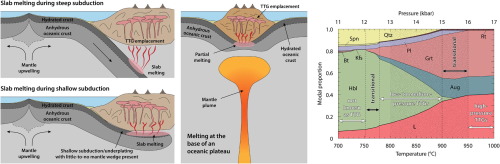
Rocks of tonalitic–trondhjemitic–granodioritic (TTG) composition preserved in Archaean terranes represent fragments of the Earth’s earliest-formed continental crust, and are thought to have formed via partial melting of hydrated metabasalt. The geodynamic environments in which such high-grade metamorphism and anatexis may have occurred in the early Earth is strongly debated. Constraining the pressure (P) and temperature (T) conditions at which melts of appropriate composition can be derived from protoliths containing plausible mineral assemblages is central to addressing this question. Phase equilibrium modelling has been undertaken for an enriched Archaean tholeiite bulk composition—a suggested protolith for early-Earth TTG magmas—using newly parameterised thermodynamic models that were specifically developed to evaluate the anatectic behaviour of metabasalt. Assuming minimal H2O saturation at the wet solidus, the potential fertility of the studied metabasalt is greatest if the solidus is crossed at a pressure of ∼11 kbar, where the solidus temperature reaches a minimum of ∼610 °C. Major-element compositions and proportions of calculated partial melts show the best correlation with those of natural Archaean TTGs when in the P–T range ∼800–950 °C and ∼10–18 kbar, which we suggest are optimal conditions for their petrogenesis. Normative geochemistry suggests that these melts would crystallise to broadly trondhjemitic or tonalitic lithologies. Calculated modal proportions of garnet, plagioclase, amphibole, and rutile in the residuum, which control diagnostic trace-element signatures in the melt, also show the best agreement with natural and experimental data at these conditions. Importantly, although partial melts calculated outside of this P–T range still produce TTG-like major-element compositions and normative mineralogies, they would poorly match the diagnostic trace-element signatures of natural Archaean examples owing to the absences of key minerals in the residuum. This optimal P–T range of 800–950 °C and 10–18 kbar defined herein is most likely to characterise metamorphism of hydrated basalt at the base of a 40-km-thick Archaean oceanic plateau/overthickened crust, or else tectonic underplating via shallow subduction, which we therefore suggest are the most likely tectonic settings for the formation of the first voluminous continental crust on the early Earth.

Thursday, August 18, 2016

Did Mercury's Volcanic Activity End 3.5 Billion Years ago?

New research from North Carolina State University finds that major volcanic activity on the planet Mercury most likely ended about 3.5 billion years ago. These findings add insight into the geological evolution of Mercury in particular, and what happens when rocky planets cool and contract in general.

There are two types of volcanic activity: effusive and explosive. Explosive volcanism is often a violent event that results in large ash and debris eruptions, such as the Mount Saint Helens eruption in 1980. Effusive volcanism refers to widespread lava flows that slowly pour out over the landscape -- believed to be a key process by which planets form their crusts.

Determining the ages of effusive volcanic deposits can give researchers a handle on a planet's geological history. For example, effusive volcanism was active a few hundred million years ago on Venus, a few million years ago on Mars, and it still takes place on Earth today. Until now, the duration of effusive volcanic activity on Mercury, made of the same materials as these other planets, had not been known.

NC State assistant professor and planetary geologist Paul Byrne and colleagues determined when the bulk of Mercury's crust-forming volcanism ended by using photographs of the surface imaged by NASA's MESSENGER mission. Because there are no physical samples from the planet that could be used for radiometric dating, the researchers used crater size-frequency analysis, in which the number and size of craters on the planet's surface are placed into established mathematical models, to calculate absolute ages for effusive volcanic deposits on Mercury.

According to their results, major volcanism on Mercury stopped at around 3.5 billion years ago, in stark contrast to the volcanic ages found for Venus, Mars and Earth.

Tuesday, May 10, 2016

Uruguay's Nico Pérez Terrane was Largely Created During the Archean

The Nico Pérez Terrane (Uruguay): from Archean crustal growth and connections with the Congo Craton to late Neoproterozoic accretion to the Río de la Plata Craton

Authors:

Oriolo et al

Abstract:

New U–Pb and first Hf data were obtained from the Nico Pérez and Piedra Alta terranes as well as from the Congo Craton. Results indicate that the Nico Pérez Terrane was mostly built during Archean episodic crustal growth and this crust underwent significant Paleo- and Neoproterozoic crustal reworking at ca. 2.2–2.0, 1.7 and 0.6 Ga. The Piedra Alta Terrane of the Río de la Plata Craton, in contrast, records only Paleoproteorozoic crustal growth. These evidences together with available geological, geochrological and isotopic data indicate the allochthony of the Nico Pérez Terrane. Furthermore, data point to an African origin of the Nico Pérez Terrane, particularly related to the southwestern Congo Craton. After Cryogenian rifting from the latter during Rodinia break–up, the Nico Pérez Terrane was accreted to the eastern Río de la Plata Craton along the Sarandí del Yí Shear Zone and underwent further crustal reworking during the evolution of the Dom Feliciano Belt.

Friday, February 13, 2015

First Evidence of MesoArchean Continental Crust?

Evolution history of the Neoproterozoic eclogite-bearing complexof the Muya dome (Central Asian Orogenic Belt): constraints from zircon U-Pb age, Hf and whole-rock Nd isotopes

Authors:

Shatsky et al

Abstract:

U-Pb dating and Hf-isotope analysis of zircons and whole-rock Nd-isotope analyses were carried out on country rocks of the eclogite-gneiss complex of the North Muya dome in the Anamakit-Muya zone of the Baikal Muya accretionary fold belt. Zircons from garnet-biotite gneisses (Qtz + Kfsp + Pl + Bt + Grt) and garnet-biotite-muscovite schist (Pl + Kfsp + Bt + Mu + Grt + Qtz) were dated using the LA-ICP-MS technique. Based on U-Pb isotope data and CL images zircon grains were divided into three groups: detrital, magmatic and metamorphic zircons. Metamorphic zircons display no zoning or the cloudy zoning. The grains morphology together with the well-developed oscillatory zoning clearly identifies the igneous origin of magmatic zircons. The metamorphic zircons (ages 576-680 Ma) have Th/U ratios varying from 0.271 to 0.004, whereas the ratio in magmatic zircons ranges from 0.779 to 0.11. Magmatic zircons from granite-gneisses of the North Muya dome exhibit a relatively narrow spread in the crystallization age with the major peak at ca 764 Ma. Younger ages are interpreted as due to the partial resetting of U-Pb system during the subsequent metamorphic evolution. Detrital zircons from two-mica schist sample Mu-93-10 give ages of 1.88-2.66 Ga. The oldest detrital zircon from this sample plots near concordia and has a Pb207/206Pb age of 3.2 Ga. Zircons from this sample are characterized by the widest scatter of ɛHf(t) values (from +13.9 to -15.3) and View the MathML sourceTDMC model ages (0.82-3.86 Ga). Zircons from other samples have a much narrower ranges of ɛHf(t) (+11.6 to -0.7) and View the MathML sourceTDMC (0.85-1.52 Ga). The involvement of older crustal material is also evident from the whole-rock Nd isotopic compositions. The gneisses and schists exhibit a range of Nd isotopic compositions with ɛNd(t) values ranging from -3.5 to +3.6 and tNd(DM) from 1.64 to 1.09 Ga. The integration of the Hf-isotope data with the age spectra provides with the first evidence for the existence of Mesoarchean crust in the Baykal-Muya sector of the Central Asian Orogenic Belt.

Monday, October 13, 2014

Evidence of Episodic Crustal Formation From the Hadean to the NeoArchean From China

Hadean to Neoarchean episodic crustal growth: Detrital zircon records in Paleoproterozoic quartzites from the southern North China Craton

Authors:

Zhang et al

Abstract:

The Archean terranes exposed in several regions of the North China Craton (NCC) provide important winodws to evaluate the Hadean-Archean continental crustal evolutoin history. Here we report results from SIMS zircon geochronology and oxygen isotopes, as well as LA-ICPMS zircon Hf isotopic analyses on detrital zircons from Paleoproterozoic quartzites to probe the early crustal evolution in the southern NCC. Our data show episodic magmatism during the Eoarchean, Paleoarchean, Mesoarchean, Neoarchean and Paleoproterozoic as inferred from the concordant ages of 3.6 Ga and 2.2 Ga and the well-defined upper intercept ages of 3404 ± 30 Ma, 2919 ± 31 Ma, 2772 ± 9.5 Ma, 2698 ± 4.7 Ma, 2652 ± 6.7 Ma, and 2532 ± 5.2 Ma. The Hf and oxygen isotopic compositions of Eoarchean-Paleoarchean zircons demonstrate that the cratonic nucleus of the NCC was built in the Hadean (∼4.0 Ga), similar to the timing of formation of the nuclei of old cratons elsewhere on the globe such as the Yilgarn Craton, Western Australia, and the Slave Craton, Canada, with the Eoarchean-Paleoarchean (3.8 Ga, 3.6 Ga and 3.4 Ga) marking the first phase of crustal reworking of the Hadean crust. The salient aspect of our data is that the Meoarchean to early Neoarchean (3.0-2.6 Ga with a peak at 2.7 Ga) was a significant period for crustal growth from the mantle throughout the NCC, comparable with the event of major Archean crustal growth worldwide. The latest Neoarchean (∼2.5 Ga) marks a period of significant crustal reworking that led to remelting of the newly-formed juvenile mafic crust (∼2.7 Ga). Integration with the data obtained from the TTG (tonalite-trondhjemite-granodiorite) and granitoid rocks of the Archean terranes and the lower crustal granulite xenoliths from various parts of the NCC suggests that the episodic Eoarchean via Paleoarchean and Mesoarchean to Neoarchean crustal growth as well as crustal reworking intensely destroyed the ancient cratonic nucleus, resulting in the scarce preservation of the Hadean and Eoarchean remnants in both the upper and lower crust of the NCC. Following the Paleoproterozoic sedimentation of the Archean zircons, apart from Pb loss during the subsequent thermal events, there was no major alteration in the Hf and oxygen isotopic compositions. Thus, our detrital zircon data provide convincing evidence for the repeated crustal growth and reworking of the NCC in the Archean.

Wednesday, October 08, 2014

Evidence of Continental Growth in the North China Craton From Neoarchean (MesoArchean?) to Statherian Paleoproterozoic


Neoarchean to Paleoproterozoic continental growth in the southeastern margin of the North China Craton: Geochemical, zircon U-Pb and Hf isotope evidence from the Huoqiu complex

Authors:

Liu et al

Abstract:

The Huoqiu complex in the southeastern margin of the North China Craton (NCC) is dominated by Neoarchean grey gneisses, amphibolites and voluminous metasediments. Here we report the occurrence of Neoarchean to Paleoproterozoic rocks from drill core samples. The gneisses are similar to TTG (tonalite-trondhjemite-granodiorite) in composition and show close spatial association with amphibolites. Geochemical characteristics such as high Sr/Y and (La/Yb)N with steep REE patterns and trace element modeling suggest that these rocks were generated by partial melting of hydrous meta-basalts (amphibolites) at the base of a thickened mafic continental crust, leaving a rutile-bearing eclogite residue. LA-MC-ICP-MS U-Pb age data from magmatic zircon grains show protolith emplacement ages of 2.76-2.71 Ga. Subsequently, widespread migmatization took place at 1.91-1.82 Ga, generating voluminous migmatites and high-K granites. Hf isotopic compositions of zircon grains from the amphibolite and gneiss show εHf(t) values of 2.4-15.5 and − 3.0-1.5, respectively. The tDM2(Hf) model ages of the gneisses range from 2.87 to 3.14 Ga, and are identical to the tDM1(Hf) ages of amphibolites (2.84-3.16 Ga) within analytical uncertainty, suggesting that the gneisses formed by partial melting of amphibolite, and attest to large-scale reworking of the ancient continental crust during Neoarchean. The zircon grains from the granites define two groups with regard to their Hf isotopic composition. The older group (1916 ± 42 Ma) has εHf(t) values and tDM2(Hf) ages of − 10.5-2.4 and 2.40-3.20 Ga, respectively, whereas the younger one (1823 ± 41 Ma) shows a large variation in εHf(t) values ranging from − 18.1 to 12.5, with tDM2(Hf) model ages of 1.70-3.59 Ga. A couple of zircon grains from the younger group display consistent U-Pb ages and tDM2, indicating accretion of juvenile crust from depleted mantle sources during 1.82 to 1.91 Ga. However, the dominant Hf isotope features are consistent with the reworking of preexisting continental crust. We therefore infer that only limited accretion of juvenile crust occurred during this time, and that the Paleoproterozoic (1.82 to 1.91 Ga) tectonics in the southeastern margin of the NCC witnessed extensive reworking of older continental crust.

Monday, September 08, 2014

Volcanic Continental Arcs Were Important in the Archean

Archean magmatism and crustal evolution in the northern Tarim Craton: Insights from zircon U–Pb–Hf–O isotopes and geochemistry of ∼2.7 Ga orthogneiss and amphibolite in the Korla Complex

Authors:

Ge et al

Abstract:

Extensive granitoid and mafic–ultramafic magmatism and crustal growth occurred at ∼2.7 Ga in many cratons of the world, but the geodynamic setting during this period is complicated because both arc- and plume-related metavolcanic rocks are closely associated in several greenstone belts. Here, we present in situ zircon U–Pb–Hf–O isotopic and whole-rock geochemical data for meta-igneous rocks from the Korla Complex, northern Tarim Craton, NW China. SHRIMP and/or LA-ICP-MS zircon U–Pb dating indicates that two orthogneisses and an amphibolite crystallized at ∼2.71–2.74 Ga and were affected by at least two metamorphic events at ∼2.0–1.8 Ga and 0.8–0.6 Ga, respectively. These are the oldest rocks with reliable crystallization ages so far identified in the northern Tarim Craton. These rocks exhibit heterogeneous zircon Hf isotopic compositions, with the most radiogenic analyses (average ɛHf(t) = +7.4, n = 8) plotting on the depleted mantle evolution array and the most unradiogenic ɛHf(t) extending down to −5.6. This implies that both ∼2.7 Ga depleted mantle and ancient continental crust at least as old as 3.4–3.5 Ga contributed to the magma source. This conclusion is supported by zircon O isotopic data and Hf–O isotopic modeling of the orthogneisses. Available zircon U–Pb ages and Hf isotopic data show that two important Neoarchean magmatic events occurred at ∼2.71 and ∼2.55 Ga in northern Tarim, and that both events involved synchronous crustal growth and reworking. This observation suggests that the apparent peaks of zircon Hf crustal model ages of these rocks do not represent the time of crustal growth but are artifacts of magma mixing. Geochemical data show that the parent mafic magmas of the amphibolites follow two distinct evolution trends: a Fenner trend of extreme Fe–Ti enrichment (Group I) and a typical tholeiitic trend with Fe–Ti enrichment followed by Fe–Ti depletion (Group II). This was probably controlled by the fractionation of Fe–Ti oxides, which was in turn controlled by magma oxygen fugacity. The orthogneisses follow the second trend and can be interpreted as the products of assimilation and fractional crystallization of the Group II magmas. Trace element systematics indicate that the parent magma of Group I amphibolites resembled Nb-enriched or high-Nb arc basalts, whereas the Group II amphibolites were probably derived from tholeiitic arc basalts. Such a rock assemblage is similar to the island arc volcanic association found in ∼2.7 Ga greenstone belts in other cratons and indicates subduction of young and hot oceanic crust under an ancient continental block, which was probably an important process in the growth and differentiation of continental crust in the Archean.

Thursday, August 21, 2014

The Four Ice Ages of NeoProterozoic Namibia and Associated Evidence of Crustal Growth


The four Neoproterozoic glaciations of southern Namibia and their detrital zircon record: The fingerprints of four crustal growth events during two supercontinent cycles

Authors:

Hofmann et al

Abstract:

The transition from supercontinent Rodinia to Gondwana took place in the Neoproterozoic. The western margin of the Kalahari Craton in southern Namibia underwent rifting at c. 750 Ma, caused by the break-up of Rodinia, followed by drift-events and ongoing sedimentation throughout the Cryogenian (at least from 750 to 630 Ma) in Namibia. These sediments comprise at least three different deposits of glacio-marine diamictites (Kaigas at c. 750-720 Ma, Sturtian at c. 716 Ma and Marinoan at c. 635 Ma). The Ediacaran is characterised by collision during the assembly of Gondwana and includes a fourth glacial deposit (post-Gaskiers Vingerbreek glaciation at c. 547 Ma). This study presents more than 1050 single zircon grain U-Pb analyses of different diamictite horizons from southern Namibia and discusses their correlation. For all samples from sediments related to the Kaigas, Sturtian and Marinoan glacial events, the youngest obtained zircon ages were at c. 1.0 Ga, making differentiation by the maximum age of sedimentation impossible. But a correlation was still possible by using the complete detrital zircon U-Pb age patterns, with a significant change in the relative abundance of concordant Mesoproterozoic to Paleoproterozoic zircons. This P/M ratio seems to be a good tool to distinguish the Cryogenian diamictites (Marinoan: P/M less than 0.4, Sturtian: 0.4 less than P/M less than 10, Kaigas: P/M greater than 10). Although all the observed ages from the detrital zircons can be explained by derivation of local material, none of our samples correspond to the Cryogenian rifting events in southern Namibia. Therefore the source area can not be local and more probably is located in the east of the studied areas. The constancy of the main U-Pb ages suggests a constant sediment supply direction throughout the Cryogenian. The same age populations occurring in the Ediacaran Aar Member indicate the same sediment transport direction from the east, but with an increased proportion of zircon grains older than 2.2 Ga. This marks a transition to the unconformably overlying Vingerbreek (post-Gaskiers) diamictite horizons, which show a significant change in the age spectra. Probably due to mixed input from the east (Kalahari Craton) and from the west (Gariep Belt), the Vingerbreek diamictites show a wider range of zircon ages with youngest ages at c. 590 Ma. This time is characterised by collision events and the Gondwana formation. The Hf isotope record shows that the only input of juvenile material in our samples occurred in the Mesoproterozoic during the Namaqua Natal Orogeny (formation of the Namaqua Belt). In total, four Archean to Proterozoic crustal growth events are recognized in the western part of the Kalahari Craton: (1) Meso- to Paleoarchean (c. 3.42-2.8 Ga), (2) lower Paleoproterozoic to Neoarchean (c. 2.8- 2.27 Ga), (3) lower to upper Paleoproterozoic (c. 2.27-1.7 Ga) and (3) Mesoproterozoic (c. 1.6-1.0 Ga).

Monday, July 21, 2014

Crustal Formation in the NeoArchean and PaleoProterozoic of Tanzania

Neoarchean and Paleoproterozoic crust formation in the Ubendian Belt of Tanzania: Insights from zircon geochronology and geochemistry

Authors:

Kazimoto et al

Abstract:

LA-ICP-MS U-Pb zircon geochronological and geochemical data of meta-igneous and metasedimentary rock types of the Katuma Block of the Paleoproterozoic Ubendian Belt in Tanzania are used to unravel the crustal evolution of this metalliferous terrain. The protoliths of the metabasites and orthogneisses previously considered to be Paleoproterozoic are in fact mostly Neoarchean in age (2713 ± 11 Ma to 2638 ± 5 Ma), from which the oldest rocks experienced their first metamorphism during the same Neoarchean orogenic cycle at ca. 2650 Ma. A second event of mafic magmatism (2021 ± 11 Ma) was concomitant with the migmatization of the Neoarchean orthogneisses and was succeeded by granitic intrusions at 1990–1940 Ma. All rocks of the Katuma Block experienced their main metamorphic reworking during several Paleoproterozoic orogenic events, which were recognized by dating of various metamorphic zircon growth zones and the age of magmatic events dated at ca. 2050, 1960 and 1880 Ma. The detritus of the high-grade metasedimentary rocks derived from Neoarchean (Katuma Block or Tanzania Craton?) and Paleoproterozoic provenances and the minimum age for the deposition is constrained by its first metamorphism at ca. 1960 Ma. The Neoarchean and Paleoproterozoic metabasites, gabbronorites and orthogneisses are sub-alkaline in composition displaying a REE and trace element geochemistry akin to those of rocks formed in modern-arc settings. On the basis of the geochemical data, the presence of eclogites, deformation and metamorphic ages, we suggest that in Paleoproterozoic time the Katuma Block was again at an active continental margin, below which a Paleoproterozoic oceanic lithosphere was subducting.

Friday, July 11, 2014

Evidence of Crustal Growth During Archean/Proterozoic Transition India

Convergent margin processes during Archean–Proterozoic transition in southern India: Geochemistry and zircon U–Pb geochronology of gold-bearing amphibolites, associated metagabbros, and TTG gneisses from Nilambur

Authors:

Shaji et al

Abstract:

The northern domain of the Southern Granulite Terrane (SGT) in India comprises a collage of Mesoarchean to Neoarchean crustal blocks which preserve important imprints of crustal growth during the early history of the Earth. Here we investigate the zircon U–Pb geochronology and geochemistry of a suite of amphibolites, metagabbros, TTG gneisses and charnockites from the Nilambur region, which forms part of the Wynad Gold Belt in the SGT. Magmatic zircons from three amphibolites yield weighted mean 207Pb/206Pb ages of 2661 ± 59 Ma, 2499 ± 19 Ma, 2570 ± 19 Ma and 2542 ± 49 Ma, closely followed by metamorphism at ca. 2.45 Ga. Zircons from the TTG gneisses show protolith emplacement ages of 2619 ± 21 Ma and the overgrowth rims define an age of 2524 ± 6 Ma. Zircons from the metagabbro show spot ages between 2576 Ma and 2717 Ma and a weighted mean 206Pb/207Pb age of 2644 ± 30 Ma, with metamorphism at 2503 ± 28 Ma. The U–Pb data suggest prominent magmatic and metamorphic events during the Archean–Proterozoic transition.

Geochemical features of the Nilambur rock suite suggest that the amphibolites, metagabbros, and TTG gneisses could be related to a common basaltic protolith. Their data are consistent with formation in primitive arc magmatic settings with MORB-like components in the source followed by magmatic differentiation. The amphibolites and metagabbros show negative Nb–Ta, Zr–Hf and Ti anomalies, typical of subduction-related intraoceanic tholeiitic arc basalt. Their low Th/Ce ratios (less than 0 .1 ) preclude any significant contribution from subducted sediments. The rocks are characterized by marked enrichment in LILE and LREE, and show relative depletion of HFSE. Most of the samples show a flat or slightly LREE enriched patterns, with P, Ti, Th and Nb depletion. The results are consistent with magma derivation from MORB-like mantle wedge, without metasomatism by LILE–LREE-rich fluids derived through the dehydration of the subducted slab. The data obtained in this study, and those from recent studies suggest that the crustal blocks adjacent to the southern margin of the Dharwar Carton in Peninsular India preserve important evidence for active convergent margin tectonics during Archean–Proterozoic transition associated with the generation and emplacement of subduction-related arc magmas and continental growth.


Saturday, May 24, 2014

Evidence of Crustal Growth and Reworking in the EoArchean and PaleoArchean

Zircon U-Pb-Lu-Hf-O isotopic evidence for ≥ 3.5 Ga crustal growth, reworking and differentiation in the northern Tarim Craton

Authors:

Ge et al

Abstract:

Continental crust was largely generated before 2.5 Ga through mafic-ultramafic and TTG (tonalite-trondhjemite-granodiorite) magmatism, but it is contentious when did such primitive crust evolve into mature granodioritic to granitic composition similar to modern upper crust. Here we present zircon U-Pb-Lu-Hf-O isotopic data for late Paleoproterozoic metasedimentary rocks (Xingditag Group) in the Kuruktag area, northern Tarim Craton, NW China. CL-imaging reveals core-rim structures for most zircons from a garnet-bearing paragneiss and a semi-pelitic schist, whereas two quartzites are dominated by metamorphic zircons. SHRIMP and/or LA-ICP-MS U-Pb dating yielded a range of detrital ages from ca. 2.0 – 3.5 Ga for the zircon cores and a consistent metamorphic age of ca. 1.93 Ga for the rims for the paragneiss and schist. However, zircons from the two quartzites mainly record a ca. 1.85 Ga metamorphic event; detrital zircons are rare or absent. These data confirm that the Xingditag Group was deposited after ca. 2.0 Ga and was metamorphosed at ca. 1.93 and/or 1.85 Ga. Importantly, the ca. 2.0 – 3.5 Ga concordant detrital zircons exhibit low initial 176Hf/177Hf ratios (as low as 0.28045) and high δ18O values (6.6 – 11.4‰). These values are interpreted as recording primary magmatic features of the basement rocks in the northern Tarim Craton, because: 1) the dominantly prismatic or fragmentary morphology, oscillatory zoning and moderate Th/U ratios of the detrital zircons indicate a local provenance dominated by igneous rocks; and 2) the within-grain and overall heterogeneities argue against Hf and O isotopic resetting during metamorphism. Linear regressions of the initial 176Hf/177Hf values of these detrital zircons yield a remarkably consistent 176Lu/177Hf ratio of 0.01 for the oldest (TDM2 = 3.9 and 3.7 Ga) and youngest (TDM2 = 2.8 Ga) crustal components. These observations suggest that significant amounts of felsic continental crust may have been formed, altered and reworked as early as ca. 3.5 Ga, marking crustal differentiation and maturation during the Paleoarchean. Hafnium crustal model ages reveal that the oldest crustal component in the northern Tarim Craton may have been generated before ca. 3.9 Ga, much earlier than previously thought.

Monday, March 10, 2014

Evidence of the Hadean Crust Found

Hadean age for a post-magma-ocean zircon confirmed by atom-probe tomography

Authors:

Valley et al

Abstract:

The only physical evidence from the earliest phases of Earth’s evolution comes from zircons, ancient mineral grains that can be dated using the U–Th–Pb geochronometer. Oxygen isotope ratios from such zircons have been used to infer when the hydrosphere and conditions habitable to life were established. Chemical homogenization of Earth’s crust and the existence of a magma ocean have not been dated directly, but must have occurred earlier. However, the accuracy of the U–Pb zircon ages can plausibly be biased by poorly understood processes of intracrystalline Pb mobility. Here we use atom-probe tomography to identify and map individual atoms in the oldest concordant grain from Earth, a 4.4-Gyr-old Hadean zircon with a high-temperature overgrowth that formed about 1 Gyr after the mineral’s core. Isolated nanoclusters, measuring about 10 nm and spaced 10–50 nm apart, are enriched in incompatible elements including radiogenic Pb with unusually high 207Pb/206Pb ratios. We demonstrate that the length scales of these clusters make U–Pb age biasing impossible, and that they formed during the later reheating event. Our tomography data thereby confirm that any mixing event of the silicate Earth must have occurred before 4.4 Gyr ago, consistent with magma ocean formation by an early moon-forming impact4 about 4.5 Gyr ago.