Authors:Boehnke et alAbstract:The Late Heavy Bombardment (LHB), a hypothesized impact spike at ∼3.9 Ga, is one of the major scientific concepts to emerge from Apollo-era lunar exploration. A significant portion of the evidence for the existence of the LHB comes from histograms of 40Ar/39Ar “plateau” ages (i.e., regions selected on the basis of apparent isochroneity). However, due to lunar magmatism and overprinting from subsequent impact events, virtually all Apollo-era samples show evidence for 40Ar/39Ar age spectrum disturbances, leaving open the possibility that partial 40Ar* resetting could bias interpretation of bombardment histories due to plateaus yielding misleadingly young ages. We examine this possibility through a physical model of 40Ar* diffusion in Apollo samples and test the uniqueness of the impact histories obtained by inverting plateau age histograms. Our results show that plateau histograms tend to yield age peaks, even in those cases where the input impact curve did not contain such a spike, in part due to the episodic nature of lunar crust or parent body formation. Restated, monotonically declining impact histories yield apparent age peaks that could be misinterpreted as LHB-type events. We further conclude that the assignment of apparent 40Ar/39Ar plateau ages bears an undesirably high degree of subjectivity. When compounded by inappropriate interpretations of histograms constructed from plateau ages, interpretation of apparent, but illusory, impact spikes is likely.
Showing posts with label late heavy bombardment. Show all posts
Showing posts with label late heavy bombardment. Show all posts
Friday, September 16, 2016
Questioning the Late Heavy Bombardment's Impact on Earth


Tuesday, November 03, 2015
Did the Late Heavy Bombardment Destroy the Hadean Crust?
Excavation and Melting of the Hadean Continental Crust by Late Heavy Bombardment
Authors:
Shibaike et al
Abstract:
No Hadean rocks have ever been found on Earth's surface except for zircons---evidence of continental crust, suggesting that Hadean continental crust existed but later disappeared. One hypothesis for the disappearance of the continental crust is excavation/melting by the Late Heavy Bombardment (LHB), a concentration of impacts in the last phase of the Hadean eon. In this paper, we calculate the effects of LHB on Hadean continental crust in order to investigate this hypothesis. Approximating the size-frequency distribution of the impacts by a power-law scaling with an exponent {\alpha} as a parameter, we have derived semi-analytical expressions for the effects of LHB impacts. We calculated the total excavation/melting volume and area affected by the LHB from two constraints of LHB on the moon, the size of the largest basin during LHB, and the density of craters larger than 20 km. We also investigated the effects of the value of {\alpha}. Our results show that LHB does not excavate/melt all of Hadean continental crust directly, but over 70% of the Earth's surface area can be covered by subsequent melts in a broad range of {\alpha}. If there have been no overturns of the continental crust until today, LHB could be responsible for the absence of Hadean rocks because most of Hadean continental crust is not be exposed on the Earth's surface in this case.
Thursday, October 29, 2015
Encledadus' Irregularly Shaped Core Caused by Very large Impacts AFTER the Late Heavy Bombardment
Consequences of large impacts on Enceladus’ core shape
Authors:
Monteux et al
Abstract:
The intense activity on Enceladus suggests a differentiated interior consisting of a rocky core, an internal ocean and an icy mantle. However, topography and gravity data suggests large heterogeneity in the interior, possibly including significant core topography. In the present study, we investigated the consequences of collisions with large impactors on the core shape. We performed impact simulations using the code iSALE2D considering large differentiated impactors with radius ranging between 25 and 100 km and impact velocities ranging between 0.24 and 2.4 km/s. Our simulations showed that the main controlling parameters for the post-impact shape of Enceladus’ rock core are the impactor radius and velocity and to a lesser extent the presence of an internal water ocean and the porosity and strength of the rock core. For low energy impacts, the impactors do not pass completely through the icy mantle. Subsequent sinking and spreading of the impactor rock core lead to a positive core topographic anomaly. For moderately energetic impacts, the impactors completely penetrate through the icy mantle, inducing a negative core topography surrounded by a positive anomaly of smaller amplitude. The depth and lateral extent of the excavated area is mostly determined by the impactor radius and velocity. For highly energetic impacts, the rocky core is strongly deformed, and the full body is likely to be disrupted. Explaining the long-wavelength irregular shape of Enceladus’ core by impacts would imply multiple low velocity (less than 2.4 km/s) collisions with deca-kilometric differentiated impactors, which is possible only after the LHB period.
Tuesday, October 20, 2015
Did Life Originate During the Hadean Prior to the end of the Late Heavy Bombardment?
UCLA geochemists have found evidence that life likely existed on Earth at least 4.1 billion years ago -- 300 million years earlier than previous research suggested. The discovery indicates that life may have begun shortly after the planet formed 4.54 billion years ago.
The research is published today in the online early edition of the journal Proceedings of the National Academy of Sciences.
"Twenty years ago, this would have been heretical; finding evidence of life 3.8 billion years ago was shocking," said Mark Harrison, co-author of the research and a professor of geochemistry at UCLA.
"Life on Earth may have started almost instantaneously," added Harrison, a member of the National Academy of Sciences. "With the right ingredients, life seems to form very quickly."
The new research suggests that life existed prior to the massive bombardment of the inner solar system that formed the moon's large craters 3.9 billion years ago.
"If all life on Earth died during this bombardment, which some scientists have argued, then life must have restarted quickly," said Patrick Boehnke, a co-author of the research and a graduate student in Harrison's laboratory.
Scientists had long believed the Earth was dry and desolate during that time period. Harrison's research -- including a 2008 study in Nature he co-authored with Craig Manning, a professor of geology and geochemistry at UCLA, and former UCLA graduate student Michelle Hopkins -- is proving otherwise.
"The early Earth certainly wasn't a hellish, dry, boiling planet; we see absolutely no evidence for that," Harrison said. "The planet was probably much more like it is today than previously thought."
Tuesday, June 09, 2015
The Effects of Late Heavy Bombardment on Titan's Atmopshere

Evolution of Titan’s atmosphere during the Late Heavy Bombardment
Authors:
Marounina et al
Abstract:
The mass and composition of Titan’s massive atmosphere, which is dominated by N2 and CH4 at present, have probably varied all along its history owing to a combination of exogenous and endogenous processes. In the present study, we investigate its fate during the Late Heavy Bombardment (LHB) by modeling the competitive loss and supply of volatiles by cometary impacts and their consequences on the atmospheric balance. For surface albedos ranging between 0.1 and 0.7, we examine the emergence of an atmosphere during the LHB as well as the evolution of a primitive atmosphere with various masses and compositions prior to this event, accounting for impact-induced crustal NH3–N2 conversion and subsequent outgassing as well as impact-induced atmospheric erosion. By considering an impactor population characteristic of the LHB, we show that the generation of a N2-rich atmosphere with a mass equivalent to the present-day one requires ammonia mass fraction of 2–5%, depending on surface albedos, in an icy layer of at least 50 km below the surface, implying an undifferentiated interior at the time of LHB. Except for high surface albedos (AS⩾0.7AS⩾0.7) where most of the released N2 remain frozen at the surface, our calculations indicate that the high-velocity impacts led to a strong atmospheric erosion. For a differentiated Titan with a thin ammonia-enriched crust (⩽5 km) and AS less than 0.6AS less than 0.6, any atmosphere preexisting before the LHB should be more than 5 times more massive than at present, in order to sustain an atmosphere equivalent to the present-day one. This implies that either a massive atmosphere was formed on Titan during its accretion or that the nitrogen-rich atmosphere was generated after the LHB.
Monday, August 04, 2014
Could the Oldest Fossils of Life on Earth be on the Moon?
Signs of ancient life could be littered across the moon, just waiting for an intrepid explorer to find them. That's according to physicists who tested what would happen if a chunk of rock containing microscopic fossils from Earth were to be launched into space and smash into the lunar surface. Finding one could give us a pristine glimpse into past life on Earth.
Meteorites found on Earth that were created by impacts on the moon and Mars suggest that cosmic bodies regularly chuck rocks at each other. A few researchers have claimed that some of these meteorites show signs of fossilised bacteria, the most famous being Mars rock ALH 84001. However, the evidence is shaky – and misses a more fundamental question, says Mark Burchell at the University of Kent, UK.
"No one ever seems to have asked, even if the fossils did exist in a rock, would they survive?" he says. To find out, Burchell and his colleagues tried to simulate the conditions that fossilised diatoms – microscopic algae with detailed shells – would face on a trip from here to the moon.
The team powdered rock containing these fossils then mixed it with water and froze it to replicate a meteoroid. They then fired it into a bag of water using a large gas-powered gun. The force of the gun mimics what happens when a nearby impact launches a rock into orbit, and the rapid deceleration and high pressures of hitting the water simulates smacking into the moon at high speeds.
link (warning, New Scientist)
Late Heavy Bombardment Significantly Altered Hadean Earth

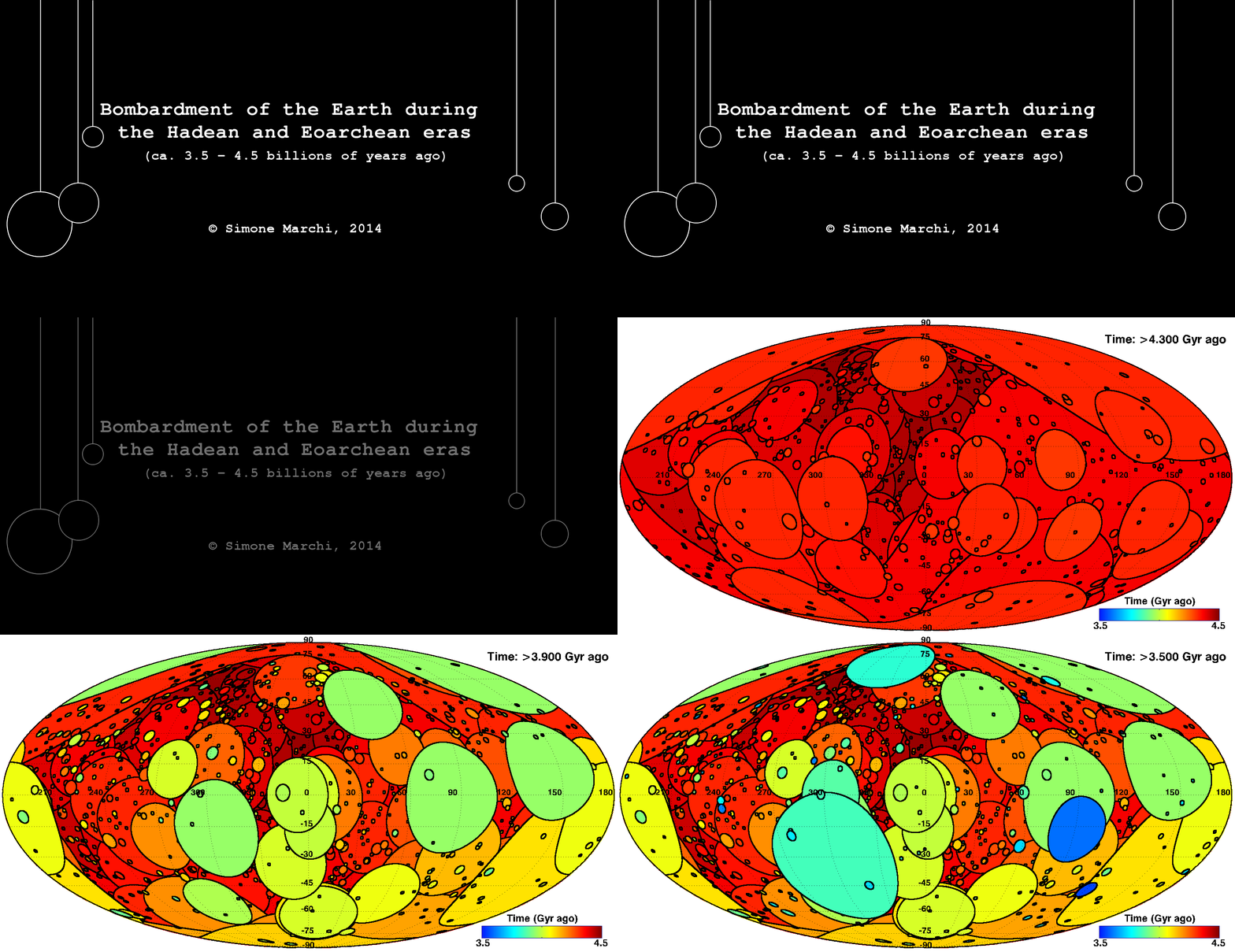
New research shows that more than four billion years ago, the surface of Earth was heavily reprocessed – or mixed, buried and melted – as a result of giant asteroid impacts. A new terrestrial bombardment model based on existing lunar and terrestrial data sheds light on the role asteroid bombardments played in the geological evolution of the uppermost layers of the Hadean Earth (approximately 4 to 4.5 billion years ago).
An international team of researchers published their findings in the July 31, 2014 issue of Nature.
"When we look at the present day, we have a very high fidelity timeline over the last about 500 million years of what's happened on Earth, and we have a pretty good understanding that plate tectonics and volcanism and all these kinds of processes have happened more or less the same way over the last couple of billion years," says Lindy Elkins-Tanton, director of the School of Earth and Space Exploration at Arizona State University.
But, in the very beginning of Earth's formation, the first 500 million years, there's a less well-known period which has typically been called the Hadean (meaning hell-like) because it was assumed that it was wildly hot and volcanic and everything was covered with magma – completely unlike the present day.
Terrestrial planet formation models indicate Earth went through a sequence of major growth phases: accretion of planetesimals and planetary embryos over many tens of millions of years; a giant impact that led to the formation of our Moon; and then the late bombardment, when giant asteroids, dwarfing the one that presumably killed the dinosaurs, periodically hit ancient Earth.
While researchers estimate accretion during late bombardment contributed less than one percent of Earth's present-day mass, giant asteroid impacts still had a profound effect on the geological evolution of early Earth. Prior to four billion years ago Earth was resurfaced over and over by voluminous impact-generated melt. Furthermore, large collisions as late as about four billion years ago, may have repeatedly boiled away existing oceans into steamy atmospheres. Despite heavy bombardment, the findings are compatible with the claim of liquid water on Earth's surface as early as about 4.3 billion years ago based on geochemical data.
A key part of Earth's mysterious infancy period that has not been well quantified in the past is the kind of impacts Earth was experiencing at the end of accretion. How big and how frequent were those incoming bombardments and what were their effects on the surface of the Earth? How much did they affect the ability of the now cooling crust to actually form plates and start to subduct and make plate tectonics? What kind of volcanism did it produce that was different from volcanoes today?"
"We are increasingly understanding both the similarities and the differences to present day Earth conditions and plate tectonics," says Elkins-Tanton. "And this study is a major step in that direction, trying to bridge that time from the last giant accretionary impact that largely completed the Earth and produced the Moon to the point where we have something like today's plate tectonics and habitable surface."
The new research reveals that asteroidal collisions not only severely altered the geology of the Hadean Earth, but likely played a major role in the subsequent evolution of life on Earth as well.
link.
Friday, August 01, 2014
Evidence of Impacts From Archean South Africa Changes Picture of Late Heavy Bombardment
Recently discovered 3.42–3.23 Ga impact layers, Barberton Belt, South Africa: 3.8 Ga detrital zircons, Archean impact history, and tectonic implications
Authors:
Lowe et al
Abstract:
The Barberton greenstone belt (BGB) includes eight known layers containing spherical particles (spherules) that condensed from rock vapor clouds formed by the impact of large meteorites or asteroids at 3.47–3.23 Ga. Previous studies have inferred that the spherules represent bolides at least 20–70 km across. Spherule beds S1–S4 have been previously characterized in detail: we provide here the first detailed analysis of more recently discovered beds S5–S8. All eight beds are composed of the same basic compositional and textural spherule types, including nearly pure silica spherules representing nonaluminous melt precursors, nearly pure phyllosilicate spherules representing mostly mafic and ultramafic liquids, and compositionally mixed spherules. Evidence of spherule amalgamation and surface corrosion within the rock vapor clouds is developed in some beds. Bed S6, which occurs within a thick sequence of ultramafic volcanic rocks, is overlain by a tsunami layer containing zircons as old as 3811 ± 7 Ma, suggesting deep, possibly impact-related crustal uplift and erosion in distant areas. The formation of at least 8 major impact layers representing bolides 20–70 km in diameter over an interval of ∼240 m.y. suggests impact rates greatly exceeding those of later geologic time, and provides direct evidence that terrestrial bombardment by large bolides did not end abruptly at 3.8 Ga, but waned gradually until 3.0 Ga or even later. The coincidence of at least four large impact layers and the initiation of BGB deformation at 3.26–3.23 Ga suggests that an impact cluster at this time may have disrupted a long-lived earlier geodynamic system and triggered the development of a contrasting, more modern plate tectonic regime.
Friday, February 28, 2014
During the Late Hadean 3.9 Billion Years ago, Impacts Smashed, Repaved the World

The impact environment of the Hadean Earth
Authors:
Abramov et al
Abstract:
Impact bombardment in the first billion years of solar system history determined in large part the initial physical and chemical states of the inner planets and their potential to host biospheres. The range of physical states and thermal consequences of the impact epoch, however, are not well quantified. Here, we assess these effects on the young Earth's crust as well as the likelihood that a record of such effects could be preserved in the oldest terrestrial minerals and rocks. We place special emphasis on modeling the thermal effects of the late heavy bombardment (LHB) – a putative spike in the number of impacts at about 3.9 Gyr ago – using several different numerical modeling and analytical techniques. A comprehensive array of impact-produced heat sources was evaluated which includes shock heating, impact melt generation, uplift, and ejecta heating. Results indicate that ∼1.5–2.5 vol.% of the upper 20 km of Earth's crust was melted in the LHB, with only ∼0.3–1.5 vol.% in a molten state at any given time. The model predicts that approximately 5–10% of the planet's surface area was covered by less than 1 km deep impact melt sheets. A global average of ∼600–800 m of ejecta and ∼800–1000 m of condensed rock vapor is predicted to have been deposited in the LHB, with most of the condensed rock vapor produced by the largest (greater than 100-km) projectiles. To explore for a record of such catastrophic events, we created two- and three-dimensional models of post-impact cooling of ejecta and craters, coupled to diffusion models of radiogenic Pb*-loss in zircons. We used this to estimate what the cumulative effects of putative LHB-induced age resetting would be of Hadean zircons on a global scale. Zircons entrained in ejecta are projected to have the following average global distribution after the end of the LHB: ∼59% with no impact-induced Pb*-loss, ∼26% with partial Pb*-loss and ∼15% with complete Pb*-loss or destruction of the grain. In addition to the relatively high erodibility of ejecta, our results show that if discordant ca. 3.9 Gyr old zones in the Jack Hills zircons are a signature of the LHB, they were most likely sourced from impact ejecta.
Subscribe to:
Posts (Atom)