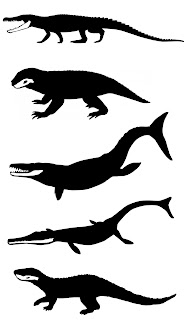
Revised phylogenetic analysis of the Aetosauria (Archosauria: Pseudosuchia); assessing the effects of incongruent morphological character setsDr Parker has his own post over at his own blog, Chinleana.
Author:
Parker
Abstract:
Aetosauria is an early-diverging clade of pseudosuchians (crocodile-line archosaurs) that had a global distribution and high species diversity as a key component of various Late Triassic terrestrial faunas. It is one of only two Late Triassic clades of large herbivorous archosaurs, and thus served a critical ecological role. Nonetheless, aetosaur phylogenetic relationships are still poorly understood, owing to an overreliance on osteoderm characters, which are often poorly constructed and suspected to be highly homoplastic. A new phylogenetic analysis of the Aetosauria, comprising 27 taxa and 83 characters, includes more than 40 new characters that focus on better sampling the cranial and endoskeletal regions, and represents the most comprenhensive phylogeny of the clade to date. Parsimony analysis recovered three most parsimonious trees; the strict consensus of these trees finds an Aetosauria that is divided into two main clades: Desmatosuchia, which includes the Desmatosuchinae and the Stagonolepidinae, and Aetosaurinae, which includes the Typothoracinae. As defined Desmatosuchinae now contains Neoaetosauroides engaeus and several taxa that were previously referred to the genus Stagonolepis, and a new clade, Desmatosuchini, is erected for taxa more closely related to Desmatosuchus. Overall support for some clades is still weak, and Partitioned Bremer Support (PBS) is applied for the first time to a strictly morphological dataset demonstrating that this weak support is in part because of conflict in the phylogenetic signals of cranial versus postcranial characters. PBS helps identify homoplasy among characters from various body regions, presumably the result of convergent evolution within discrete anatomical modules. It is likely that at least some of this character conflict results from different body regions evolving at different rates, which may have been under different selective pressures.
Showing posts with label pseudosuchians. Show all posts
Friday, January 22, 2016
Too Kewl Not to Share: Dr Bill Parker's Aetosaurs!
Labels:
aetosaurs,
archosaurs,
fossils,
mesozoic,
paleontology,
pseudosuchians,
Triassic
Tuesday, January 05, 2016
Archosauriforms From a Flood Plain in Late Triassic Argentina
Archosauriform remains from the Late Triassic of San Luis province, Argentina, Quebrada del Barro Formation, Marayes–El Carrizal Basin
Authors:
Gianechini et al
Abstract:
Here we present archosauriform remains from ‘Abra de los Colorados’, a fossiliferous locality at Sierra de Guayaguas, NW San Luis Province. Two fossiliferous levels were identified in outcrops of the Quebrada del Barro Formation (Norian), which represent the southernmost outcrops of the Marayes–El Carrizal Basin. These levels are composed by massive muddy lithofacies, interpreted as floodplain deposits. The specimens consist of one incomplete maxilla (MIC-V718), one caudal vertebra (MIC-V719), one metatarsal (MIC-V720) and one indeterminate appendicular bone (MIC-V721). The materials can be assigned to Archosauriformes but the fragmentary nature and lack of unambiguous synapomorphies preclude a more precise taxomic assignment. The maxilla is remarkably large and robust and represents the posterior process. It preserved one partially erupted tooth with ziphodont morphology. This bone shows some anatomical traits and size match with ‘rauisuchians’ and theropods. MIC-V719 corresponds to a proximal caudal vertebra. It has a high centrum, a ventral longitudinal furrow, expanded articular processes for the chevrons, a posteriorly displaced diapophysis located below the level of the prezygapophyses, and short prezygapophyses. This vertebra would be from an indeterminate archosauriform. MIC-V720 presents a cylindrical diaphysis, with a well-developed distal trochlea, which present resemblances with metatarsals of theropods, pseudosuchians, and silesaurids, although the size matches better with theropods. MIC-V721 has a slender diaphysis and a convex triangular articular surface, and corresponds to an indeterminate archosauriform. Despite being fragmentary, these materials indicate the presence of a diverse archosauriforms association from Late Triassic beds of San Luis. Thus, they add to the faunal assemblage recently reported from this basin at San Juan Province, which is much rich and diverse than the coeval paleofauna well known from Los Colorados Formation in the Ischigualasto–Villa Union Basin.
Wednesday, April 29, 2015
Dagasuchus santacruzensis: A New Rauisuchian Archosaur From Ladinian Triassic Brazil
First 'Rauisuchian' archosaur (Pseudosuchia, Loricata) for the Middle Triassic Santacruzodon Assemblage Zone (Santa Maria Supersequence), Rio Grande do Sul State, Brazil
Authors:
Lacerda et al
Abstract:
The ‘Rauisuchia’ are a group of Triassic pseudosuchian archosaurs that displayed a near worldwide distribution. In Brazil, their fossils are found only in the Santa Maria Formation (Paraná Basin) of the Rio Grande do Sul State, specifically in the Middle Triassic Dinodontosaurus assemblage zone (AZ) and the Late Triassic Hyperodapedon AZ (Rauisuchus tiradentes). Between these two cenozones is the Santacruzodon AZ (Middle Triassic), whose record was, until now, restricted to non-mammalian cynodonts and the proterochampsian Chanaresuchus bonapartei. Here we present the first occurrence of a rauisuchian archosaur for this cenozone, from the Schoenstatt outcrop, located near the city of Santa Cruz do Sul and propose a new species, based on biostratigraphical evidence and a comparative osteological analysis.
Labels:
archosaurs,
brazil,
fossils,
ladinian,
paleontology,
pseudosuchians,
Rauisuchids,
Triassic
Wednesday, December 17, 2014
Revisting Carnian Triassic Rauisuchid Rauisuchus tiradentes
Osteology of Rauisuchus tiradentes from the Late Triassic (Carnian) Santa Maria Formation of Brazil, and its implications for rauisuchid anatomy and phylogeny
Authors:
Lautenschlager et al
Abstract:
As the eponymous type species for rauisuchians, Rauisuchus tiradentes von Huene, 1938 represents an important but inadequately known specimen. The revision of the type material from the Upper Triassic (Carnian) Santa Maria Formation of Brazil reveals new anatomical data and previously unrecognised characters, including three new possible autapomorphies: a knob-like thickening on the base of the posterior process of the premaxilla; short and ventrally keeled cervicals lacking postzygodiapophyseal laminae; and mid-caudal vertebrae with an accessory neural spine and a postspinal lamina. Several elements are re-identified, including a postorbital (originally identified as postfrontal) and a pterygoid (originally identified as a prefrontal), and additional material from a secondary fossil site, originally assigned to R. tiradentes, including a left ilium, is excluded. Based on the recovered information and new morphological data, the systematic position of R. tiradentes is tested in a comparison of two phylogenetic reanalyses. Both analyses differ in respect to the phylogenetic position of R. tiradentes, and recover ‘rauisuchians’ as a paraphyletic assemblage of non-crocodylomoprh archosaurs. © 2014 The Linnean Society of London
Labels:
brazil,
carnian,
crurotarsans,
mesozoic,
paleontology,
phylogenetics,
pseudosuchians,
Rauisuchids,
Triassic
Friday, November 14, 2014
Venaticosuchus rusconii: a Carnian/Norian Triassic Pseudosuchian Archosaur Revisited
Anatomy and phylogenetic position of Venaticosuchus rusconii Bonaparte, 1970 (Archosauria, Pseudosuchia), from the Ischigualasto Formation (Late Triassic), La Rioja, Argentina
Authors:
Belén Von Baczko et al
Abstract:
Ornithosuchidae is a group of Late Triassic pseudosuchian archosaurs of controversial phylogenetic affinities. This clade currently comprises three taxa: Venaticosuchus rusconii and Riojasuchus tenuisceps, both from Argentina, and Ornithosuchus longidens, from Scotland. V. rusconii was erected on the basis of an incomplete skull with articulated lower jaws and some elements of the postcranium that are currently lost. Venaticosuchus rusconii is redescribed here and included for the first time in a phylogenetic analysis to test its affinities with ornithosuchids. The bizarre morphology of V. rusconii has a unique combination of traits that distinguishes it from the other ornithosuchids, such as basipterygoid processes directed ventrally, dentary with the dorsal margin of the anterior end dorsally expanded, articular without a foramen on its medial side, and the absence of a surangular foramen, corroborating the validity of this taxon. V. rusconii is recovered as an ornithosuchid more closely related to R. tenuisceps than to O. longidens, based on the presence of a nearly pointed anterior margin of the antorbital fenestra, and a vertical bony strut of the jugal that separates the antorbital fenestra from the infratemporal fenestra.
Labels:
archosaurs,
argentina,
carnian,
fossils,
mesozoic,
norian,
Ornithosuchidae,
paleontology,
phylogenetics,
pseudosuchians,
south america,
Triassic
Wednesday, November 05, 2014
Nundasuchus songeaensis: a new Anisian Triassic Pseudosuchian Archosaur From Tanzania
A new archosaur from the Manda beds (Anisian, Middle Triassic) of southern Tanzania and its implications for character state optimizations at Archosauria and Pseudosuchia
Authors:
Nesbitt et al
Abstract:
The presence of early pseudosuchians and avemetatarsalians in Anisian beds of Africa demonstrates that the archosaur radiation was well underway by the beginning of the Middle Triassic. The rapid radiation produced a variety of forms, but many of the unique, well-diagnosed Late Triassic clades (e.g., Aetosauria, Ornithosuchidae) lack diagnosable members from the Middle Triassic. Here, we introduce a new Middle Triassic archosaur, Nundasuchus songeaensis, gen. et sp. nov., with an unusual mix of apomorphic character states found within Pseudosuchia and just outside Archosauria. The holotype consists of partial skeleton, including representative postcranial elements and parts of the skull. We added Nundasuchus songeaensis, gen. et sp. nov., into the two most comprehensive early archosaur phylogenetic data sets available, and in both analyses the new taxon falls within Pseudosuchia. However, a number of plesiomorphic archosaurian character states (e.g., posterolaterally directed tuber of the calcaneum) optimize as local autapomorphies of the new taxon within Pseudosuchia in our analyses. Therefore, we tested alternative hypotheses of relationships for the new taxon by utilizing constraint trees. The analyses resulted in little change in the relationships and structure of other Triassic archosaur clades, but changed optimizations of certain character states and character support at the base of Pseudosuchia and Archosauria. Our analyses suggest that the complex evolution of character-state changes at the base of Archosauria is inhibiting our understanding of the relationships of early Pseudosuchia and, in turn, Archosauria.
Labels:
adaptive radiation,
africa,
anisian,
archosaurs,
crurotarsans,
fossils,
mesozoic,
paleontology,
pseudosuchians,
tanzania,
Triassic
Wednesday, June 18, 2014
Gracilisuchids: A new Clade Erected for Anisian to Carnian Triassic Chinese and Argentinian Pseudosuchians
New clade of enigmatic early archosaurs yields insights into early pseudosuchian phylogeny and the biogeography of the archosaur radiation
Authors:
Butler et al
Abstract:
Background
The origin and early radiation of archosaurs and closely related taxa (Archosauriformes) during the Triassic was a critical event in the evolutionary history of tetrapods. This radiation led to the dinosaur-dominated ecosystems of the Jurassic and Cretaceous, and the high present-day archosaur diversity that includes around 10,000 bird and crocodylian species. The timing and dynamics of this evolutionary radiation are currently obscured by the poorly constrained phylogenetic positions of several key early archosauriform taxa, including several species from the Middle Triassic of Argentina (Gracilisuchus stipanicicorum) and China (Turfanosuchus dabanensis, Yonghesuchus sangbiensis). These species act as unstable 'wildcards' in morphological phylogenetic analyses, reducing phylogenetic resolution.
Results
We present new anatomical data for the type specimens of G. stipanicicorum, T. dabanensis, and Y. sangbiensis, and carry out a new morphological phylogenetic analysis of early archosaur relationships. Our results indicate that these three previously enigmatic taxa form a well-supported clade of Middle Triassic archosaurs that we refer to as Gracilisuchidae. Gracilisuchidae is placed basally within Suchia, among the pseudosuchian (crocodile-line) archosaurs. The approximately contemporaneous and morphologically similar G. stipanicicorum and Y. sangbiensis may be sister taxa within Gracilisuchidae.
Conclusions
Our results provide increased resolution of the previously poorly constrained relationships of early archosaurs, with increased levels of phylogenetic support for several key early pseudosuchian clades. Moreover, they falsify previous hypotheses suggesting that T. dabanensis and Y. sangbiensis are not members of the archosaur crown group. The recognition of Gracilisuchidae provides further support for a rapid phylogenetic diversification of crown archosaurs by the Middle Triassic. The disjunct distribution of the gracilisuchid clade in China and Argentina demonstrates that early archosaurs were distributed over much or all of Pangaea although they may have initially been relatively rare members of faunal assemblages.
Labels:
anisian,
archosaurs,
argentina,
carnian,
china,
crurotarsans,
fossils,
gracilosuchids,
ladinian,
mesozoic,
paleontology,
pseudosuchians,
Triassic
Tuesday, February 11, 2014
Polesinesuchus aurelioi: a new Aetosaur From Carnian Triassic Brazil
A new aetosaur from the Upper Triassic of the Santa Maria Formation, southern Brazil
Authors:
ROBERTO-DA-SILVA et al
Abstract:
Aetosaurs are armored pseudosuchian archosaurs widespread in Upper Triassic units. In South America, four taxa were previously recorded: Aetosauroides scagliai, Neoaetosauroides engaeus, Aetobarbakinoides brasiliensis, and Chilenosuchus forttae. Herein we describe a new Late Triassic juvenile aetosaur from the Santa Maria Formation of southern Brazil, Polesinesuchus aurelioi gen. et sp. nov., increasing the paleobiodiversity of this interesting group to five taxa in Western Gondwana. The holotype is composed of cranial (parietal and braincase) and postcranial elements (cervical, dorsal, sacral, caudal vertebrae, both scapulae, a humerus, ilium, pubis, ischium, tibia, a partial right pes, and anterior and mid-dorsal paramedian osteoderms). It belongs to a juvenile individual, as its neurocentral sutures are open in all vertebrae, and also due to its small size. However, future paleohistological investigation is necessary to fully corroborate this assumption. This new taxon is distinguished from all other aetosaurs by the presence of an unique combination of character states (not controlled by ontogeny) such as: cervical vertebrae with prezygapophyses widely extending laterally through most of the anterior edge of the diapophyses; absence of hyposphene articulations in both cervical and mid-dorsal vertebrae; presence of a ventral keel in cervical vertebrae; anterior and mid-dorsal vertebrae without a lateral fossa in their centra; expanded proximal end of scapula; anteroposteriorly expanded medial portion of scapular blade; a short humerus with a robust shaft; and a dorsoventral and very low iliac blade with a long anterior process which slightly exceeds the pubic peduncle. Regarding
its phylogenetic relationships, the present analysis placed Polesinesuchus as the sister taxon of Aetobarbakinoides and both as sister taxa of the unnamed monophyletic clade Desmatosuchinae plus Typothoracisinae.
Labels:
aetosaurs,
archosaurs,
brazil,
carnian,
crurotarsans,
fossils,
Gondwana,
Gondwanaland,
paleontology,
pseudosuchians,
south america,
Triassic
Tuesday, January 14, 2014
Triassic Popsaurus' Convergence with the Dinosaurian Gait


Pedal Proportions of Poposaurus gracilis: Convergence and Divergence in the Feet of Archosaurs
Authors:
Farlow et al
Abstract:
The crocodile-line basal suchian Poposaurus gracilis had body proportions suggesting that it was an erect, bipedal form like many dinosaurs, prompting questions of whether its pedal proportions, and the shape of its footprint, would likewise “mimic” those of bipedal dinosaurs. We addressed these questions through a comparison of phalangeal, digital, and metatarsal proportions of Poposaurus with those of extinct and extant crocodile-line archosaurs, obligate or facultatively bipedal non-avian dinosaurs, and ground birds of several clades, as well as a comparison of the footprint reconstructed from the foot skeleton of Poposaurus with known early Mesozoic archosaurian ichnotaxa. Bivariate and multivariate analyses of phalangeal and digital dimensions showed numerous instances of convergence in pedal morphology among disparate archosaurian clades. Overall, the foot of Poposaurus is indeed more like that of bipedal dinosaurs than other archosaur groups, but is not exactly like the foot of any particular bipedal dinosaur clade. Poposaurus likely had a digitigrade stance, and its footprint shape could have resembled grallatorid ichnotaxa, unless digit I of the foot of Poposaurus commonly left an impression.
Labels:
anatomy,
archosaurs,
fossils,
paleobiology,
paleontology,
Poposauroidea,
poposaurs,
pseudosuchians,
trace fossils
Wednesday, September 11, 2013
Mesozoic "Crocodile" Jaw Evolution
New research has revealed the hidden past of crocodiles, showing for the first time how these fierce reptiles evolved and survived in a dinosaur dominated world.
While most modern crocodiles live in freshwater habitats and feed on mammals and fish, their ancient relatives were extremely diverse – with some built for running around like dogs on land and others adapting to life in the open ocean, imitating the feeding behaviour of today's killer whales.
Research published today [11 September] in the journal Proceedings of the Royal Society B shows, for the first time, how the jaws of ancient crocodiles evolved to enable these animals to survive in vastly different environments, all whilst living alongside the dinosaurs 235 to 65 million years ago.
The study was conducted by Tom Stubbs and Dr Emily Rayfield from the University of Bristol, together with Dr Stephanie Pierce from The Royal Veterinary College and Dr Phil Anderson from Duke University.
Tom Stubbs, who led the research at the University of Bristol, said: "The ancestors of today's crocodiles have a fascinating history that is relatively unknown compared to their dinosaur counterparts. They were very different creatures to the ones we are familiar with today, much more diverse and, as this research shows, their ability to adapt was quite remarkable.
"Their evolution and anatomical variation during the Mesozoic Era was exceptional. They evolved lifestyles and feeding ecologies unlike anything seen today."
The research team examined variation in the morphology (shape) and biomechanics (function) of the lower jaws in over 100 ancient crocodiles, using a unique combination of numerical methods.
Dr Stephanie Pierce, from The Royal Veterinary College, said: "We were curious how extinction events and adaptations to extreme environments during the Mesozoic - a period covering over 170 million years - impacted the feeding systems of ancient crocodiles and to do this we focused our efforts on the main food processing bone, the lower jaw."
By analysing variation in the lower jaw, the researchers provide novel insights into how the feeding systems of ancient crocodiles evolved as the group recovered from the devastating end-Triassic extinction event and subsequently responded to the distribution of ecological resources, such as habitat and foodstuff.
For the first time, the research has shown that, following the end-Triassic extinction, ancient crocodiles invaded the Jurassic seas and evolved jaws built primarily for hydrodynamic efficiency to capture agile prey, such as fish. However, only a small range of elongate lower jaw shapes were suitable in Jurassic marine environments.
The study has also revealed that variation peaked again in the Cretaceous, where ancient crocodiles evolved a great variety of lower jaw shapes, as they adapted to a diverse range of feeding ecologies and terrestrial environments, alongside the dinosaurs.
Surprisingly, the lower jaws of Cretaceous crocodiles did not have a great amount of biomechanical variation and, instead, the fossil record points towards novel adaptations in other areas of their anatomy, such as armadillo-like body armour.
Dr Pierce added: "Our results show that the ability to exploit a variety of different food resources and habitats, by evolving many different jaw shapes, was crucial to recovering from the end-Triassic extinction and most likely contributed to the success of Mesozoic crocodiles living in the shadow of the dinosaurs."
link.
Labels:
archosaurs,
crocodylians,
fossils,
mesozoic,
paleobiology,
paleontology,
pseudosuchians
Tuesday, July 30, 2013
Halticosaurus orbitoangulatus Was Not a Dinosaur
Reassessment of cf. Halticosaurus orbitoangulatus from the Upper Triassic (Norian) of Germany – a pseudosuchian, not a dinosaur
Authors:
1. HANS-DIETER SUES FLS (a)
2. RAINER R. SCHOCH (b)
Affiliations:
a. Department of Paleobiology, National Museum of Natural History, Smithsonian Institution, MRC 121, P.O. Box 37012, Washington, DC 20013-7012, USA
b. Staatliches Museum für Naturkunde Stuttgart, Rosenstein 1, D-70191 Stuttgart, Germany
Abstract:
The holotype of cf. Halticosaurus orbitoangulatus Huene, 1932, comprises an incomplete and macerated but associated skull of an archosaurian reptile from the middle (second) Stubensandstein (middle Löwenstein Formation; Upper Triassic: Norian) of Baden-Württemberg, Germany. It was originally interpreted as a theropod dinosaur but more recently it has been suggested that this taxon has crocodylomorph affinities. Detailed preparation of the holotype of cf. H. orbitoangulatus has revealed much new anatomical information and permitted reassessment of its affinities. The maxilla lacks both a distinct antorbital fossa and a medial bony lamina bordering the antorbital fenestra. The lateral surface of the dentary bears a pronounced horizontal ridge. The squamosal differs from that of basal crocodylomorphs in being L-shaped rather than arcuate in dorsal view, lacking a dorsolateral overhang, and lacking an interlocking contact with the paroccipital process as, for example, in the basal crocodylomorph Saltoposuchus connectens from the same horizon and locality. Phylogenetic analysis placed cf. H. orbitoangulatus amongst loricatan pseudosuchians (but not amongst Crocodylomorpha) rather than amongst theropod dinosaurs. The holotype of cf. H. orbitoangulatus represents a previously unrecognized taxon of loricatan pseudosuchian, which is here named Apatosuchus orbitoangulatus and set apart from other known Norian-age non-crocodylomorph loricatans by its apparently much smaller size. © 2013 The Linnean Society of London
Labels:
archosaurs,
crurotarsans,
Europe,
fossils,
germany,
mesozoic,
norian,
paleontology,
pseudosuchians,
Triassic
Thursday, June 20, 2013
Aetosaur Awesomeness!
Aetosauria: a clade of armoured pseudosuchians from the Upper Triassic continental beds
Authors:
1. Julia B. Desojo (a)
2. Andrew B. Heckert (b)
3. Jeffrey W. Martz (c)
4. William G. Parker (d,e)
5. Rainer R. Schoch (f)
6. Bryan J. Small (g)
7. Tomasz Sulej (h)
Affiliations:
a. CONICET, Comisión Nacional de Investigación Científica y Técnica, Sección Paleontología Vertebrados, Museo Argentino de Ciencias Naturales ‘Bernardino Rivadavia’, Av. Ángel Gallardo 470, C1405DJR, Buenos Aires, Argentina
b. Department of Geology, Appalachian State University, ASU Box 32067, Boone, NC 28608-2067, USA
c. Department of Earth Sciences, Denver Museum of Nature and Science, 2001 Colorado Blvd, Denver, CO 80205, USA
d. Division of Resource Management, Petrified Forest National Park, PO Box 2217, Petrified Forest, AZ 86028, USA
e. Department of Geological Sciences, University of Texas, Austin, TX 78712, USA
f. Staatliches Museum für Naturkunde, Rosenstein 1, 70191 Stuttgart, Germany
g. Museum of Texas Tech University, 3301 4th St., Lubbock, TX 79409-3191, USA
h. Instytut Paleobiologii, PAN, Twarda 51/55, 00-818 Warszawa, Poland
Abstract:
Aetosauria is a clade of obligately quadrupedal, heavily armoured pseudosuchians known from Upper Triassic (late Carnian–Rhaetian) strata on every modern continent except Australia and Antarctica. As many as 22 genera and 26 species ranging from 1 to 6 m in length, and with a body mass ranging from less than 10 to more than 500 kg, are known. Aetosauroides scagliai was recently recovered as the most basal aetosaur, placed outside of Stagonolepididae (the last common ancestor of Desmatosuchus and Aetosaurus). Interrelationships among the basal aetosaurs are not well understood but two clades with relatively apomorphic armour – the spinose Desmatosuchinae and the generally wide-bodied Typothoracisinae – are consistently recognized. Paramedian and lateral osteoderms are often distinctive at the generic level but variation within the carapace is not well understood in many taxa, warranting caution in assigning isolated osteoderms to specific taxa. The aetosaur skull and dentition varies across taxa, and there is increasing evidence that at least some aetosaurs relied on invertebrates and/or small vertebrates as a food source. Histological evidence indicates that, after an initial period of rapid growth, lines of arrested growth (LAGs) are common and later growth was relatively slow. The common and widespread Late Triassic ichnogenus Brachychirotherium probably represents the track of an aetosaur.
Labels:
aetosaurs,
archosaurs,
carnian,
crurotarsans,
fossils,
mesozoic,
norian,
paleontology,
phylogenetics,
pseudosuchains,
pseudosuchians,
rhaetian,
Triassic
Subscribe to:
Posts (Atom)