Showing posts with label saurischians. Show all posts

Monday, February 29, 2016

How big did Your Abelisaur Grow? (and explaining Stromer's Riddle)


Authors:

Chiarenza et al

Abstract:

We describe the partially preserved femur of a large-bodied theropod dinosaur from the Cenomanian “Kem Kem Compound Assemblage” (KKCA) of Morocco. The fossil is housed in the Museo Geologico e Paleontologico “Gaetano Giorgio Gemmellaro” in Palermo (Italy). The specimen is compared with the theropod fossil record from the KKCA and coeval assemblages from North Africa. The combination of a distally reclined head, a not prominent trochanteric shelf, distally placed lesser trochanter of stout, alariform shape, a stocky shaft with the fourth trochanter placed proximally, and rugose muscular insertion areas in the specimen distinguishes it from Carcharodontosaurus, Deltadromeus and Spinosaurus and supports referral to an abelisaurid. The estimated body size for the individual from which this femur was derived is comparable to Carnotaurus and Ekrixinatosaurus (up to 9 meters in length and 2 tons in body mass). This find confirms that abelisaurids had reached their largest body size in the “middle Cretaceous,” and that large abelisaurids coexisted with other giant theropods in Africa. We review the taxonomic status of the theropods from the Cenomanian of North Africa, and provisionally restrict the Linnean binomina Carcharodontosaurus iguidensis and Spinosaurus aegyptiacus to the type specimens. Based on comparisons among the theropod records from the Aptian-Cenomanian of South America and Africa, a partial explanation for the so-called “Stromer’s riddle” (namely, the coexistence of many large predatory dinosaurs in the “middle Cretaceous” record from North Africa) is offered in term of taphonomic artifacts among lineage records that were ecologically and environmentally non-overlapping. Although morphofunctional and stratigraphic evidence supports an ecological segregation between spinosaurids and the other lineages, the co-occurrence of abelisaurids and carcharodontosaurids, two groups showing several craniodental convergences that suggest direct resource competition, remains to be explained.

pop sci link too.

Monday, December 28, 2015

Were Diplodocid Sauropods Endemic to North America During the Late Jurassic

First report of Apatosaurus (Diplodocidae: Apatosaurinae) from the Cleveland-Lloyd Quarry in the Upper Jurassic Morrison Formation of Utah: abundance, distribution, paleoecology, and taphonomy of an endemic North American sauropod clade

Authors:

Foster et al

Abstract:

A cervical vertebra preserved at the famous and productive Cleveland-Lloyd Dinosaur Quarry in the Upper Jurassic Morrison Formation of Utah is that of an Apatosaurus, a sauropod dinosaur genus not previously recognized at the site and the first new dinosaur taxon identified at the site in years. The presence of Apatosaurus at a mudstone site dominated by other taxa, both theropod and sauropod, suggests a pattern of preservation within the Morrison Formation in which sites in fine-grained sediments yield dramatically uneven relative abundances of dinosaurs, with variable dominant taxa by site, compared with more time-averaged and attritional coarse-grained channel sandstone deposits. In addition, the continued demonstration of the wide-spread occurrence and abundance of Apatosaurus within the Morrison Formation, and the absence of its clade among diplodocid faunas on other continents, suggest that this group may have been endemic to North America during the Late Jurassic and that it may have originated there, though this is far from clear.

Saturday, October 24, 2015

Tototlmimus packardensis: an new Ornithomimid Dinosaur From Upper Cretaceous Mexico

A new ornithomimid dinosaur from the Upper Cretaceous Packard Shale formation (Cabullona Group) Sonora, México

Authors:

Serrano-Brañas et al

Abstract:

New ornithomimid material discovered from the Upper Cretaceous Packard Shale Formation, (Cabullona Group) of Sonora, Mexico is described. The material includes a partial skeleton, which is assigned to a new genus and species, Tototlmimus packardensis. This new taxon differs from other ornithomimids in having five unique characteristics that separate it from other Northamerican ornithomimids: (1) a distinctively articulation between metatarsals, where the distal ends of metatarsals II and IV contact directly with the distal facet of metatarsal III; (2) a metatarsal III with a weakly ginglymoid distal articular face; (3) the medial and lateral sides of metatarsal III are shaped into the form of metatarsals II and IV, so all distal ends fit together when they articulate; (4) an asymmetrical and narrow pedal ungual with shallow grooves in both medial and lateral sides; and finally, (5) the presence of a deep sulcus on the ventromedial edge, close to the articular end. Phylogenetic analysis suggests that Tototlmimus packardensis corresponds to a derived ornithomimid included in the Northamerican clade, forming a monophyly with Ornithomimus. Tototlmimus packardensis is the first definitive ornithomimid described for Mexico, and represents one of the southernmost occurrences in the Western Interior Basin of North America.

Monday, April 27, 2015

Chilesaurus diegosuarezi: A Bizarre new Herbivorous Theropod From Tithonian Jurassic Chile


An enigmatic plant-eating theropod from the Late Jurassic period of Chile

Authors:

Novas et al

Abstract:

Theropod dinosaurs were the dominant predators in most Mesozoic era terrestrial ecosystems. Early theropod evolution is currently interpreted as the diversification of various carnivorous and cursorial taxa, whereas the acquisition of herbivorism, together with the secondary loss of cursorial adaptations, occurred much later among advanced coelurosaurian theropods. new, bizarre herbivorous basal tetanuran from the Upper Jurassic of Chile challenges this conception. The new dinosaur was discovered at Aysén, a fossil locality in the Upper Jurassic Toqui Formation of southern Chile (General Carrera Lake). The site yielded abundant and exquisitely preserved three-dimensional skeletons of small archosaurs. Several articulated individuals of Chilesaurus at different ontogenetic stages have been collected, as well as less abundant basal crocodyliforms, and fragmentary remains of sauropod dinosaurs (diplodocids and titanosaurians).

No word whether it preferred red or green.   Obviously it was a Hatched variety.

Tuesday, April 07, 2015

Wait! Is Brontosaurus Really a Valid Taxon?!


Although well known as one of the most iconic dinosaurs, Brontosaurus (the 'thunder lizard') has long been considered misclassified. Since 1903, the scientific community has believed that the genus Brontosaurus was in fact the Apatosaurus. Now, an exhaustive new study by palaeontologists from Portugal and the UK provides conclusive evidence that Brontosaurus is distinct from Apatosaurus and as such can now be reinstated as its own unique genus.

Brontosaurus is one of the most charismatic dinosaurs of all time, inspiring generations of children thanks to its size and evocative name. However, as every armchair palaeontologist knows, Brontosaurus was in fact a misnomer, and it should be correctly referred to as Apatosaurus. At least, this is what scientists have believed since 1903, when it was decided that the differences between Brontosaurus excelsus and Apatosaurus were so minor that it was better to put them both in the same genus. Because Apatosaurus was named first, it was the one that was used under the rules of scientific naming.

In fact, of course, the Brontosaurus was never really gone - it was simply treated as a species of the genus Apatosaurus: Apatosaurus excelsus. So, while scientists thought the genus Brontosaurus was the same as Apatosaurus, they always agreed that the species excelsus was different from other Apatosaurus species. Now, palaeontologists Emanuel Tschopp, Octávio Mateus, and Roger Benson say that Brontosaurus was a unique genus all along.

[...]

But now, in a new study published in the peer reviewed open access journal PeerJ and consisting of almost 300 pages of evidence, a team of scientists from Portugal and the UK have shown that Brontosaurus was distinct from Apatosaurus after all - the thunder lizard is back!

How can a single study overthrow more than a century of research? "Our research would not have been possible at this level of detail 15 or more years ago", explains Emanuel Tschopp, a Swiss national who led the study during his PhD at Universidade Nova de Lisboa in Portugal, "in fact, until very recently, the claim that Brontosaurus was the same as Apatosaurus was completely reasonable, based on the knowledge we had." It is only with numerous new findings of dinosaurs similar to Apatosaurus and Brontosaurus in recent years that it has become possible to undertake a detailed reinvestigation of how different they actually were.

In science, the distinction between species and genera is without clear rules. Does this mean that the decision to resurrect Brontosaurus is just a matter of personal preference? "Not at all", explains Tschopp, "we tried to be as objective as possible whenever making a decision which would differentiate between species and genus". The researchers applied statistical approaches to calculate the differences between other species and genera of diplodocid dinosaurs, and were surprised by the result. "The differences we found between Brontosaurus and Apatosaurus were at least as numerous as the ones between other closely related genera, and much more than what you normally find between species," explained Roger Benson, a co-author from the University of Oxford.

Therefore, Tschopp and colleagues have concluded that it is now possible to resurrect Brontosaurus as a genus distinct from Apatosaurus. "It's the classic example of how science works", said Professor Mateus, a collaborator on the research. "Especially when hypotheses are based on fragmentary fossils, it is possible for new finds to overthrow years of research."

Tuesday, January 13, 2015

A Pathology From Digging too Much From a Tithonian Jurassic Camarasaurid Sauropod

Pathological phalanges in a camarasaurid sauropod dinosaur and implications on behaviour

Authors:

Tschopp et al

Abstract:

Several types of pathological bony overgrowth are known from various dinosaur taxa but, except for stress fractures, are rarely reported from appendicular elements. Herein we describe pathological manual and pedal phalanges of a camarasaurid sauropod (SMA 0002), which show features rarely recognised in non-avian dinosaurs. They include lateral osteophytes and smoothing of phalangeal articular surfaces, a deep pit, proximal enthesophytes in pedal unguals, distal overgrowth associated with a fracture, and a knob-like overgrowth lateral to the distal condyles of a pedal phalanx. Their causes were assessed by means of visual examination, CT scans, and bone histology, where possible. The lateral osteophytes are interpreted as symptoms of osteoarthritis. The ossified tendon insertions in the unguals are most probably the result of prolonged, heavy use of the pedal claws, possibly for scratchdigging. The distal overgrowth is interpreted to have developed due to changed stress regimes, and to be the cause for the fracture. The deep pit represents most likely a case of osteochondrosis, whereas the knob-like overgrowth likely represents a post-traumatic phenomenon not previously reported in dinosaurs. The study confirms that a rigorous assessment of pathologies can yield information about behaviour in long-extinct animals.

Tuesday, December 16, 2014

Exploring the Paleobiodiversity of Sauropods in Cretaceous South America


Cretaceous sauropod diversity and taxonomic succession in South America

Authors:


de Jesus Faria et al

Abstract:

The South American sauropod dinosaurs fossil record is one of the world’s most relevant for their abundance (51 taxa) and biogeographical implications. Their historical biogeography was influenced by the continental fragmentation of Gondwana. The scenery of biogeographic and stratigraphic distributions can provide new insight into the causes of the evolution of the sauropods in South America. One of the most important events of the sauropods evolution is the progressive replacement of Diplodocimorpha by the Titanosauriformes during the early Late Cretaceous. The fluctuation of the sea levels is frequently related to the diversity of sauropods, but it is necessary to take into account the geological context in each continent. During the Maastrichthian, a global sea level drop has been described; in contrast, in South America there was a significant rise in sea level (named ‘Atlantic transgression’) which is confirmed by sedimentary sequences and the fossil record of marine vertebrates. This process occurred during the Maastrichtian, when the hadrosaurs arrived from North America. The titanosaurs were amazingly diverse during the Late Cretaceous, both in size and morphology, but they declined prior to their final extinction in the Cretaceous/Paleocene boundary (65.5Yrs).

Wednesday, October 08, 2014

Sauropod Niche Partitioning in the Late Jurassic Morrison Formation

How the largest animals to have ever walked the Earth fed, and how this allowed them to live alongside one another in prehistoric ecosystems is the subject of new research from the University of Bristol and the Natural History Museum, London.

The sauropods – large, long-necked plant-eating dinosaurs such as Diplodocus and Brachiosaurus – dominated the land between 210 and 65 million years ago. They were the largest land animals of all time, with the biggest weighing 80 tonnes (more than 11 elephants) and would have needed vast amounts of food.

Despite this, multiple sauropod species often lived alongside each other. The most notable example is the community of the Late Jurassic Morrison Formation, a distinctive sequence of sedimentary rock in the western United States from which over 10 species of sauropod are known.

How so many giant herbivores could have coexisted has long been a mystery: even the highly diverse faunas seen in modern Africa only support one truly gigantic species, the elephant. This is made even more puzzling by the harsh, semi-arid environment of the Morrison Formation during the Jurassic, which would have limited plant growth.

A study conducted by David Button, a PhD student in Bristol's School of Earth Sciences and the Natural History Museum, and colleagues used a novel combination of approaches to investigate this problem.

Although sauropods were gigantic, their heads were comparatively very small and so how they ingested enough food has puzzled many scientists. The researchers focussed on the skull and jaws of sauropods, using a variety of biomechanical techniques to investigate how they functioned and what this would mean for sauropod ecology.

Using CT scans, the researchers digitally reconstructed the skulls of the sauropods Camarasaurus and Diplodocus, along with the jaw and neck muscles of both species from the traces left on the bones where these muscles were attached in life. These two species are very common in the Morrison Formation, and are known to have widely co-existed. From this data, a biomechanical computer model of the skull of Camarasaurus was built using Finite Element Analysis (FEA), a modelling technique often employed in engineering and design to calculate stress and strain distribution in complex shapes. This model was then compared to a pre-existing model of Diplodocus in order to investigate how the dinosaurs fed.

David Button said: "Our results show that although neither could chew, the skulls of both dinosaurs were sophisticated cropping tools. Camarasaurus had a robust skull and strong bite, which would have allowed it to feed on tough leaves and branches. Meanwhile, the weaker bite and more delicate skull of Diplodocus would have restricted it to softer foods like ferns. However, Diplodocus could also have used its strong neck muscles to help it detach plant material through movements of the head. This indicates differences in diet between the two dinosaurs, which would have allowed them to coexist."

The researchers also used a series of biomechanical measurements from other sauropod species to calculate the functional disparity in their skulls and jaws and found that other Morrison Formation sauropods were also highly varied in feeding adaptations, suggesting different diets.

Co-author, Professor Emily Rayfield of the University of Bristol said: "In modern animal communities differences in diet such as this – termed 'dietary niche partitioning' – allow multiple similar species to coexist by reducing competition for food. Although, dietary niche partitioning has been suspected between Morrison Formation sauropods based on their structural features and patterns of tooth-wear, this is the first study to provide strong, numerical, biomechanical evidence for its presence in this fossil community."

Tuesday, September 16, 2014

Norian Triassic Coloradisaurus is Really a Massospondylid Sauropodomorph


Redescription of the Skull of Coloradisaurus brevis (Dinosauria, Sauropodomorpha) from the Late Triassic Los Colorados Formation of the Ischigualasto-Villa Union Basin, northwestern Argentina

Authors:

Apaldetti et al

Abstract:

The cranial anatomy of the basal sauropodomorph Coloradisaurus brevis from the upper levels of the Norian Los Colorados Formation is here redescribed and comparisons made based on the holotype skull and mandible. Coloradisaurus brevis is diagnosed by most of the features proposed in the original description and an additional set of autapomorphies, such as presence of circular upper temporal fenestrae, laminae on the ventrolateral margins of a ventral fossa of the basisphenoid and on the ventral region of the parasphenoid, and tab-like medial process at the posteromedial end of the mandible. Coloradisaurus is placed within Massospondylidae, as in recent analyses. This position is supported primarily by postcranial characters, but some cranial features identified in this study provide additional evidence supporting this position (e.g., jugal contribution to the antorbital fenestra, frontal proportionately longer than nasals). However, the cranial anatomy of Coloradisaurus also bears several characters that are shared with plateosaurids (e.g., low mandibular articulation, broad maxillary wall on the anterior margin of antorbital fossa, broad prefrontals, projection of infratemporal fenestra behind the orbit, stepped braincase, robust septum between basipterygoid processes). Thus, Coloradisaurus is interpreted as a massospondylid that has convergently acquired characters that are otherwise only known in plateosaurids, highlighting the conflicting pattern of character distribution among basal sauropodomorphs.

Friday, July 04, 2014

Reconstructing Titanosaur Sauropod Feeding Grounds From Maastrichtian Cretaceous Spain


Reconstructing the foraging environment of the latest titanosaurs (Fumanya dinosaur tracksite, Catalonia)

Authors:

Marmi et al

Abstract:

The analysis of depositional environments associated with sauropod dinosaurs has been revealed as a key element for assessing their palaeoecology. A detailed study of the sedimentology, plant taphofacies and titanosaur ichnology at the Fumanya localities (early Maastrichtian, Catalonia) reveals that two distinct palaeoenvironments existed within the coastal wetlands. These settings are correlated with the occurrence of two distinct track and plant remains distributions, which correspond to a) a marginal brackish lagoon environment where no vegetation grew and titanosaurs roamed, during a short time span, without apparently any preferential purpose, and b) a freshwater swamp area around charophyte lakes with evidence of vegetation growth (charophytes, palms, and probably ferns and cheirolepidiacean conifers) where titanosaurs congregated and fed actively during a long time span. These data indicate that titanosaurs trampled the muddy substrates of freshwater wetlands in order to forage according to the availability of plants.

Monday, June 23, 2014

Were Cenomanian to Santonian Cretaceous Megaraptorids From South America Really Tyrannosaurs?


Juvenile specimen of Megaraptor (Dinosauria, Theropoda) sheds light about tyrannosauroid radiation

Authors:

Porfiri et al

Abstract:

Megaraptorids are a group of predatory dinosaurs that inhabited Gondwana from Cenomanian to Santonian times (Late Cretaceous). Phylogenetic relationships of megaraptorids have been matter of recent debate, being alternatively interpreted as basal coelurosaurs, carcharodontosaurian allosauroids, megalosauroids, and basal tyrannosauroids. One of the main reasons for such different interpretations is the incomplete nature of most available megaraptorid skeletons and, in particular, the scarce information about their cranial anatomy. Here we describe a partially preserved skeleton of a juvenile specimen of Megaraptor namunhuaiquii that provides substantial new information about the cranial morphology of this Patagonian taxon. The specimen comes from the Upper Cretaceous (Turonian–Coniacian) of the Portezuelo Formation, northwestern Patagonia, Argentina. The anatomy of the new specimen bolsters the recently proposed hypothesis that megaraptorids are nested within Coelurosauria, and possibly within Tyrannosauroidea. The most relevant features that megaraptorans share with tyrannosauroids include several foramina on the premaxillary body, extremely long and straight prenarial process of the premaxilla, incisiviform premaxillary teeth with a D-shaped cross-section, and cranially expanded supratemporal fossae separated from each other by a sharp sagittal median crest on frontals, which was presumably extended caudally above the parietals (not preserved). Information gathered from the present specimen allows to make for the first time a reconstruction of the skull of Megaraptor and hypothesize about evolutionary trends within Tyrannosauroidea.

Monday, June 02, 2014

A Virus Induced Bone Disease in a Basal Sauropodomorph in Late Triassic Patagonia

Unusual Endosteally Formed Bone Tissue in a Patagonian Basal Sauropodomorph Dinosaur

Authors:

Cerda et al

Abstract:

Mussaurus patagonicus (Dinosauria: Sauropodomorpha) is a basal sauropodomorph from the Late Triassic of southern Argentina that is known from a large number of individuals, including juveniles, subadults, and adults. Here, we report on the occurrence of an unusual bone tissue in an individual of M. patagonicus. The rather atypical bone tissue is located within the femoral medullary cavity and also occurs within several erosion cavities of the midinner part of the cortex. This tissue is well vascularized and is composed of a matrix that consists of abundant and densely packed osteocyte lacunae. Although some features of this tissue resembles avian medullary bone, the histological features are distinctive and share more features with the pathological, reactive bone produced in extant birds in response to a retrovirus-induced disease (avian osteopetrosis). Here, we also discuss and provide histological features to effectively differentiate endosteally formed medullary bone from pathological avian osteopetrosis.

Thursday, May 01, 2014

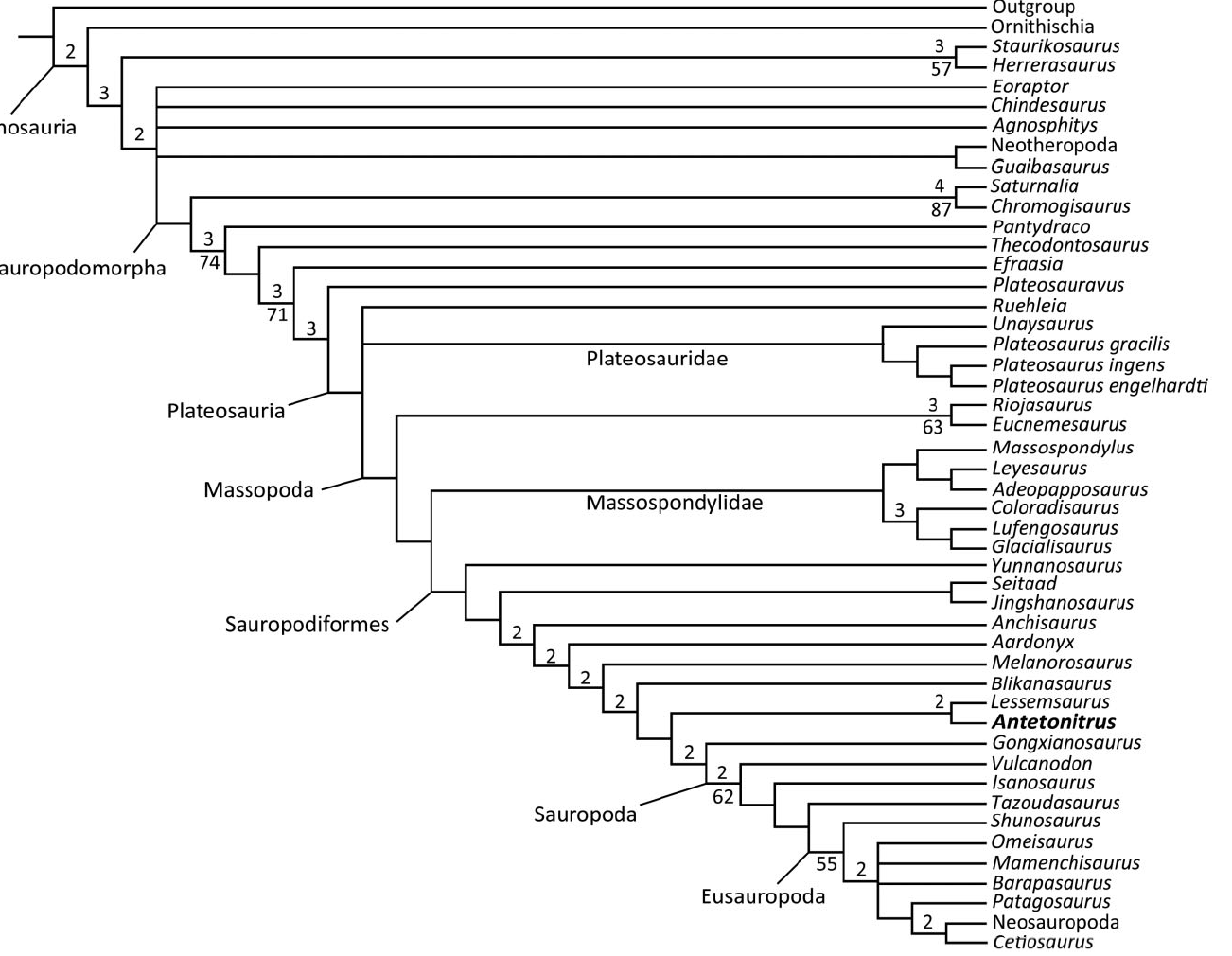
Antetonitrus ingenipes: A Sauropodiforme From Carnian/Rhaetian Triassic South Africa


The complete anatomy and phylogenetic relationships of Antetonitrus ingenipes (Sauropodiformes, Dinosauria): implications for the origins of Sauropoda

Authors:

McPhee et al

Abstract:

We present a comprehensive description and phylogenetic analysis of the important transitional sauropodomorph Antetonitrus ingenipes. New information sheds light on the stepwise acquisition of sauropod-like traits just prior to the Triassic/Jurassic boundary. Although the forelimb of Antetonitrus and other closely related sauropodomorph taxa retains the plesiomorphic morphology typical of a mobile grasping structure, the changes in the weight-bearing dynamics of both the musculature and the architecture of the hindlimb document the progressive shift towards a sauropodan form of graviportal locomotion. Nonetheless, the presence of hypertrophied muscle attachment sites in the femur of Antetonitrus suggests the retention of an intermediary form of facultative bipedalism. The term Sauropodiformes is adopted here and given a novel definition intended to capture those transitional sauropodomorph taxa occupying a contiguous position on the pectinate line towards Sauropoda. A re-examination of the biased distribution of Sauropodomorpha in the earliest Jurassic suggests the presence of genuine palaeo-environmental processes that may have excluded the large-bodied, graviportal taxa from participating in a number of Early Jurassic ecosystems.

Tuesday, April 08, 2014

Did Sauropods Cascade into Gigantism?


An Evolutionary Cascade Model for Sauropod Dinosaur Gigantism - Overview, Update and Tests

Author:

Saunders

Abstract:

Sauropod dinosaurs are a group of herbivorous dinosaurs which exceeded all other terrestrial vertebrates in mean and maximal body size. Sauropod dinosaurs were also the most successful and long-lived herbivorous tetrapod clade, but no abiological factors such as global environmental parameters conducive to their gigantism can be identified. These facts justify major efforts by evolutionary biologists and paleontologists to understand sauropods as living animals and to explain their evolutionary success and uniquely gigantic body size. Contributions to this research program have come from many fields and can be synthesized into a biological evolutionary cascade model of sauropod dinosaur gigantism (sauropod gigantism ECM). This review focuses on the sauropod gigantism ECM, providing an updated version based on the contributions to the PLoS ONE sauropod gigantism collection and on other very recent published evidence. The model consist of five separate evolutionary cascades (“Reproduction”, “Feeding”, “Head and neck”, “Avian-style lung”, and “Metabolism”). Each cascade starts with observed or inferred basal traits that either may be plesiomorphic or derived at the level of Sauropoda. Each trait confers hypothetical selective advantages which permit the evolution of the next trait. Feedback loops in the ECM consist of selective advantages originating from traits higher in the cascades but affecting lower traits. All cascades end in the trait “Very high body mass”. Each cascade is linked to at least one other cascade. Important plesiomorphic traits of sauropod dinosaurs that entered the model were ovipary as well as no mastication of food. Important evolutionary innovations (derived traits) were an avian-style respiratory system and an elevated basal metabolic rate. Comparison with other tetrapod lineages identifies factors limiting body size.

Thursday, March 20, 2014

Anzu wyliei: a Feathered Caenagnathidae Oviraptorosaur (Hell Chicken) From Maastrichtian Cretaceous Hell Creek


A team of researchers has announced the discovery of a bizarre, bird-like dinosaur, named Anzu wyliei, that provides paleontologists with their first good look at a dinosaur group that has been shrouded in mystery for almost a century. Anzu was described from three specimens that collectively preserve almost the entire skeleton, giving scientists a remarkable opportunity to study the anatomy and evolutionary relationships of Caenagnathidae (pronounced SEE-nuh-NAY-thih-DAY)—the long-mysterious group of theropod dinosaurs to which Anzu belongs. The scientific paper describing the discovery appears today in the well-known and freely-accessible journal PLOS ONE.

The three described fossil skeletons of Anzu were unearthed in North and South Dakota, from roughly 66 million-year-old rocks of the Hell Creek Formation, a rock unit celebrated for its abundant fossils of famous dinosaurs such as Tyrannosaurus rex and Triceratops.

The team of scientists who studied Anzu was led by Dr. Matthew Lamanna of Carnegie Museum of Natural History in Pittsburgh. Dr. Lamanna's collaborators include Dr. Hans-Dieter Sues and Dr. Tyler Lyson of the Smithsonian Institution's National Museum of Natural History in Washington, DC, and Dr. Emma Schachner of the University of Utah in Salt Lake City. According to Dr. Lamanna, "Anzu is far and away the most complete caenagnathid that has ever been discovered. After nearly a century of searching, we paleontologists finally have the fossils to show what these creatures looked like from virtually head to toe. And in almost every way, they're even weirder than we imagined."


2nd link.

3rd link.

4th link.

paper link.

Thursday, March 13, 2014

Nanuqsaurus hoglundi: A New, Small Maastrichtian Cretaceous Tyrannosaur From Alaska


A Diminutive New Tyrannosaur from the Top of the World

Authors:

Fiorillo et al

Abstract:

Tyrannosaurid theropods were dominant terrestrial predators in Asia and western North America during the last of the Cretaceous. The known diversity of the group has dramatically increased in recent years with new finds, but overall understanding of tyrannosaurid ecology and evolution is based almost entirely on fossils from latitudes at or below southern Canada and central Asia. Remains of a new, relatively small tyrannosaurine were recovered from the earliest Late Maastrichtian (70-69Ma) of the Prince Creek Formation on Alaska's North Slope. Cladistic analyses show the material represents a new tyrannosaurine species closely related to the highly derived Tarbosaurus+Tyrannosaurus clade. The new taxon inhabited a seasonally extreme high-latitude continental environment on the northernmost edge of Cretaceous North America. The discovery of the new form provides new insights into tyrannosaurid adaptability, and evolution in an ancient greenhouse Arctic.

Torvosaurus gurneyi the Largest Land Predator of Kimmeridgian-Tithonian Jurassic Europe


Torvosaurus gurneyi n. sp., the Largest Terrestrial Predator from Europe, and a Proposed Terminology of the Maxilla Anatomy in Nonavian Theropods

Authors:

Hendrickx et al

Abstract:

The Lourinhã Formation (Kimmeridgian-Tithonian) of Central West Portugal is well known for its diversified dinosaur fauna similar to that of the Morrison Formation of North America; both areas share dinosaur taxa including the top predator Torvosaurus, reported in Portugal. The material assigned to the Portuguese T. tanneri, consisting of a right maxilla and an incomplete caudal centrum, was briefly described in the literature and a thorough description of these bones is here given for the first time. A comparison with material referred to Torvosaurus tanneri allows us to highlight some important differences justifying the creation of a distinct Eastern species. Torvosaurus gurneyi n. sp. displays two autapomorphies among Megalosauroidea, a maxilla possessing fewer than eleven teeth and an interdental wall nearly coincidental with the lateral wall of the maxillary body. In addition, it differs from T. tanneri by a reduced number of maxillary teeth, the absence of interdental plates terminating ventrally by broad V-shaped points and falling short relative to the lateral maxillary wall, and the absence of a protuberant ridge on the anterior part of the medial shelf, posterior to the anteromedial process. T. gurneyi is the largest theropod from the Lourinhã Formation of Portugal and the largest land predator discovered in Europe hitherto. This taxon supports the mechanism of vicariance that occurred in the Iberian Meseta during the Late Jurassic when the proto-Atlantic was already well formed. A fragment of maxilla from the Lourinhã Formation referred to Torvosaurus sp. is ascribed to this new species, and several other bones, including a femur, a tibia and embryonic material all from the Kimmeridgian-Tithonian of Portugal, are tentatively assigned to T. gurneyi. A standard terminology and notation of the theropod maxilla is also proposed and a record of the Torvosaurus material from Portugal is given.

Thursday, January 30, 2014

Yongjinglong datangi: a new, Very Derived Titanosaur Sauropod From Albian/Cenomanian Cretaceous China


A team led by University of Pennsylvania paleontologists has characterized a new dinosaur based on fossil remains found in northwestern China. The species, a plant-eating sauropod named Yongjinglong datangi, roamed during the Early Cretaceous period, more than 100 million years ago. This sauropod belonged to a group known as Titanosauria, members of which were among the largest living creatures to ever walk the earth.

At roughly 50-60 feet long, the Yongjinglong individual discovered was a medium-sized Titanosaur. Anatomical evidence, however, points to it being a juvenile; adults may have been larger.

The find, reported in the journal PLOS ONE, helps clarify relationships among several sauropod species that have been found in the last few decades in China and elsewhere. Its features suggest that Yongjinglong is among the most derived, or evolutionarily advanced, of the Titanosaurs yet discovered from Asia.

Tuesday, December 17, 2013

A new Abelisaurid Theropod From Campanian Cretaceous France


A new abelisaurid dinosaur from the Late Cretaceous of southern France: Palaeobiogeographical implications

Authors:

Tortosa et al

Abstract:

The Abelisauridae are a family of mainly Cretaceous theropod dinosaurs with a wide distribution across the Gondwanan land masses. Although their presence in Europe was reported twenty-five years ago, it has often been considered as controversial largely because of the incompleteness of the available specimens. We report here the discovery of well-preserved abelisaurid material, including a highly diagnostic braincase, at a Late Cretaceous (late Campanian) locality in the Aix-en-Provence Basin, near the eponym city in south-eastern France. A new abelisaurid taxon is erected, Arcovenator escotae gen. nov., sp. nov., on the basis of cranial and postcranial material. A phylogenetic analysis reveals that the new Abelisauridae from Provence is more closely related to taxa from India and Madagascar than to South American forms. Moreover, Genusaurus, Tarascosaurus and the previous Late Cretaceous discoveries are identified as basal abelisaurids. Contrary to previously proposed palaeobiogeographical models of abelisaurid evolution, the presence of the new taxon in Europe suggests that Europe and Africa may have played a major role in abelisaurid dispersal, which apparently involved crossing marine barriers.

Monday, December 09, 2013

Tyrannosauroid Alioramus Retains Basal Sinuses Lost in Birds

The Cranial Pneumatic Sinuses of the Tyrannosaurid Alioramus (Dinosauria: Theropoda) and the Evolution of Cranial Pneumaticity in Theropod Dinosaurs

Authors:

Gold et al

Abstract:

Archosaurs and mammals exhibit skeletal pneumaticity, where bone is infilled by air-filled soft tissues. Some theropod dinosaurs possess extensively pneumatic skulls in which many of the individual bones are hollowed out by diverticula of three main cranial sinus systems: the paranasal, suborbital, and tympanic sinuses. Computed tomography (CT scanning) permits detailed study of the internal morphology of cranial sinuses. But only a few theropod specimens have yet been subjected to this type of analysis. We present CT scans of the remarkably preserved and disarticulated skull bones of the long-snouted tyrannosaurid theropod Alioramus. These scans indicate that Alioramus has extensive cranial pneumaticity, with pneumatic sinuses invading the maxilla, lacrimal, jugal, squamosal, quadrate, palatine, ectopterygoid, and surangular. Pneumaticity is not present, however, in the nasal, postorbital, quadratojugal, pterygoid, or angular. Comparisons between Alioramus and other theropods (most importantly the closely related Tyrannosaurus) show that the cranial sinuses of Alioramus are modified to fill the long-snouted skull of this taxon, and that Alioramus has an extreme degree of cranial pneumaticity compared to other theropods, which may be the result of the juvenile status of the specimen, a difference in feeding style between Alioramus and other theropods, or passive processes. Based on these comparisons, we provide a revised terminology of cranial pneumatic structures and review the distribution, variation, and evolution of cranial pneumaticity within theropod dinosaurs. This review illustrates that most theropods possess a common “groundplan” in which the maxilla and lacrimal are pneumatized, and that various theropods modify this groundplan by pneumatizing numerous other bones of the skull. Tyrannosaurids are very pneumatic compared to other theropods, particularly in the development of extensive ectopterygoid, quadrate, and palatine sinuses, as well as a pneumatic invasion into the surangular. Tyrannosauroids seem to retain many cranial sinuses, such as the jugal and nasal recesses, which are primitive for coelurosaurs but lost or apomorphically modified in taxa more closely related to birds.