An enigmatic aquatic snake from the Cenomanian of Northern South America
Authors:
Albino et al
Abstract:
We report the first record of a snake from the Cretaceous of northern South America. The remains come from the La Luna Formation (La Aguada Member, Cenomanian of Venezuela) and consist of several vertebrae, which belong to the precloacal region of the vertebral column. Comparisons to extant and extinct snakes show that the remains represent a new taxon, Lunaophis aquaticus gen. et sp nov. An aquatic mode of life is supported by the ventral position of the ribs, indicating a laterally compressed body. The systematic relationships of this new taxon are difficult to determine due to the scarcity of fossil material; it is, however, a representative of an early lineage of snakes that exploited tropical marine pelagic environments, as reflected by the depositional conditions of the La Aguada Member. Lunaophis is also the first aquatic snake from the Cenomanian found outside of the African and European Tethyan and Boreal Zones.
Showing posts with label squamates. Show all posts
Showing posts with label squamates. Show all posts
Friday, May 27, 2016
An enigmatic aquatic snake from the Cenomanian Cretaceous Venezuela


Monday, April 04, 2016
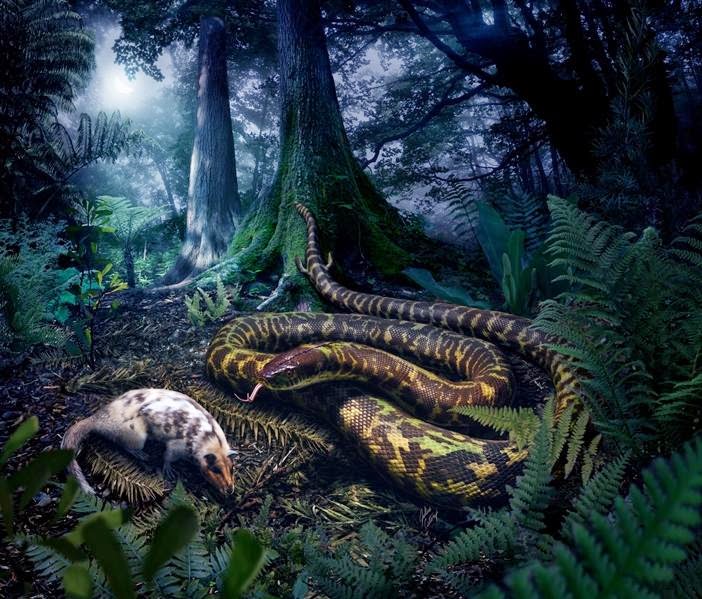
What Color was That Spanish Miocene Neogene Snake? Green and Black

Ten million years ago, a green and black snake lay coiled in the Spanish undergrowth. Once, paleontologists would have been limited to the knowledge they could glean from its colorless fossil remains, but now they know what the snake looked like and can guess how it acted. Researchers reporting on March 31 in Current Biology have discovered that some fossils can retain evidence of skin color from multiple pigments and structural colors, aiding research into the evolution and function of color.
So far, scientists filling the ancient-Earth coloring book with pigment have been limited to browns, blacks, and muddy reds when melanin lasts as organic material. No other pigments have been shown to survive fossilization. But this snake's skin was fossilized in calcium phosphate, a mineral that preserves details on a subcellular level.
The fossilized snakeskin maintained the unique shapes of different types of pigment cells, which would have created yellows, greens, blacks, browns, and iridescence while the animal was alive. The pigments themselves are now decayed, but with the cell shapes—specific to each kind of pigment—mineralized, there's enough information to reconstruct their colors.
"When you get fossil tissues preserved with this kind of detail, you're just gobsmacked when you're looking at it under the microscope," says first author Maria McNamara, a paleobiologist at University College Cork. "I was astounded. You almost can't believe what you're seeing."
link.
Sunday, April 03, 2016
Were Mosasaurs Warm Blooded?
Endothermic mosasaurs? Possible thermoregulation of Late Cretaceous mosasaurs (Reptilia, Squamata) indicated by stable oxygen isotopes in fossil bioapatite in comparison with coeval marine fish and pelagic seabirds
Authors:
Lynn Harrell et al
Abstract:
The thermoregulatory style of Late Cretaceous mosasaurs has become a highly controversial subject in vertebrate palaeontology. These extinct marine reptiles have previously been described as poikilothermic, endothermic or gigantothermic. Here we analyse three genera of mosasaurs from the Mooreville Chalk in Alabama (USA) of differing body mass, and compare their δ18OPO4 derived body temperatures (Tb) with those of coeval poikilothermic fish (Enchodus) and endothermic pelagic seabirds (Ichthyornis). Results show that all mosasaurs, Clidastes (Tb = 33.1°C), Platecarpus (Tb = 36.3°C), and Tylosaurus (Tb = 34.3°C), had elevated average body temperatures in relation to those of the fish (Tb = 28.3°C) and were closer to those of Ichthyornis (Tb = 38.6°C). The temperatures calculated for Enchodus compare well with previously reported temperature estimates for the Mooreville Chalk and the Tb of Ichthyornis compares well with temperatures that have been reported for modern seabirds, suggesting that this method provides accurate results. Finally, although there are small differences of body temperature among mosasaur genera, these are independent of size, and thus inferred body mass, suggesting that mosasaurs were not gigantotherms, but rather endotherms.
Saturday, March 12, 2016
Lizards Preserved in Albian/Cenomanian Cretaceous Amber From Myanmar
Mid-Cretaceous amber fossils illuminate the past diversity of tropical lizards
Authors:
Daza et al
Abstract:
Modern tropical forests harbor an enormous diversity of squamates, but fossilization in such environments is uncommon and little is known about tropical lizard assemblages of the Mesozoic. We report the oldest lizard assemblage preserved in amber, providing insight into the poorly preserved but potentially diverse mid-Cretaceous paleotropics. Twelve specimens from the Albian-Cenomanian boundary of Myanmar (99 Ma) preserve fine details of soft tissue and osteology, and high-resolution x-ray computed tomography permits detailed comparisons to extant and extinct lizards. The extraordinary preservation allows several specimens to be confidently assigned to groups including stem Gekkota and stem Chamaleonidae. Other taxa are assignable to crown clades on the basis of similar traits. The detailed preservation of osteological and soft tissue characters in these specimens may facilitate their precise phylogenetic placement, making them useful calibration points for molecular divergence time estimates and potential keys for resolving conflicts in higher-order squamate relationships.
Saturday, January 09, 2016
Yellow-bellied Sea Snakes Wash up on Southern California Beach

A venomous sea snake washed up on a Southern California beach recently, striking fear in the hearts of beachgoers but eliciting excitement from the scientists who study these marine reptiles.
The stranded snake, which was dead when it was discovered on Dec. 12, was a yellow-bellied sea snake (Pelamis platura), the most widespread marine snake in the world. But despite its wide range of habitats, this snake isn't usually observed in the waters off the coast of Southern California, as it tends to keep to the warmer waters just south of that coastline, closer to Baja California, Mexico. Yet, in 2015, two of these critters washed up on California beaches, leading many to wonder why the snake is venturing outside its normal habitat.
link.
Friday, November 27, 2015
Amphibians and Squamates From Maastrichtian Cretaceous Iberia
Late Cretaceous (Maastrichtian) amphibians and squamates from northeastern Iberia
Authors:
Blanco et al
Abstract:
Maastrichtian biodiversity of medium- and large-sized terrestrial vertebrates is well known in Europe and, specifically, in the Iberian Peninsula. Regarding small-sized herpetofaunas (lissamphibians and squamates), only a few European sites have yielded a significant amount of fossils, and they are still poorly known from the Iberian Peninsula. Recent fieldwork carried out at several sites exposing the Tremp Formation (Southern Pyrenees) has revealed four new localities yielding microvertebrates. Two of them (L'Espinau and Serrat del Rostiar-1) are relatively diverse in herpetofauna, containing albanerpetontids, four different anurans (two different alytids, a pelobatid or gobiatid and a palaeobatrachid), as well as six types of squamates (including scincomorphs, iguanids, anguids and probably gekkotans). Most of these groups are shared with other Campanian-Maastrichtian localities from eastern Iberia although, in some cases, morphological differences might suggest the presence of new lower-level taxa (i.e., genera or species). Also remarkable is the presence of alytines and likely gekkotans that would represent the oldest records of these taxa in Europe and in the Iberian Peninsula, respectively. Taxa of Laurasian origin are common at the Serrat del Rostiar-1 and L'Espinau localities, while Gondwanan taxa are lacking in all cases. Evidence for Asian immigrants (i.e., alytines) is found amongst anurans. Some differences regarding the faunal composition could be explained by environmental factors (i.e., coastal wetlands vs. fluvial settings), although the possibility of taphonomic biases cannot be ruled out.
Friday, May 22, 2015
Deriving What the First Snakes Were Like
The original snake ancestor was a nocturnal, stealth-hunting predator that had tiny hindlimbs with ankles and toes, according to research published in the open access journal BMC Evolutionary Biology.
The study, led by Yale University, USA, analyzed fossils, genes, and anatomy from 73 snake and lizard species, and suggests that snakes first evolved on land, not in the sea, which contributes to a longstanding debate. They most likely originated in the warm, forested ecosystems of the Southern Hemisphere around 128 million years ago.
Snakes show incredible diversity, with over 3,400 living species found in a wide range of habitats, such as land, water and in trees. But little is known about where and when they evolved, and how their original ancestor looked and behaved.
Lead author Allison Hsiang said: "While snake origins have been debated for a long time, this is the first time these hypotheses have been tested thoroughly using cutting-edge methods. By analyzing the genes, fossils and anatomy of 73 different snake and lizard species, both living and extinct, we've managed to generate the first comprehensive reconstruction of what the ancestral snake was like."
By identifying similarities and differences between species, the team constructed a large family tree and illustrated the major characteristics that have played out throughout snake evolutionary history.
Their results suggest that snakes originated on land, rather than in water, during the middle Early Cretaceous period (around 128.5 million years ago), and most likely came from the ancient supercontinent of Laurasia. This period coincides with the rapid appearance of many species of mammals and birds on Earth.
The ancestral snake likely possessed a pair of tiny hindlimbs, and targeted soft-bodied vertebrate and invertebrate prey that were relatively large in size compared to prey targeted by lizards at the time. While the snake was not limited to eating very small animals, it had not yet developed the ability to manipulate prey much larger than itself by using constriction as a form of attack, as seen in modern Boa constrictors.
While many ancestral reptiles were most active during the daytime (diurnal), the ancestral snake is thought to have been nocturnal. Diurnal habits later returned around 50-45 million years ago with the appearance of Colubroidea - the family of snakes that now make up over 85% of living snake species. As colder night time temperatures may have limited nocturnal activity, the researchers say that the success of Colubroidea may have been facilitated by the return of these diurnal habits.
link.
Friday, April 10, 2015
Mosasaurs Didn't lay Eggs on the Beach, Were Viviparous

Pelagic neonatal fossils support viviparity and precocial life history of Cretaceous mosasaurs
Authors:
Field et al
Abstract:
Mosasaurs were large marine squamates that inhabited all of the world's oceans during the Late Cretaceous. Their success as apex predators has been attributed to their rapid acquisition of aquatic adaptations, which allowed them to become fully pelagic. However, little is known about the breeding biology of derived, flipper-bearing mosasaurs, as the record of neonatal mosasaur fossils is extremely sparse. Here, we report on the fragmentary cranial remains of two neonatal mosasaurs from the Niobrara Formation, referred to Clidastes sp. Comparison with other preliminary reports of neonatal mosasaurs reveals that these specimens are among the smallest individuals ever found and certainly represent the smallest known Clidastes specimens. The recovery of these extremely young specimens from a pelagic setting indicates that even neonatal mosasaurs occupied open oceanic habitats and were likely born in this setting. These data shed new light on the ecology of neonatal mosasaurs and illustrate the degree to which size-related taphonomic and collection biases have influenced our understanding of the early life history of these iconic marine reptiles.
Friday, February 20, 2015
Pliocene Neogene Chameleon Fossils Found in South Africa

Morphometric analysis of chameleon fossil fragments from the Early Pliocene of South Africa: a new piece of the chamaeleonid history
Authors:
Dollion et al
Abstract:
The evolutionary history of chameleons has been predominantly studied through phylogenetic approaches as the fossil register of chameleons is limited and fragmented. The poor state of preservation of these fossils has moreover led to the origin of numerous nomen dubia, and the identification of many chameleon fossils remains uncertain. We here examine chameleon fossil fragments from the Early Pliocene Varswater formation, exposed at the locality of Langebaanweg “E” Quarry along the southwestern coast of South Africa. Our aim was to explore whether these fossil fragments could be assigned to extant genera. To do so, we used geometric morphometric approaches based on microtomographic imaging of extant chameleons as well as the fossil fragments themselves. Our study suggests that the fossils from this deposit most likely represent at least two different forms that may belong to different genera. Most fragments are phenotypically dissimilar from the South African endemic genus Bradypodion and are more similar to other chameleon genera such as Trioceros or Kinyongia. However, close phenetic similarities between some of the fragments and the Seychelles endemic Archaius or the Madagascan genus Furcifer suggest that some of these fragments may not contain enough genus-specific information to allow correct identification. Other fragments such as the parietal fragments appear to contain more genus-specific information, however. Although our data suggest that the fossil diversity of chameleons in South Africa was potentially greater than it is today, this remains to be verified based on other and more complete fragments.
Wednesday, August 27, 2014
Eonatator coellensis: a new, Seemingly Ovoviviparous Campanian Cretaceous Mosasaur From Colombia
Eonatator coellensis nov. sp. (Squamata: Mosasauridae), a new species from the Upper Cretaceous of Colombia.
Author:
Páramo-Fonseca
Abstract:
In this study a new mosasaur found in Colombia is given out. The fossil was extracted from Campanian rocks, North of the town of Coello, Tolima Department. It is a nearly complete articulated skeleton with soft tissue remains preserved in its cavities. It was
determined as a new species of the genus Eonatator, E. coellensis, based on the systematics proposed in 2005 by Bardet and others. The anatomy of the anterior part of the skull, as well the morphology and the inter-relationships of the bones of the pelvic girdle and limbs, constitute a new contribution to the genus definition. The Colombian specimen represents the most complete halisaurine mosasaur known so far in the world, and provides new evidence of ovoviviparity in mosasaurs.
Tuesday, August 26, 2014
More Material From Globidensine Mosasaur Prognathodon From Maastrichtian Cretaceous Netherlands
New material of Prognathodon (Squamata, Mosasauridae) from the type Maastrichtian of the Netherlands
Authors:
Schulp et al
Abstract:
A partial quadrate, here assigned to the globidensine mosasaur Prognathodon cf. saturator, is recorded from the basal Valkenburg Member (Maastricht Formation) in the type area of the Maastrichtian Stage (southeast Netherlands, northeast Belgium). Occurrences of Prognathodon saturator in this area are extremely rare, which might well be linked to the offshore habitat preferred by this species.
Thursday, July 24, 2014
Giant Mosasaurus hoffmanni From Maastrichtian Cretaceous Russia
Giant Mosasaurus hoffmanni (Squamata, Mosasauridae) from the Late Cretaceous (Maastrichtian) of Penza, Russia.
Author:
Grigoriev
Abstract:
This study provides a morphological description of the fragmentary skull of a mosasaur discovered in 1927 in the Upper Cretaceous (Maastrichtian) deposits in the city of Penza (Russia). Some bones from the original material had been lost since their discovery; their
description is based on plaster casts. The Penza mosasaur displays characteristic features of Mosasaurus hoffmanni such as the posterior carina that shifts from a somewhat lateral position in the anterior teeth to a posterior position further along the tooth row, a frontal
with convex lateral margins, and a powerfully built dentary. This is the first unequivocal record of this taxon from Russia. M. hoffmanni from the Penza is one of the largest mosasaurs ever known with an overall length of the body about 17 m.
Wednesday, July 23, 2014
An Amazing Mosasaurus missouriensis Specimen From Campanian Cretaceous Canada

A small, exquisitely preserved specimen of Mosasaurus missouriensis (Squamata, Mosasauridae) from the upper Campanian of the Bearpaw Formation, western Canada, and the first stomach contents for the genus
Authors:
Konishi et al
Abstract:
A new, exquisitely preserved specimen of a small mosasaur, referable to Mosasaurus missouriensis, is reported from the Bearpaw Formation (ca. 75 Ma, upper Campanian) of southern Alberta, Canada. Many calcified cartilaginous elements, including tracheal rings and the sternum, are preserved. The sternum most closely resembles that of Clidastes propython, bearing five shallow sternal rib facets on each side. Our comparative study of the new material with the holotype, referred material, and the genotype M. hoffmannii is congruent with the preexisting hypothesis that M. missouriensis and M. hoffmannii are phylogenetically more closely related to each other than to the other congeners, in spite of a temporal gap of nearly 10 million years between them. Also preserved with the mosasaur, inside its ribcage and around the specimen, are well-preserved aulopiform fish bones, including a skull. The fish skull is punctured and its centra truncated, suggesting macrophagy was employed by M. missouriensis despite the apparent lack of tooth wear. A sympatric specimen of Prognathodon overtoni is known to have consumed a sea turtle as well as fishes, and consistently exhibits apical wear across marginal teeth. We hypothesize that coexistence of these apex predators in the Bearpaw Sea was possible because of niche partitioning. Finally, the mosasaur carcass was likely scavenged by at least three lamniform sharks, based on their shed teeth and a series of truncated transverse processes on the mosasaur tail.
Monday, March 31, 2014
The Drivers for Mosasaur Evolution

Physical drivers of mosasaur evolution
Authors:
Polcyn et al
Abstract:
Mosasaurs are marine squamates with a 32.5 million-year history from their appearance at 98 Ma to their extinction at the K–Pg boundary (65.5 Ma). Using a database of 43 generic and 94 species-level taxa, we compare the taxonomic diversity and patterns of morphological disparity in mosasaurs with sea level, sea surface temperature, and stable carbon isotope curves for the Upper Cretaceous to explore factors that may have influenced their evolution. No single factor unambiguously accounts for all radiations, diversification, and extinctions; however, the broader patterns of taxonomic diversification and morphological disparity point to niche differentiation in a “fishing up” scenario under the influence of “bottom-up” selective pressures. The most likely driving force in mosasaur evolution was high productivity in the Late Cretaceous, driven by tectonically controlled sea levels and climatically controlled ocean stratification and nutrient delivery. When productivity collapsed at the end of the Cretaceous, coincident with bolide impact, mosasaurs became extinct.
Tuesday, March 25, 2014
A Giant Campanian Cretaceous Mosasaur With Twisted Teeth From Northern Italy
A giant mosasaur (Reptilia, Squamata) with an unusually twisted dentition from the Argille Scagliose Complex (late Campanian) of Northern Italy
Authors:
Fanti et al
Abstract:
A snout of a large-sized mosasaur from the Upper Cretaceous pelagic-turbiditic deposits of the Argille Scagliose Complex of Northern Italy is described. Nannofossil assemblages from the immediately overlying strata belong to the late but not latest Campanian calcareous nannofossil standard zone CC22, based on the presence of Uniplanarius trifidus and Eiffellithus eximius. The specimen includes a broken premaxilla, the anterior part of the maxillae and dentaries in articulation: preserved teeth show distinctive characters previously unreported in other mosasaurs. Although the marginal teeth show a posterior migration of the labial carina along the jaw length – diagnostic of derived mosasaurines – they are unusual in the combination of features, including anteriormost teeth with asteroid cross section followed by teeth with crowns twisted labioposteriorly from one-third to one-half of their height toward the apices. A comparison between the new specimen and Mosasaurus hoffmanni skulls suggests an estimated skull length comparable with some of the largest known mosasaurids. Consequently, the new specimen represents the largest mosasaur and the largest fossil reptile found in Italy to date. Several lines of dental evidence also support the interpretation of the Italian mosasaur as a macrophagous generalist predator. Paleogeographic reconstruction for the Argille Scagliose Complex as well as the occurrence of typical low- to mid-latitude nannofossils support a southern Tethyan margin affinity of the taxon.
Wednesday, January 08, 2014
How Dark is Your Santonian Cretaceous Mosasaur? Your Sinemurian Jurassic Ichthyosaur?

Unique finds of original pigment in fossilised skin from three multi-million-year old marine reptiles attract considerable attention from the scientific community. The pigment reveals that these animals were, at least partially, dark-coloured in life, which is likely to have contributed to more efficient thermoregulation, as well as providing means for camouflage and UV protection. Researchers at Lund University are among the scientists that made the spectacular discovery.
During the Age of the dinosaurs, huge reptiles, such as mosasaurs and ichthyosaurs, ruled the seas. Previously, scientists could only guess what colours these spectacular animals had; however, pigment preserved in fossilised skin has now been analysed at SP Technical Research Institute of Sweden and MAX IV Laboratory, Lund University, Sweden. The unique soft tissue remains were obtained from a 55 million-year-old leatherback turtle, an 85 million-year-old mosasaur and a 196 million-year-old ichthyosaur. This is the first time that the colour scheme of any extinct marine animal has been revealed.
"This is fantastic! When I started studying at Lund University in 1993, the film Jurassic Park had just been released, and that was one of the main reasons why I got interested in biology and palaeontology. Then, 20 years ago, it was unthinkable that we would ever find biological remains from animals that have been extinct for many millions of years, but now we are there and I am proud to be a part of it", said Johan Lindgren about the discovery of the ancient pigment molecules.
link.
Wednesday, December 25, 2013
Did the Ancestor of Extant Squamates (Lizards, Snakes) Give Birth to Live Young?
The ancestor of snakes and lizards likely gave birth to live young, rather than laid eggs, and over time species have switched back and forth in their preferred reproductive mode, according to research published in print in Ecology Letters Dec. 17.
"This is a very unusual and controversial finding, and a major overturn of an accepted school of thought," said Alex Pyron, Robert F. Griggs Assistant Professor of Biology in the Columbian College of Arts and Sciences at the George Washington University. "Before, researchers long assumed that the ancestor of snakes and lizards laid eggs, and that if a species switched to live birth, it never reverted back. We found this wasn't the case."
The findings push researchers' understanding of the evolution of live birth a lot further back in time to 175 million years ago, showing that live birth has a much more ancient past as a strategy than previously believed. The findings are backed by several recent plesiosaur and mosasaur fossil discoveries and the fossil record of a few lizards from the Cretaceous Period, which had embryos in the mother and had live birth.
Dr. Pyron analyzed an evolutionary tree containing all groups of squamates—the group that comprises lizards and snakes—which he and a team of researchers published in the journal BMC Evolutionary Biology earlier this year. The tree, which uses DNA sequencing technology to group thousands of lizards and snakes, includes all families and subfamilies and most genus and species groups.
link.
Friday, December 20, 2013
Monitor Lizards in Miocene Neogene Spain
Early Miocene dispersal of the lizard Varanus into Europe: Reassessment of vertebral material from Spain
Authors:
Delfino et al
Abstract:
Iberovaranus Hoffstetter, 1969 was erected as a monotypic genus of varanine varanid lizard on the basis of a single trunk vertebra from the Miocene of Spain. Thanks to the study of the holotype, as well as of a still undescribed cervical vertebra from the same locality, we show that the vertebral morphology of Iberovaranus is contained within the known variability of Varanus. Therefore, Iberovaranus Hoffstetter, 1969 is considered a subjective junior synonym of Varanus Merrem, 1820, and the species Iberovaranus catalaunicus Hoffstetter, 1969 should be considered a nomen dubium.
Friday, December 13, 2013
Monitors Breathe Like Birds: How Basal is Unidirectional Airflow in Diapsids???

Air flows mostly in a one-way loop through the lungs of monitor lizards – a breathing method shared by birds, alligators and presumably dinosaurs, according to a new University of Utah study.
The findings – published online Wednesday, Dec. 11 in the journal Nature – raise the possibility this breathing pattern originated 270 million years ago, about 20 million years earlier than previously believed and 100 million years before the first birds. Why remains a mystery.
"It appears to be much more common and ancient than anyone thought," says C.G. Farmer, the study's senior author and an associate professor of biology at the University of Utah. "It has been thought to be important for enabling birds to support strenuous activity, such as flight. We now know it's not unique to birds. It shows our previous notions about the function of these one-way patterns of airflow are inadequate. They are found in animals besides those with fast metabolisms."
But Farmer cautions that because lizard lungs have a different structure than bird and alligator lungs, it is also possible that one-way airflow evolved independently about 30 million years ago in the ancestors of monitor lizards and about 250 million years ago in the archosaurs, the group that gave rise to alligators, dinosaurs and birds. More lizard species, such as geckos and iguanas, must be studied to learn the answer, she says.
Farmer conducted the study with two University of Utah biologists – first author and postdoctoral fellow Emma Schachner and doctoral student Robert Cieri – and with James Butler, a Harvard University physiologist.
link.
Awesome pop write up by Matt Wedel.
Monday, November 18, 2013
Studying Cenomanian Cretaceous Marine Snakes
Reevaluation of the anatomy of the Cenomanian (Upper Cretaceous) hind-limbed marine fossil snakes Pachyrhachis, Haasiophis, and Eupodophis
Authors:
Alessandro Palci, Michael W. Caldwell & Randall L. Nydam
Abstract:
New anatomical observations and reinterpretations of previously identified structures have resulted in new taxonomic diagnoses for the fossil hind-limbed marine snakes Pachyrhachis problematicus, Eupodophis descouensi, and Haasiophis terrasanctus. Among the most important conclusions of our study are the following: Haasiophis and Eupodophis show no evidence of possessing a laterosphenoid; Pachyrhachis and Eupodophis do retain a jugal; Haasiophis, like Eupodophis, has chevron bones in the caudal region; Haasiophis has a large number of unfused intercentra along the anterior portion of the precloacal column; the dentary of Pachyrhachis has numerous mental foramina (at least four); Pachyrhachis has at least one sacral vertebra with unfused sacral ribs. To test the effect of our new observations on the phylogenetic relationships of snakes, we ran three phylogenetic analyses using alternative outgroups to polarize the character transformations. The ingroup consisted of all well-preserved fossil snakes from the Cretaceous, the madtsoiids, and taxa that are representative of all major groups of extant snakes. The analyses yielded a series of most parsimonious trees that placed Pachyrhachis, Eupodophis, and Haasiophis either as a series of stem taxa at the base of the radiation of snakes (two analysis), or as members of a clade of fossil snakes that are the sister group of all living alethinopidians (one analysis).
Subscribe to:
Posts (Atom)