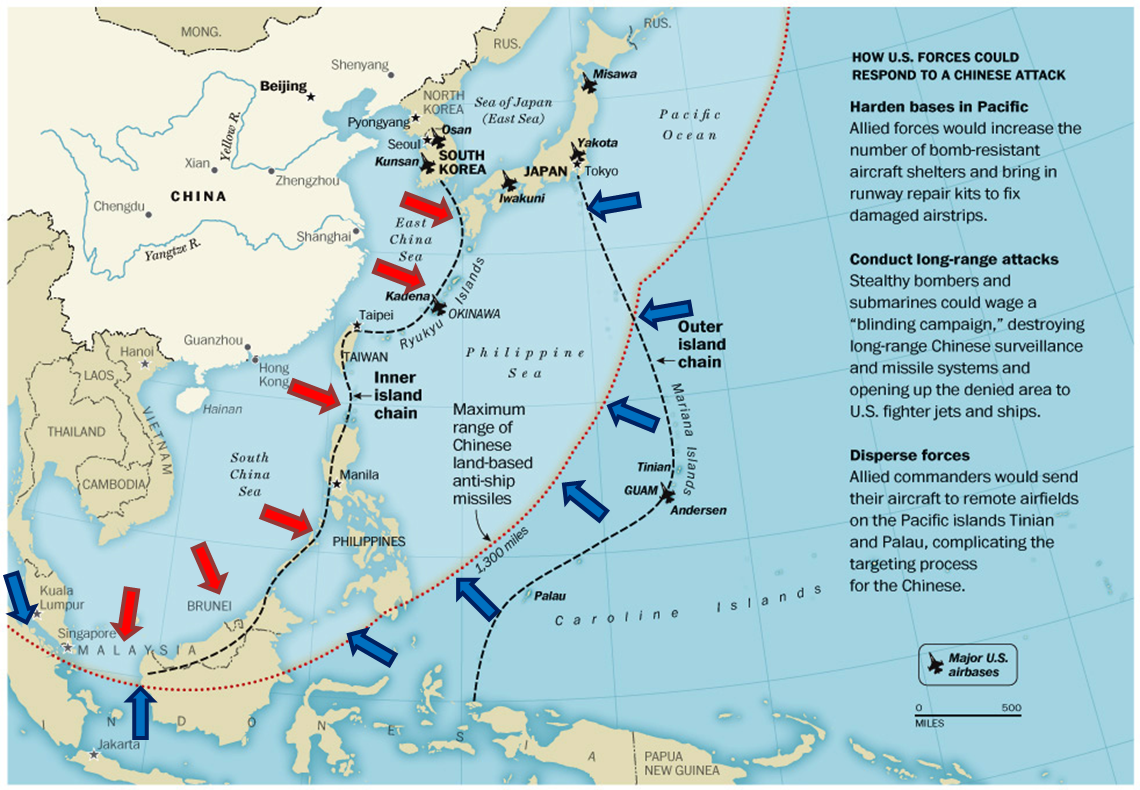
Powered by the world’s second largest economy and defense budget, China has implemented a consistent, incremental strategy of upholding its outstanding territorial and maritime claims in the Near Seas (Yellow, East, and South China Seas), while more gradually developing an outer layer of less-intensive capabilities to further its interests and influence farther afield. In March, China further enshrined its turn toward maritime power in the 13th Five-Year Plan.
Although China is often frustratingly opaque to outside analysts with respect to specific military hardware capabilities, the military strategy that informs the People’s Liberation Army’s (PLA) organization and use of its forces is often far more transparent in its broader objectives and dimensions. Demonstrably authoritative PLA texts that discuss these topics, such as the Academy of Military Science’s (AMS) multiple versions of Science of Military Strategy (战略学, or SMS), are increasingly joined by official Defense White Papers (DWP) as well as a wide range of other publications and data. [1] Considering this material together offers a fairly clear picture of where China stands militarily and its intended course for the future.
Despite reports that China is planning a fourth fleet for the Indian Ocean, India doesn't appear to be losing any sleep over it.
Unconfirmed reports from Chinese-language articles and Western defense industry reports suggest China would build a fleet command headquarters at Sanya on Hainan Island.
Yet the main obstacles to such a strategy include diplomacy, logistics, and reliability, despite conducting successful, but limited, anti-piracy patrols in the Gulf of Aden off Somalia, experts say.
The reports of the fourth fleet are "overstated speculation" and lack "credibility," said Ching Chang, a research fellow at Taiwan's ROC Society for Strategic Studies and a former Taiwan naval officer.
"Without any diplomatically credible, militarily reliable, and logistically functional forward base in the Indian Ocean area, it is impossible for the [Chinese Navy] to establish any long-lasting military organization there, though certain ad hoc arrangements such as dispatch forces, task forces and exercise maneuvering units may appear in the Indian Ocean from time to time," he said.
The Chinese Navy has three fleet commands: the North Sea Fleet in the Yellow Sea, East Sea Fleet in the East China Sea, and the South Sea Fleet in the South China Sea.
Hainan Island, the would-be headquarters for the fourth fleet, is only 200 nautical direct miles from the South Sea Fleet's base at Zhanjiang, Guangdong Province.
As China flexes its economic and military muscle, it's bumping elbows with Asia's other big and fast-growing power: India.
China's hunger for energy from the Middle East and resources from Africa brings it into the Indian Ocean. And some defense analysts in India are watching uneasily as China develops commercial ports in some of India's neighbor countries.
To understand India's concerns about China, it helps to remember that the two countries have a history of border disputes, and that they fought a brief but ferocious war over territory in 1962.
The May 2014 Moscow Conference on International Security (MCIS), sponsored by the Russian Ministry of Defense, was focused on the role of popular protest, and specifically color revolutions, in international security. The speakers, which included top Russian military and diplomatic officials such as Defense Minister Sergei Shoigu and Foreign Minister Sergei Lavrov, argued that color revolutions are a new form of warfare invented by Western governments seeking to remove independently-minded national governments in favor of ones controlled by the West. They argued that this was part of a global strategy to force foreign values on a range of nations around the world that refuse to accept U.S. hegemony and that Russia was a particular target of this strategy.
While the West considers color revolutions to be peaceful expressions of popular will opposing repressive authoritarian regimes, Russian officials argue that military force is an integral part of all aspects of color revolutions. Western governments start by using non-military tactics to change opposing governments through color revolutions that utilize the protest potential of the population to engineer peaceful regime change. But military force is concealed behind this effort. If the protest potential turns out to be insufficient, military force is then used openly to ensure regime change. This includes the use of external pressure on the regime in question to prevent the use of force to restore order, followed by the provision of military and economic assistance to rebel forces. If these measures are not sufficient, Western states organize a military operation to defeat government forces and allow the rebels to take power. Russian officials at the MCIS conference described color revolutions as a new technique of aggression pioneered by the United States and geared toward destroying a state from within by dividing its population. The advantage of this technique, compared to military intervention, is that it requires a relatively low expenditure of resources to achieve its goals.
Shoigu argued that this scheme has been used in a wide range of cases, including Serbia, Libya, and Syria—all cases where political interference by the West transitioned into military action. In 2014, the same scheme was followed in Ukraine, where anti-regime protests over several months transformed into a civil war, and in Venezuela, where the so-called democratic opposition is supposedly organized by the United States. While Western readers may find the lumping together of uprisings as disparate as those in Serbia in 2000, Syria in 2011, and Venezuela in 2014 hard to swallow, from the Russian point of view, they all share the common thread of occurring in countries that had governments that were opposed to the United States. Although uprisings in countries whose governments were close to the United States, such as Kyrgyzstan in 2010 and Egypt and Bahrain in 2011, are harder to explain, such inconsistencies do not appear to trouble the Russian government.
Furthermore, while Russian discussion of the destabilizing role of color revolutions usually portrays U.S. actions as taking place around the world, there is a clear perception that Russia is one of the main targets. This drives fear that unrest in the post-Soviet region may be a wedge for the United States to force regime change in Russia itself.
In World War II, this country served the allied cause as a giant aircraft carrier and port, providing planes, men and materiel to deploy throughout the Pacific. Allied aircraft flew from the northeastern town of Cairns during the Battle of the Coral Sea — known by some as the “battle that saved Australia.”
The Battle of Milne Bay on the eastern tip of New Guinea, little known to Americans, marked the first time allied troops turned back what had been the unstoppable Japanese. Australians fought that battle, aided by allied aircraft flying from an airstrip inland of the port of Townsville, which played crucial roles in virtually every battle of the Pacific.
Today, the strategic situation is very different. The greatest threats to peace in the region are North Korea and an increasingly assertive China. Indonesia has replaced Japan as the central threat faced by the Australia, although relations between the two states have improved considerably over the last two decades. Defense policymakers still consider the Aussie military’s ability to defeat Indonesia a primary benchmark.
What does all this translate into? Defend Australia from the north (hence the carefully circumscribed agreement to allow US Marines to operate from Darwin but not to be based there) and ensure Australian submarines can avoid its enormous shoal waters and deploy undetected from the deep water ports in the south to help protect the country.
That has been the essential model for a long time but some basic strategic facts have recently changed.
Tarawa. Saipan. Iwo Jima. Peleliu. Okinawa, Inchon. These are among the most sacred names in Marine Corps history. They define the sea-borne warriors’ in so many ways: sacrifice, grit, honor, competence. To most Americans, and to many Marines, those amphibious assaults are the soul of the Corps.
But those bloody and costly frontal assaults are not the future of the Marines, even as they plan for a return to sea-based operations after more than a decade of land wars in Aghanistan and Iraq. For much of the last two years reporters have heard the Marines talk of going back to their roots. Some sort of successor to the failed but fast Expeditionary Fighting Vehicle was in the works, we heard.
Lt. Gen. Kenneth Guelick, deputy commandant for combat development and integration, made clear this morning that the Marines will sidestep the full force of an enemy’s firepower in future amphibious operations. I asked him at a Defense Writers Group breakfast how the Corps would cope with the environment of death expected in an anti-access/area denial (A2/AD) battle for which the US military now trains and equips. “We want to pit strength against weakness,” Guelick told me, adding the Marines would look to exploit the “seams” in an enemy’s force and position.
The A2/AD battle is predicated on in-depth and layered defenses such as China’s advanced CSS-6 and CSS-7 short-range ballistic missiles (SRBMs), SA-10 SAMs, anti-ship cruise missiles and over-the-horizon targeting systems. A battle group of ships launching Marines in ship-to-shore connectors like the Amphibious Combat Vehicle (ACV) could be decimated by the rain of steel from such a power.
Careful not to identify any particular scenarios (though we were all thinking China), Guelick offered one other characterization: “The intent is not to go in force on force. The intent,” he said, “is to find the gaps.”
That sounds very much as if the Marines have read Chinese doctrine...
If there was any doubt, last week’s Shangri-La Dialogue in Singapore made it clear that China is unhappy with the behavior of the United States in Asia. Following speeches by Japanese Prime Minister Shinzo Abe and U.S. Defense Secretary Chuck Hagel that criticized Chinese actions, General Wang Guanzhong departed from his prepared speech to accuse the two countries of revealing a “taste of hegemony” and trying to “stir up trouble." But his scripted remarks highlighted something which may be an even more fundamental challenge to the U.S. role in the region: China’s “New Security Concept for Asia.” This concept appears to be an effort to redefine the idea of security on terms that cast China as a regional security provider and the United States as an over-assertive outsider that threatens to undermine regional security. Official Chinese interpretations of the argument largely accords with a headline from the online edition of the People’s Daily: “The Shangri-La Confrontation is a Clash Between Old and New Security Concepts.”
The core of the New Security Concept, introduced by Chinese President Xi Jinping in a May 21 speech at the Conference on Interactions and Confidence-Building in Asia, is the idea that “development is the greatest form of security.” As the largest trading partner of most countries in the region and a major contributor to infrastructure investment, China already has a good claim to be the chief driver of the region’s development. If security is development, China is therefore also the main provider of Asian security—killing two birds with one stone. But to make this argument persuasive, China must refute understandings of security that emphasize traditional concerns such as territory and national sovereignty. This means contesting international norms with the United States. Ultimately, like the earlier Five Principles for Peaceful Coexistence, the New Security Concept will “gradually become a universal norm of international relations.”
This concept is more than a bit of rhetorical slight of hand—it is both an application of the Deng-era verdict that the goal of security policy should be to “maintain a peaceful external environment for development,” and an effort to promote this understanding abroad. It most likely represents beliefs genuinely used in Chinese policy-making: A similar effort is simultaneously underway in China’s domestic security sphere. Xi has recently emphasized the concept of “overall national security,” a comprehensive view of security which has been defined to include both fairly conventional matters such as military and territorial security, and non-traditional fields such as economic, cultural and ecological security
Djibouti and China signed a "security and defence strategic partnership" agreement on 25 February, according to the Horn of Africa's Sabahi news service.
Sabahi cited Djiboutian Defence Minister Hassan Darar Houffaneh as saying he had signed an agreement with his Chinese counterpart, Chang Wanquan, that covered the use of his country's military facilities, including its port, by China.
"In exchange, we have asked for our military co-operation to be expanded to enable us to build the operational capacities of the Djiboutian armed forces," Sabahi quoted Houffaneh as saying. "In this deal, we laid emphasis on building the capacities of Djibouti's navy, which lacks patrol boats, and building the capacities of the air force, which will soon acquire Chinese aircraft."

China’s top maritime priorities will remain in the East and South China Seas. Nevertheless, extended expeditionary ambitions are real. However, more assertive Chinese behavior on blue-waters does not mean that great power conflict is inevitable. Coming East Asia Summits may be a forum for finding solutions.
China does not seek an overseas presence as the Soviets did in the 1980s. They simply cannot do it yet. The USSR needed decades to establish a global naval presence. For China, it would not be different. However, the world is watching how China is on the march to reach the status of a ‘medium global force projection navy’, comparable to the British and French. In terms of numbers, but not in terms of quality, Beijing’s navy has already surpassed Paris’ and London’s and the naval armament goes on:
“During 2013 alone, over fifty naval ships were laid down, launched, or commissioned, with a similar number expected in 2014. Major qualitative improvements are occurring within naval aviation and the submarine force, which are increasingly capable of striking targets hundreds of miles from the Chinese mainland.” (Source: USNI)
Moreover, ‘medium global force projection navy’ does not necessarily mean that there are warships in all oceans. It means that China could globally project power in one or two theaters simultaneously, if its political masters so decide. Besides the question of whether a Chinese naval presence outside the Pacific really would have a serious impact, political prestige must also be taken into account. Britain’s Indian Ocean presence does not make a difference. However, London decides to go there just because they can, and to pretend that Britain is still a global power. Beijing’s political and military elites might feel the same way. Often criticized is China’s military bureaucracy and corruption. However, for naval power projection, it does not matter whether Chinese officers in Xingjang or Tibet are corrupt Maoist bureaucrats.
link.
Recent events have underscored that Air-Sea Battle (ASB) is at best a necessary but insufficient solution to China’s military modernization and increasingly assertive diplomatic posture.
Although there’s a legitimate debate about whether ASB is too escalatory to be credible against a nuclear-armed adversary in any scenario, even ASB’s strongest proponents must concede that it would only be politically viable if the U.S. and China move from a state of tense peace to open war. That is, unless China presents the U.S. with a “Pearl Harbor” type moment—most likely an invasion of Taiwan or the Senkaku Islands—no U.S. president would be comfortable ordering the military to execute an ASB operation against China.
During peacetime, a key function of the General Staff, Ministry of Defense, and key components of them like the Academy of Military Sciences is to determine the nature of contemporary war and the ensuing responsibilities of the armed forces. To judge from the remarks given at the Academy’s annual meeting in late January, Russian thinking is once again in flux. Chief of Staff Valeriy Gerasimov observed on behalf of Defense Minister Sergei Shoigu that the “contradictory geopolitical situation” that has recently developed places “new heightened demands” on Russia’s defense. It appears that those heightened demands encompass both military and non-military threats.
Five strategic architectures can be applied to U.S.-China confrontation. The nature of how each achieves “victory” differs, and they have unique strengths and weaknesses.

The European Council’s December session on security policy offers only one remarkable result: In June 2014, the EU will endorse a new European Maritime Security Strategy (EMSS). After years of economic crisis, geopolitical decline and military constraints, an EMSS could give the EU a new push to adapt to the evolving security environment. Such a push is more than necessary. Ten years after the European Security Strategy (ESS), Europe drifted from large ambitions into a strategic no man’s land: as seen in the Middle East and East Asia soft power has become more and more irrelevant, while great power competitions and geopolitics are back on the stage. In consequence, nobody is talking about a more secure Europe nor about the EU building a better world.
However, in the maritime domain Europe could come back on track. Therefore, the EMSS must address three key points. First, it has to define Europe’s strategic-maritime aims and set out the means to implement them. Second, due to its capabilities, there has to be a clear work-sharing with NATO, because the Alliance is much stronger in maritime security than the EU. Third, the EMSS must outline how the EU wants to adapt to a geopolitical/strategic environment that will not only develop to Europe’s disadvantage, but also to the advantage of other powers.
In the EMSS’ development, there is no need for a long debate about security challenges, risks and threats, because the problems are well known: Terrorism, piracy, proliferation, organized crime, energy security, choke points, critical infrastructure, disaster relief and so forth. Not war-fighting or deterrence, but rather military operations other than war (MOOTW) are likely to dominate the operational agenda. What changed, in contrast to ESS 2003, are not the security challenges, risks and threats, but rather the players and theaters.