Redescription of the geikiid Pelanomodon (Therapsida, Dicynodontia), with a reconsideration of ‘Propelanomodon’
Authors:
Kammerer et al
Abstract:
Cryptodont dicynodonts are some of the most abundant therapsid taxa in the upper Permian fossil record. Despite extensive taxonomic study of these families, the species diversity of geikiid cryptodonts remains problematic, particularly for the set of edentulous taxa in the genera Pelanomodon, Propelanomodon, and Geikia. Here, all known specimens of tuskless geikiid dicynodonts from the upper Permian Karoo Basin of South Africa are reevaluated. The genus Pelanomodon is redescribed based on a series of skulls representing a range of sizes. All tuskless geikiids from the Karoo Basin are considered to represent a single species (Pelanomodon moschops) that exhibited cranial dimorphism as adults. The nominal species Pe. moschops and Pe. rubidgei differ only in degree of facial boss development and are most parsimoniously interpreted as sexual dimorphs. Propelanomodon is considered to represent the juvenile morphotype of Pelanomodon moschops, as indicated by the geographic and stratigraphic overlap of the two taxa, the lack of any small skulls of the Pelanomodon morphotype in well-sampled localities, and the presence of specimens of intermediate size and morphology. ‘Propelanomodon’ specimens are distinctive among juvenile dicynodonts in having a significantly narrower intertemporal region than adults. Analysis of intertemporal width relative to total skull size in Pelanomodon and the abundant cryptodont taxa Aulacephalodon, Oudenodon, and Tropidostoma suggests that Pelanomodon had a unique growth trajectory. Based on available stratigraphic data, Pelanomodon was restricted to the uppermost Permian Daptocephalus Assemblage Zone of the South African Beaufort Group and was a victim of the end-Permian mass extinction.
Showing posts with label Changhsingian. Show all posts
Showing posts with label Changhsingian. Show all posts
Tuesday, December 15, 2015
Late Permian Tuskless Geikiid Cryptodont Dicynodont Pelanomodon Redescribed, Shows Sexual Dimorphism


Friday, July 31, 2015
Chinese Kayitou Formation is Latest Changhsingian Permian, not Triassic, & Witness to PT Extinction

The terrestrial end-Permian mass extinction in South China
Authors:
Zhang et al
Abstract:
The end-Permian mass extinction reflects the most severe life crisis during the Phanerozoic and was associated with major global environmental changes. However, the consistency of the time and pattern of the terrestrial and marine extinctions remains controversial. In this paper, we presented detailed analyses of the high-resolution biostratigraphical and geochemical data from terrestrial sections in South China. Our analyses show that the transitional Kayitou Formation actually recorded the process of terrestrial mass extinction as evidenced by the mass disappearance of the Gigantopteris megaflora in the lower part, the dramatic reduction in abundance of palynomorphs in the middle, and the last occurrences of plant remains and abundant charcoal fossils in the uppermost part. It is associated with a distinct negative shift of δ13Corg, beginning in the middle part of the formation, which is correlative with that in the top of Bed 26 at the marine Meishan section. In addition, the Kayitou Formation is characterized by a distinct shift of lithofacies of fresh lake-swamp or river flat environment from olive/grey/black mudstone, siltstone, fine to coarse sandstone in the lower part to gradually increasing maroon rocks, to purely maroon mudrocks with poorly-sorted breccia, calcic palaeosols and calcareous nodules in the lowest part of the Dongchuan Formation, which indicates a dramatic collapse of soil system associated with rapid deforestation and climatic warming and drying. In the coastal area, the Kayitou Formation contains marine beds with the typical Permian–Triassic mixed faunas and floras which are correlative with the latest Changhsingian marine mixed fauna 1 at Meishan. The Kayitou Formation also recorded a distinct transgression that began in the latest Changhsingian. All above phenomena suggest that the Kayitou Formation is actually the witness of the terrestrial end-Permian mass extinction; and it is mostly or entirely of latest Changhsingian (Permian), rather than Triassic age.
Monday, June 29, 2015
NeoTethys Seawater was Oxygenated, but had Increasingly and Rapidly Warming Temperatures Just Before the Permian Extinction

Neotethys seawater chemistry and temperature at the dawn of the end Permian mass extinction
Authors:
Garbelli et al
Abstract:
The end of the Permian was a time of great death and massive upheaval in the biosphere, atmosphere and hydrosphere. Over the last decades, many causes have been suggested to be responsible for that catastrophe such as global warming, anoxia and acidification. The Gyanyima limestone block was an open ocean seamount in the southern Neotethys at subtropical latitude, and it affords us insight into open-ocean oceanographic changes during the end of the Permian After careful screening using multiple tests, we reconstructed carbonate/seawater curves from the geochemical data stored in pristine brachiopod shell archives from the shallow water limestone of the Changhsingian Gyanyima Formation of Tibet. The reconstructed strontium isotope curve and data for the late Changhsingian is relatively invariant about 0.707013, but in the upper part of the succession the values become more radiogenic climaxing at about 0.707244. The 87Sr/86Sr curve and trend is similar to that observed for the Upper Permian succession in northern Italy, but dissimilar (less radiogenic) to whole rock results from Austria, Iran, China and Spitsbergen. The Ce/Ce* anomaly results. ranging from 0.310 to 0.577 for the brachiopods and from 0.237 to 0.655 for the coeval whole rock before the event, and of 0.276 for whole rock during the extinction event, suggest normal redox conditions. These Ce* values are typical of normal open-ocean oxic water quality conditions observed in modern and other ancient counterparts. The biota and Ce* information clearly discounts global anoxia as a primary cause for the end-Permian biotic crisis. Carbon isotopes from brachiopod shells and whole rock are relatively invariant for most of the latest Permian interval, which is in stark contrast to the distinct negative carbon isotope excursion observed near and about the event. Estimates of seawater temperature at shallow depth fluctuated from 22.2 to 29.0 °C up to unit 8-2, and then gradually rise from 29.7 °C in unit 8-13 to values exceeding 35 °C at a stratigraphic level about 120 ky before the Permian-Triassic boundary, and just before the onset of the extinction interval. This dramatic increase in seawater temperature has been observed in global successions from tropical to mid latitude and from restricted to open ocean localities (e.g., northern Italy, Iran). The brachiopod archive and its geochemical proxies from Tibet support the paradigm that global warming must have been an important factor of the biotic crisis for the terrestrial and marine faunas and floras of the late Paleozoic world.
Tuesday, June 23, 2015
Archosauriforms Radiated, Became Parasagittal During Late Permian
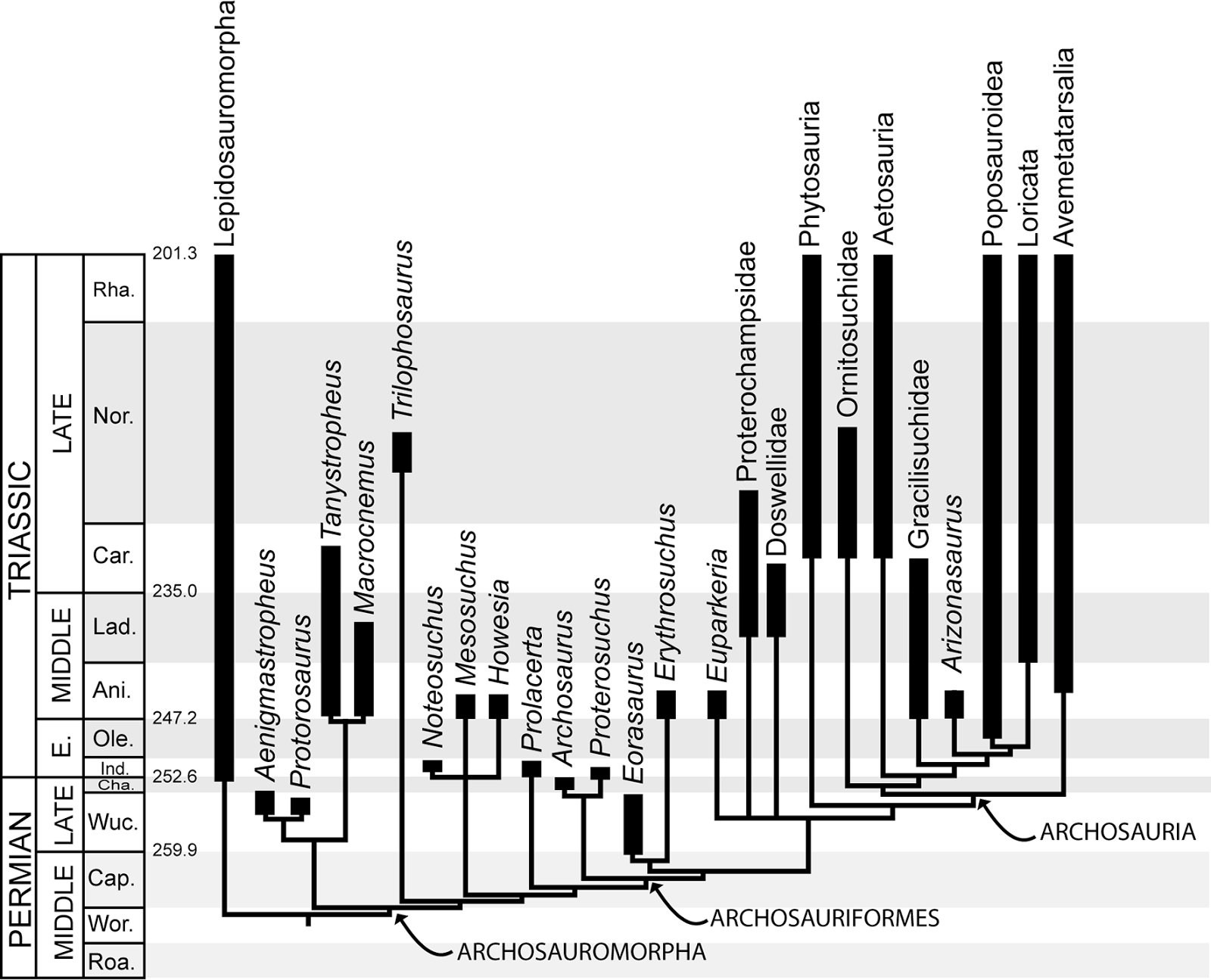
The Origin and Early Radiation of Archosauriforms: Integrating the Skeletal and Footprint Record
Authors:
Bernardi et al
Abstract:
We present a holistic approach to the study of early archosauriform evolution by integrating body and track records. The ichnological record supports a Late Permian–Early Triassic radiation of archosauriforms not well documented by skeletal material, and new footprints from the Upper Permian of the southern Alps (Italy) provide evidence for a diversity not yet sampled by body fossils. The integrative study of body fossil and footprint data supports the hypothesis that archosauriforms had already undergone substantial taxonomic diversification by the Late Permian and that by the Early Triassic archosauromorphs attained a broad geographical distribution over most parts of Pangea. Analysis of body size, as deduced from track size, suggests that archosauriform average body size did not change significantly from the Late Permian to the Early Triassic. A survey of facies yielding both skeletal and track record indicate an ecological preference for inland fluvial (lacustrine) environments for early archosauromorphs. Finally, although more data is needed, Late Permian chirotheriid imprints suggest a shift from sprawling to erect posture in archosauriforms before the end-Permian mass extinction event. We highlight the importance of approaching palaeobiological questions by using all available sources of data, specifically through integrating the body and track fossil record.
Tuesday, December 30, 2014
An Early Archosauromorph From Permian-Triassic Bounary of Uruguay
Early archosauromorph remains from the Permo-Triassic Buena Vista formation of NorthEastern Uruguay
Authors:
Ezcurra et al
Abstract:
The Permo-Triassic archosauromorph record is crucial to understand the impact of the Permo-Triassic mass extinction on the early evolution of the group and its subsequent dominance in Mesozoic terrestrial ecosystems. However, the Permo-Triassic archosauromorph record is still very poor in most continents and hampers the identification of global macroevolutionary patterns. Here we describe cranial and postcranial bones from the Permo-Triassic Buena Vista Formation of northeastern Uruguay that contribute to increase the meagre early archosauromorph record from South America. A basioccipital fused to both partial exoccipitals and three cervical vertebrae are assigned to Archosauromorpha based on apomorphies or a unique combination of characters. The archosauromorph remains of the Buena Vista Formation probably represent a multi-taxonomic assemblage composed of non-archosauriform archosauromorphs and a ‘proterosuchid-grade’ animal. This assemblage does not contribute in the discussion of a Late Permian or Early Triassic age for the Buena Vista Formation, but reinforces the broad palaeobiogeographic distribution of ‘proterosuchid grade’ diapsids in Permo-Triassic beds worldwide.
Thursday, December 19, 2013
Floral Change Across the Permian-Triassic Boundary in Pakistan

Vegetation history across the Permian–Triassic boundary in Pakistan (Amb section, Salt Range)
Authors:
Schneebeli-Hermann et al
Abstract:
Hypotheses about the Permian–Triassic floral turnover range from a catastrophic extinction of terrestrial plant communities to a gradual change in floral composition punctuated by intervals indicating dramatic changes in the plant communities. The shallow marine Permian–Triassic succession in the Amb Valley, Salt Range, Pakistan, yields palynological suites together with well-preserved cuticle fragments in a stratigraphically well-constrained succession across the Permian–Triassic boundary. Palynology and cuticle analysis indicate a mixed Glossopteris-Dicroidium flora in the Late Permian. For the first time Dicroidium cuticles are documented from age-constrained Upper Permian deposits on the Indian subcontinent. Close to the Permian–Triassic boundary, several sporomorph taxa disappear. However, more than half of these taxa reappear in the overlying Smithian to Spathian succession. The major floral change occurs towards the Dienerian. From the Permian–Triassic boundary up to the middle Dienerian a gradual increase of lycopod spore abundance and a decrease in pteridosperms and conifers is evident. Synchronously, the generic richness of sporomorphs decreases. The middle Dienerian assemblages resemble the previously described spore spikes observed at the end-Permian (Norway) and in the middle Smithian (Pakistan) and might reflect a similar ecological crisis.
Thursday, September 26, 2013
New Pareiasaur Fossils From Changhsingian Permian China Have Taxonomy Implications

New specimens of pareiasaurs from the Upper Permian Sunjiagou Formation of Liulin, Shanxi and their implications for the taxonomy of Chinese pareiasaurs
Authors:
1. Li Xing-Wen (a)
2. Liu Jun (a)
Affiliation:
a. Key Laboratory of Vertebrate Evolution and Human Origins of Chinese Academy of Sciences, Institute of Vertebrate Paleontology and Paleoanthropology, Chinese Academy of Sciences Beijing 100044
Abstract:
New pareiasaur specimens from the Sunjiagou Formation of Xuecun, Liulin, Shanxi,China are described. These new specimens comprise two marginal teeth from the upper jaw (IVPP V 18613) and an incomplete left dentary with teeth (IVPP V 18614). They provide novel anatomical information and allow the direct comparison of Sanchuansaurus pygmaeus with Huanghesaurus liulinensis. The two taxa cannot be differentiated by the known features, and both taxa are declared junior synonyms of Shansisaurus xuecunensis.
Thursday, September 19, 2013
Late Permian Milankovitch Cycles Time Calibrated, Indicate a 22 Hour Day


Time-calibrated Milankovitch cycles for the late Permian
Authors:
1. Huaichun Wu (a,b)
2. Shihong Zhang (a)
3. Linda A. Hinnov (c)
4. Ganqing Jiang (d)
5. Qinglai Feng (e)
6. Haiyan Li (a)
7. Tianshui Yang (a)
Affiliations:
a. State Key Laboratory of Biogeology and Environmental Geology, China University of Geosciences, Beijing 100083, China
b. School of Ocean Sciences, China University of Geosciences, Beijing 100083, China
c. Department of Earth and Planetary Sciences, Johns Hopkins University, Baltimore, Maryland 21218, USA
d. Department of Geoscience, University of Nevada, Las Vegas, Nevada 89154, USA
e. State Key Laboratory of Geological Processes and Mineral Resources, China University of Geosciences, Wuhan 430074, China
Abstract:
An important innovation in the geosciences is the astronomical time scale. The astronomical time scale is based on the Milankovitch-forced stratigraphy that has been calibrated to astronomical models of paleoclimate forcing; it is defined for much of Cenozoic–Mesozoic. For the Palaeozoic era, however, astronomical forcing has not been widely explored because of lack of high-precision geochronology or astronomical modelling. Here we report Milankovitch cycles from late Permian (Lopingian) strata at Meishan and Shangsi, South China, time calibrated by recent high-precision U–Pb dating. The evidence extends empirical knowledge of Earth’s astronomical parameters before 250 million years ago. Observed obliquity and precession terms support a 22-h length-of-day. The reconstructed astronomical time scale indicates a 7.793-million year duration for the Lopingian epoch, when strong 405-kyr cycles constrain astronomical modelling. This is the first significant advance in defining the Palaeozoic astronomical time scale, anchored to absolute time, bridging the Palaeozoic–Mesozoic transition.
Monday, June 24, 2013
Bunostegos: a Desert Dwelling Relic Pareiasaur From the Late Permian Niger

During the Permian era, the Earth was dominated by a single supercontinent called Pangea – "All-Earth". Animal and plant life dispersed broadly across this land, as documented by identical fossil species found on multiple modern continents. But a new study published in the Journal of Vertebrate Paleontology supports the idea that there was an isolated desert in the middle of Pangea with a fauna all its own.
Roaming this desert in what is now northern Niger was a very distinctive creature known as a pareiasaur. Pareiasaurs were large, herbivorous reptiles that were common across Pangea during the Middle and Late Permian, about 266-252 million years ago. "Imagine a cow-sized, plant-eating reptile with a knobby skull and bony armor down its back," said lead author Linda Tsuji. The newly discovered fossils belong to the aptly-named genus Bunostegos, which means "knobby [skull] roof."
Most pareiasaurs had bony knobs on their skulls, but Bunostegos sported the largest, most bulbous ones ever discovered. In life, these were probably skin-covered horns like those on the heads of modern giraffes. Although at first blush these features seem to suggest that Bunostegos was an evolutionarily advanced pareiasaur, it also had many primitive characteristics. Tsuji's analysis showed that Bunostegos was actually more closely related to older and more primitive pareiasaurs, leading to two conclusions: first, that its knobby noggin was the result of convergent evolution, and second, that its genealogical lineage had been isolated for millions of years.
So how do you isolate a population of cow-sized reptiles? Though there were no fences in the Permian, climatic conditions conspired to corral Bunostegos – along with several other reptiles, amphibians, and plants – and keep them constrained to the central area of the supercontinent. "Our work supports the theory that central Pangea was climatically isolated, allowing a unique relict fauna to persist into the Late Permian," said Christian Sidor, another author of the paper. This is surprising because areas outside this central region show fossil evidence of regular faunal interchange.
Geological data also show that central Pangea was hyperarid (extremely dry), effectively discouraging some animals from passing through, while keeping those within from venturing out. The long period of isolation under these parched conditions gave Bunostegos lineage time to evolve its unique anatomical features.
Paleontologist Gabe Bever, who was not involved with the study, said "Research in these lesser-known basins is critically important for meaningful interpretation of the Permian fossil record. Our understanding of the Permian and the mass extinction that ended it depends on discovery of more fossils like the beautifully bizarre Bunostegos."
Paper link
Subscribe to:
Posts (Atom)