Ichnology and depositional environment of the Middle Devonian Valentia Island tetrapod trackways, south-west Ireland
Authors:
Stössel et al
Abstract:
Nine tetrapod trackways are described from the Middle Devonian continental Valentia Slate Formation on the north-eastern coast of Valentia Island in County Kerry, Ireland. The trackways occur at three sites – Dohilla, Coosadillisk and Culoo Head – the latter two being recorded for the first time. Morphological and taphonomic analyses of the trackways suggest they were made by populations of similar tetrapods, but of varying size (body length = 0.5 to 1 m; width = 0.15 to 0.30 m), that moved in some cases by terrestrial locomotion and in others possibly by a slow “paddling gait” while the substrate was submerged by very shallow floodwater. Sedimentological facies analysis of the trackway-bearing sequences has been carried out for the first time and shows that the preserved trackways are associated with the late stages of (1) a principal river channel margin (Coosadillisk), (2) a minor floodplain drainage channel (Culoo Head) and (3) a sand-rich crevasse splay/medial alluvial-ridge environment (Dohilla). The Valentia Island tetrapods inhabited marginal environments of proximal river channels less than 20 km from the northern margin of the Munster Basin, where hinterland drainage basins probably provided reliable sources of water in an overall semi-arid climate. It is proposed that the more perennial river channel belts crossing the basin would have provided conducive route ways that allowed ancestral tetrapods to migrate (greater than 170 km) northwards into the continent from postulated shallow marine habitats as they evolved this capability over a potential 4–5 million year period during the Middle Devonian.
Showing posts with label ichnology. Show all posts
Showing posts with label ichnology. Show all posts
Friday, November 04, 2016
Irish Middle Devonian Trackways Were Deposited in Semi Arid Environs


Thursday, January 07, 2016
The Paleoenvironments of the Catalan Pyrenees From the Middle Permian Through the Olenekian Triassic
Constraining the Permian/Triassic transition in continental environments: Stratigraphic and paleontological record from the Catalan Pyrenees (NE Iberian Peninsula)
Authors:
Mujal et al
Abstract:
The continental Permian-Triassic transition in southern Europe presents little paleontological evidence of the Permian mass extinction and the subsequent faunal recovery during the early stages of the Triassic. New stratigraphic, sedimentological and paleontological analyses from Middle-Upper Permian to Lower-Middle Triassic deposits of the Catalan Pyrenees (NE Iberian Peninsula) allow to better constrain the Permian-Triassic succession in the Western Tethys basins, and provide new (bio-) chronologic data. For the first time, a large vertebra attributed to a caseid synapsid from the ?Middle Permian is reported from the Iberian Peninsula - one of the few reported from western Europe. Osteological and ichnological records from the Triassic Buntsandstein facies reveal a great tetrapod ichnodiversity, dominated by small to medium archosauromorphs and lepidosauromorphs (Rhynchosauroides cf. schochardti, R. isp. 1 and 2, Prorotodactylus-Rotodactylus, an undetermined Morphotype A and to a lesser degree large archosaurians (chirotheriids), overall suggesting a late Early Triassic-early Middle Triassic age. This is in agreement with recent palynological analyses in the Buntsandstein basal beds that identify different lycopod spores and other bisaccate and taeniate pollen types of late Olenekian age (Early Triassic). The Permian caseid vertebra was found in a playa-lake setting with a low influence of fluvial water channels and related to the distal parts of alluvial fans. In contrast, the Triassic Buntsandstein facies correspond to complex alluvial fan systems, dominated by high-energy channels and crevasse splay deposits, hence a faunal and environmental turnover is observed. The Pyrenean biostratigraphical data show similarities with those of the nearby Western Tethys basins, and can be tentatively correlated with North African and European basins. The Triassic Pyrenean fossil remains might rank among the continental oldest records of the Western Tethys, providing new keys to decipher the Triassic faunal biogeography and recovery.
Monday, January 04, 2016
Very Diverse Dinosaur Trackway has Ornithopod and Pterosaur Traces Amongst Lots of Theropod and Sauropods Tracks
A diverse saurischian (theropod–sauropod) dominated footprint assemblage from the Lower Cretaceous Jiaguan Formation in the Sichuan Basin, southwestern China: A new ornithischian ichnotaxon, pterosaur tracks and an unusual sauropod walking pattern
Authors:
Xing et al
Abstract:
A sample of fallen blocks of fluvial sandstone from the Lower Cretaceous Jiaguan Formation of Sichuan Province yielded an assemblage of dinosaur and pterosaur tracks preserved as natural impressions and casts. Collectively the assemblage reveals 132 tracks representing at least 30 trackways of tridactyl and didactyl theropods, sauropods, ornithopods and pterosaurs. Ichnotaxonomically, the trackways of small tridactyl theropods (pes lengths 7–18 cm) are indeterminable, whereas the trackway of a small didactyl dromaeosaur (pes length up to 7.5 cm) is tentatively assigned to cf. Velociraptorichnus. The sauropod trackways are assigned to cf. Brontopodus based on the medium to nearly wide-gauge pattern. Other characteristics are the U-shaped manus and strong heteropody. One sauropod trackway shows a peculiar pattern with a lack of left manus imprints, and an unusual position and rotation of right manus imprints. Different scenarios and explanations for this phenomenon are discussed. Ornithopod trackways are the most abundant in the sample and characterized by pes imprints of a small biped that are assigned here to the new ichnospecies Caririchnium liucixini. It is characterized by an unusual broad shape and weak mesaxony. Bivariate analysis of different Caririchnium ichnospecies reveals increasing mesaxony toward the larger forms, a trend that is the reverse of typical theropod ichnotaxa, where large imprints have weak mesaxony. Three isolated, small pterosaur tracks (two manus, one pes) are visible on a single surface. They show strong similarities to the widespread ichnogenus Pteraichnus. This is the ninth report of tetrapod tracks from the Jiaguan Formation in recent years and represents one of the most diverse assemblages recorded to date. It is also rare evidence of typical didactyl dromaeosaur tracks and the co-occurrence of sauropod and ornithopod tracks in a fluvial depositional environment representing arid climate conditions.
Keywords
Thursday, December 17, 2015
Early Permian Paleopolar, River-Dominated, Shallow Marine Delta's Ichnology From Antarctica
Ichnology of a Paleopolar, River-Dominated, Shallow Marine Deltaic Succession in the Mackellar Sea: The Mackellar Formation (Lower Permian), Central Transantarctic Mountains, Antarctica
Authors:
Jackson et al
Abstract:
The Lower Permian Mackellar Formation in the Beardmore Glacier Area of the Central Transantarctic Mountains, Antarctica, was deposited between 80 and 85°S paleolatitude. Previous studies suggest that Mackellar Formation strata were deposited in either a large glacial lake or inland sea. Our study identified 30 ichnogenera from Turnabout Ridge and Buckley Island of which: 1) none are exclusively freshwater forms; 2) 20 ichnogenera are found in freshwater, brackish, and marine settings; and 3) 10 ichnogenera are exclusively found in marine settings. Combining ichnologic evidence with sedimentologic observations suggests that the Mackellar Formation was deposited in a river-dominated delta in a fully marine to brackish-marine setting. Trace-fossil associations are grouped into the Arenicolites–Phycodes, Lingulichnus, Arenicolites–Planolites, Kouphichnium, Phycodes–Teichichnus–Arenicolites, and Planolites–Teichichnus–Phycodes ichnocoenoses of a mixed Skolithos–Cruziana ichnofacies. These associations are characteristic of epi- and endobenthic worms arthropods, and mollusks, with the vast majority of the traces being diminutive in diameter and length, and exhibit shallow (≤ 10 mm) penetration depths. These ichnocoenoses occur in paleoenvironments that include the prodelta, distal to proximal delta front including mouth bars, and subaqueous terminal distributary channels. The diminutive morphology, shallow penetration depth, low bed ichnodiversity, high overall ichnodiversity, and sedimentologic characteristics are indicative of benthic organisms in a marine deltaic environment with short-lived communities composed of small-bodied organisms stressed by high freshwater input and high sedimentation rates.
Friday, December 11, 2015
Crayfish Burrows From Maastrichtian Cretaceous Alaska Suggest PaleoTemperature Range Between -6 C to 28C
Crayfish burrows from the latest Cretaceous lower Cantwell Formation (Denali National Park, Alaska): Their morphology and paleoclimatic significance
Authors:
Fiorillo et al
Abstract:
Latest Cretaceous strata of the lower Cantwell Formation, Denali National Park, central Alaska Range, contain an abundance of megafloral remains and invertebrate and vertebrate trace fossils. Though dominated by herbivorous dinosaur footprints, the abundance and diversity of fossil bird tracks are unique. We present newly discovered crayfish burrows from several areas along a 50 km transect with Denali National Park. Most crayfish burrows from the lower Cantwell Formation are preserved only in cross-section and range from approximately 5–10 cm in diameter. Where preserved in full relief and terminations present, burrow depth is generally less than 50 cm. Burrow morphology is similar to burrow morphology of modern freshwater crayfish (Cambaridae).
The Cantwell Formation fills the Cantwell Basin, a 135 km-long and up to 35 km-wide, east–west trending basin, bracketed by the Hines Creek Fault to the north and the McKinley Fault to the south. Basin fill comprises up to 4000 m of continental deposits, interpreted as braided rivers, alluvial fans, floodplains, swamps, and ponds.
Crayfish burrows provide evidence of water table level, soil moisture fluctuations, as well as insight into mean annual temperatures at the time of deposition of the lower Cantwell Formation, a Late Cretaceous high-latitude paleoecosystem. Despite a relatively high latitudinal setting (~ 71°N paleolatitude), the Late Cretaceous (i.e., Campanian–Maastrichtian) mean annual temperature, based on the distribution of similar present-day crayfish burrows, was more like that of southernmost Ontario, Canada, where the northernmost burrowing crayfish are found today. The burrow depth suggests (1) no permafrost was present, and (2) the phreatic zone was ~ 30–50 cm below the paleo-ground surface. Based on the presence of these crayfish burrows, the paleoclimate is interpreted as humid continental (Köppen scheme), with average summer high temperatures between 25 °C and 28 °C and average winter low temperatures between − 6 °C and 0 °C. These estimates compare somewhat favorably with previous CLAMP estimates of a warm monthly mean temperature of 17.08 +/− 1.6 °C and a cold monthly mean temperature of − 2.31 +/− 1.9 °C.
Tuesday, October 20, 2015
Trackway Compositions Appear to Indicate PaleoEnvironment, Biome in Early Permian Spain
Palaeoenvironmental reconstruction and early Permian ichnoassemblage from the NE Iberian Peninsula (Pyrenean Basin)
Authors:
Mujal et al
Abstract:
Recent finds of tetrapod ichnites in the red-bed and volcaniclastic succession of the Iberian Pyrenean Basin permits an assessment of the faunal diversity and palaeoenvironment of a late early Permian setting. The tetrapod ichnoassemblage is inferred with the aid of photogrammetry and constituted by Batrachichnus salamandroides, Limnopus isp., cf. Amphisauropus (these three ichnotaxa present associated swimming traces, assigned to Characichnos), cf. Ichniotherium, Dromopus isp., cf. Varanopus, Hyloidichnus isp. and Dimetropus leisnerianus. These ichnotaxa suggest the presence of temnospondyls, seymouriamorphs, diadectomorphs, araeoscelids, captorhinids and synapsid pelycosaurs as potential trackmakers. These faunas correlate to the late early Permian. Two ichnoassociations correspond to two different palaeoenvironments that were permanently or occasionally aquatic (meandering fluvial systems and unconfined runoff surfaces, respectively). Ichnotaxa in the fluvial system is more diverse and abundant than in the runoff surfaces system. The Iberian Pyrenean ichnoassemblage reveals the faunistic connection and similarities among nearing basins (Spain, southern France and Morocco) differing from the Central European basins (i.e. German Tambach Formation). Based on the palaeogeography and the climate models of the early Permian, we suggest the correlation of ichnofaunal composition with different palaeoclimate biomes. This results in a diffuse boundary of Gondwana–Laurasia land masses, indicating no geographic barriers but a possible climate control on the faunal distribution. Further studies, integrating data from distant tracksites, should refine these biome boundaries.
Tuesday, June 23, 2015
Archosauriforms Radiated, Became Parasagittal During Late Permian
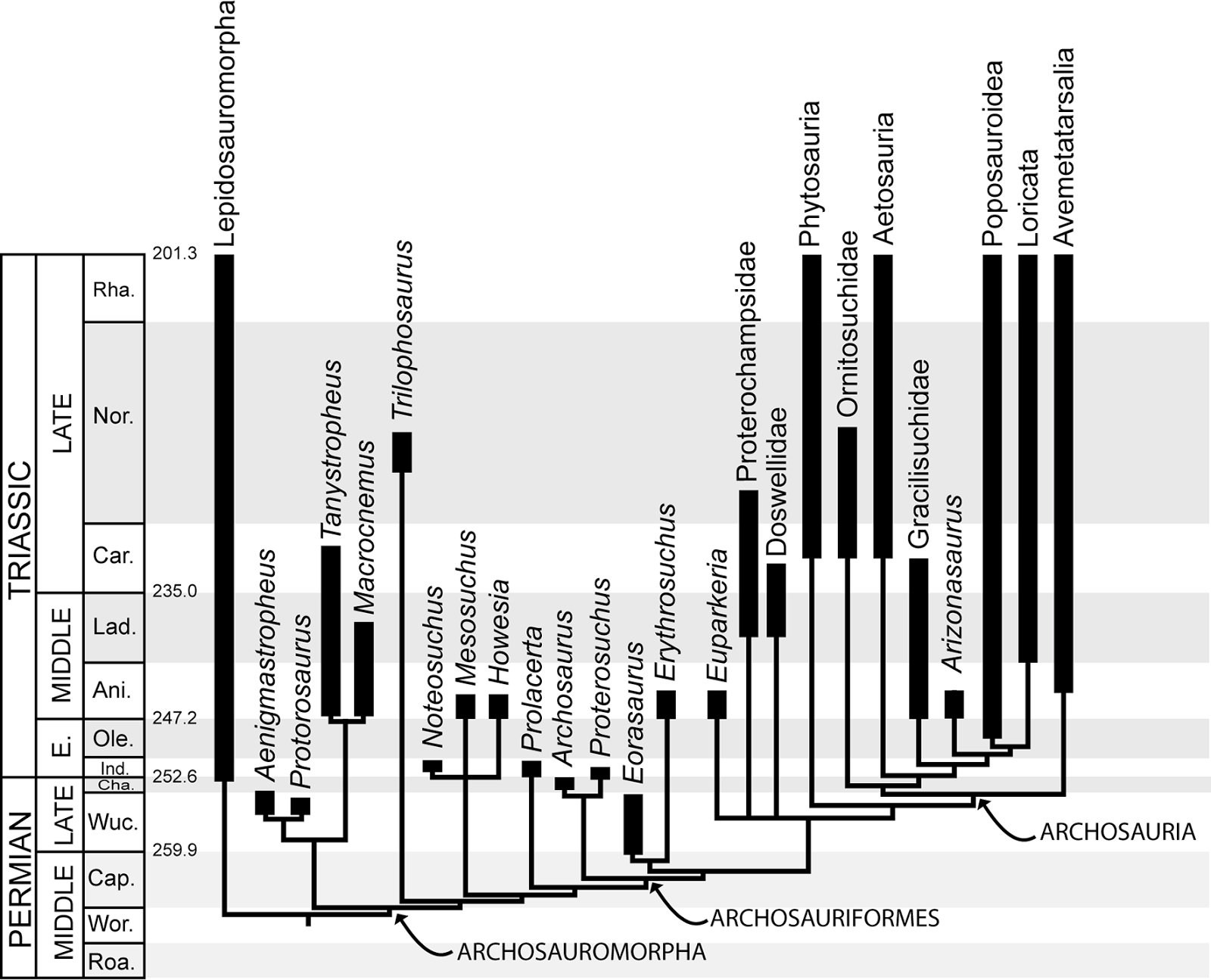
The Origin and Early Radiation of Archosauriforms: Integrating the Skeletal and Footprint Record
Authors:
Bernardi et al
Abstract:
We present a holistic approach to the study of early archosauriform evolution by integrating body and track records. The ichnological record supports a Late Permian–Early Triassic radiation of archosauriforms not well documented by skeletal material, and new footprints from the Upper Permian of the southern Alps (Italy) provide evidence for a diversity not yet sampled by body fossils. The integrative study of body fossil and footprint data supports the hypothesis that archosauriforms had already undergone substantial taxonomic diversification by the Late Permian and that by the Early Triassic archosauromorphs attained a broad geographical distribution over most parts of Pangea. Analysis of body size, as deduced from track size, suggests that archosauriform average body size did not change significantly from the Late Permian to the Early Triassic. A survey of facies yielding both skeletal and track record indicate an ecological preference for inland fluvial (lacustrine) environments for early archosauromorphs. Finally, although more data is needed, Late Permian chirotheriid imprints suggest a shift from sprawling to erect posture in archosauriforms before the end-Permian mass extinction event. We highlight the importance of approaching palaeobiological questions by using all available sources of data, specifically through integrating the body and track fossil record.
Tuesday, May 26, 2015
Evidence Stegosaurs Could Swim


Could stegosaurs swim? Suggestive evidence from the Middle Jurassic tracksite of the Cleveland Basin, Yorkshire, UK
Authors:
Romano et al
Abstract:
Ichnological evidence from the Ravenscar Group (Middle Jurassic) of Yorkshire reveals a distinctive type of swimming track associated with walking tracks of the ichnogenus Deltapodus. The morphology of the prints suggests that both track types were made by the same type of animal. Since Deltapodus is interpreted as having been made by a stegosaur, the associated footprints suggest that stegosaurs could swim. This has significant implications for their palaeobiology and dispersal. The swimming prints are assigned to the ichnotaxon Characichnos isp.
Wednesday, March 25, 2015
A key for Understanding Cisuralian Permian Tetrapod Ichnofaunas

The Gerola Valley site (Orobic Basin, Northern Italy): A key for understanding late Early Permian tetrapod ichnofaunas
Authors:
Marchetti et al
Abstract:
A taxonomic study has been carried out on the historical Gerola Valley locality (Pizzo del Diavolo formation, late Cisuralian), which represents one of the best tetrapod ichnosites of the whole Southern Alps (North Italy). With respect to previous studies, the ichnoassociation is now enlarged and lists the following taxa: Amphisauropus, Dromopus, Erpetopus, Hyloidichnus, Limnopus, Varanopus. The optimal preservation of the material, which in some cases shows even traces of the skin, allowed the recognition of a new morphotype of Varanopus. The invertebrate ichnoassociation is newly described and is representative of impoverished Scoyenia and Mermia ichnofacies. A detailed facies analysis of the uppermost arenitic-pelitic lithofacies of the Pizzo del Diavolo formation, which revealed the most abundant fossil content (Locality 1) and of two new localities (pelitic facies, Localities 2, 3) shows a transition from shallow lacustrine to floodplain and alluvial fan environments under a generally dry climate. Besides the taxonomic revision of vertebrate tracks, the final aims of our study are: i) the depositional, palaeoenvironmental and climatic reconstruction of this sector of the Orobic Basin through an integration of palaeontological data and facies analysis; and ii) the regional correlation of this key stratigraphic succession with other coeval ichnofaunas in Pangaea.
Wednesday, August 06, 2014
Chirothere Trackways Found in Norian/Rhaetian Triassic China

First chirothere and possible grallatorid footprint assemblage from the Upper Triassic Baoding Formation of Sichuan Province, southwestern China
Authors:
Xing et al
Abstract:
Trackways of archosaurs have recently been discovered in sandstones of the Upper Triassic (Norian-Rhaetian) Baoding Formation of Panzhihua City in southern Sichuan Province, China. Based on their overall-morphology, pes imprints are of characteristic chirotheriid shape showing a compact and symmetrical anterior group of digit traces II–IV with the trace of digit III being longest, and a posterolaterally positioned, long and slender trace of digit V. Imprints of digit I and the manus are not preserved. This could be related to substrate conditions and the relatively shallow impressions, even if peculiarities in the gait such as overstep of the manus by the pes or bipedal movement cannot completely be excluded. Ichnotaxonomically, the imprints are assigned tentatively to cf. Chirotherium. There are some similarities with the type ichnospecies C. barthii from the Middle Triassic that has a global distribution and that was described also from the Guanling Formation (Middle Triassic) of adjacent Guizhou Province. However, the long and slender digit V that lacks a distinct large oval basal pad, the relatively short stride/step length, the low pace angulation, and the slight inward rotation of the imprints toward the midline are different. The peculiar shape of digit V and the lack of digit I in all imprints also precludes an assignment to the common Late Triassic ichnogenus Brachychirotherium or similar ichnotaxa such as Pseudotetrasauropus. An isolated tridactyl footprint on the same surface is different in shape from the chirotheriid ones by the stronger mesaxony and narrower digit divarication. It is considered here as a possible large grallatorid. This is the first occurrence of tetrapod footprints in the Baoding Formation of Sichuan Province and the second record of chirotheriids in the Triassic of China. The Baoding Formation has also yielded a characteristic Upper Triassic flora with cycads, filicopsids, gingkos, and conifers as well as bivalve fossils. The depositional environment can be designated as fluvial-lacustrine with occasional opening to marine areas. Considering biostratigraphic and palaeobiogeographic aspects, the late occurrence of chirotheriids cf. Chirotherium in China supports the view that basal crown-group archosaurs with a distinct tendency toward a functionally tridactyl pes developed and dispersed in parallel to typical tridactyl dinosaurs.
Monday, February 10, 2014
Berriasian Cretaceous Track Makers Were Orinthopod Dinosaurs, not Theropods

Discriminating between Medium-Sized Tridactyl Trackmakers: Tracking Ornithopod Tracks in the Base of the Cretaceous (Berriasian, Spain)
Authors:
Castanera et al
Abstract:
Background
Recent work on the Jurassic-Cretaceous transition of the Iberian Range (Spain) has opened a new window onto the interpretation of the trackmakers of some medium-sized tridactyl tracks. The ichnotaxon Therangospodus oncalensis has been described in the Huérteles Formation (Berriasian) and is one of the classical tracks from the area assigned to medium-sized theropods.
Methodology/Principal Findings
A review of the type locality of Therangospodus oncalensis (Fuentesalvo tracksite) and other tracksites from the Huérteles Formation (Berriasian) has yielded new information on the morphology, gait and trackmaker identity of the aforementioned ichnospecies. The new data suggest that the trackmaker is an ornithopod rather than a theropod on the basis of the length/width ratio, the anterior triangle length-width ratio, the short steps, the round to quadrangular heel pad impression and the probable manus impressions.
Conclusions/Significance
T. oncalensis shows similarities with various tracks from the Berriasian of Europe assigned to Iguanodontipus. The ichnotaxonomical status of this ichnospecies is here considered as Iguanodontipus? oncalensis due to the current state of knowledge of the ichnotaxonomy of medium-sized ornithopod tracks. This reassessment of I? oncalensis also has two significant implications for the palaeoecology of the faunas during the deposition of the Huérteles Formation: 1- the high number and percentage of theropod tracks would be lower than previous papers have suggested. 2- the gregarious behaviour described in the type locality (Fuentesalvo) would be among ornithopods instead of theropods.
Saturday, February 08, 2014
Oldest Footprints Outside of Africa Found in Calabrian Pleistocene Quaternary Britain

Hominin Footprints from Early Pleistocene Deposits at Happisburgh, UK
Authors:
Ashton et al
Abstract:
Investigations at Happisburgh, UK, have revealed the oldest known hominin footprint surface outside Africa at between ca. 1 million and 0.78 million years ago. The site has long been recognised for the preservation of sediments containing Early Pleistocene fauna and flora, but since 2005 has also yielded humanly made flint artefacts, extending the record of human occupation of northern Europe by at least 350,000 years. The sediments consist of sands, gravels and laminated silts laid down by a large river within the upper reaches of its estuary. In May 2013 extensive areas of the laminated sediments were exposed on the foreshore. On the surface of one of the laminated silt horizons a series of hollows was revealed in an area of ca. 12 m2. The surface was recorded using multi-image photogrammetry which showed that the hollows are distinctly elongated and the majority fall within the range of juvenile to adult hominin foot sizes. In many cases the arch and front/back of the foot can be identified and in one case the impression of toes can be seen. Using foot length to stature ratios, the hominins are estimated to have been between ca. 0.93 and 1.73 m in height, suggestive of a group of mixed ages. The orientation of the prints indicates movement in a southerly direction on mud-flats along the river edge. Early Pleistocene human fossils are extremely rare in Europe, with no evidence from the UK. The only known species in western Europe of a similar age is Homo antecessor, whose fossil remains have been found at Atapuerca, Spain. The foot sizes and estimated stature of the hominins from Happisburgh fall within the range derived from the fossil evidence of Homo antecessor.
Wednesday, December 25, 2013
More Trace Fossil Evidence of Animals in the Ediacaran From South China

Interactions between Ediacaran animals and microbial mats: Insights from Lamonte trevallis, a new trace fossil from the Dengying Formation of South China
Authors:
Meyer et al
Abstract:
A new ichnogenus and ichnospecies, Lamonte trevallis, is formally described from the Shibantan Member limestone of the upper Ediacaran Dengying Formation, Yangtze Gorges area, South China. It is characterized by horizontal tunnels connected with short vertical burrows and surface trails. The horizontal burrows are elliptical or bilobed in transverse cross-section, preserved in full relief, and filled with carbonate intraclasts, micrites, as well as calcite and silica cements. They occur exclusively in silty, crinkled, and microlaminated layers that are interpreted as amalgamated cyanobacterial microbial mats; no burrows have been found in intraclastic layers adjacent to the microlaminated layers. The vertical traces are filled with the same material as the burrows, but they typically project through the crinkled microlaminae and are exposed on the bedding surface. The surface tracks are always preserved in negative epirelief or positive hyporelief and consist of two parallel series of either sharp scratch marks or small knobs. The burrow infill has δ18Ocarb and δ13Ccarb values distinct from, but intermediate between, microlaminated and intraclastic layers, consistent with petrographic observation that burrow infill consists of a mixture of early carbonate cements, intraclasts, and micrites. Bedding plane bioturbation intensity (20–40%)—measured as percentage of bedding plane area covered by L. trevallis traces—is comparable to similar measurements in pre-trilobite Cambrian carbonates. The exclusive occurrence of L. trevallis within microbial mats may have both taphonomic and ecological significance. These mats may have provided firm substrates and localized geochemical conditions that contributed to the structural integrity of the burrows, and they may have also facilitated early diagenetic cementation of burrow infill, thus facilitating burrow preservation. The close association of these burrows with microbial mats implies that the trace producers actively mined cyanobacterial mats to exploit oxygen or nutrient resources. The trace makers of L. trevallis were better able to utilize the resources around them than many other Ediacaran trace makers and provide an ichnological record of a flourishing benthic ecology in late Ediacaran oceans at the dawn of the agronomic revolution.
Tuesday, December 24, 2013
Pterosaur and Bird Trackway From Cretaceous China
New Early Cretaceous Pterosaur-Bird Track Assemblage from Xinjiang, China: Palaeoethology and Palaeoenvironment
Authors:
He Qing et al
Abstract:
A pterosaur-bird track assemblage from a sandstone-siltstone-mudstone sequence of the Lower Cretaceous Tugulu Group of Xinjiang comprises the first pterosaur track record from this province and the largest specimen thus far known from China. The pterosaur tracks are assigned to the ichnogenus Pteraichnus based on the triangular overall-shape, the four elongate digit traces and the robust manual digit trace III. Supposed trackmakers were dsungaripterid pterodactyloids whose skeletal remains are well known from the Tugulu Group. The bird tracks that occur on the same surface, are those of typical shorebirds, known from different other localities in southeast Asia. The congruence with Koreanaornis dodsoni described from the same stratigraphic level justifies an assignment to this ichnospecies. This is a further evidence of the co-occurrence of pterosaurs and birds in a typical lakeshore environment with possible seasonal alteration of water supply and aerial exposure indicated by wave ripples, mudcracks and repeated cycles of coarse to fine sediment. Pterosaurs and birds frequented the shoreline and may have fed also on the numerous invertebrates such as the Scoyenia tracemaker that left abundant burrows.
Monday, December 23, 2013

Thursday, December 19, 2013
Trilobites Invaded Tidal Flats During the Early Cambrian
Trilobites in early Cambrian tidal flats and the landward expansion of the Cambrian explosion
Authors:
Mángano et al
Abstract:
The timing of the early invasion of the continents, the routes to the land, and the environmental breadth of the Cambrian explosion are important topics because they are at the core of our understanding of early evolutionary breakthroughs. Illuminating some aspects of these problems are trilobite trace fossils in tidal-flat deposits from the lower Cambrian Rome Formation in the southern Appalachian Mountains of Tennessee (USA). Morphologic details and size range of the trace fossils suggest production by olenellid trilobites, which occur as body fossils in the same unit. The occurrence of this ichnofauna, together with physical structures indicative of periodic subaerial exposure (desiccation cracks) and deposition within the intertidal zone (flat-topped ripples), shows that trilobites forayed into the upper intertidal zone during the Cambrian. Our finding supports the migration of subtidal organisms into marginal-marine, intertidal settings at the dawn of the Phanerozoic, suggesting that trilobites contributed to the establishment of the intertidal ecosystem during the Cambrian. The sequence of events involved in the colonization of early Paleozoic tidal flats is consistent with the idea that most terrestrial taxa originated from marine rather than freshwater ancestors, and that direct routes to the land from marginal-marine ecosystems were involved in the colonization of continental environments early in the Phanerozoic.
Thursday, December 05, 2013
Thursday, November 21, 2013
A Pterosaur Trackway From Berriasian Cretaceous Germany
The First Record of the Pterosaur Ichnogenus Purbeckopus in the Late Berriasian (Early Cretaceous) of Northwest Germany
Authors:
Jahn J. Hornung & Mike Reich
Abstract:
A hypichnium of a manus imprint (preserved as plaster cast) indicates for the first time the presence of the large pterosaur ichnotaxon Purbeckopus cf. pentadactylus Delair, 1963 in the late Berriasian of northwest Germany. It is only the second record of Purbeckopus globally and the first pterosaur track from Germany. It provides evidence of a very large pterosaur (wingspan c. 6 m) in this area and from this time period not yet represented by skeletal remains. When compared with the English type material, the specimen exhibits some differences that are related mostly to different properties of the substrate on which both were left. These include, in the German track, an impression of the metacarpo-phalangeal joint of the wing finger, normally not present in pterosaur tracks. Also interesting is the rather blunt termination of the deeply impressed digits I–III, indicating rather short and blunt claws, which seem more suitable for walking than for grasping or climbing. The specimens of Purbeckopus in England and Germany occur in different environments: the English locality was situated close to a brackish lagoon, while the German site belongs to a limnic-deltaic system at the margin of a large, freshwater lake.
Friday, November 08, 2013
Experimental Paleontology: Determining Body Mass From Trackways
Quantitative Interpretation of Tracks for Determination of Body Mass
Authors:
Schanz et al
Abstract:
To better understand the biology of extinct animals, experimentation with extant animals and innovative numerical approaches have grown in recent years. This research project uses principles of soil mechanics and a neoichnological field experiment with an African elephant to derive a novel concept for calculating the mass (i.e., the weight) of an animal from its footprints. We used the elephant's footprint geometry (i.e., vertical displacements, diameter) in combination with soil mechanical analyses (i.e., soil classification, soil parameter determination in the laboratory, Finite Element Analysis (FEA) and gait analysis) for the back analysis of the elephant's weight from a single footprint. In doing so we validated the first component of a methodology for calculating the weight of extinct dinosaurs. The field experiment was conducted under known boundary conditions at the Zoological Gardens Wuppertal with a female African elephant. The weight of the elephant was measured and the walking area was prepared with sediment in advance. Then the elephant was walked across the test area, leaving a trackway behind. Footprint geometry was obtained by laser scanning. To estimate the dynamic component involved in footprint formation, the velocity the foot reaches when touching the subsoil was determined by the Digital Image Correlation (DIC) technique. Soil parameters were identified by performing experiments on the soil in the laboratory. FEA was then used for the backcalculation of the elephant's weight. With this study, we demonstrate the adaptability of using footprint geometry in combination with theoretical considerations of loading of the subsoil during a walk and soil mechanical methods for prediction of trackmakers weight.
Wednesday, November 06, 2013
Frasnian–Famennian Devonian Geirud Formation in Iran has Fascinating Trace Fossils


Trace fossils analysis of fluvial to open marine transitional sediments: Example from the Upper Devonian (Geirud Formation), Central Alborz, Iran
Authors:
Sharafi et al
Abstract:
This study integrates ichnological and sedimentological data to interpret depositional environments of the mixed siliciclastic-carbonate fluvial to marine sediments of the Geirud Formation (Upper Devonian) in the central Alborz, northern Iran. Lithofacies analysis shows that these sediments are deposited in fluvial, tidal, shoreface, and shelf environments. Fluvial and tidal deposits are characterized by the presence of bi- to multi-directional cross beddings, reverse directional current ripples, low angle cross beddings, and herringbone cross beddings, with a few scattered Skolithos and Palaeophycus. Shoreface sediments, accumulated in a storm-influenced setting, are characterized by a preferentially interface and low diversity Cruziana ichnoassemblage (Rhizocorallium, Thalassinoides, Palaeophycus, Chondrites, and Ophiomorpha). In contrast to the fluvial-tidal assemblage, the storm-influenced shelf sediments display a highly diversified, mixture of dwelling and feeding forms (Arenicolites, Protovirgularia, Diplocraterion, Palaeophycus, Thalassinoides, Chondrites, and Helminthopsis), reflecting the presence of adequate food resources both in substrate and water column under normal salinity conditions. A fluvial-shelf replacement of the weakly to scarcely bioturbated sediments by the Rhizocorallium-Thalassinoides suite (Cruziana)–Chondrites-Helminthopsis (distal Cruziana) suite from the lower to upper parts of the succession clearly indicates an overall deepening upward in the Geirud Formation. In contrast to the lower part, generally of restricted environment, the upper part of the succession mainly shows open marine conditions. Ichnofabric development is controlled primarily by depositional conditions, e.g., bottom water oxygenation, sediment type, food abundance, and hydrodynamic level, which all exert control on substrate colonization style.
Subscribe to:
Posts (Atom)