Showing posts with label cruisers. Show all posts

Sunday, July 15, 2018

China has Launched two new Type 055 Destroyers Simultaneously


Two 10,000-tonne Type 055 destroyers were launched simultaneously by the Dalian Shipbuilding Industry Company (DSIC) on 3 July in a move that reflects the rapid pace at which China is building this new class of warship. The latest ships are the third and fourth to be launched, with all four entering the water in a little over a year.


These are far closer in role and capability to our Ticonderoga class cruisers rather than the Burke class destroyers.

Sunday, October 22, 2017

China's new Cruiser may be Comparable to the US Navy's Ticonderoga Class


Chinese state television has broadcast the first clear, overhead view of the Chinese navy’s first Type 055 cruiser. The image confirms what foreign analysts have expected since the new cruiser began taking shape in 2014.

The Type 055 carries no fewer than 122 missiles in vertical cells — any mix of anti-air, anti-ship and land-attack models. That matches the weapons-loadout of the U.S. Navy’s Ticonderoga-class cruisers … and exceeds the armament of every other surface warship in the Pacific region.

The new cruiser could enter service as early as 2018.

The Type 055 — which is an estimate 590 feet long and displaces at least 10,000 tons — represents a new class of warship for the Chinese navy. When Beijing launched its naval rearmament program in the 1990s, it focused on building large numbers of small- and medium-size corvettes, frigates and destroyers.

Wednesday, July 27, 2016

Russia's Navy Claims to be Working on a Nuclear Powered "Destroyer"

The Project 23560 Leader-class destroyer will replace several warship types at once in the Russian Navy’s inventory, including guided missile cruisers and large antisubmarine warfare (ASW) ships. The Severnoye Design Bureau has started working on her engineering design, according to the Izvestia daily.

The ship will displace about 17,500 tons, which will make her close enough to Project 1144 Orlan-class (NATO reporting name: Kirov-class) heavy missile cruisers in terms of dimensions. According to former Russian Navy Deputy Commander-in-Chief Admiral Igor Kasatonov, the development of a ship like that implies certain geopolitical interests of Russia’s leadership. Metal will be cut for the new warship after 2018, according to the United Shipbuilding Corporation (USC). In all, a series of eight destroyers is planned.

Nuclear-powered cruisers have the self-sustained operating capability and formidable weaponry and can operate anywhere in the world. The Russian Navy has not ordered ships like that since 1989. Hence, the development means that the country has regained geopolitical interests in remote corners of the world now, Kasatonov noted.

Valery Polovinkin, advisor to the director general of the Krylov State Research Center that worked out the destroyer’s preliminary design, says the sophisticated ship will combine the best of several types of surface combatants at once. She will have antimissile and space defense capabilities and serve as a kind of strong point in the ocean.

The Leader will be a versatile ship triple-hatted as destroyer, large ASW ship and guided missile cruiser while being smaller than Project 1144 ships and carrying far more weaponry. The self-contained operation capability of similar ships is usually based on their stock of provisions, and their nuclear propulsion plants can do without refueling for years.

The advanced destroyer will be equipped with the RITM-200 nuclear power plant fitting the future Project 22220 icebreaker, which lead ship, the Arktika, was launched in June. The Leader’s power plant will propel her to 30 knots.

Thursday, January 14, 2016

Could the US Navy's Next Cruiser be Derived From the San Antonio Class LPD?


Huntington Ingalls Industries is in discussions with defense officials about potentially putting missile defense radars and laser weapons on San Antonio-class amphibious transport docks, a company executive said Jan. 13.

“You can put a lot of additional weight on the ship and you can put … some modern technologies like ballistic missile defense radars that are very heavy,” Brian Cuccias, corporate vice president at HII and president of Ingalls Shipbuilding, told reporters on the sidelines of a Surface Navy Association symposium in Arlington, Virginia. “We think it’s a great idea.”

The vessels, which are manufactured by the company, have design features that make them well-suited to carry a large radar, he said

“You have a design life margin …. on some ships that say you can only take so much more weight before you have a stability issue or, you know, you don’t have your margins,” he said. “When you close in the well deck of the LPD ship you expand that capability to take a lot of weight, and the stability on LPD is such you can actually put weight up high” where missile defense radars would be positioned.

One of the challenges of hosting ballistic missile defense radars is the need to power them and cool them, Cuccias noted. “You need arrangeable volume for power generation. You need arrangeable volume to have cooling,” he said. “LPD allows for that. … The basic bones of the ship allow that to take place.”

[...]

The Navy is hoping to equip some of its ships with high-powered lasers and electromagnetic railguns to enable them to shoot down enemy missiles and aircraft and attack surface targets with the emerging technologies. Cuccias said the LPD could potentially host those types of weapons.


The article above does not say the ships would be the replacements for the Tico cruisers, but that is effectively what is being talked about.  So let's consider it.


On the Plus side:

1.  The  LPD's are huge.  Just look at the picture right above.  There are two San Antonios present side by side and a Ticonderoga in the foreground.  You can see the vast size difference.  The LPD's displace 28,000 tons, whereas the Ticos displace ~9,800 tons.

2.  The volume is huge within the San Antonios as well.  There's plenty of space to place pretty much anything.

3.  The hull is a known quantity and would save some money by being reused.  A simplified form of the hull is being used for the LX(R).


On the Down Side:

1.  The LPDs need a complete revamp for their propulsion.  Right now they use diesel engines able to move the hull a sedate 22 knots.  The Ticos move at a rate of ~32, almost 33 knots and this is far slower than the carriers with their nuclear propulsion.  

2.  The hull needs to be updated for carrying more helicopters - we got away from strictly specialist ships after the ending of the Burke Flight I destroyers.  The flight deck is plenty large, but the hangar space is far, far too small.  

3.  The hull needs to rebuilt so far, far more VLS cells can be added to the ship.  Currently, there are provisions for 8 VLS cells.  A cruiser needs 120+ and probably ought to use the more up to date Mark 57 vs the Mk 41 allowing for dispersing the cells through the hull for better survivability and  larger missiles.

4.  The lasers and railguns speculated on are a great idea...but its unknown how much they will cost in the end.  The savings of using the LPD hull may be a very, very small portion of the cost.  

5.  Power generation.  The diesel engines on the LPD-17 class are not going to be sufficient for the continual firing of railguns or fleet defense lasers.  This is only worsened by the fact in combat the ships must move as well.  However, there is the volume to replace, well everything and significantly add on.

6.  Its highly likely the electric propulsion system for the Zumwalt class will have to be adapted for the new LPD derived cruiser.  This would mean needing to upscale the system: the Zumwalts are 19,000 tons.  The new LPD derived cruisers would be at least 28,000 tons.  And scaling is a huge issue with any project.


Idle Thoughts:

1.  I suppose if the American definition of 'destroyer' is 19,000 tons now with the Zumwalts, it would make 'sense' the cruisers would be 28,000 tons.  :)

2.  This has potential, but I worry this will get killed the same way the Zumwalts did through rising costs triggering the death spiral.

3.   I also wonder about the survivability of the ship that was originally an amphib.  They are built with different expectations than the cruisers and destroyers.

4.  A dedicated BMD ship is a bad idea (see image right above and below).  The use of lasers and railguns will really change that design as well.


its an interesting idea.  We'll see if it goes anywhere.

Friday, December 11, 2015

US Navy Wants Littoral Combat Ship-like Modular Upgrade System for Next gen Cruisers

As the U.S. Navy gets down to developing its future cruiser or large surface combatant, the service wants to design and build a ship that can be upgraded to face new threats in a way that does not mean ripping apart most of the ship, as it does with the current fleet.

pay wall link.

Thursday, July 23, 2015

What is the Real Cost of the Nakhimov BBN for the Russian Navy? And is it Worth it?


Blogger Aleksandr Shishkin recently offered his rationale (and that of other navy advocates) for repairing and modernizing Admiral Nakhimov.

As a shipbuilder, Shishkin says the “enemies of these monster-ships” think that the extraordinary expenditures required to renovate Nakhimov could be redirected to better use for the Russian military. But he contends that Russia’s nuclear-powered guided missile cruisers have a disproportionate military-political effect when compared to other ways of spending this part of the MOD budget.

[...]

It’d be interesting to read an argument for Admiral Nakhimov addressing how the ship will figure in future Russian fleet operations and larger military strategy. How will it operate in defense of Moscow’s naval strategic nuclear forces, or in more likely contingencies short of this?

Monday, June 01, 2015

US Navy Hypersonic Railgun Round Being Adapted to Standard Deck Guns


The U.S. Navy’s deck guns could take on new relevance if ongoing tests to fire a guided round at five times the speed of sound from their muzzles are successful, USNI News has learned.

Using rounds initially designed for the service’s emerging electromagnetic railgun, Naval Sea Systems Command are now in early testing phases of using the planned hyper velocity projectile (HVPs) with the service’s existing gunpowder-based deck guns found on almost every U.S. Navy surface ship, NAVSEA told USNI News.

The HVPs from a traditional deck gun will be slower than one launched from a railgun — a little over Mach 5 versus Mach 7 — but still double the speed of an unguided regular shell from the service’s Mk 45 five-inch gun found on its guided missile cruisers and destroyers, according to information from NAVSEA.

While deck guns are standard through out the fleet, they lack the range precision of the guided missiles found on cruisers and destroyers and have had shrinking utility in high-end warfare.

A high speed guided round from a deck gun could give U.S. ships more options to deal with air and ballistic missile threats while the Navy continues to refine the railgun design.

Tuesday, January 20, 2015

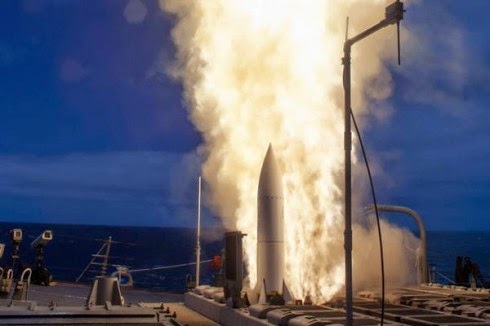
US Navy Expands Use of SM-6 Missile From Five to 35 Warships


The Navy is massively expanding its planned use of the Standard Missile-6, a new high-tech ship-launched surface-to-air missile that can destroy enemy missiles, aircraft and unmanned systems.

In total, the Navy has authorized use of the SM-6 to expand from five ships to more than 35 ships.

“This effort is steeped in fleet requirements, focusing on delivering capability to support urgent operational needs in targeted areas of responsibility,” a Navy official told Military​.com

Previously, the SM-6 was only configured to fire from the most recent Aegis radar combat weapons system on Navy ships, a system called Aegis baseline nine. The Navy’s new authorization allows the SM-6 to integrate with the software and electronics used in Aegis Combat Weapon System baselines 5.3 and 3.A.0.

The Navy’s Aegis Weapon System, currently deployed on cruisers and destroyers, is a command and control technology using computers linked to a multi-function, phased array AN/SPY-1B radar. The high-powered, four megawatt Aegis radar is able to search and track more than 100 potential targets, Navy officials said.

“We came to the realization that we can do AAW(anti-air warfare) with baseline 5. That opened up a world of potential for concept of operations for the Navy –for fleet defense and area defense strategies,” said Mike Campisi, SM-6 program director, Raytheon.

The SM-6, which first became operational in December of last year, is engineered with both an active and semi-active seeker, giving it an increased ability to discern and discriminate targets when compared to other missiles, Campisi explained.

“It has capabilities to go over-the-horizon,” he said.

In addition to missile defense and defense against fixed and rotary wing aircraft, the SM-6 can also defend against land-attack and anti-ship cruise missiles in flight. Having an over-the-horizon ability against anti-ship cruise missiles could prove extremely advantageous as it brings the possibility of destroying them at much greater ranges.


Wednesday, July 16, 2014

Congress not Happy About Plan to Decommission 11 Ticonderoga Cruisers

A key congressional navy panel agreed with the US Navy (USN) on 10 July that the service needs more ships, but lawmakers questioned the service's plan to remove half of its CG 47 Ticonderoga-class guided-missile air-defence cruisers from operations.

Members of the US House Armed Services subcommittee on seapower and projection forces are concerned that the navy's proposal to remove 11 Ticonderoga cruisers from service while the fleet undergoes modernisation is really a ploy to eventually decommission those ships.

The navy has asked to take 11 CG 47s out of service during a phased modernisation. Sean Stackley, the service's top acquisition official, said during the 10 July hearing that the ships, charged with protecting aircraft carriers, would begin retiring from service in 2019.

Tuesday, June 17, 2014

DARPA & US Navy ONR Ink Deal on TERN UAV for Surface Combatants

The U.S. Navy and the Defense Advanced Research Projects Agency (DARPA) have signed an agreement to launch a program to develop long-range reconnaissance drones that would launch from ships.

The program is based on an existing DARPA program called TERN, short for Tactically Exploited Reconnaissance Node, which has been exploring concepts for unmanned aerial systems that could operate from smaller Navy vessels.

"This represents a new approach to providing long-range, long-endurance aircraft based off Navy ships," Gil Graff, TERN deputy program manager from the Office of Naval Research (ONR) in Arlington, Virginia, said in a statement.

In modern warfare, the ability to strike mobile targets, or perform airborne surveillance and reconnaissance, has become critical, according to DARPA. However, current vehicles fall short in some regards — helicopters are limited by how long and how far they can fly, and existing manned and unmanned long-distance, fixed-wing aircraft require aircraft carriers or large land bases for takeoff and landing.

As an alternative, the TERN program would use smaller ships to launch and recover medium-altitude, long-range drones. The goal is to enable a full-scale demonstration, at sea, of a prototype drone launched from a vessel roughly equivalent to an Arleigh Burke-class destroyer, DARPA officials said.

Arleigh Burke-class destroyers are roughly 505 feet (154 meters) long, and are typically equipped with a variety of anti-submarine and anti-aircraft missiles.

The TERN program's initial phases will focus on preliminary designs for the unmanned vehicles. Five drone-makers are under contract for the first phase of testing; one or more groups will advance to the second phase; and one will be selected to build a full-scale prototype for ground-based testing and, ultimately, an at-sea launch and recovery demonstration, according to DARPA.
link.

Thursday, May 01, 2014

House Committee Brings Harshness to US Navy

Rep. Randy Forbes remains deeply concerned about the Navy’s plan to mothball seven cruisers (ostensibly temporarily) and about what he considers its too-modest ambitions for its new UCLASS drone – but language fixing those problems will have to wait till later in the legislative process, he told reporters this morning.

“I will tell you this, we will keep that carrier,” Forbes said at a Defense Writers’ Group breakfast. “You won’t see a mark coming out under my name that doesn’t have that carrier taken care of.”

What about the planes that go on the carrier, which the administration would also eliminate under a sequester-level budget? “The air wing worries me,” Forbes said. “We’re working on that too.”

“We’re still working on the cruisers,” he added, for which legislative language will likely come later in the HASC process. “It may be later even this week,” he said. While details are still being worked out after a key decision “last night,” Forbes told the assembled reporters, “I feel pretty comfortable we won’t go with the exact plan the Navy has.

As for the UCLASS, the Unmanned Carrier-Launched Surveillance and Strike drone, the Navy recently released a classified request for proposals with which Forbes and his staff are clearly dissatisfied. Forbes feels the Navy is putting too much emphasis on “surveillance” and not enough on the payload and survivability required for “strike.” So he intends to require Defense Secretary Chuck Hagel to reconsider the Navy’s requirements – “there’s a lot of support within the department for this,” he said. While Forbes emphasized he doesn’t want to delay UCLASS, which he considers a high priority, he did say he may propose enforcing this mandate by “fencing” funding for UCLASS so the Navy can’t spend it until that relook happens.